Submitted by :
Jaya Nathani
Surabhi Nogariya
Department of Pedodontics
Govt. College of Dentistry, indore
 Introduction
 Advantages
 Disadvantages
 Objectives
 Types
 Indications
 Contraindications
 Factors To be considered in pre operative evaluation
 Clinical Procedure
 Modifications
 Complications
 References
 Stainless steel crown is semi permanent restoration used in primary
and young permanent teeth
It was introduced as chrome-steel crown by ‘Humphrey’ in 1950.
Stainless steel crown is more frequently used in deciduous dentition
than permanent dentition because of two reasons.
1. In deciduous teeth caries can destroy the tooth faster than permanent
. 2. In deciduous tooth pulp is larger than permanent and enamel and
dentin thickness is less.
• The crowns are far superior to multi surface amalgam restorations
with respect to life span , replacement ,retention and resistance.
• They are acceptable to both patient and dentist.
• They are also more cost effective because of comparatively
simple procedures involved in restoring severely affected primary
molar.
The aesthetics is not fair.
 To achieve biologically compatible , competent for mastication and
clinically acceptable restoration.
 To maintain the form and function and where possible the vitality of
the tooth should be maintained.
Untrimmed crowns
Neither trimmed
 Nor contoured
 Require lot of adaptation and are time consuming
 eg. rocky mountain
Pre-trimmed crowns
 Straight non-contoured sides
 festooned to follow a line parallel to the
gingival crest
 Still require contouring and trimming
 Eg. Unitek stainless steel crown
Pre-contoured crowns
 Festooned
 Pre-contoured
 A minimal amount of festooning
and trimming may be necessary
 eg. Ni-Cr Ion crowns
According to composition stainless steel crowns are of two
types
1.Austentic type
•Best corrosion resistance
•These crowns are available in various sizes.
•Mostly these crowns are used in posterior teeth which
undergone pulp therapy.
2.Nickel – base crowns
The alloys have good formability and ductility necessary for
clinical adaptation of crowns and wear resistance to resist
opposing occlusal forces.
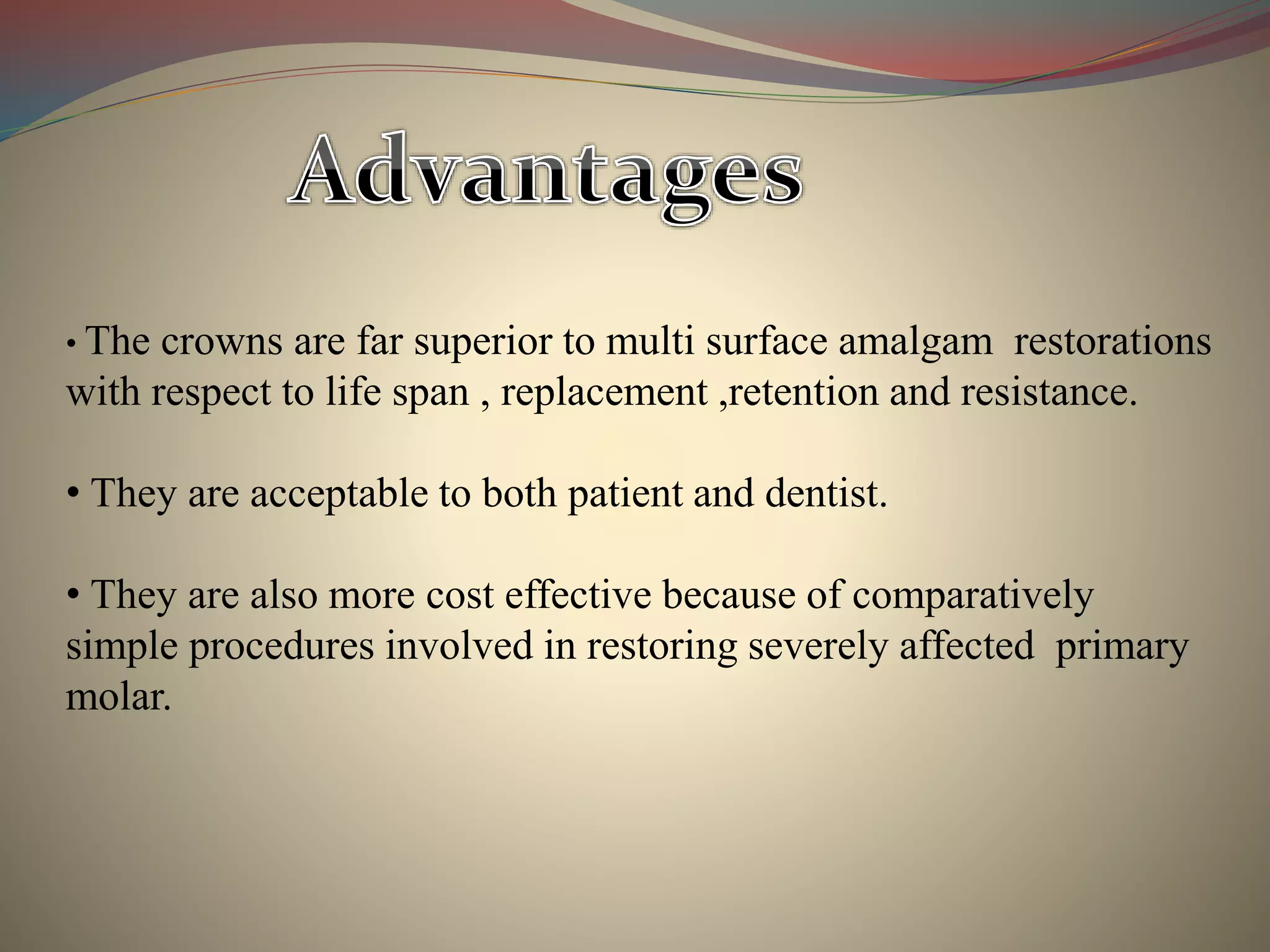
 Extensive decay in primary & young permanent teeth.
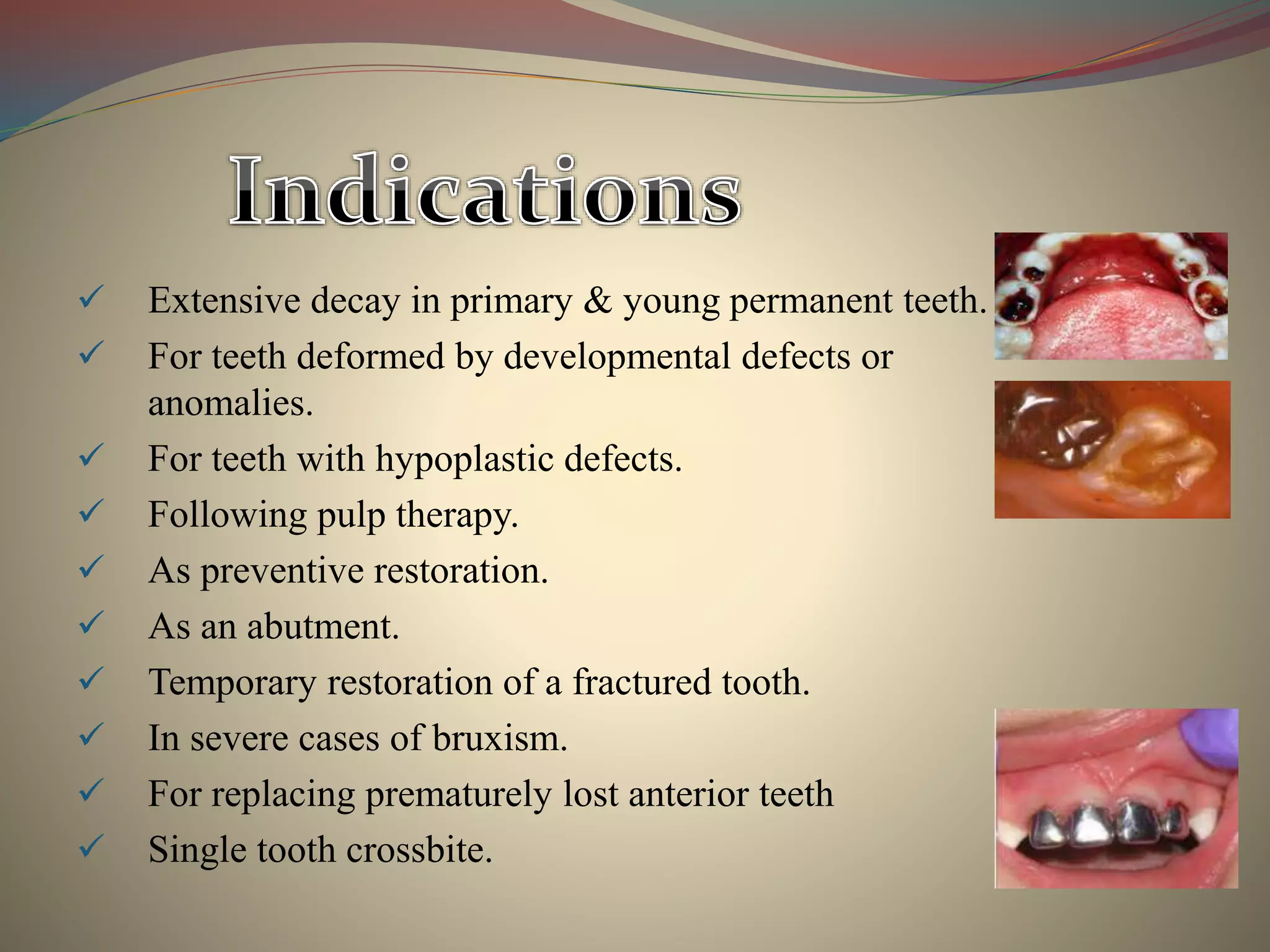
 For teeth deformed by developmental defects or
anomalies.
 For teeth with hypoplastic defects.
 Following pulp therapy.
 As preventive restoration.
 As an abutment.
 Temporary restoration of a fractured tooth.
 In severe cases of bruxism.
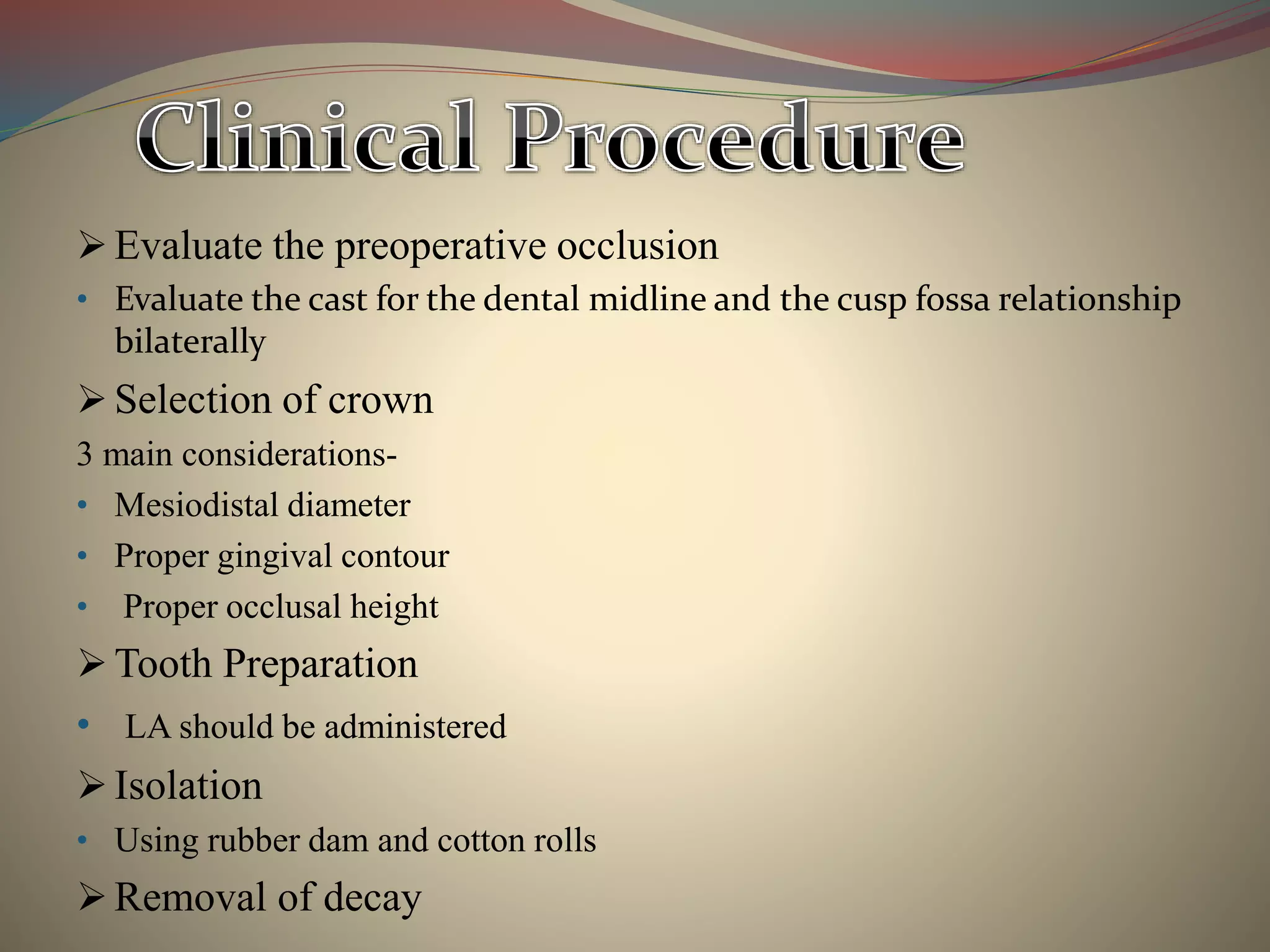
 For replacing prematurely lost anterior teeth
 Single tooth crossbite.
 If the primary molar is close to exfoliation with more than half
the roots resorbed or exfoliation within 6-12 months
 Clinical or radiological evidence of radicular pathology
Tooth exhibits excessive mobility
Partially erupted teeth
Where conservative restorations can be placed
 In a patient with a known nickel allergy
1. Dental age of the patient.
2. Cooperation of the patient.
3. Motivation of the parents.
4. Medically compromised/disabled child.
 Evaluate the preoperative occlusion
• Evaluate the cast for the dental midline and the cusp fossa relationship
bilaterally
 Selection of crown
3 main considerations-
• Mesiodistal diameter
• Proper gingival contour
• Proper occlusal height
 Tooth Preparation
• LA should be administered
 Isolation
• Using rubber dam and cotton rolls
 Removal of decay
Reduction
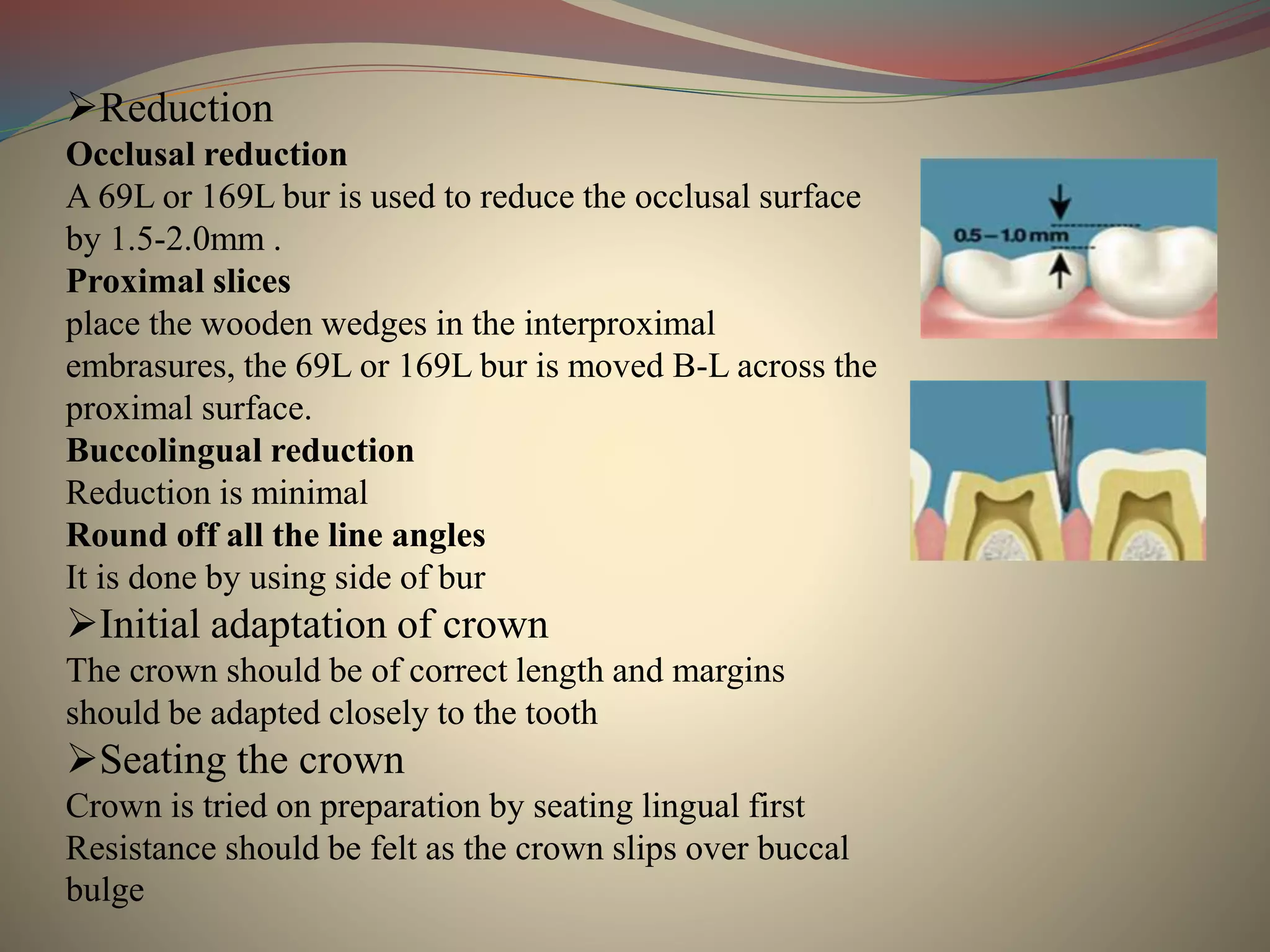
Occlusal reduction
A 69L or 169L bur is used to reduce the occlusal surface
by 1.5-2.0mm .
Proximal slices
place the wooden wedges in the interproximal
embrasures, the 69L or 169L bur is moved B-L across the
proximal surface.
Buccolingual reduction
Reduction is minimal
Round off all the line angles
It is done by using side of bur
Initial adaptation of crown
The crown should be of correct length and margins
should be adapted closely to the tooth
Seating the crown
Crown is tried on preparation by seating lingual first
Resistance should be felt as the crown slips over buccal
bulge
Crown contouring
 Performed with a 114 plier in the middle 1/3rd of the crown to
produce a belling effect.
 This will give the crown a more even curvature.
 Crown crimping
 Done with Unitek 800-412 pliers
 The tight marginal fit aids in:
1. Mechanical retention of the crown.
2. Maintenance of gingival health.
3. Protect of cement from exposure to oral fluids.
 Checking the final adaptation of the crown
 The crown should snaps securely into place.
 Occlusion should be checked
Finishing and polishing
The crown should be polished prior to cementation with
rubber wheel to remove all scratches.
Radiographic confirmation of the gingival
fit
Before cementation a bitewing is taken to verify proximal
marginal integrity
Cementation
A zinc phosphate, polycarboxylate or GIC is preferred.
Result
 In 1971, Mink & Hill report several way of
modifying the SSC when they are either too large
or too small
1. Undersize tooth or the oversize crown.
2. Oversize tooth or undersize crown.
3. Deep subgingival caries.
4. Open contact.
5. Open-faced stainless steel crown.
 Interproximal ledge.
 Crown tilt.
 Poor margins.
 Inhalation or ingestion of crown.
 Shobha Tandon, 2nd edition
 McDonald . Avery . Dean, 9th edition
Thank You

Stainless steel crowns

  • 1.
    Submitted by : JayaNathani Surabhi Nogariya Department of Pedodontics Govt. College of Dentistry, indore
  • 2.
     Introduction  Advantages Disadvantages  Objectives  Types  Indications  Contraindications  Factors To be considered in pre operative evaluation  Clinical Procedure  Modifications  Complications  References
  • 3.
     Stainless steelcrown is semi permanent restoration used in primary and young permanent teeth It was introduced as chrome-steel crown by ‘Humphrey’ in 1950. Stainless steel crown is more frequently used in deciduous dentition than permanent dentition because of two reasons. 1. In deciduous teeth caries can destroy the tooth faster than permanent . 2. In deciduous tooth pulp is larger than permanent and enamel and dentin thickness is less.
  • 4.
    • The crownsare far superior to multi surface amalgam restorations with respect to life span , replacement ,retention and resistance. • They are acceptable to both patient and dentist. • They are also more cost effective because of comparatively simple procedures involved in restoring severely affected primary molar.
  • 5.
  • 6.
     To achievebiologically compatible , competent for mastication and clinically acceptable restoration.  To maintain the form and function and where possible the vitality of the tooth should be maintained.
  • 7.
    Untrimmed crowns Neither trimmed Nor contoured  Require lot of adaptation and are time consuming  eg. rocky mountain Pre-trimmed crowns  Straight non-contoured sides  festooned to follow a line parallel to the gingival crest  Still require contouring and trimming  Eg. Unitek stainless steel crown
  • 8.
    Pre-contoured crowns  Festooned Pre-contoured  A minimal amount of festooning and trimming may be necessary  eg. Ni-Cr Ion crowns
  • 9.
    According to compositionstainless steel crowns are of two types 1.Austentic type •Best corrosion resistance •These crowns are available in various sizes. •Mostly these crowns are used in posterior teeth which undergone pulp therapy. 2.Nickel – base crowns The alloys have good formability and ductility necessary for clinical adaptation of crowns and wear resistance to resist opposing occlusal forces.
  • 10.
     Extensive decayin primary & young permanent teeth.  For teeth deformed by developmental defects or anomalies.  For teeth with hypoplastic defects.  Following pulp therapy.  As preventive restoration.  As an abutment.  Temporary restoration of a fractured tooth.  In severe cases of bruxism.  For replacing prematurely lost anterior teeth  Single tooth crossbite.
  • 11.
     If theprimary molar is close to exfoliation with more than half the roots resorbed or exfoliation within 6-12 months  Clinical or radiological evidence of radicular pathology Tooth exhibits excessive mobility Partially erupted teeth Where conservative restorations can be placed  In a patient with a known nickel allergy
  • 12.
    1. Dental ageof the patient. 2. Cooperation of the patient. 3. Motivation of the parents. 4. Medically compromised/disabled child.
  • 13.
     Evaluate thepreoperative occlusion • Evaluate the cast for the dental midline and the cusp fossa relationship bilaterally  Selection of crown 3 main considerations- • Mesiodistal diameter • Proper gingival contour • Proper occlusal height  Tooth Preparation • LA should be administered  Isolation • Using rubber dam and cotton rolls  Removal of decay
  • 14.
    Reduction Occlusal reduction A 69Lor 169L bur is used to reduce the occlusal surface by 1.5-2.0mm . Proximal slices place the wooden wedges in the interproximal embrasures, the 69L or 169L bur is moved B-L across the proximal surface. Buccolingual reduction Reduction is minimal Round off all the line angles It is done by using side of bur Initial adaptation of crown The crown should be of correct length and margins should be adapted closely to the tooth Seating the crown Crown is tried on preparation by seating lingual first Resistance should be felt as the crown slips over buccal bulge
  • 15.
    Crown contouring  Performedwith a 114 plier in the middle 1/3rd of the crown to produce a belling effect.  This will give the crown a more even curvature.  Crown crimping  Done with Unitek 800-412 pliers  The tight marginal fit aids in: 1. Mechanical retention of the crown. 2. Maintenance of gingival health. 3. Protect of cement from exposure to oral fluids.  Checking the final adaptation of the crown  The crown should snaps securely into place.  Occlusion should be checked Finishing and polishing The crown should be polished prior to cementation with rubber wheel to remove all scratches.
  • 16.
    Radiographic confirmation ofthe gingival fit Before cementation a bitewing is taken to verify proximal marginal integrity Cementation A zinc phosphate, polycarboxylate or GIC is preferred.
  • 17.
  • 18.
     In 1971,Mink & Hill report several way of modifying the SSC when they are either too large or too small 1. Undersize tooth or the oversize crown. 2. Oversize tooth or undersize crown. 3. Deep subgingival caries. 4. Open contact. 5. Open-faced stainless steel crown.
  • 19.
     Interproximal ledge. Crown tilt.  Poor margins.  Inhalation or ingestion of crown.
  • 20.
     Shobha Tandon,2nd edition  McDonald . Avery . Dean, 9th edition
  • 21.