Submitted to :
Dr. Anjuman Ara Akhter
Dr. AKM Asad Polash
Dr. Shahina Shoheli
Department of Orthodontics &
Dentofacial Orthopedics
Dental Unit,Rajshahi Medical
Prepared by:
Name: Md. Sharif
Hossain
Batch: 24th B.D.S.
Roll No. : 02
Session: 2012-13
Class I
Malocclusion It’s Variation and
Management
 Occlusion:
Occlusion of the teeth means the relationship which the
teeth of one arch bear to the teeth of other arch when
the jaws are closed into maximum cuspal occlusion.
 Normal occlusion:
Normal occlusion is commonly defined as,
“An occlusion within the accepted
deviation of the ideal.’’
 Malocclusion may be defined as an irregularities of
teeth beyond the accepted range of normal.
 In modern times, Dr. Edward Angle,who is considered
as father of “Orthodontics’’, gave us the first indices of
malocclusion which is based on the mesio-distal
relation of the teeth,dental arches and the jaws.
 Later many classification have been put fourth but till
today Angle’s classification is being used
widely because of it’s simplicity.
 Different classes of malocclusion according to
E. H Angle are:
1. Class I malocclusion
2. Class II division 1 malocclusion
3. Class II division 2 malocclusion
4. Class II subdivision malocclusion
5. Class III malocclusion
6. Pseudo-class III malocclusion
7. Class III subdivision malocclusion.
 Malocclusion can be broadly divided into:
1. Intra-arch malocclusions
-Mesial inclination
-Distal inclination
-Lingual inclination
-Buccal inclination
-Mesial displacement
-Distal displacement
-Lingual displacement
-Buccal displacement
-Infraversion
-Supraversion
-Rotations
.Mesio-lingual or disto-buccal
.Disto-lingual or mesio-buccal
-Transposition
-Imbrication
2. Inter-arch malocclusions
-Sagittal plane
-Vertical plane
-Transverse plane
3. Skeletal malocclusions.
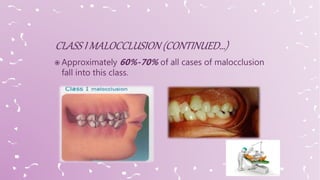
 Angle’s class I malocclusion is characterized by
the presence of a normal inter-arch molar
relationship. The mesio-buccal cusp of the
maxillary first permanent molar occludes in the
anterior-buccal groove of mandibular first
permanent molar.
 The patient may exhibit dental irregularities such
as crowding,spacing,rotations,
missing tooth,etc.
 Approximately 60%-70% of all cases of malocclusion
fall into this class.
 Extra-oral features:
1. Straight profile
2. Competent/incompetent lips
3. Normal/deep/shallow mento-labial sulcus
 Intra-oral features:
1. Class I molar canine incisor relationship
2. Spacing of teeth
3. Crowding of teeth
4. Anterior crossbite
5. Posterior crossbite
6. Anterior openbite
7. Proclination
8. Retroclination
9. Rotation of teeth
10. Deep bite
11. Bi-maxillary protrusion
General factors
1. Heredity: this largely dictate the tooth tissue ratio,
the general form & relationship of the jaws and the soft
tissue pattern
2. Congenital: clefts,birth injury,adverse effects of drugs
on foetus etc.
3. Environmental function: functions such as
feeding,swallowing,mastication,speech,habit etc.
4. Endocrines: cretinism,acromegali etc.
5. Pathology: osteodystrophies,tumors,
trauma,burn etc.
Local factors
 Mainly inherited factors:
1. Abnormalities in the size & number of teeth
. Missing or congenitally absent teeth
. Teeth of abnormal shape & size
. Superneumerary teeth
2. Abnormal position of crypt & total displacement
or transposition of teeth
3. Impaction of upper first permanent molars
4. Abnormal labial frenum
 Mainly environmental factors:
1. Premature loss of deciduous teeth
2. Retention of deciduous teeth
3. Loss of permanent teeth
4. Delayed eruption of permanent teeth
5. Failure of teeth to erupt
6. Habit: sucking
7. Trauma
8. Local pathological factors
9. Misplaced teeth causing abnormal path of
closure.
Aims:
1. To improve the aesthetics and function
of the teeth and jaw
2. To relieve crowding and align the teeth
within the arch
3. If necessary to reduce a deep overbite
and improve the inter-incisal angle.
–Spacing
–Midline diastema
–Crowding
–Crossbite
–Openbite (anterior)
–Rotations
–Deepbite (anterior)
–Bimaxillary protrusion.
 History
 Clinical examination
 Study models
 Radiography
-OPG
-Intra-oral periapical
-Lateral cephalogram.
1. Removal of the etiology
2. Use of removable appliance
If the spacing is associated with proclination of
teeth,we can manage the case with an appliance
having labial bow
3. Use of fixed appliance
Elastic chain or elastic thread for correction
of generalised spacing.
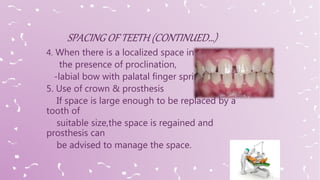
4. When there is a localized space in
the presence of proclination,
-labial bow with palatal finger spring
5. Use of crown & prosthesis
If space is large enough to be replaced by a
tooth of
suitable size,the space is regained and
prosthesis can
be advised to manage the space.
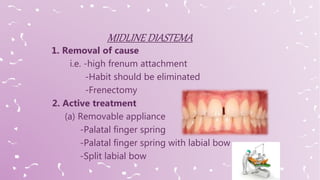
1. Removal of cause
i.e. -high frenum attachment
-Habit should be eliminated
-Frenectomy
2. Active treatment
(a) Removable appliance
-Palatal finger spring
-Palatal finger spring with labial bow
-Split labial bow
(b) Fixed appliance
-Elastic or spring between two
central incisors.
3. Retention
-Long term retention using suitable retainer
such as lingual bonded retainer,
Hawley’s retainer.
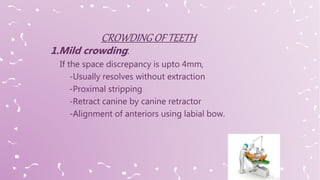
Fig: Midline diastema Fig: Spacing
1.Mild crowding:
If the space discrepancy is upto 4mm,
-Usually resolves without extraction
-Proximal stripping
-Retract canine by canine retractor
-Alignment of anteriors using labial bow.
2. Moderate crowding:
If the space discrepancy is in the range of
5-9mm,treated without extractions by:
-Arch expansion
-Molar anchorage or
-Enamel reduction.
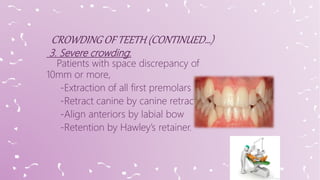
3. Severe crowding:
Patients with space discrepancy of
10mm or more,
-Extraction of all first premolars
-Retract canine by canine retractor
-Align anteriors by labial bow
-Retention by Hawley’s retainer.
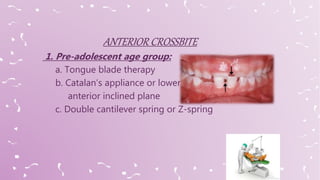
1. Pre-adolescent age group:
a. Tongue blade therapy
b. Catalan’s appliance or lower
anterior inclined plane
c. Double cantilever spring or Z-spring
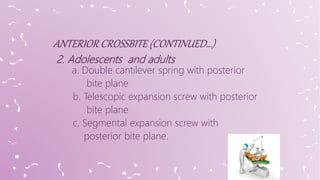
2. Adolescents and adults
a. Double cantilever spring with posterior
bite plane
b. Telescopic expansion screw with posterior
bite plane
c. Segmental expansion screw with
posterior bite plane.
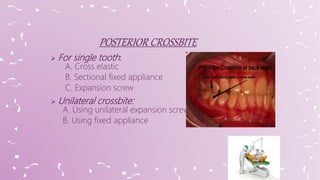
 For single tooth:
A. Cross elastic
B. Sectional fixed appliance
C. Expansion screw
 Unilateral crossbite:
A. Using unilateral expansion screw
B. Using fixed appliance
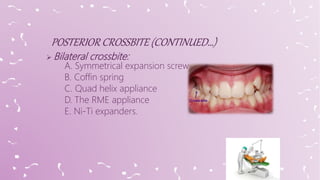
 Bilateral crossbite:
A. Symmetrical expansion screw
B. Coffin spring
C. Quad helix appliance
D. The RME appliance
E. Ni-Ti expanders.
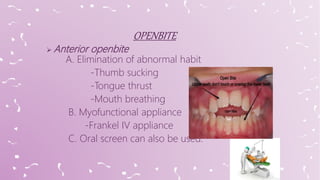
 Anterior openbite
A. Elimination of abnormal habit
-Thumb sucking
-Tongue thrust
-Mouth breathing
B. Myofunctional appliance
-Frankel IV appliance
C. Oral screen can also be used.
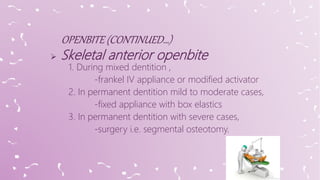
 Skeletal anterior openbite
1. During mixed dentition ,
-frankel IV appliance or modified activator
2. In permanent dentition mild to moderate cases,
-fixed appliance with box elastics
3. In permanent dentition with severe cases,
-surgery i.e. segmental osteotomy.
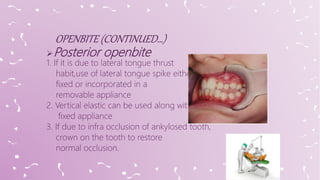
Posterior openbite
1. If it is due to lateral tongue thrust
habit,use of lateral tongue spike either
fixed or incorporated in a
removable appliance
2. Vertical elastic can be used along with
fixed appliance
3. If due to infra occlusion of ankylosed tooth,
crown on the tooth to restore
normal occlusion.
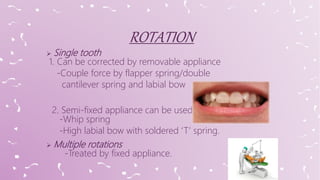
 Single tooth
1. Can be corrected by removable appliance
-Couple force by flapper spring/double
cantilever spring and labial bow
2. Semi-fixed appliance can be used
-Whip spring
-High labial bow with soldered ‘T’ spring.
 Multiple rotations
-Treated by fixed appliance.
 Long term retention is required to achieve stability of
the treatment.
 Retention can be given by either removable or fixed
appliances.
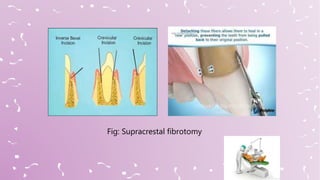
 Pericision or circumferential supracrestal fibrotomy is
an adjunctive surgical procedure where the gingival
fibres are incised to prevent relapse.
Fig: Supracrestal fibrotomy
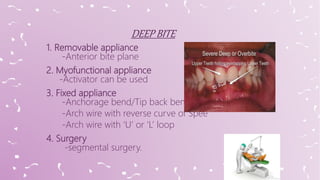
1. Removable appliance
-Anterior bite plane
2. Myofunctional appliance
-Activator can be used
3. Fixed appliance
-Anchorage bend/Tip back bend
-Arch wire with reverse curve of Spee
-Arch wire with ‘U’ or ‘L’ loop
4. Surgery
-segmental surgery.
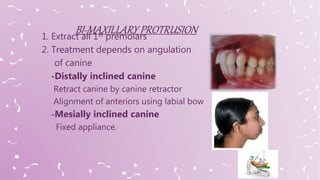
1. Extract all 1st premolars
2. Treatment depends on angulation
of canine
-Distally inclined canine
Retract canine by canine retractor
Alignment of anteriors using labial bow
-Mesially inclined canine
Fixed appliance.
Retainers are passive orthodontic appliances that help
in maintaining & stabilizing the position of teeth long
enough to permit rearrangement and remodelling of
the supporting structures after the active phase of
orthodontic treatment.
Retention can be given by-
 Removable retainers
 Fixed retainers.
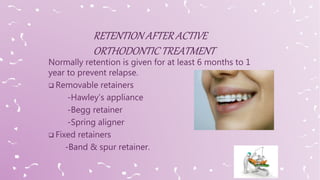
Normally retention is given for at least 6 months to 1
year to prevent relapse.
 Removable retainers
-Hawley’s appliance
-Begg retainer
-Spring aligner
 Fixed retainers
-Band & spur retainer.
 First level
 Second level
 Third level
 Fourth level
 Fifth level
0
1
2
3
4
5
6
Category 1 Category 2 Category 3 Category 4
Series 1 Series 2 Series 3
 First bullet point here
 Second bullet point here
 Third bullet point here
Group A Group B
Class 1 82 85
Class 2 76 88
Group A
•Task 1
•Task 2
Group B
•Task 1
•Task 2
Group C Task 1
 First bullet point here
 Second bullet point here
 Third bullet point here

Class i malocclusion and it’s variation and management .

  • 3.
    Submitted to : Dr.Anjuman Ara Akhter Dr. AKM Asad Polash Dr. Shahina Shoheli Department of Orthodontics & Dentofacial Orthopedics Dental Unit,Rajshahi Medical Prepared by: Name: Md. Sharif Hossain Batch: 24th B.D.S. Roll No. : 02 Session: 2012-13
  • 4.
    Class I Malocclusion It’sVariation and Management
  • 5.
     Occlusion: Occlusion ofthe teeth means the relationship which the teeth of one arch bear to the teeth of other arch when the jaws are closed into maximum cuspal occlusion.  Normal occlusion: Normal occlusion is commonly defined as, “An occlusion within the accepted deviation of the ideal.’’
  • 6.
     Malocclusion maybe defined as an irregularities of teeth beyond the accepted range of normal.  In modern times, Dr. Edward Angle,who is considered as father of “Orthodontics’’, gave us the first indices of malocclusion which is based on the mesio-distal relation of the teeth,dental arches and the jaws.  Later many classification have been put fourth but till today Angle’s classification is being used widely because of it’s simplicity.
  • 7.
     Different classesof malocclusion according to E. H Angle are: 1. Class I malocclusion 2. Class II division 1 malocclusion 3. Class II division 2 malocclusion 4. Class II subdivision malocclusion 5. Class III malocclusion 6. Pseudo-class III malocclusion 7. Class III subdivision malocclusion.
  • 8.
     Malocclusion canbe broadly divided into: 1. Intra-arch malocclusions -Mesial inclination -Distal inclination -Lingual inclination -Buccal inclination -Mesial displacement -Distal displacement -Lingual displacement -Buccal displacement
  • 9.
    -Infraversion -Supraversion -Rotations .Mesio-lingual or disto-buccal .Disto-lingualor mesio-buccal -Transposition -Imbrication 2. Inter-arch malocclusions -Sagittal plane -Vertical plane -Transverse plane 3. Skeletal malocclusions.
  • 10.
     Angle’s classI malocclusion is characterized by the presence of a normal inter-arch molar relationship. The mesio-buccal cusp of the maxillary first permanent molar occludes in the anterior-buccal groove of mandibular first permanent molar.  The patient may exhibit dental irregularities such as crowding,spacing,rotations, missing tooth,etc.
  • 11.
     Approximately 60%-70%of all cases of malocclusion fall into this class.
  • 13.
     Extra-oral features: 1.Straight profile 2. Competent/incompetent lips 3. Normal/deep/shallow mento-labial sulcus  Intra-oral features: 1. Class I molar canine incisor relationship 2. Spacing of teeth 3. Crowding of teeth 4. Anterior crossbite 5. Posterior crossbite
  • 14.
    6. Anterior openbite 7.Proclination 8. Retroclination 9. Rotation of teeth 10. Deep bite 11. Bi-maxillary protrusion
  • 15.
    General factors 1. Heredity:this largely dictate the tooth tissue ratio, the general form & relationship of the jaws and the soft tissue pattern 2. Congenital: clefts,birth injury,adverse effects of drugs on foetus etc. 3. Environmental function: functions such as feeding,swallowing,mastication,speech,habit etc. 4. Endocrines: cretinism,acromegali etc. 5. Pathology: osteodystrophies,tumors, trauma,burn etc.
  • 16.
    Local factors  Mainlyinherited factors: 1. Abnormalities in the size & number of teeth . Missing or congenitally absent teeth . Teeth of abnormal shape & size . Superneumerary teeth 2. Abnormal position of crypt & total displacement or transposition of teeth 3. Impaction of upper first permanent molars 4. Abnormal labial frenum
  • 17.
     Mainly environmentalfactors: 1. Premature loss of deciduous teeth 2. Retention of deciduous teeth 3. Loss of permanent teeth 4. Delayed eruption of permanent teeth 5. Failure of teeth to erupt 6. Habit: sucking 7. Trauma 8. Local pathological factors 9. Misplaced teeth causing abnormal path of closure.
  • 19.
    Aims: 1. To improvethe aesthetics and function of the teeth and jaw 2. To relieve crowding and align the teeth within the arch 3. If necessary to reduce a deep overbite and improve the inter-incisal angle.
  • 20.
  • 21.
     History  Clinicalexamination  Study models  Radiography -OPG -Intra-oral periapical -Lateral cephalogram.
  • 22.
    1. Removal ofthe etiology 2. Use of removable appliance If the spacing is associated with proclination of teeth,we can manage the case with an appliance having labial bow 3. Use of fixed appliance Elastic chain or elastic thread for correction of generalised spacing.
  • 23.
    4. When thereis a localized space in the presence of proclination, -labial bow with palatal finger spring 5. Use of crown & prosthesis If space is large enough to be replaced by a tooth of suitable size,the space is regained and prosthesis can be advised to manage the space.
  • 24.
    1. Removal ofcause i.e. -high frenum attachment -Habit should be eliminated -Frenectomy 2. Active treatment (a) Removable appliance -Palatal finger spring -Palatal finger spring with labial bow -Split labial bow
  • 25.
    (b) Fixed appliance -Elasticor spring between two central incisors. 3. Retention -Long term retention using suitable retainer such as lingual bonded retainer, Hawley’s retainer.
  • 26.
  • 27.
    1.Mild crowding: If thespace discrepancy is upto 4mm, -Usually resolves without extraction -Proximal stripping -Retract canine by canine retractor -Alignment of anteriors using labial bow.
  • 28.
    2. Moderate crowding: Ifthe space discrepancy is in the range of 5-9mm,treated without extractions by: -Arch expansion -Molar anchorage or -Enamel reduction.
  • 29.
    3. Severe crowding: Patientswith space discrepancy of 10mm or more, -Extraction of all first premolars -Retract canine by canine retractor -Align anteriors by labial bow -Retention by Hawley’s retainer.
  • 30.
    1. Pre-adolescent agegroup: a. Tongue blade therapy b. Catalan’s appliance or lower anterior inclined plane c. Double cantilever spring or Z-spring
  • 31.
    2. Adolescents andadults a. Double cantilever spring with posterior bite plane b. Telescopic expansion screw with posterior bite plane c. Segmental expansion screw with posterior bite plane.
  • 32.
     For singletooth: A. Cross elastic B. Sectional fixed appliance C. Expansion screw  Unilateral crossbite: A. Using unilateral expansion screw B. Using fixed appliance
  • 33.
     Bilateral crossbite: A.Symmetrical expansion screw B. Coffin spring C. Quad helix appliance D. The RME appliance E. Ni-Ti expanders.
  • 34.
     Anterior openbite A.Elimination of abnormal habit -Thumb sucking -Tongue thrust -Mouth breathing B. Myofunctional appliance -Frankel IV appliance C. Oral screen can also be used.
  • 35.
     Skeletal anterioropenbite 1. During mixed dentition , -frankel IV appliance or modified activator 2. In permanent dentition mild to moderate cases, -fixed appliance with box elastics 3. In permanent dentition with severe cases, -surgery i.e. segmental osteotomy.
  • 36.
    Posterior openbite 1. Ifit is due to lateral tongue thrust habit,use of lateral tongue spike either fixed or incorporated in a removable appliance 2. Vertical elastic can be used along with fixed appliance 3. If due to infra occlusion of ankylosed tooth, crown on the tooth to restore normal occlusion.
  • 37.
     Single tooth 1.Can be corrected by removable appliance -Couple force by flapper spring/double cantilever spring and labial bow 2. Semi-fixed appliance can be used -Whip spring -High labial bow with soldered ‘T’ spring.  Multiple rotations -Treated by fixed appliance.
  • 38.
     Long termretention is required to achieve stability of the treatment.  Retention can be given by either removable or fixed appliances.  Pericision or circumferential supracrestal fibrotomy is an adjunctive surgical procedure where the gingival fibres are incised to prevent relapse.
  • 39.
  • 40.
    1. Removable appliance -Anteriorbite plane 2. Myofunctional appliance -Activator can be used 3. Fixed appliance -Anchorage bend/Tip back bend -Arch wire with reverse curve of Spee -Arch wire with ‘U’ or ‘L’ loop 4. Surgery -segmental surgery.
  • 41.
    1. Extract all1st premolars 2. Treatment depends on angulation of canine -Distally inclined canine Retract canine by canine retractor Alignment of anteriors using labial bow -Mesially inclined canine Fixed appliance.
  • 42.
    Retainers are passiveorthodontic appliances that help in maintaining & stabilizing the position of teeth long enough to permit rearrangement and remodelling of the supporting structures after the active phase of orthodontic treatment. Retention can be given by-  Removable retainers  Fixed retainers.
  • 43.
    Normally retention isgiven for at least 6 months to 1 year to prevent relapse.  Removable retainers -Hawley’s appliance -Begg retainer -Spring aligner  Fixed retainers -Band & spur retainer.
  • 45.
     First level Second level  Third level  Fourth level  Fifth level
  • 46.
    0 1 2 3 4 5 6 Category 1 Category2 Category 3 Category 4 Series 1 Series 2 Series 3
  • 47.
     First bulletpoint here  Second bullet point here  Third bullet point here Group A Group B Class 1 82 85 Class 2 76 88
  • 48.
    Group A •Task 1 •Task2 Group B •Task 1 •Task 2 Group C Task 1  First bullet point here  Second bullet point here  Third bullet point here