Classification of Matter
What is matter?
Some common matter:
• Steel, Lead, Stone, Wood
• Water, Alcohol
• Air, Carbon Dioxide, Oxygen, Helium
All examples of matter – something you can
touch, taste, smell or hear.
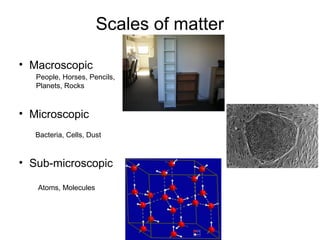
Scales of matter
• Macroscopic
• Microscopic
• Sub-microscopic
People, Horses, Pencils,
Planets, Rocks
Bacteria, Cells, Dust
Atoms, Molecules
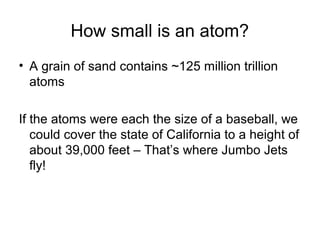
How small is an atom?
• A grain of sand contains ~125 million trillion
atoms
If the atoms were each the size of a baseball, we
could cover the state of California to a height of
about 39,000 feet – That’s where Jumbo Jets
fly!
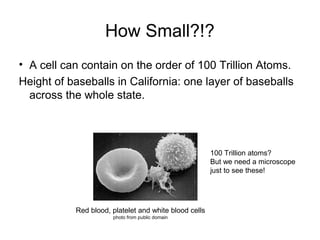
How Small?!?
• A cell can contain on the order of 100 Trillion Atoms.
Height of baseballs in California: one layer of baseballs
across the whole state.
Red blood, platelet and white blood cells
photo from public domain
100 Trillion atoms?
But we need a microscope
just to see these!
Properties of Substances
• Physical Properties
- Tells us about the stuff itself, without it being turned
into a new substance.
(Example: water is a liquid at room temperature.)
• Chemical Properties
- Tells us what it can change into, and under what
conditions.
(Example: water can be split into hydrogen and oxygen gas if
you run an electric current through it.)
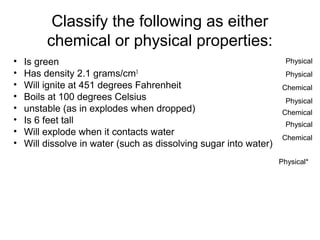
Classify the following as either
chemical or physical properties:
• Is green
• Has density 2.1 grams/cm3
• Will ignite at 451 degrees Fahrenheit
• Boils at 100 degrees Celsius
• unstable (as in explodes when dropped)
• Is 6 feet tall
• Will explode when it contacts water
• Will dissolve in water (such as dissolving sugar into water)
Physical
Physical
Chemical
Physical
Chemical
Physical
Chemical
Physical*
How we describe changes in stuff:
Physical and Chemical Changes
• Physical change
– change in size, shape, etc., but molecules remain
the same.
• Chemical change
– new stuff gets made.
• Ask yourself the question: If I changed the
physical conditions (temperature for instance)
back to what they were before the change,
would it undo the change?
If so, you have a physical change.
If not, you have a chemical change.
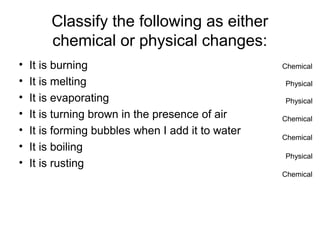
Classify the following as either
chemical or physical changes:
• It is burning
• It is melting
• It is evaporating
• It is turning brown in the presence of air
• It is forming bubbles when I add it to water
• It is boiling
• It is rusting
Chemical
Physical
Physical
Chemical
Chemical
Physical
Chemical
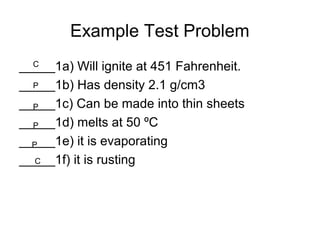
Example Test Problem
_____1a) Will ignite at 451 Fahrenheit.
_____1b) Has density 2.1 g/cm3
_____1c) Can be made into thin sheets
_____1d) melts at 50 ºC
_____1e) it is evaporating
_____1f) it is rusting
C
P
P
P
P
C
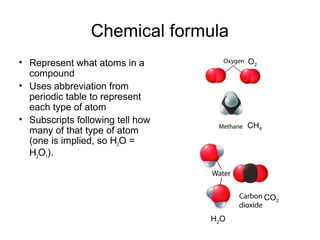
Chemical formula
• Represent what atoms in a
compound
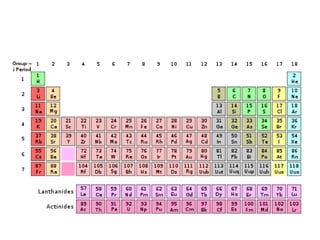
• Uses abbreviation from
periodic table to represent
each type of atom
• Subscripts following tell how
many of that type of atom
(one is implied, so H2O =
H2O1).
O2
CH4
H2O
CO2
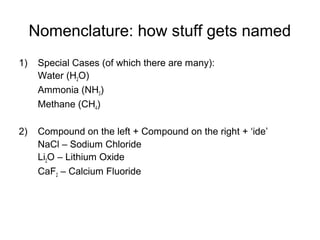
Nomenclature: how stuff gets named
1) Special Cases (of which there are many):
Water (H2O)
Ammonia (NH3)
Methane (CH4)
2) Compound on the left + Compound on the right + ‘ide’
NaCl – Sodium Chloride
Li2O – Lithium Oxide
CaF2 – Calcium Fluoride
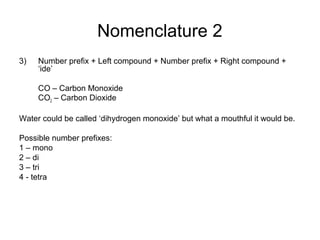
Nomenclature 2
3) Number prefix + Left compound + Number prefix + Right compound +
‘ide’
CO – Carbon Monoxide
CO2 – Carbon Dioxide
Water could be called ‘dihydrogen monoxide’ but what a mouthful it would be.
Possible number prefixes:
1 – mono
2 – di
3 – tri
4 - tetra
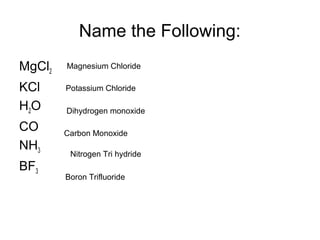
Name the Following:
MgCl2
KCl
H2O
CO
NH3
BF3
Magnesium Chloride
Potassium Chloride
Dihydrogen monoxide
Carbon Monoxide
Nitrogen Tri hydride
Boron Trifluoride
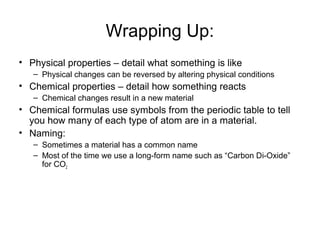
Wrapping Up:
• Physical properties – detail what something is like
– Physical changes can be reversed by altering physical conditions
• Chemical properties – detail how something reacts
– Chemical changes result in a new material
• Chemical formulas use symbols from the periodic table to tell
you how many of each type of atom are in a material.
• Naming:
– Sometimes a material has a common name
– Most of the time we use a long-form name such as “Carbon Di-Oxide”
for CO2
Mixtures
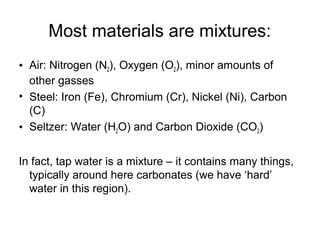
Most materials are mixtures:
• Air: Nitrogen (N2), Oxygen (O2), minor amounts of
other gasses
• Steel: Iron (Fe), Chromium (Cr), Nickel (Ni), Carbon
(C)
• Seltzer: Water (H2O) and Carbon Dioxide (CO2)
In fact, tap water is a mixture – it contains many things,
typically around here carbonates (we have ‘hard’
water in this region).
• Mixtures do not react when formed - when you
mix salt into water the salt stays salt (NaCl)
and the water stays water (H2O).
• Mixtures may be separated by physical means:
– Solids separated from liquids by filtration
– liquids from other liquids by distillation
Purity
• “Pure” materials contain one element or
compound – pure gold, pure water.
• True purity is never found – even a spec of
something else prevents 100% purity.
• Purity is relative. 99% pure gold is less pure
than 99.9% pure gold.
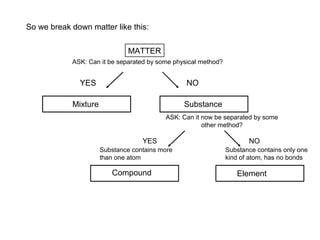
So we break down matter like this:
MATTER
ASK: Can it be separated by some physical method?
YES NO
Mixture Substance
YES NO
ASK: Can it now be separated by some
other method?
Substance contains more
than one atom
Compound
Substance contains only one
kind of atom, has no bonds
Element
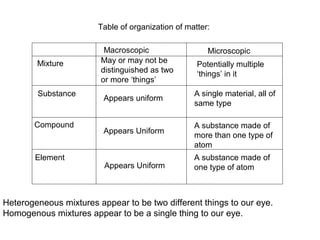
Table of organization of matter:
Macroscopic Microscopic
Mixture
Substance
Compound
Element
Potentially multiple
‘things’ in it
A single material, all of
same type
A substance made of
more than one type of
atom
A substance made of
one type of atom
May or may not be
distinguished as two
or more ‘things’
Appears uniform
Appears Uniform
Appears Uniform
Heterogeneous mixtures appear to be two different things to our eye.
Homogenous mixtures appear to be a single thing to our eye.
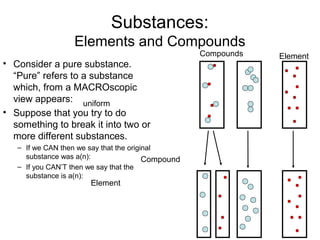
Substances:
Elements and Compounds
• Consider a pure substance.
“Pure” refers to a substance
which, from a MACROscopic
view appears:
• Suppose that you try to do
something to break it into two or
more different substances.
– If we CAN then we say that the original
substance was a(n):
– If you CAN’T then we say that the
substance is a(n):
uniform
Compound
Element
Compounds Element
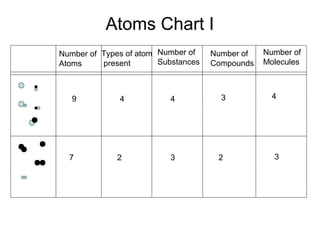
Atoms Chart I
Number of
Molecules
Number of
Compounds
Number of
Substances
Types of atom
present
Number of
Atoms
9 4 4 3 4
7 2 3 2 3
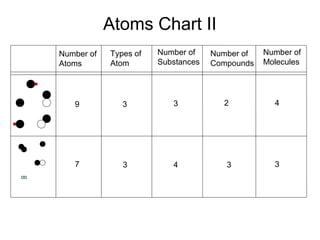
Atoms Chart II
Number of
Molecules
Number of
Compounds
Number of
Substances
Types of
Atom
Number of
Atoms
9
7
3
4
2
3 3
43
3
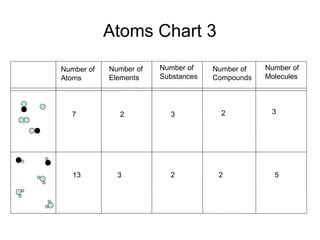
Atoms Chart 3
Number of
Molecules
Number of
Compounds
Number of
Substances
Number of
Elements
Number of
Atoms
7 2 3 2 3
13 3 2 2 5
Separation:
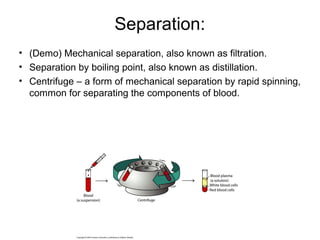
• (Demo) Mechanical separation, also known as filtration.
• Separation by boiling point, also known as distillation.
• Centrifuge – a form of mechanical separation by rapid spinning,
common for separating the components of blood.
Example Problem
Suppose you are given a container of purple
liquid. How would you determine if the liquid is
a mixture, compound or element?
(Hint – how could you separate a mixture?)
Solutions
• What happens when we dissolve something?
– Is it lost?
– Does it fit into the space between particles in the
thing it is dissolved into?
– Or does something else happen?
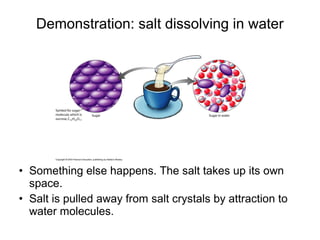
• Something else happens. The salt takes up its own
space.
• Salt is pulled away from salt crystals by attraction to
water molecules.
Demonstration: salt dissolving in water
Solutions
• Examples: sugar in water, salt in water, chromium in
aluminum oxide (ruby), titanium and iron in
aluminum oxide (sapphire).
• solvent – larger component
• Solute – smaller components
• Process of mixing solute into solvent: dissolution or
dissolving
Dissolving depends on attractions between solvent and
solute.
Concentration
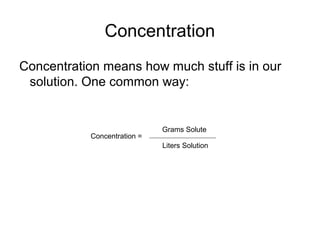
Concentration means how much stuff is in our
solution. One common way:
Grams Solute
Liters Solution
Concentration =
The Mole
• The mole is a measure
of number of particles
– 6.02*1023
particles = 1 mole
– a couple coconuts = 2 coconuts
– a dozen donuts = 12 donuts
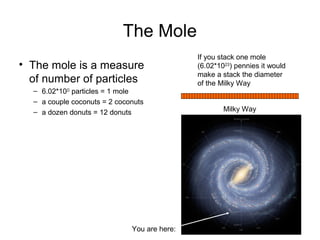
You are here:
If you stack one mole
(6.02*1023
) pennies it would
make a stack the diameter
of the Milky Way
Milky Way
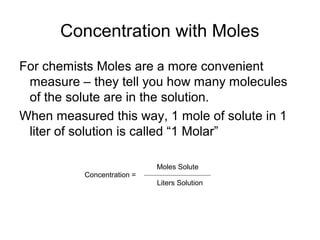
Concentration with Moles
For chemists Moles are a more convenient
measure – they tell you how many molecules
of the solute are in the solution.
When measured this way, 1 mole of solute in 1
liter of solution is called “1 Molar”
Moles Solute
Liters Solution
Concentration =

Lecture 2 (1)

  • 1.
  • 2.
    What is matter? Somecommon matter: • Steel, Lead, Stone, Wood • Water, Alcohol • Air, Carbon Dioxide, Oxygen, Helium All examples of matter – something you can touch, taste, smell or hear.
  • 3.
    Scales of matter •Macroscopic • Microscopic • Sub-microscopic People, Horses, Pencils, Planets, Rocks Bacteria, Cells, Dust Atoms, Molecules
  • 4.
    How small isan atom? • A grain of sand contains ~125 million trillion atoms If the atoms were each the size of a baseball, we could cover the state of California to a height of about 39,000 feet – That’s where Jumbo Jets fly!
  • 5.
    How Small?!? • Acell can contain on the order of 100 Trillion Atoms. Height of baseballs in California: one layer of baseballs across the whole state. Red blood, platelet and white blood cells photo from public domain 100 Trillion atoms? But we need a microscope just to see these!
  • 6.
    Properties of Substances •Physical Properties - Tells us about the stuff itself, without it being turned into a new substance. (Example: water is a liquid at room temperature.) • Chemical Properties - Tells us what it can change into, and under what conditions. (Example: water can be split into hydrogen and oxygen gas if you run an electric current through it.)
  • 7.
    Classify the followingas either chemical or physical properties: • Is green • Has density 2.1 grams/cm3 • Will ignite at 451 degrees Fahrenheit • Boils at 100 degrees Celsius • unstable (as in explodes when dropped) • Is 6 feet tall • Will explode when it contacts water • Will dissolve in water (such as dissolving sugar into water) Physical Physical Chemical Physical Chemical Physical Chemical Physical*
  • 8.
    How we describechanges in stuff: Physical and Chemical Changes • Physical change – change in size, shape, etc., but molecules remain the same. • Chemical change – new stuff gets made.
  • 9.
    • Ask yourselfthe question: If I changed the physical conditions (temperature for instance) back to what they were before the change, would it undo the change? If so, you have a physical change. If not, you have a chemical change.
  • 10.
    Classify the followingas either chemical or physical changes: • It is burning • It is melting • It is evaporating • It is turning brown in the presence of air • It is forming bubbles when I add it to water • It is boiling • It is rusting Chemical Physical Physical Chemical Chemical Physical Chemical
  • 11.
    Example Test Problem _____1a)Will ignite at 451 Fahrenheit. _____1b) Has density 2.1 g/cm3 _____1c) Can be made into thin sheets _____1d) melts at 50 ºC _____1e) it is evaporating _____1f) it is rusting C P P P P C
  • 12.
    Chemical formula • Representwhat atoms in a compound • Uses abbreviation from periodic table to represent each type of atom • Subscripts following tell how many of that type of atom (one is implied, so H2O = H2O1). O2 CH4 H2O CO2
  • 13.
    Nomenclature: how stuffgets named 1) Special Cases (of which there are many): Water (H2O) Ammonia (NH3) Methane (CH4) 2) Compound on the left + Compound on the right + ‘ide’ NaCl – Sodium Chloride Li2O – Lithium Oxide CaF2 – Calcium Fluoride
  • 15.
    Nomenclature 2 3) Numberprefix + Left compound + Number prefix + Right compound + ‘ide’ CO – Carbon Monoxide CO2 – Carbon Dioxide Water could be called ‘dihydrogen monoxide’ but what a mouthful it would be. Possible number prefixes: 1 – mono 2 – di 3 – tri 4 - tetra
  • 16.
    Name the Following: MgCl2 KCl H2O CO NH3 BF3 MagnesiumChloride Potassium Chloride Dihydrogen monoxide Carbon Monoxide Nitrogen Tri hydride Boron Trifluoride
  • 17.
    Wrapping Up: • Physicalproperties – detail what something is like – Physical changes can be reversed by altering physical conditions • Chemical properties – detail how something reacts – Chemical changes result in a new material • Chemical formulas use symbols from the periodic table to tell you how many of each type of atom are in a material. • Naming: – Sometimes a material has a common name – Most of the time we use a long-form name such as “Carbon Di-Oxide” for CO2
  • 18.
  • 19.
    Most materials aremixtures: • Air: Nitrogen (N2), Oxygen (O2), minor amounts of other gasses • Steel: Iron (Fe), Chromium (Cr), Nickel (Ni), Carbon (C) • Seltzer: Water (H2O) and Carbon Dioxide (CO2) In fact, tap water is a mixture – it contains many things, typically around here carbonates (we have ‘hard’ water in this region).
  • 20.
    • Mixtures donot react when formed - when you mix salt into water the salt stays salt (NaCl) and the water stays water (H2O). • Mixtures may be separated by physical means: – Solids separated from liquids by filtration – liquids from other liquids by distillation
  • 21.
    Purity • “Pure” materialscontain one element or compound – pure gold, pure water. • True purity is never found – even a spec of something else prevents 100% purity. • Purity is relative. 99% pure gold is less pure than 99.9% pure gold.
  • 22.
    So we breakdown matter like this: MATTER ASK: Can it be separated by some physical method? YES NO Mixture Substance YES NO ASK: Can it now be separated by some other method? Substance contains more than one atom Compound Substance contains only one kind of atom, has no bonds Element
  • 23.
    Table of organizationof matter: Macroscopic Microscopic Mixture Substance Compound Element Potentially multiple ‘things’ in it A single material, all of same type A substance made of more than one type of atom A substance made of one type of atom May or may not be distinguished as two or more ‘things’ Appears uniform Appears Uniform Appears Uniform Heterogeneous mixtures appear to be two different things to our eye. Homogenous mixtures appear to be a single thing to our eye.
  • 24.
    Substances: Elements and Compounds •Consider a pure substance. “Pure” refers to a substance which, from a MACROscopic view appears: • Suppose that you try to do something to break it into two or more different substances. – If we CAN then we say that the original substance was a(n): – If you CAN’T then we say that the substance is a(n): uniform Compound Element Compounds Element
  • 25.
    Atoms Chart I Numberof Molecules Number of Compounds Number of Substances Types of atom present Number of Atoms 9 4 4 3 4 7 2 3 2 3
  • 26.
    Atoms Chart II Numberof Molecules Number of Compounds Number of Substances Types of Atom Number of Atoms 9 7 3 4 2 3 3 43 3
  • 27.
    Atoms Chart 3 Numberof Molecules Number of Compounds Number of Substances Number of Elements Number of Atoms 7 2 3 2 3 13 3 2 2 5
  • 28.
    Separation: • (Demo) Mechanicalseparation, also known as filtration. • Separation by boiling point, also known as distillation. • Centrifuge – a form of mechanical separation by rapid spinning, common for separating the components of blood.
  • 29.
    Example Problem Suppose youare given a container of purple liquid. How would you determine if the liquid is a mixture, compound or element? (Hint – how could you separate a mixture?)
  • 30.
  • 31.
    • What happenswhen we dissolve something? – Is it lost? – Does it fit into the space between particles in the thing it is dissolved into? – Or does something else happen?
  • 32.
    • Something elsehappens. The salt takes up its own space. • Salt is pulled away from salt crystals by attraction to water molecules. Demonstration: salt dissolving in water
  • 33.
    Solutions • Examples: sugarin water, salt in water, chromium in aluminum oxide (ruby), titanium and iron in aluminum oxide (sapphire). • solvent – larger component • Solute – smaller components • Process of mixing solute into solvent: dissolution or dissolving Dissolving depends on attractions between solvent and solute.
  • 34.
    Concentration Concentration means howmuch stuff is in our solution. One common way: Grams Solute Liters Solution Concentration =
  • 35.
    The Mole • Themole is a measure of number of particles – 6.02*1023 particles = 1 mole – a couple coconuts = 2 coconuts – a dozen donuts = 12 donuts You are here: If you stack one mole (6.02*1023 ) pennies it would make a stack the diameter of the Milky Way Milky Way
  • 36.
    Concentration with Moles Forchemists Moles are a more convenient measure – they tell you how many molecules of the solute are in the solution. When measured this way, 1 mole of solute in 1 liter of solution is called “1 Molar” Moles Solute Liters Solution Concentration =