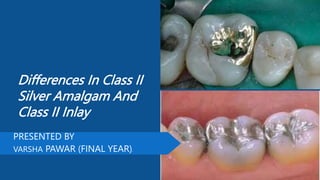
Differences In Class II
Silver Amalgam And
Class II Inlay
PRESENTED BY
VARSHA PAWAR (FINAL YEAR)))
AMALGAM INLAY
Amalgam restoration is direct procedure that can
be finished in one appointment.
Cast inlay is an indirect procedure requiring two
appointments. One for tooth preparation and the other
for delivering restoration.
Indicated in conservative and moderate carious
lesions.
Indicated in extensive carious lesions due to durability,
biocompatibility and ability to withstand forces.
Indicated in young as well as old patients. Contraindicated in young patients, due to presence of
large pulp chambers and in old patients, due to lengthy
and multistep procedures.
Indicated as interim and caries control
restorations.
Contraindicated in patients with high caries rate.
There is less control on the placement of proper
contours and contacts.
Superior control of contours and contacts can be
achieved. It is indicated for diastema closure between
teeth.
Inexpensive. More cost to the patient.
SILVER AMALGAM INLAY
edge strength i.e(the resistance to fracture of
the beveled extension normally located at the
cavosurface margin of dental restoration) is
less
High edge strength due to precise fabrication
process involved.
Concern of mercury toxicity. Biocompatible as high gold dental casting
alloys are unreactive in oral environment.
Alloys used are noble metals,base metals ,and
recent alloys such as titanium
Less technique sensitive More technique sensitive.
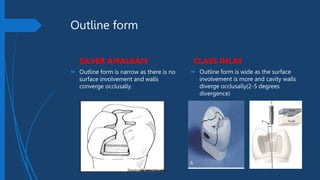
Outline form
SILVER AMALGAM
 Outline form is narrow as there is no
surface involvement and walls
converge occlusally.
CLASS INLAY
 Outline form is wide as the surface
involvement is more and cavity walls
diverge occlusally(2-5 degrees
divergence)
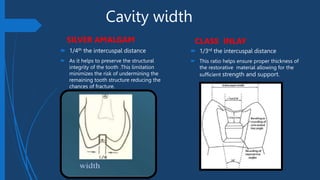
Cavity width
SILVER AMALGAM
 1/4th the intercuspal distance
 As it helps to preserve the structural
integrity of the tooth .This limitation
minimizes the risk of undermining the
remaining tooth structure reducing the
chances of fracture.
CLASS INLAY
 1/3rd the intercuspal distance
 This ratio helps ensure proper thickness of
the restorative material allowing for the
sufficient strength and support.
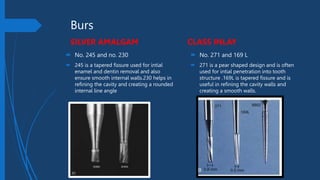
Burs
SILVER AMALGAM
 No. 245 and no. 230
 245 is a tapered fissure used for intial
enamel and dentin removal and also
ensure smooth internal walls.230 helps in
refining the cavity and creating a rounded
internal line angle
CLASS INLAY
 No. 271 and 169 L
 271 is a pear shaped design and is often
used for intial penetration into tooth
structure .169L is tapered fissure and is
useful in refining the cavity walls and
creating a smooth walls.
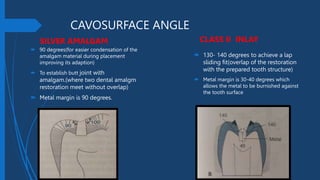
CAVOSURFACE ANGLE
SILVER AMALGAM
 90 degrees(for easier condensation of the
amalgam material during placement
improving its adaption)
 To establish butt joint with
amalgam.(where two dental amalgm
restoration meet without overlap)
 Metal margin is 90 degrees.
CLASS II INLAY
 130- 140 degrees to achieve a lap
sliding fit(overlap of the restoration
with the prepared tooth structure)
 Metal margin is 30-40 degrees which
allows the metal to be burnished against
the tooth surface
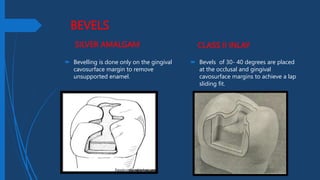
BEVELS
SILVER AMALGAM
 Bevelling is done only on the gingival
cavosurface margin to remove
unsupported enamel.
CLASS II INLAY
 Bevels of 30- 40 degrees are placed
at the occlusal and gingival
cavosurface margins to achieve a lap
sliding fit.
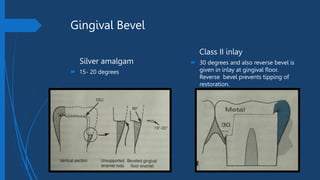
Gingival Bevel
Silver amalgam
 15- 20 degrees
Class II inlay
 30 degrees and also reverse bevel is
given in inlay at gingival floor.
Reverse bevel prevents tipping of
restoration.
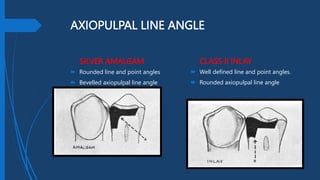
AXIOPULPAL LINE ANGLE
SILVER AMALGAM
 Rounded line and point angles
 Bevelled axiopulpal line angle
CLASS II INLAY
 Well defined line and point angles.
 Rounded axiopulpal line angle
SILVER AMALGAM CLASS II INLAY
Undercuts improve retention Undercuts should be absent
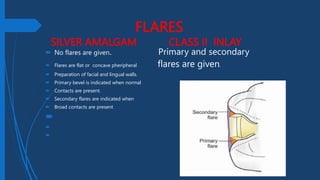
FLARES
SILVER AMALGAM CLASS II INLAY
 No flares are given. Primary and secondary
 Flares are flat or concave pheripheral flares are given.
 Preparation of facial and lingual walls.
 Primary bevel is indicated when normal
 Contacts are present.
 Secondary flares are indicated when
 Broad contacts are present



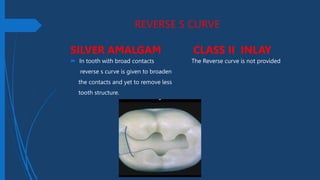
REVERSE S CURVE
SILVER AMALGAM CLASS II INLAY
 In tooth with broad contacts The Reverse curve is not provided
reverse s curve is given to broaden
the contacts and yet to remove less
tooth structure.
GINGIVAL SEAT
SILVER AMALGAM CLASS II INLAY
 Gingival seat should be located Subgingival extension of
supragingivally gingival seat is
acceptable
SECONDARY RETENTION
SILVER AMALGAM CLASS II INLAY
Secondary retention is Secondary retention is
provided by grooves, provided by locks, slots
Slots ,pins collars, and reverse bevel
SECONDARY RETENTION
SILVER AMALGAM CLASS II INLAY
Secondary retention is Secondary retention is
provided by grooves, provided by locks, slots
Slots ,pins collars, and reverse bevel
 Proximally, minimal clearance Proximally more clearance is acceptable
is provided not more than
0.5mm from adjacent tooth.
SILVER AMALGAM CLASS II INLAY
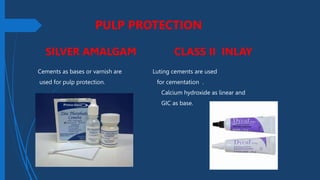
PULP PROTECTION
SILVER AMALGAM CLASS II INLAY
Cements as bases or varnish are Luting cements are used
used for pulp protection. for cementation .
Calcium hydroxide as linear and
GIC as base.
.
THANK
YOU!

Differences-Between-Cast-Restoration-and-Amalgam[1].pptx

  • 1.
    Differences In ClassII Silver Amalgam And Class II Inlay PRESENTED BY VARSHA PAWAR (FINAL YEAR)))
  • 2.
    AMALGAM INLAY Amalgam restorationis direct procedure that can be finished in one appointment. Cast inlay is an indirect procedure requiring two appointments. One for tooth preparation and the other for delivering restoration. Indicated in conservative and moderate carious lesions. Indicated in extensive carious lesions due to durability, biocompatibility and ability to withstand forces. Indicated in young as well as old patients. Contraindicated in young patients, due to presence of large pulp chambers and in old patients, due to lengthy and multistep procedures. Indicated as interim and caries control restorations. Contraindicated in patients with high caries rate. There is less control on the placement of proper contours and contacts. Superior control of contours and contacts can be achieved. It is indicated for diastema closure between teeth. Inexpensive. More cost to the patient.
  • 3.
    SILVER AMALGAM INLAY edgestrength i.e(the resistance to fracture of the beveled extension normally located at the cavosurface margin of dental restoration) is less High edge strength due to precise fabrication process involved. Concern of mercury toxicity. Biocompatible as high gold dental casting alloys are unreactive in oral environment. Alloys used are noble metals,base metals ,and recent alloys such as titanium Less technique sensitive More technique sensitive.
  • 4.
    Outline form SILVER AMALGAM Outline form is narrow as there is no surface involvement and walls converge occlusally. CLASS INLAY  Outline form is wide as the surface involvement is more and cavity walls diverge occlusally(2-5 degrees divergence)
  • 5.
    Cavity width SILVER AMALGAM 1/4th the intercuspal distance  As it helps to preserve the structural integrity of the tooth .This limitation minimizes the risk of undermining the remaining tooth structure reducing the chances of fracture. CLASS INLAY  1/3rd the intercuspal distance  This ratio helps ensure proper thickness of the restorative material allowing for the sufficient strength and support.
  • 6.
    Burs SILVER AMALGAM  No.245 and no. 230  245 is a tapered fissure used for intial enamel and dentin removal and also ensure smooth internal walls.230 helps in refining the cavity and creating a rounded internal line angle CLASS INLAY  No. 271 and 169 L  271 is a pear shaped design and is often used for intial penetration into tooth structure .169L is tapered fissure and is useful in refining the cavity walls and creating a smooth walls.
  • 7.
    CAVOSURFACE ANGLE SILVER AMALGAM 90 degrees(for easier condensation of the amalgam material during placement improving its adaption)  To establish butt joint with amalgam.(where two dental amalgm restoration meet without overlap)  Metal margin is 90 degrees. CLASS II INLAY  130- 140 degrees to achieve a lap sliding fit(overlap of the restoration with the prepared tooth structure)  Metal margin is 30-40 degrees which allows the metal to be burnished against the tooth surface
  • 8.
    BEVELS SILVER AMALGAM  Bevellingis done only on the gingival cavosurface margin to remove unsupported enamel. CLASS II INLAY  Bevels of 30- 40 degrees are placed at the occlusal and gingival cavosurface margins to achieve a lap sliding fit.
  • 9.
    Gingival Bevel Silver amalgam 15- 20 degrees Class II inlay  30 degrees and also reverse bevel is given in inlay at gingival floor. Reverse bevel prevents tipping of restoration.
  • 10.
    AXIOPULPAL LINE ANGLE SILVERAMALGAM  Rounded line and point angles  Bevelled axiopulpal line angle CLASS II INLAY  Well defined line and point angles.  Rounded axiopulpal line angle
  • 11.
    SILVER AMALGAM CLASSII INLAY Undercuts improve retention Undercuts should be absent
  • 12.
    FLARES SILVER AMALGAM CLASSII INLAY  No flares are given. Primary and secondary  Flares are flat or concave pheripheral flares are given.  Preparation of facial and lingual walls.  Primary bevel is indicated when normal  Contacts are present.  Secondary flares are indicated when  Broad contacts are present   
  • 13.
    REVERSE S CURVE SILVERAMALGAM CLASS II INLAY  In tooth with broad contacts The Reverse curve is not provided reverse s curve is given to broaden the contacts and yet to remove less tooth structure.
  • 14.
    GINGIVAL SEAT SILVER AMALGAMCLASS II INLAY  Gingival seat should be located Subgingival extension of supragingivally gingival seat is acceptable
  • 15.
    SECONDARY RETENTION SILVER AMALGAMCLASS II INLAY Secondary retention is Secondary retention is provided by grooves, provided by locks, slots Slots ,pins collars, and reverse bevel
  • 16.
    SECONDARY RETENTION SILVER AMALGAMCLASS II INLAY Secondary retention is Secondary retention is provided by grooves, provided by locks, slots Slots ,pins collars, and reverse bevel
  • 17.
     Proximally, minimalclearance Proximally more clearance is acceptable is provided not more than 0.5mm from adjacent tooth. SILVER AMALGAM CLASS II INLAY
  • 18.
    PULP PROTECTION SILVER AMALGAMCLASS II INLAY Cements as bases or varnish are Luting cements are used used for pulp protection. for cementation . Calcium hydroxide as linear and GIC as base. .
  • 19.