1
CONTENTS
 INTRODUCTION
 CLASSIFICATION OF
PERIODONTAL INSTRUMENTS
 PARTS OF INSTRUMENT
 MOUTH MIRRORS
 PERIODONTAL PROBES
 EXPLORERS
 SCALERS
 CURETTES
 SONIC AND ULTRASONIC INSTRUMENTS
 SURGICAL INSTRUMENTS
 INSTRUMENT SHARPENING 2
INTRODUCTION
 Since ancient times when dental therapists
recognized the importance of removal of calculus
and dental plaque as a treatment for gum disease,
instruments were specifically designed to affect the
procedure.
 Periodontal instruments are designed for specific
purposes ; such as removing calculus , planing root
surfaces ,curetting the gingiva and removing the
diseased tissue.
3/56
CLASSIFICATION
 Periodontal probes
 Explorers
 Scaling, root planing and curettage instruments:
a- sickle scaler
b- curettes
c- hoe, chisel and file scaler
d- ultrasonic and sonic scaler
 Periodontal endoscope
 Cleansing and polishing instruments
(CARRANZA 10th ed) 4/56
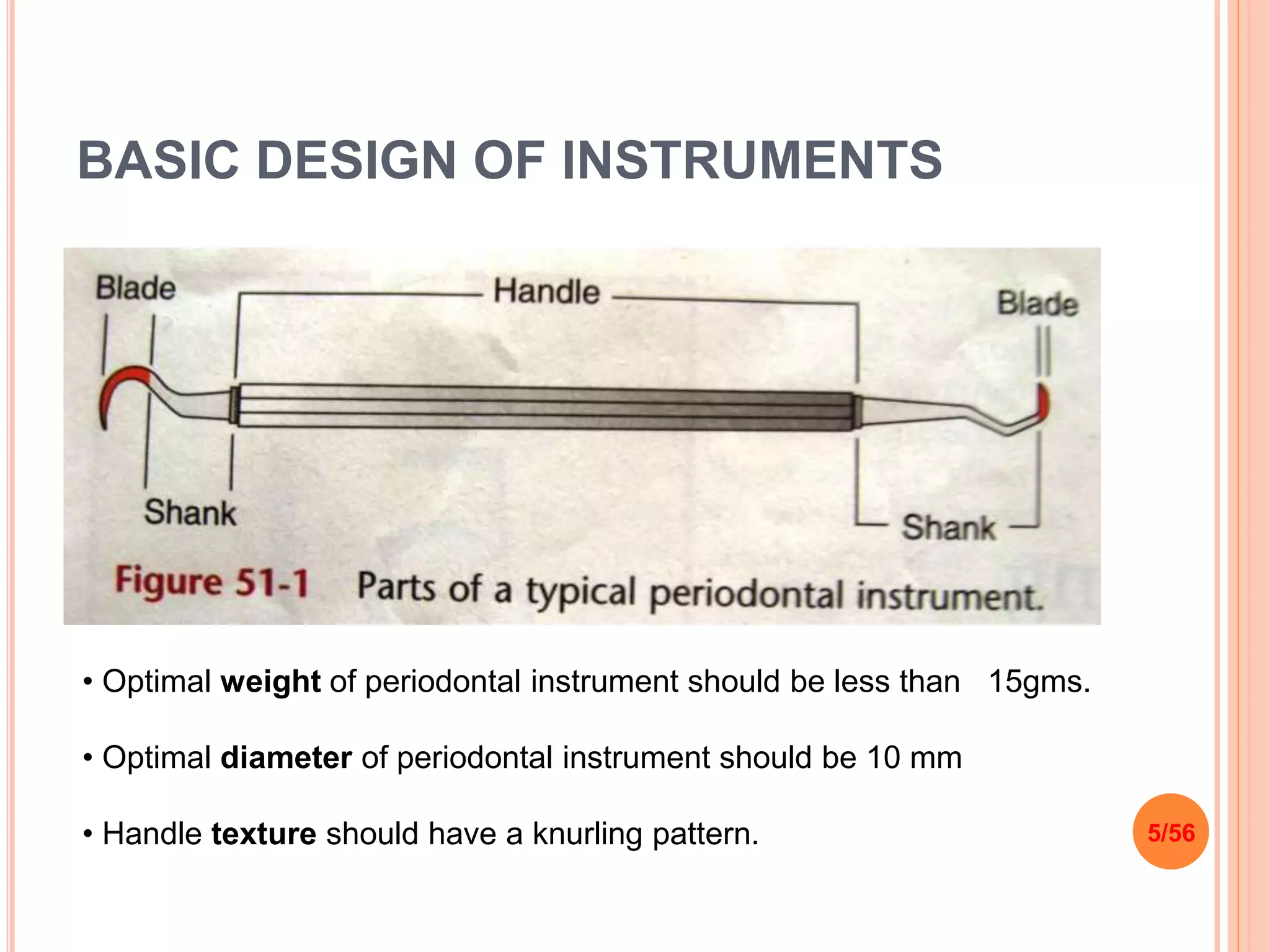
BASIC DESIGN OF INSTRUMENTS
• Optimal weight of periodontal instrument should be less than 15gms.
• Optimal diameter of periodontal instrument should be 10 mm
• Handle texture should have a knurling pattern. 5/56
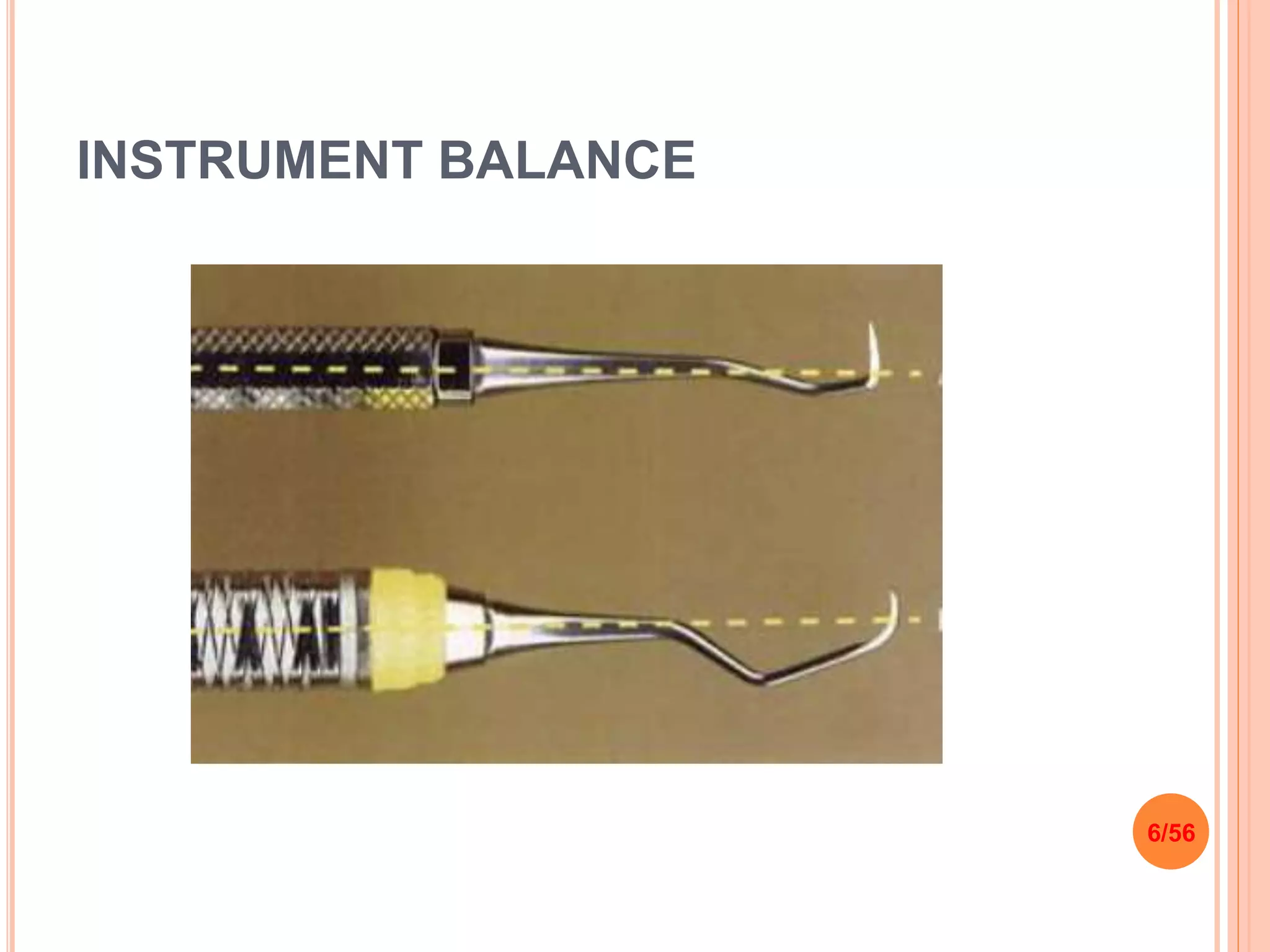
INSTRUMENT BALANCE
6/56
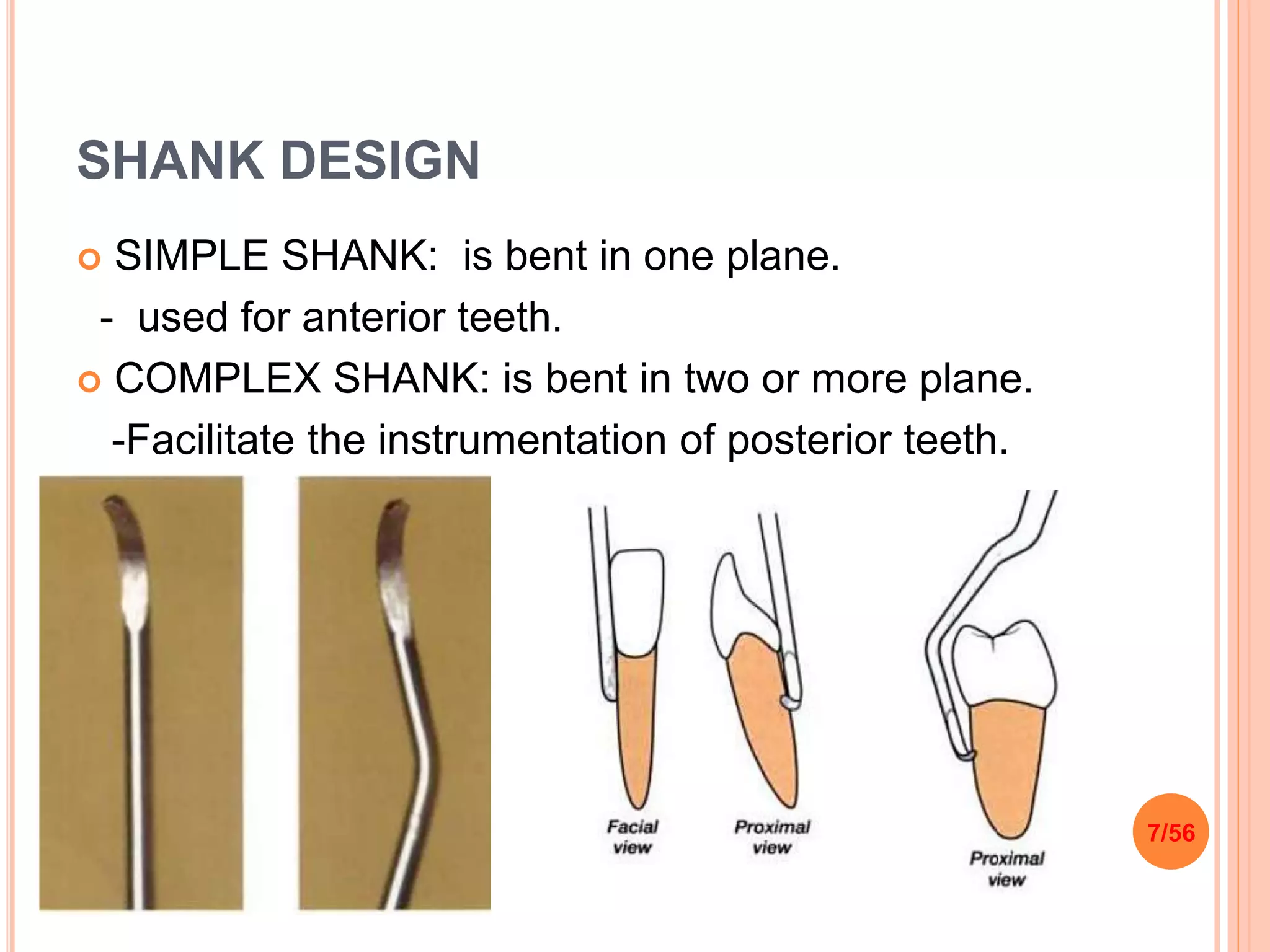
SHANK DESIGN
 SIMPLE SHANK: is bent in one plane.
- used for anterior teeth.
 COMPLEX SHANK: is bent in two or more plane.
-Facilitate the instrumentation of posterior teeth.
7/56
SHANK FLEXIBILITY
 RIGID SHANK: larger in diameter
- can withstand the pressure required to remove
heavy calculus
 FLEXIBLE SHANK: thinner in diameter.
- enhance the tactile sensitivity.
8/56
WORKING END DESIGN
9/56
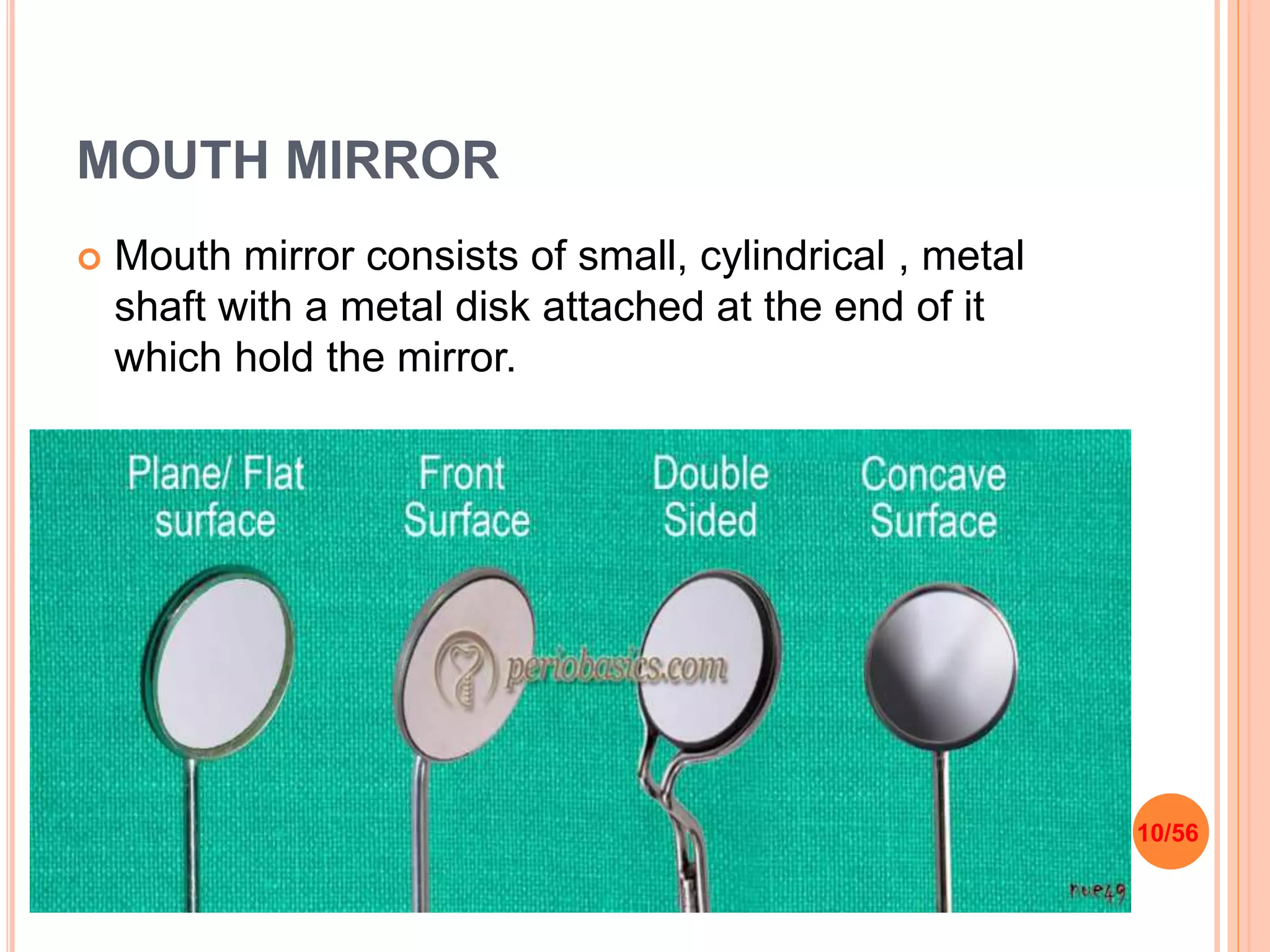
MOUTH MIRROR
 Mouth mirror consists of small, cylindrical , metal
shaft with a metal disk attached at the end of it
which hold the mirror.
10/56
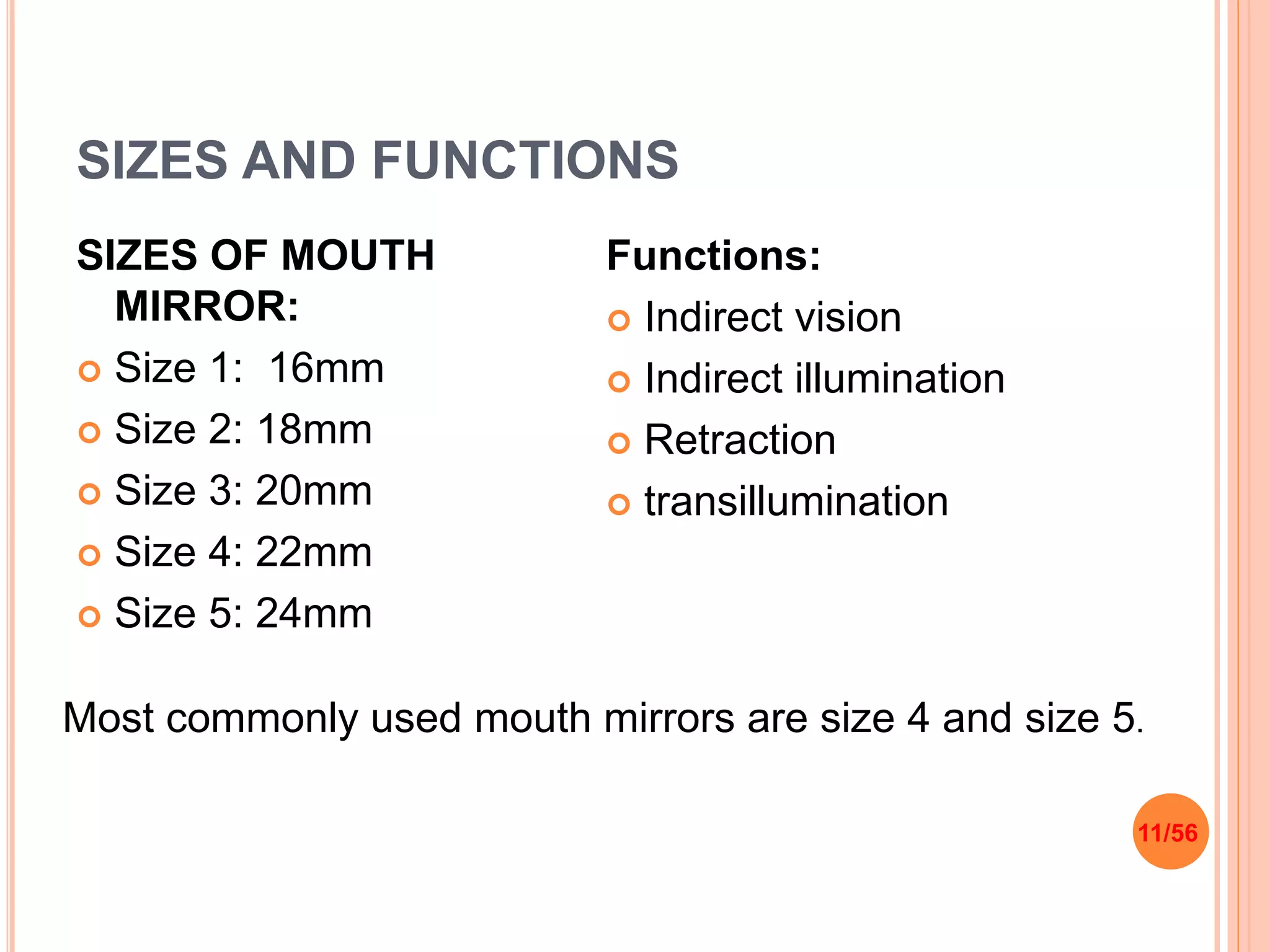
SIZES AND FUNCTIONS
SIZES OF MOUTH
MIRROR:
 Size 1: 16mm
 Size 2: 18mm
 Size 3: 20mm
 Size 4: 22mm
 Size 5: 24mm
Functions:
 Indirect vision
 Indirect illumination
 Retraction
 transillumination
Most commonly used mouth mirrors are size 4 and size 5.
11/56
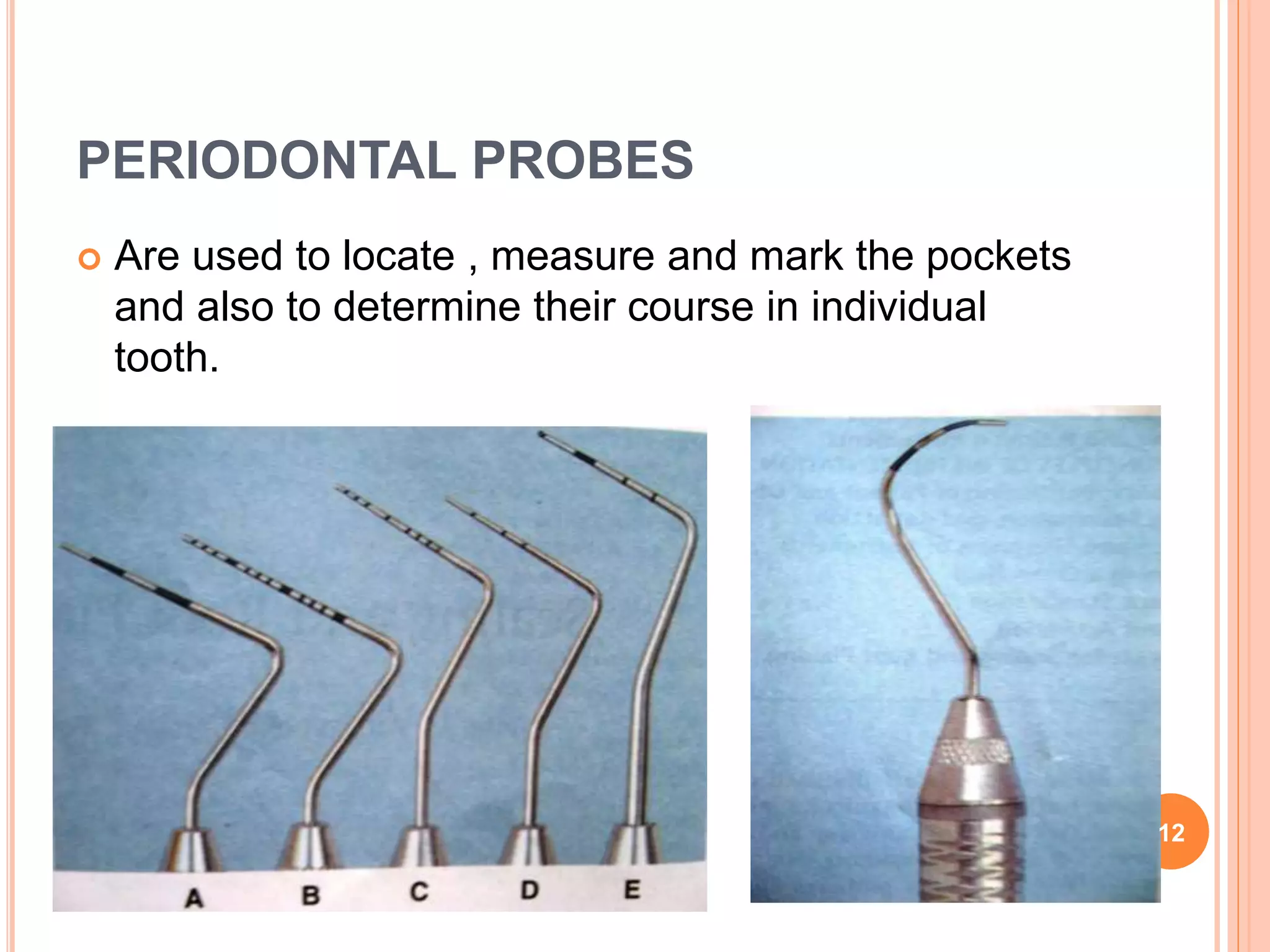
PERIODONTAL PROBES
 Are used to locate , measure and mark the pockets
and also to determine their course in individual
tooth.
12
WALKING OF PROBE
 Walking stroke is a series of strokes along the
junctional epithelium.
 Each up and down stroke should be exactly 1mm in
length.
 The stroke should be very close together
13/56
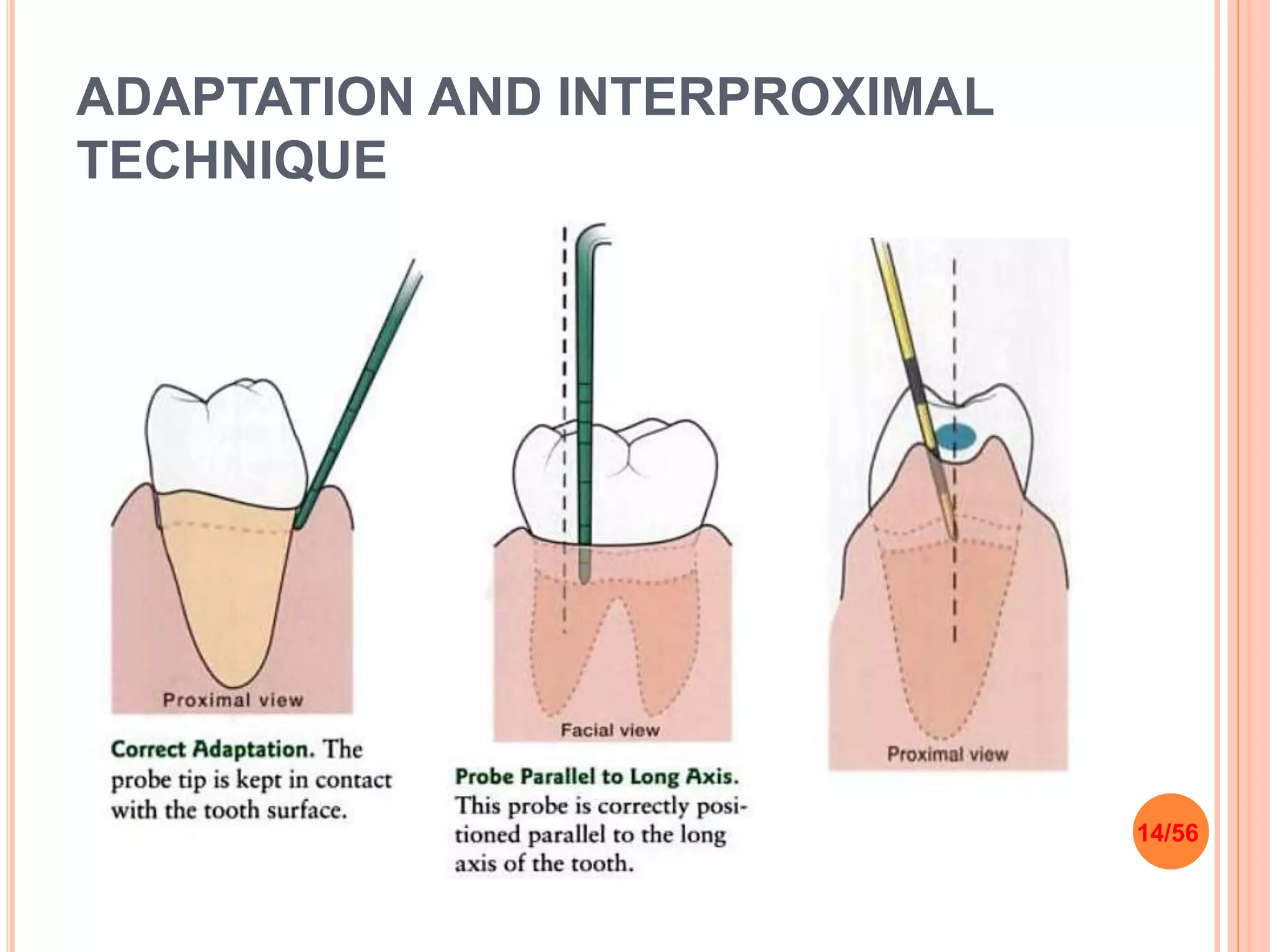
ADAPTATION AND INTERPROXIMAL
TECHNIQUE
14/56
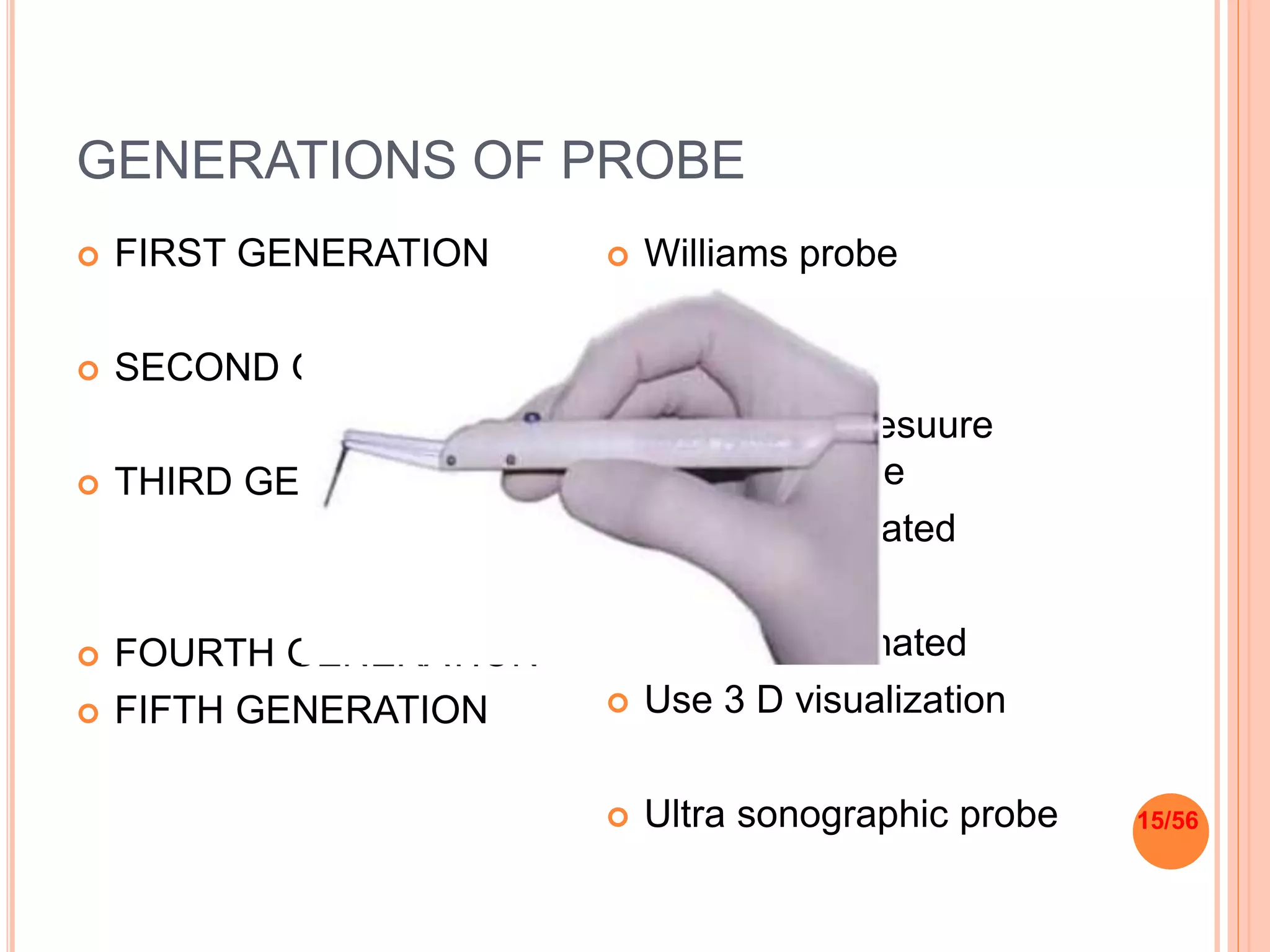
GENERATIONS OF PROBE
15/56
 FIRST GENERATION
 SECOND GENERATION
 THIRD GENERATION
 FOURTH GENERATION
 FIFTH GENERATION
 Williams probe
 UNC 15
 Hunter probe
 Borodontic presuure
sensitive probe
 Florida automated
 Foster miller
 Toronto automated
 Use 3 D visualization
 Ultra sonographic probe
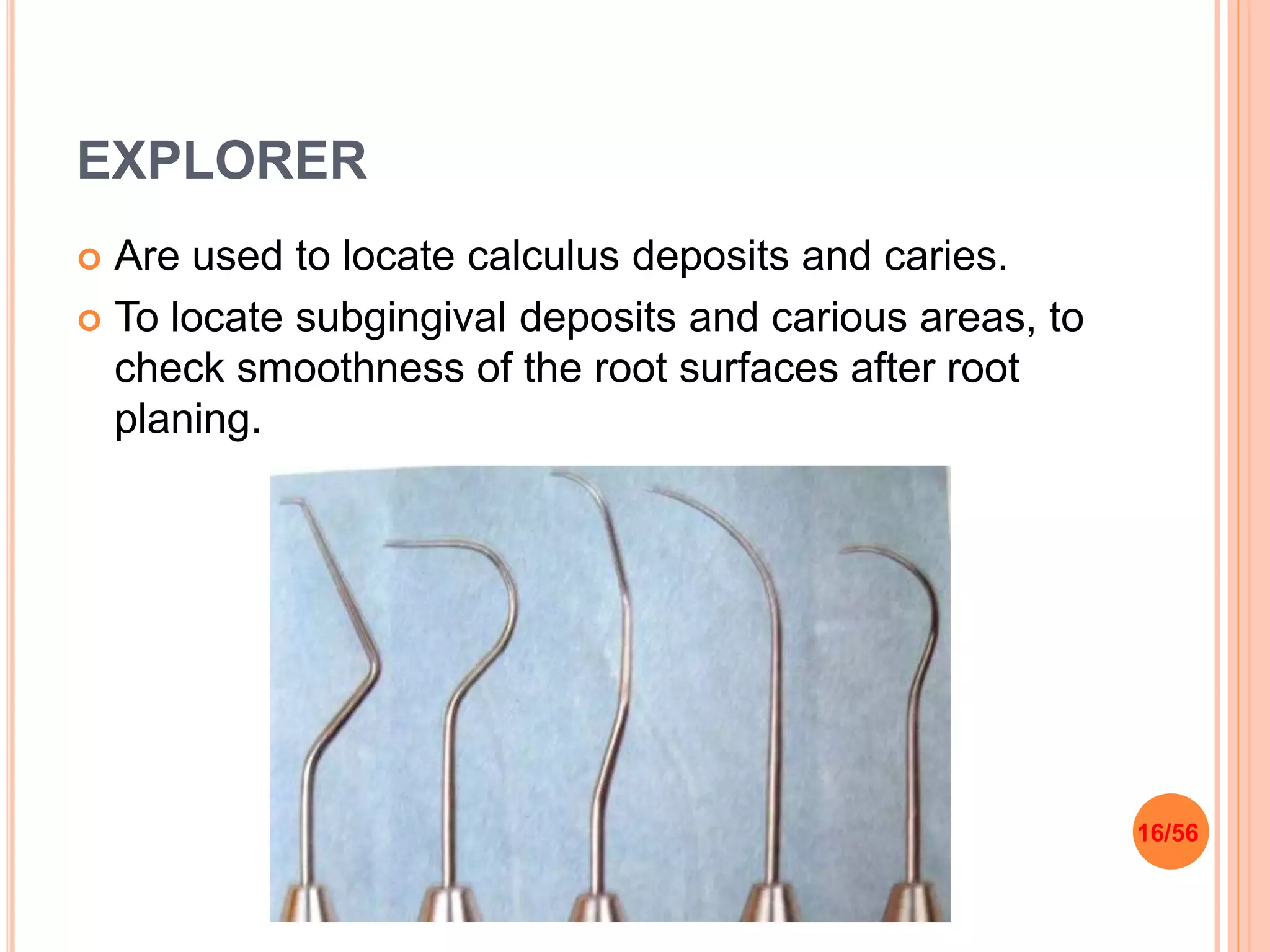
EXPLORER
 Are used to locate calculus deposits and caries.
 To locate subgingival deposits and carious areas, to
check smoothness of the root surfaces after root
planing.
16/56
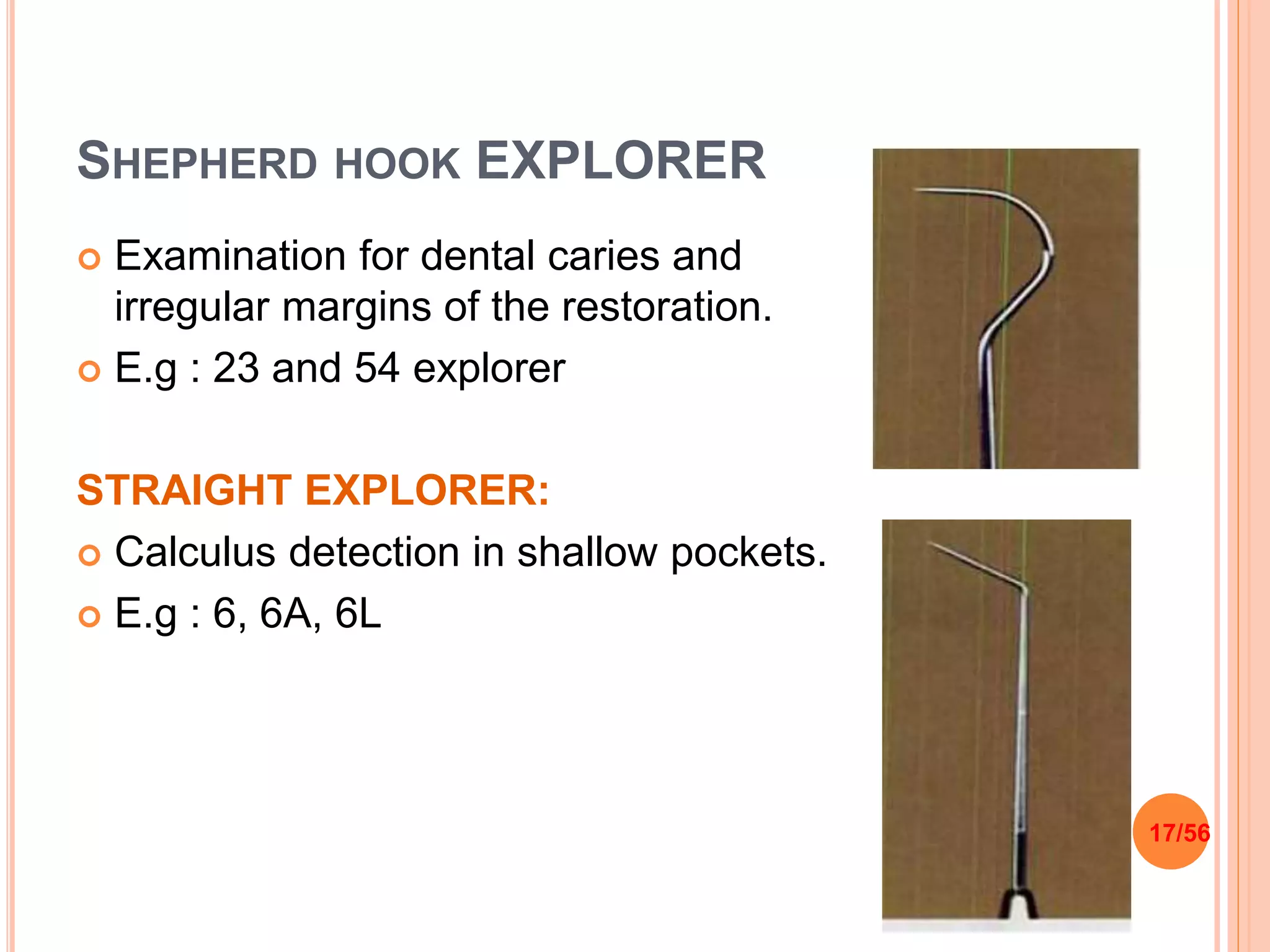
SHEPHERD HOOK EXPLORER
 Examination for dental caries and
irregular margins of the restoration.
 E.g : 23 and 54 explorer
STRAIGHT EXPLORER:
 Calculus detection in shallow pockets.
 E.g : 6, 6A, 6L
17/56
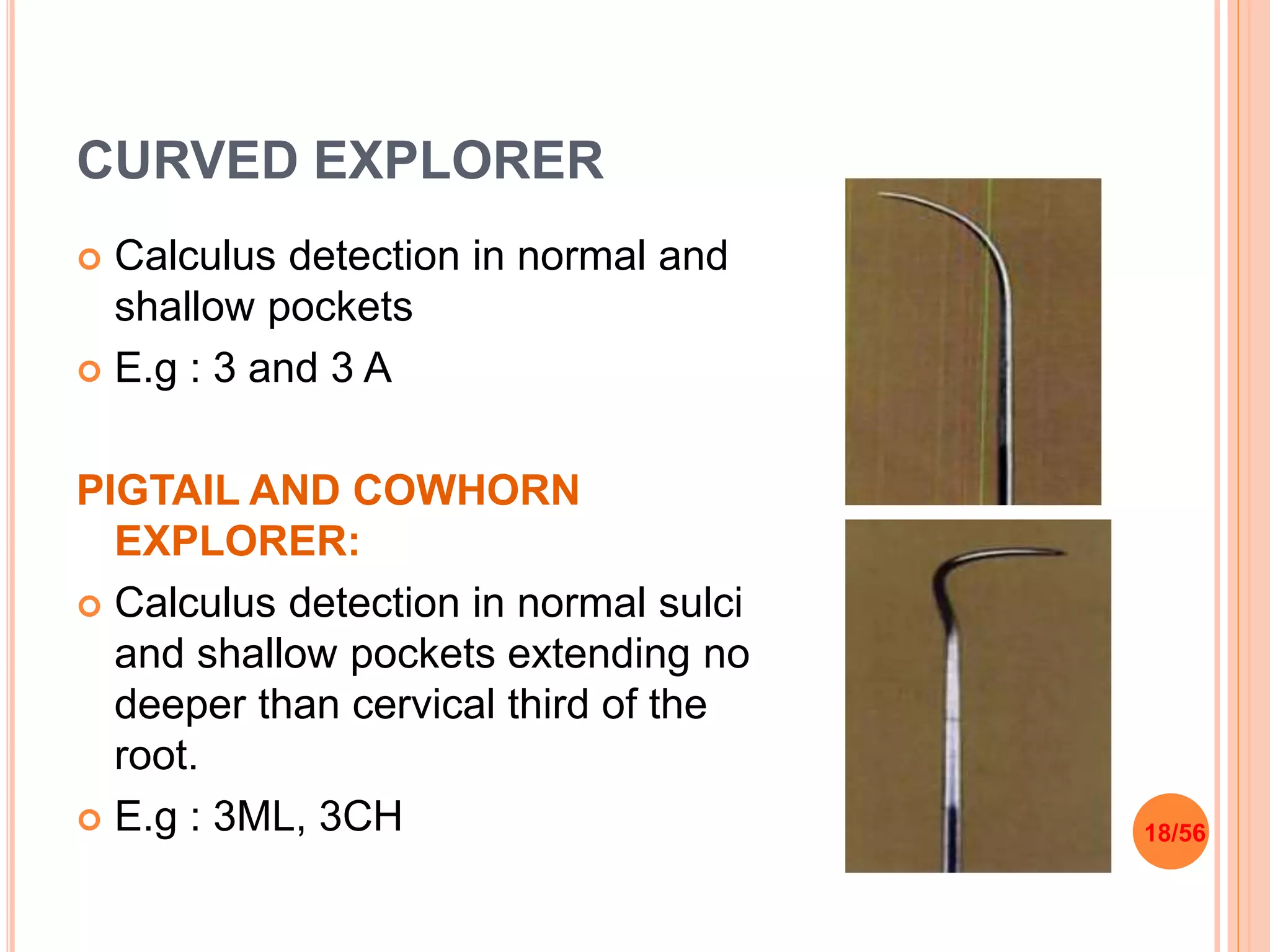
CURVED EXPLORER
 Calculus detection in normal and
shallow pockets
 E.g : 3 and 3 A
PIGTAIL AND COWHORN
EXPLORER:
 Calculus detection in normal sulci
and shallow pockets extending no
deeper than cervical third of the
root.
 E.g : 3ML, 3CH 18/56
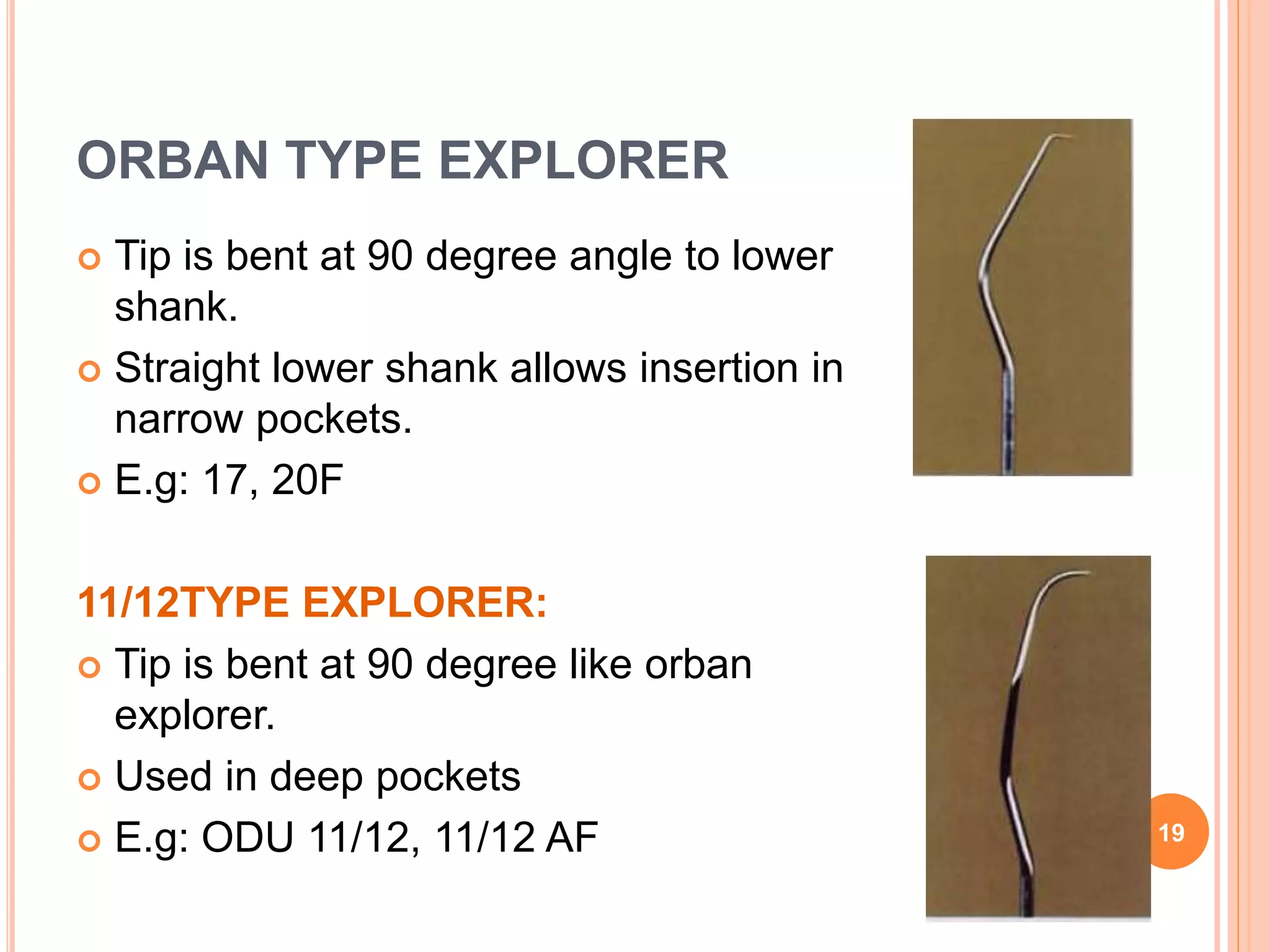
ORBAN TYPE EXPLORER
 Tip is bent at 90 degree angle to lower
shank.
 Straight lower shank allows insertion in
narrow pockets.
 E.g: 17, 20F
11/12TYPE EXPLORER:
 Tip is bent at 90 degree like orban
explorer.
 Used in deep pockets
 E.g: ODU 11/12, 11/12 AF 19
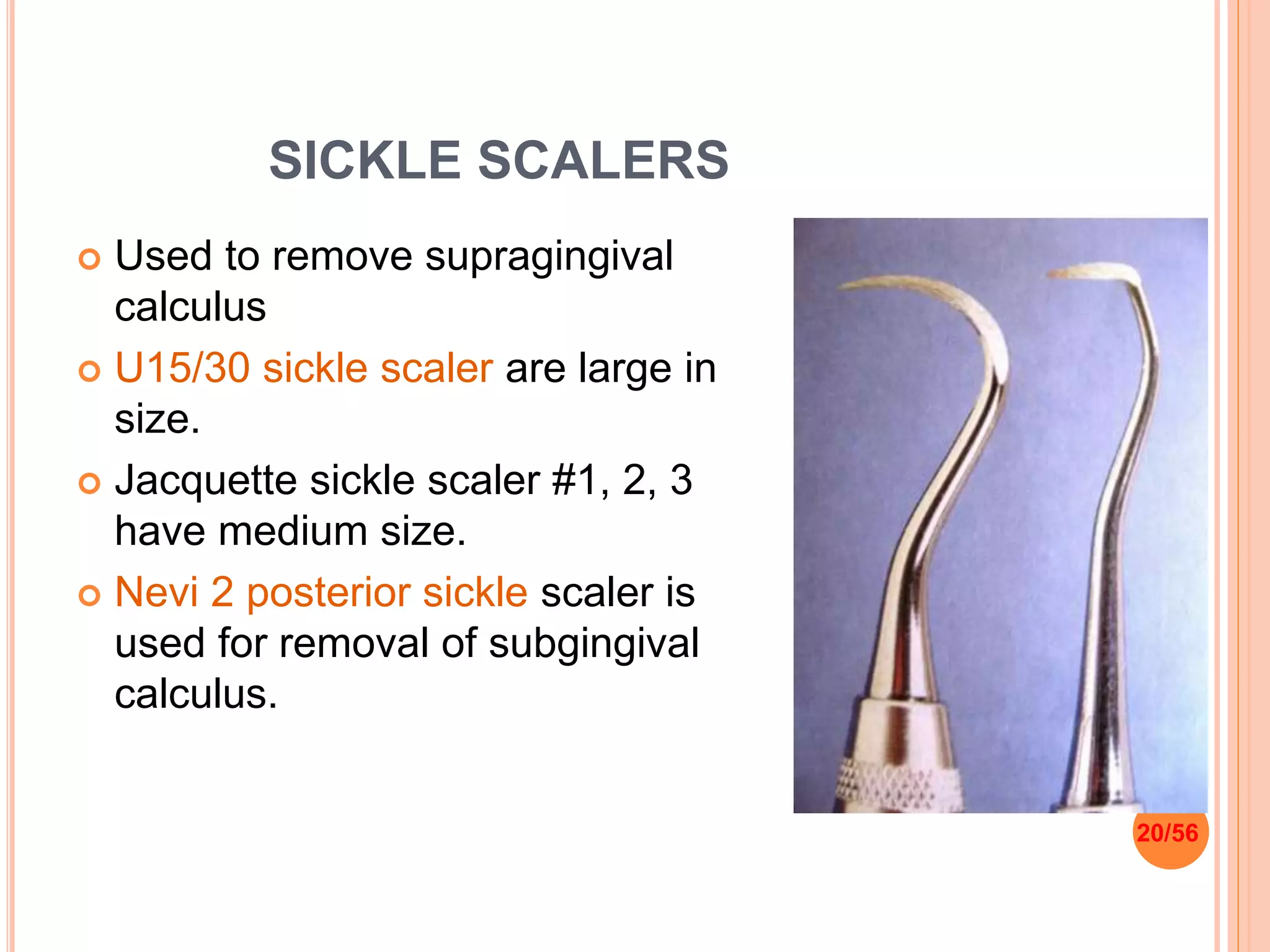
SICKLE SCALERS
 Used to remove supragingival
calculus
 U15/30 sickle scaler are large in
size.
 Jacquette sickle scaler #1, 2, 3
have medium size.
 Nevi 2 posterior sickle scaler is
used for removal of subgingival
calculus.
20/56
CHARACTERISTIC OF SICKLE SCALER
21/56
ANTERIOR AND POSTERIOR SCALER
 Anterior scaler: Jacquette30,33,
Goldman H6, H7.
 Posterior scaler: Jacquette 31/32,
Jacquette 34/35
1.ADAPTATION : tip third should be adapted.
2.ANGULATION: 60-70 degree
3.CHARCTERISTIC: short, powerful pull stroke.
22/56
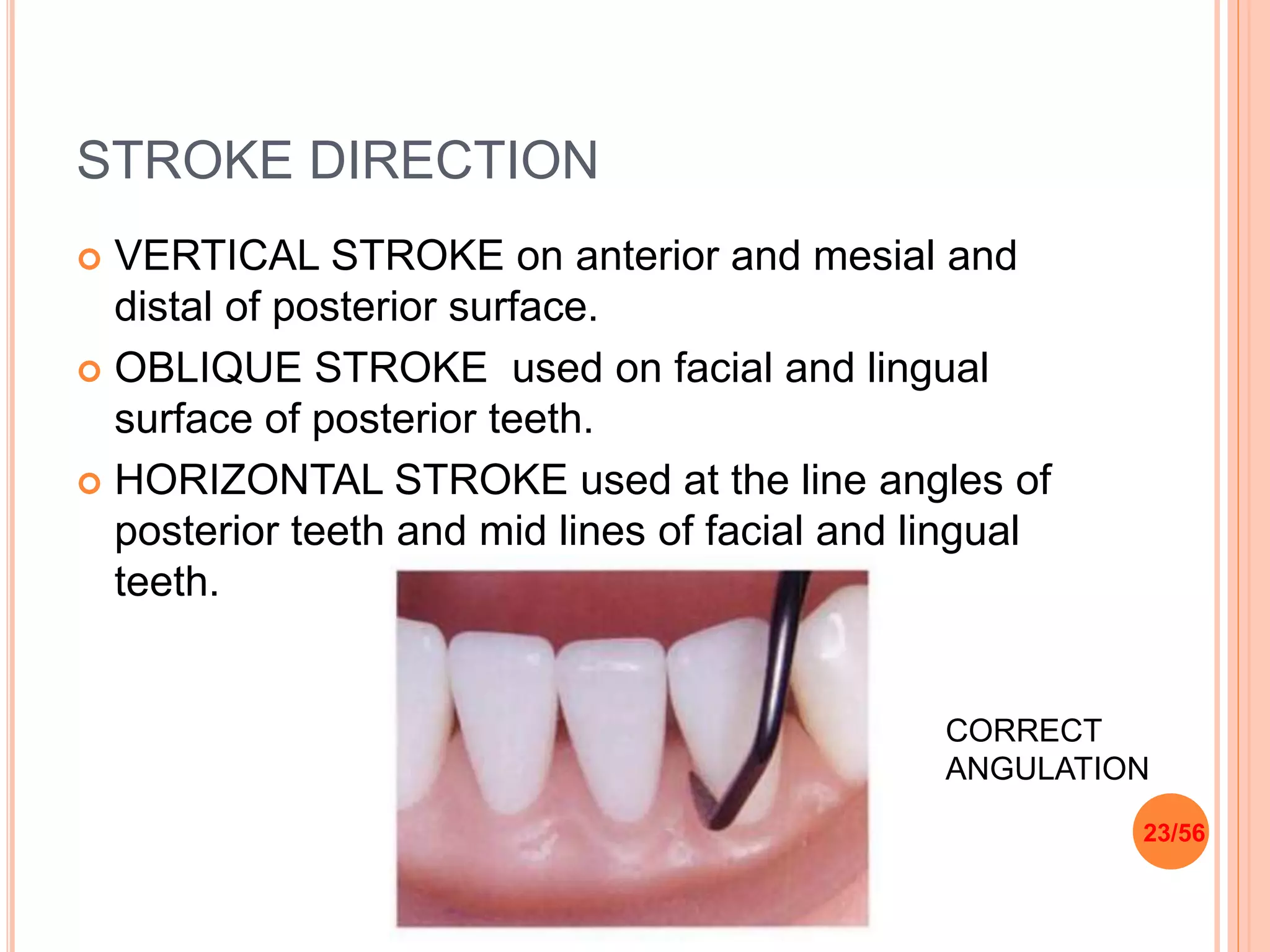
STROKE DIRECTION
 VERTICAL STROKE on anterior and mesial and
distal of posterior surface.
 OBLIQUE STROKE used on facial and lingual
surface of posterior teeth.
 HORIZONTAL STROKE used at the line angles of
posterior teeth and mid lines of facial and lingual
teeth.
23/56
CORRECT
ANGULATION
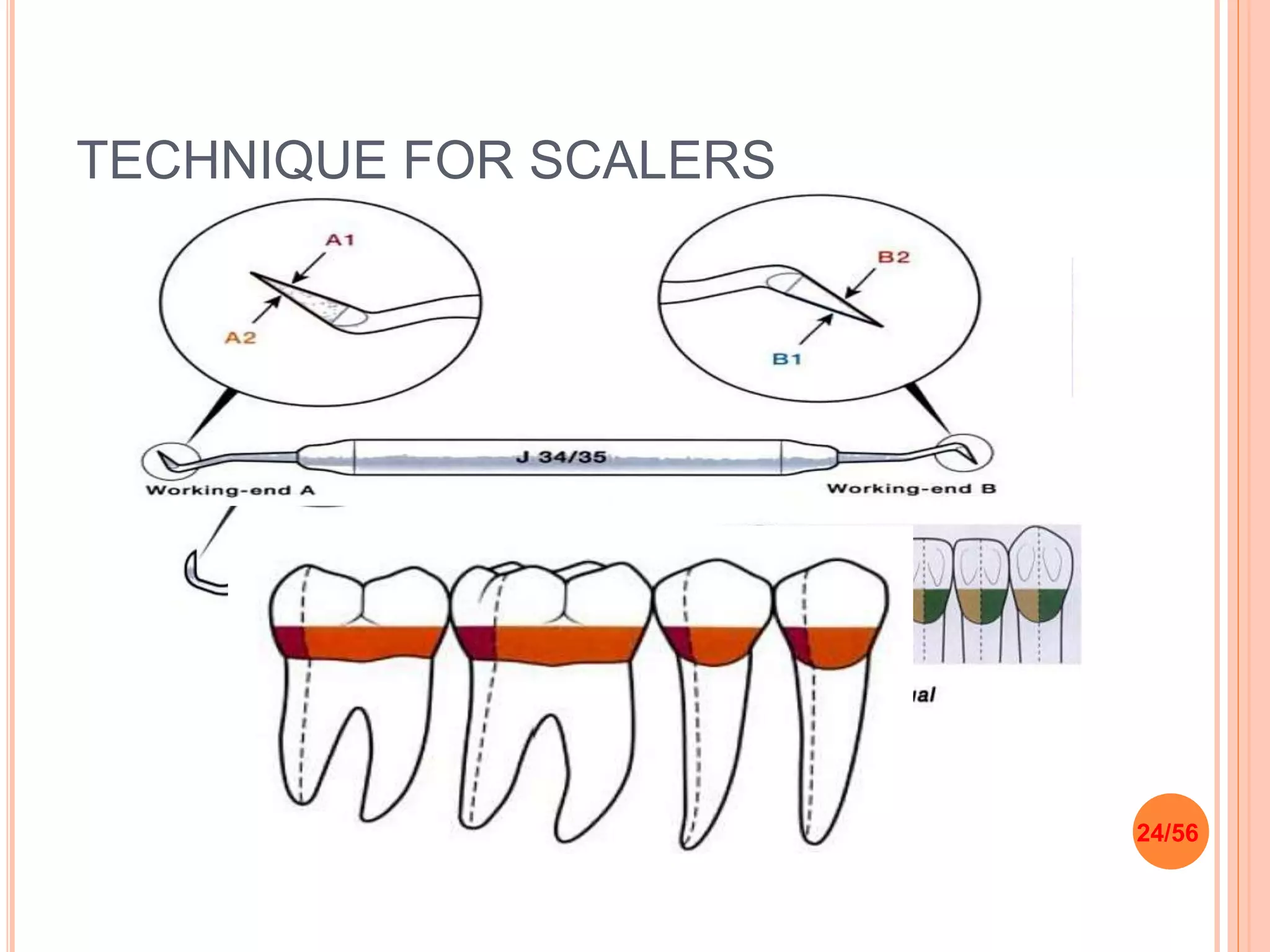
TECHNIQUE FOR SCALERS
24/56
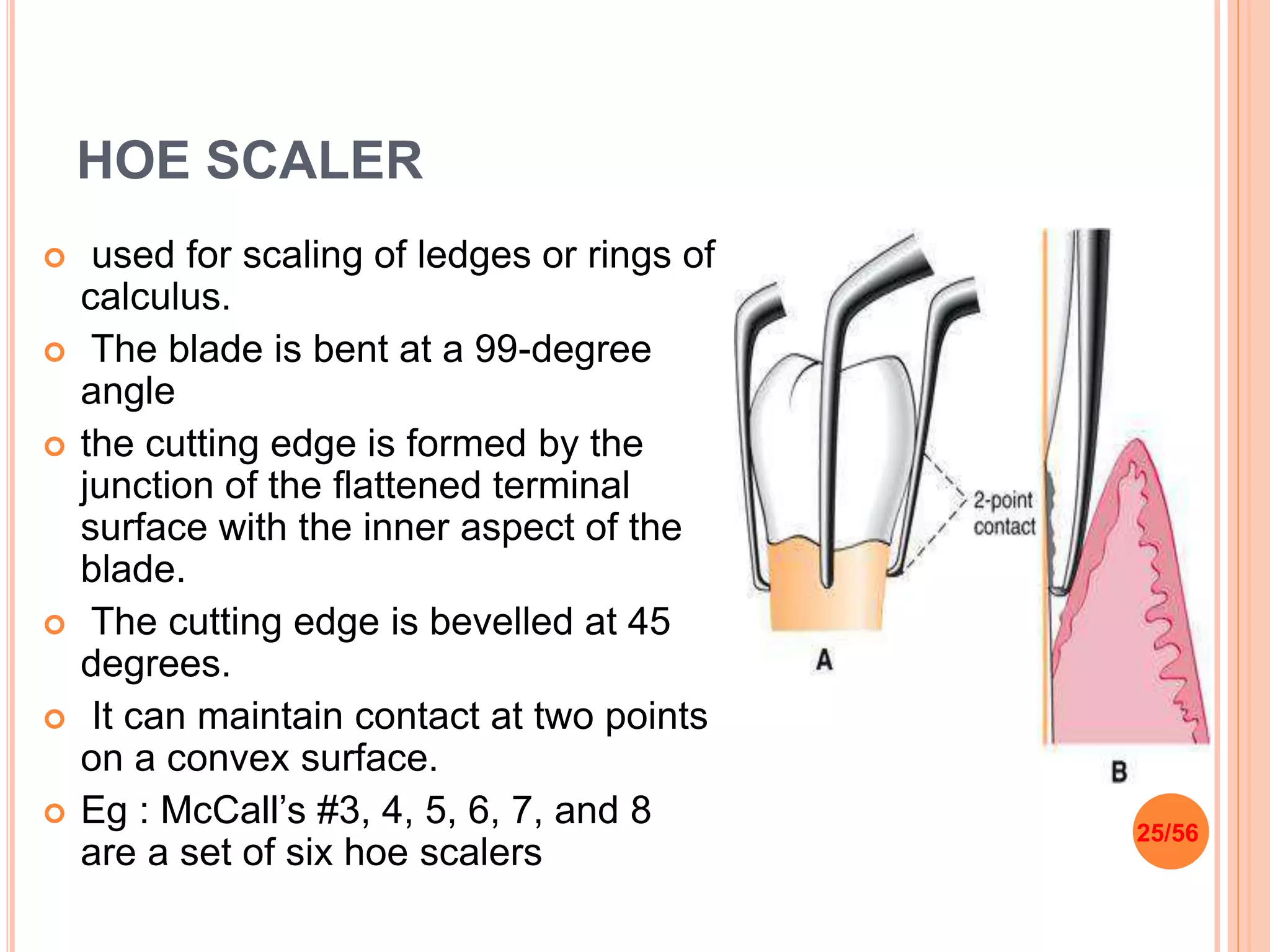
HOE SCALER
 used for scaling of ledges or rings of
calculus.
 The blade is bent at a 99-degree
angle
 the cutting edge is formed by the
junction of the flattened terminal
surface with the inner aspect of the
blade.
 The cutting edge is bevelled at 45
degrees.
 It can maintain contact at two points
on a convex surface.
 Eg : McCall’s #3, 4, 5, 6, 7, and 8
are a set of six hoe scalers
25/56
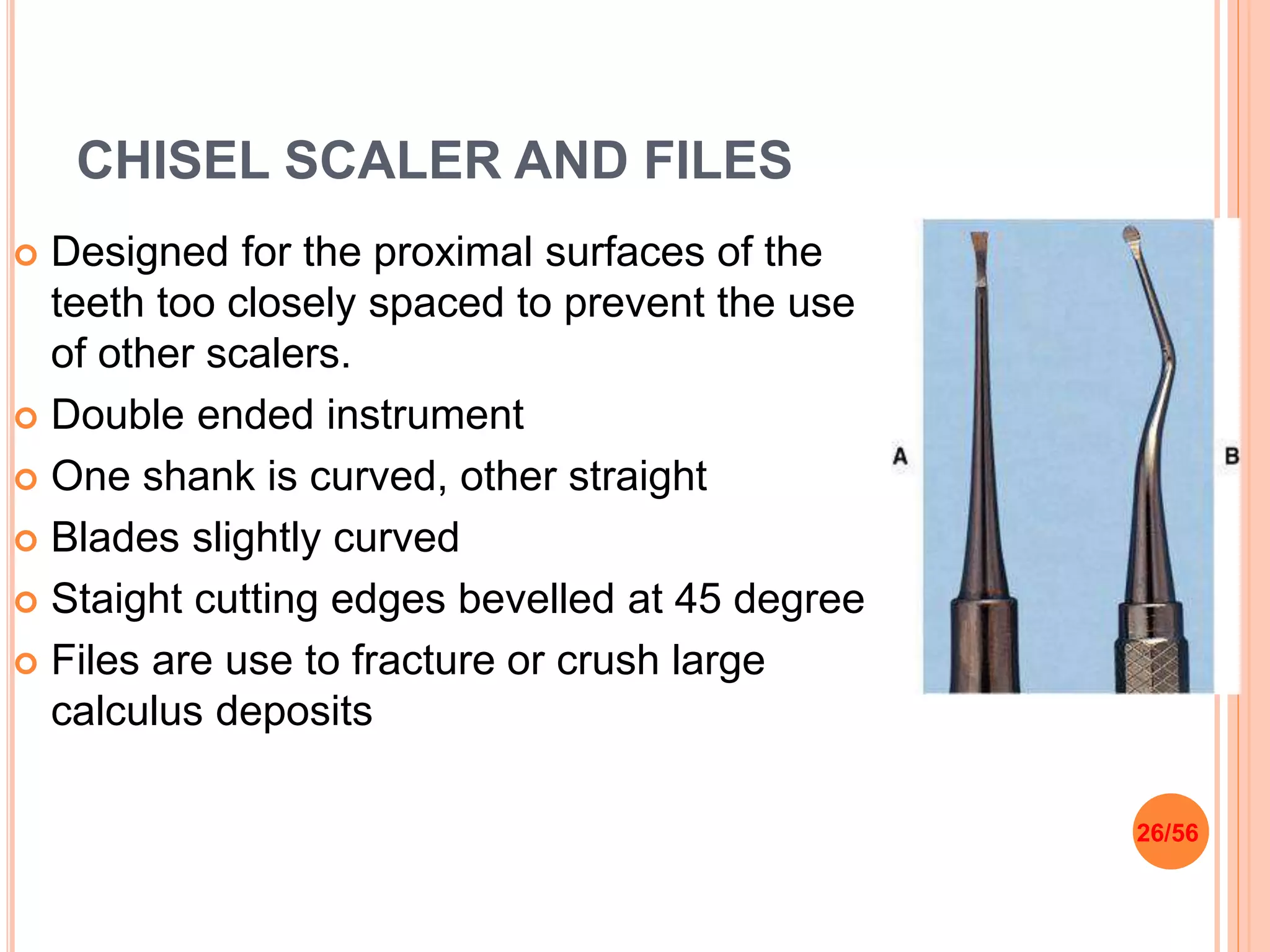
CHISEL SCALER AND FILES
 Designed for the proximal surfaces of the
teeth too closely spaced to prevent the use
of other scalers.
 Double ended instrument
 One shank is curved, other straight
 Blades slightly curved
 Staight cutting edges bevelled at 45 degree
 Files are use to fracture or crush large
calculus deposits
26/56
CURETTES
 For removing deep subgingival calculus, root
planing altered cementum and removing the soft
tissue lining the periodontal pocket.
 Finer than sickle scaler.
 Provide good access to deep pockets
 CURETTES ARE OF TWO TYPES:
1. UNIVERSAL
2. AREA SPECIFIC
27/56
CHARACTERISTICS OF CURETTE
 Inner cutting edge is
used for distal surfaces.
 Outer cutting edge is
used for lingual, facial
and mesial.
28/56
AREA SPECIFIC CURETTE
-used in specific areas
-one cutting edge used
-curved in two plane
-offset blade
29/56
GRACEY CURETTES
1-2 & 3-4 ANTERIOR TEETH
5-6 ANTERIOR TEETH &
PREMOLARS
7-8 & 9-10 FACIAL & LINGUAL-
POSTERIORS
11-12 MESIAL- POSTERIORS
13-14 DISTAL- POSTERIORS
30/56
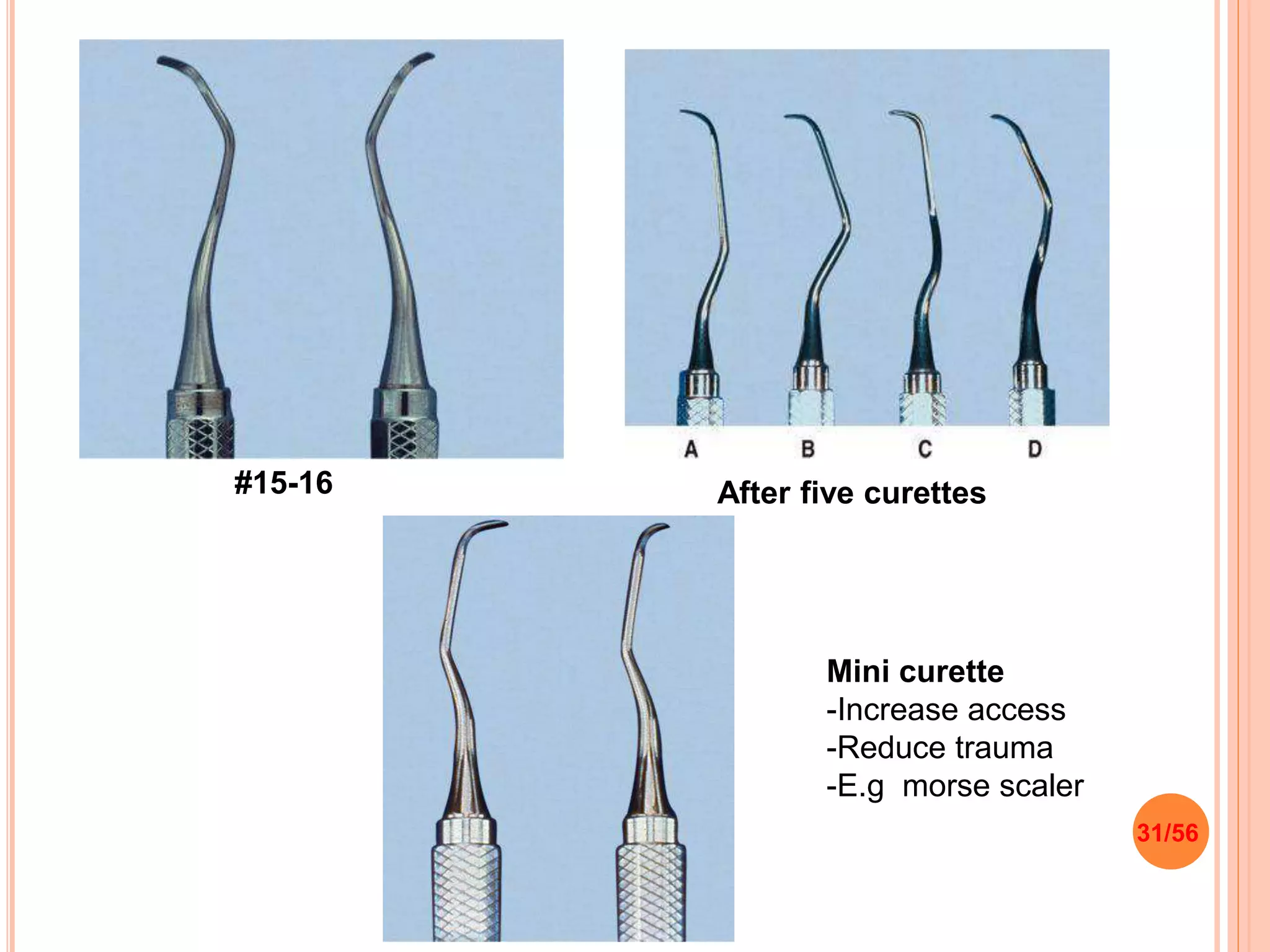
#15-16 After five curettes
Mini curette
-Increase access
-Reduce trauma
-E.g morse scaler
31/56
MINI FIVE CURETTE
 The Mini Five curettes are available in both
finishing and rigid designs.
 Rigid Mini Five curettes are recommended for
calculus removal.
 The more flexible, shanked, finishing Mini Five
curettes are appropriate for light scaling and
deplaquing in periodontal maintenance patients
with tight pockets.
 The Mini Five curettes are available in all standard
Gracey numbers, except the #9-10.
32/56
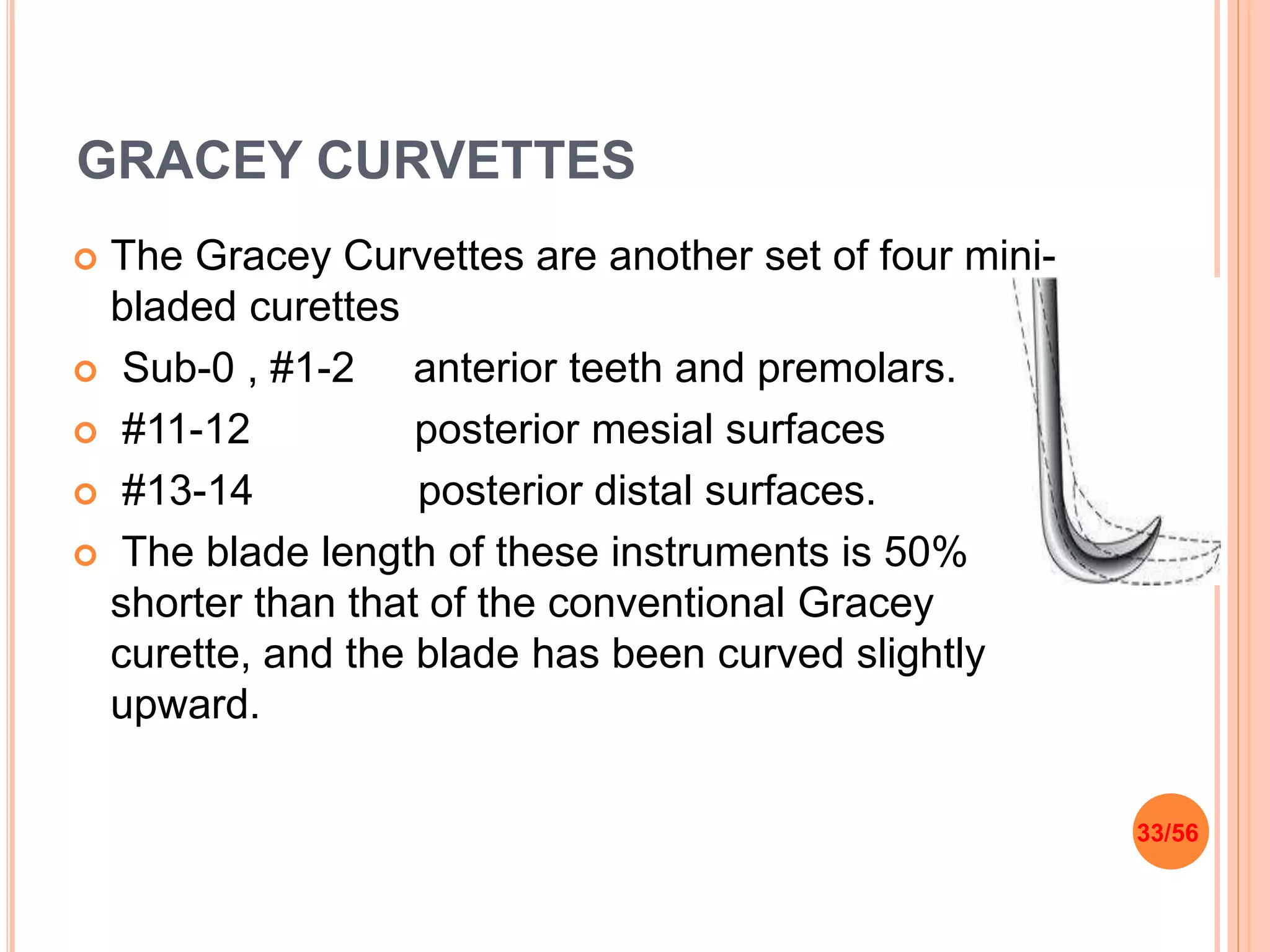
GRACEY CURVETTES
 The Gracey Curvettes are another set of four mini-
bladed curettes
 Sub-0 , #1-2 anterior teeth and premolars.
 #11-12 posterior mesial surfaces
 #13-14 posterior distal surfaces.
 The blade length of these instruments is 50%
shorter than that of the conventional Gracey
curette, and the blade has been curved slightly
upward.
33/56
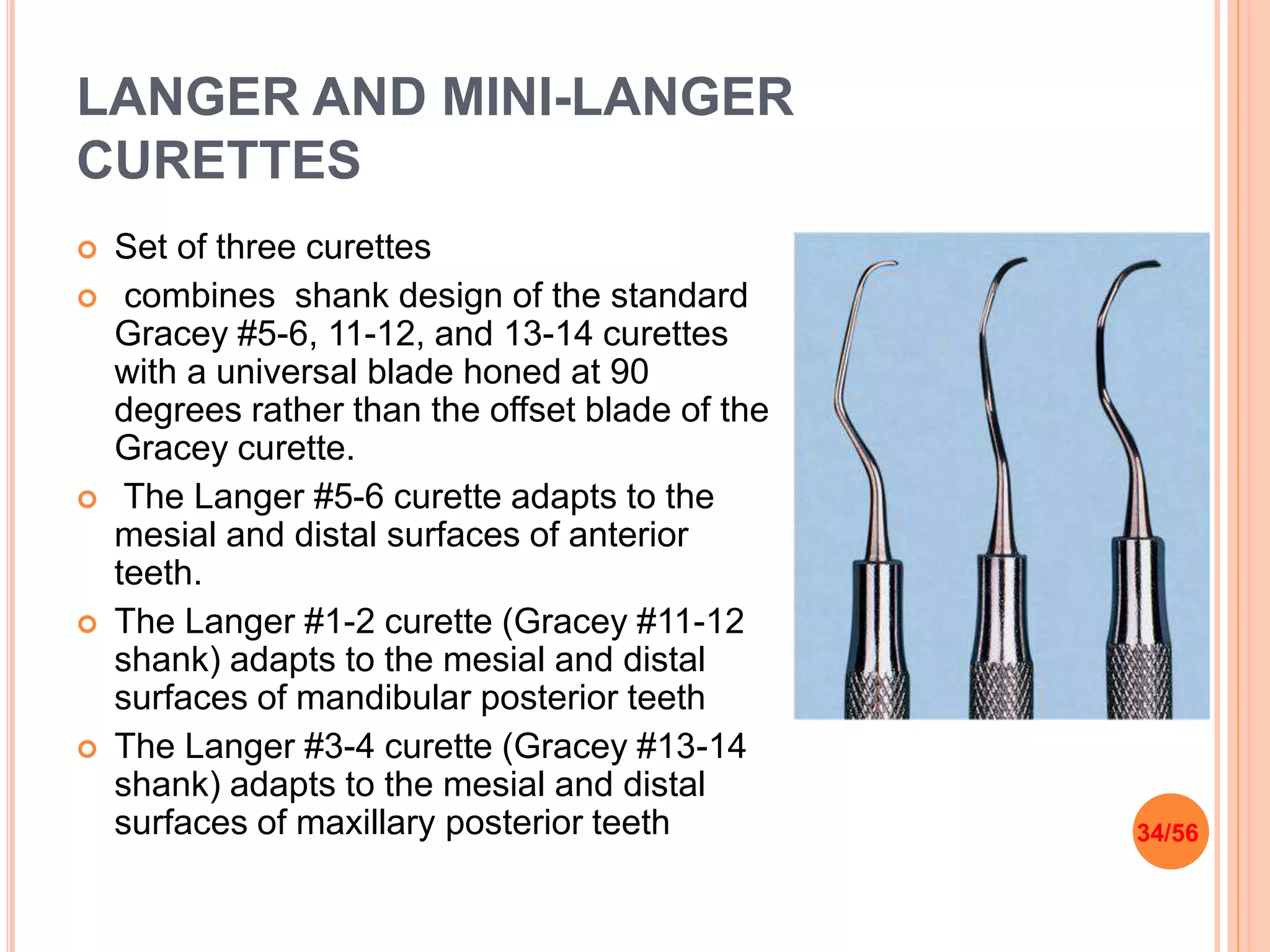
LANGER AND MINI-LANGER
CURETTES
 Set of three curettes
 combines shank design of the standard
Gracey #5-6, 11-12, and 13-14 curettes
with a universal blade honed at 90
degrees rather than the offset blade of the
Gracey curette.
 The Langer #5-6 curette adapts to the
mesial and distal surfaces of anterior
teeth.
 The Langer #1-2 curette (Gracey #11-12
shank) adapts to the mesial and distal
surfaces of mandibular posterior teeth
 The Langer #3-4 curette (Gracey #13-14
shank) adapts to the mesial and distal
surfaces of maxillary posterior teeth 34/56
QUETIN FURCATION CURETTE
 Shallow half moon radius
 Fits into the roof or floor of the furcation.
 The shanks are slightly curved for better
access.
 The tips are available in two widths.
 The BL1 and MD1 instruments are small
and fine, with a 0.9-mm blade width.
 The BL2 and MD2 instruments are larger
and wider, with a 1.3-mm blade width.
35/56
PLASTIC INSTRUMENTS FOR IMPLANT
 Plastic rather than metal instruments be used to
avoid scarring and permanent damage to the
implants.
 E.g: Coulumbia 4R/4L curette tip,H6-H7 sickle
scaler , 204S sickle scaler tip.
36/56
DIAMOND FILES
 Used for final finishing of root surfaces.
 Do not use cutting edges
 Used to remove small embedded calculus on root
surfaces seen with endoscope.
37/56
SONIC INSTRUMENTS
 Sonic units consist of a handpiece that attaches to
a compressed-air line .
 Vibrations at the sonic tip range from 2000 to 6500
cps
 provides less power for calculus removal than
ultrasonic units.
38/56
ULTRASONIC INSTRUMENT
 Vibration ranges from 20000 to 45000cps
MAGNETOSTRICTIVE
 Pattern of vibration of tip is elliptical.
 All sides are active while working.
PIEZOELECTRIC
The pattern of vibration of the tip is linear
The two sides of the tip are the most active
39
POWERED INSTRUMENT TIP DESIGN
40/56
STANDARD DIAMETER
TIPS
 Larger in size
 Short shank length
 Heavy deposit removal,
use for supra gingival
calculus removal
SLIM DIAMETER TIPS
 40%smaller diameter
 Long shank length
 Light deposit removal,
 Furcation area
 deplaquing
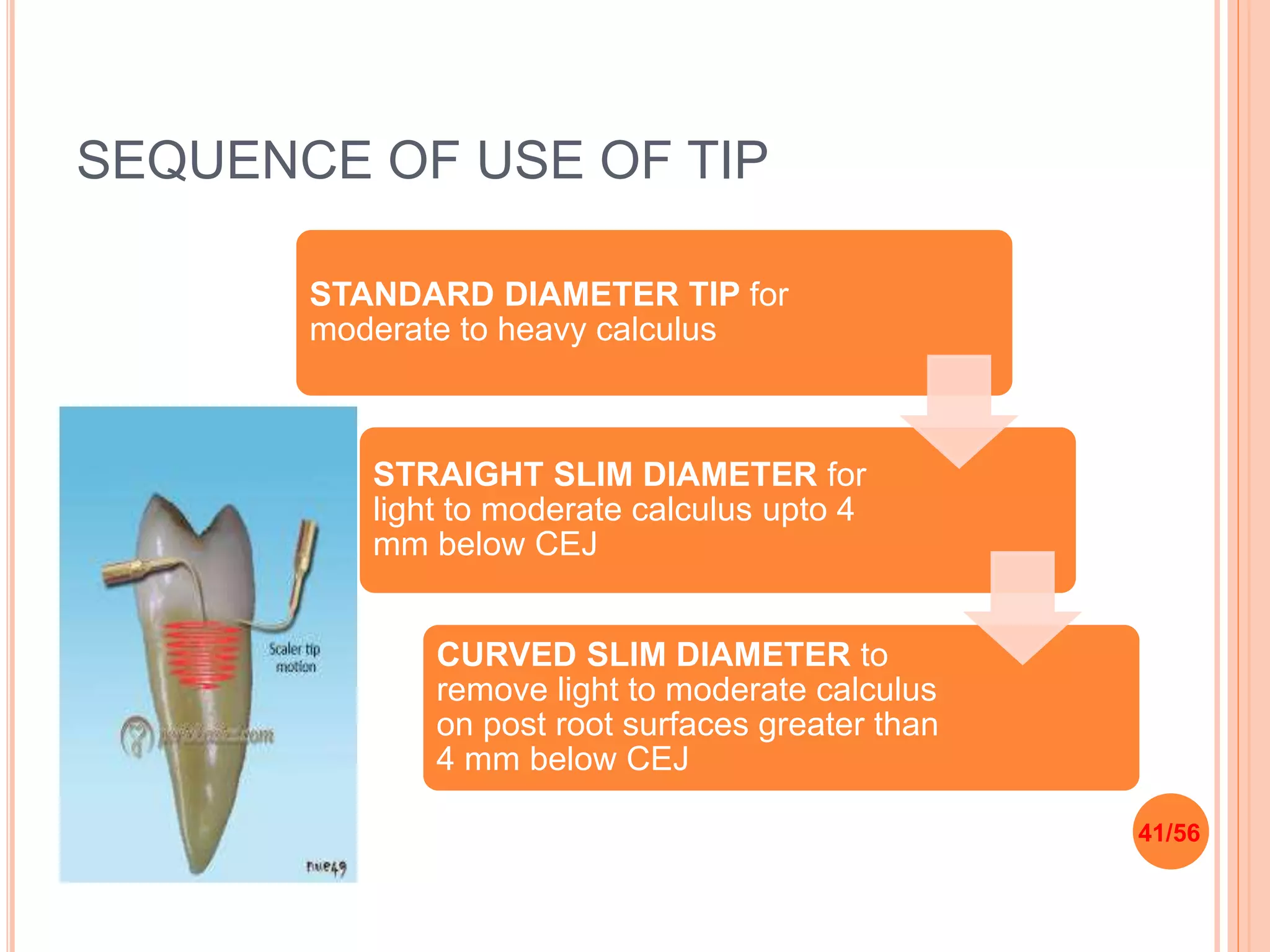
SEQUENCE OF USE OF TIP
41/56
STANDARD DIAMETER TIP for
moderate to heavy calculus
STRAIGHT SLIM DIAMETER for
light to moderate calculus upto 4
mm below CEJ
CURVED SLIM DIAMETER to
remove light to moderate calculus
on post root surfaces greater than
4 mm below CEJ
DENTAL ENDOSCOPE
 Allows clear visualization of
deep sub gingival pockets
and in the furcations.
 Consists of 0.99mm
diameter reusable fibre optic
endoscope over which is
fitted a disposable sterile
sheath.
 Magnification ranges from
24X to 46X.
42/56
CLEANSING AND POLISHING
INSTRUMENT
 Rubber cups
 Bristle brushes
 Dental tape
 Air powder polishing
43/56
SURGICAL INSTRUMENTS
 Excisional and incisional instruments
 Surgical curettes and sickles
 Periosteal elevator
 Surgical chisels
 Surgical files
 Scissors
 Haemostats and tissue forceps
44/56
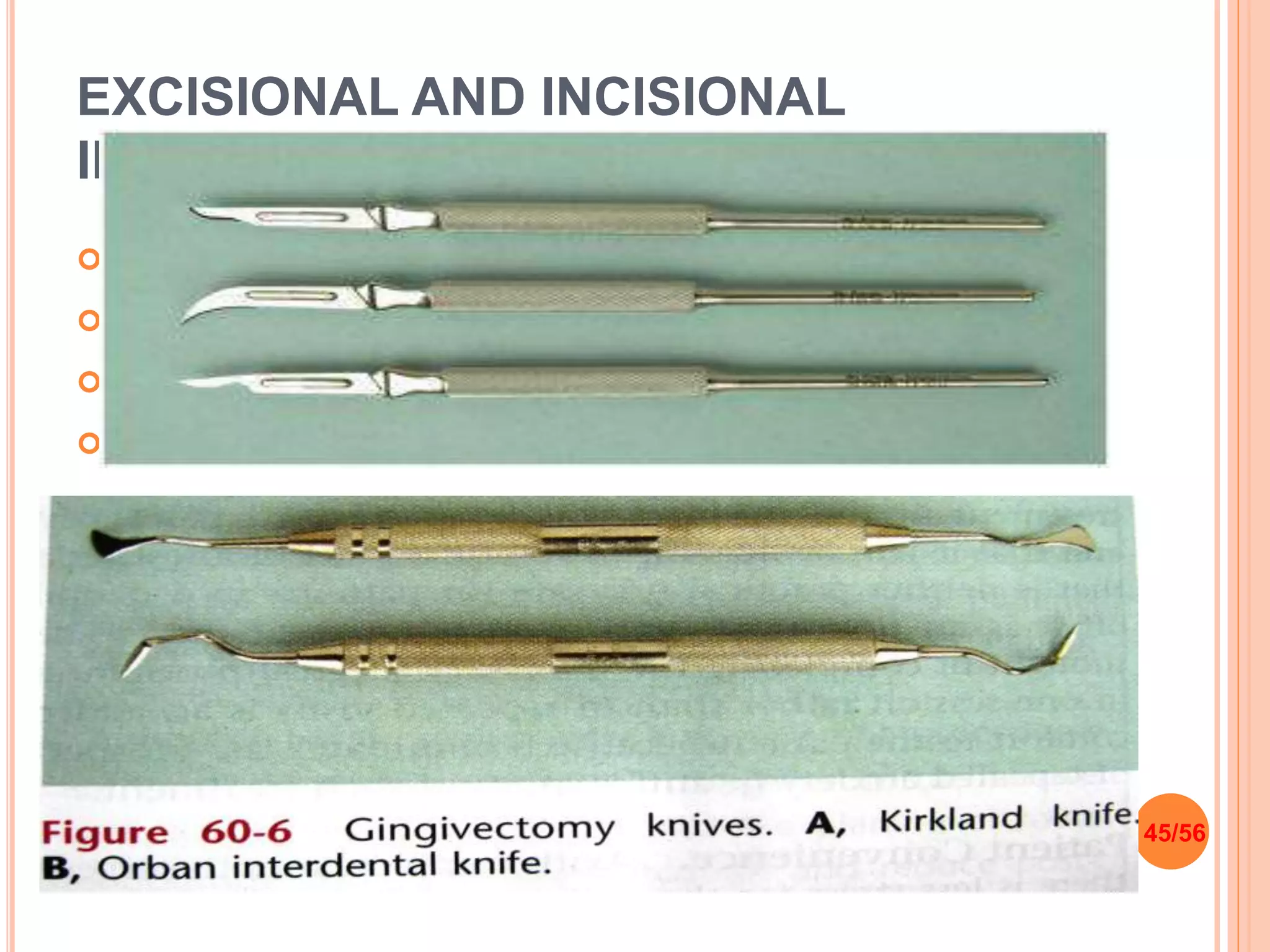
EXCISIONAL AND INCISIONAL
INSTRUMENT
 PERIODONTAL KNIVES e.g : Kirkland knife
 INTERDENTAL KNIVES e.g : Orbans knife
 Merifield knife#1,2,3,4
 SURGICAL BLADES : 15C, 15, 12D
45/56
SURGICAL CURETTES AND SICKLES
 Used for the removal of granulation tissue, fibrous
interdental tissues, and tenacious sub gingival
deposits during surgery.
 HEAVY CURETTE : Prichard curette
Kirkland curette
 HEAVY SCALER : Ball Scaler #B2-B3
46/56
PERIOSTEAL ELEVATOR
 To reflect and move the flap after the incision has
been made for flap surgery.
E.G: The Woodson elevator
 Prichard elevators
47/56
SURGICAL CHISEL
Used for removal and reshaping the bone.
- STRAIGHT CHISEL
 E.g : Wiedelstadt , Ochsenbein #1-2.(push motion)
-BACK ACTION CHISEL e.g: Rhodes Chisel (pull
motion).
48/56
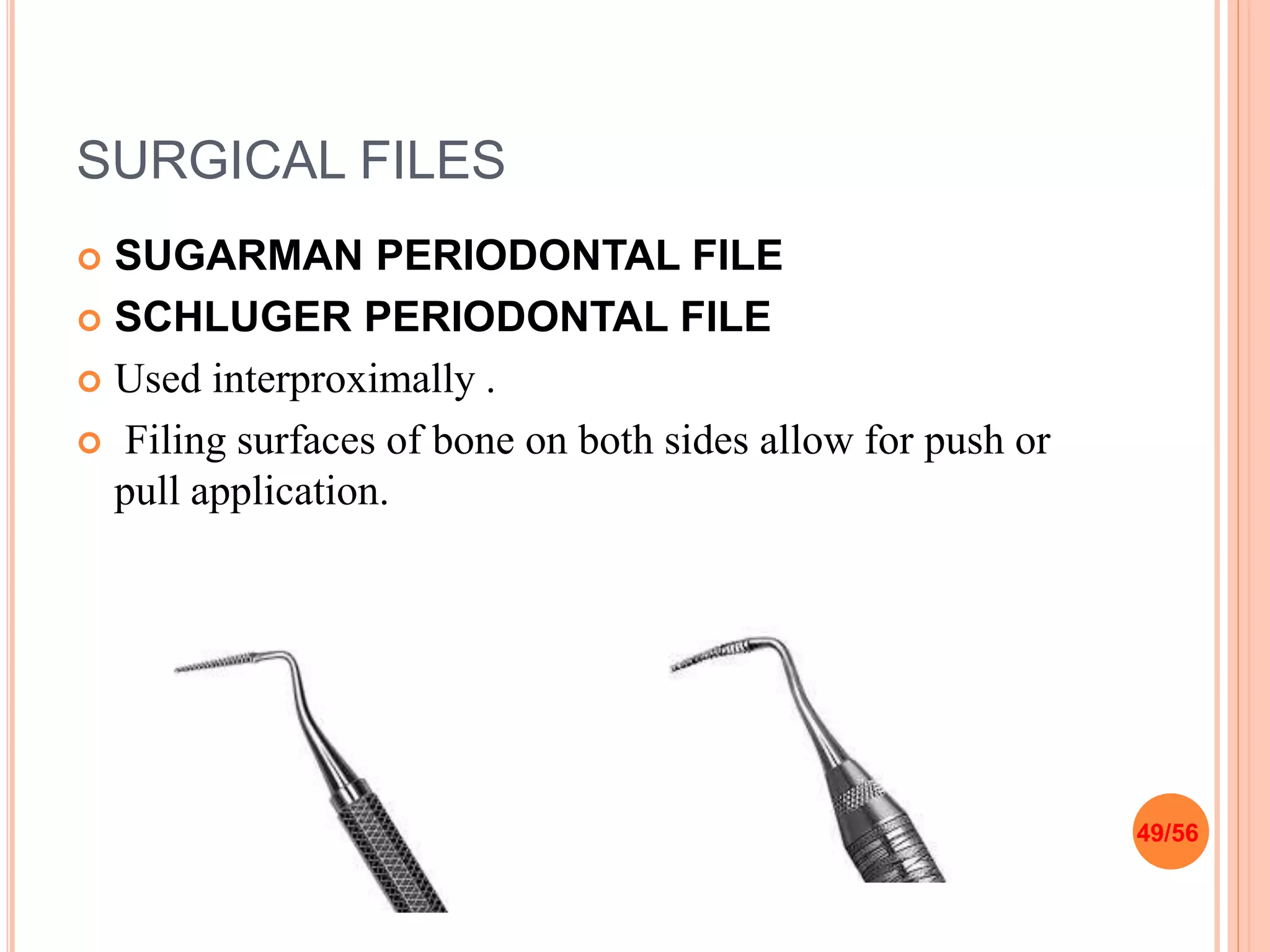
SURGICAL FILES
 SUGARMAN PERIODONTAL FILE
 SCHLUGER PERIODONTAL FILE
 Used interproximally .
 Filing surfaces of bone on both sides allow for push or
pull application.
49/56
TISSUE FORCEPS AND SCISSORS
 used to hold the flap during suturing.
 used to position and displace the flap after the flap
has been reflected.
SCISSORS are used in periodontal surgery to:
 remove tabs of tissue during gingivectomy,
 trim the margins of flaps
 enlarge incisions in periodontal abscesses
 remove muscle attachments in mucogingival
surgery
50/56
NEEDLE HOLDER
51/56
INSTRUMENT SHAPENING
 The objective of sharpening is to restore the
fine, thin, linear cutting edge of the
instrument .
 Sharpness can be evaluated by sight and
touch .
 Sharpening stones can be natural or
artificial.
 Can be mounted or unmounted.
 Natural abrasive stones : India and
Arkansas oilstones
 Carborundum, ruby, and ceramic stones
are synthetically produced stones.
52/56
53/56
CONCLUSION
 The advancing abilities of instrument makers, coupled
with the ingenuity of dental practitioners, have provided
the present practitioner with a multitude of instrument
designs capable of reaching nearly every portion of the
dentition.
 some of the more efficient instruments from past
instruments sets have withstood the test of long-term use
and now appear and reappear in newly created
instrument sets.
54/56
REFRENCES
1. Carranza’s clinical periodontology- 10 th edition
2. Carranza’s clinical periodontology- 9th edition
3. Principles & Fundamentals of Periodontal
Instrumentation – 6th edition- Jill S Nield -Gehrig.
55/56
56/56

Periodontal instruments

  • 1.
  • 2.
    CONTENTS  INTRODUCTION  CLASSIFICATIONOF PERIODONTAL INSTRUMENTS  PARTS OF INSTRUMENT  MOUTH MIRRORS  PERIODONTAL PROBES  EXPLORERS  SCALERS  CURETTES  SONIC AND ULTRASONIC INSTRUMENTS  SURGICAL INSTRUMENTS  INSTRUMENT SHARPENING 2
  • 3.
    INTRODUCTION  Since ancienttimes when dental therapists recognized the importance of removal of calculus and dental plaque as a treatment for gum disease, instruments were specifically designed to affect the procedure.  Periodontal instruments are designed for specific purposes ; such as removing calculus , planing root surfaces ,curetting the gingiva and removing the diseased tissue. 3/56
  • 4.
    CLASSIFICATION  Periodontal probes Explorers  Scaling, root planing and curettage instruments: a- sickle scaler b- curettes c- hoe, chisel and file scaler d- ultrasonic and sonic scaler  Periodontal endoscope  Cleansing and polishing instruments (CARRANZA 10th ed) 4/56
  • 5.
    BASIC DESIGN OFINSTRUMENTS • Optimal weight of periodontal instrument should be less than 15gms. • Optimal diameter of periodontal instrument should be 10 mm • Handle texture should have a knurling pattern. 5/56
  • 6.
  • 7.
    SHANK DESIGN  SIMPLESHANK: is bent in one plane. - used for anterior teeth.  COMPLEX SHANK: is bent in two or more plane. -Facilitate the instrumentation of posterior teeth. 7/56
  • 8.
    SHANK FLEXIBILITY  RIGIDSHANK: larger in diameter - can withstand the pressure required to remove heavy calculus  FLEXIBLE SHANK: thinner in diameter. - enhance the tactile sensitivity. 8/56
  • 9.
  • 10.
    MOUTH MIRROR  Mouthmirror consists of small, cylindrical , metal shaft with a metal disk attached at the end of it which hold the mirror. 10/56
  • 11.
    SIZES AND FUNCTIONS SIZESOF MOUTH MIRROR:  Size 1: 16mm  Size 2: 18mm  Size 3: 20mm  Size 4: 22mm  Size 5: 24mm Functions:  Indirect vision  Indirect illumination  Retraction  transillumination Most commonly used mouth mirrors are size 4 and size 5. 11/56
  • 12.
    PERIODONTAL PROBES  Areused to locate , measure and mark the pockets and also to determine their course in individual tooth. 12
  • 13.
    WALKING OF PROBE Walking stroke is a series of strokes along the junctional epithelium.  Each up and down stroke should be exactly 1mm in length.  The stroke should be very close together 13/56
  • 14.
  • 15.
    GENERATIONS OF PROBE 15/56 FIRST GENERATION  SECOND GENERATION  THIRD GENERATION  FOURTH GENERATION  FIFTH GENERATION  Williams probe  UNC 15  Hunter probe  Borodontic presuure sensitive probe  Florida automated  Foster miller  Toronto automated  Use 3 D visualization  Ultra sonographic probe
  • 16.
    EXPLORER  Are usedto locate calculus deposits and caries.  To locate subgingival deposits and carious areas, to check smoothness of the root surfaces after root planing. 16/56
  • 17.
    SHEPHERD HOOK EXPLORER Examination for dental caries and irregular margins of the restoration.  E.g : 23 and 54 explorer STRAIGHT EXPLORER:  Calculus detection in shallow pockets.  E.g : 6, 6A, 6L 17/56
  • 18.
    CURVED EXPLORER  Calculusdetection in normal and shallow pockets  E.g : 3 and 3 A PIGTAIL AND COWHORN EXPLORER:  Calculus detection in normal sulci and shallow pockets extending no deeper than cervical third of the root.  E.g : 3ML, 3CH 18/56
  • 19.
    ORBAN TYPE EXPLORER Tip is bent at 90 degree angle to lower shank.  Straight lower shank allows insertion in narrow pockets.  E.g: 17, 20F 11/12TYPE EXPLORER:  Tip is bent at 90 degree like orban explorer.  Used in deep pockets  E.g: ODU 11/12, 11/12 AF 19
  • 20.
    SICKLE SCALERS  Usedto remove supragingival calculus  U15/30 sickle scaler are large in size.  Jacquette sickle scaler #1, 2, 3 have medium size.  Nevi 2 posterior sickle scaler is used for removal of subgingival calculus. 20/56
  • 21.
  • 22.
    ANTERIOR AND POSTERIORSCALER  Anterior scaler: Jacquette30,33, Goldman H6, H7.  Posterior scaler: Jacquette 31/32, Jacquette 34/35 1.ADAPTATION : tip third should be adapted. 2.ANGULATION: 60-70 degree 3.CHARCTERISTIC: short, powerful pull stroke. 22/56
  • 23.
    STROKE DIRECTION  VERTICALSTROKE on anterior and mesial and distal of posterior surface.  OBLIQUE STROKE used on facial and lingual surface of posterior teeth.  HORIZONTAL STROKE used at the line angles of posterior teeth and mid lines of facial and lingual teeth. 23/56 CORRECT ANGULATION
  • 24.
  • 25.
    HOE SCALER  usedfor scaling of ledges or rings of calculus.  The blade is bent at a 99-degree angle  the cutting edge is formed by the junction of the flattened terminal surface with the inner aspect of the blade.  The cutting edge is bevelled at 45 degrees.  It can maintain contact at two points on a convex surface.  Eg : McCall’s #3, 4, 5, 6, 7, and 8 are a set of six hoe scalers 25/56
  • 26.
    CHISEL SCALER ANDFILES  Designed for the proximal surfaces of the teeth too closely spaced to prevent the use of other scalers.  Double ended instrument  One shank is curved, other straight  Blades slightly curved  Staight cutting edges bevelled at 45 degree  Files are use to fracture or crush large calculus deposits 26/56
  • 27.
    CURETTES  For removingdeep subgingival calculus, root planing altered cementum and removing the soft tissue lining the periodontal pocket.  Finer than sickle scaler.  Provide good access to deep pockets  CURETTES ARE OF TWO TYPES: 1. UNIVERSAL 2. AREA SPECIFIC 27/56
  • 28.
    CHARACTERISTICS OF CURETTE Inner cutting edge is used for distal surfaces.  Outer cutting edge is used for lingual, facial and mesial. 28/56
  • 29.
    AREA SPECIFIC CURETTE -usedin specific areas -one cutting edge used -curved in two plane -offset blade 29/56
  • 30.
    GRACEY CURETTES 1-2 &3-4 ANTERIOR TEETH 5-6 ANTERIOR TEETH & PREMOLARS 7-8 & 9-10 FACIAL & LINGUAL- POSTERIORS 11-12 MESIAL- POSTERIORS 13-14 DISTAL- POSTERIORS 30/56
  • 31.
    #15-16 After fivecurettes Mini curette -Increase access -Reduce trauma -E.g morse scaler 31/56
  • 32.
    MINI FIVE CURETTE The Mini Five curettes are available in both finishing and rigid designs.  Rigid Mini Five curettes are recommended for calculus removal.  The more flexible, shanked, finishing Mini Five curettes are appropriate for light scaling and deplaquing in periodontal maintenance patients with tight pockets.  The Mini Five curettes are available in all standard Gracey numbers, except the #9-10. 32/56
  • 33.
    GRACEY CURVETTES  TheGracey Curvettes are another set of four mini- bladed curettes  Sub-0 , #1-2 anterior teeth and premolars.  #11-12 posterior mesial surfaces  #13-14 posterior distal surfaces.  The blade length of these instruments is 50% shorter than that of the conventional Gracey curette, and the blade has been curved slightly upward. 33/56
  • 34.
    LANGER AND MINI-LANGER CURETTES Set of three curettes  combines shank design of the standard Gracey #5-6, 11-12, and 13-14 curettes with a universal blade honed at 90 degrees rather than the offset blade of the Gracey curette.  The Langer #5-6 curette adapts to the mesial and distal surfaces of anterior teeth.  The Langer #1-2 curette (Gracey #11-12 shank) adapts to the mesial and distal surfaces of mandibular posterior teeth  The Langer #3-4 curette (Gracey #13-14 shank) adapts to the mesial and distal surfaces of maxillary posterior teeth 34/56
  • 35.
    QUETIN FURCATION CURETTE Shallow half moon radius  Fits into the roof or floor of the furcation.  The shanks are slightly curved for better access.  The tips are available in two widths.  The BL1 and MD1 instruments are small and fine, with a 0.9-mm blade width.  The BL2 and MD2 instruments are larger and wider, with a 1.3-mm blade width. 35/56
  • 36.
    PLASTIC INSTRUMENTS FORIMPLANT  Plastic rather than metal instruments be used to avoid scarring and permanent damage to the implants.  E.g: Coulumbia 4R/4L curette tip,H6-H7 sickle scaler , 204S sickle scaler tip. 36/56
  • 37.
    DIAMOND FILES  Usedfor final finishing of root surfaces.  Do not use cutting edges  Used to remove small embedded calculus on root surfaces seen with endoscope. 37/56
  • 38.
    SONIC INSTRUMENTS  Sonicunits consist of a handpiece that attaches to a compressed-air line .  Vibrations at the sonic tip range from 2000 to 6500 cps  provides less power for calculus removal than ultrasonic units. 38/56
  • 39.
    ULTRASONIC INSTRUMENT  Vibrationranges from 20000 to 45000cps MAGNETOSTRICTIVE  Pattern of vibration of tip is elliptical.  All sides are active while working. PIEZOELECTRIC The pattern of vibration of the tip is linear The two sides of the tip are the most active 39
  • 40.
    POWERED INSTRUMENT TIPDESIGN 40/56 STANDARD DIAMETER TIPS  Larger in size  Short shank length  Heavy deposit removal, use for supra gingival calculus removal SLIM DIAMETER TIPS  40%smaller diameter  Long shank length  Light deposit removal,  Furcation area  deplaquing
  • 41.
    SEQUENCE OF USEOF TIP 41/56 STANDARD DIAMETER TIP for moderate to heavy calculus STRAIGHT SLIM DIAMETER for light to moderate calculus upto 4 mm below CEJ CURVED SLIM DIAMETER to remove light to moderate calculus on post root surfaces greater than 4 mm below CEJ
  • 42.
    DENTAL ENDOSCOPE  Allowsclear visualization of deep sub gingival pockets and in the furcations.  Consists of 0.99mm diameter reusable fibre optic endoscope over which is fitted a disposable sterile sheath.  Magnification ranges from 24X to 46X. 42/56
  • 43.
    CLEANSING AND POLISHING INSTRUMENT Rubber cups  Bristle brushes  Dental tape  Air powder polishing 43/56
  • 44.
    SURGICAL INSTRUMENTS  Excisionaland incisional instruments  Surgical curettes and sickles  Periosteal elevator  Surgical chisels  Surgical files  Scissors  Haemostats and tissue forceps 44/56
  • 45.
    EXCISIONAL AND INCISIONAL INSTRUMENT PERIODONTAL KNIVES e.g : Kirkland knife  INTERDENTAL KNIVES e.g : Orbans knife  Merifield knife#1,2,3,4  SURGICAL BLADES : 15C, 15, 12D 45/56
  • 46.
    SURGICAL CURETTES ANDSICKLES  Used for the removal of granulation tissue, fibrous interdental tissues, and tenacious sub gingival deposits during surgery.  HEAVY CURETTE : Prichard curette Kirkland curette  HEAVY SCALER : Ball Scaler #B2-B3 46/56
  • 47.
    PERIOSTEAL ELEVATOR  Toreflect and move the flap after the incision has been made for flap surgery. E.G: The Woodson elevator  Prichard elevators 47/56
  • 48.
    SURGICAL CHISEL Used forremoval and reshaping the bone. - STRAIGHT CHISEL  E.g : Wiedelstadt , Ochsenbein #1-2.(push motion) -BACK ACTION CHISEL e.g: Rhodes Chisel (pull motion). 48/56
  • 49.
    SURGICAL FILES  SUGARMANPERIODONTAL FILE  SCHLUGER PERIODONTAL FILE  Used interproximally .  Filing surfaces of bone on both sides allow for push or pull application. 49/56
  • 50.
    TISSUE FORCEPS ANDSCISSORS  used to hold the flap during suturing.  used to position and displace the flap after the flap has been reflected. SCISSORS are used in periodontal surgery to:  remove tabs of tissue during gingivectomy,  trim the margins of flaps  enlarge incisions in periodontal abscesses  remove muscle attachments in mucogingival surgery 50/56
  • 51.
  • 52.
    INSTRUMENT SHAPENING  Theobjective of sharpening is to restore the fine, thin, linear cutting edge of the instrument .  Sharpness can be evaluated by sight and touch .  Sharpening stones can be natural or artificial.  Can be mounted or unmounted.  Natural abrasive stones : India and Arkansas oilstones  Carborundum, ruby, and ceramic stones are synthetically produced stones. 52/56
  • 53.
  • 54.
    CONCLUSION  The advancingabilities of instrument makers, coupled with the ingenuity of dental practitioners, have provided the present practitioner with a multitude of instrument designs capable of reaching nearly every portion of the dentition.  some of the more efficient instruments from past instruments sets have withstood the test of long-term use and now appear and reappear in newly created instrument sets. 54/56
  • 55.
    REFRENCES 1. Carranza’s clinicalperiodontology- 10 th edition 2. Carranza’s clinical periodontology- 9th edition 3. Principles & Fundamentals of Periodontal Instrumentation – 6th edition- Jill S Nield -Gehrig. 55/56
  • 56.