Matrix Systems
CHAPTER 38
Matrix
 The matrix is a collective term used to refer to the matrix band and the retainer.
 The matrix band forms the missing surface or wall and reestablishes the normal
contour of the prepared tooth while the tooth is being filled with the
restorative material.
 The matrix band is inserted into the retainer and then placed on the tooth.
 The retainer is the device which holds the band.
 It is tightened on the tooth and secures the band in place.
Matrix
 In addition to replacing the missing tooth surface of the cavity
preparation, the matrix restores the natural contours of the tooth
and the proximal contact with the adjacent tooth.
 A matrix also contains the restorative material within the walls,
thereby preventing any excess material from getting near the
gingiva.
 In addition, the matrix must be stable enough to withstand the
pressure of the restorative material being placed in the cavity
preparation.
Matrix
 Several different matrices are available, and the type of matrix
selected depends on the type of restorative materials being used.
 For amalgam restorations, the Tofflemire matrix or the AutoMatrix is used.
 With composite material, a plastic strip matrix, shell matrix, or a sectional
matrix system is used.
 Some dentists use the Tofflemire and AutoMatrix for composites
also…
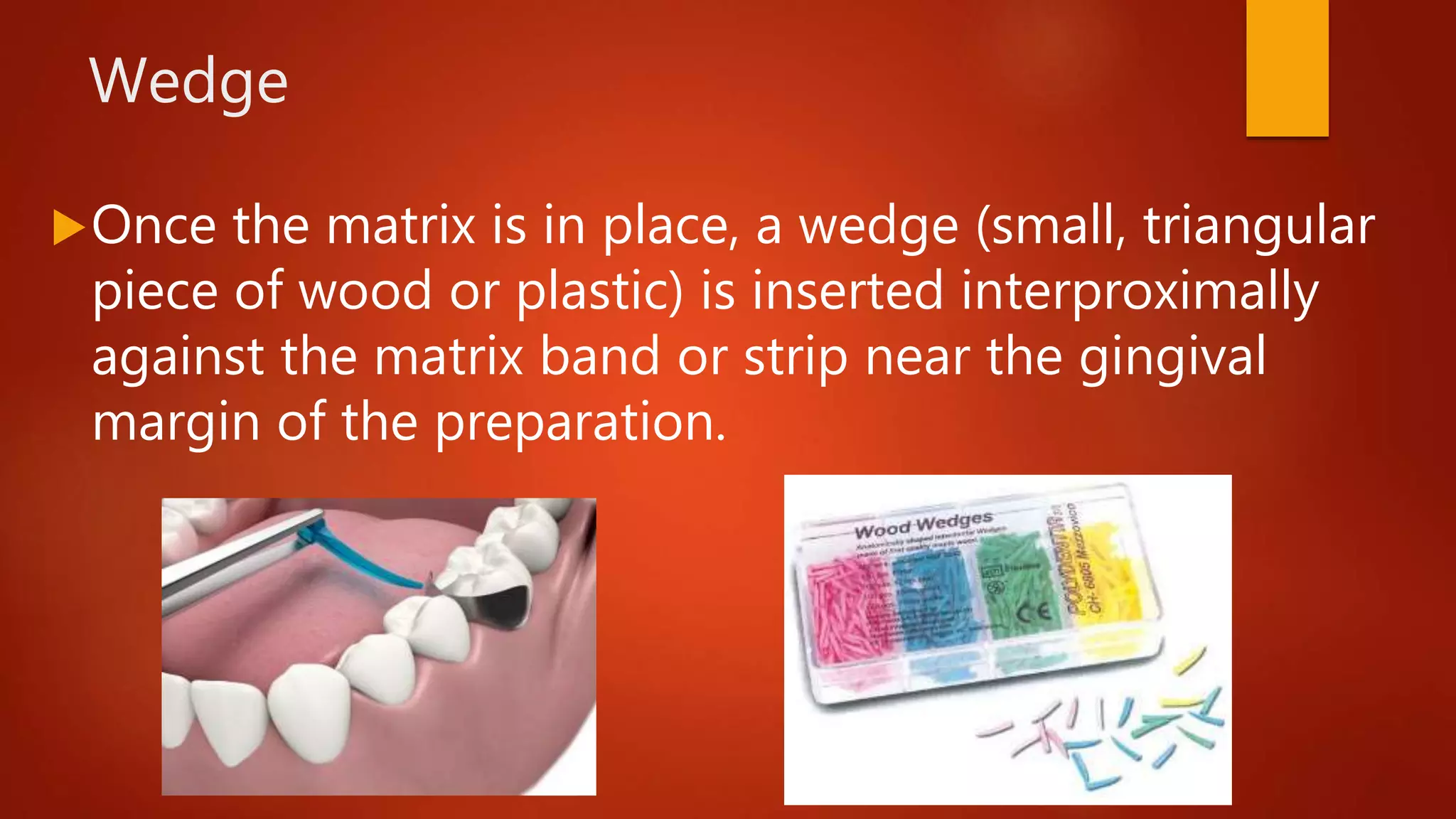
Wedge
Once the matrix is in place, a wedge (small, triangular
piece of wood or plastic) is inserted interproximally
against the matrix band or strip near the gingival
margin of the preparation.
Wedge
 This wedge holds the band securely in place and also prevents excess
filling material from escaping between the tooth and the matrix band.
 This excess is called an overhang.
 An overhang can be damaging to the gingival tissues if left in place,
so the correct positioning of the wedge is important in order to
prevent this from occurring.
Wedge
The wedge also separates the teeth slightly to
compensate for the thickness of the band.
This ensures good contact with the adjacent
tooth after the band has been removed.
Wedges
 Wedges come in different sizes and are either natural wood,
clear, or colored.
 The clear or transparent wedges are used with light-curing
restorative materials.
 These wedges deflect light into the restoration to ensure a
thoroughly cured material without marginal gaps.
Wedges
They usually come in an assortment kit with various
sizes, with the colors marking the different sizes.
Some wedges can be altered in shape with a knife, if
needed.
Once the procedure is complete, the wedges are
discarded.
Wedges
Wedges
 Wedges are only used when the preparation includes a proximal
surface(s).
 For example, if the tooth had a mesio-occlusal (MO) cavity preparation, only
one wedge would be needed on the mesial.
 On the posterior teeth, either the wooden or plastic wedges can be
used.
 On the anterior teeth, when light-cured materials are used, the
plastic wedges are best.
Wedges
 The wedges are usually placed from the lingual on the posterior
teeth.
 This makes placement easier and prevents interference with the
retainer.
 Cotton pliers or a hemostat are used to place and remove the
wedges.
 When placing the wedge, the smallest of the three sides is placed
toward the gingiva.
 The wedge should fill the space and fit snugly
Toffelmire Matrix with wedge
Tofflemire
Tofflemire
The Tofflemire retainer has a top (occlusal) side and a
bottom (gingival) side.
The occlusal side is directed toward the occlusal
surface and is the smooth side of the guide channels
and the vise.
The gingival side is directed toward the gingival tissues
and has the diagonal slot on the vise and the open
ends of the guide channels.
Components of Tofflemire
Part Function
Frame Main body of retainer.
Guide channels
Slots in end of retainer that hold matrix band. The slots direct band to right
or left of retainer.
Vise (locking) Holds ends of matrix band in place in diagonal slot.
Spindle Screw-like rod used to secure band in vise.
Inner knob (adjusting knob) Adjusts size of matrix band loop by moving vise along retainer frame.
Outer knob (locking knob) Tightens and loosens spindle against band in the vise.
Different Styles of Retainers
Matrix Bands
 Matrix bands are made of stainless steel and are approximately all the same
length.
 They differ in the shape of one edge and their widths
 The size and shape of the cavity prep indicate which band is used.
 The more the prep extends toward the gingiva, the wider the matrix band
needs to be.
 The matrix band is slightly curved and when looped over so both ends meet,
the small circumference edge faces toward the gingiva and the larger
circumference edge faces toward the occlusal.
Matrix Bands
Matrix Bands
Hold matrix band in smile and loop ends of band
together.
The smaller circumference, the gingival edge, will be
on the top and the larger circumference, the occlusal
edge, will be on the bottom.
Matrix Bands
Matrix Bands
Hold Tofflemire retainer with
guide channels and slot facing
up, and insert the matrix band
into vise slot and guide
channels
Matrix Bands
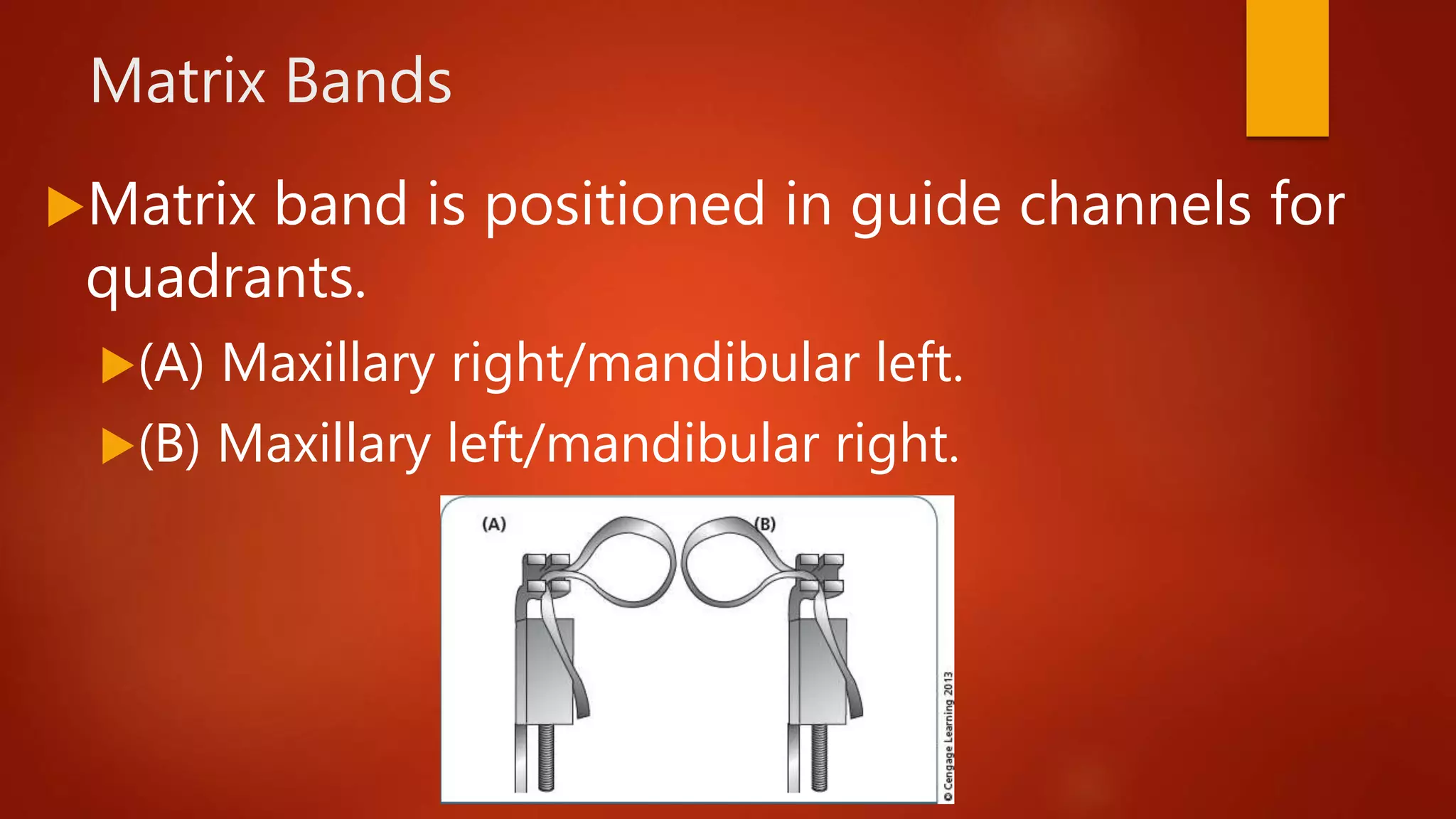
Matrix band is positioned in guide channels for
quadrants.
(A) Maxillary right/mandibular left.
(B) Maxillary left/mandibular right.
Matrix Bands
 (A) By turning the outer knob of the tofflemire retainer, the band will be secured.
 (B) By turning the inner knob of the tofflemire retainer, the matrix band loop
increases and decreases in size.
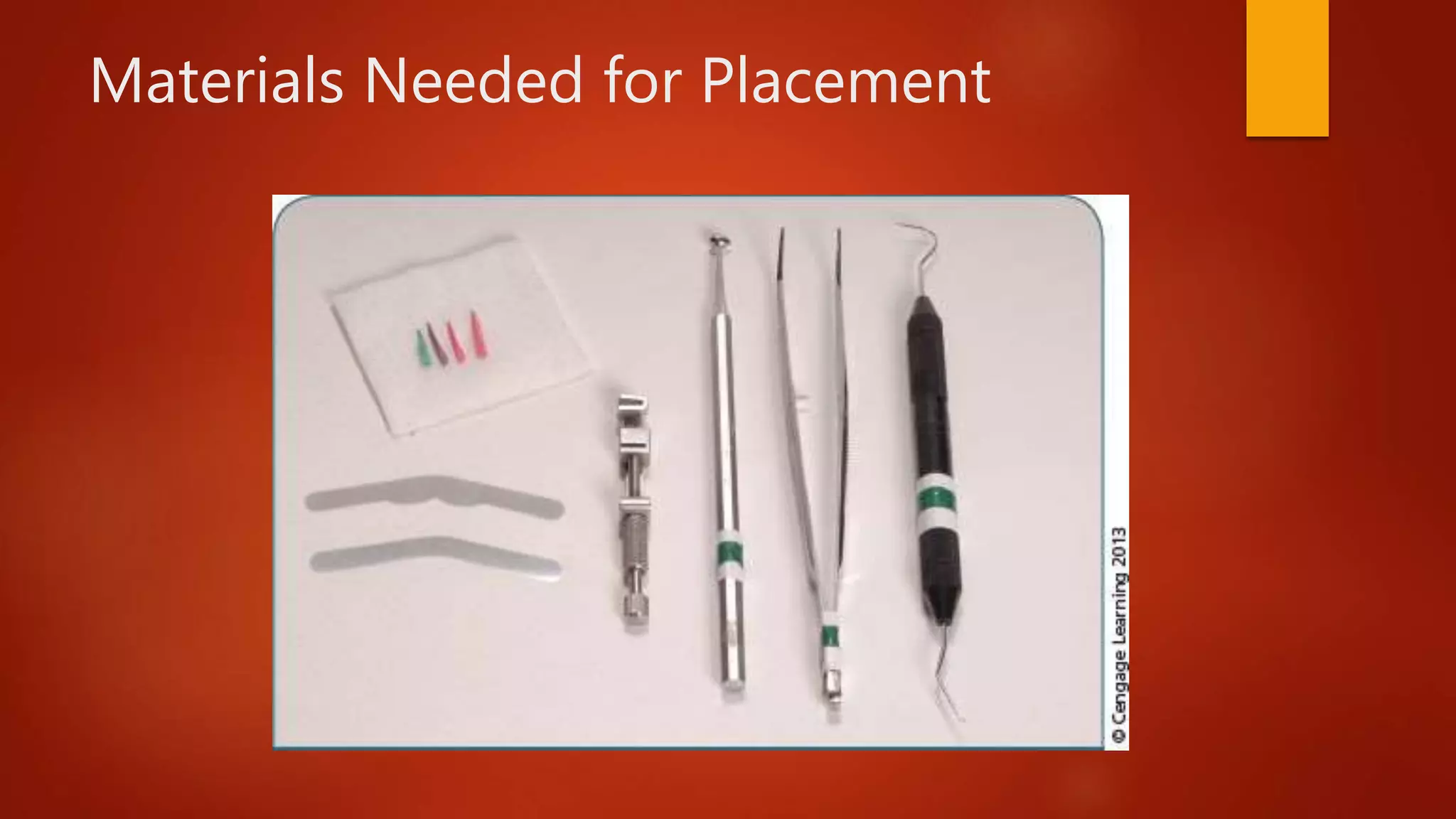
Materials Needed for Placement
Matrix Bands
Matrix Bands
Matrix Bands
 https://www.youtube.com/watch?feature=player_detailpage&v=RTfaz2YzS
Bs
 https://www.youtube.com/watch?feature=player_detailpage&v=XfL7vzfa0
gY
 https://www.youtube.com/watch?feature=player_detailpage&v=2lH1JT4lk
QQ
AutoMatrix
The AutoMatrix is a matrix without a retainer.
The stainless steel bands are conical shaped and
come in four sizes.
The conical shape makes the band easy to
burnish (smooth) for better contact in proximal
areas.
AutoMatrix
 The bands are circles with autolock loops that lock the matrices on the
teeth.
 The tightening coil on the outside of the band is where the matrix is
adapted to the tooth.
 There is no retainer to obstruct the operator's access or vision.
 The AutoMatrix comes in a kit that contains the clipping pliers, the
tightening device, and bands in assorted sizes.
AutoMatrix
AutoMatrix
To place the AutoMatrix, position the matrix on the
tooth following the same criteria as with the Tofflemire.
Place the tightening device in the coil and rotate the
handle to tighten the band around the tooth.
AutoMatrix
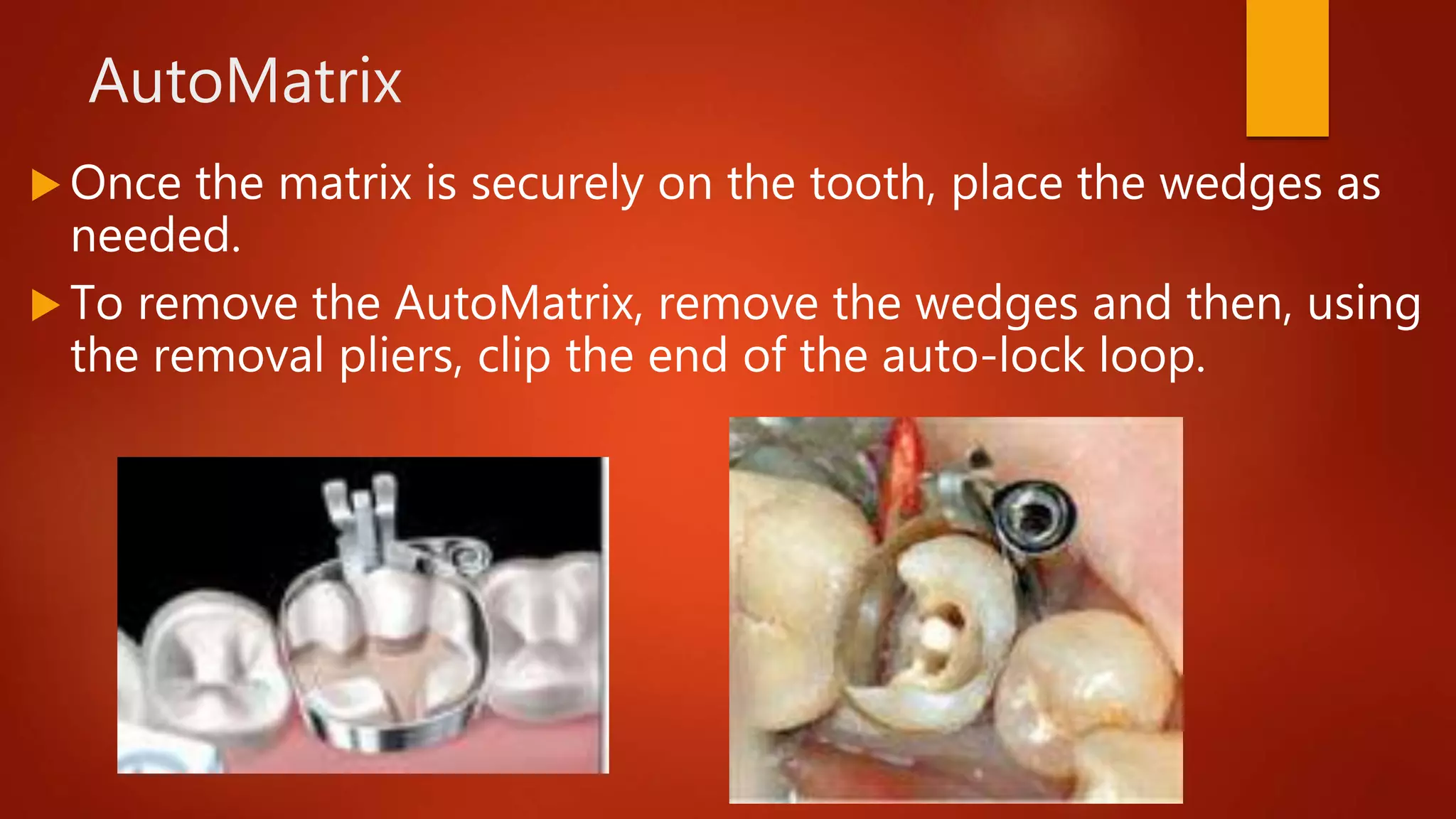
 Once the matrix is securely on the tooth, place the wedges as
needed.
 To remove the AutoMatrix, remove the wedges and then, using
the removal pliers, clip the end of the auto-lock loop.
AutoMatrix
 The pliers clip the loop and have a plastic cover to then catch the ends
of the loop as they fall after being cut.
 Open the matrix and slide toward the buccal or lingual while pulling it
occlusally.
Plastic Strip Matrix
 The thin, transparent, strip matrix is used with composite, glass
ionomer, or compomer restorative materials on anterior teeth
 The strip can be made of nylon, acetate, celluloid, or resin and is
approximately 3 inches long and ⅜ inch wide.
Plastic Strip Matrix
 The functions of the strip matrix are as follows:
 Provide anatomical contour and proximal contact relation
 Prevent excess material at the gingival margin
 Confine the restorative material under pressure while the material is being
cured
 Protect the restorative material from losing or gaining moisture during the
setting time
 Allow the polymerizing light to reach the composite restorative material
Crown Matrix
 The crown matrix form is a thin, plastic form that is shaped like
the crown.
 On anterior teeth when the incisal edge is involved (Class IV
restorations), a crown form is often used to restore the tooth.
Crown Matrix
 The crown forms come preformed in various designs and sizes.
 The restorative material is placed both in the cavity preparation and in
the crown form.
 The crown form is then placed on the tooth.
 These crown forms are clear and can be used with light-cured
materials.
 Once the restorative material is set, the crown form is removed and the
tooth is ready for final contouring and finishing.
Sectional Matrix
 A sectional matrix system is most often used on
Class II restorations to restore anatomical contacts.
 The matrix is stable and produces a tight contact
with no overhangs.
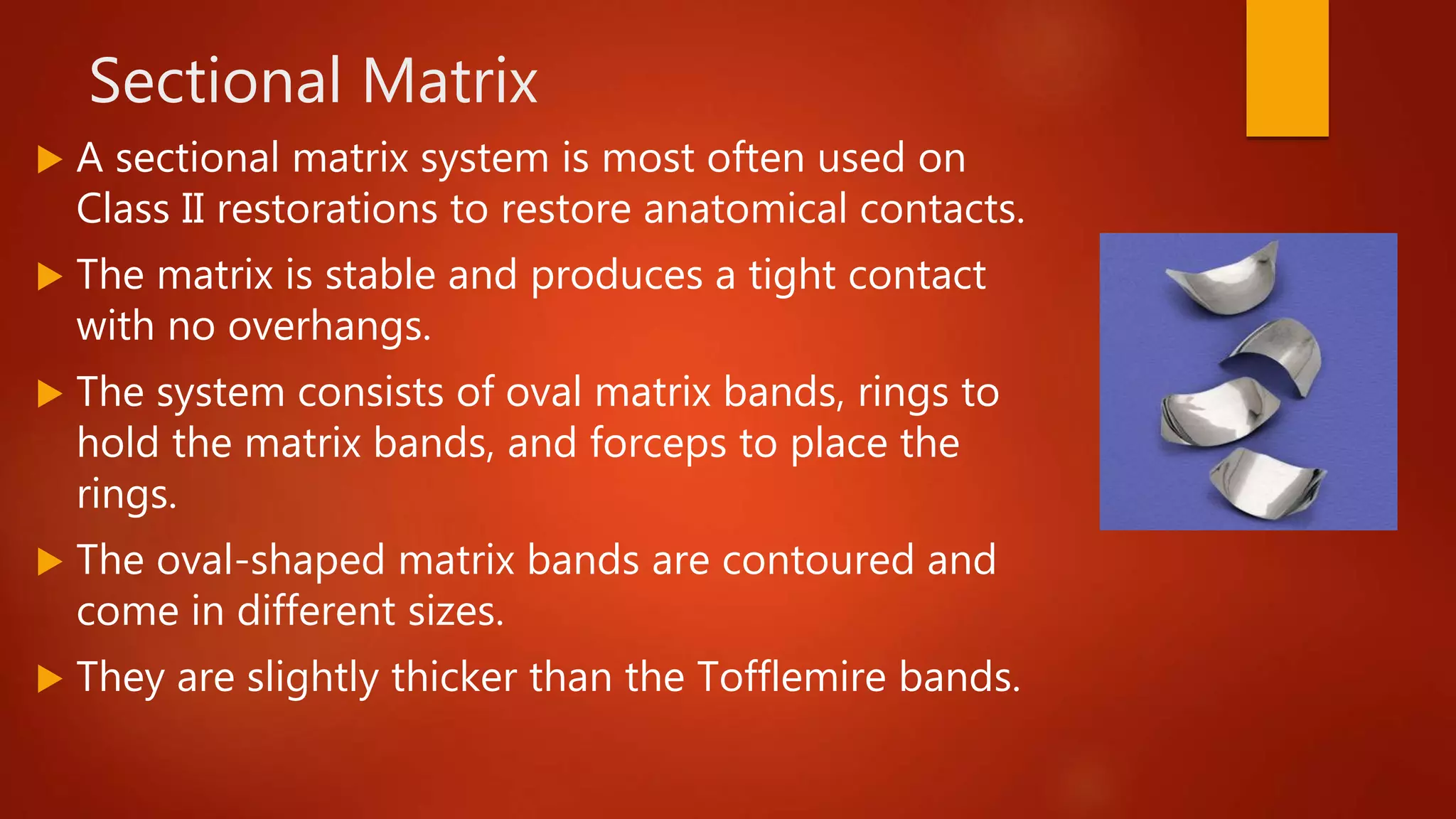
 The system consists of oval matrix bands, rings to
hold the matrix bands, and forceps to place the
rings.
 The oval-shaped matrix bands are contoured and
come in different sizes.
 They are slightly thicker than the Tofflemire bands.
Sectional Matrix
The rings are used to hold the matrix bands in place
and usually come in two different sizes.
The forceps are designed to open the rings for
placement and removal.
They are like dental dam forceps except the ends are
shorter, broader, and angled slightly for better
retention.
Sectional Matrix
Sectional Matrix
Sectional Matrix
 https://www.youtube.com/watch?feature=player_detailpage&v=WMNmt-
eKz1s

Matrix Systems

  • 1.
  • 2.
    Matrix  The matrixis a collective term used to refer to the matrix band and the retainer.  The matrix band forms the missing surface or wall and reestablishes the normal contour of the prepared tooth while the tooth is being filled with the restorative material.  The matrix band is inserted into the retainer and then placed on the tooth.  The retainer is the device which holds the band.  It is tightened on the tooth and secures the band in place.
  • 3.
    Matrix  In additionto replacing the missing tooth surface of the cavity preparation, the matrix restores the natural contours of the tooth and the proximal contact with the adjacent tooth.  A matrix also contains the restorative material within the walls, thereby preventing any excess material from getting near the gingiva.  In addition, the matrix must be stable enough to withstand the pressure of the restorative material being placed in the cavity preparation.
  • 4.
    Matrix  Several differentmatrices are available, and the type of matrix selected depends on the type of restorative materials being used.  For amalgam restorations, the Tofflemire matrix or the AutoMatrix is used.  With composite material, a plastic strip matrix, shell matrix, or a sectional matrix system is used.  Some dentists use the Tofflemire and AutoMatrix for composites also…
  • 5.
    Wedge Once the matrixis in place, a wedge (small, triangular piece of wood or plastic) is inserted interproximally against the matrix band or strip near the gingival margin of the preparation.
  • 6.
    Wedge  This wedgeholds the band securely in place and also prevents excess filling material from escaping between the tooth and the matrix band.  This excess is called an overhang.  An overhang can be damaging to the gingival tissues if left in place, so the correct positioning of the wedge is important in order to prevent this from occurring.
  • 7.
    Wedge The wedge alsoseparates the teeth slightly to compensate for the thickness of the band. This ensures good contact with the adjacent tooth after the band has been removed.
  • 8.
    Wedges  Wedges comein different sizes and are either natural wood, clear, or colored.  The clear or transparent wedges are used with light-curing restorative materials.  These wedges deflect light into the restoration to ensure a thoroughly cured material without marginal gaps.
  • 9.
    Wedges They usually comein an assortment kit with various sizes, with the colors marking the different sizes. Some wedges can be altered in shape with a knife, if needed. Once the procedure is complete, the wedges are discarded.
  • 10.
  • 11.
    Wedges  Wedges areonly used when the preparation includes a proximal surface(s).  For example, if the tooth had a mesio-occlusal (MO) cavity preparation, only one wedge would be needed on the mesial.  On the posterior teeth, either the wooden or plastic wedges can be used.  On the anterior teeth, when light-cured materials are used, the plastic wedges are best.
  • 12.
    Wedges  The wedgesare usually placed from the lingual on the posterior teeth.  This makes placement easier and prevents interference with the retainer.  Cotton pliers or a hemostat are used to place and remove the wedges.  When placing the wedge, the smallest of the three sides is placed toward the gingiva.  The wedge should fill the space and fit snugly
  • 13.
  • 14.
  • 15.
    Tofflemire The Tofflemire retainerhas a top (occlusal) side and a bottom (gingival) side. The occlusal side is directed toward the occlusal surface and is the smooth side of the guide channels and the vise. The gingival side is directed toward the gingival tissues and has the diagonal slot on the vise and the open ends of the guide channels.
  • 16.
    Components of Tofflemire PartFunction Frame Main body of retainer. Guide channels Slots in end of retainer that hold matrix band. The slots direct band to right or left of retainer. Vise (locking) Holds ends of matrix band in place in diagonal slot. Spindle Screw-like rod used to secure band in vise. Inner knob (adjusting knob) Adjusts size of matrix band loop by moving vise along retainer frame. Outer knob (locking knob) Tightens and loosens spindle against band in the vise.
  • 17.
  • 18.
    Matrix Bands  Matrixbands are made of stainless steel and are approximately all the same length.  They differ in the shape of one edge and their widths  The size and shape of the cavity prep indicate which band is used.  The more the prep extends toward the gingiva, the wider the matrix band needs to be.  The matrix band is slightly curved and when looped over so both ends meet, the small circumference edge faces toward the gingiva and the larger circumference edge faces toward the occlusal.
  • 19.
  • 20.
    Matrix Bands Hold matrixband in smile and loop ends of band together. The smaller circumference, the gingival edge, will be on the top and the larger circumference, the occlusal edge, will be on the bottom.
  • 21.
  • 22.
    Matrix Bands Hold Tofflemireretainer with guide channels and slot facing up, and insert the matrix band into vise slot and guide channels
  • 23.
    Matrix Bands Matrix bandis positioned in guide channels for quadrants. (A) Maxillary right/mandibular left. (B) Maxillary left/mandibular right.
  • 24.
    Matrix Bands  (A)By turning the outer knob of the tofflemire retainer, the band will be secured.  (B) By turning the inner knob of the tofflemire retainer, the matrix band loop increases and decreases in size.
  • 25.
  • 26.
  • 27.
  • 28.
    Matrix Bands  https://www.youtube.com/watch?feature=player_detailpage&v=RTfaz2YzS Bs https://www.youtube.com/watch?feature=player_detailpage&v=XfL7vzfa0 gY  https://www.youtube.com/watch?feature=player_detailpage&v=2lH1JT4lk QQ
  • 29.
    AutoMatrix The AutoMatrix isa matrix without a retainer. The stainless steel bands are conical shaped and come in four sizes. The conical shape makes the band easy to burnish (smooth) for better contact in proximal areas.
  • 30.
    AutoMatrix  The bandsare circles with autolock loops that lock the matrices on the teeth.  The tightening coil on the outside of the band is where the matrix is adapted to the tooth.  There is no retainer to obstruct the operator's access or vision.  The AutoMatrix comes in a kit that contains the clipping pliers, the tightening device, and bands in assorted sizes.
  • 31.
  • 32.
    AutoMatrix To place theAutoMatrix, position the matrix on the tooth following the same criteria as with the Tofflemire. Place the tightening device in the coil and rotate the handle to tighten the band around the tooth.
  • 33.
    AutoMatrix  Once thematrix is securely on the tooth, place the wedges as needed.  To remove the AutoMatrix, remove the wedges and then, using the removal pliers, clip the end of the auto-lock loop.
  • 34.
    AutoMatrix  The pliersclip the loop and have a plastic cover to then catch the ends of the loop as they fall after being cut.  Open the matrix and slide toward the buccal or lingual while pulling it occlusally.
  • 35.
    Plastic Strip Matrix The thin, transparent, strip matrix is used with composite, glass ionomer, or compomer restorative materials on anterior teeth  The strip can be made of nylon, acetate, celluloid, or resin and is approximately 3 inches long and ⅜ inch wide.
  • 36.
    Plastic Strip Matrix The functions of the strip matrix are as follows:  Provide anatomical contour and proximal contact relation  Prevent excess material at the gingival margin  Confine the restorative material under pressure while the material is being cured  Protect the restorative material from losing or gaining moisture during the setting time  Allow the polymerizing light to reach the composite restorative material
  • 37.
    Crown Matrix  Thecrown matrix form is a thin, plastic form that is shaped like the crown.  On anterior teeth when the incisal edge is involved (Class IV restorations), a crown form is often used to restore the tooth.
  • 38.
    Crown Matrix  Thecrown forms come preformed in various designs and sizes.  The restorative material is placed both in the cavity preparation and in the crown form.  The crown form is then placed on the tooth.  These crown forms are clear and can be used with light-cured materials.  Once the restorative material is set, the crown form is removed and the tooth is ready for final contouring and finishing.
  • 39.
    Sectional Matrix  Asectional matrix system is most often used on Class II restorations to restore anatomical contacts.  The matrix is stable and produces a tight contact with no overhangs.  The system consists of oval matrix bands, rings to hold the matrix bands, and forceps to place the rings.  The oval-shaped matrix bands are contoured and come in different sizes.  They are slightly thicker than the Tofflemire bands.
  • 40.
    Sectional Matrix The ringsare used to hold the matrix bands in place and usually come in two different sizes. The forceps are designed to open the rings for placement and removal. They are like dental dam forceps except the ends are shorter, broader, and angled slightly for better retention.
  • 41.
  • 42.
  • 43.
  • 44.