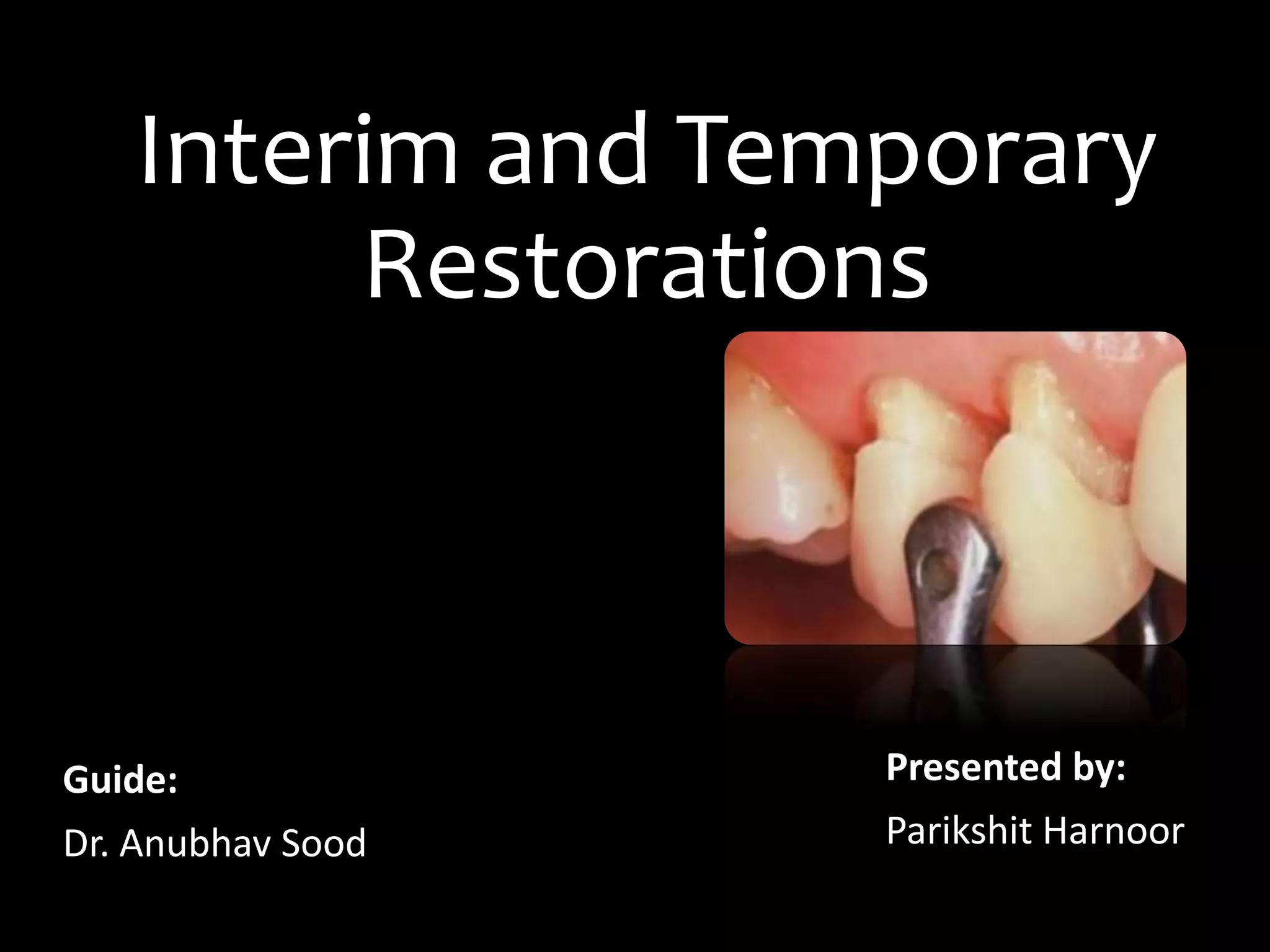
Interim and Temporary
Restorations
Guide:
Dr. Anubhav Sood
Presented by:
Parikshit Harnoor
Introduction
• Acc to GPT 8: A fixed or removable dental prosthesis or
maxillofacial prosthesis, designed to enhance aesthetics,
stabilisation and/or function for a limited period of time, after
which it is to be replaced by a definitive dental or maxillofacial
prostheses. Often such prosthesis are used to assist in
determination of the therapeutic effectiveness of a specific
treatment plan or the form and function of the planned
definitive prostheses
• Selection – size of cavity, period, form and eventual
restoration.
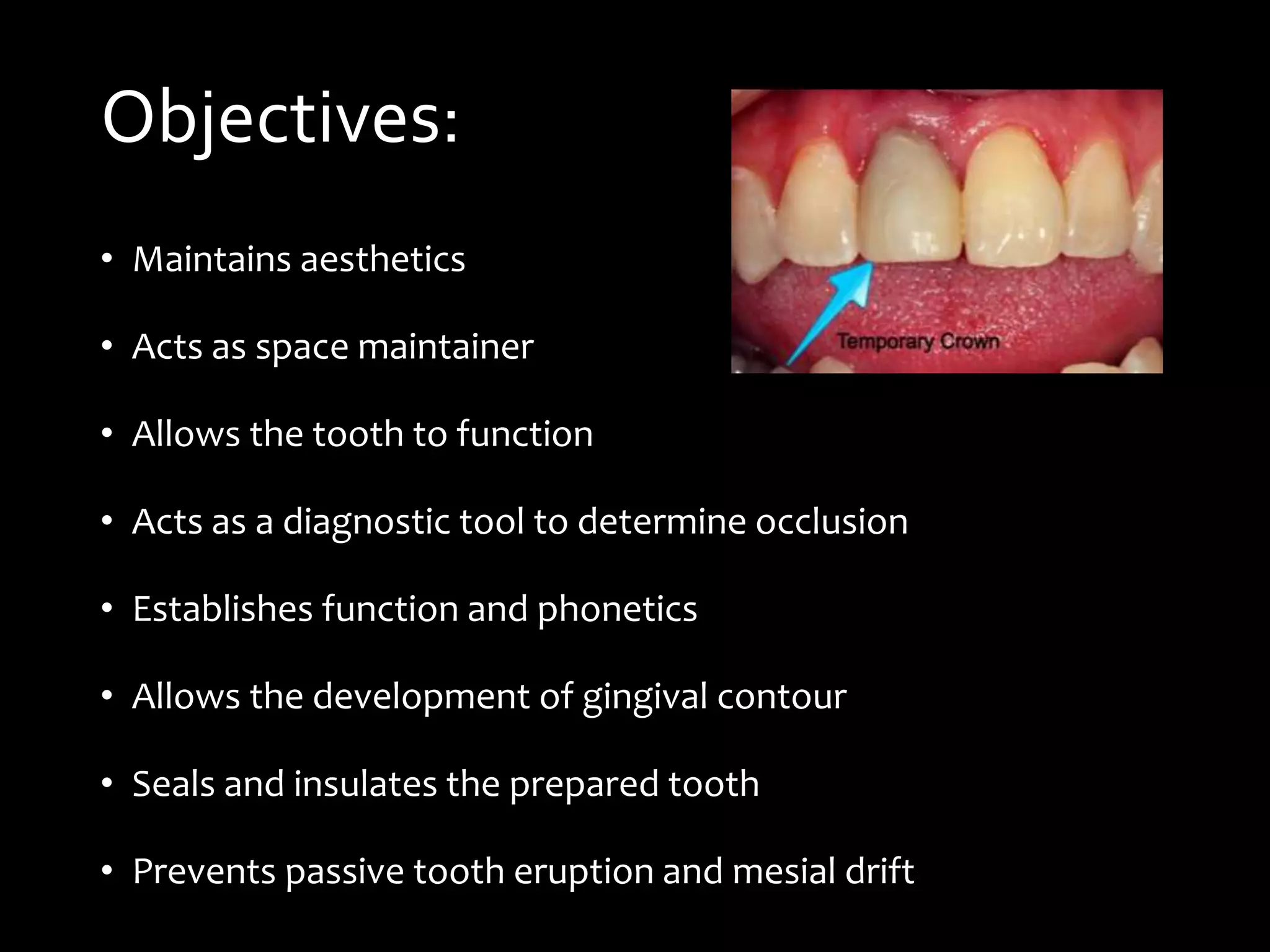
Objectives:
• Maintains aesthetics
• Acts as space maintainer
• Allows the tooth to function
• Acts as a diagnostic tool to determine occlusion
• Establishes function and phonetics
• Allows the development of gingival contour
• Seals and insulates the prepared tooth
• Prevents passive tooth eruption and mesial drift
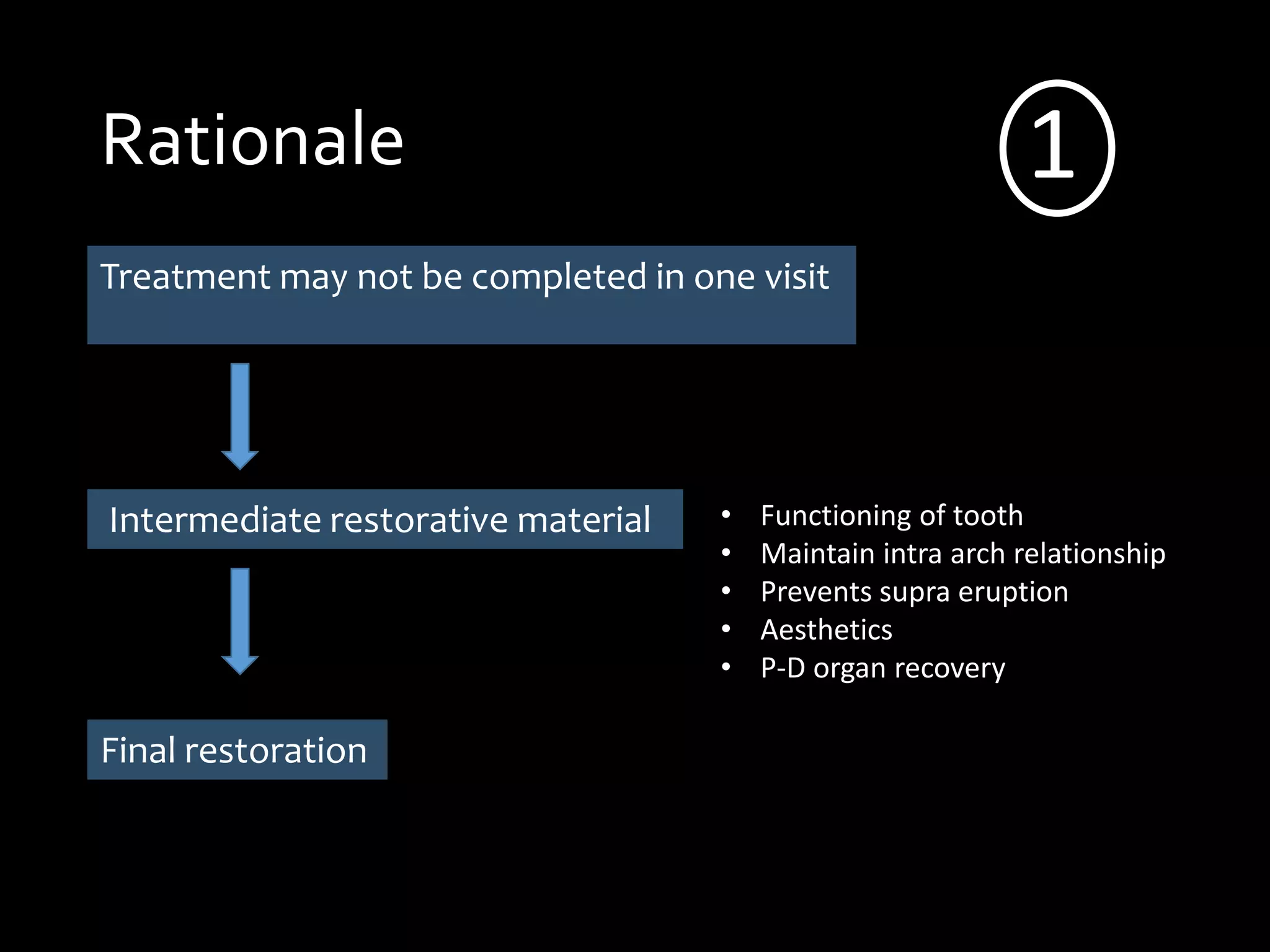
Rationale
Treatment may not be completed in one visit
Intermediate restorative material • Functioning of tooth
• Maintain intra arch relationship
• Prevents supra eruption
• Aesthetics
• P-D organ recovery
Final restoration
1
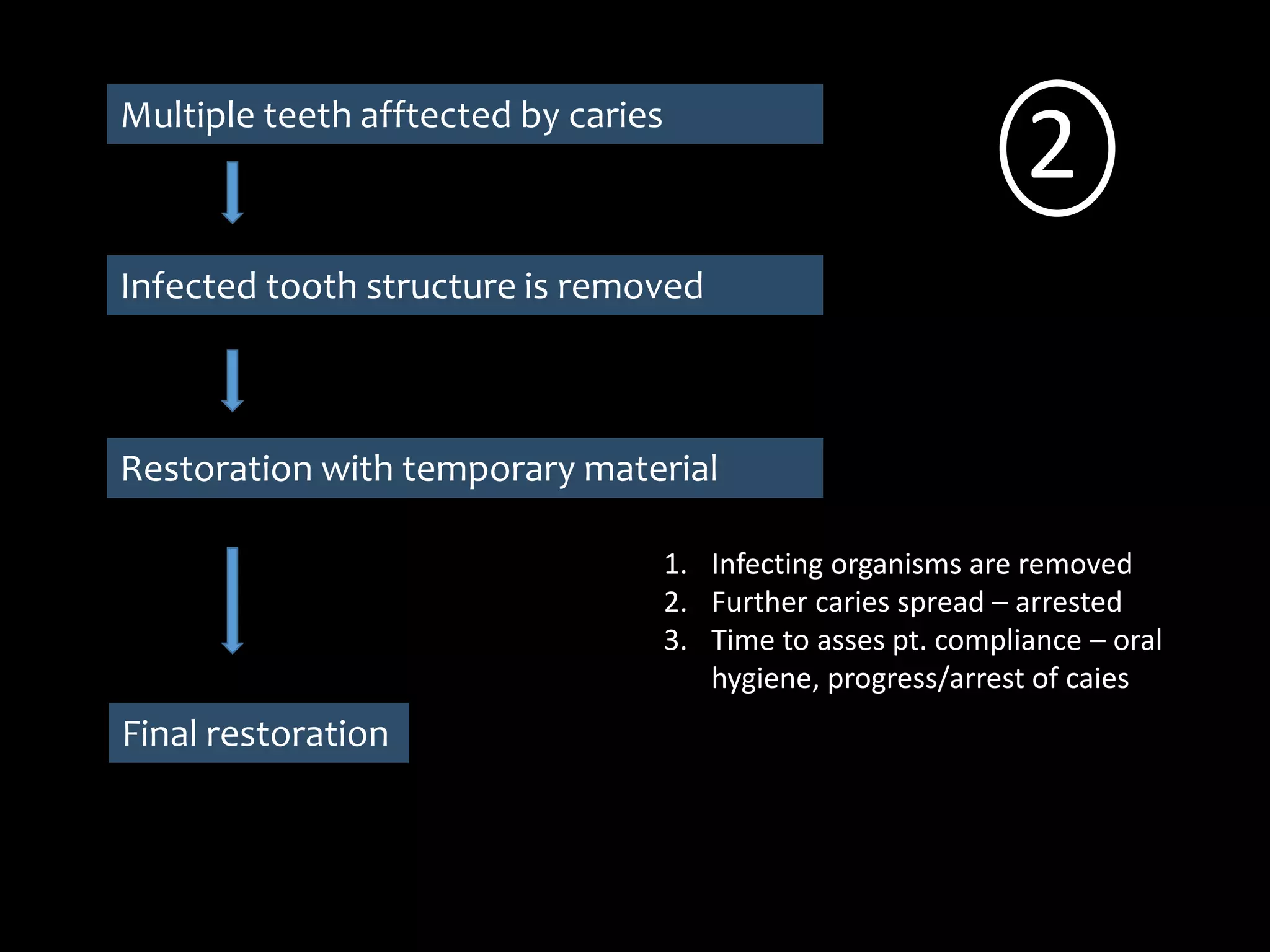
Multiple teeth afftected by caries
Infected tooth structure is removed
Restoration with temporary material
1. Infecting organisms are removed
2. Further caries spread – arrested
3. Time to asses pt. compliance – oral
hygiene, progress/arrest of caies
Final restoration
2
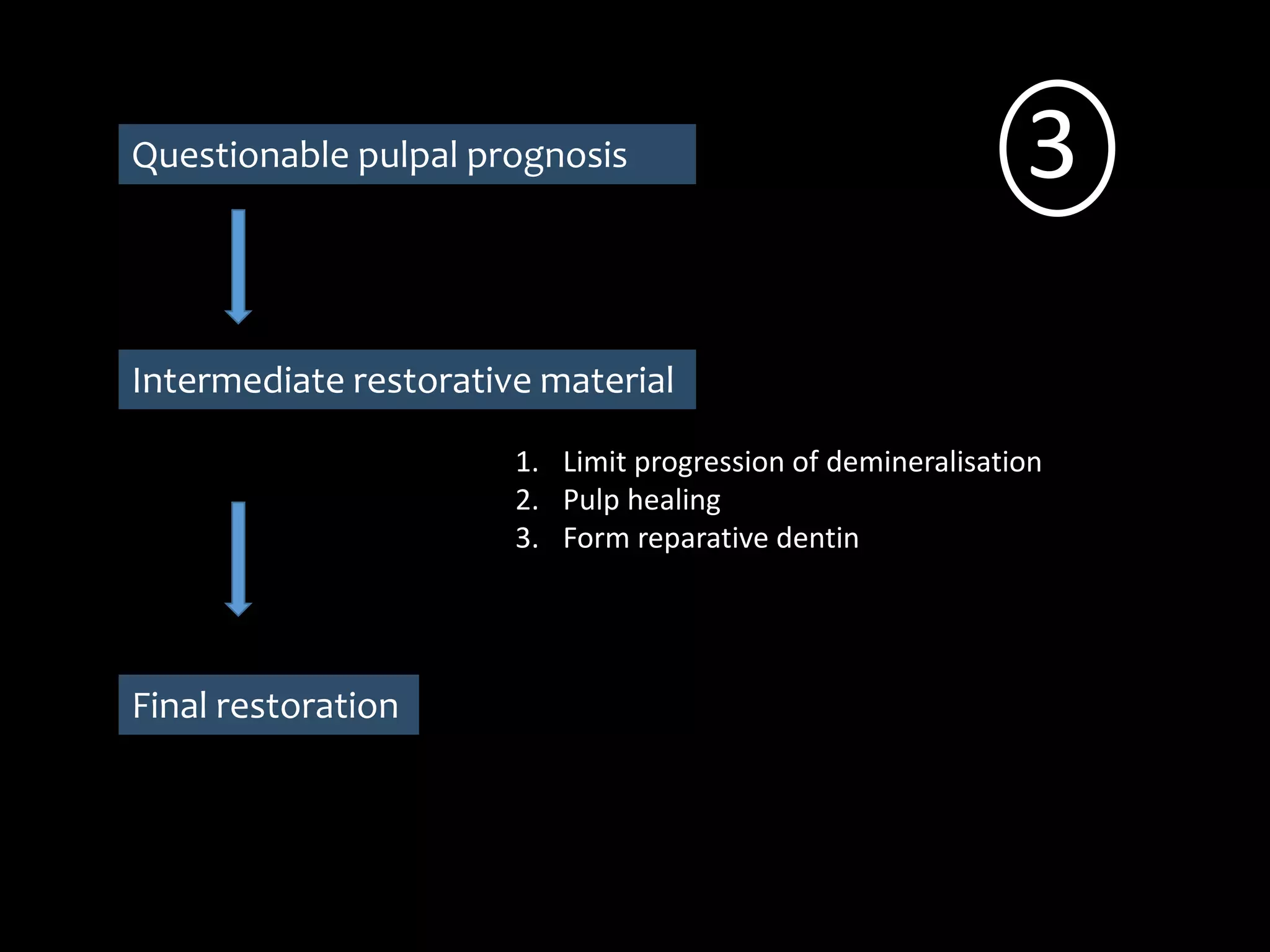
3Questionable pulpal prognosis
Intermediate restorative material
1. Limit progression of demineralisation
2. Pulp healing
3. Form reparative dentin
Final restoration
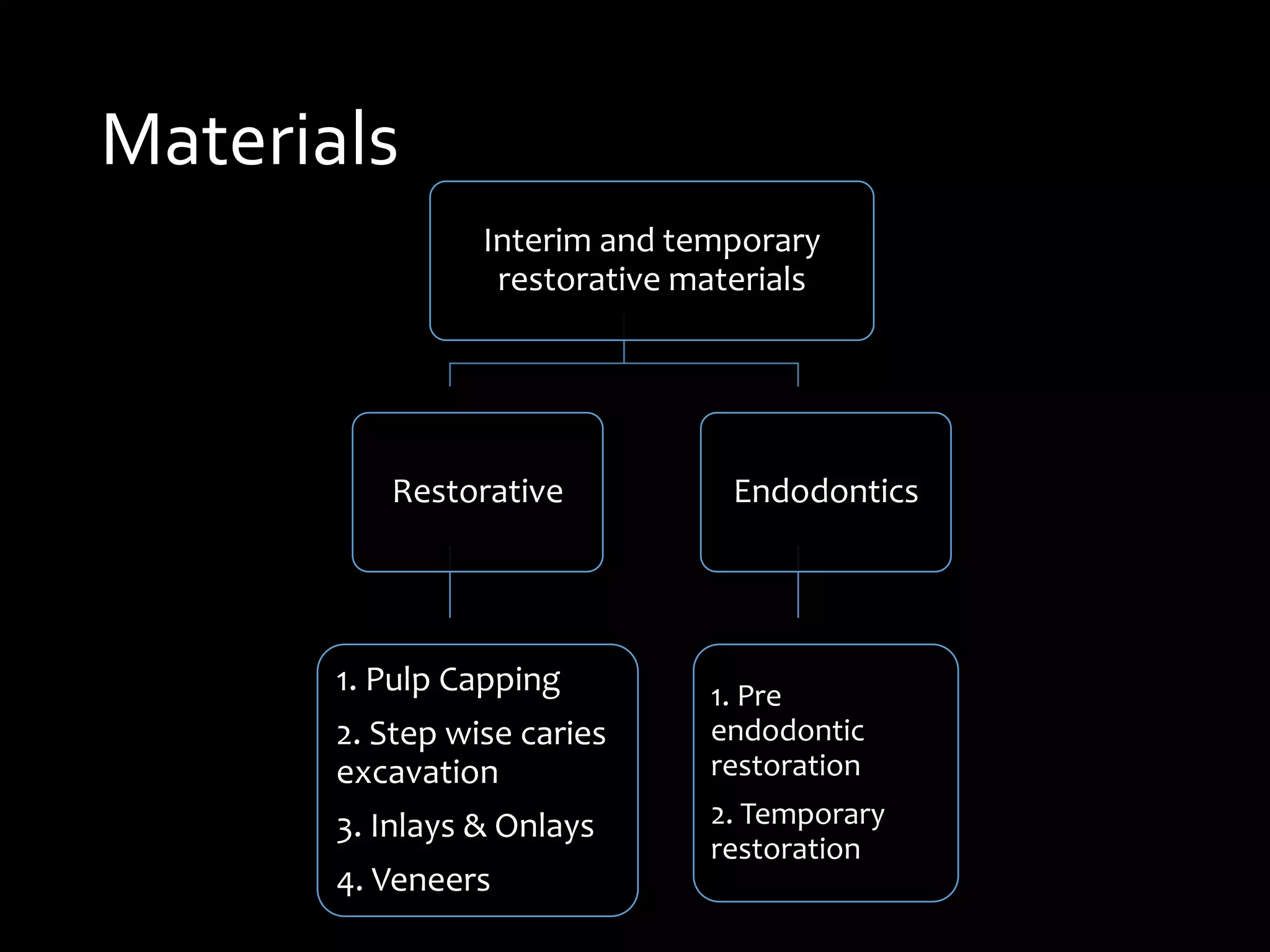
Materials
Interim and temporary
restorative materials
Restorative
1. Pulp Capping
2. Step wise caries
excavation
3. Inlays & Onlays
4. Veneers
Endodontics
1. Pre
endodontic
restoration
2. Temporary
restoration
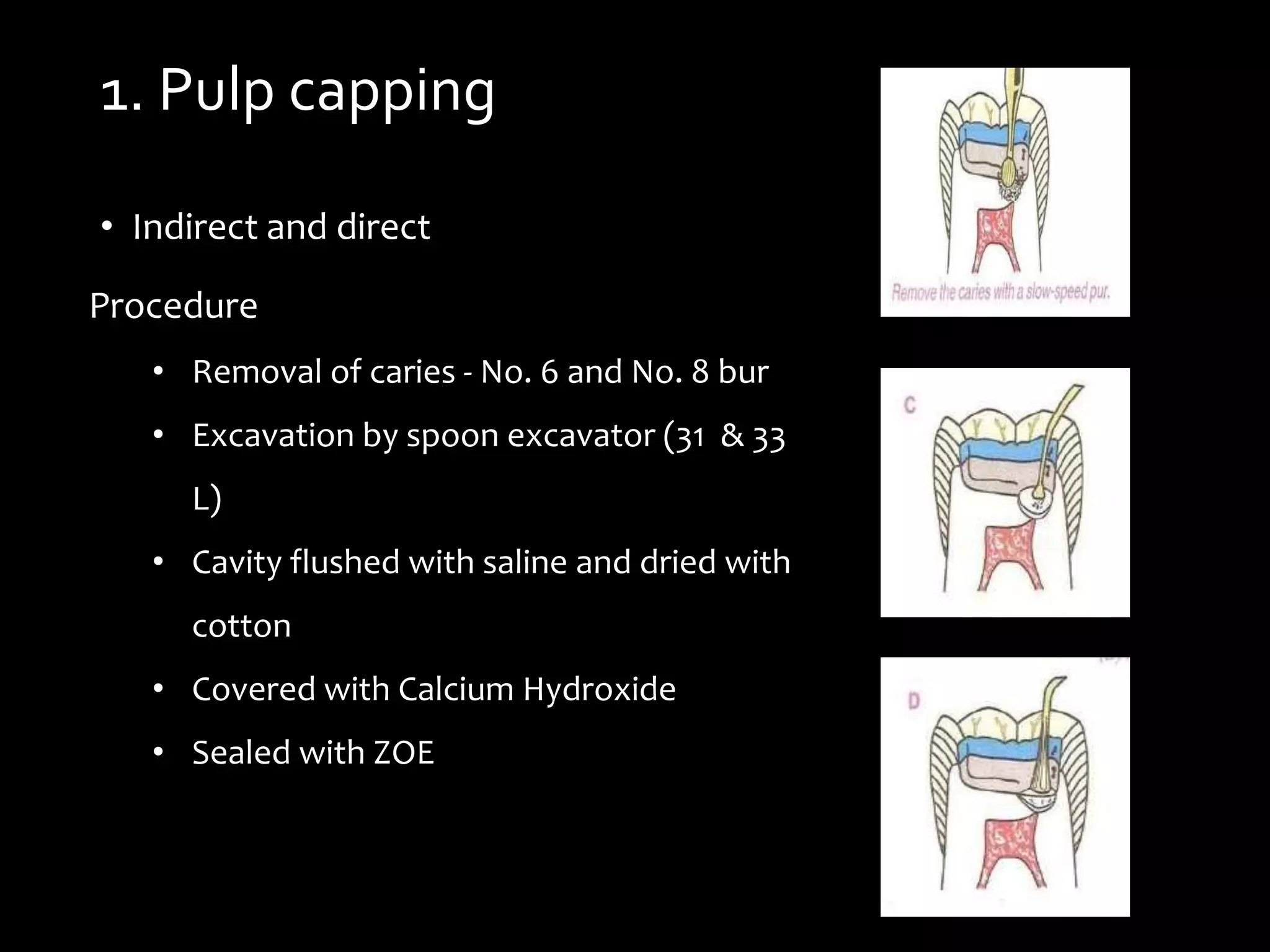
1. Pulp capping
• Indirect and direct
Procedure
• Removal of caries - No. 6 and No. 8 bur
• Excavation by spoon excavator (31 & 33
L)
• Cavity flushed with saline and dried with
cotton
• Covered with Calcium Hydroxide
• Sealed with ZOE
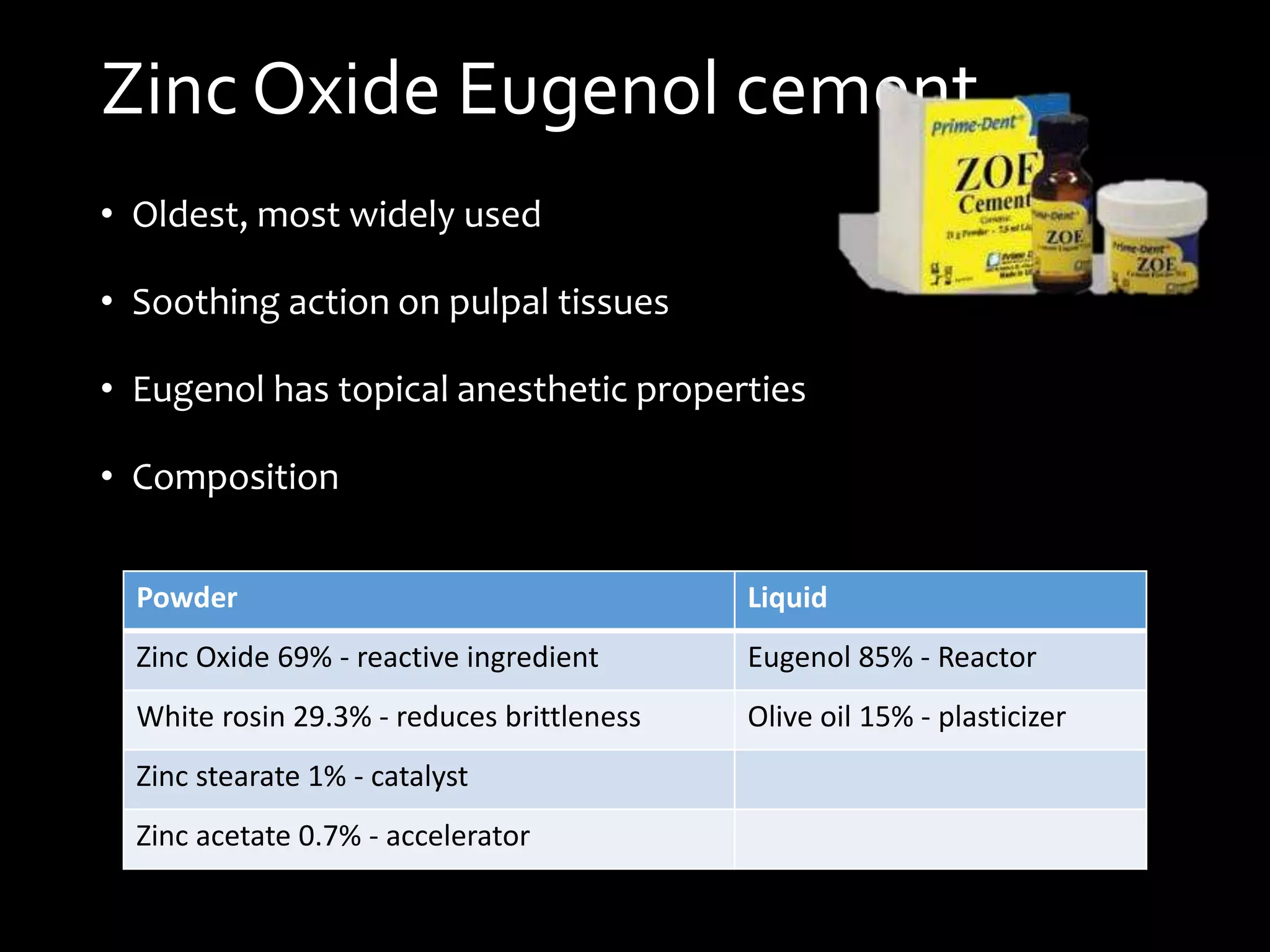
Zinc Oxide Eugenol cement
• Oldest, most widely used
• Soothing action on pulpal tissues
• Eugenol has topical anesthetic properties
• Composition
Powder Liquid
Zinc Oxide 69% - reactive ingredient Eugenol 85% - Reactor
White rosin 29.3% - reduces brittleness Olive oil 15% - plasticizer
Zinc stearate 1% - catalyst
Zinc acetate 0.7% - accelerator
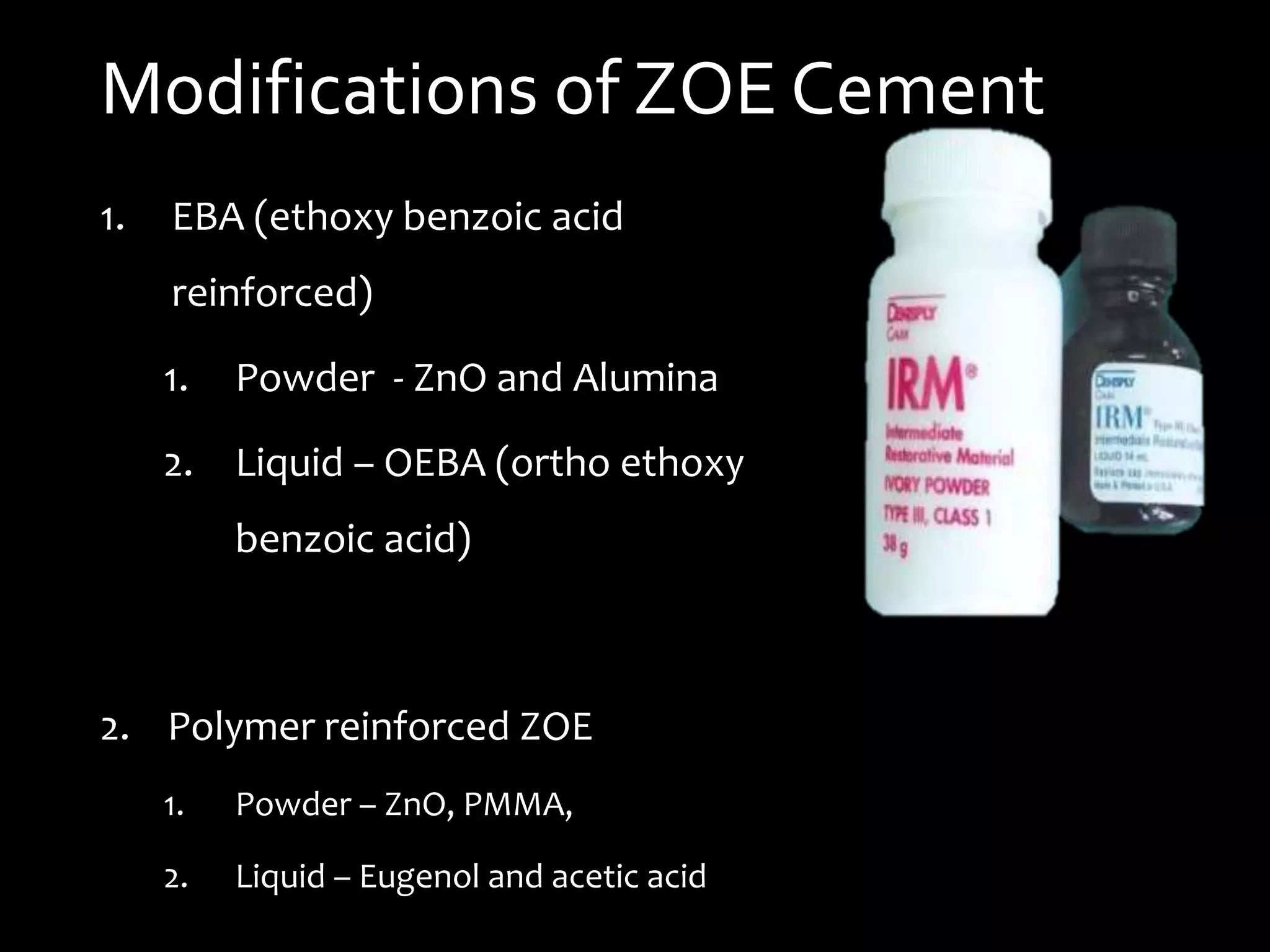
Modifications of ZOE Cement
1. EBA (ethoxy benzoic acid
reinforced)
1. Powder - ZnO and Alumina
2. Liquid – OEBA (ortho ethoxy
benzoic acid)
2. Polymer reinforced ZOE
1. Powder – ZnO, PMMA,
2. Liquid – Eugenol and acetic acid
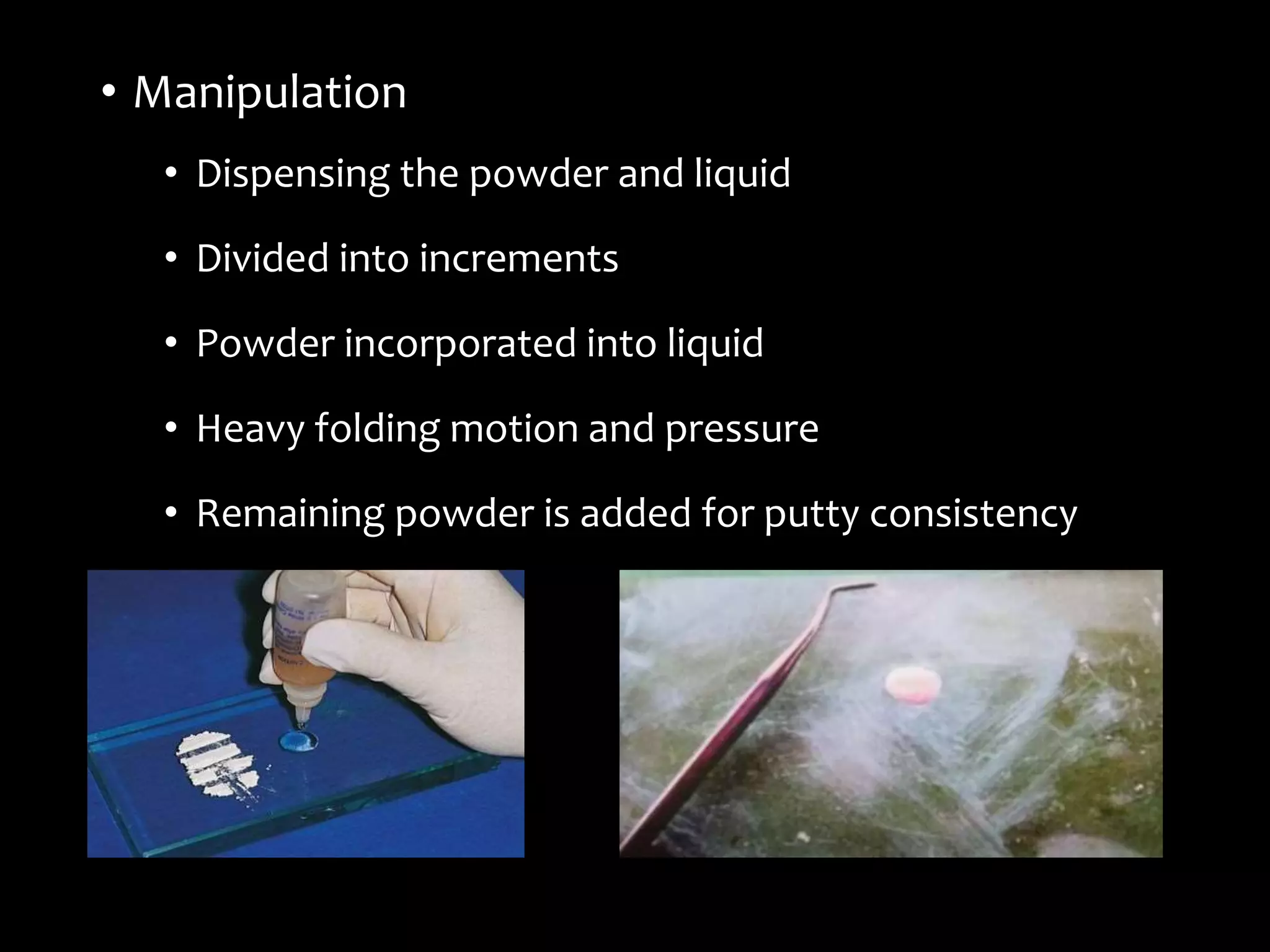
• Manipulation
• Dispensing the powder and liquid
• Divided into increments
• Powder incorporated into liquid
• Heavy folding motion and pressure
• Remaining powder is added for putty consistency
• Advantages
1. Least irritating cement with pH = 7
2. Good short term sealing
• Disadvantages
1. Highly soluble
2. Low strength
3. Low setting time
4. Low compressive strength
2. Inlays and onlays
• Provisional restorations – acrylic resin or autopolymerizing
resin
• Processed intraorally or indirectly on the cast
• Well contoured anatomically shaped provisional restoration is
cememented with temporary cementation
• Ultimately removed before the final restoration.
• Basic systems for fabricating provisional restorations
• Direct method
• Indirect method
Direct method
• Easier approach
• Inlay preparation - GIC base –
dried – coated with petroleum
jelly
• Thin dead-soft matrix band
placement and wedged
• Composite restoration - without
etching or bonding agent
• Shade selection should not be
similar to tooth shade
Indirect Method
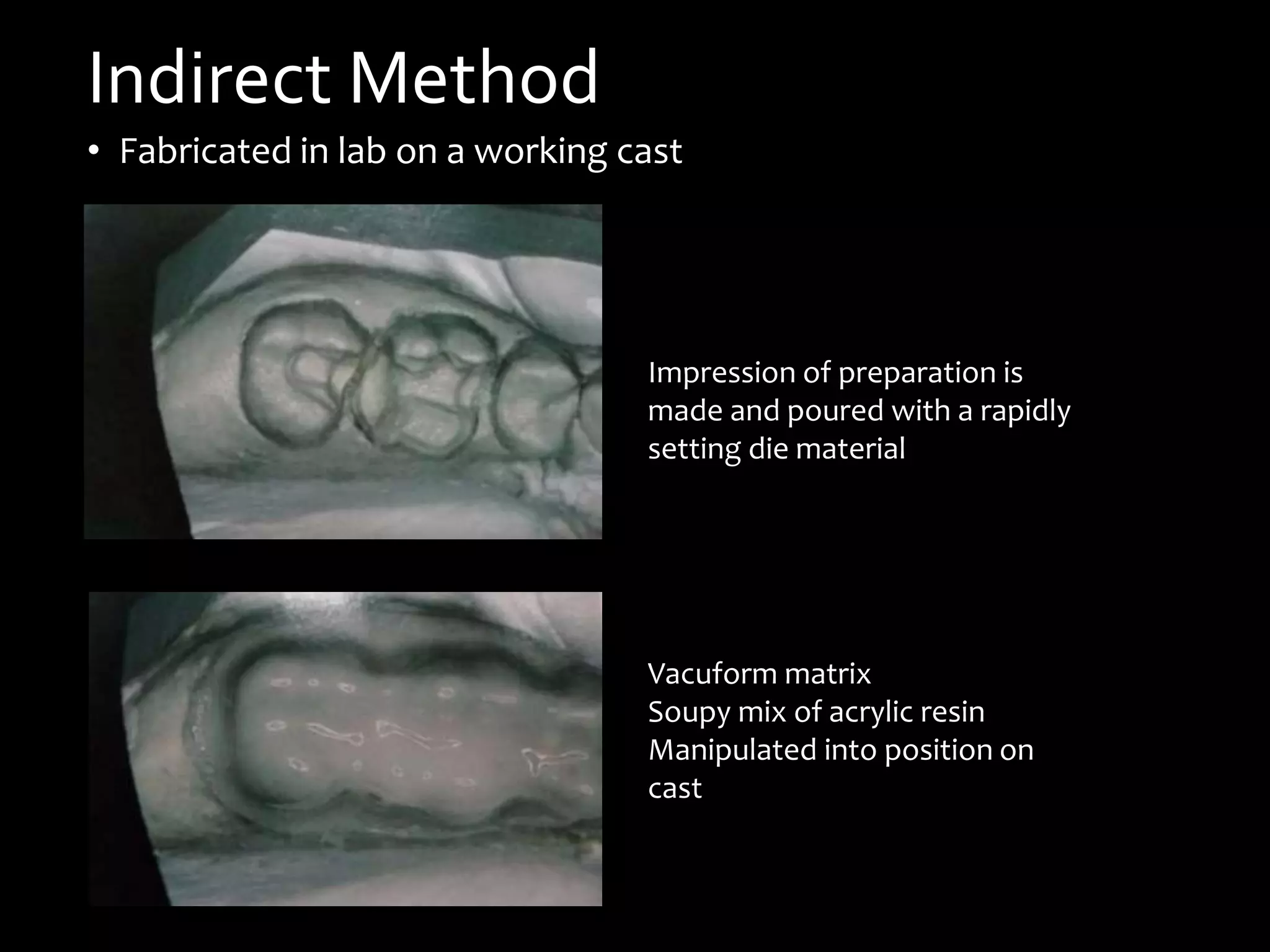
• Fabricated in lab on a working cast
Impression of preparation is
made and poured with a rapidly
setting die material
Vacuform matrix
Soupy mix of acrylic resin
Manipulated into position on
cast
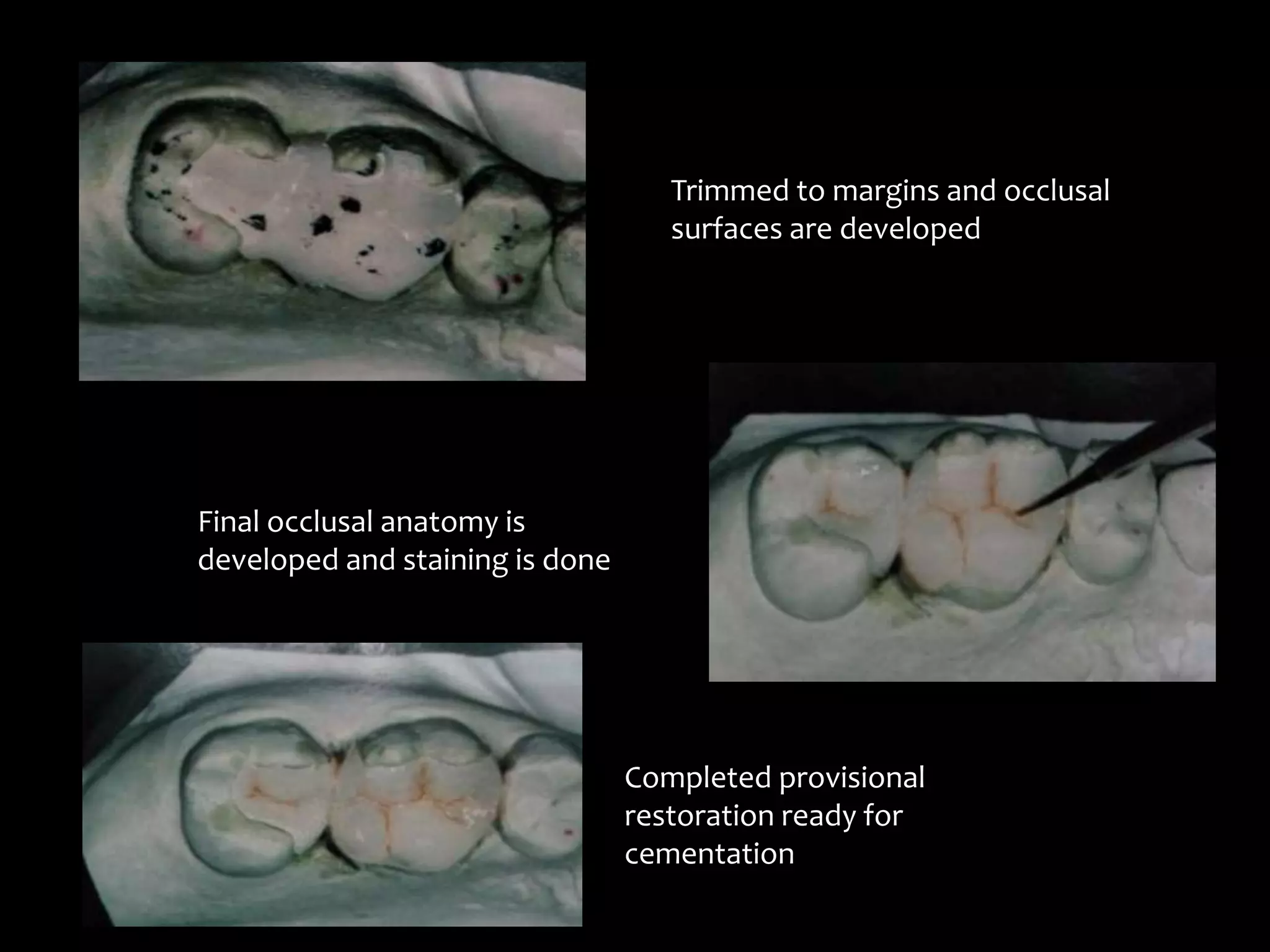
Trimmed to margins and occlusal
surfaces are developed
Final occlusal anatomy is
developed and staining is done
Completed provisional
restoration ready for
cementation
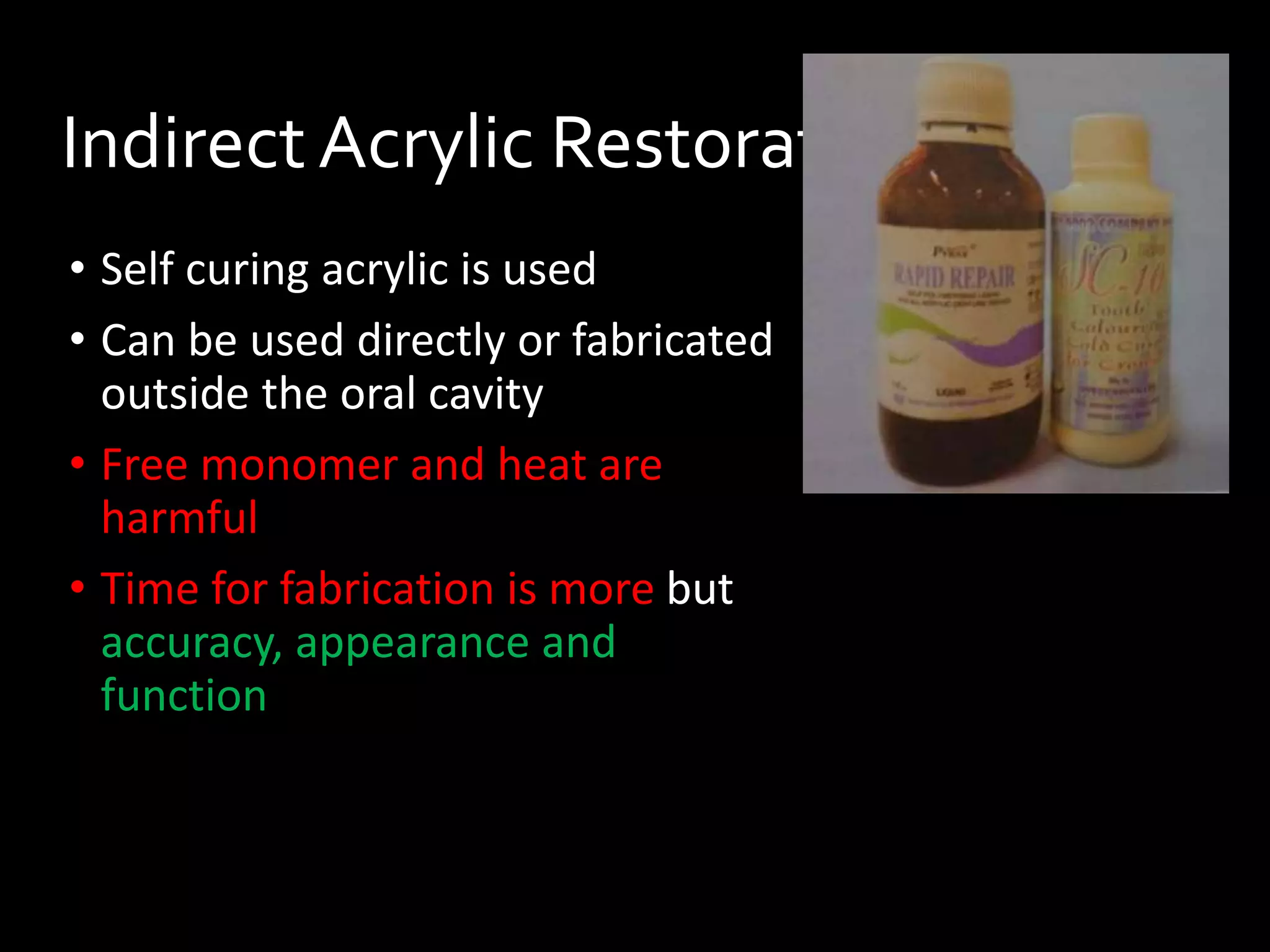
Indirect Acrylic Restorations
• Self curing acrylic is used
• Can be used directly or fabricated
outside the oral cavity
• Free monomer and heat are
harmful
• Time for fabrication is more but
accuracy, appearance and
function
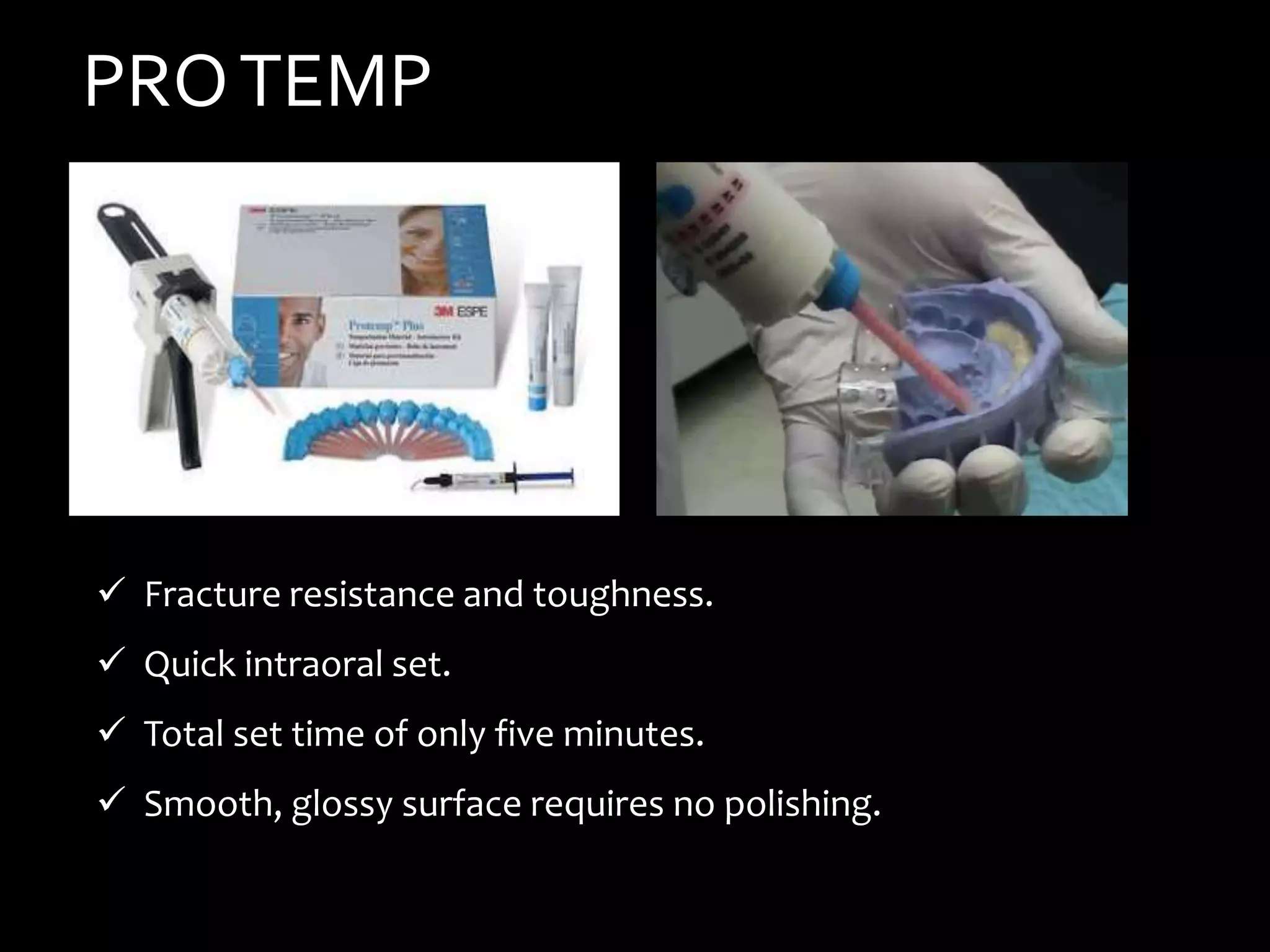
PROTEMP
 Fracture resistance and toughness.
 Quick intraoral set.
 Total set time of only five minutes.
 Smooth, glossy surface requires no polishing.
Integrity
Composition
• Barium glass
• Fumed Silica
• Methacrylate
• Monomers
• Catalyst
• Sabilizers
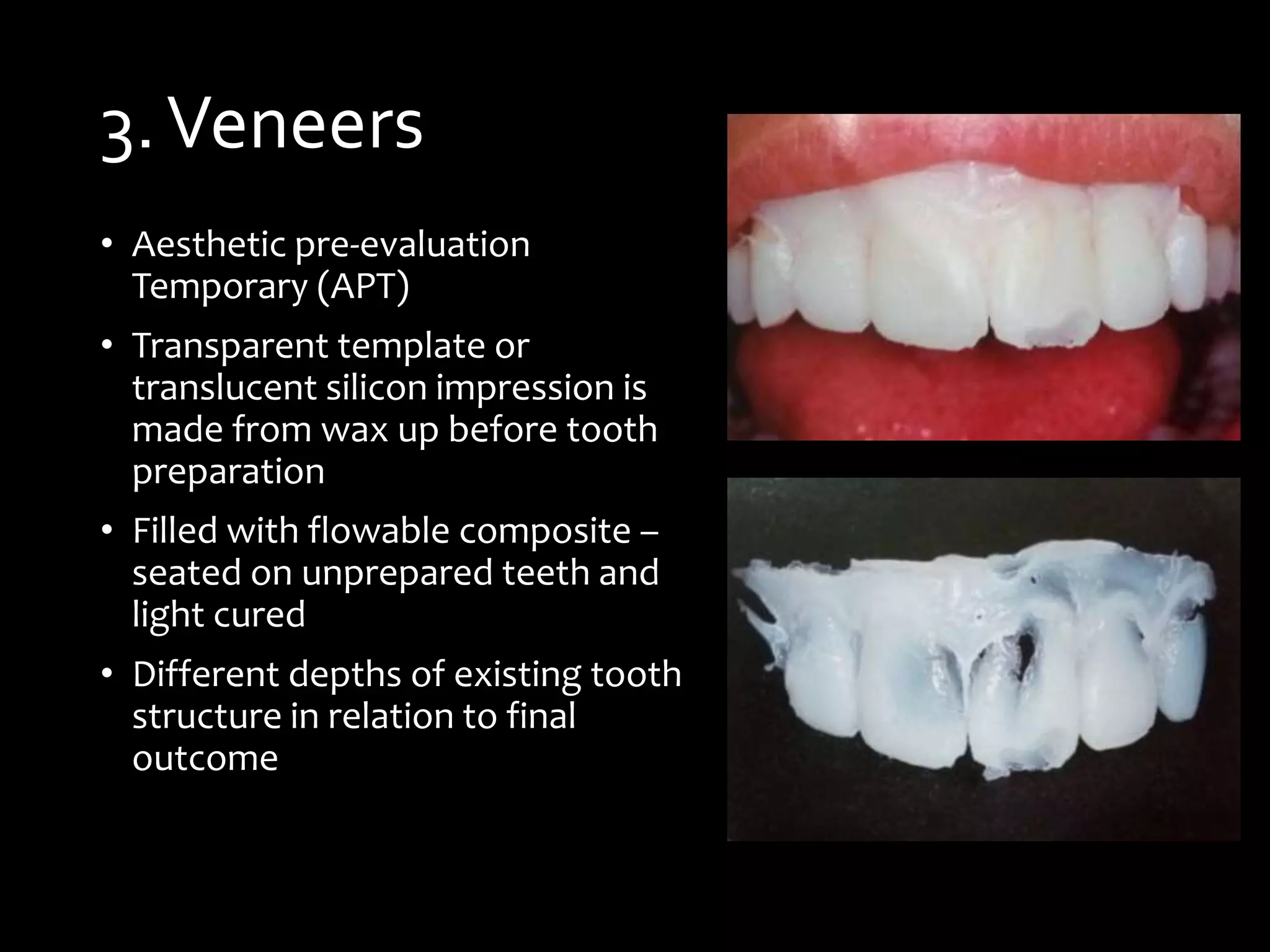
3.Veneers
• Aesthetic pre-evaluation
Temporary (APT)
• Transparent template or
translucent silicon impression is
made from wax up before tooth
preparation
• Filled with flowable composite –
seated on unprepared teeth and
light cured
• Different depths of existing tooth
structure in relation to final
outcome
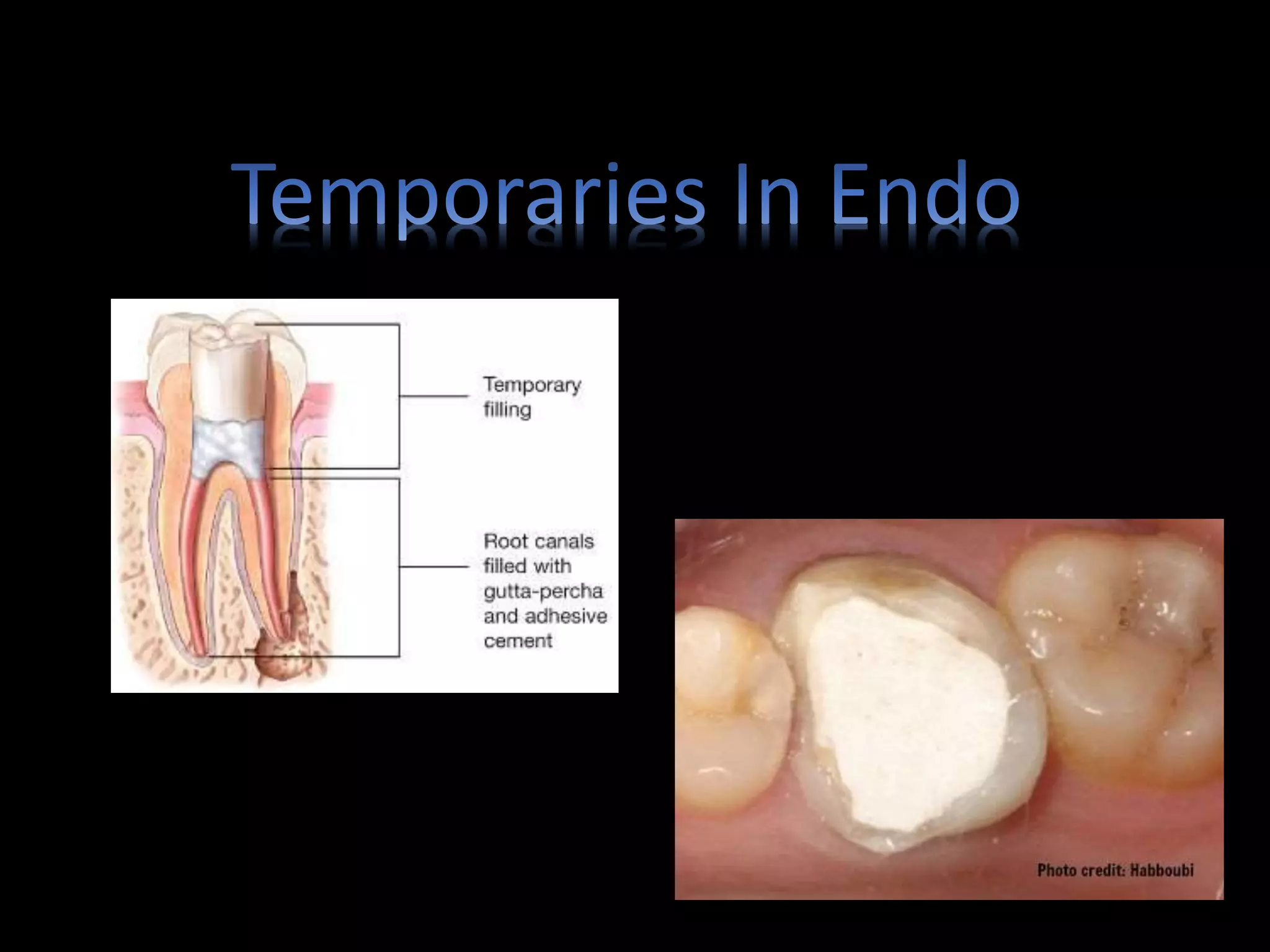
1.Temporary Filling Materials
• Certain indications demand the completion of RCT in multiple
visit – temporary filling is used
• Purpose:
• Seal the access cavity between visits
• Prevent contamination of root canal
• Prevent leakage of intracanal medication
• Requirements
• Impervious to fluids
• Hermetically seal the access cavity
• Harden within few min after insertion
• Withstand forces of mastication
• Be easy to manipulate and remove
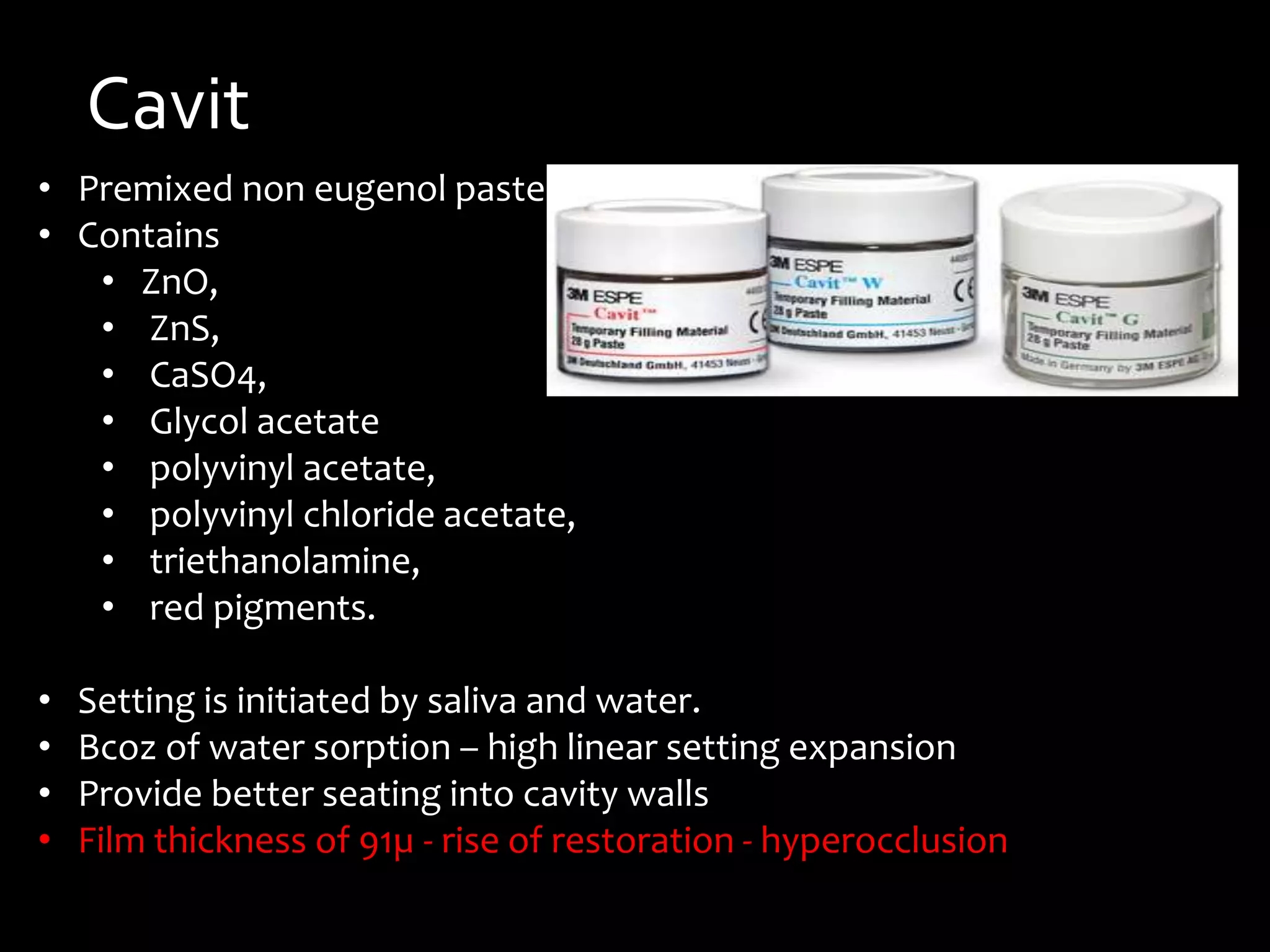
Cavit
• Premixed non eugenol paste
• Contains
• ZnO,
• ZnS,
• CaSO4,
• Glycol acetate
• polyvinyl acetate,
• polyvinyl chloride acetate,
• triethanolamine,
• red pigments.
• Setting is initiated by saliva and water.
• Bcoz of water sorption – high linear setting expansion
• Provide better seating into cavity walls
• Film thickness of 91µ - rise of restoration - hyperocclusion
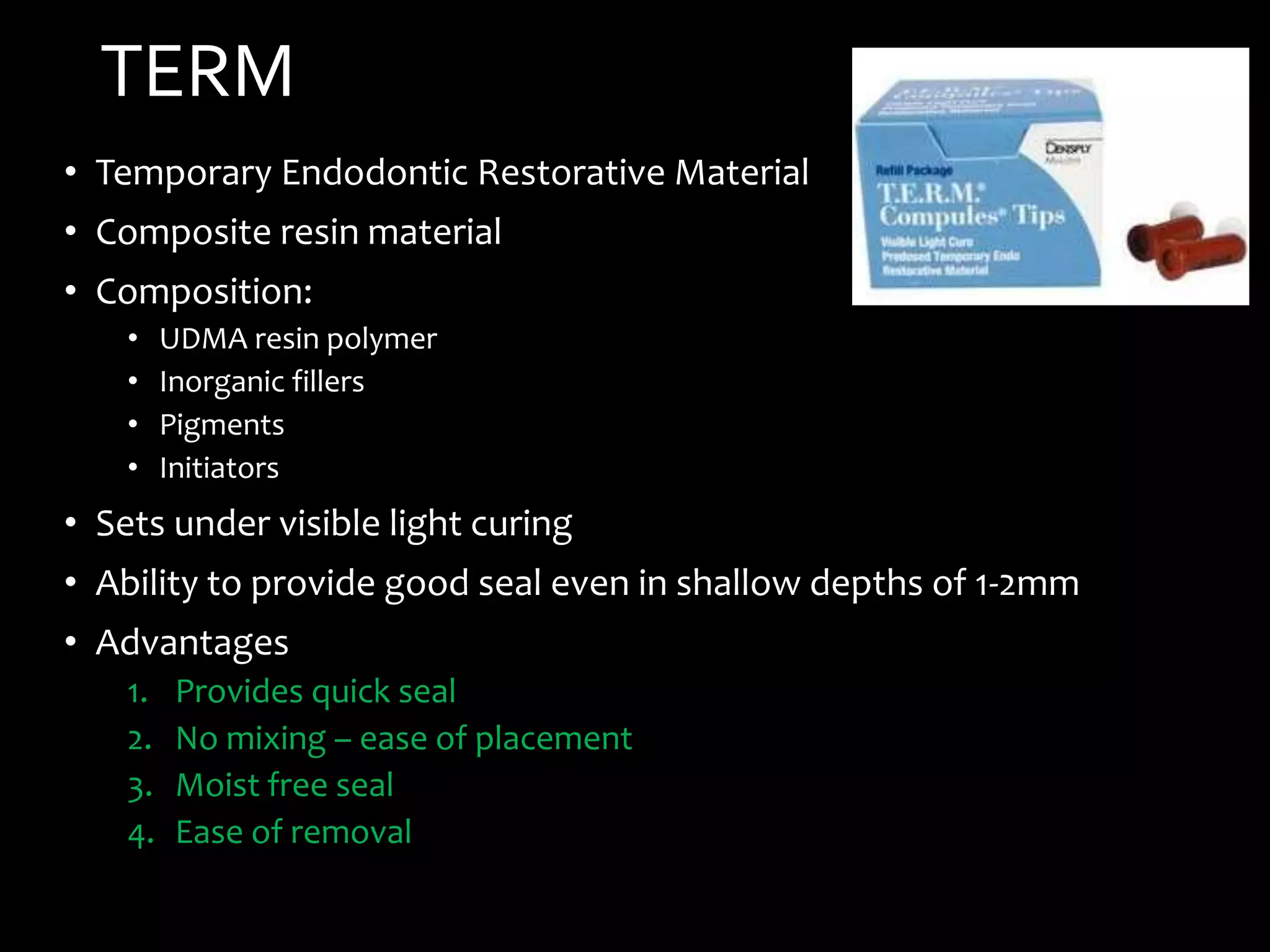
TERM
• Temporary Endodontic Restorative Material
• Composite resin material
• Composition:
• UDMA resin polymer
• Inorganic fillers
• Pigments
• Initiators
• Sets under visible light curing
• Ability to provide good seal even in shallow depths of 1-2mm
• Advantages
1. Provides quick seal
2. No mixing – ease of placement
3. Moist free seal
4. Ease of removal
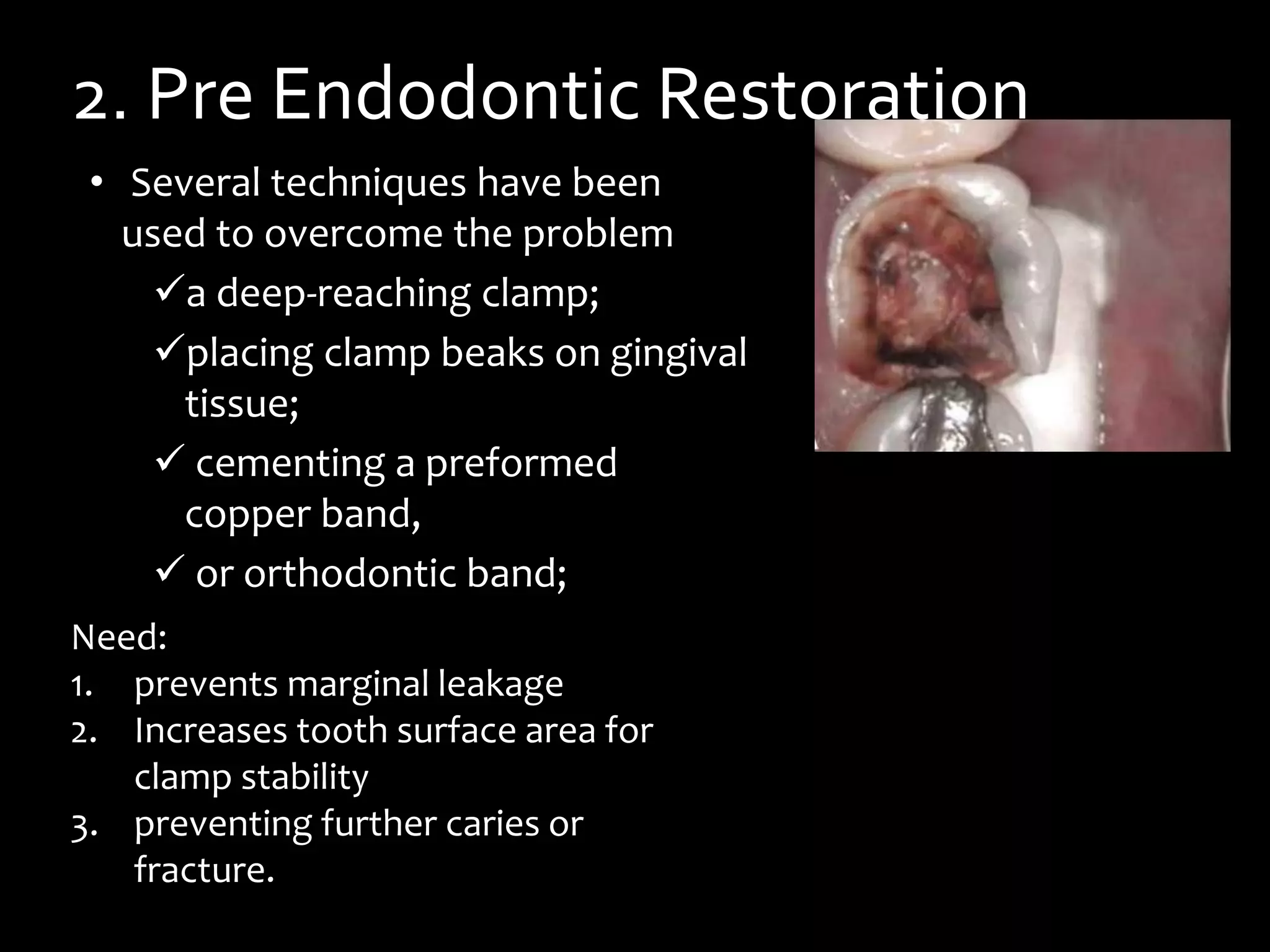
2. Pre Endodontic Restoration
• Several techniques have been
used to overcome the problem
a deep-reaching clamp;
placing clamp beaks on gingival
tissue;
 cementing a preformed
copper band,
 or orthodontic band;
Need:
1. prevents marginal leakage
2. Increases tooth surface area for
clamp stability
3. preventing further caries or
fracture.
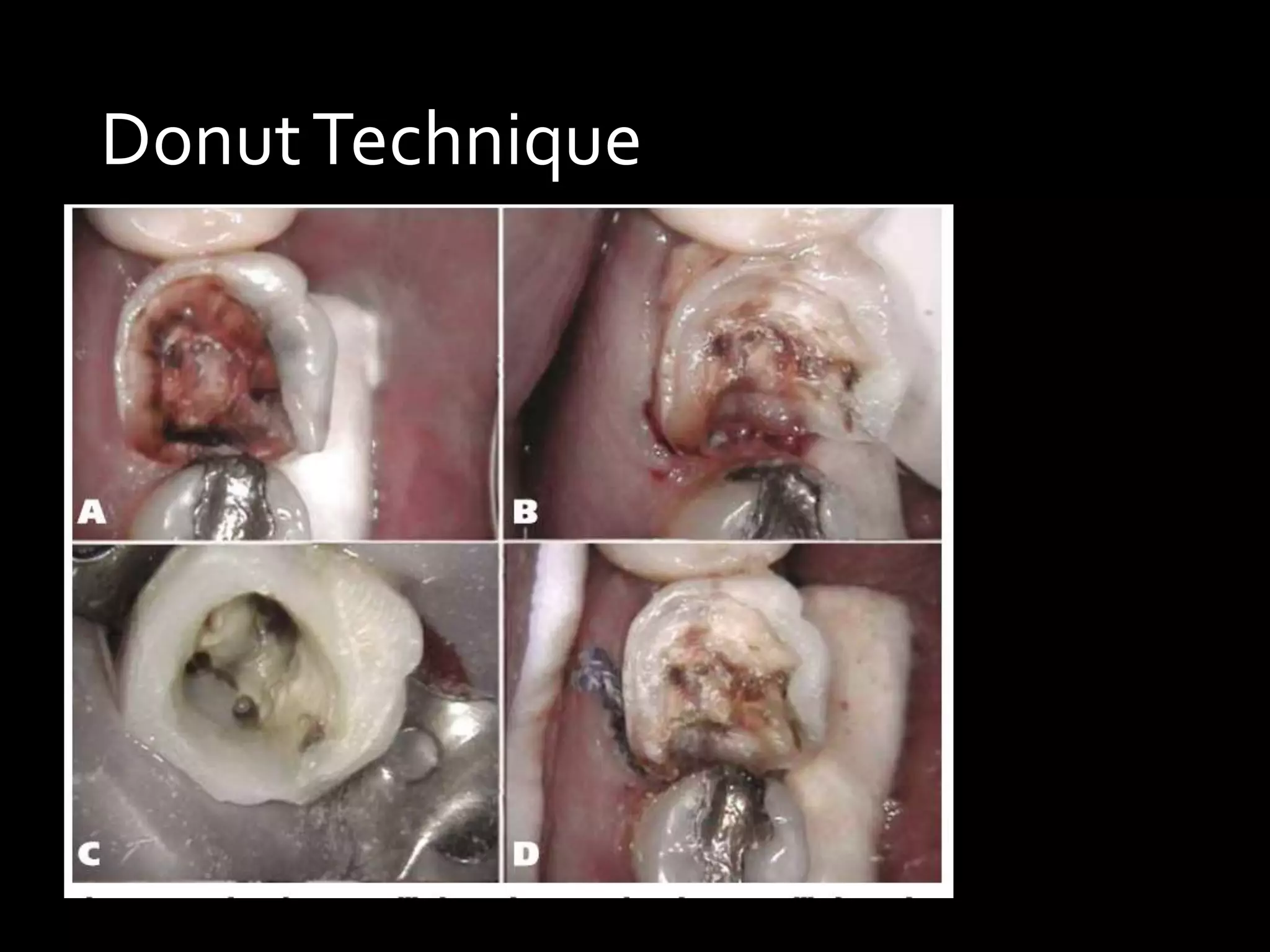
DonutTechnique
Matrix BandTechnique
Bibliography
• The Science of PLV – Galip Gurel
• Porcelain and composite inlays and onlays – Graber, Goldstein
• Grossman’s endodontic practice
• Pathways of Pulp – Cohen
• Endodontics – J I Ingle
• Operative Dentistry – Sturdevant
• Glossary of Prosthodontic Terms – 8
• Pre-endodontic treatment restorations A modification of the
‘donut’ technique - ROBERT W. HEYDRICH
• Pre Endodontic Build-up of a Grossly Destructed Tooth: A Case
Report Shirin Kshirsagar1, Shalini Aggarwal2, Alia Mukhtar1,
Pooja Gupta1, Vinay Rai1, Monika Chawla1
Interim and Temporary restorations

Interim and Temporary restorations

  • 1.
    Interim and Temporary Restorations Guide: Dr.Anubhav Sood Presented by: Parikshit Harnoor
  • 2.
    Introduction • Acc toGPT 8: A fixed or removable dental prosthesis or maxillofacial prosthesis, designed to enhance aesthetics, stabilisation and/or function for a limited period of time, after which it is to be replaced by a definitive dental or maxillofacial prostheses. Often such prosthesis are used to assist in determination of the therapeutic effectiveness of a specific treatment plan or the form and function of the planned definitive prostheses • Selection – size of cavity, period, form and eventual restoration.
  • 3.
    Objectives: • Maintains aesthetics •Acts as space maintainer • Allows the tooth to function • Acts as a diagnostic tool to determine occlusion • Establishes function and phonetics • Allows the development of gingival contour • Seals and insulates the prepared tooth • Prevents passive tooth eruption and mesial drift
  • 4.
    Rationale Treatment may notbe completed in one visit Intermediate restorative material • Functioning of tooth • Maintain intra arch relationship • Prevents supra eruption • Aesthetics • P-D organ recovery Final restoration 1
  • 5.
    Multiple teeth afftectedby caries Infected tooth structure is removed Restoration with temporary material 1. Infecting organisms are removed 2. Further caries spread – arrested 3. Time to asses pt. compliance – oral hygiene, progress/arrest of caies Final restoration 2
  • 6.
    3Questionable pulpal prognosis Intermediaterestorative material 1. Limit progression of demineralisation 2. Pulp healing 3. Form reparative dentin Final restoration
  • 7.
    Materials Interim and temporary restorativematerials Restorative 1. Pulp Capping 2. Step wise caries excavation 3. Inlays & Onlays 4. Veneers Endodontics 1. Pre endodontic restoration 2. Temporary restoration
  • 8.
    1. Pulp capping •Indirect and direct Procedure • Removal of caries - No. 6 and No. 8 bur • Excavation by spoon excavator (31 & 33 L) • Cavity flushed with saline and dried with cotton • Covered with Calcium Hydroxide • Sealed with ZOE
  • 9.
    Zinc Oxide Eugenolcement • Oldest, most widely used • Soothing action on pulpal tissues • Eugenol has topical anesthetic properties • Composition Powder Liquid Zinc Oxide 69% - reactive ingredient Eugenol 85% - Reactor White rosin 29.3% - reduces brittleness Olive oil 15% - plasticizer Zinc stearate 1% - catalyst Zinc acetate 0.7% - accelerator
  • 10.
    Modifications of ZOECement 1. EBA (ethoxy benzoic acid reinforced) 1. Powder - ZnO and Alumina 2. Liquid – OEBA (ortho ethoxy benzoic acid) 2. Polymer reinforced ZOE 1. Powder – ZnO, PMMA, 2. Liquid – Eugenol and acetic acid
  • 11.
    • Manipulation • Dispensingthe powder and liquid • Divided into increments • Powder incorporated into liquid • Heavy folding motion and pressure • Remaining powder is added for putty consistency
  • 12.
    • Advantages 1. Leastirritating cement with pH = 7 2. Good short term sealing • Disadvantages 1. Highly soluble 2. Low strength 3. Low setting time 4. Low compressive strength
  • 13.
    2. Inlays andonlays • Provisional restorations – acrylic resin or autopolymerizing resin • Processed intraorally or indirectly on the cast • Well contoured anatomically shaped provisional restoration is cememented with temporary cementation • Ultimately removed before the final restoration. • Basic systems for fabricating provisional restorations • Direct method • Indirect method
  • 14.
    Direct method • Easierapproach • Inlay preparation - GIC base – dried – coated with petroleum jelly • Thin dead-soft matrix band placement and wedged • Composite restoration - without etching or bonding agent • Shade selection should not be similar to tooth shade
  • 15.
    Indirect Method • Fabricatedin lab on a working cast Impression of preparation is made and poured with a rapidly setting die material Vacuform matrix Soupy mix of acrylic resin Manipulated into position on cast
  • 16.
    Trimmed to marginsand occlusal surfaces are developed Final occlusal anatomy is developed and staining is done Completed provisional restoration ready for cementation
  • 17.
    Indirect Acrylic Restorations •Self curing acrylic is used • Can be used directly or fabricated outside the oral cavity • Free monomer and heat are harmful • Time for fabrication is more but accuracy, appearance and function
  • 18.
    PROTEMP  Fracture resistanceand toughness.  Quick intraoral set.  Total set time of only five minutes.  Smooth, glossy surface requires no polishing.
  • 19.
    Integrity Composition • Barium glass •Fumed Silica • Methacrylate • Monomers • Catalyst • Sabilizers
  • 20.
    3.Veneers • Aesthetic pre-evaluation Temporary(APT) • Transparent template or translucent silicon impression is made from wax up before tooth preparation • Filled with flowable composite – seated on unprepared teeth and light cured • Different depths of existing tooth structure in relation to final outcome
  • 23.
    1.Temporary Filling Materials •Certain indications demand the completion of RCT in multiple visit – temporary filling is used • Purpose: • Seal the access cavity between visits • Prevent contamination of root canal • Prevent leakage of intracanal medication • Requirements • Impervious to fluids • Hermetically seal the access cavity • Harden within few min after insertion • Withstand forces of mastication • Be easy to manipulate and remove
  • 24.
    Cavit • Premixed noneugenol paste • Contains • ZnO, • ZnS, • CaSO4, • Glycol acetate • polyvinyl acetate, • polyvinyl chloride acetate, • triethanolamine, • red pigments. • Setting is initiated by saliva and water. • Bcoz of water sorption – high linear setting expansion • Provide better seating into cavity walls • Film thickness of 91µ - rise of restoration - hyperocclusion
  • 25.
    TERM • Temporary EndodonticRestorative Material • Composite resin material • Composition: • UDMA resin polymer • Inorganic fillers • Pigments • Initiators • Sets under visible light curing • Ability to provide good seal even in shallow depths of 1-2mm • Advantages 1. Provides quick seal 2. No mixing – ease of placement 3. Moist free seal 4. Ease of removal
  • 26.
    2. Pre EndodonticRestoration • Several techniques have been used to overcome the problem a deep-reaching clamp; placing clamp beaks on gingival tissue;  cementing a preformed copper band,  or orthodontic band; Need: 1. prevents marginal leakage 2. Increases tooth surface area for clamp stability 3. preventing further caries or fracture.
  • 27.
  • 28.
  • 30.
    Bibliography • The Scienceof PLV – Galip Gurel • Porcelain and composite inlays and onlays – Graber, Goldstein • Grossman’s endodontic practice • Pathways of Pulp – Cohen • Endodontics – J I Ingle • Operative Dentistry – Sturdevant • Glossary of Prosthodontic Terms – 8 • Pre-endodontic treatment restorations A modification of the ‘donut’ technique - ROBERT W. HEYDRICH • Pre Endodontic Build-up of a Grossly Destructed Tooth: A Case Report Shirin Kshirsagar1, Shalini Aggarwal2, Alia Mukhtar1, Pooja Gupta1, Vinay Rai1, Monika Chawla1