Matrices
&
wedges
DR. MANJIRI HONAP
WHAT IS
MATRIX
AND
WEDGE?
MATRIX
Appropriate axial tooth contours.
Confine restorative material in plastic state.
MATRIXING
Temporary wall.
WEDGES
Device that create rapid separation.
DEFINITION
MATRIX
 A device used to contour a restoration to simulate that of a tooth structure, which
it is replacing.
MATRICING
 Is the procedure whereby a temporary wall is created opposite to axial walls,
surrounding areas of the tooth structure that were lost during the cavity
preparation.
Requirements
 Easy insertion
 Sufficiently rigid to contour
 Should not adhere or react with the restorative material
 Should resist the condensation pressure
 Ease of removal
 Economical
Functions
 Act as a temporary wall of resistance
 It should provide shape to the restoration.
 Should confine the restoration with the acceptable physiological limits.
 Assist in isolating the gingiva and rubber dam during introduction of restorative
material.
 Must help in maintaining a dry operative field.
Matrix system – BAND &
RETAINER
MATRIX BAND
 supplied as strips of different dimensions.
 Thickness – may be 0.001” (0.025mm) or 0.002” (0.05mm)
 Width – may be ¼”, 3/8”, 5/16” or 1/8”.•
Materials used as matrix band
 Stainless steel
 Cellulose acetate (cellophane)
 Cellulose nitrate(celluloid)
 Polyacetate (mylar)
 Copper band Matrices are also supplied as
crown forms• split crown forms• hollow cylinders
RETAINER
 This is a device by which the band can be maintained in its designated position
and shape.
 The retainer may be a mechanical device , dental floss, a metal ring or impression
compound.
CLASSIFICATION
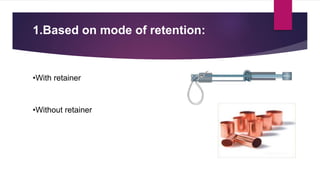
•With retainer
•Without retainer
1.Based on mode of retention:
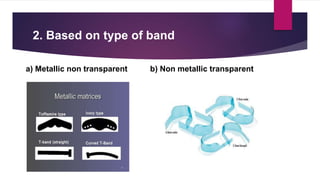
2. Based on type of band
a) Metallic non transparent b) Non metallic transparent
3- Based on
type of cavity
for which it is
used
A-Matrix for Class I cavity preparation Ex:
Double banded tofflemire
B-Matrix for Class II cavity preparation
Ex:Single banded tofflemire
Ivory No. 1
Ivory No. 8
Copper band
Anatomical Matrix
Automatrix
3- Based on
type of cavity
for which it is
used
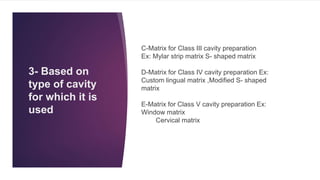
C-Matrix for Class III cavity preparation
Ex: Mylar strip matrix S- shaped matrix
D-Matrix for Class IV cavity preparation Ex:
Custom lingual matrix ,Modified S- shaped
matrix
E-Matrix for Class V cavity preparation Ex:
Window matrix
Cervical matrix
4-Based on its preparation
Custom made or anatomic
Ex: compound supported matrix
Mechanical matrix
Ex: tofflemire, ivory no.1 & 8 matrices
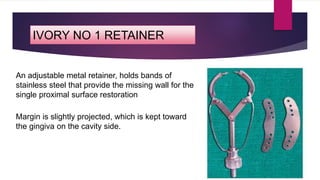
IVORY NO 1 RETAINER
An adjustable metal retainer, holds bands of
stainless steel that provide the missing wall for the
single proximal surface restoration
Margin is slightly projected, which is kept toward
the gingiva on the cavity side.
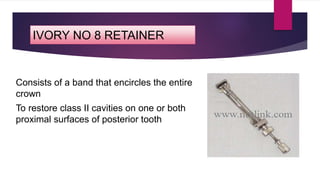
IVORY NO 8 RETAINER
Consists of a band that encircles the entire
crown
To restore class II cavities on one or both
proximal surfaces of posterior tooth
UNIVERASAL MATRIX [TOFFLEMIRE]
INDICATIONS:
Class I cavity with buccal/lingual extension
b) Class II cavities
ADVANTAGES:
Ease of use.
Good contact & contour
Rigid & stable
DISADVANTAGES:
Does not produce optimum contact & contour for posterior composite
Not useful for extensive class II
UNIVERASAL MATRIX
[TOFFLEMIRE]
WEDGES
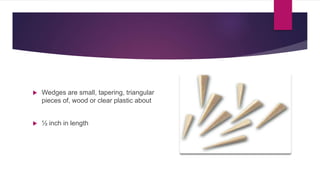
 Wedges are small, tapering, triangular
pieces of, wood or clear plastic about
 ½ inch in length
WEDGE
PRINCIPAL
 Mechanical method of tooth separation where
a wedge or conical shaped device is inserted
between adjacent teeth beneath the contact
area of teeth which leads to separation.
WEDGE PLACEMNT
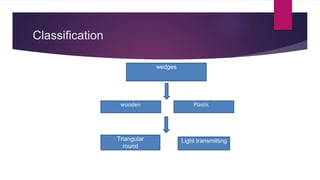
Classification
Triangular
round
Light transmitting
wedges
wooden Plastic
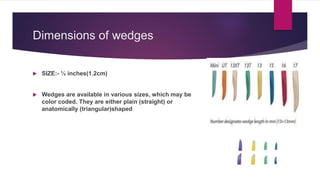
Dimensions of wedges
 SIZE:- ½ inches(1.2cm)
 Wedges are available in various sizes, which may be
color coded. They are either plain (straight) or
anatomically (triangular)shaped
Placement &
function
 Not only stabilizing the matrix but more
importantly it is placed below gingival
cavosurface margin to prevent amalgam
from flowing below the cavo surface margin.
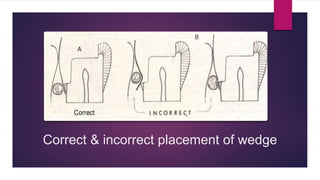
Correct & incorrect placement of wedge
WEDGING
TECHNIQUES
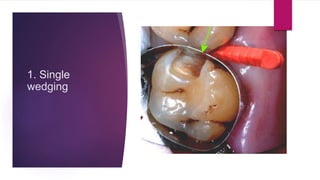
1. Single
wedging
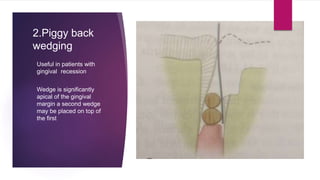
2.Piggy back
wedging
Useful in patients with
gingival recession
Wedge is significantly
apical of the gingival
margin a second wedge
may be placed on top of
the first
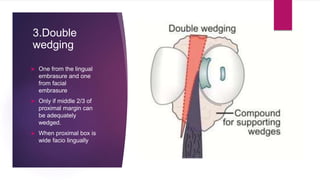
3.Double
wedging
 One from the lingual
embrasure and one
from facial
embrasure
 Only if middle 2/3 of
proximal margin can
be adequately
wedged.
 When proximal box is
wide facio lingually
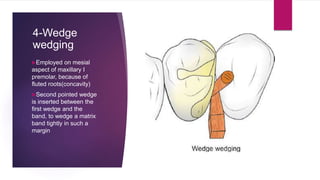
4-Wedge
wedging
Employed on mesial
aspect of maxillary I
premolar, because of
fluted roots(concavity)
Second pointed wedge
is inserted between the
first wedge and the
band, to wedge a matrix
band tightly in such a
margin
Thank you!

WEDGES & MATRIX II YR.pptx

  • 1.
  • 2.
    WHAT IS MATRIX AND WEDGE? MATRIX Appropriate axialtooth contours. Confine restorative material in plastic state. MATRIXING Temporary wall. WEDGES Device that create rapid separation.
  • 3.
    DEFINITION MATRIX  A deviceused to contour a restoration to simulate that of a tooth structure, which it is replacing. MATRICING  Is the procedure whereby a temporary wall is created opposite to axial walls, surrounding areas of the tooth structure that were lost during the cavity preparation.
  • 4.
    Requirements  Easy insertion Sufficiently rigid to contour  Should not adhere or react with the restorative material  Should resist the condensation pressure  Ease of removal  Economical
  • 5.
    Functions  Act asa temporary wall of resistance  It should provide shape to the restoration.  Should confine the restoration with the acceptable physiological limits.  Assist in isolating the gingiva and rubber dam during introduction of restorative material.  Must help in maintaining a dry operative field.
  • 6.
    Matrix system –BAND & RETAINER MATRIX BAND  supplied as strips of different dimensions.  Thickness – may be 0.001” (0.025mm) or 0.002” (0.05mm)  Width – may be ¼”, 3/8”, 5/16” or 1/8”.•
  • 7.
    Materials used asmatrix band  Stainless steel  Cellulose acetate (cellophane)  Cellulose nitrate(celluloid)  Polyacetate (mylar)  Copper band Matrices are also supplied as crown forms• split crown forms• hollow cylinders
  • 8.
    RETAINER  This isa device by which the band can be maintained in its designated position and shape.  The retainer may be a mechanical device , dental floss, a metal ring or impression compound.
  • 9.
  • 10.
  • 11.
    2. Based ontype of band a) Metallic non transparent b) Non metallic transparent
  • 12.
    3- Based on typeof cavity for which it is used A-Matrix for Class I cavity preparation Ex: Double banded tofflemire B-Matrix for Class II cavity preparation Ex:Single banded tofflemire Ivory No. 1 Ivory No. 8 Copper band Anatomical Matrix Automatrix
  • 13.
    3- Based on typeof cavity for which it is used C-Matrix for Class III cavity preparation Ex: Mylar strip matrix S- shaped matrix D-Matrix for Class IV cavity preparation Ex: Custom lingual matrix ,Modified S- shaped matrix E-Matrix for Class V cavity preparation Ex: Window matrix Cervical matrix
  • 14.
    4-Based on itspreparation Custom made or anatomic Ex: compound supported matrix Mechanical matrix Ex: tofflemire, ivory no.1 & 8 matrices
  • 15.
    IVORY NO 1RETAINER An adjustable metal retainer, holds bands of stainless steel that provide the missing wall for the single proximal surface restoration Margin is slightly projected, which is kept toward the gingiva on the cavity side.
  • 16.
    IVORY NO 8RETAINER Consists of a band that encircles the entire crown To restore class II cavities on one or both proximal surfaces of posterior tooth
  • 17.
  • 18.
    INDICATIONS: Class I cavitywith buccal/lingual extension b) Class II cavities ADVANTAGES: Ease of use. Good contact & contour Rigid & stable DISADVANTAGES: Does not produce optimum contact & contour for posterior composite Not useful for extensive class II UNIVERASAL MATRIX [TOFFLEMIRE]
  • 19.
  • 20.
     Wedges aresmall, tapering, triangular pieces of, wood or clear plastic about  ½ inch in length
  • 21.
    WEDGE PRINCIPAL  Mechanical methodof tooth separation where a wedge or conical shaped device is inserted between adjacent teeth beneath the contact area of teeth which leads to separation.
  • 22.
  • 23.
  • 24.
    Dimensions of wedges SIZE:- ½ inches(1.2cm)  Wedges are available in various sizes, which may be color coded. They are either plain (straight) or anatomically (triangular)shaped
  • 25.
    Placement & function  Notonly stabilizing the matrix but more importantly it is placed below gingival cavosurface margin to prevent amalgam from flowing below the cavo surface margin.
  • 26.
    Correct & incorrectplacement of wedge
  • 27.
  • 28.
  • 29.
    2.Piggy back wedging Useful inpatients with gingival recession Wedge is significantly apical of the gingival margin a second wedge may be placed on top of the first
  • 30.
    3.Double wedging  One fromthe lingual embrasure and one from facial embrasure  Only if middle 2/3 of proximal margin can be adequately wedged.  When proximal box is wide facio lingually
  • 31.
    4-Wedge wedging Employed on mesial aspectof maxillary I premolar, because of fluted roots(concavity) Second pointed wedge is inserted between the first wedge and the band, to wedge a matrix band tightly in such a margin
  • 32.