Instruments in Operative
Dentistry
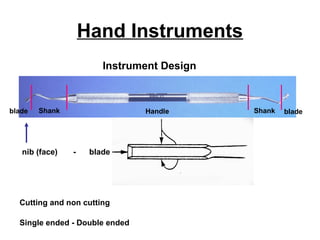
nib (face) - blade
Hand Instruments
Instrument Design
Single ended - Double ended
Shank Shank
Handle blade
blade
Cutting and non cutting
Non cutting instruments
Diagnostic: mirror, probe (dental explorer), tweezers.
Filling :
 Dycal applicator,
 Cement spatula,
Glass slab,
 Retainer,
 Dappen dish,
 Amalgam carrier,
 Condenser,
carver,
 Burnisher,
 Plastic instrument…….
Instruments Techniques (Grasping)
Modified pen grasp: greatest touch delicacy is
permitted with this grasp. A pad of thumb, index and
middle fingers contacting the instrument. While tip of ring
and/or little fingers is used for rest or support on the
nearby teeth surface of the same arch for better controlling
the action and the magnitude of force applied. Palm is
usually facing away from the operator
.
Inverted pen grasp: same as modified pen grasp except
that the hand is rotated so that palm is facing more toward
operator. Usually used with lingual surfaces of anterior
teeth
.
Palm and thumb grasp: similar to that used
for holding a knife while paring the skin from
an apple. Rest is provided by supporting the
thumb on nearby teeth. Used for preparing
incisal retention in class III cavities
.
Modified palm and thumb grasp: only
used when its feasible to rest the thumb on the
tooth to be prepared or the adjacent tooth
.
Pen Grasp Modified Pen Grasp
Inverted Pen Grasp Palm and Thumb Grasp
• 250,000 and 420,000 rpm
• 5000-40000rpm
23
high speed ( turbine )
Advantages over slow speed
 Remove tooth structure much more faster.
 Less pressure required.
 Less vibration.
 Better controlled by operator and easier for use.
 Instruments (burs) last longer.
24
Cutting instrument Slow speed handpeice
Tooth structure can be removed by slow speed but this must be avoided,
 Traumatic experience for both patient and dentist.
 Ineffective.
 Time consuming.
 Require heavy force.
 Excessive vibration and heat generation.
 Burs have tendency to roll out of cavity and the cavity margins or outer
tooth surface.
 Carbide burs easily broken by slow speed and high pressure.
So it has limited uses for:
prophylaxis.
 caries excavation.
 finishing and polishing.
25
Classification of Burs
According to Material used
Steel burs:
Dulls easily.
 Heat production.
 Vibration.
Carbide burs:
Stiffer and stronger than steel but unfortunately:
 Rust easily,
 Easily fractured at neck when subjected to excessive force or sudden blow
• Diamond burs:
1.High cutting efficiency
2.less heat generation
3.Not fractured easily
26
27
28
29
1
Matrices in Operative Dentistry
2
Matrix ?
A matrix is defined as a properly
contoured piece of metal or other material
used to support and give form to the
restoration during its placement and
hardening.
The art and science of operative dentistry,1995: Mosby-
Year Book,Inc.
32
 Unfortunately, dentistry does not have a truly
satisfactory manufactured matrix for directly placed
restorations.
 Most matrices available to the profession have some
good qualities but do not meet all the requisites.
 The primary function of the matrix is to restore
anatomical contours and contact areas.
Why do we need matrices ?
33
 Gingival floor of a class II
cavity is the most vulnerable
area where overhang of
restorative material can take
place.
 There is no method to
control the placement and contour
of restoration without a matrix
wall.
If we do not use a matrix
• Food impaction leading to recurrent caries
• Change in occlusion and intercuspal
relations
• Rotation and drifting of teeth
• Trauma to the periodontium.
Characteristics of a good
matrix
36
 Rigidity.
 Establishment of proper anatomical contour.
 Restoration of correct proximal contact relation.
 Easy adaptation to the tooth.
 Ability to be contoured.
 Prevention of gingival excess.
 Strength to offer resistance to condensation. pressure.
 Easy removal from the tooth.
Functions of matrix
37
 Provision of a temporary wall of resistance
to the pressure necessary for amalgam
insertion.
 Provision of shape and contour to the
restoration.
 Maintenance of form during placement
and set of the amalgam/composite.
Classification
38
 On the basis of chemistry
 On the basis of thickness
 On the basis of rigidity
 On the basis of circumference
Metallic Matrices
39
Circumferential Sectional
Tofflemire (universal) 
Palodent
Automatrix 
Composi -tight
Siquveland  Ivory
T-band  Strip-
T matrix
Circumferential Type
40
 The band encircles the tooth and is
secured by the retainer on the buccal or
lingual aspect.
 Band may be straight, curved or
contoured.
 Advantage: this type can be firmly adapted
to the tooth.
Metallic matrices
41
Ivory type
Tofflemire type
T- band (straight) Curved T-
Band
Dimensions
42
 The non-contoured bands are available in
two thicknesses, 0.05mm and 0.038mm.
 Contoured matrices may have variable
dimensions (depending upon the
commercial product).
Tofflemire matrix band
43
 The Tofflemire matrix assembly consists
of the following:
Matrix bands
Matrix retainer
Wedge
Matrix
bands
•.
44
Assembled bands
45
Fig 12-6
Assembly of tofflemire retainer
46
• Matrix band should extend 2 mm above
the marginal ridge height and 1 mm below
gingival margin of the preparation
Wedges
51
Wedges
52
 Anatomical (triangular
wedges) are recommended for
deeper and / or wider proximal
preparations.
 Rounded wedges are
recommended for shallower and / or narrower proximal
preparations.
Sturdevant JR et al: Conservative preparation designs for class II
amalgam restorations, Dent Mater 3:144, 1987.
Role of wedge
53
 It should hold the matrix band firmly in position
cervically.
 It should not be of such a height that it prevents
the formation of a contact point.
 Another function is to separate the teeth slightly
so that when it and the matrix are finally
removed, the teeth return to their original
positions, closing the small space left by the
thickness of the matrix band.
Technique
54
Techniq
ue
.
55
Technique
56
 Either precontoure the matrix material before
placing on the tooth.
 Matrix band can be contoured after being
adapted on the tooth with the help of an egg-
shaped burnisher, back side of the blade of 15-
8-14 spoon excavator or blade of a Hollenbeck
carver.
Wedge placement
57
 Simple wedging
 Piggy-back wedging
 Double-wedging
 Wedge-wedging
https://image.slidesharecdn.com/cons-
190422173528/95/wedging-technique-15-
638.jpg?cb=1555954642
Modification of matrices
62
All matrices require modification when:
proximal surface is a guide plane for tooth/
tissue supported partial denture.
Adjacent tooth has a flatter contact.
Adjacent proximal contours are not normal.
Clear matrices
63
 Polyester strips
 Mylar strips
 Cellophane strips
 Plastic strips
 Clear plastic crown form
Wedges for composite
64
 Light reflecting wedges along with clear matrices are recommended for
composite restorations.
 Alternatively, ultra thin (0.013mm) metal matrices can be used for
composites.
Prewedging
65
 Placement of wedge prior to tooth preparation is helpful especially in case
of composite restorations.
 It allows greater separation of the teeth and more space to build a contact.
Acid etching
• Acid etchant (more commonly known as
acid etch) is available in a phosphoric acid
solution or gel and is commonly available in
37% concentration
• Acid etch creates microscopic spaces in
enamel (increasing surface roughness) into
which the bonding agent/adhesive can flow,
aiding the bonding process
(micromechanical retention).
66
67

Hand-Instruments dentistry hand instruments

  • 1.
  • 2.
    nib (face) -blade Hand Instruments Instrument Design Single ended - Double ended Shank Shank Handle blade blade Cutting and non cutting
  • 3.
    Non cutting instruments Diagnostic:mirror, probe (dental explorer), tweezers. Filling :  Dycal applicator,  Cement spatula, Glass slab,  Retainer,  Dappen dish,  Amalgam carrier,  Condenser, carver,  Burnisher,  Plastic instrument…….
  • 17.
    Instruments Techniques (Grasping) InstrumentsTechniques (Grasping) Modified pen grasp: greatest touch delicacy is permitted with this grasp. A pad of thumb, index and middle fingers contacting the instrument. While tip of ring and/or little fingers is used for rest or support on the nearby teeth surface of the same arch for better controlling the action and the magnitude of force applied. Palm is usually facing away from the operator . Inverted pen grasp: same as modified pen grasp except that the hand is rotated so that palm is facing more toward operator. Usually used with lingual surfaces of anterior teeth .
  • 18.
    Palm and thumbgrasp: similar to that used for holding a knife while paring the skin from an apple. Rest is provided by supporting the thumb on nearby teeth. Used for preparing incisal retention in class III cavities . Modified palm and thumb grasp: only used when its feasible to rest the thumb on the tooth to be prepared or the adjacent tooth .
  • 19.
  • 20.
    Inverted Pen GraspPalm and Thumb Grasp
  • 22.
    • 250,000 and420,000 rpm • 5000-40000rpm
  • 23.
    23 high speed (turbine ) Advantages over slow speed  Remove tooth structure much more faster.  Less pressure required.  Less vibration.  Better controlled by operator and easier for use.  Instruments (burs) last longer.
  • 24.
    24 Cutting instrument Slowspeed handpeice Tooth structure can be removed by slow speed but this must be avoided,  Traumatic experience for both patient and dentist.  Ineffective.  Time consuming.  Require heavy force.  Excessive vibration and heat generation.  Burs have tendency to roll out of cavity and the cavity margins or outer tooth surface.  Carbide burs easily broken by slow speed and high pressure. So it has limited uses for: prophylaxis.  caries excavation.  finishing and polishing.
  • 25.
    25 Classification of Burs Accordingto Material used Steel burs: Dulls easily.  Heat production.  Vibration. Carbide burs: Stiffer and stronger than steel but unfortunately:  Rust easily,  Easily fractured at neck when subjected to excessive force or sudden blow
  • 26.
    • Diamond burs: 1.Highcutting efficiency 2.less heat generation 3.Not fractured easily 26
  • 27.
  • 28.
  • 29.
  • 30.
  • 31.
    2 Matrix ? A matrixis defined as a properly contoured piece of metal or other material used to support and give form to the restoration during its placement and hardening. The art and science of operative dentistry,1995: Mosby- Year Book,Inc.
  • 32.
    32  Unfortunately, dentistrydoes not have a truly satisfactory manufactured matrix for directly placed restorations.  Most matrices available to the profession have some good qualities but do not meet all the requisites.  The primary function of the matrix is to restore anatomical contours and contact areas.
  • 33.
    Why do weneed matrices ? 33  Gingival floor of a class II cavity is the most vulnerable area where overhang of restorative material can take place.  There is no method to control the placement and contour of restoration without a matrix wall.
  • 34.
    If we donot use a matrix • Food impaction leading to recurrent caries • Change in occlusion and intercuspal relations • Rotation and drifting of teeth • Trauma to the periodontium.
  • 36.
    Characteristics of agood matrix 36  Rigidity.  Establishment of proper anatomical contour.  Restoration of correct proximal contact relation.  Easy adaptation to the tooth.  Ability to be contoured.  Prevention of gingival excess.  Strength to offer resistance to condensation. pressure.  Easy removal from the tooth.
  • 37.
    Functions of matrix 37 Provision of a temporary wall of resistance to the pressure necessary for amalgam insertion.  Provision of shape and contour to the restoration.  Maintenance of form during placement and set of the amalgam/composite.
  • 38.
    Classification 38  On thebasis of chemistry  On the basis of thickness  On the basis of rigidity  On the basis of circumference
  • 39.
    Metallic Matrices 39 Circumferential Sectional Tofflemire(universal)  Palodent Automatrix  Composi -tight Siquveland  Ivory T-band  Strip- T matrix
  • 40.
    Circumferential Type 40  Theband encircles the tooth and is secured by the retainer on the buccal or lingual aspect.  Band may be straight, curved or contoured.  Advantage: this type can be firmly adapted to the tooth.
  • 41.
    Metallic matrices 41 Ivory type Tofflemiretype T- band (straight) Curved T- Band
  • 42.
    Dimensions 42  The non-contouredbands are available in two thicknesses, 0.05mm and 0.038mm.  Contoured matrices may have variable dimensions (depending upon the commercial product).
  • 43.
    Tofflemire matrix band 43 The Tofflemire matrix assembly consists of the following: Matrix bands Matrix retainer Wedge
  • 44.
  • 45.
  • 46.
  • 47.
    • Matrix bandshould extend 2 mm above the marginal ridge height and 1 mm below gingival margin of the preparation
  • 51.
  • 52.
    Wedges 52  Anatomical (triangular wedges)are recommended for deeper and / or wider proximal preparations.  Rounded wedges are recommended for shallower and / or narrower proximal preparations. Sturdevant JR et al: Conservative preparation designs for class II amalgam restorations, Dent Mater 3:144, 1987.
  • 53.
    Role of wedge 53 It should hold the matrix band firmly in position cervically.  It should not be of such a height that it prevents the formation of a contact point.  Another function is to separate the teeth slightly so that when it and the matrix are finally removed, the teeth return to their original positions, closing the small space left by the thickness of the matrix band.
  • 54.
  • 55.
  • 56.
    Technique 56  Either precontourethe matrix material before placing on the tooth.  Matrix band can be contoured after being adapted on the tooth with the help of an egg- shaped burnisher, back side of the blade of 15- 8-14 spoon excavator or blade of a Hollenbeck carver.
  • 57.
    Wedge placement 57  Simplewedging  Piggy-back wedging  Double-wedging  Wedge-wedging
  • 58.
  • 62.
    Modification of matrices 62 Allmatrices require modification when: proximal surface is a guide plane for tooth/ tissue supported partial denture. Adjacent tooth has a flatter contact. Adjacent proximal contours are not normal.
  • 63.
    Clear matrices 63  Polyesterstrips  Mylar strips  Cellophane strips  Plastic strips  Clear plastic crown form
  • 64.
    Wedges for composite 64 Light reflecting wedges along with clear matrices are recommended for composite restorations.  Alternatively, ultra thin (0.013mm) metal matrices can be used for composites.
  • 65.
    Prewedging 65  Placement ofwedge prior to tooth preparation is helpful especially in case of composite restorations.  It allows greater separation of the teeth and more space to build a contact.
  • 66.
    Acid etching • Acidetchant (more commonly known as acid etch) is available in a phosphoric acid solution or gel and is commonly available in 37% concentration • Acid etch creates microscopic spaces in enamel (increasing surface roughness) into which the bonding agent/adhesive can flow, aiding the bonding process (micromechanical retention). 66
  • 67.