



Contents
 History of matrices
 Introduction of matrices
 Definition of matrix
 Matrix Multiplication
 Row & column
 Order of matrix
 Compact form of matrix
 Determinants of ad joint inverse of a matrix
 Ad joint Matrix
 Inverse Matrix
 Inverse Matrix Method
 Gauss-Jordan's Metod
 Steps to convert the augmented matrix into fins=al matrix & get solutions
James Joseph Sylvester:
He was British mathematician. He was born in London ,England.
His father Abraham joseph was a merchant. James adopted the summaries
Sylvester when his older brother did so uponemringtion united states at age of
14. Sylvester was a student of Augustus de Morgan at the university of
London.
Arthur Clayey:
He was British mathematician who helped founding the British
school of pure mathematics. Although clayey was born in England, his first
seven years were spent in St. Petersburg Russian where his parents lived in the
family permanent return to England in 1828. He was educated at a small
private school in blackheart followed by the three - years course at king
college, London.
Matrices
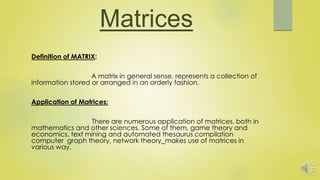
Definition of MATRIX:
A matrix in general sense, represents a collection of
information stored or arranged in an orderly fashion.
Application of Matrices:
There are numerous application of matrices, both in
mathematics and other sciences. Some of them, game theory and
economics, text mining and automated thesaurus compilation
computer graph theory, network theory makes use of matrices in
various way.
Matrix Multiplication
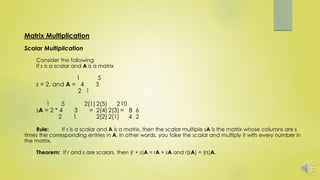
Scalar Multiplication
Consider the following
If s is a scalar and A is a matrix
1 5
s = 2, and A = 4 3
2 1
1 5 2(1) 2(5) 210
sA = 2 * 4 3 = 2(4) 2(3) = 8 6
2 1 2(2) 2(1) 4 2
Rule: If s is a scalar and A is a matrix, then the scalar multiple sA is the matrix whose columns are s
times the corresponding entries in A. In other words, you take the scalar and multiply it with every number in
the matrix.
Theorem: If r and s are scalars, then (r + s)A = rA + sA and r(sA) = (rs)A.
Matrix Multiplication
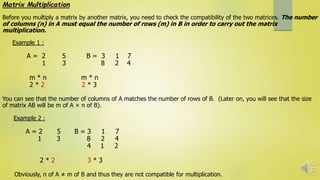
Before you multiply a matrix by another matrix, you need to check the compatibility of the two matrices. The number
of columns (n) in A must equal the number of rows (m) in B in order to carry out the matrix
multiplication.
Example 1 :
A = 2 5 B = 3 1 7
1 3 8 2 4
m * n m * n
2 * 2 2 * 3
You can see that the number of columns of A matches the number of rows of B. (Later on, you will see that the size
of matrix AB will be m of A × n of B).
Example 2 :
A = 2 5 B = 3 1 7
1 3 8 2 4
4 1 2
2 * 2 3 * 3
Obviously, n of A ≠ m of B and thus they are not compatible for multiplication.
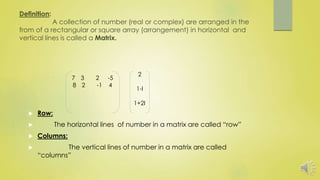
Definition:
A collection of number (real or complex) are arranged in the
from of a rectangular or square array (arrangement) in horizontal and
vertical lines is called a Matrix.
 Row:
 The horizontal lines of number in a matrix are called “row”
 Columns:
 The vertical lines of number in a matrix are called
“columns”
7 3 2 -5
8 2 -1 4
2
1-I
1+2I
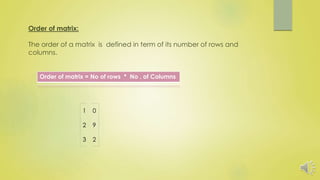
Order of matrix:
The order of a matrix is defined in term of its number of rows and
columns.
Order of matrix = No of rows * No . of Columns
1
2
3
0
9
2
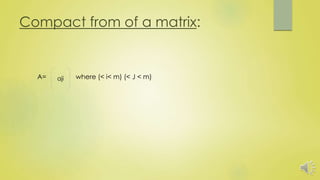
Compact from of a matrix:
A= where (< i< m) (< J < m)aji
Determinants(Ad joint& Inverse of a
matrix)
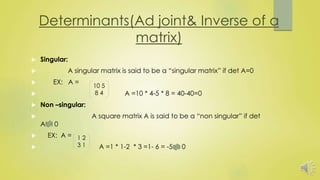
 Singular:
 A singular matrix is said to be a “singular matrix” if det A=0
 EX: A =
 A =10 * 4-5 * 8 = 40-40=0
 Non –singular:
 A square matrix A is said to be a “non singular” if det
A 0
 EX: A =
 A =1 * 1-2 * 3 =1- 6 = -5 0
10 5
8 4
1 2
3 1
Adjoins matrix
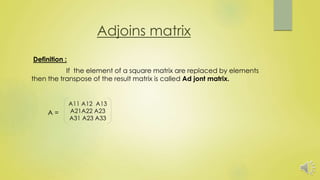
Definition :
If the element of a square matrix are replaced by elements
then the transpose of the result matrix is called Ad jont matrix.
A =
A11 A12 A13
A21A22 A23
A31 A23 A33
Inverse of matrix
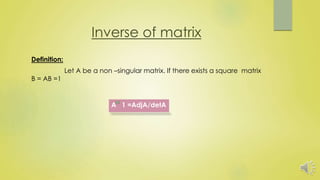
Definition:
Let A be a non –singular matrix. If there exists a square matrix
B = AB =1
A 1 =AdjA/detA
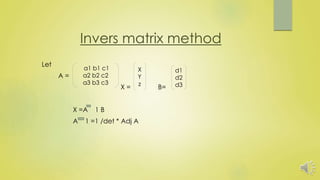
Invers matrix method
Let
A =
X = B=
X =A 1 B
A 1 =1 /det * Adj A
a1 b1 c1
a2 b2 c2
a3 b3 c3
X
Y
z
d1
d2
d3
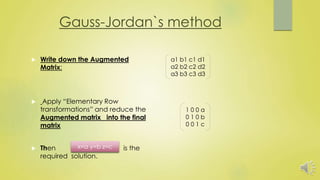
Gauss-Jordan`s method
 Write down the Augmented
Matrix:
 Apply “Elementary Row
transformations” and reduce the
Augmented matrix into the final
matrix
 Then is the
required solution.
a1 b1 c1 d1
a2 b2 c2 d2
a3 b3 c3 d3
1 0 0 a
0 1 0 b
0 0 1 c
x=a y=b z=c
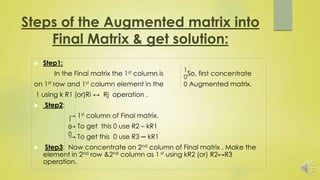
Steps of the Augmented matrix into
Final Matrix & get solution:
 Step1:
In the Final matrix the 1st column is So, first concentrate
on 1st row and 1st column element in the Augmented matrix.
1 using k R1 (or)Ri ↔ Rj operation .
 Step2:
→ 1st column of Final matrix.
→ To get this 0 use R2 – kR1
→ To get this 0 use R3 ─ kR1
 Step3: Now concentrate on 2nd column of Final matrix . Make the
element in 2nd row &2nd column as 1 st using kR2 (or) R2↔R3
operation.
1
0
0
1
0
0
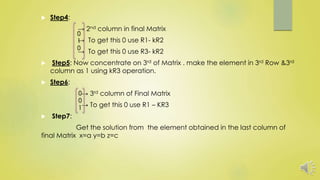
 Step4:
→ 2nd column in final Matrix
→ To get this 0 use R1- kR2
→ To get this 0 use R3- kR2
 Step5: Now concentrate on 3rd of Matrix . make the element in 3rd Row &3rd
column as 1 using kR3 operation.
 Step6:
→ 3rd column of Final Matrix
→ To get this 0 use R1 – KR3
 Step7:
Get the solution from the element obtained in the last column of
final Matrix x=a y=b z=c
0
1
0
0
0
1
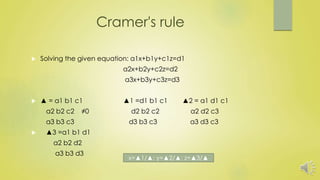
Cramer's rule
 Solving the given equation: a1x+b1y+c1z=d1
a2x+b2y+c2z=d2
a3x+b3y+c3z=d3
 ▲ = a1 b1 c1 ▲1 =d1 b1 c1 ▲2 = a1 d1 c1
a2 b2 c2 ≠0 d2 b2 c2 a2 d2 c3
a3 b3 c3 d3 b3 c3 a3 d3 c3
 ▲3 =a1 b1 d1
a2 b2 d2
a3 b3 d3
x=▲1/▲: y=▲2/▲: z=▲3/▲
Royal CIVIL
Presented by
B.Lokeshwar.

matricesMrtices

  • 2.
    Contents  History ofmatrices  Introduction of matrices  Definition of matrix  Matrix Multiplication  Row & column  Order of matrix  Compact form of matrix  Determinants of ad joint inverse of a matrix  Ad joint Matrix  Inverse Matrix  Inverse Matrix Method  Gauss-Jordan's Metod  Steps to convert the augmented matrix into fins=al matrix & get solutions
  • 3.
    James Joseph Sylvester: Hewas British mathematician. He was born in London ,England. His father Abraham joseph was a merchant. James adopted the summaries Sylvester when his older brother did so uponemringtion united states at age of 14. Sylvester was a student of Augustus de Morgan at the university of London. Arthur Clayey: He was British mathematician who helped founding the British school of pure mathematics. Although clayey was born in England, his first seven years were spent in St. Petersburg Russian where his parents lived in the family permanent return to England in 1828. He was educated at a small private school in blackheart followed by the three - years course at king college, London.
  • 4.
    Matrices Definition of MATRIX: Amatrix in general sense, represents a collection of information stored or arranged in an orderly fashion. Application of Matrices: There are numerous application of matrices, both in mathematics and other sciences. Some of them, game theory and economics, text mining and automated thesaurus compilation computer graph theory, network theory makes use of matrices in various way.
  • 5.
    Matrix Multiplication Scalar Multiplication Considerthe following If s is a scalar and A is a matrix 1 5 s = 2, and A = 4 3 2 1 1 5 2(1) 2(5) 210 sA = 2 * 4 3 = 2(4) 2(3) = 8 6 2 1 2(2) 2(1) 4 2 Rule: If s is a scalar and A is a matrix, then the scalar multiple sA is the matrix whose columns are s times the corresponding entries in A. In other words, you take the scalar and multiply it with every number in the matrix. Theorem: If r and s are scalars, then (r + s)A = rA + sA and r(sA) = (rs)A.
  • 6.
    Matrix Multiplication Before youmultiply a matrix by another matrix, you need to check the compatibility of the two matrices. The number of columns (n) in A must equal the number of rows (m) in B in order to carry out the matrix multiplication. Example 1 : A = 2 5 B = 3 1 7 1 3 8 2 4 m * n m * n 2 * 2 2 * 3 You can see that the number of columns of A matches the number of rows of B. (Later on, you will see that the size of matrix AB will be m of A × n of B). Example 2 : A = 2 5 B = 3 1 7 1 3 8 2 4 4 1 2 2 * 2 3 * 3 Obviously, n of A ≠ m of B and thus they are not compatible for multiplication.
  • 7.
    Definition: A collection ofnumber (real or complex) are arranged in the from of a rectangular or square array (arrangement) in horizontal and vertical lines is called a Matrix.  Row:  The horizontal lines of number in a matrix are called “row”  Columns:  The vertical lines of number in a matrix are called “columns” 7 3 2 -5 8 2 -1 4 2 1-I 1+2I
  • 8.
    Order of matrix: Theorder of a matrix is defined in term of its number of rows and columns. Order of matrix = No of rows * No . of Columns 1 2 3 0 9 2
  • 9.
    Compact from ofa matrix: A= where (< i< m) (< J < m)aji
  • 10.
    Determinants(Ad joint& Inverseof a matrix)  Singular:  A singular matrix is said to be a “singular matrix” if det A=0  EX: A =  A =10 * 4-5 * 8 = 40-40=0  Non –singular:  A square matrix A is said to be a “non singular” if det A 0  EX: A =  A =1 * 1-2 * 3 =1- 6 = -5 0 10 5 8 4 1 2 3 1
  • 11.
    Adjoins matrix Definition : Ifthe element of a square matrix are replaced by elements then the transpose of the result matrix is called Ad jont matrix. A = A11 A12 A13 A21A22 A23 A31 A23 A33
  • 12.
    Inverse of matrix Definition: LetA be a non –singular matrix. If there exists a square matrix B = AB =1 A 1 =AdjA/detA
  • 13.
    Invers matrix method Let A= X = B= X =A 1 B A 1 =1 /det * Adj A a1 b1 c1 a2 b2 c2 a3 b3 c3 X Y z d1 d2 d3
  • 14.
    Gauss-Jordan`s method  Writedown the Augmented Matrix:  Apply “Elementary Row transformations” and reduce the Augmented matrix into the final matrix  Then is the required solution. a1 b1 c1 d1 a2 b2 c2 d2 a3 b3 c3 d3 1 0 0 a 0 1 0 b 0 0 1 c x=a y=b z=c
  • 15.
    Steps of theAugmented matrix into Final Matrix & get solution:  Step1: In the Final matrix the 1st column is So, first concentrate on 1st row and 1st column element in the Augmented matrix. 1 using k R1 (or)Ri ↔ Rj operation .  Step2: → 1st column of Final matrix. → To get this 0 use R2 – kR1 → To get this 0 use R3 ─ kR1  Step3: Now concentrate on 2nd column of Final matrix . Make the element in 2nd row &2nd column as 1 st using kR2 (or) R2↔R3 operation. 1 0 0 1 0 0
  • 16.
     Step4: → 2ndcolumn in final Matrix → To get this 0 use R1- kR2 → To get this 0 use R3- kR2  Step5: Now concentrate on 3rd of Matrix . make the element in 3rd Row &3rd column as 1 using kR3 operation.  Step6: → 3rd column of Final Matrix → To get this 0 use R1 – KR3  Step7: Get the solution from the element obtained in the last column of final Matrix x=a y=b z=c 0 1 0 0 0 1
  • 17.
    Cramer's rule  Solvingthe given equation: a1x+b1y+c1z=d1 a2x+b2y+c2z=d2 a3x+b3y+c3z=d3  ▲ = a1 b1 c1 ▲1 =d1 b1 c1 ▲2 = a1 d1 c1 a2 b2 c2 ≠0 d2 b2 c2 a2 d2 c3 a3 b3 c3 d3 b3 c3 a3 d3 c3  ▲3 =a1 b1 d1 a2 b2 d2 a3 b3 d3 x=▲1/▲: y=▲2/▲: z=▲3/▲
  • 18.