BendingBending
Shear and Moment Diagram,
Graphical method to construct shear
and moment diagram, Bending deformation of a
straight member, The flexure formula
1
2
Shear and moment diagramShear and moment diagram
3
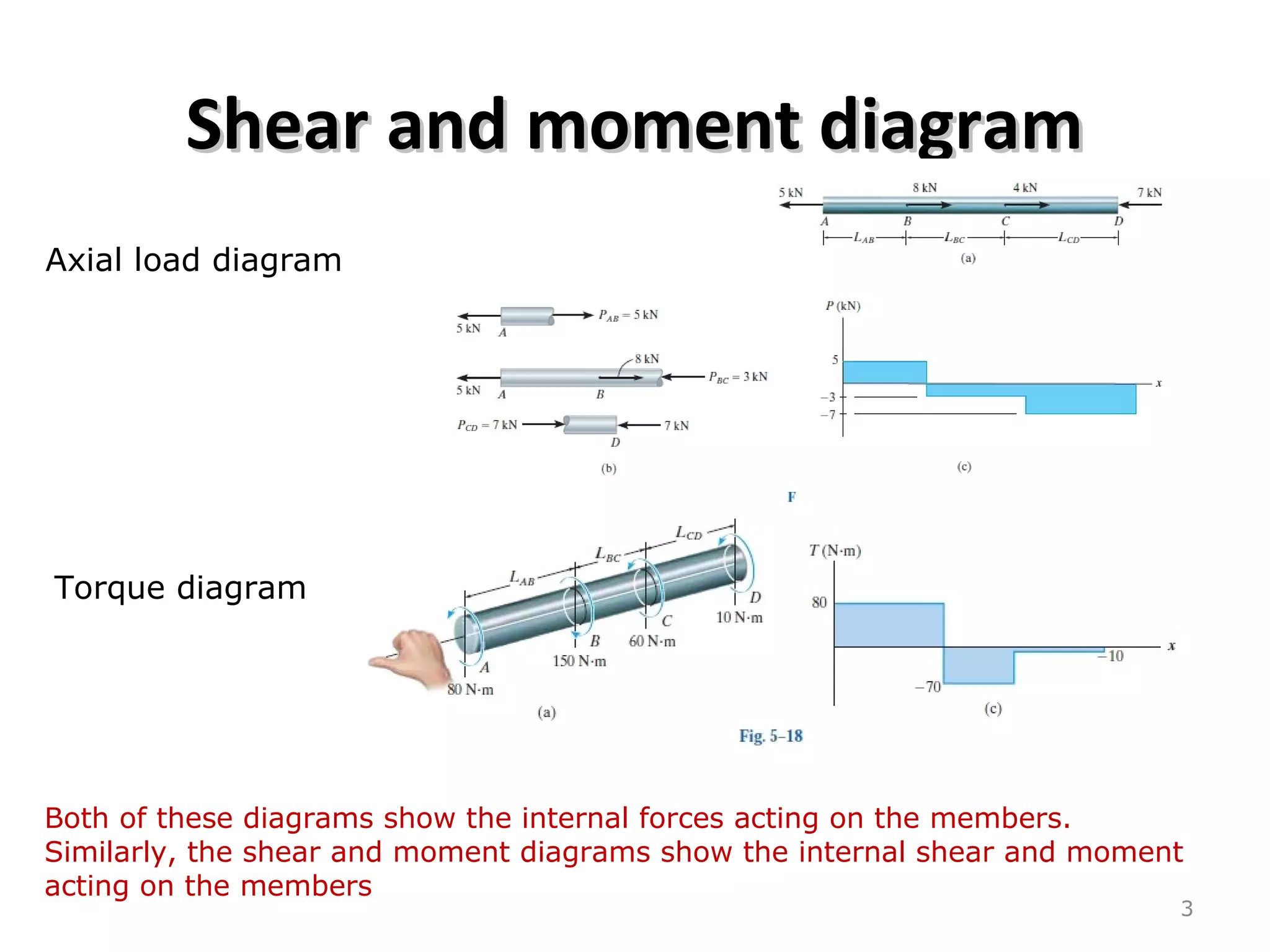
Axial load diagram
Torque diagram
Both of these diagrams show the internal forces acting on the members.
Similarly, the shear and moment diagrams show the internal shear and moment
acting on the members
Type of BeamsType of Beams
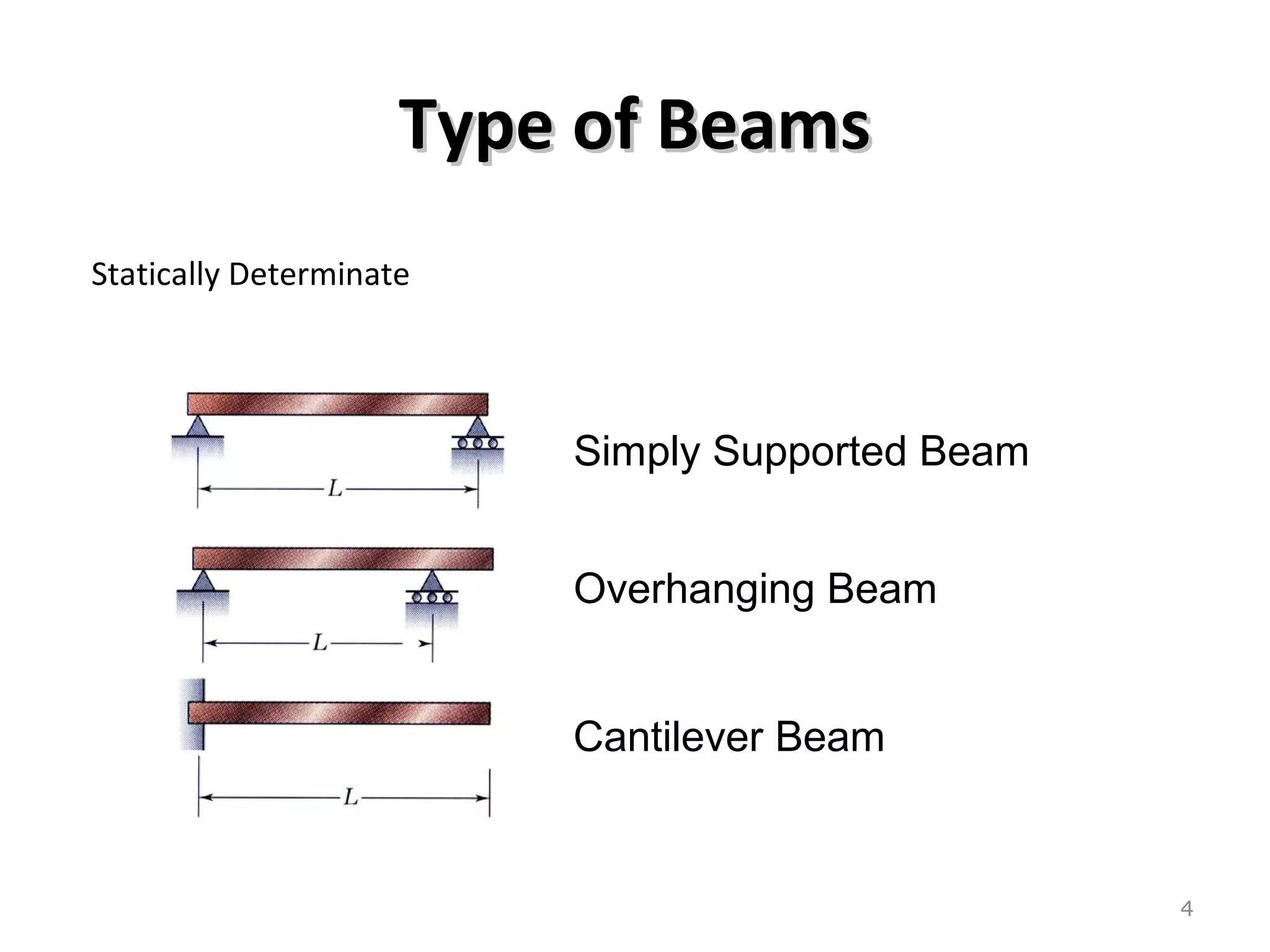
Statically Determinate
4
Simply Supported Beam
Overhanging Beam
Cantilever Beam
Type of BeamsType of Beams
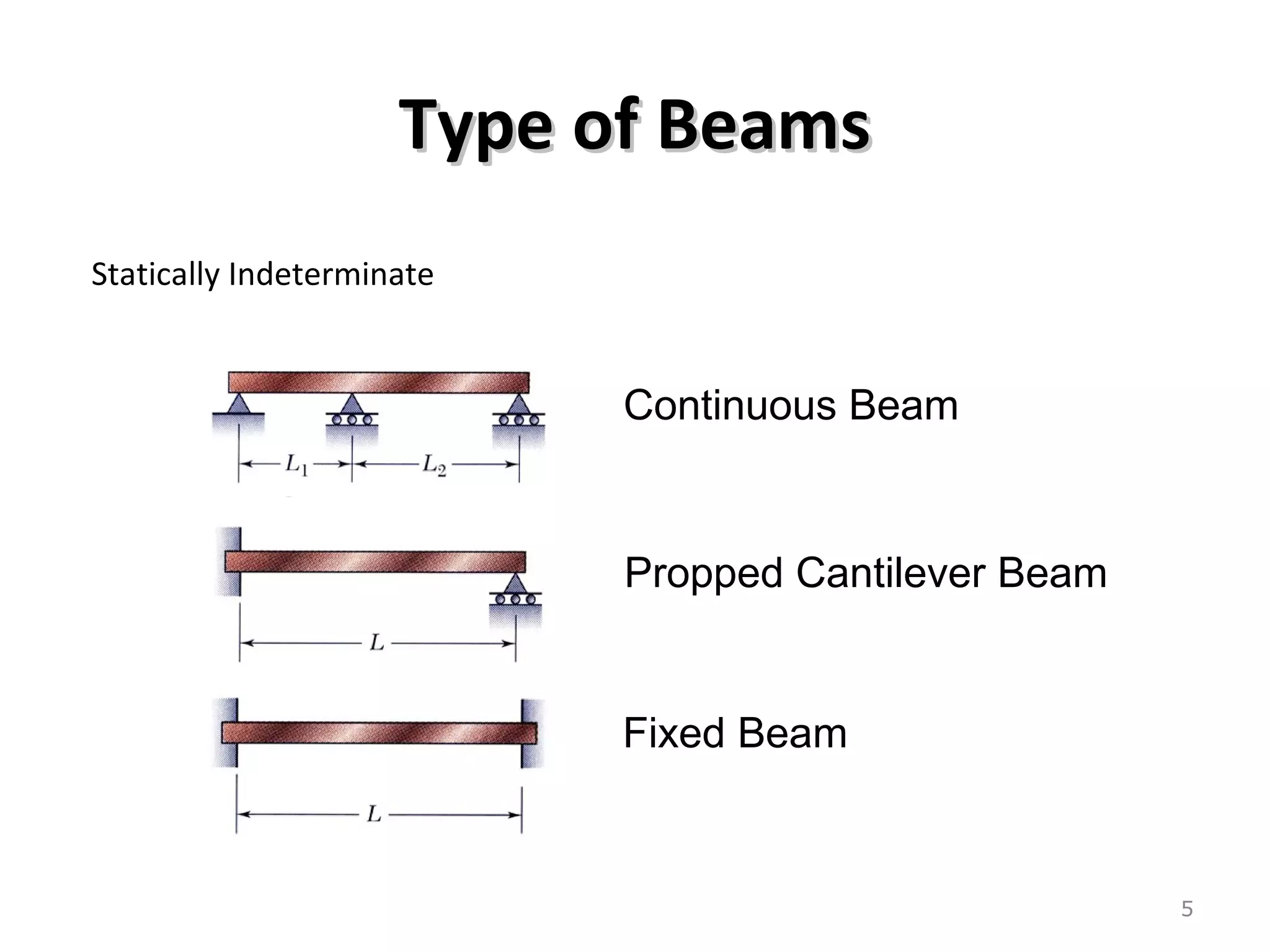
Statically Indeterminate
5
Continuous Beam
Propped Cantilever Beam
Fixed Beam
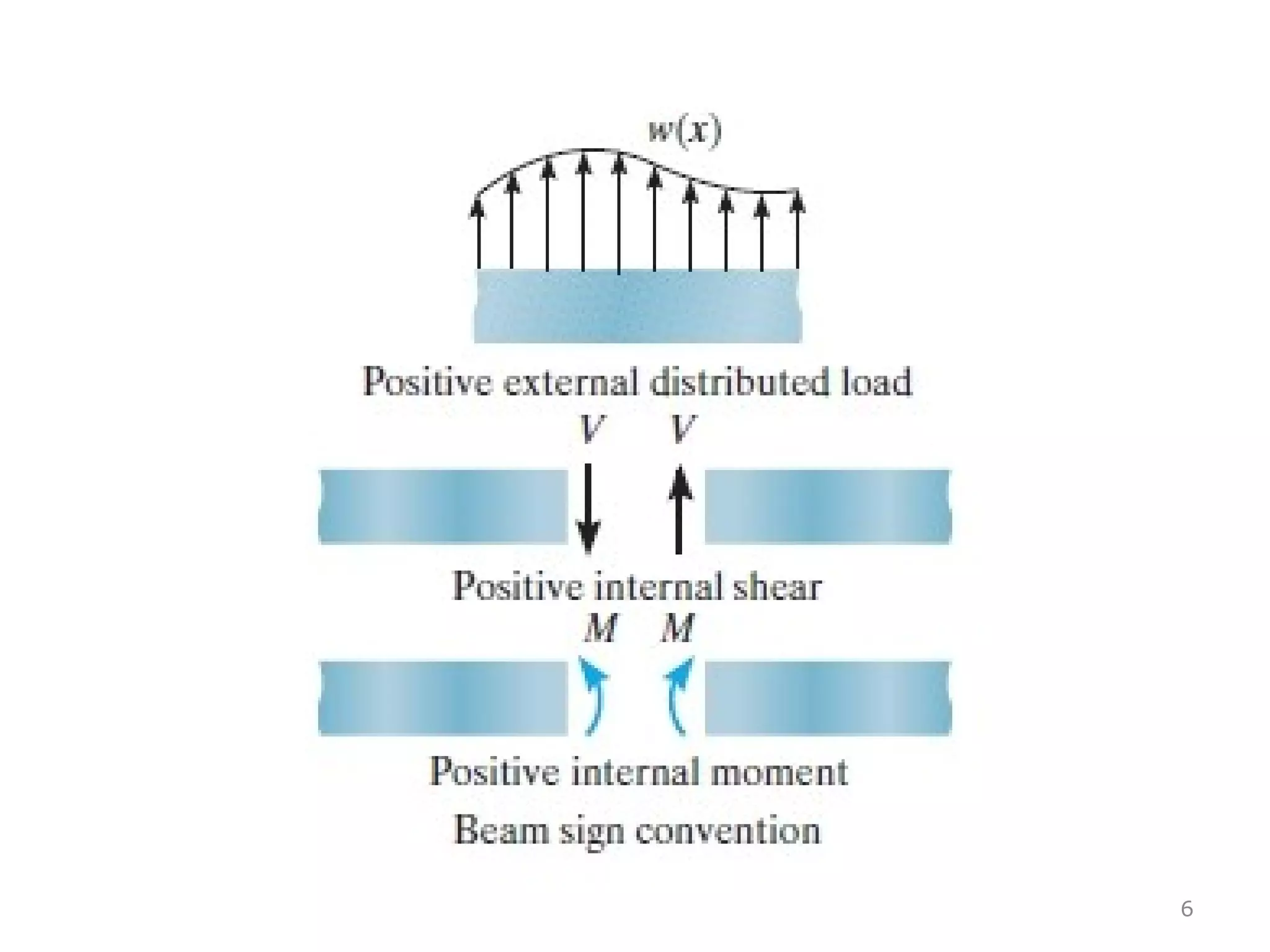
6
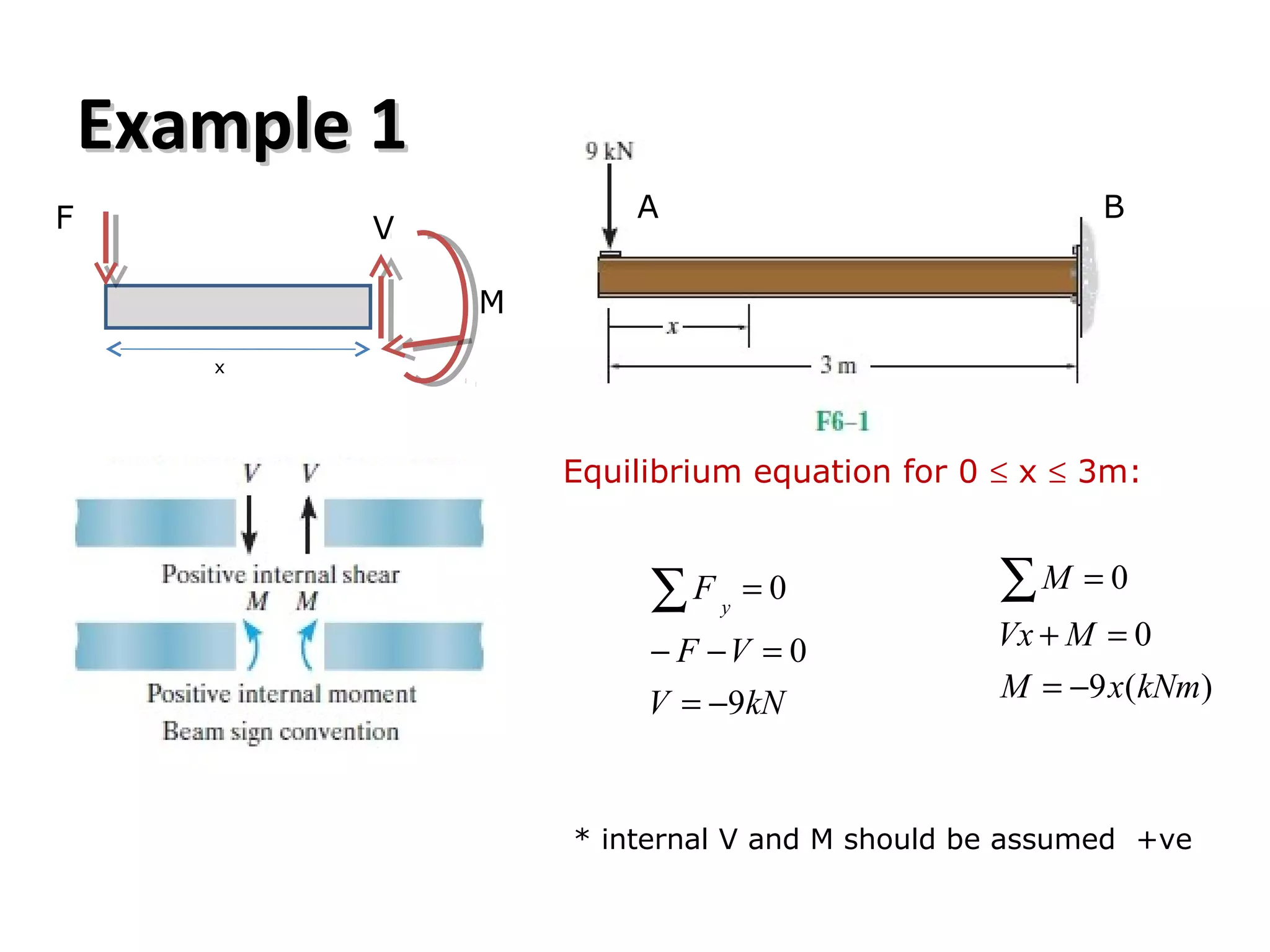
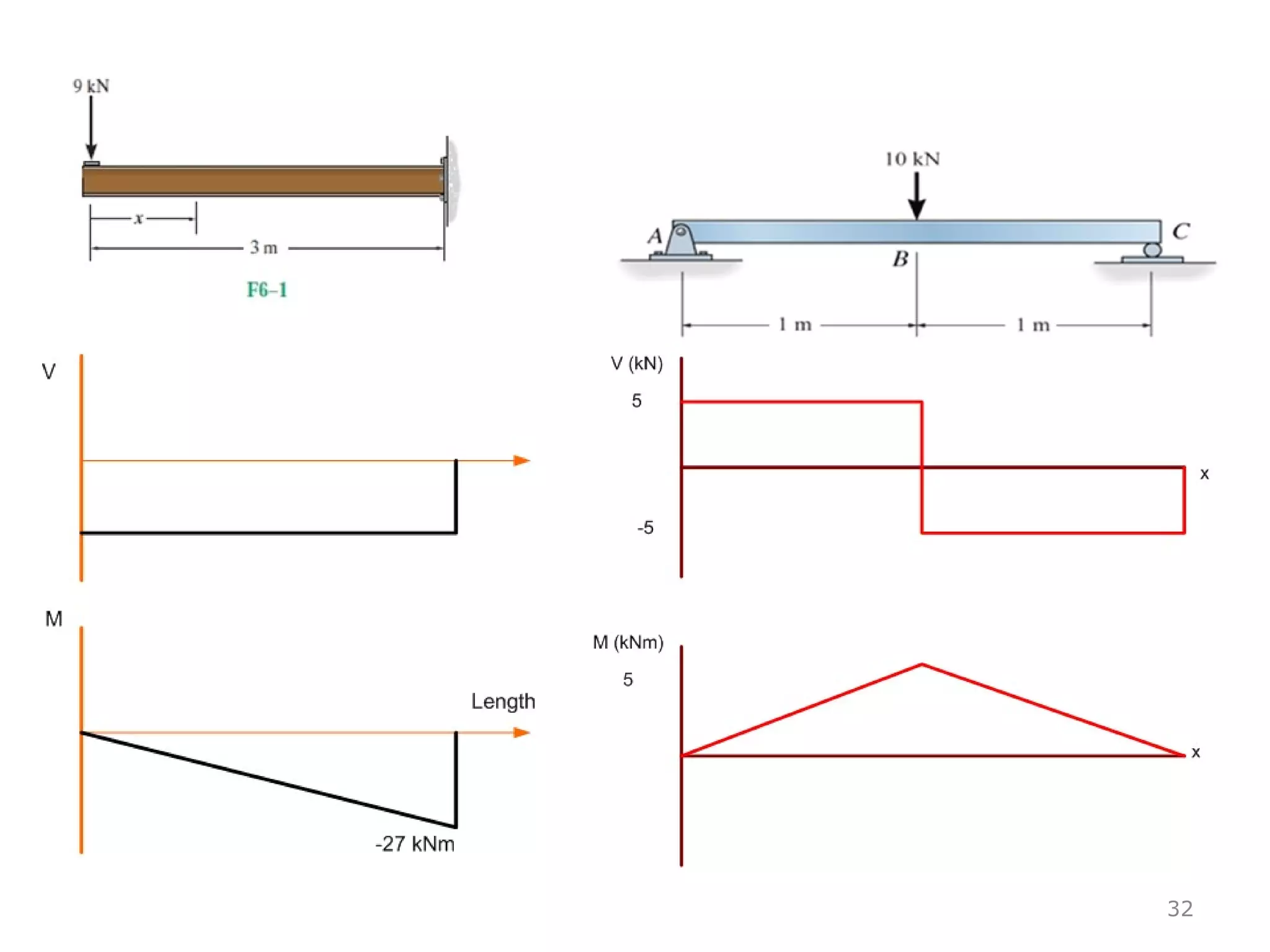
Example 1Example 1
Equilibrium equation for 0 ≤ x ≤ 3m:
A B
* internal V and M should be assumed +ve
kNV
VF
F y
9
0
0
−=
=−−
=∑
)(9
0
0
kNmxM
MVx
M
−=
=+
=∑
M
VF
x
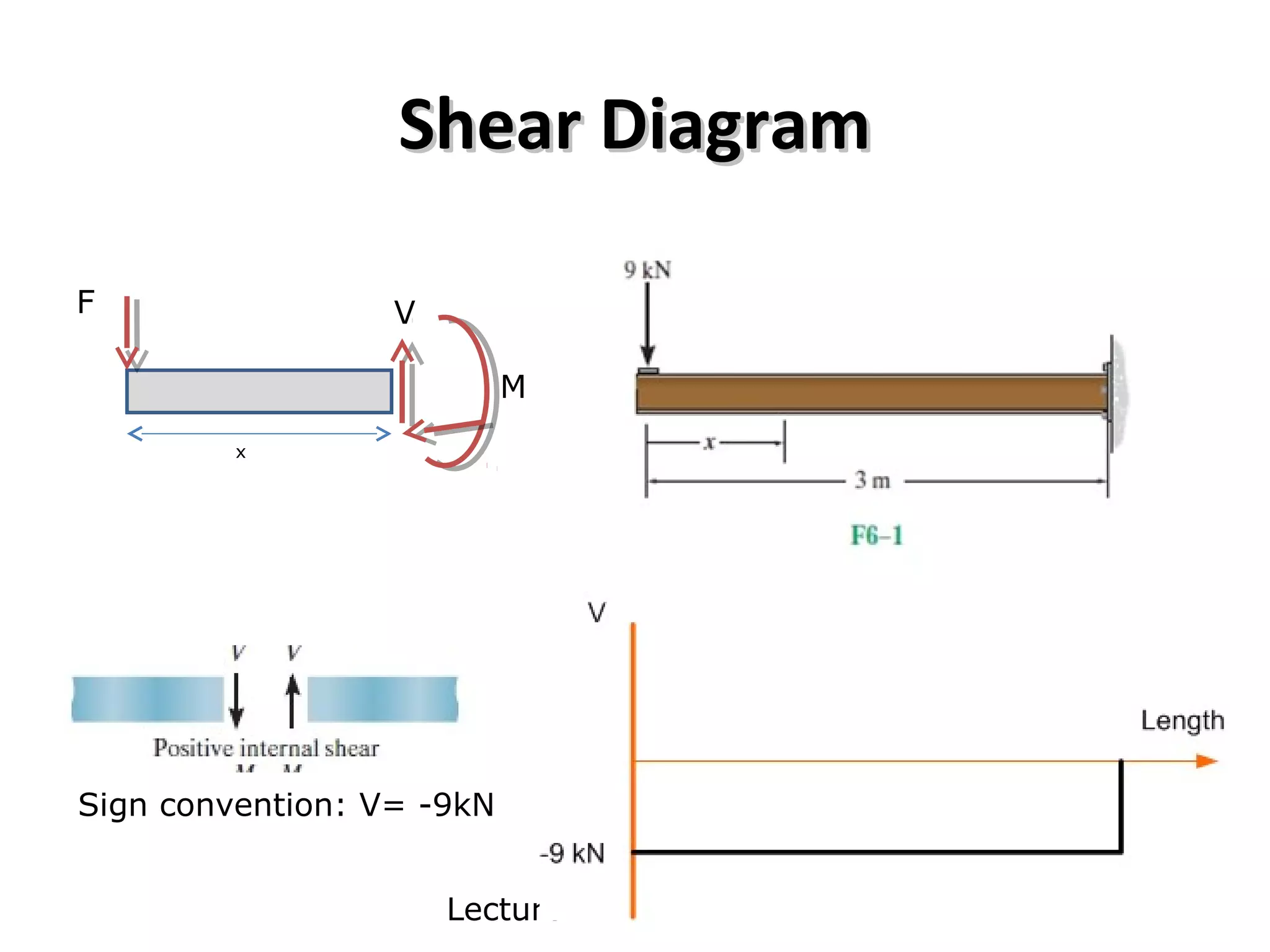
Shear DiagramShear Diagram
Lecture 1 8
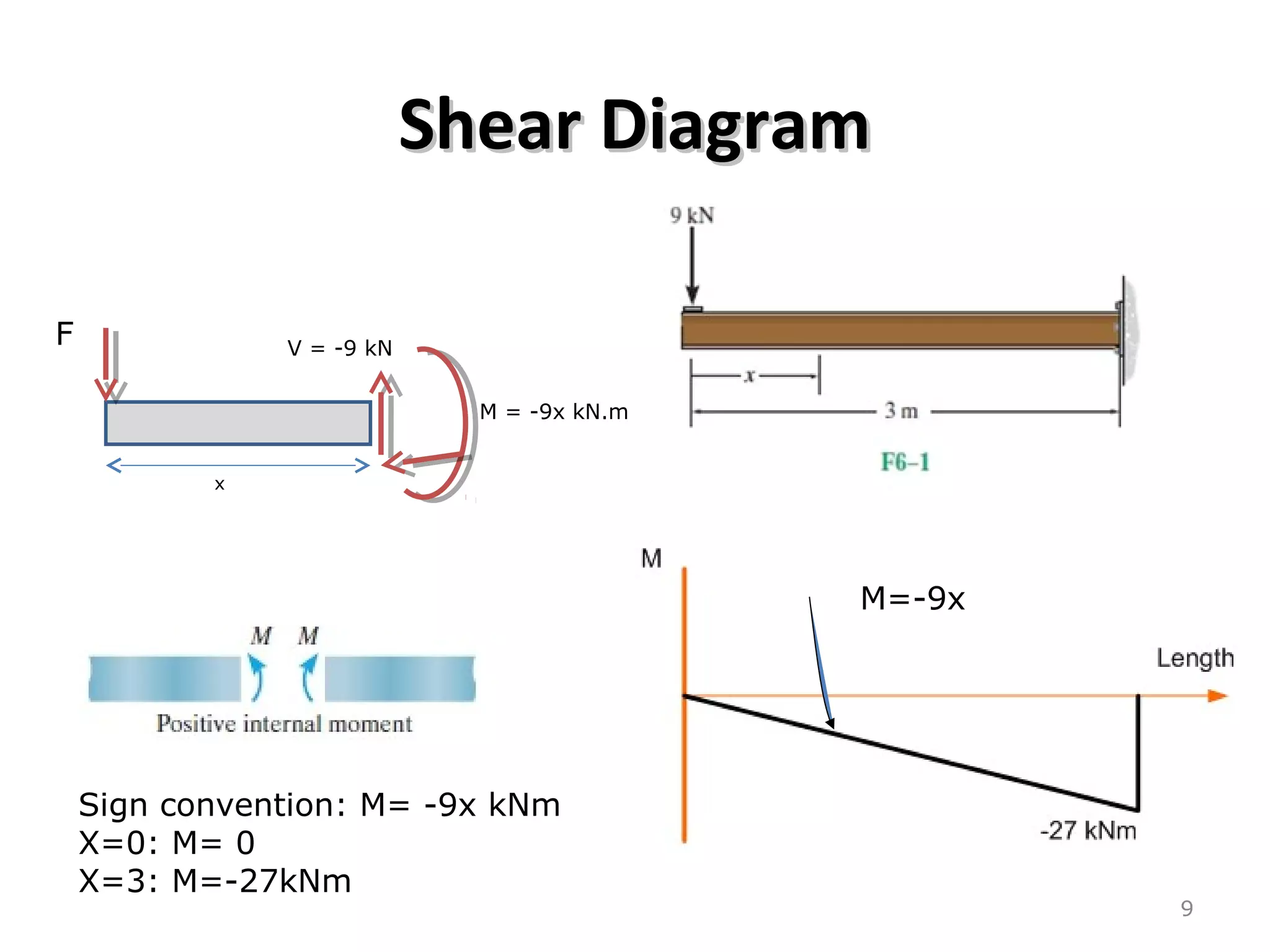
Sign convention: V= -9kN
M
VF
x
Shear DiagramShear Diagram
9
Sign convention: M= -9x kNm
X=0: M= 0
X=3: M=-27kNm
M=-9x
M = -9x kN.m
V = -9 kN
F
x
10
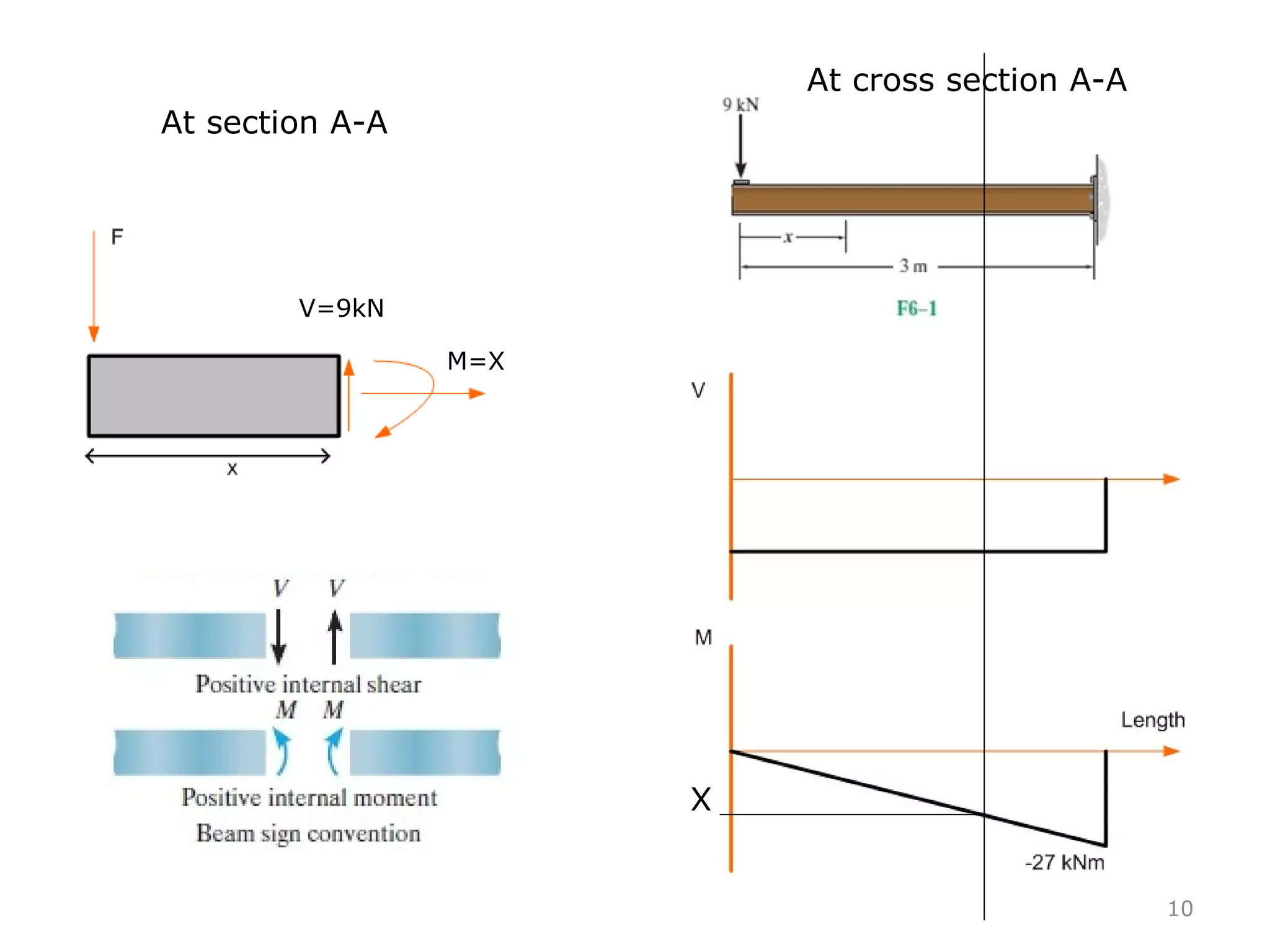
V=9kN
M=X
At cross section A-A
X
At section A-A
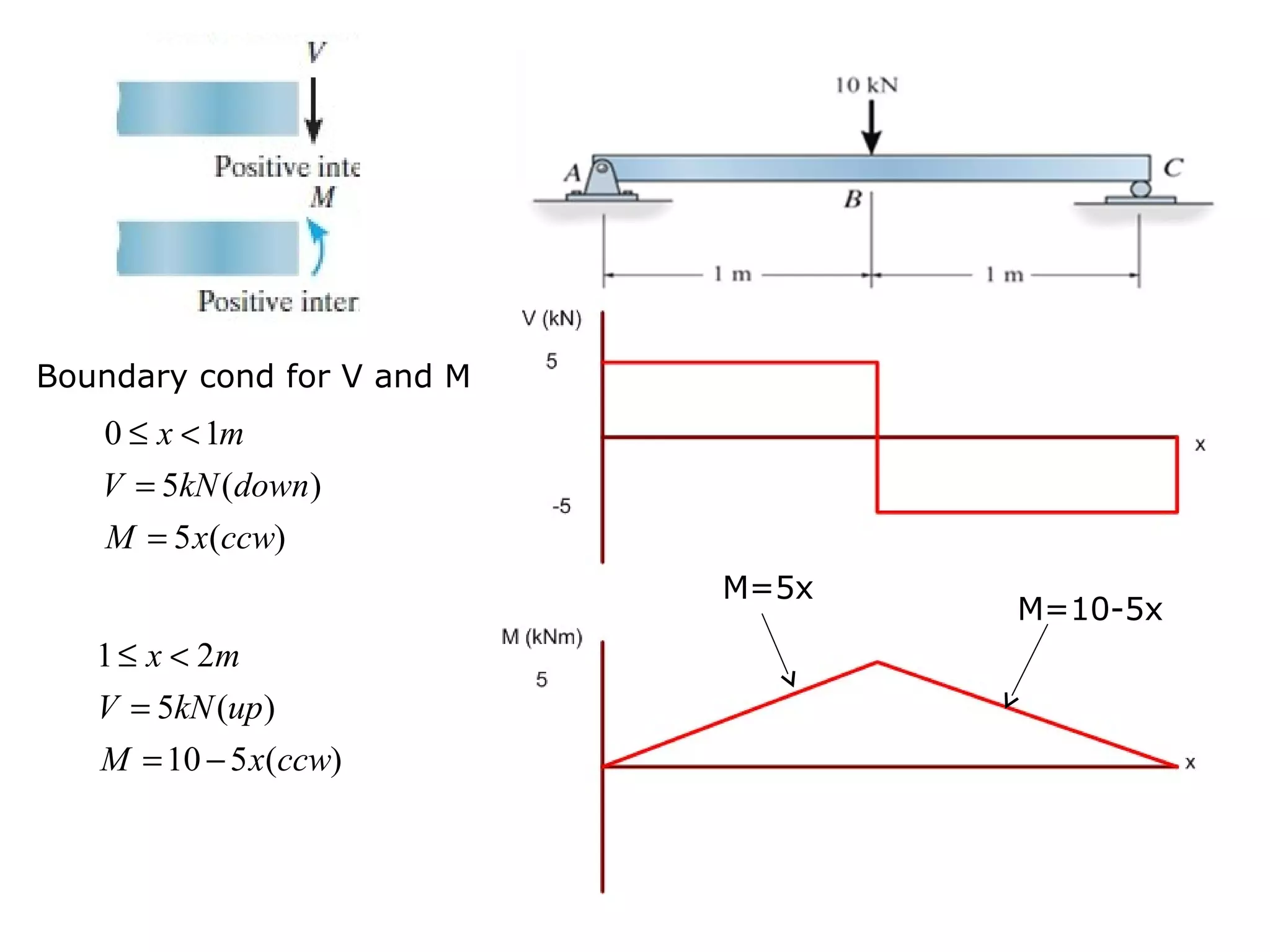
Example 2Example 2
11
kN5
01050F
kN5
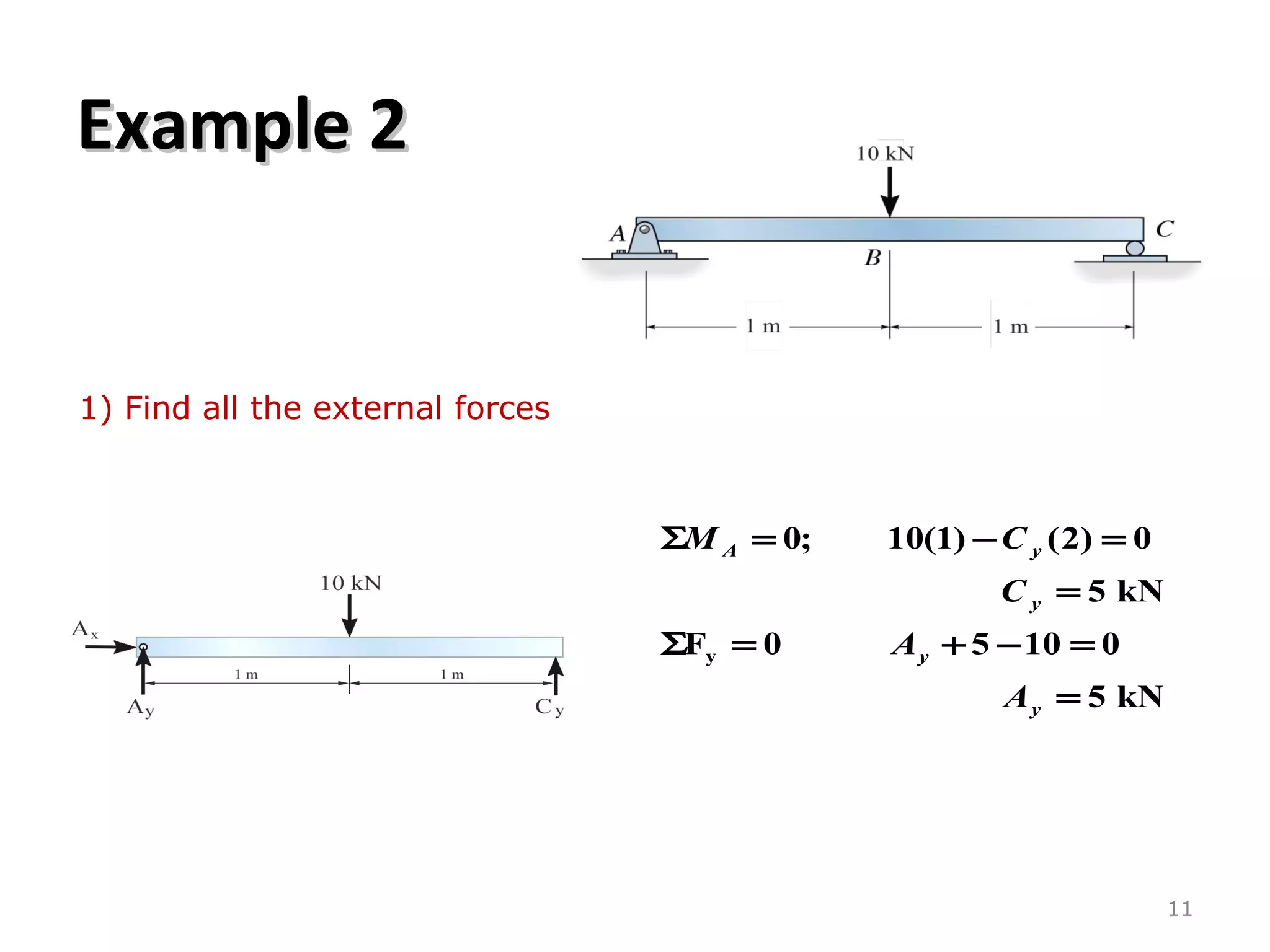
0)2()1(10;0
y
=
=−+=Σ
=
=−=Σ
y
y
y
yA
A
A
C
CM
1) Find all the external forces
12
)(5
0
0
10
downkNV
VF
F
mx
y
=
=−
=
<≤
∑
)(5
0
0
10
ccwkNmVxM
VxM
M
mx
A
==
=−
=
<≤
∑
)(5
010
0
21
upkNV
VF
F
mx
y
=
=+−
=
≤≤
∑
)()510(
10
0)1(10
0
21
ccwkNmxM
VxM
MVx
M
mx
A
−=
−=
=+−
=
≤≤
∑
Force equilibrium
Force equilibrium
Moment equilibrium
Moment equilibrium
)(5
)(5
10
ccwxM
downkNV
mx
=
=
<≤
)(510
)(5
21
ccwxM
upkNV
mx
−=
=
<≤
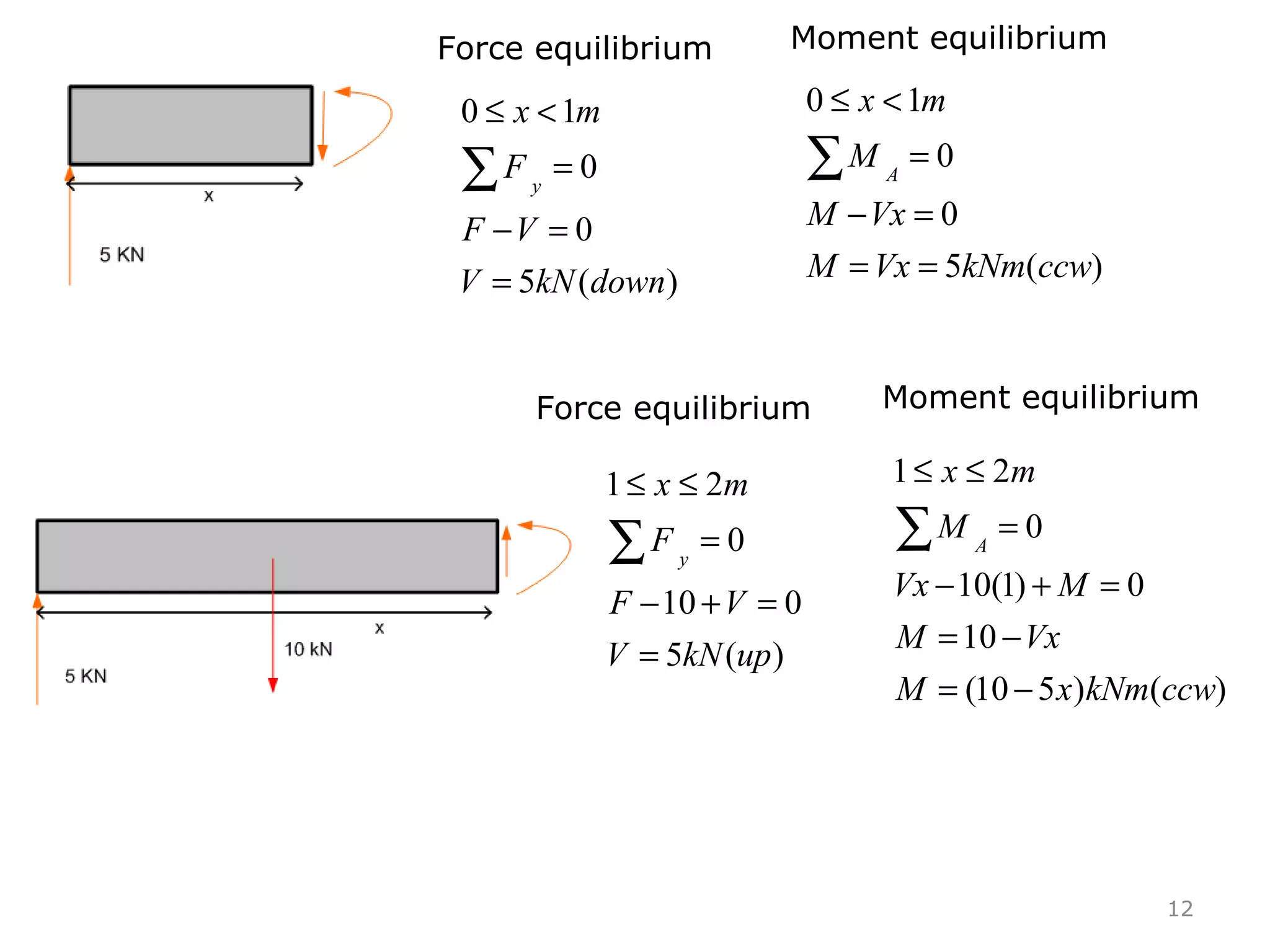
M=5x
M=10-5x
Boundary cond for V and M
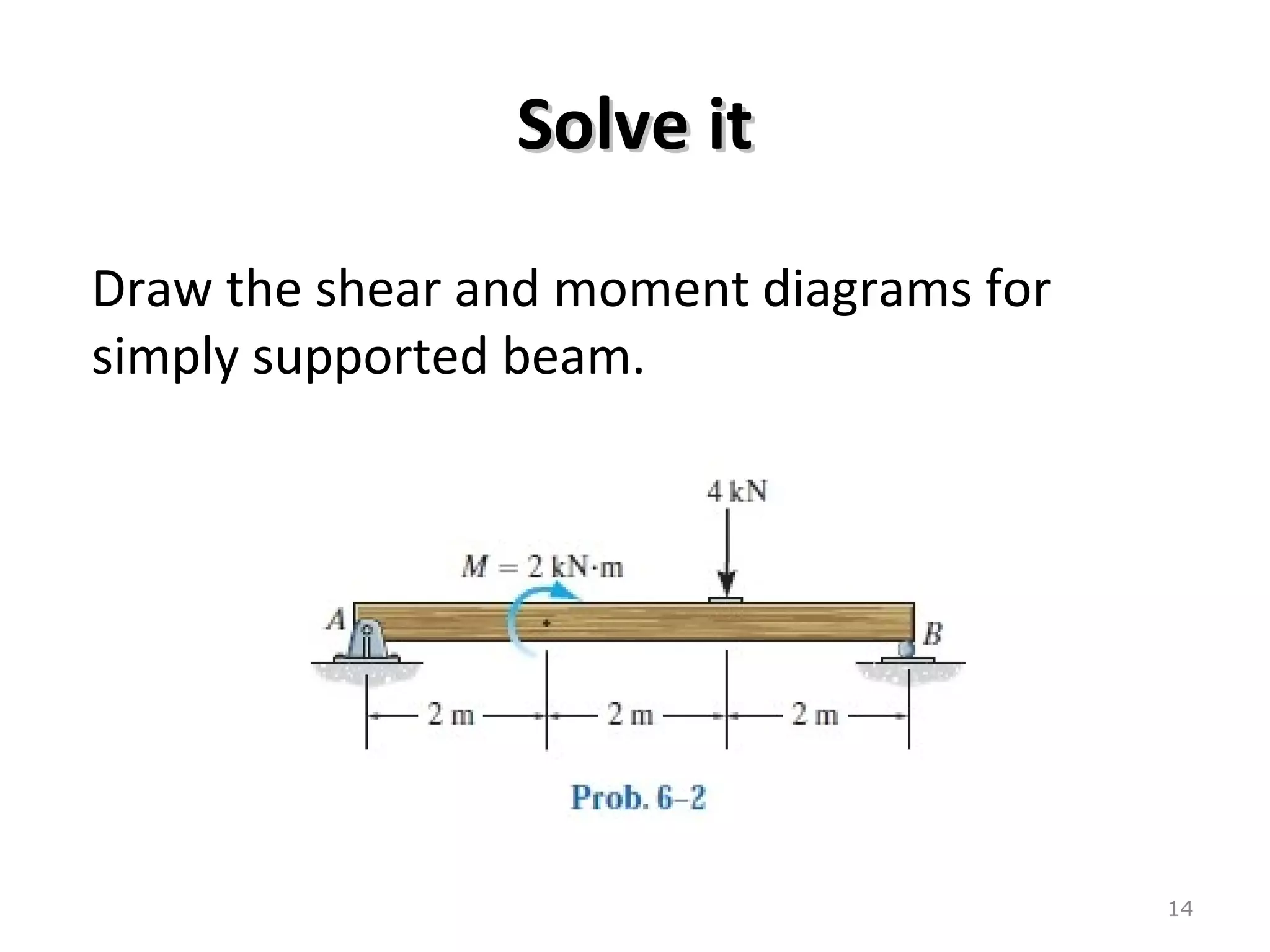
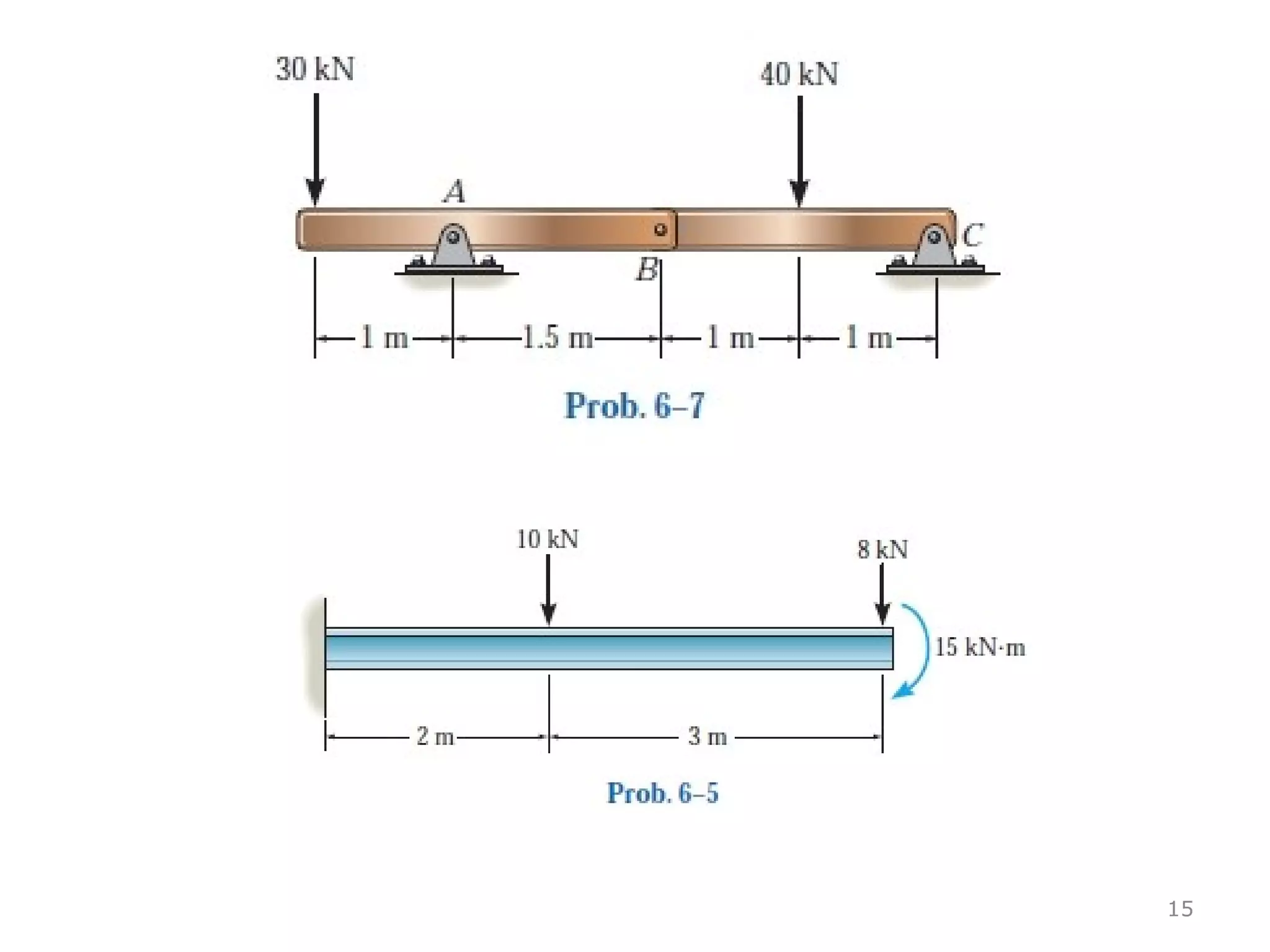
Solve itSolve it
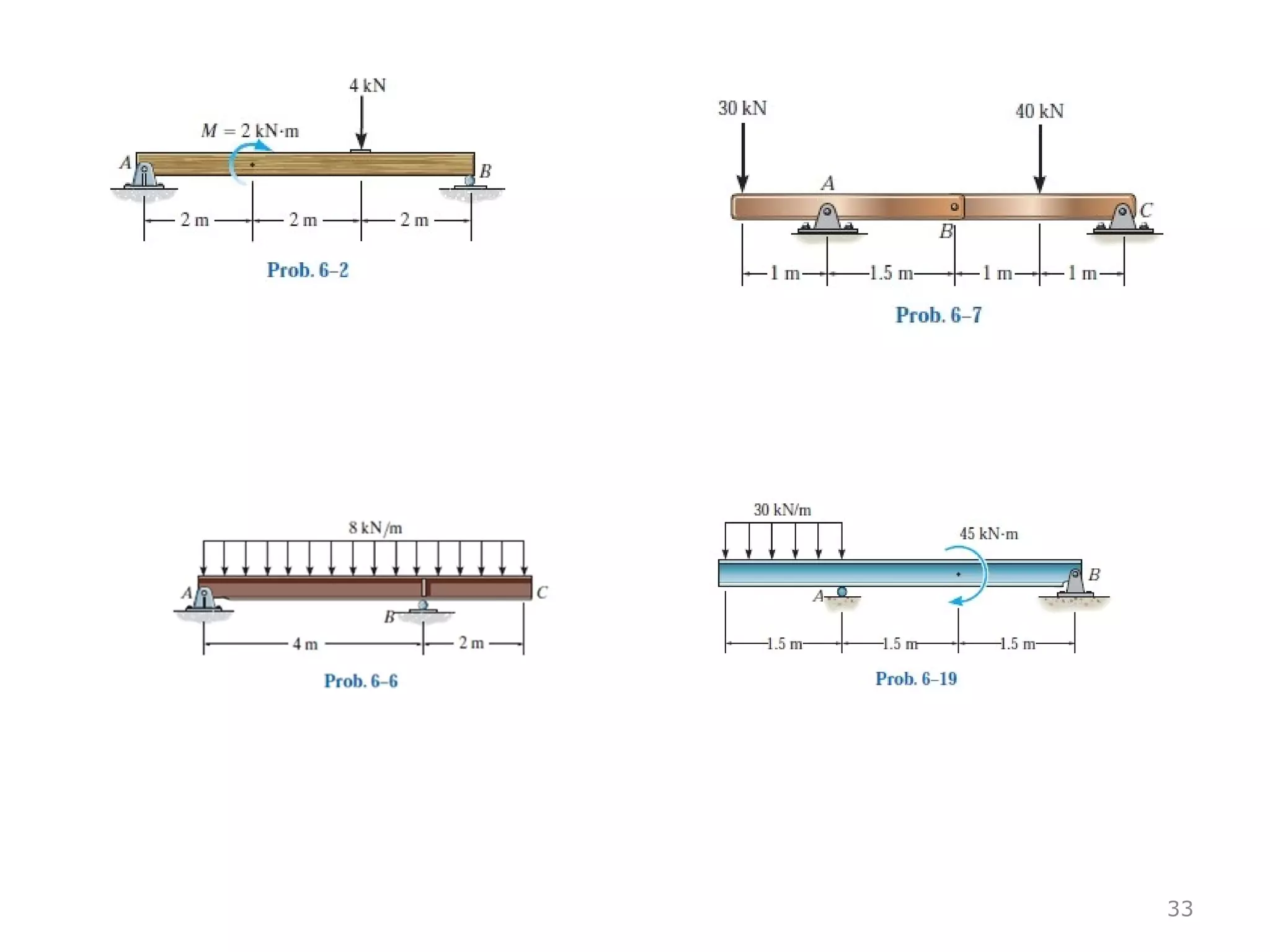
Draw the shear and moment diagrams for
simply supported beam.
14
15
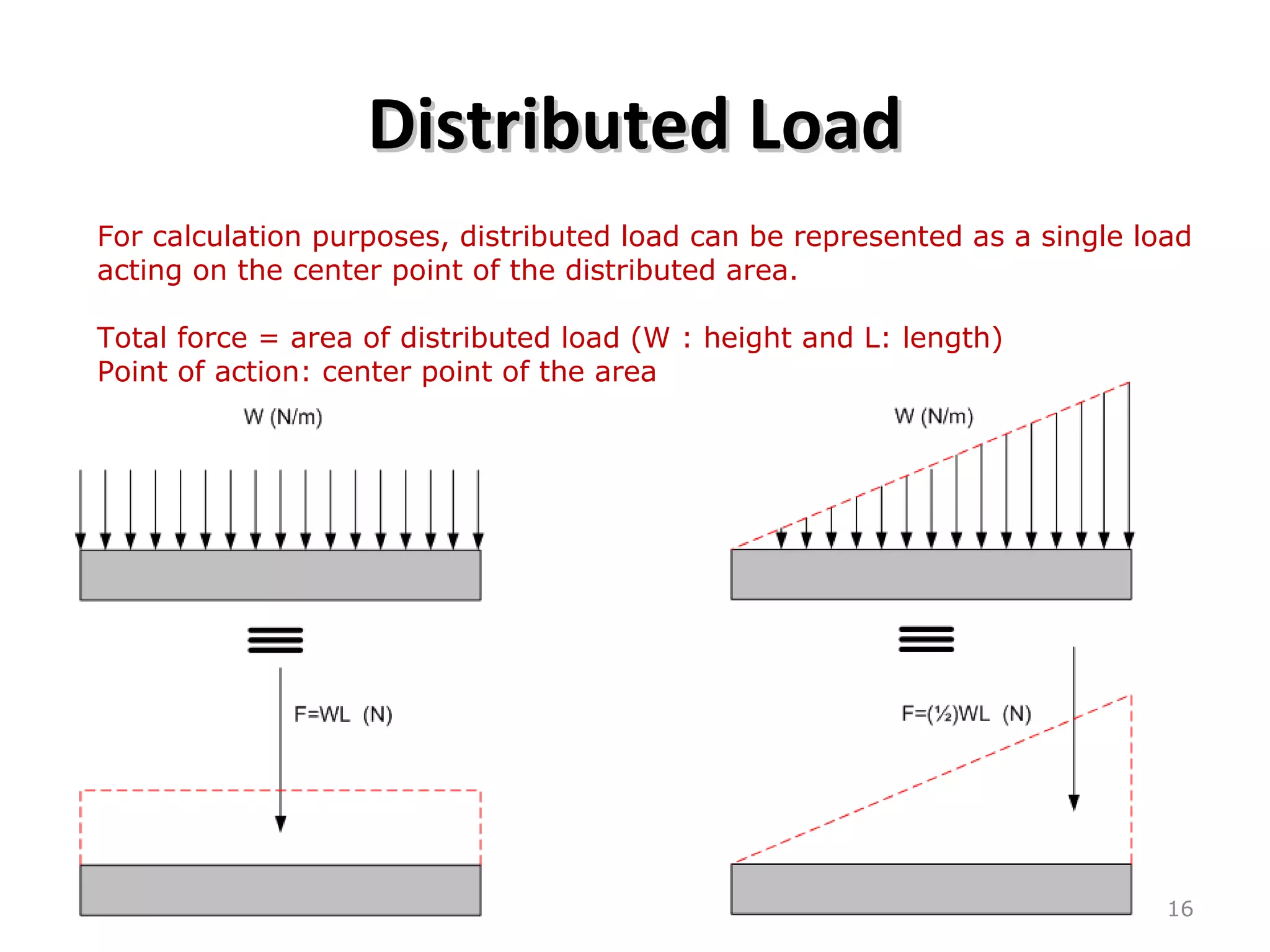
Distributed LoadDistributed Load
16
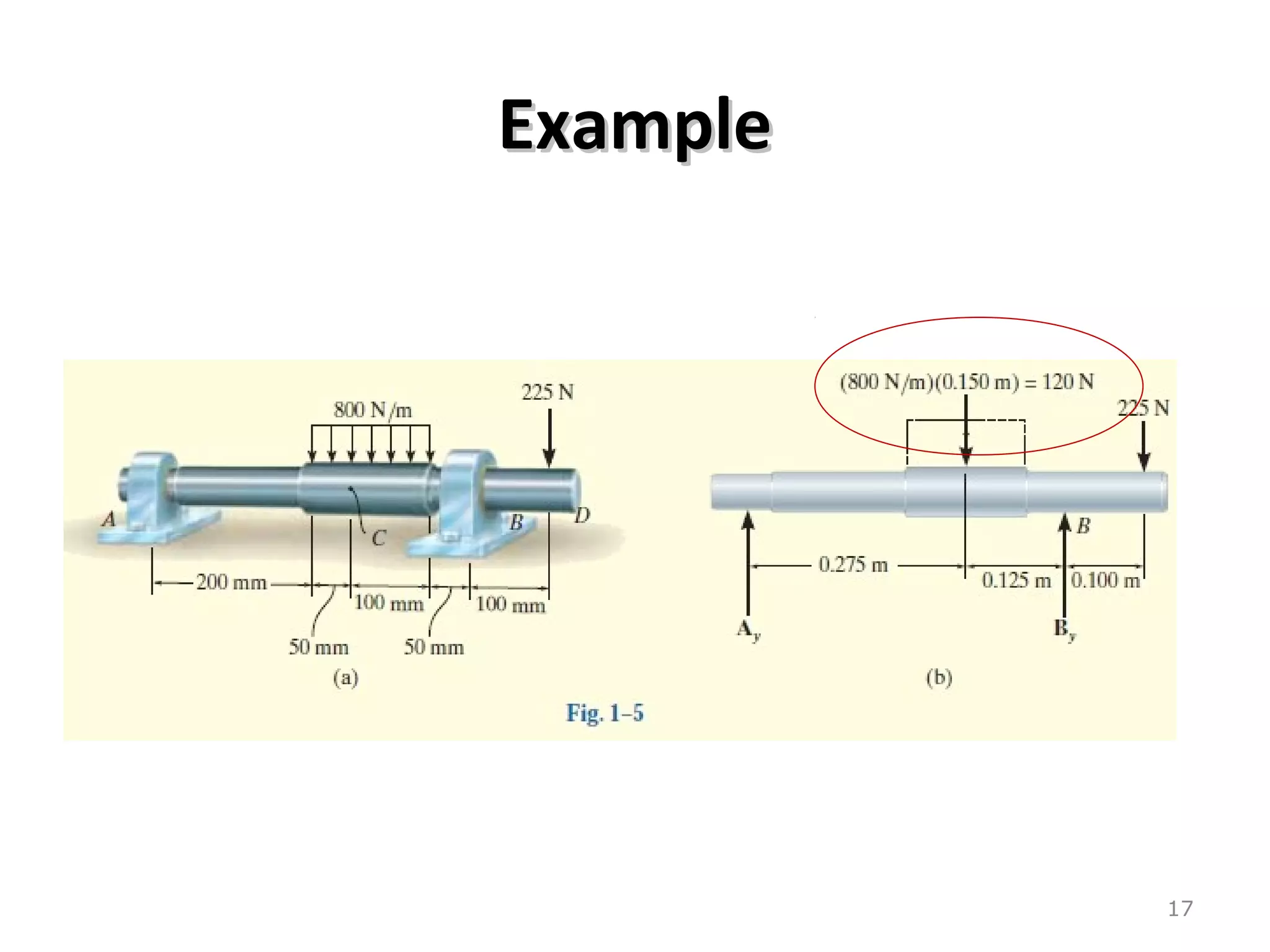
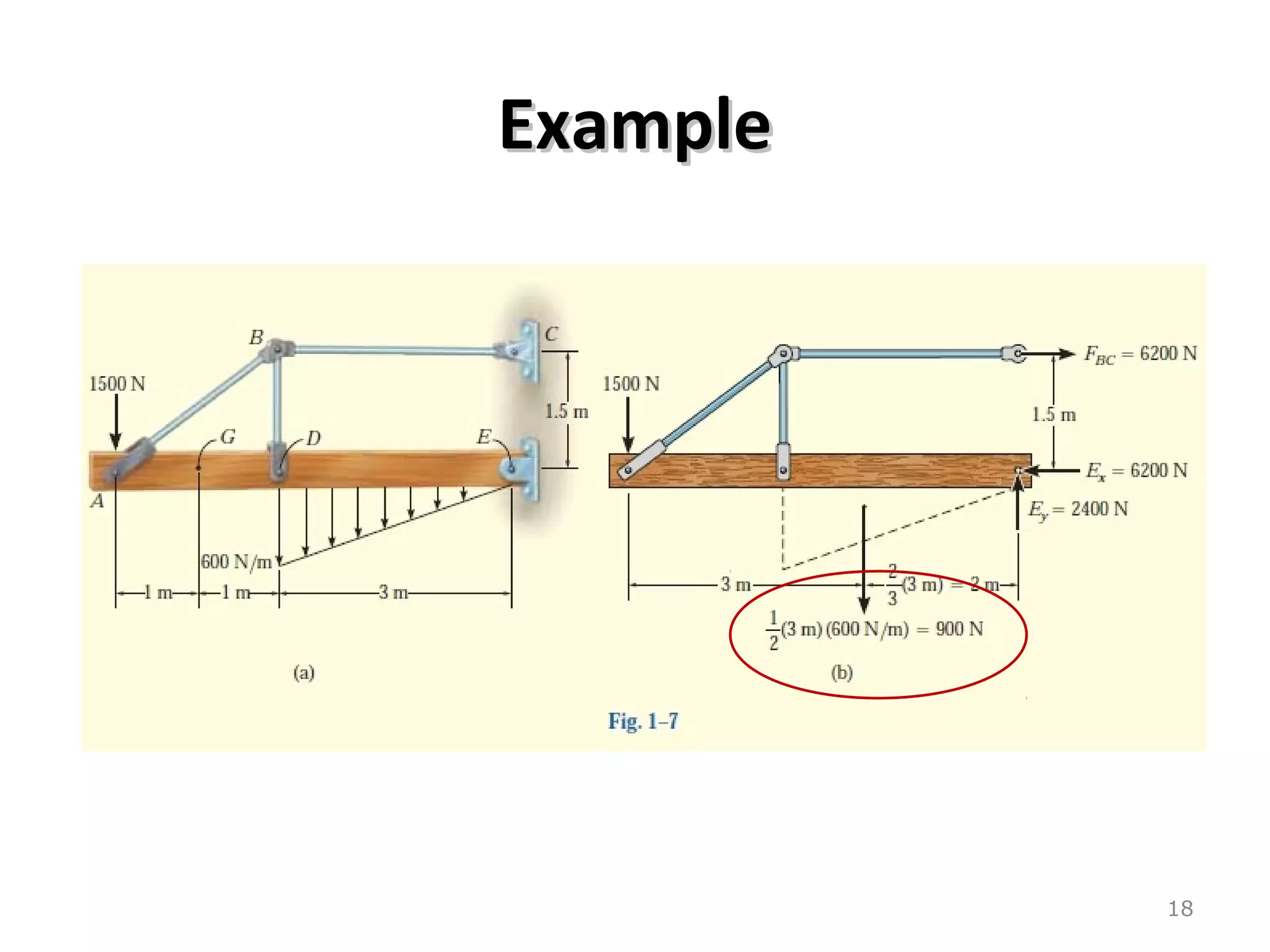
For calculation purposes, distributed load can be represented as a single load
acting on the center point of the distributed area.
Total force = area of distributed load (W : height and L: length)
Point of action: center point of the area
ExampleExample
17
ExampleExample
18
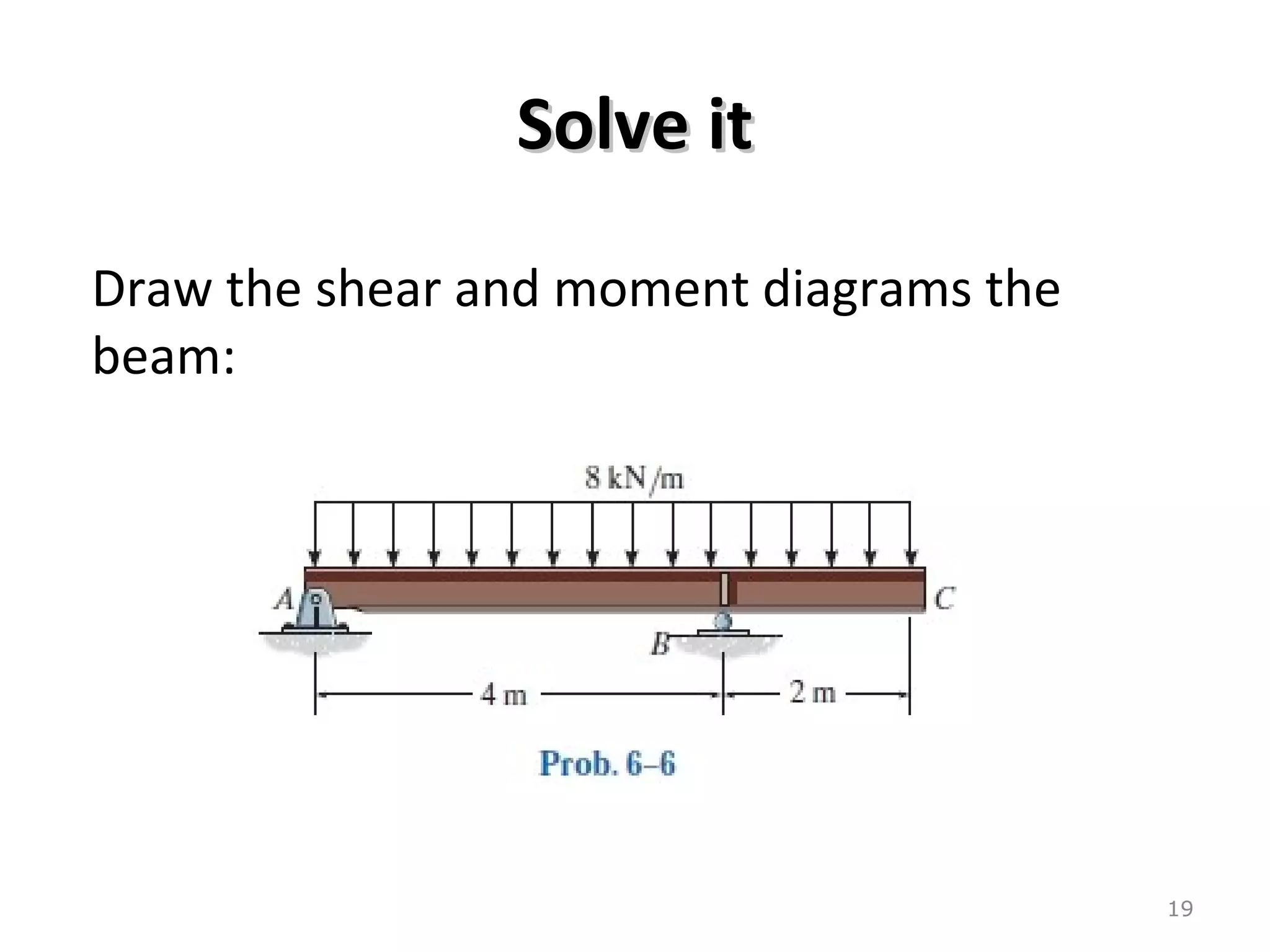
Solve itSolve it
Draw the shear and moment diagrams the
beam:
19
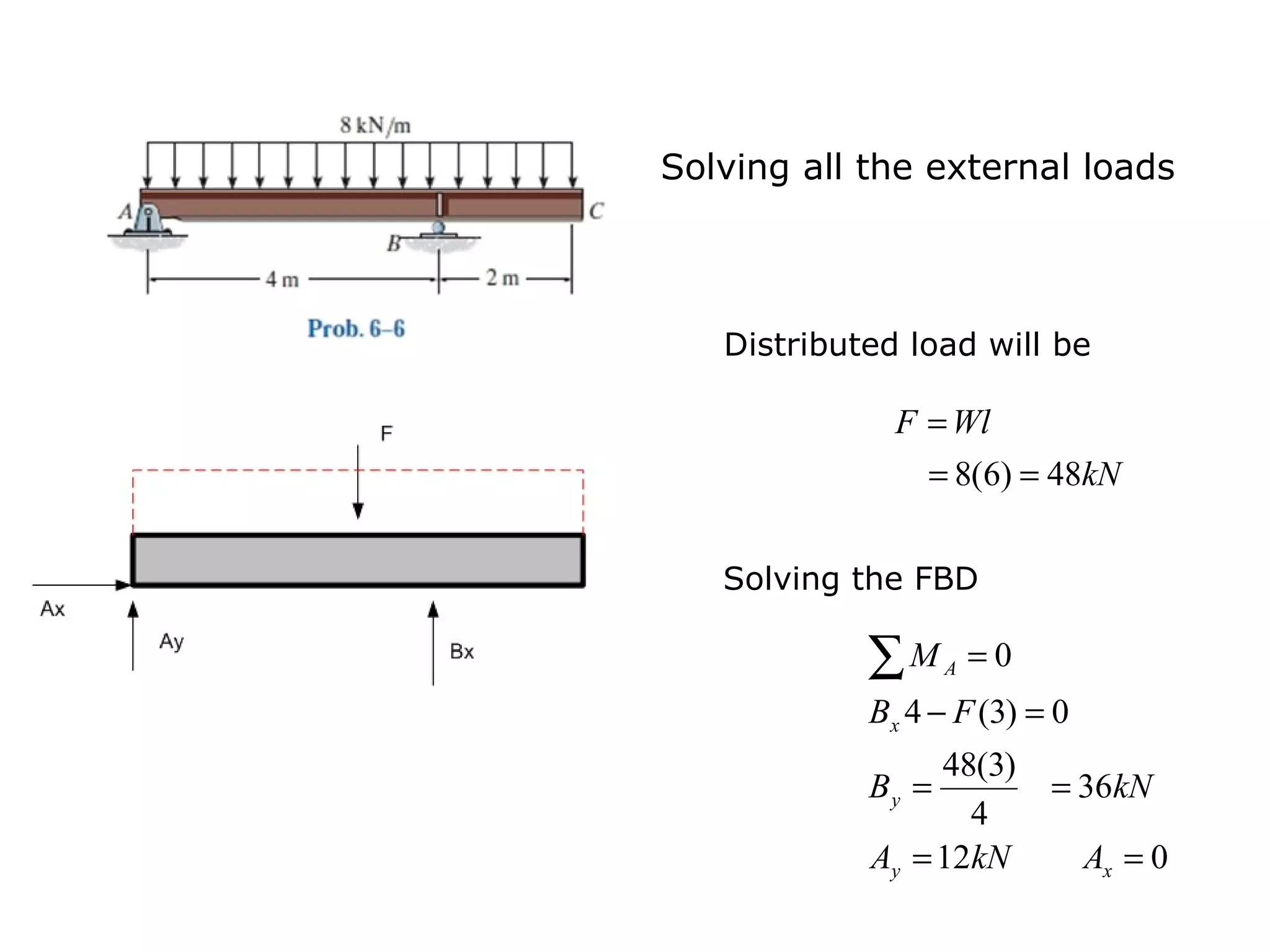
Solving all the external loads
kN
WlF
48)6(8 ==
=
Distributed load will be
Solving the FBD
012
36
4
)3(48
0)3(4
0
==
==
=−
=∑
xy
y
x
A
AkNA
kNB
FB
M
21
Boundary Condition 40 <≤ x
xV
Vx
FY
812
0812
0
−=
=−−
=∑
2
2
2
412
0412
04)812(
04
0
xxM
xxM
xxxM
xVxM
M A
−=
=+−
=−−−
=−−
=∑
Equilibrium eq
22
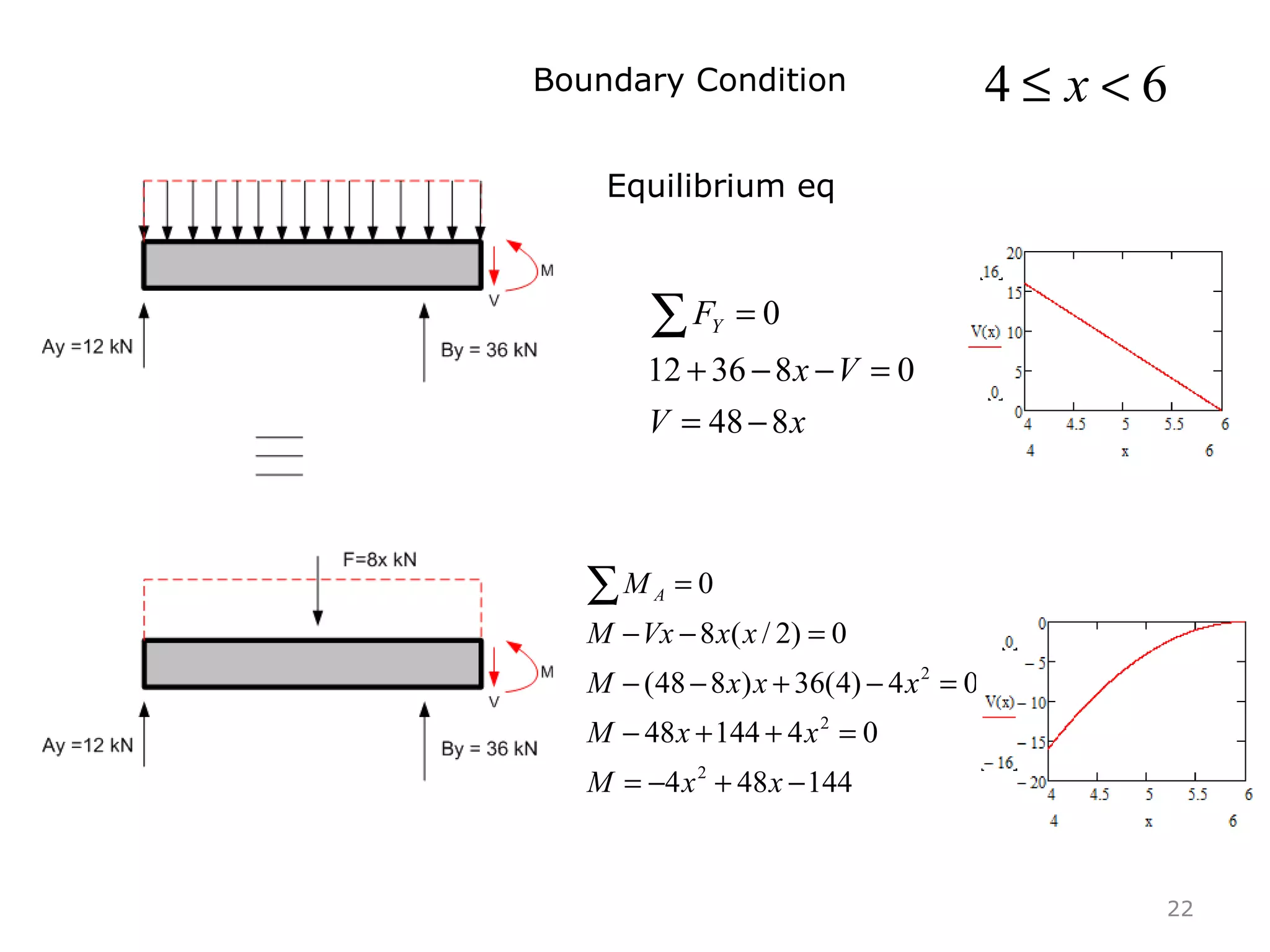
Boundary Condition 64 <≤ x
xV
Vx
FY
848
083612
0
−=
=−−+
=∑
144484
0414448
04)4(36)848(
0)2/(8
0
2
2
2
−+−=
=++−
=−+−−
=−−
=∑
xxM
xxM
xxxM
xxVxM
M A
Equilibrium eq
23
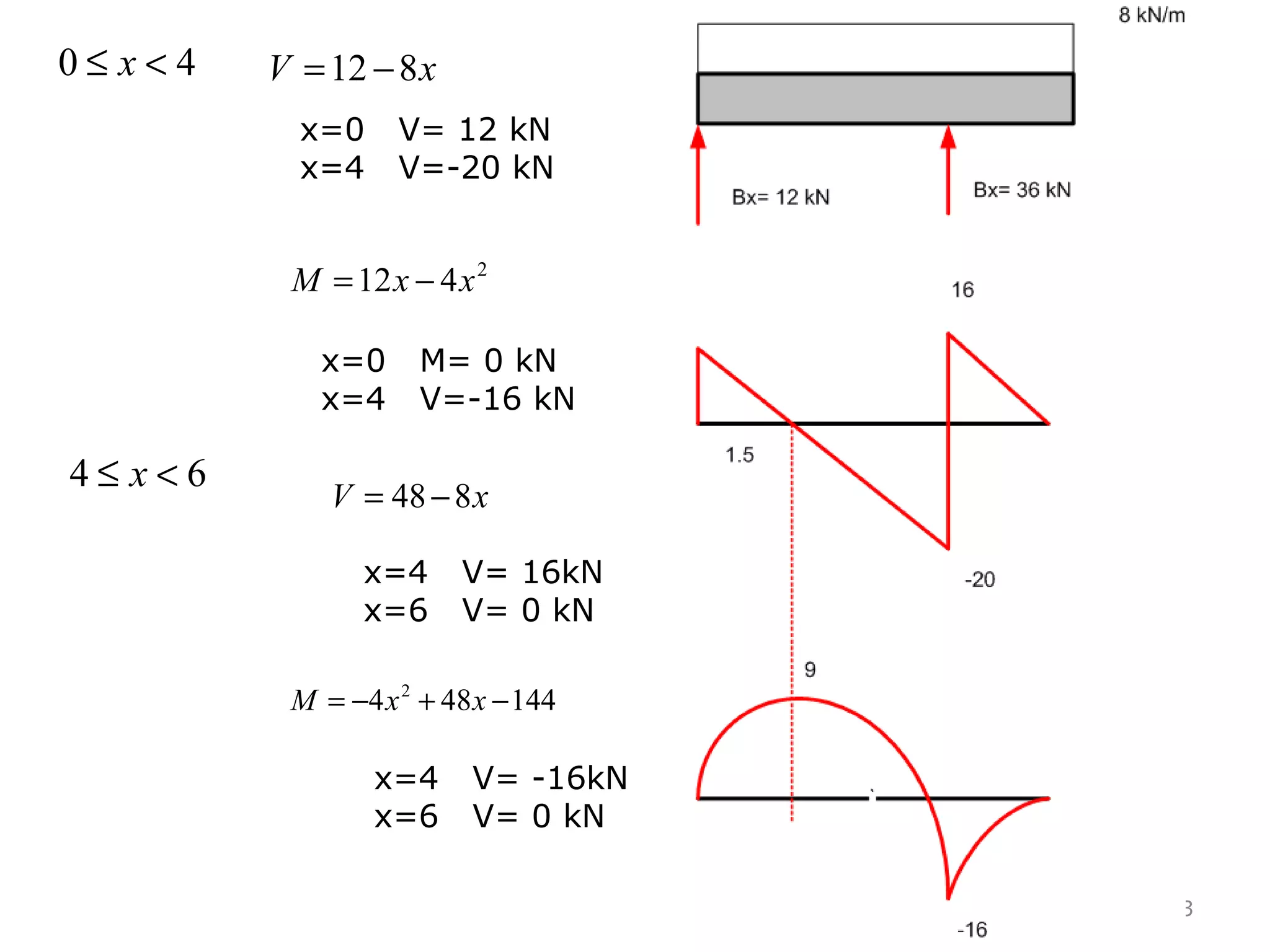
40 <≤ x
x=0 V= 12 kN
x=4 V=-20 kN
xV 812 −=
2
412 xxM −=
x=0 M= 0 kN
x=4 V=-16 kN
64 <≤ x
xV 848−=
x=4 V= 16kN
x=6 V= 0 kN
144484 2
−+−= xxM
x=4 V= -16kN
x=6 V= 0 kN
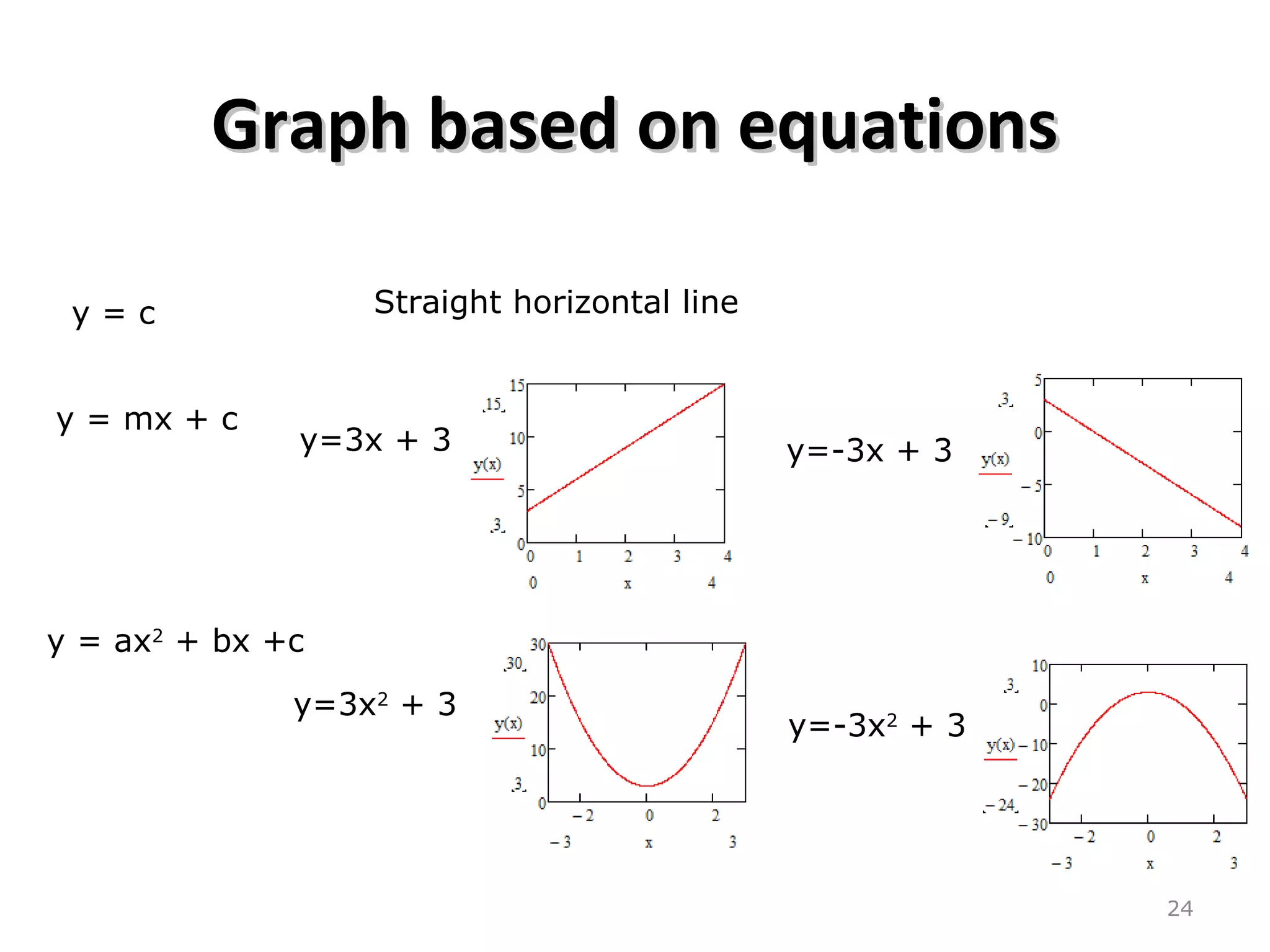
Graph based on equationsGraph based on equations
24
y = c Straight horizontal line
y = mx + c
y=3x + 3 y=-3x + 3
y=3x2
+ 3
y=-3x2
+ 3
y = ax2
+ bx +c
25
Graphical methodGraphical method
26
( )
( ) xxwV
VVxxwV
Fy
∆−=∆
=∆+−∆−
=Σ↑+
0)(
:0
• Relationship between load and
shear:
( ) ( )[ ] ( )
( ) ( )2
0
:0
xkxwxVM
MMxkxxwMxV
Mo
∆−∆=∆
=∆++∆∆+−∆−
=Σ
• Relationship between shear and
bending moment:
26
27
27
Dividing by ∆x and taking the limit as ∆x0, the
above two equations become:
Regions of distributed load:
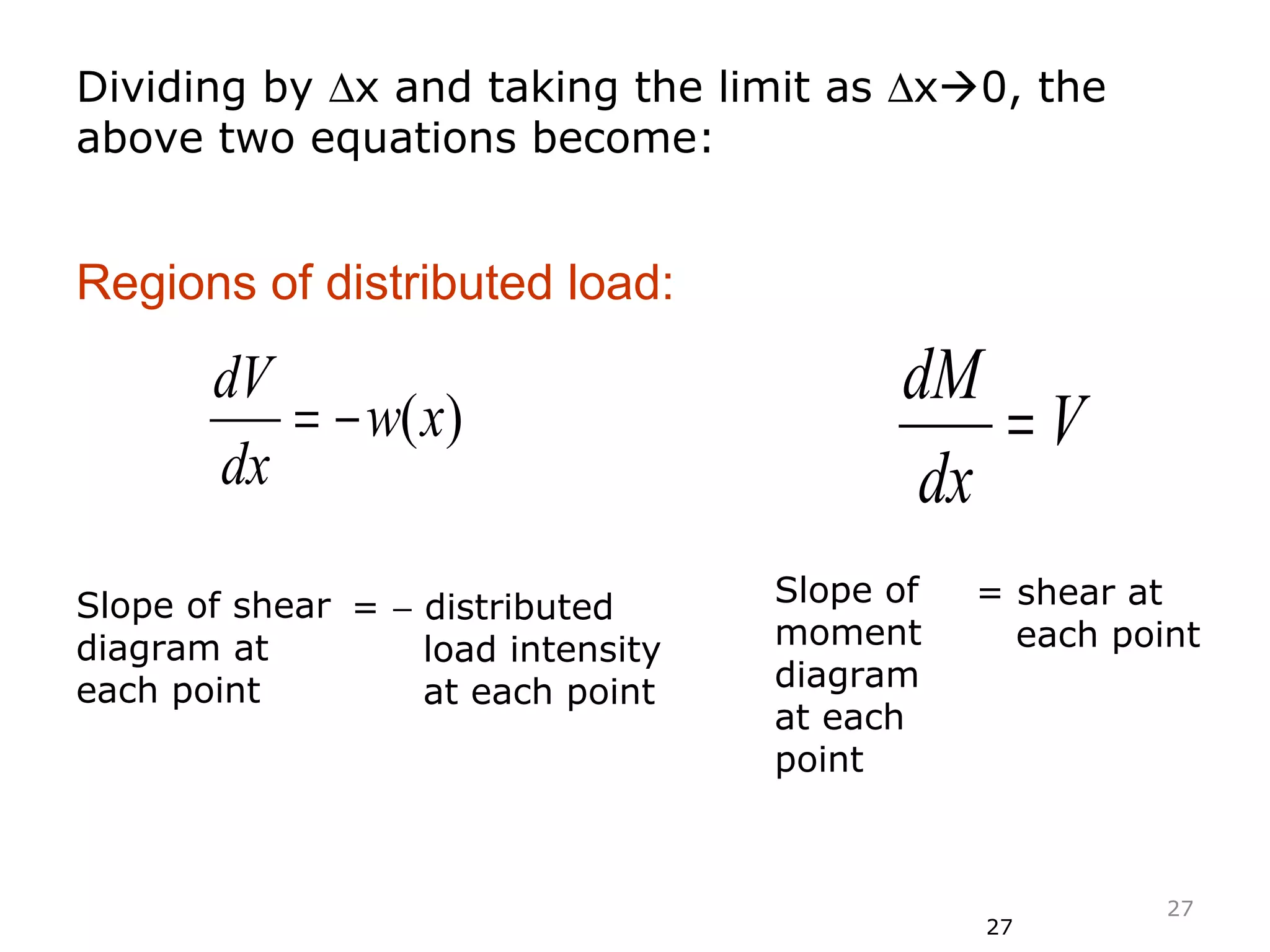
Slope of shear
diagram at
each point
Slope of
moment
diagram
at each
point
= − distributed
load intensity
at each point
= shear at
each point
)(xw
dx
dV
−= V
dx
dM
=
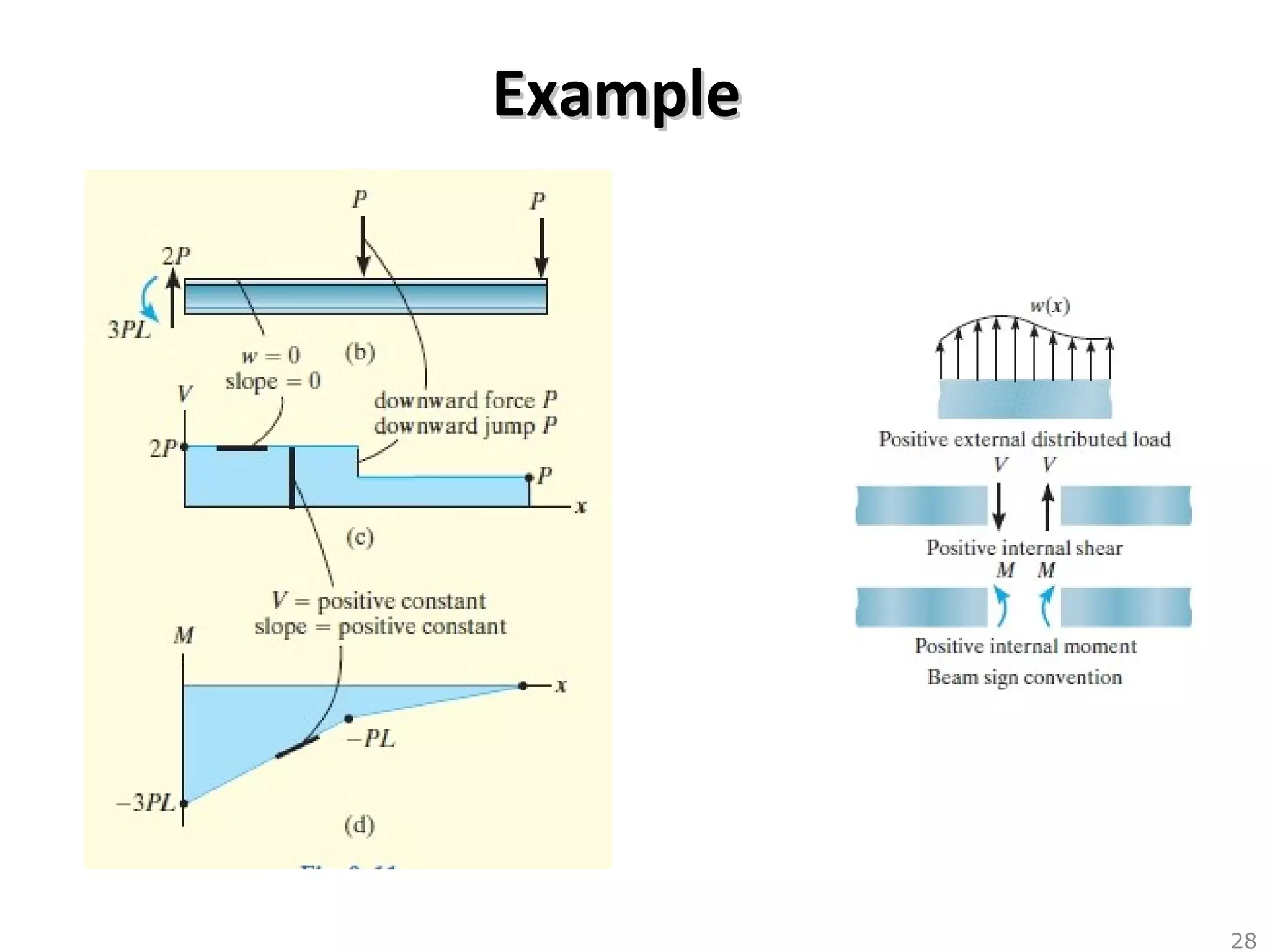
ExampleExample
28
29
30
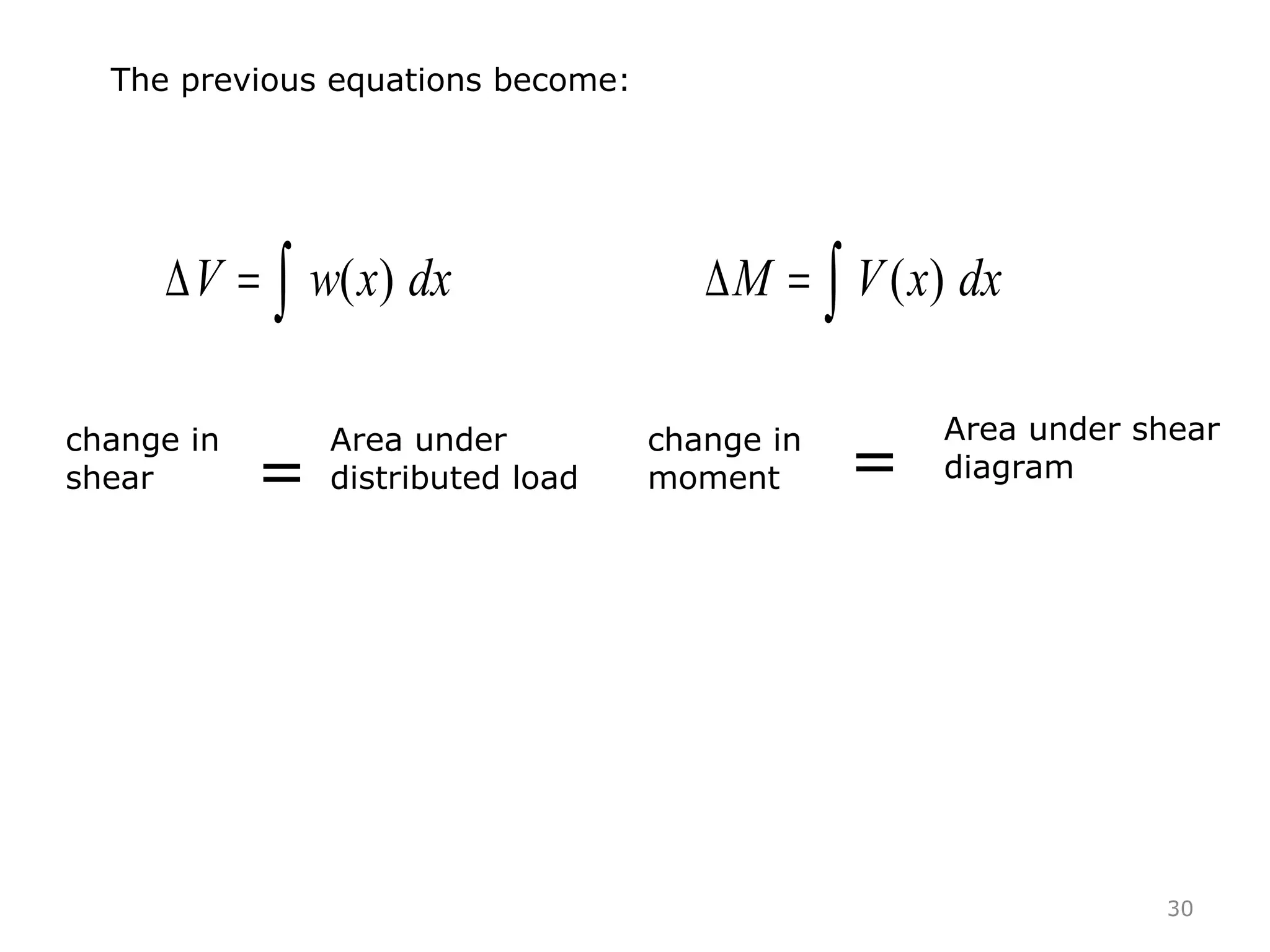
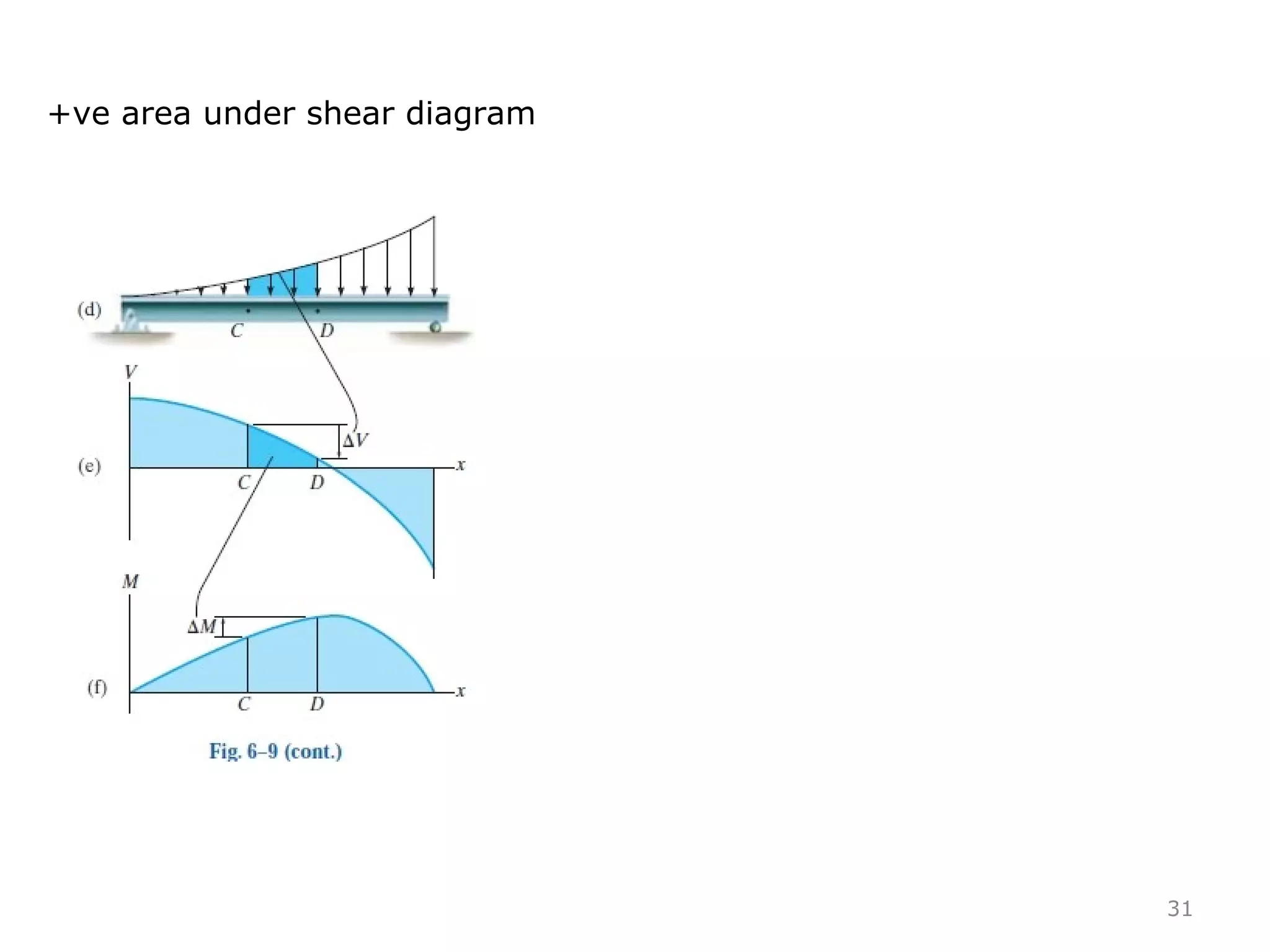
∫=∆ dxxwV )( ∫=∆ dxxVM )(
The previous equations become:
change in
shear =
Area under
distributed load
change in
moment =
Area under shear
diagram
31
+ve area under shear diagram
32
33
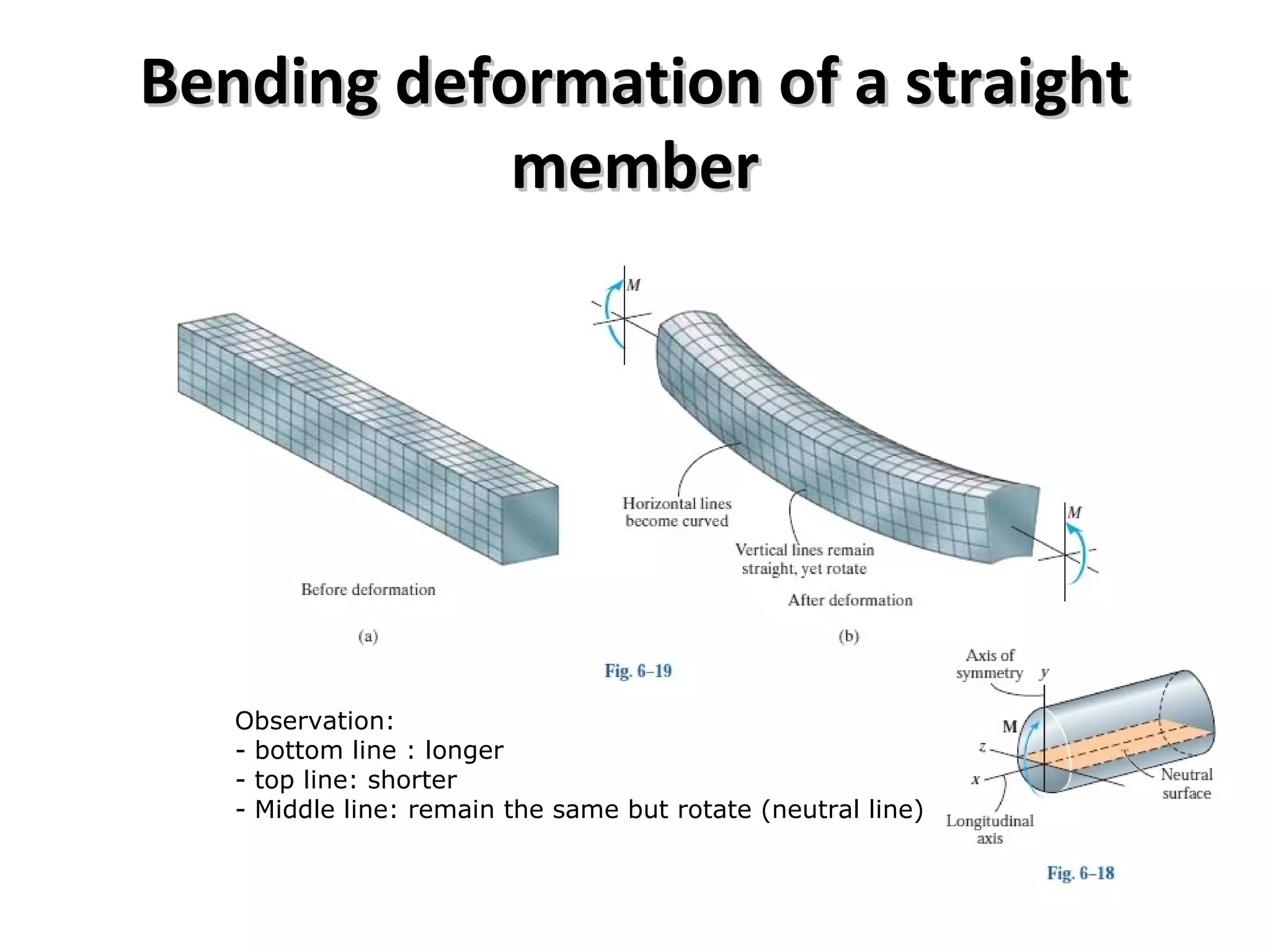
Bending deformation of a straightBending deformation of a straight
membermember
34
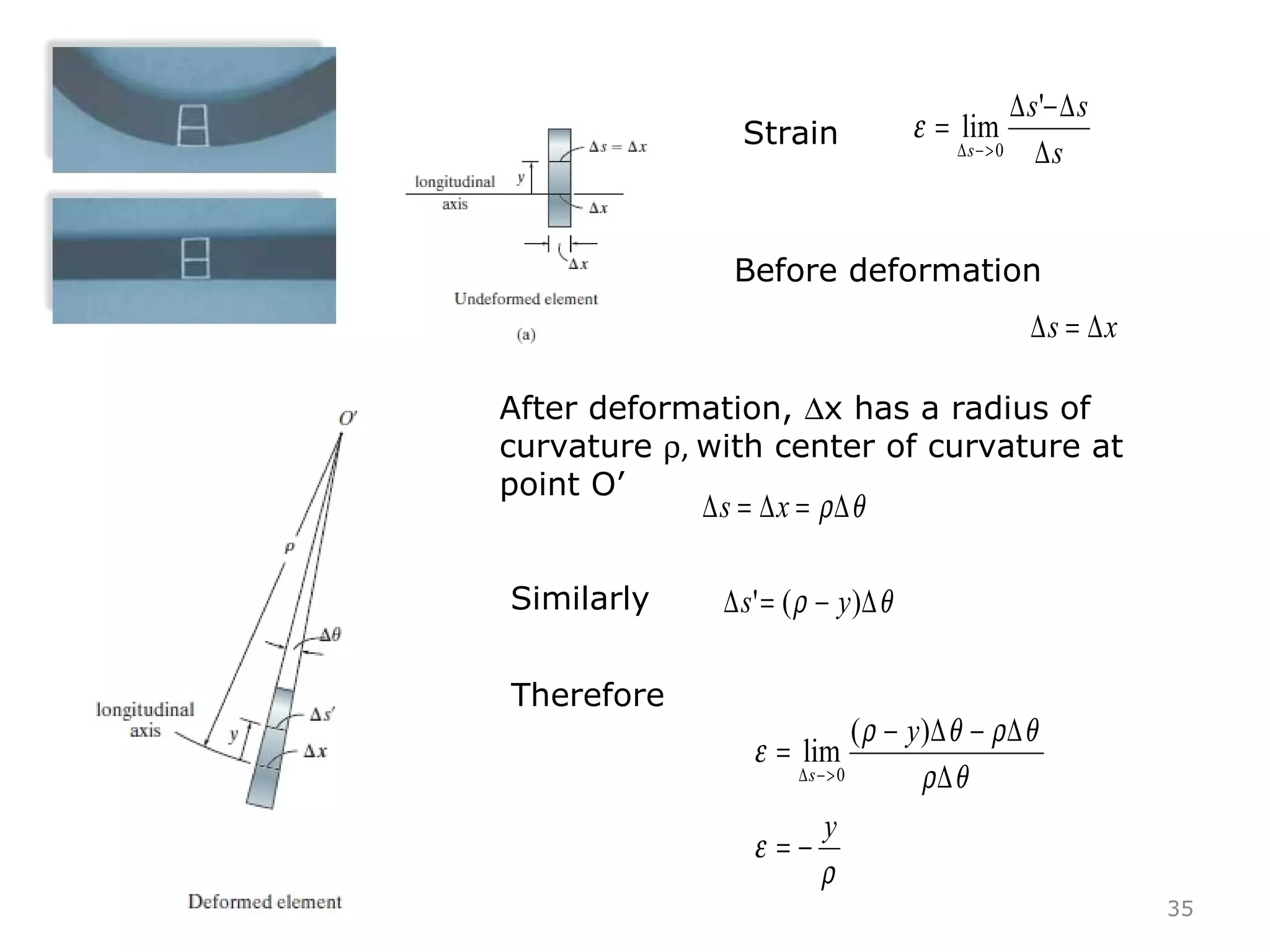
Observation:
- bottom line : longer
- top line: shorter
- Middle line: remain the same but rotate (neutral line)
35
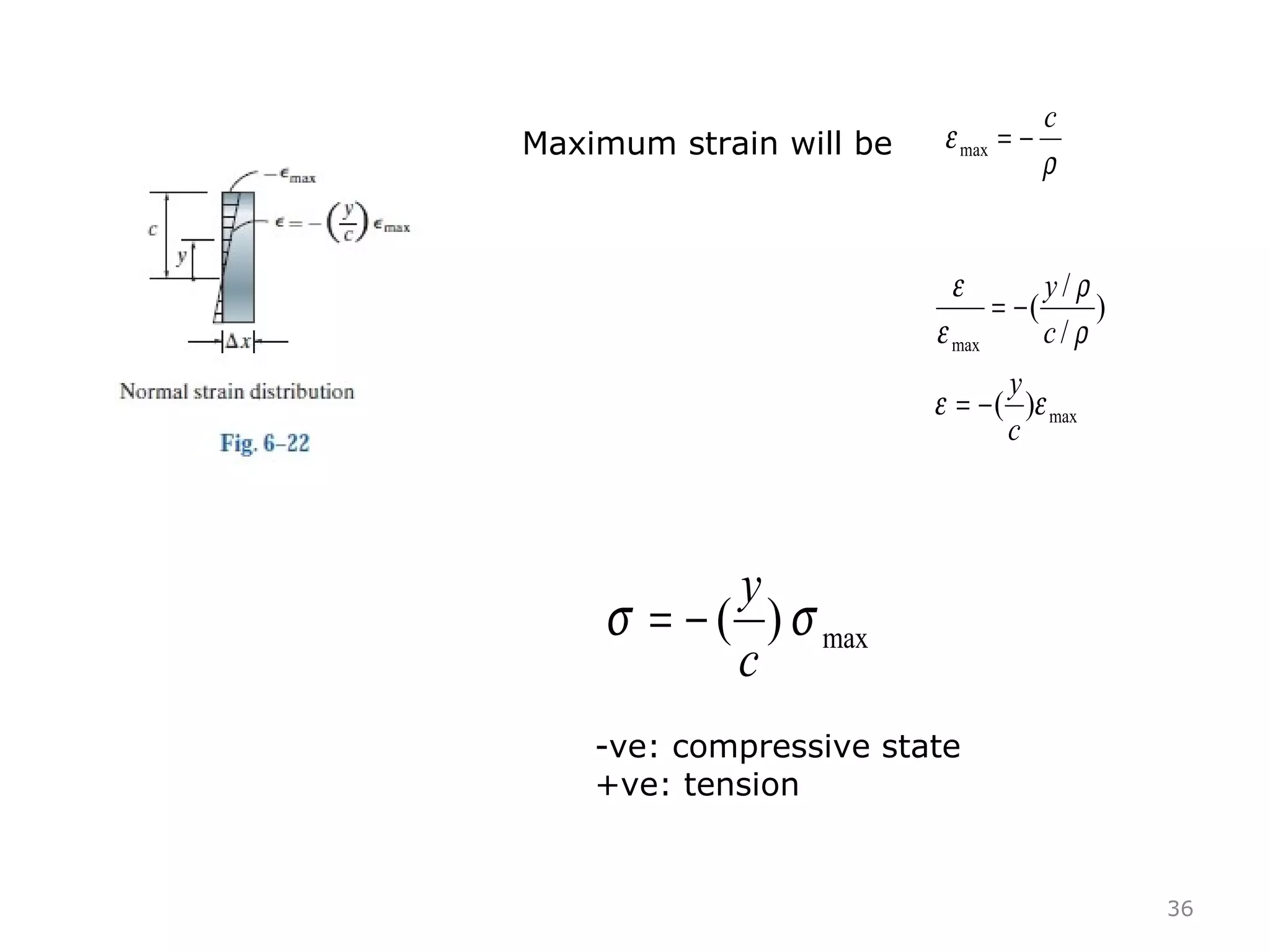
Strain
s
ss
s ∆
∆−∆
=
>−∆
'
lim
0
ε
Before deformation
xs ∆=∆
After deformation, ∆x has a radius of
curvature ρ, with center of curvature at
point O’
θρ∆=∆=∆ xs
Similarly θρ ∆−=∆ )(' ys
ρ
ε
θρ
θρθρ
ε
y
y
s
−=
∆
∆−∆−
=
>−∆
)(
lim
0
Therefore
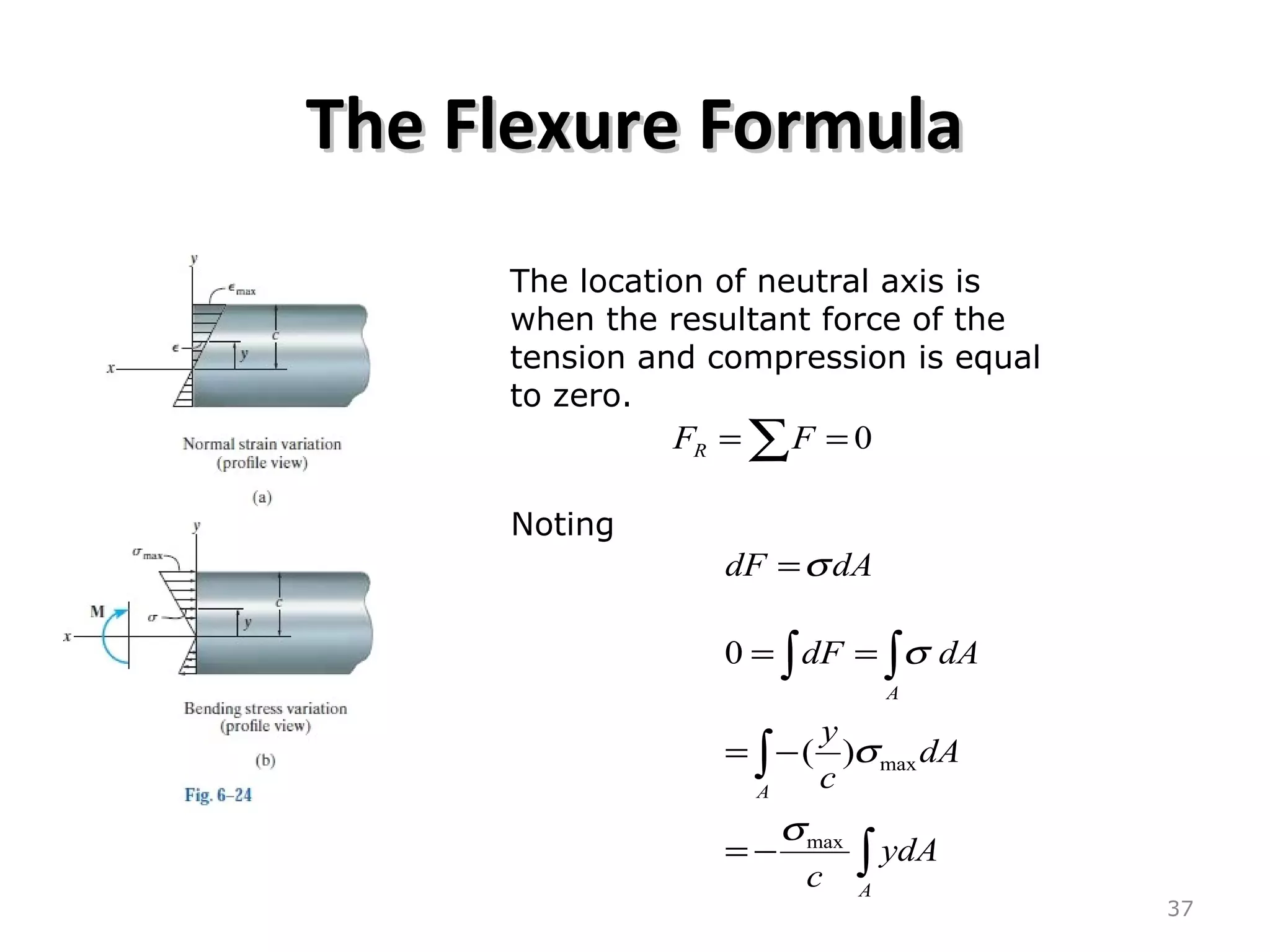
36
ρ
ε
c
−=maxMaximum strain will be
max
max
)(
)
/
/
(
εε
ρ
ρ
ε
ε
c
y
c
y
−=
−=
max)( σσ
c
y
−=
-ve: compressive state
+ve: tension
The Flexure FormulaThe Flexure Formula
37
The location of neutral axis is
when the resultant force of the
tension and compression is equal
to zero.
∑ == 0FFR
Noting
dAdF σ=
∫
∫
∫∫
−=
−=
==
A
A
A
ydA
c
dA
c
y
dAdF
max
max)(
0
σ
σ
σ
38
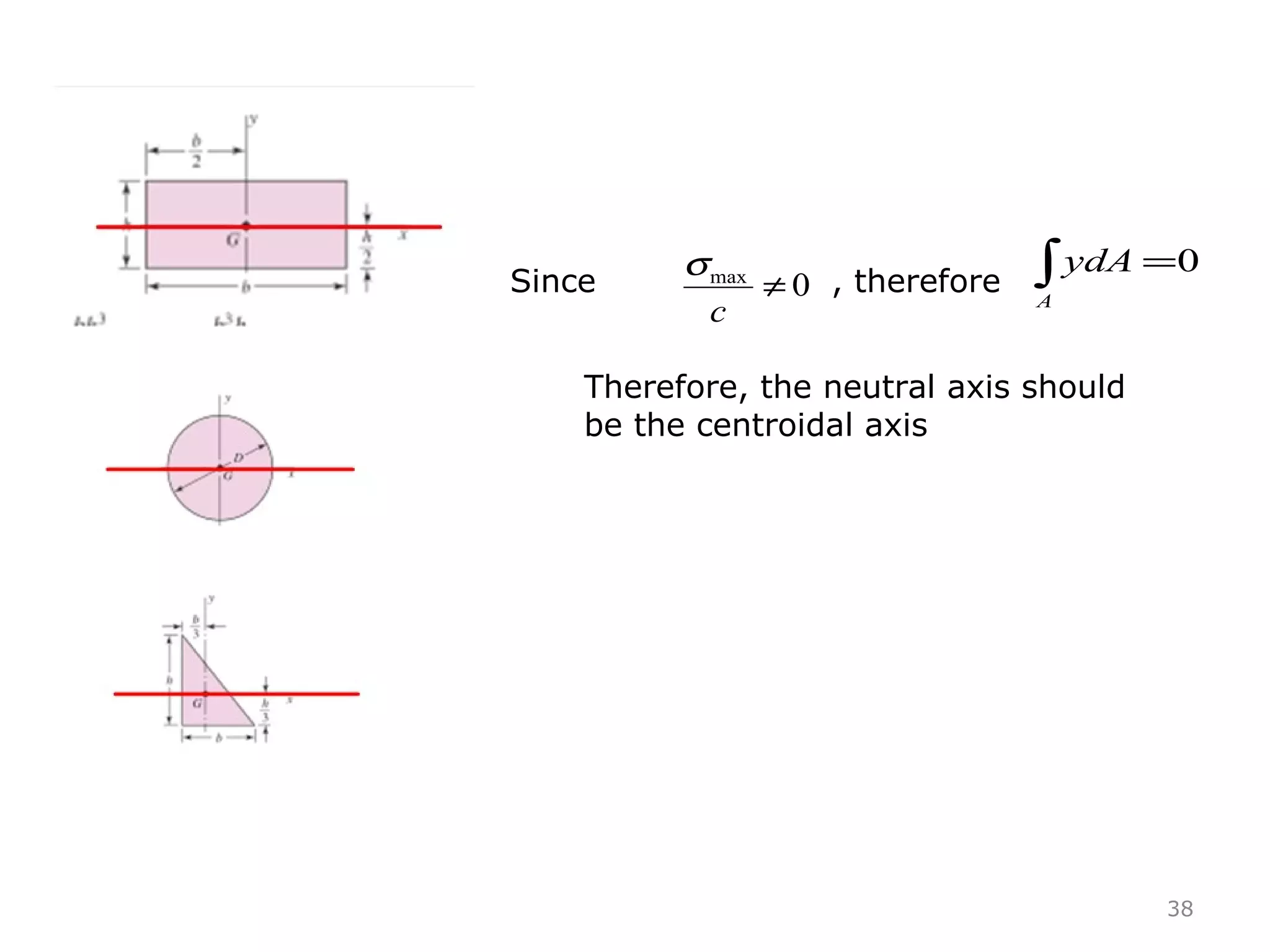
Since , therefore
Therefore, the neutral axis should
be the centroidal axis
0max
≠
c
σ 0=∫A
ydA
39
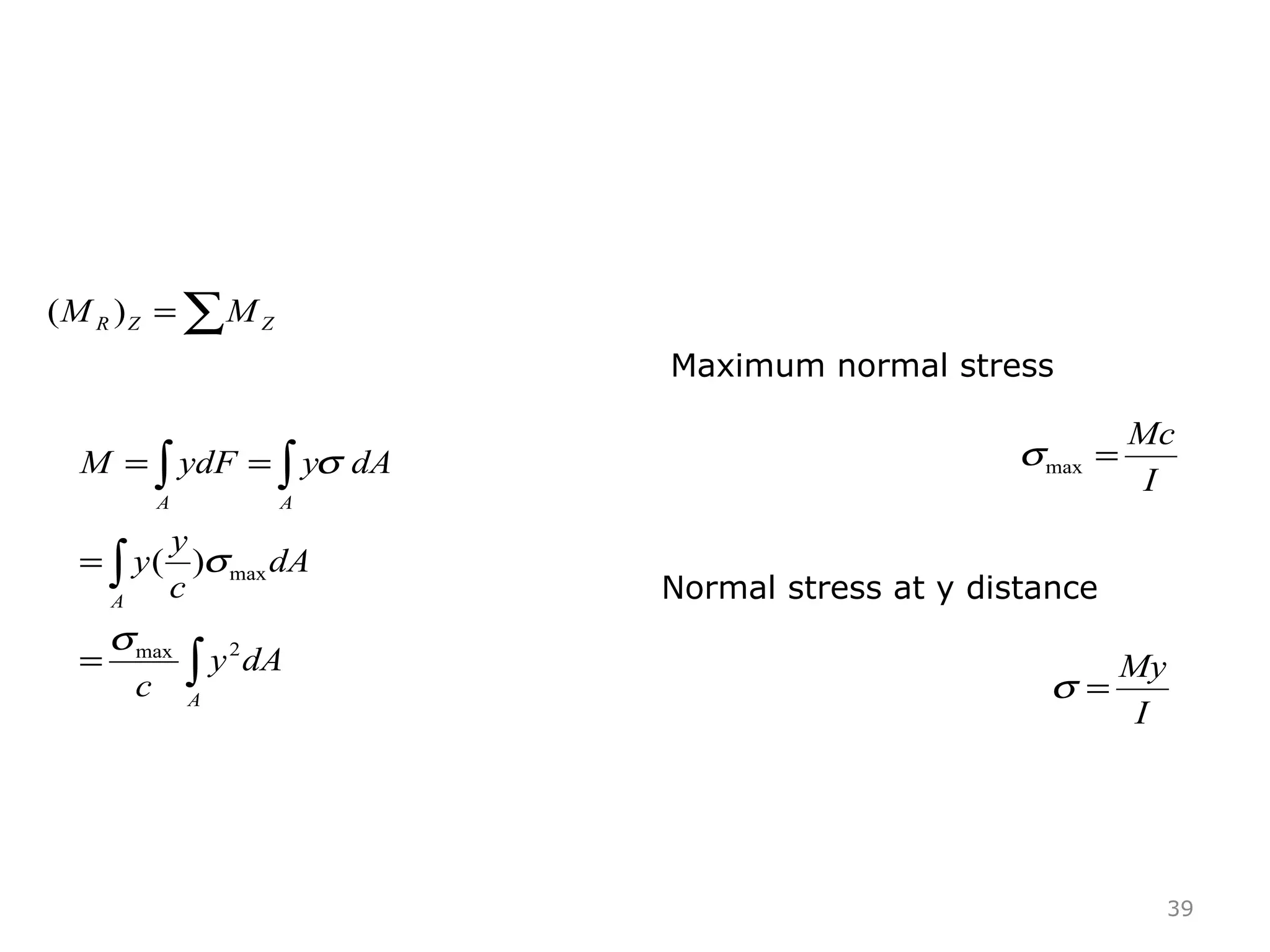
∑= ZZR MM )(
∫
∫
∫ ∫
=
=
==
A
A
A A
dAy
c
dA
c
y
y
dAyydFM
2max
max)(
σ
σ
σ
I
Mc
=maxσ
Maximum normal stress
Normal stress at y distance
I
My
=σ
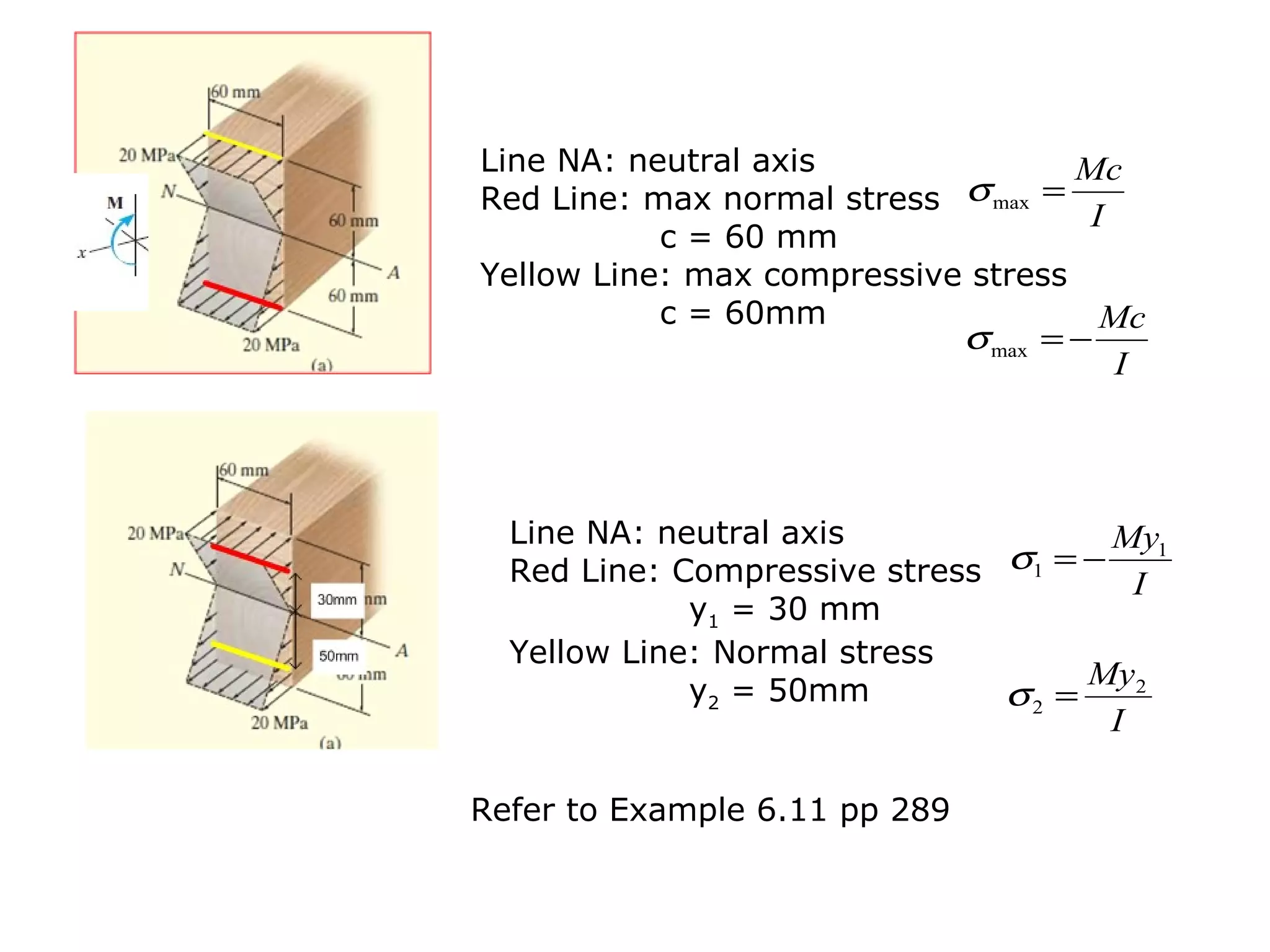
Line NA: neutral axis
Red Line: max normal stress
c = 60 mm
Yellow Line: max compressive stress
c = 60mm
I
Mc
=maxσ
I
Mc
−=maxσ
Line NA: neutral axis
Red Line: Compressive stress
y1 = 30 mm
Yellow Line: Normal stress
y2 = 50mm
I
My1
1 −=σ
I
My2
2 =σ
Refer to Example 6.11 pp 289
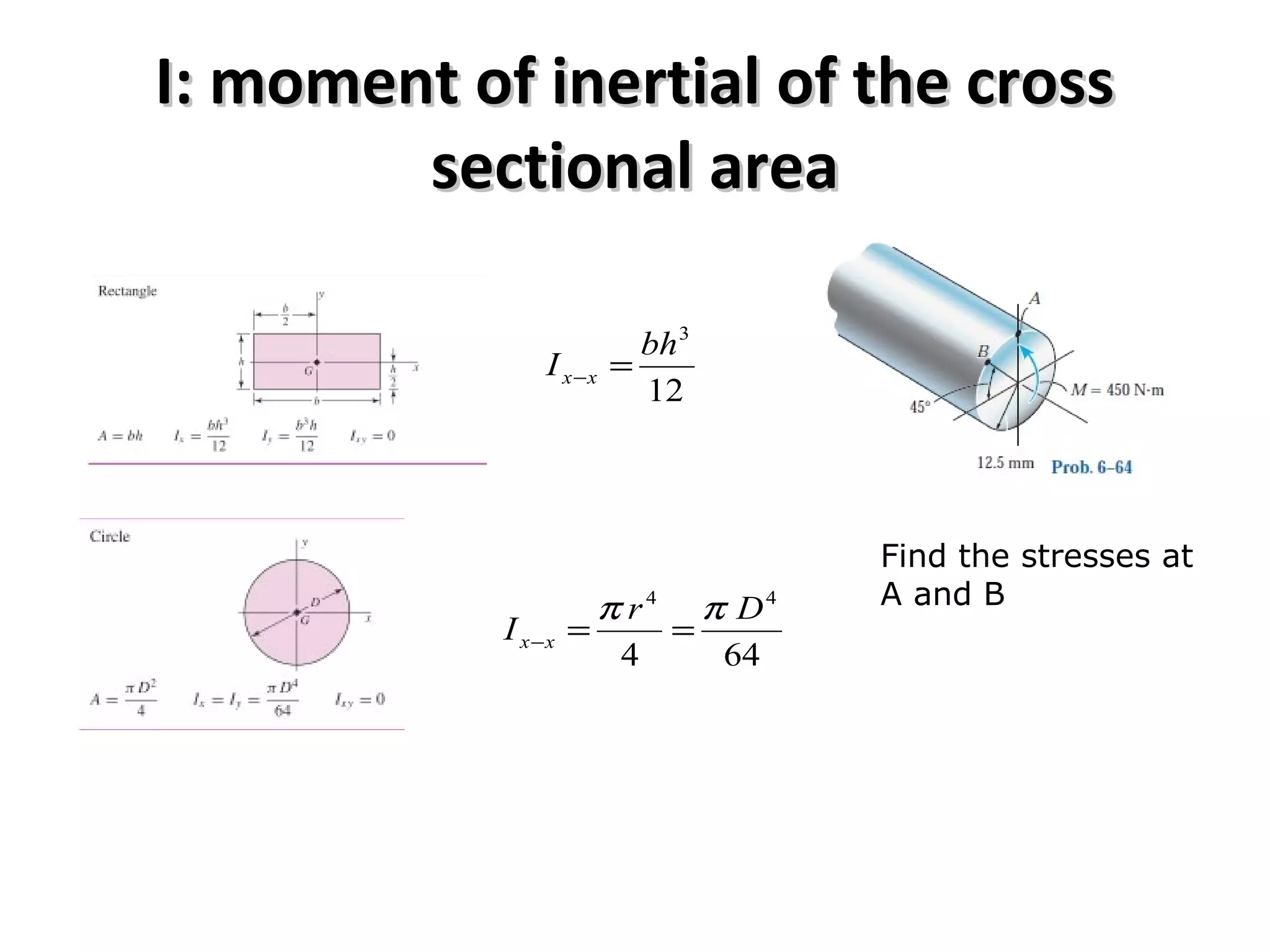
I: moment of inertial of the crossI: moment of inertial of the cross
sectional areasectional area
12
3
bh
I xx =−
644
44
Dr
I xx
ππ
==−
Find the stresses at
A and B
I: moment of inertial of the crossI: moment of inertial of the cross
sectional areasectional area
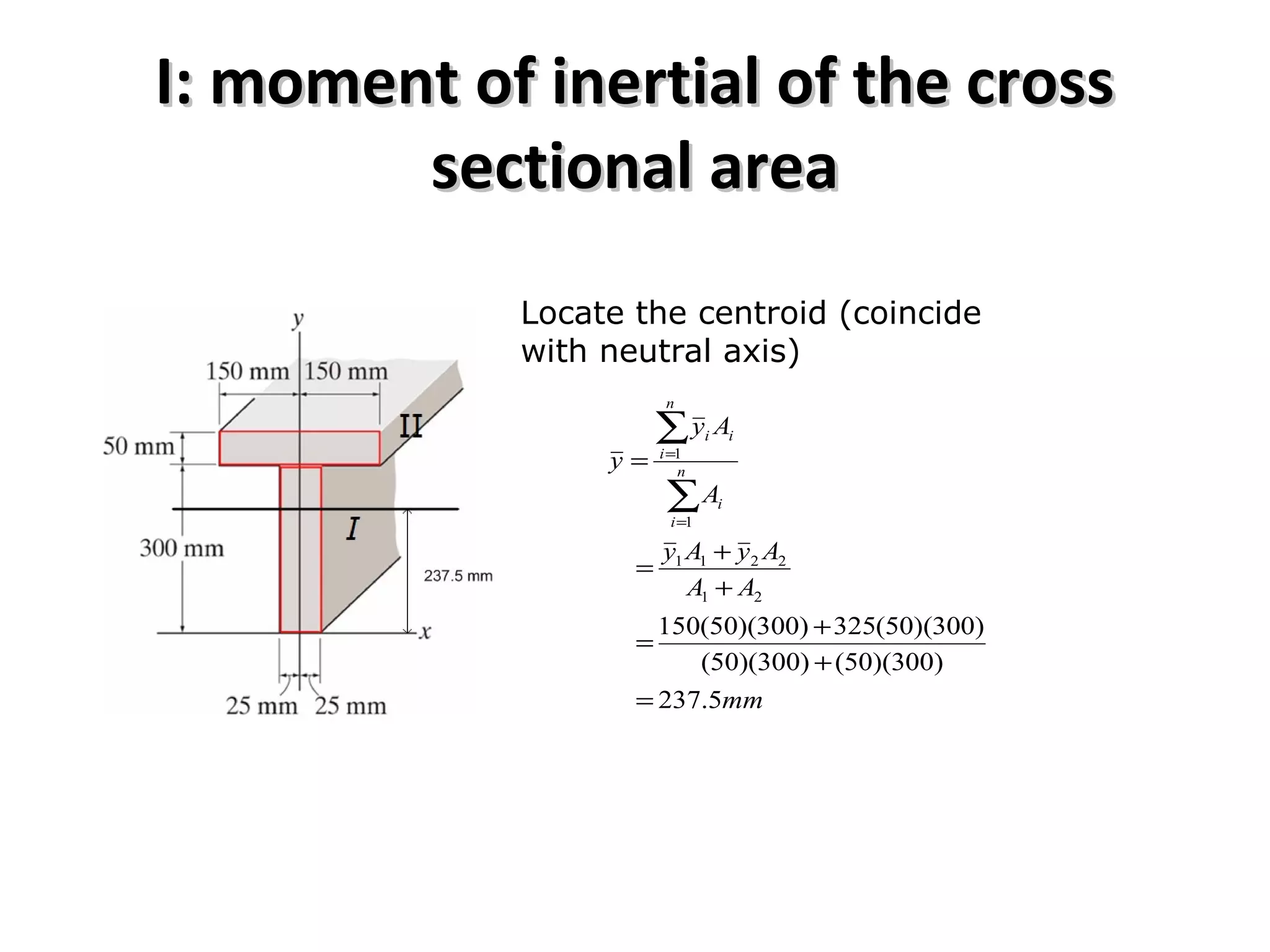
Locate the centroid (coincide
with neutral axis)
mm
AA
AyAy
A
Ay
y n
i
i
n
i
ii
5.237
)300)(50()300)(50(
)300)(50(325)300)(50(150
21
2211
1
1
=
+
+
=
+
+
=
=
∑
∑
=
=
I: moment of inertial of the crossI: moment of inertial of the cross
sectional areasectional area
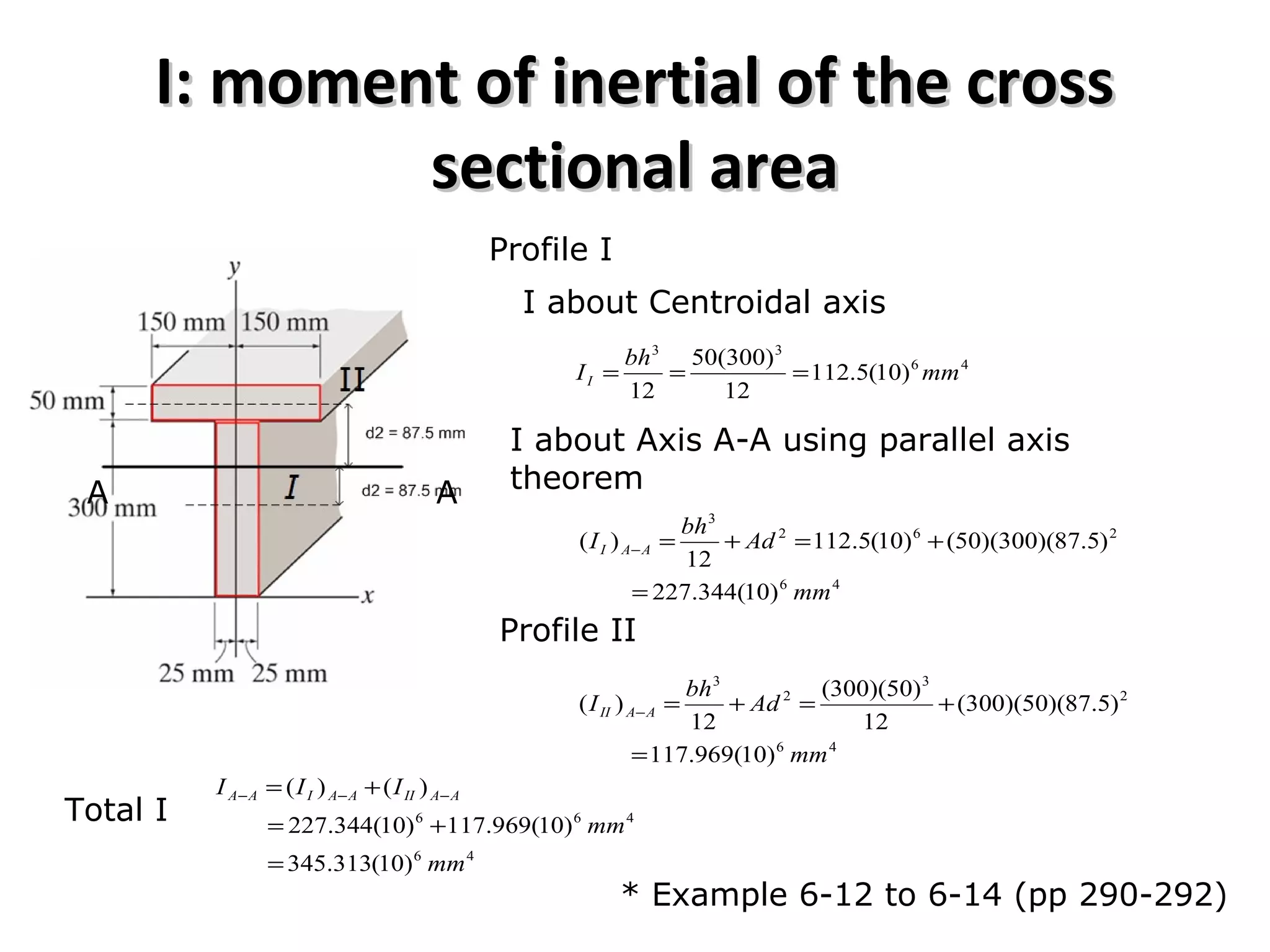
Profile I
46
33
)10(5.112
12
)300(50
12
mm
bh
II ===
A A
46
262
3
)10(344.227
)5.87)(300)(50()10(5.112
12
)(
mm
Ad
bh
I AAI
=
+=+=−
I about Centroidal axis
I about Axis A-A using parallel axis
theorem
Profile II
46
2
3
2
3
)10(969.117
)5.87)(50)(300(
12
)50)(300(
12
)(
mm
Ad
bh
I AAII
=
+=+=−
Total I
46
466
)10(313.345
)10(969.117)10(344.227
)()(
mm
mm
III AAIIAAIAA
=
+=
+= −−−
* Example 6-12 to 6-14 (pp 290-292)
Solve itSolve it
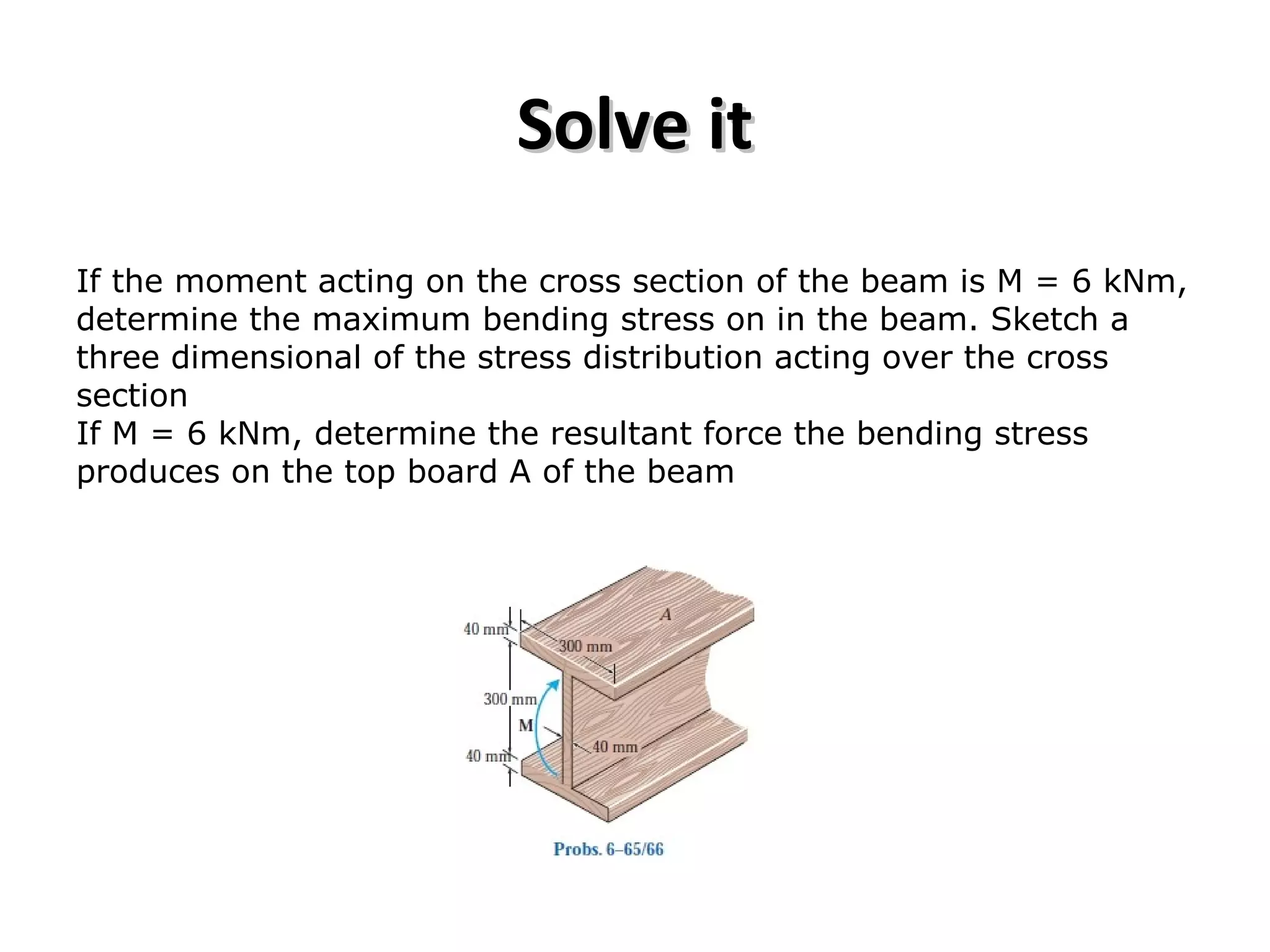
If the moment acting on the cross section of the beam is M = 6 kNm,
determine the maximum bending stress on in the beam. Sketch a
three dimensional of the stress distribution acting over the cross
section
If M = 6 kNm, determine the resultant force the bending stress
produces on the top board A of the beam
46
3
2
3
)10(8.786
12
)300(40
])170)(40)(300(
12
)40(300
[2
mm
II
=
++=
Total Moment of Inertia
Max Bending Stress at the top and bottom
MPa
II
Mc
Mtop 45.1
)190()10(6000 3
−=
−
=−=
MPaMbottom 45.1=
Bottom of the flange
MPa
II
Mc
M topf 14.1
)150()10(6000 3
_ −=
−
=−=
MPaM bottomf 14.1_ =
1.45MPa
1.14MPa
6kNm
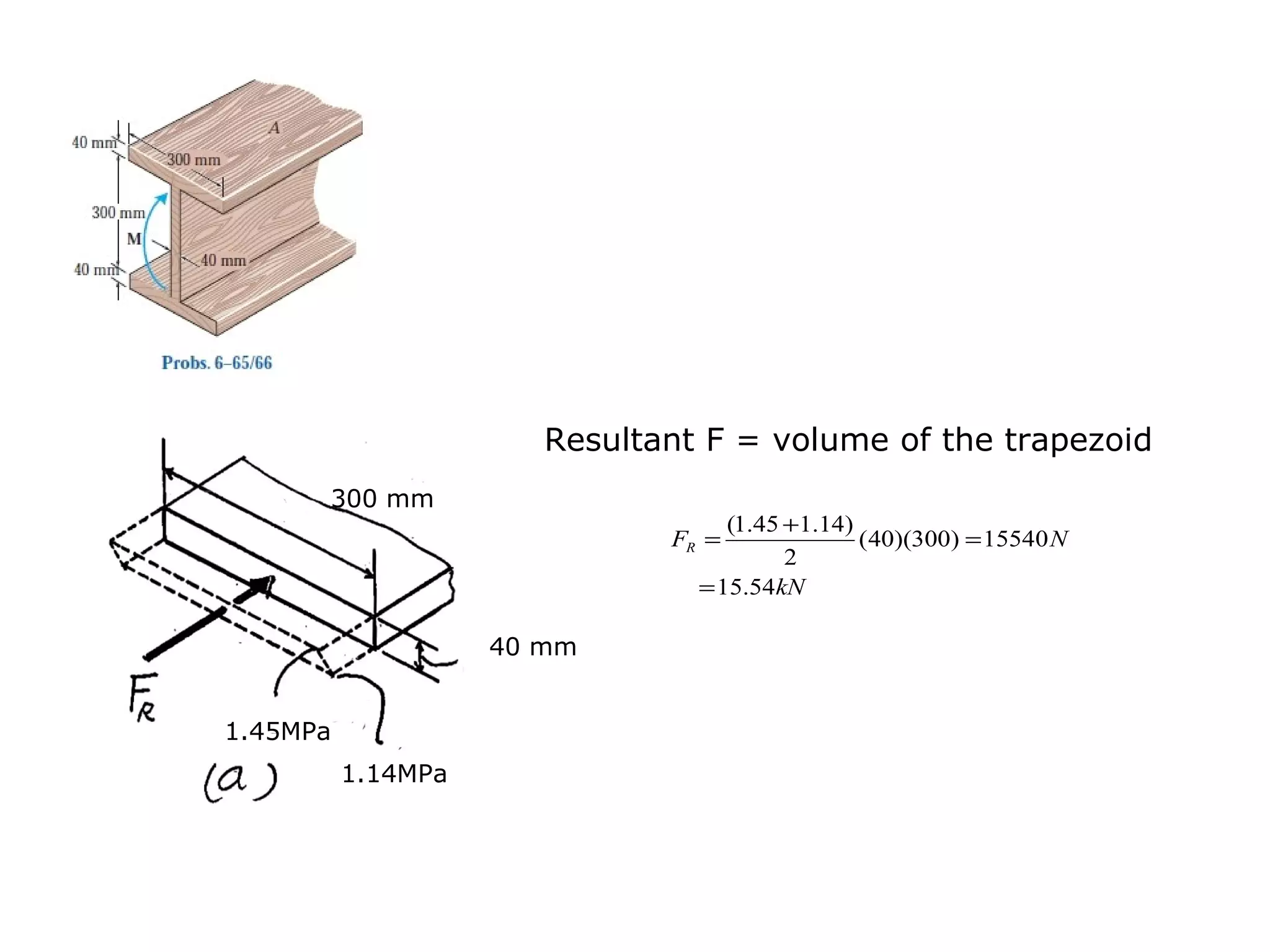
Resultant F = volume of the trapezoid
1.45MPa
1.14MPa
40 mm
300 mm
kN
NFR
54.15
15540)300)(40(
2
)14.145.1(
=
=
+
=
Solve itSolve it
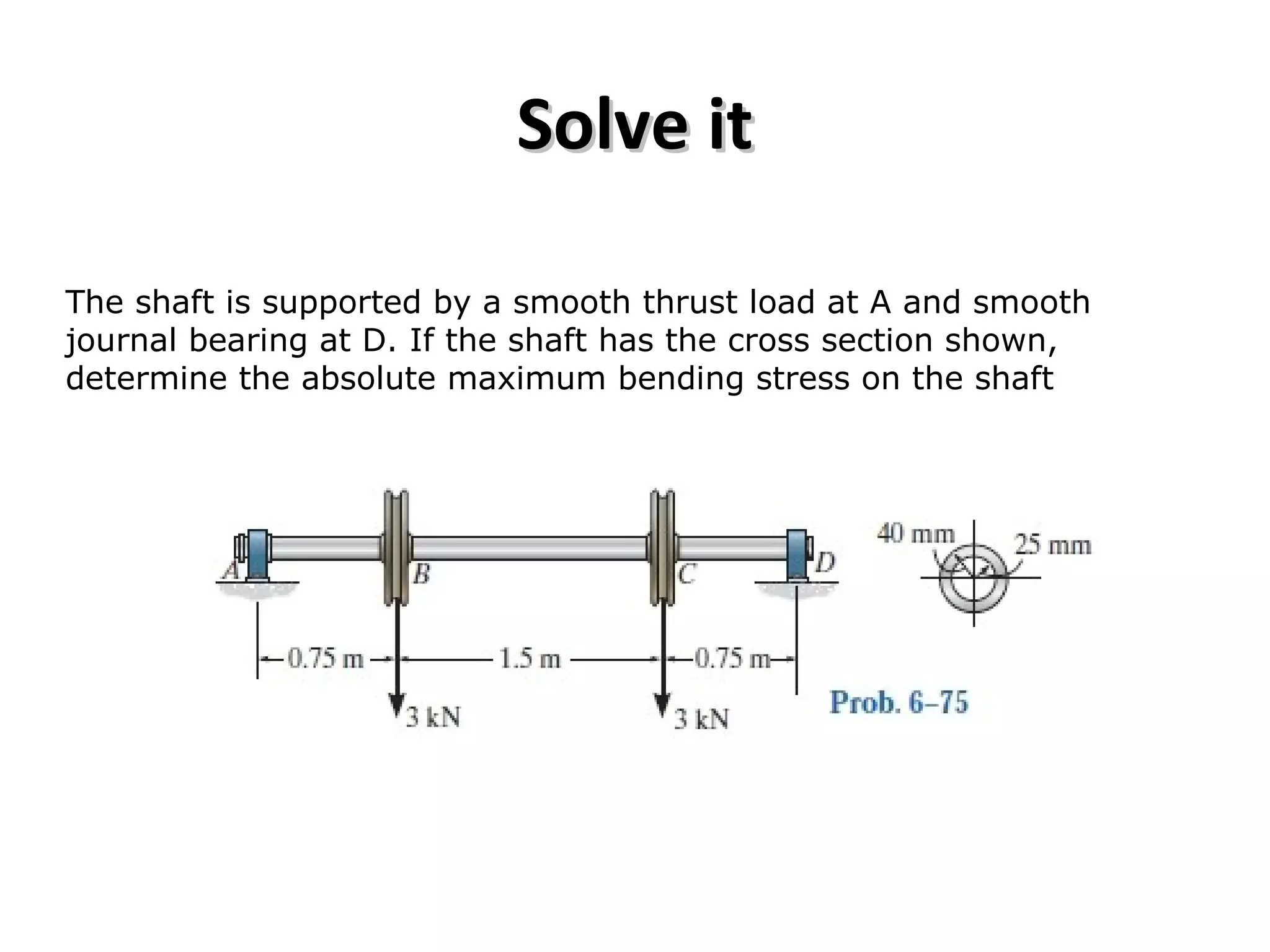
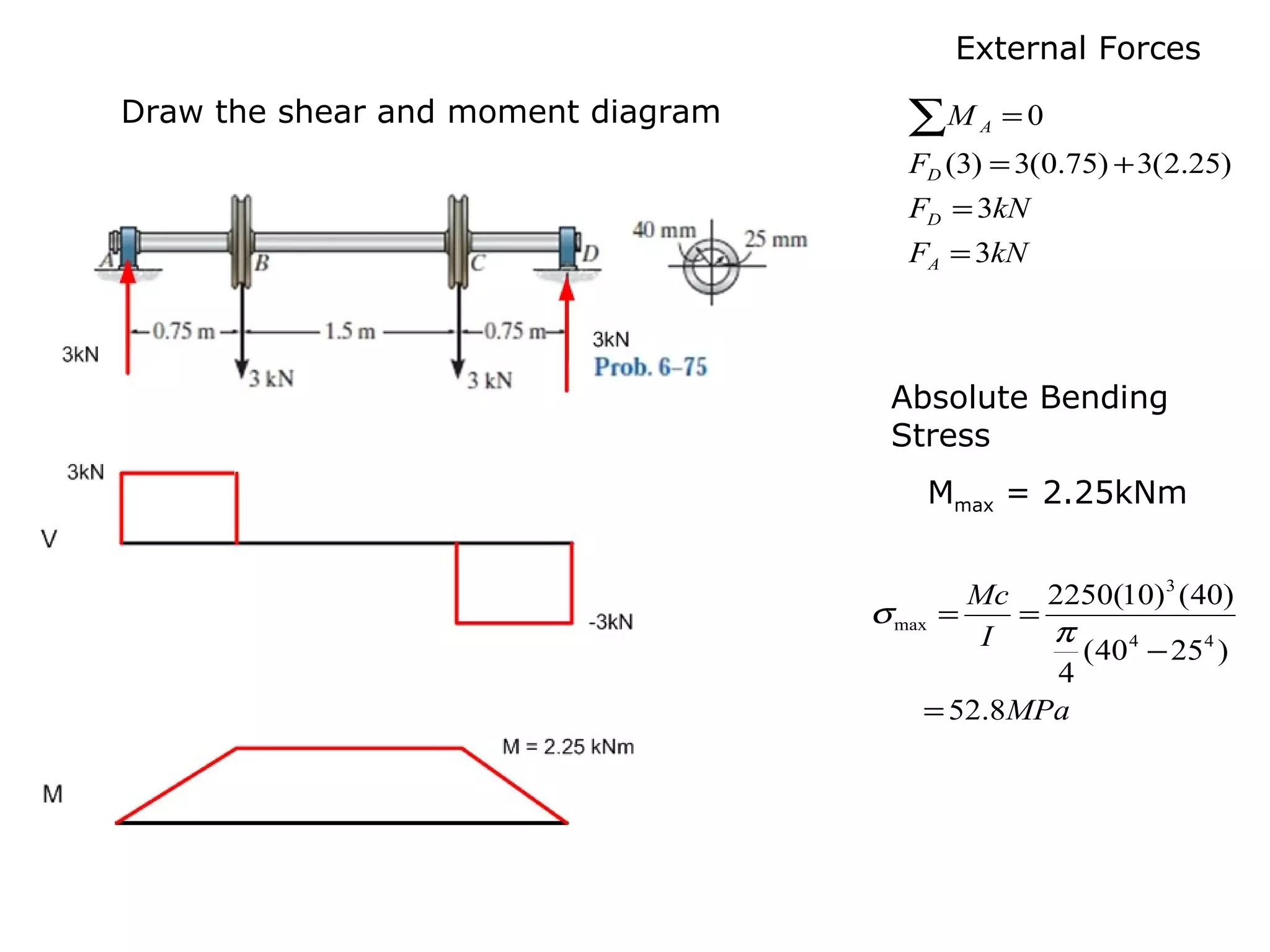
The shaft is supported by a smooth thrust load at A and smooth
journal bearing at D. If the shaft has the cross section shown,
determine the absolute maximum bending stress on the shaft
Draw the shear and moment diagram
kNF
kNF
F
M
A
D
D
A
3
3
)25.2(3)75.0(3)3(
0
=
=
+=
=∑
External Forces
Absolute Bending
Stress
Mmax = 2.25kNm
MPa
I
Mc
8.52
)2540(
4
)40()10(2250
44
3
max
=
−
==
π
σ

Types of beam

  • 1.
    BendingBending Shear and MomentDiagram, Graphical method to construct shear and moment diagram, Bending deformation of a straight member, The flexure formula 1
  • 2.
  • 3.
    Shear and momentdiagramShear and moment diagram 3 Axial load diagram Torque diagram Both of these diagrams show the internal forces acting on the members. Similarly, the shear and moment diagrams show the internal shear and moment acting on the members
  • 4.
    Type of BeamsTypeof Beams Statically Determinate 4 Simply Supported Beam Overhanging Beam Cantilever Beam
  • 5.
    Type of BeamsTypeof Beams Statically Indeterminate 5 Continuous Beam Propped Cantilever Beam Fixed Beam
  • 6.
  • 7.
    Example 1Example 1 Equilibriumequation for 0 ≤ x ≤ 3m: A B * internal V and M should be assumed +ve kNV VF F y 9 0 0 −= =−− =∑ )(9 0 0 kNmxM MVx M −= =+ =∑ M VF x
  • 8.
    Shear DiagramShear Diagram Lecture1 8 Sign convention: V= -9kN M VF x
  • 9.
    Shear DiagramShear Diagram 9 Signconvention: M= -9x kNm X=0: M= 0 X=3: M=-27kNm M=-9x M = -9x kN.m V = -9 kN F x
  • 10.
    10 V=9kN M=X At cross sectionA-A X At section A-A
  • 11.
  • 12.
  • 13.
  • 14.
    Solve itSolve it Drawthe shear and moment diagrams for simply supported beam. 14
  • 15.
  • 16.
    Distributed LoadDistributed Load 16 Forcalculation purposes, distributed load can be represented as a single load acting on the center point of the distributed area. Total force = area of distributed load (W : height and L: length) Point of action: center point of the area
  • 17.
  • 18.
  • 19.
    Solve itSolve it Drawthe shear and moment diagrams the beam: 19
  • 20.
    Solving all theexternal loads kN WlF 48)6(8 == = Distributed load will be Solving the FBD 012 36 4 )3(48 0)3(4 0 == == =− =∑ xy y x A AkNA kNB FB M
  • 21.
    21 Boundary Condition 40<≤ x xV Vx FY 812 0812 0 −= =−− =∑ 2 2 2 412 0412 04)812( 04 0 xxM xxM xxxM xVxM M A −= =+− =−−− =−− =∑ Equilibrium eq
  • 22.
    22 Boundary Condition 64<≤ x xV Vx FY 848 083612 0 −= =−−+ =∑ 144484 0414448 04)4(36)848( 0)2/(8 0 2 2 2 −+−= =++− =−+−− =−− =∑ xxM xxM xxxM xxVxM M A Equilibrium eq
  • 23.
    23 40 <≤ x x=0V= 12 kN x=4 V=-20 kN xV 812 −= 2 412 xxM −= x=0 M= 0 kN x=4 V=-16 kN 64 <≤ x xV 848−= x=4 V= 16kN x=6 V= 0 kN 144484 2 −+−= xxM x=4 V= -16kN x=6 V= 0 kN
  • 24.
    Graph based onequationsGraph based on equations 24 y = c Straight horizontal line y = mx + c y=3x + 3 y=-3x + 3 y=3x2 + 3 y=-3x2 + 3 y = ax2 + bx +c
  • 25.
  • 26.
    Graphical methodGraphical method 26 () ( ) xxwV VVxxwV Fy ∆−=∆ =∆+−∆− =Σ↑+ 0)( :0 • Relationship between load and shear: ( ) ( )[ ] ( ) ( ) ( )2 0 :0 xkxwxVM MMxkxxwMxV Mo ∆−∆=∆ =∆++∆∆+−∆− =Σ • Relationship between shear and bending moment: 26
  • 27.
    27 27 Dividing by ∆xand taking the limit as ∆x0, the above two equations become: Regions of distributed load: Slope of shear diagram at each point Slope of moment diagram at each point = − distributed load intensity at each point = shear at each point )(xw dx dV −= V dx dM =
  • 28.
  • 29.
  • 30.
    30 ∫=∆ dxxwV )(∫=∆ dxxVM )( The previous equations become: change in shear = Area under distributed load change in moment = Area under shear diagram
  • 31.
    31 +ve area undershear diagram
  • 32.
  • 33.
  • 34.
    Bending deformation ofa straightBending deformation of a straight membermember 34 Observation: - bottom line : longer - top line: shorter - Middle line: remain the same but rotate (neutral line)
  • 35.
    35 Strain s ss s ∆ ∆−∆ = >−∆ ' lim 0 ε Before deformation xs∆=∆ After deformation, ∆x has a radius of curvature ρ, with center of curvature at point O’ θρ∆=∆=∆ xs Similarly θρ ∆−=∆ )(' ys ρ ε θρ θρθρ ε y y s −= ∆ ∆−∆− = >−∆ )( lim 0 Therefore
  • 36.
    36 ρ ε c −=maxMaximum strain willbe max max )( ) / / ( εε ρ ρ ε ε c y c y −= −= max)( σσ c y −= -ve: compressive state +ve: tension
  • 37.
    The Flexure FormulaTheFlexure Formula 37 The location of neutral axis is when the resultant force of the tension and compression is equal to zero. ∑ == 0FFR Noting dAdF σ= ∫ ∫ ∫∫ −= −= == A A A ydA c dA c y dAdF max max)( 0 σ σ σ
  • 38.
    38 Since , therefore Therefore,the neutral axis should be the centroidal axis 0max ≠ c σ 0=∫A ydA
  • 39.
    39 ∑= ZZR MM)( ∫ ∫ ∫ ∫ = = == A A A A dAy c dA c y y dAyydFM 2max max)( σ σ σ I Mc =maxσ Maximum normal stress Normal stress at y distance I My =σ
  • 40.
    Line NA: neutralaxis Red Line: max normal stress c = 60 mm Yellow Line: max compressive stress c = 60mm I Mc =maxσ I Mc −=maxσ Line NA: neutral axis Red Line: Compressive stress y1 = 30 mm Yellow Line: Normal stress y2 = 50mm I My1 1 −=σ I My2 2 =σ Refer to Example 6.11 pp 289
  • 41.
    I: moment ofinertial of the crossI: moment of inertial of the cross sectional areasectional area 12 3 bh I xx =− 644 44 Dr I xx ππ ==− Find the stresses at A and B
  • 42.
    I: moment ofinertial of the crossI: moment of inertial of the cross sectional areasectional area Locate the centroid (coincide with neutral axis) mm AA AyAy A Ay y n i i n i ii 5.237 )300)(50()300)(50( )300)(50(325)300)(50(150 21 2211 1 1 = + + = + + = = ∑ ∑ = =
  • 43.
    I: moment ofinertial of the crossI: moment of inertial of the cross sectional areasectional area Profile I 46 33 )10(5.112 12 )300(50 12 mm bh II === A A 46 262 3 )10(344.227 )5.87)(300)(50()10(5.112 12 )( mm Ad bh I AAI = +=+=− I about Centroidal axis I about Axis A-A using parallel axis theorem Profile II 46 2 3 2 3 )10(969.117 )5.87)(50)(300( 12 )50)(300( 12 )( mm Ad bh I AAII = +=+=− Total I 46 466 )10(313.345 )10(969.117)10(344.227 )()( mm mm III AAIIAAIAA = += += −−− * Example 6-12 to 6-14 (pp 290-292)
  • 44.
    Solve itSolve it Ifthe moment acting on the cross section of the beam is M = 6 kNm, determine the maximum bending stress on in the beam. Sketch a three dimensional of the stress distribution acting over the cross section If M = 6 kNm, determine the resultant force the bending stress produces on the top board A of the beam
  • 45.
    46 3 2 3 )10(8.786 12 )300(40 ])170)(40)(300( 12 )40(300 [2 mm II = ++= Total Moment ofInertia Max Bending Stress at the top and bottom MPa II Mc Mtop 45.1 )190()10(6000 3 −= − =−= MPaMbottom 45.1= Bottom of the flange MPa II Mc M topf 14.1 )150()10(6000 3 _ −= − =−= MPaM bottomf 14.1_ = 1.45MPa 1.14MPa 6kNm
  • 46.
    Resultant F =volume of the trapezoid 1.45MPa 1.14MPa 40 mm 300 mm kN NFR 54.15 15540)300)(40( 2 )14.145.1( = = + =
  • 47.
    Solve itSolve it Theshaft is supported by a smooth thrust load at A and smooth journal bearing at D. If the shaft has the cross section shown, determine the absolute maximum bending stress on the shaft
  • 48.
    Draw the shearand moment diagram kNF kNF F M A D D A 3 3 )25.2(3)75.0(3)3( 0 = = += =∑ External Forces Absolute Bending Stress Mmax = 2.25kNm MPa I Mc 8.52 )2540( 4 )40()10(2250 44 3 max = − == π σ