Matrix Algebra
Methods for Dummies
FIL
January 25 2006
Jon Machtynger & Jen Marchant
Acknowledgements / Info
• Mikkel Walletin’s (Excellent) slides
• John Ashburner (GLM context)
• Slides from SPM courses:
http://www.fil.ion.ucl.ac.uk/spm/course/
• Good Web Guides
– www.sosmath.com
– http://mathworld.wolfram.com/LinearAlgebra.html
– http://ceee.rice.edu/Books/LA/contents.html
– http://archives.math.utk.edu/topics/linearAlgebra.html
Scalars, vectors and matrices
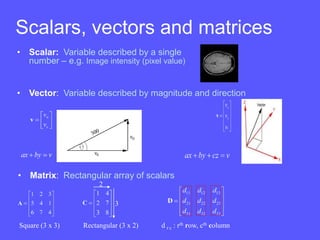
• Scalar: Variable described by a single
number – e.g. Image intensity (pixel value)
• Vector: Variable described by magnitude and direction
Square (3 x 3) Rectangular (3 x 2) d r c : rth row, cth column
3
2
• Matrix: Rectangular array of scalars
Matrices
• A matrix is defined by the number of Rows and the
number of Columns.
• An mxn matrix has m rows and n columns.
A = 4x3 matrix
• A square matrix of order n, is an nxn matrix.
21 2 53
5 34 12
6 33 55
74 27 3
Matlab notes ( ;  End of matrix row )
A = [ 21 5 53 ; 5 34 12 ; 6 33 55 ; 74 27 3 ]
To extract data: Matrix name( row, column )
Scalar Data Point A( 1 , 2 ) = 2
Row Vector A( 2 , : ) = [ 5 34 12 ]
Column Vector A( : , 3 ) = [ 53 ; 12 ; 55 ; 3 ]
Smaller Matrix A(2:4,1:2) = [ 5 34 ; 6 33 ; 74 27 ]
Another Matrix A( 2:2:4 , 2:3 ) = [ 34 12 ; 27 3 ]
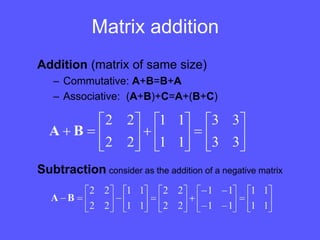
Addition (matrix of same size)
– Commutative: A+B=B+A
– Associative: (A+B)+C=A+(B+C)
Subtraction consider as the addition of a negative matrix
Matrix addition
Matrix multiplication
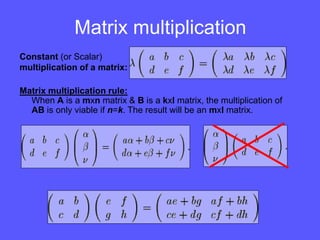
Matrix multiplication rule:
When A is a mxn matrix & B is a kxl matrix, the multiplication of
AB is only viable if n=k. The result will be an mxl matrix.
Constant (or Scalar)
multiplication of a matrix:
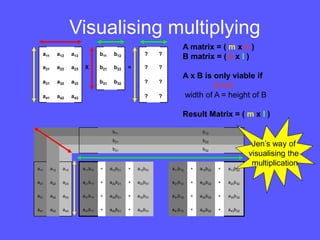
Visualising multiplying
b11 b12
b21 b22
b31 b32
a11 a12 a13 a11b11 + a12b21 + a13b31 a11b12 + a12b22 + a13b32
a21 a22 a23 a21b11 + a22b21 + a23b31 a21b12 + a22b22 + a23b32
a31 a32 a33 a31b11 + a32b21 + a33b31 a31b12 + a32b22 + a33b32
a41 a42 a43 a41b11 + a42b21 + a43b31 a41b12 + a42b22 + a43b32
a11 a12 a13 b11 b12 ? ?
a21 a22 a23 X b21 b22 = ? ?
a31 a32 a33 b31 b32 ? ?
a41 a42 a43 ? ?
A matrix = ( m x n )
B matrix = ( k x l )
A x B is only viable if
k = n
width of A = height of B
Result Matrix = ( m x l )
Jen’s way of
visualising the
multiplication
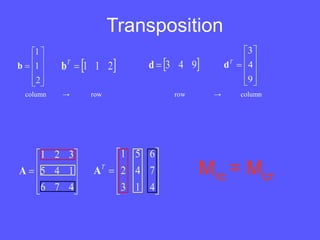
Transposition
column → row row → column
Mrc = Mcr
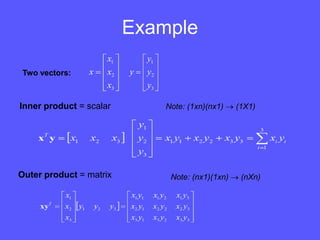
Outer product = matrix
Inner product = scalar
Two vectors:
Example
Note: (1xn)(nx1)  (1X1)
Note: (nx1)(1xn)  (nXn)
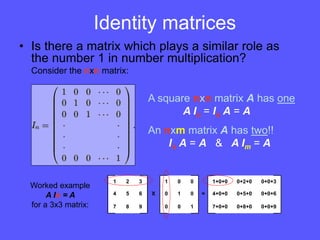
Identity matrices
• Is there a matrix which plays a similar role as
the number 1 in number multiplication?
Consider the nxn matrix:
A square nxn matrix A has one
A In = In A = A
An nxm matrix A has two!!
In A = A & A Im = A
1 2 3 1 0 0 1+0+0 0+2+0 0+0+3
4 5 6 X 0 1 0 = 4+0+0 0+5+0 0+0+6
7 8 9 0 0 1 7+0+0 0+8+0 0+0+9
Worked example
A In = A
for a 3x3 matrix:
Inverse matrices
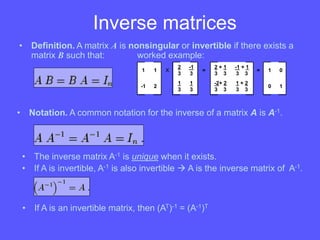
• Definition. A matrix A is nonsingular or invertible if there exists a
matrix B such that: worked example:
• Notation. A common notation for the inverse of a matrix A is A-1.
• If A is an invertible matrix, then (AT)-1 = (A-1)T
• The inverse matrix A-1 is unique when it exists.
• If A is invertible, A-1 is also invertible  A is the inverse matrix of A-1.
1 1 X
2
3
-1
3
=
2 + 1
3 3
-1 + 1
3 3
= 1 0
-1 2
1
3
1
3
-2+ 2
3 3
1 + 2
3 3
0 1
Determinants
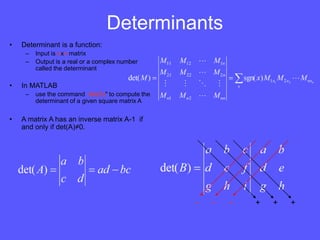
• Determinant is a function:
– Input is nxn matrix
– Output is a real or a complex number
called the determinant
• In MATLAB
– use the command det(A)" to compute the
determinant of a given square matrix A
• A matrix A has an inverse matrix A-1 if
and only if det(A)≠0.
+ + +
- - -
Matrix Inverse - Calculations
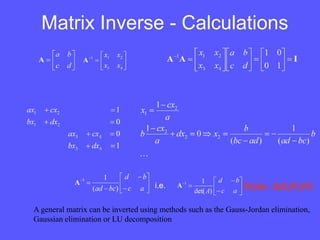
A general matrix can be inverted using methods such as the Gauss-Jordan elimination,
Gaussian elimination or LU decomposition
i.e. Note: det(A)≠0
Some Application Areas
• Simultaneous Equations
• Simple Neural Network
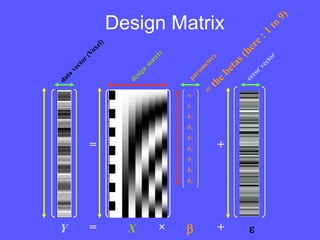
• GLM
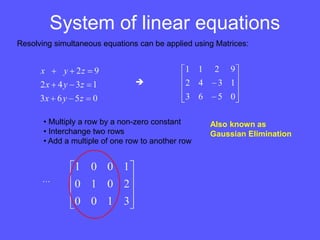
System of linear equations
Resolving simultaneous equations can be applied using Matrices:
• Multiply a row by a non-zero constant
• Interchange two rows
• Add a multiple of one row to another row

…
Also known as
Gaussian Elimination
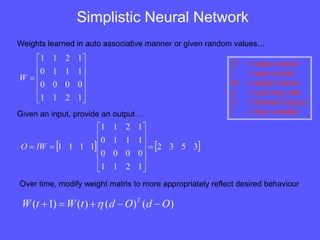
Simplistic Neural Network
O = output vector
I = input vector
W = weight matrix
η = Learning rate
d = Desired output
t = time variable
Given an input, provide an output…
Weights learned in auto associative manner or given random values…
Over time, modify weight matrix to more appropriately reflect desired behaviour
a
m
b3
b4
b5
b6
b7
b8
b9
+
e
= b +
Y X ×
Design Matrix
=
a
m
b3
b4
b5
b6
b7
b8
b9
+
e
= b +
Y X ×
Design Matrix
=
Questions?

Linear_Algebra_Matrices.ppt

  • 1.
    Matrix Algebra Methods forDummies FIL January 25 2006 Jon Machtynger & Jen Marchant
  • 2.
    Acknowledgements / Info •Mikkel Walletin’s (Excellent) slides • John Ashburner (GLM context) • Slides from SPM courses: http://www.fil.ion.ucl.ac.uk/spm/course/ • Good Web Guides – www.sosmath.com – http://mathworld.wolfram.com/LinearAlgebra.html – http://ceee.rice.edu/Books/LA/contents.html – http://archives.math.utk.edu/topics/linearAlgebra.html
  • 3.
    Scalars, vectors andmatrices • Scalar: Variable described by a single number – e.g. Image intensity (pixel value) • Vector: Variable described by magnitude and direction Square (3 x 3) Rectangular (3 x 2) d r c : rth row, cth column 3 2 • Matrix: Rectangular array of scalars
  • 4.
    Matrices • A matrixis defined by the number of Rows and the number of Columns. • An mxn matrix has m rows and n columns. A = 4x3 matrix • A square matrix of order n, is an nxn matrix. 21 2 53 5 34 12 6 33 55 74 27 3 Matlab notes ( ;  End of matrix row ) A = [ 21 5 53 ; 5 34 12 ; 6 33 55 ; 74 27 3 ] To extract data: Matrix name( row, column ) Scalar Data Point A( 1 , 2 ) = 2 Row Vector A( 2 , : ) = [ 5 34 12 ] Column Vector A( : , 3 ) = [ 53 ; 12 ; 55 ; 3 ] Smaller Matrix A(2:4,1:2) = [ 5 34 ; 6 33 ; 74 27 ] Another Matrix A( 2:2:4 , 2:3 ) = [ 34 12 ; 27 3 ]
  • 5.
    Addition (matrix ofsame size) – Commutative: A+B=B+A – Associative: (A+B)+C=A+(B+C) Subtraction consider as the addition of a negative matrix Matrix addition
  • 6.
    Matrix multiplication Matrix multiplicationrule: When A is a mxn matrix & B is a kxl matrix, the multiplication of AB is only viable if n=k. The result will be an mxl matrix. Constant (or Scalar) multiplication of a matrix:
  • 7.
    Visualising multiplying b11 b12 b21b22 b31 b32 a11 a12 a13 a11b11 + a12b21 + a13b31 a11b12 + a12b22 + a13b32 a21 a22 a23 a21b11 + a22b21 + a23b31 a21b12 + a22b22 + a23b32 a31 a32 a33 a31b11 + a32b21 + a33b31 a31b12 + a32b22 + a33b32 a41 a42 a43 a41b11 + a42b21 + a43b31 a41b12 + a42b22 + a43b32 a11 a12 a13 b11 b12 ? ? a21 a22 a23 X b21 b22 = ? ? a31 a32 a33 b31 b32 ? ? a41 a42 a43 ? ? A matrix = ( m x n ) B matrix = ( k x l ) A x B is only viable if k = n width of A = height of B Result Matrix = ( m x l ) Jen’s way of visualising the multiplication
  • 8.
    Transposition column → rowrow → column Mrc = Mcr
  • 9.
    Outer product =matrix Inner product = scalar Two vectors: Example Note: (1xn)(nx1)  (1X1) Note: (nx1)(1xn)  (nXn)
  • 10.
    Identity matrices • Isthere a matrix which plays a similar role as the number 1 in number multiplication? Consider the nxn matrix: A square nxn matrix A has one A In = In A = A An nxm matrix A has two!! In A = A & A Im = A 1 2 3 1 0 0 1+0+0 0+2+0 0+0+3 4 5 6 X 0 1 0 = 4+0+0 0+5+0 0+0+6 7 8 9 0 0 1 7+0+0 0+8+0 0+0+9 Worked example A In = A for a 3x3 matrix:
  • 11.
    Inverse matrices • Definition.A matrix A is nonsingular or invertible if there exists a matrix B such that: worked example: • Notation. A common notation for the inverse of a matrix A is A-1. • If A is an invertible matrix, then (AT)-1 = (A-1)T • The inverse matrix A-1 is unique when it exists. • If A is invertible, A-1 is also invertible  A is the inverse matrix of A-1. 1 1 X 2 3 -1 3 = 2 + 1 3 3 -1 + 1 3 3 = 1 0 -1 2 1 3 1 3 -2+ 2 3 3 1 + 2 3 3 0 1
  • 12.
    Determinants • Determinant isa function: – Input is nxn matrix – Output is a real or a complex number called the determinant • In MATLAB – use the command det(A)" to compute the determinant of a given square matrix A • A matrix A has an inverse matrix A-1 if and only if det(A)≠0. + + + - - -
  • 13.
    Matrix Inverse -Calculations A general matrix can be inverted using methods such as the Gauss-Jordan elimination, Gaussian elimination or LU decomposition i.e. Note: det(A)≠0
  • 14.
  • 15.
    Some Application Areas •Simultaneous Equations • Simple Neural Network • GLM
  • 16.
    System of linearequations Resolving simultaneous equations can be applied using Matrices: • Multiply a row by a non-zero constant • Interchange two rows • Add a multiple of one row to another row  … Also known as Gaussian Elimination
  • 17.
    Simplistic Neural Network O= output vector I = input vector W = weight matrix η = Learning rate d = Desired output t = time variable Given an input, provide an output… Weights learned in auto associative manner or given random values… Over time, modify weight matrix to more appropriately reflect desired behaviour
  • 18.
  • 19.
  • 20.