MATRICES
Presented by:
Farhan Tariq
Ali Hassan
Zargham Abbas
WHAT IS A MATRIX ?
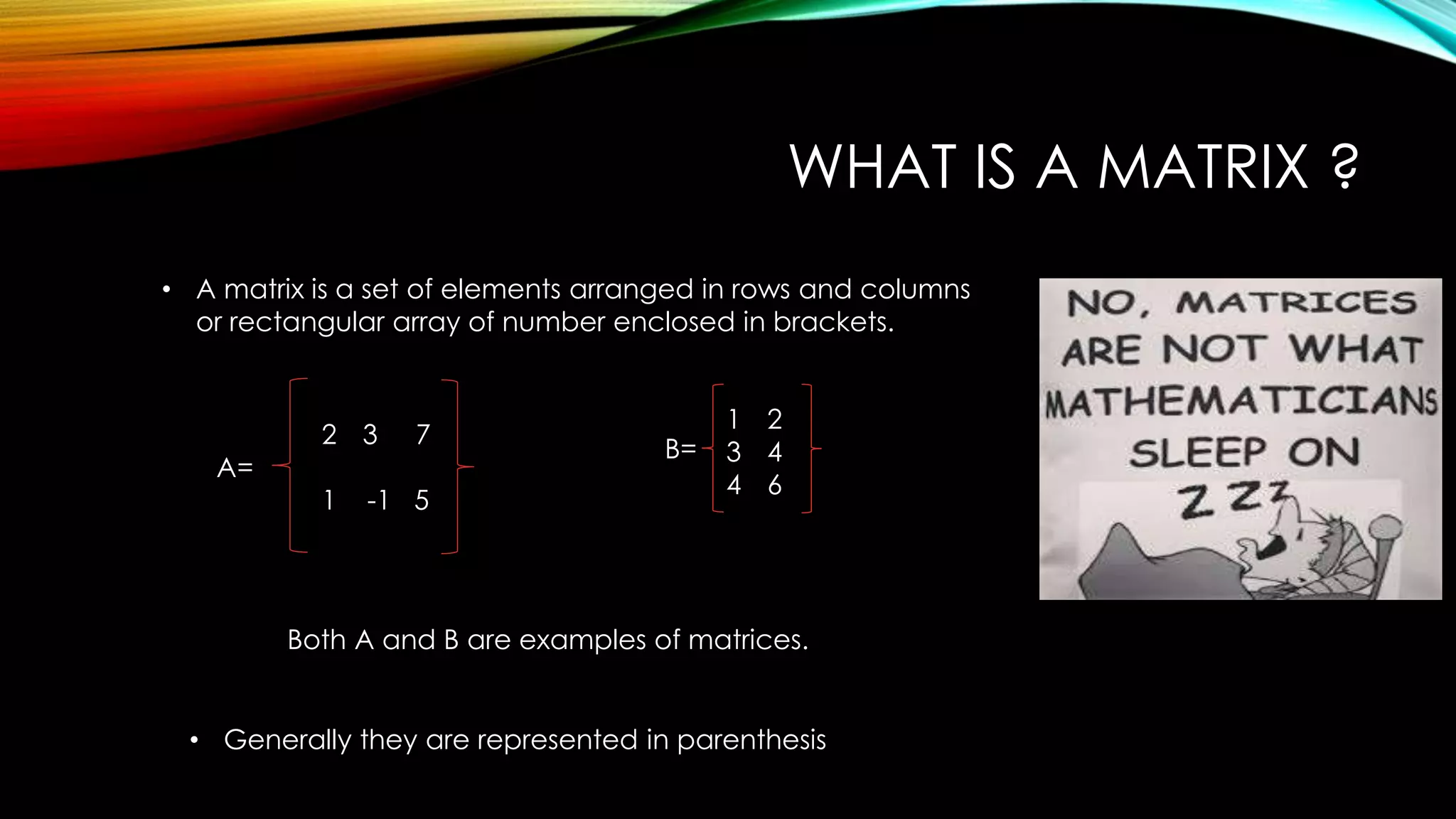
• A matrix is a set of elements arranged in rows and columns
or rectangular array of number enclosed in brackets.
2 3 7
1 -1 5
A=
B=
1 2
3 4
4 6
Both A and B are examples of matrices.
• Generally they are represented in parenthesis
ORDER OF MATRIX
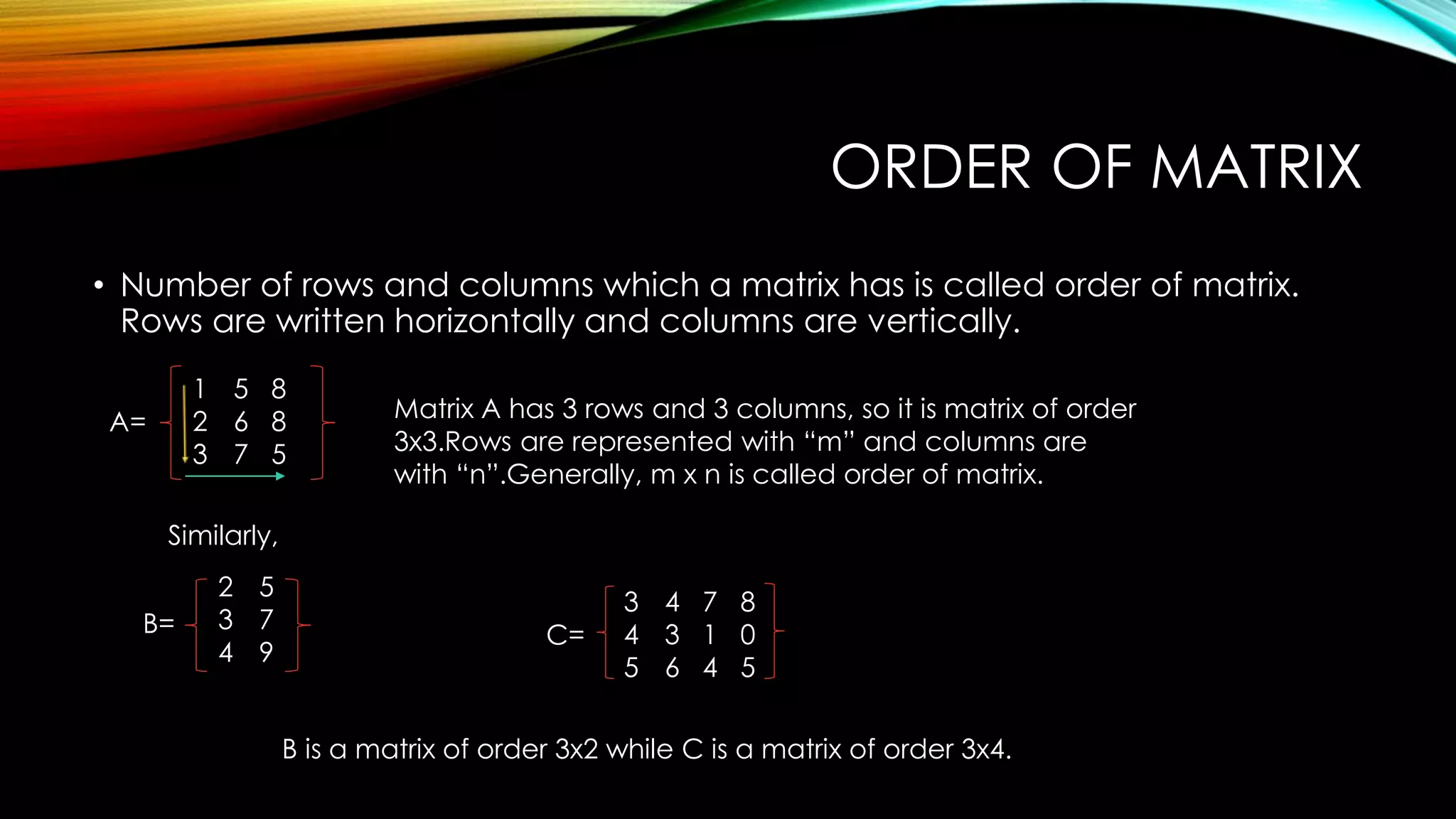
• Number of rows and columns which a matrix has is called order of matrix.
Rows are written horizontally and columns are vertically.
1 5 8
2 6 8
3 7 5
A= Matrix A has 3 rows and 3 columns, so it is matrix of order
3x3.Rows are represented with “m” and columns are
with “n”.Generally, m x n is called order of matrix.
Similarly,
2 5
3 7
4 9
3 4 7 8
4 3 1 0
5 6 4 5
B= C=
B is a matrix of order 3x2 while C is a matrix of order 3x4.
TYPES OF MATRICES
• Square matrix
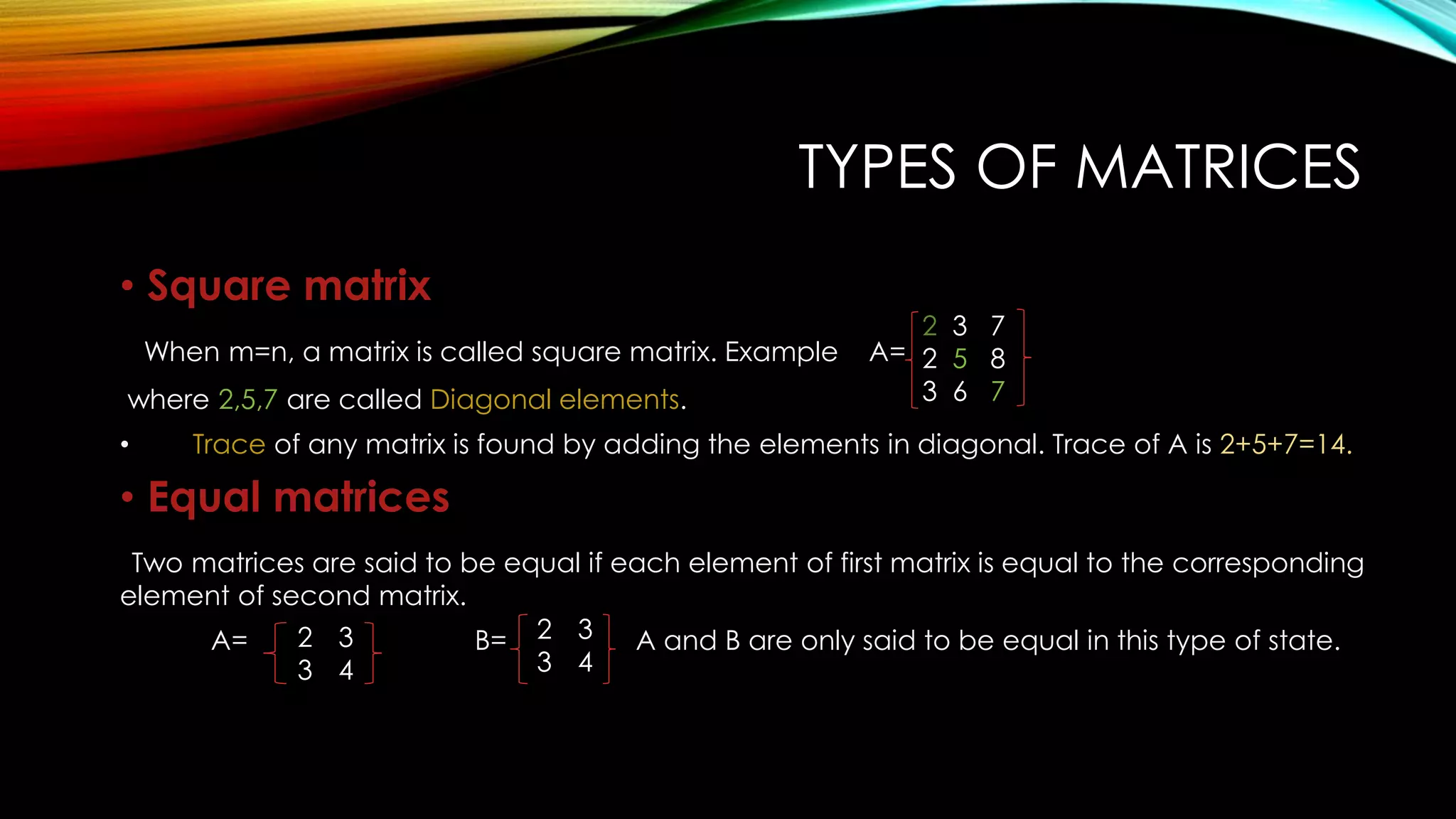
When m=n, a matrix is called square matrix. Example A=
where 2,5,7 are called Diagonal elements.
• Trace of any matrix is found by adding the elements in diagonal. Trace of A is 2+5+7=14.
• Equal matrices
Two matrices are said to be equal if each element of first matrix is equal to the corresponding
element of second matrix.
A= B= A and B are only said to be equal in this type of state.
2 3 7
2 5 8
3 6 7
2 3
3 4
2 3
3 4
• Zero Matrix
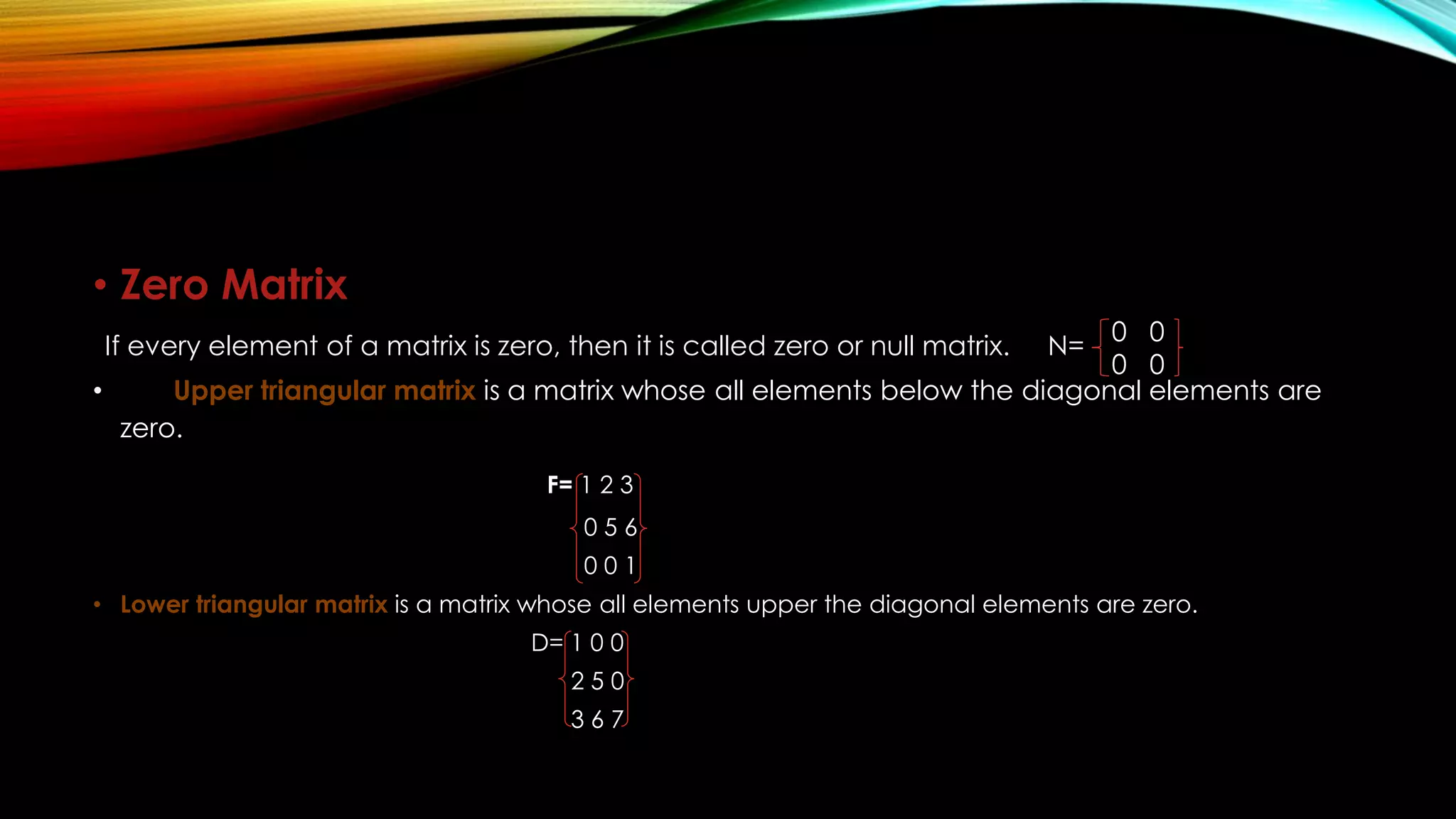
If every element of a matrix is zero, then it is called zero or null matrix. N=
• Upper triangular matrix is a matrix whose all elements below the diagonal elements are
zero.
F= 1 2 3
0 5 6
0 0 1
• Lower triangular matrix is a matrix whose all elements upper the diagonal elements are zero.
D= 1 0 0
2 5 0
3 6 7
0 0
0 0
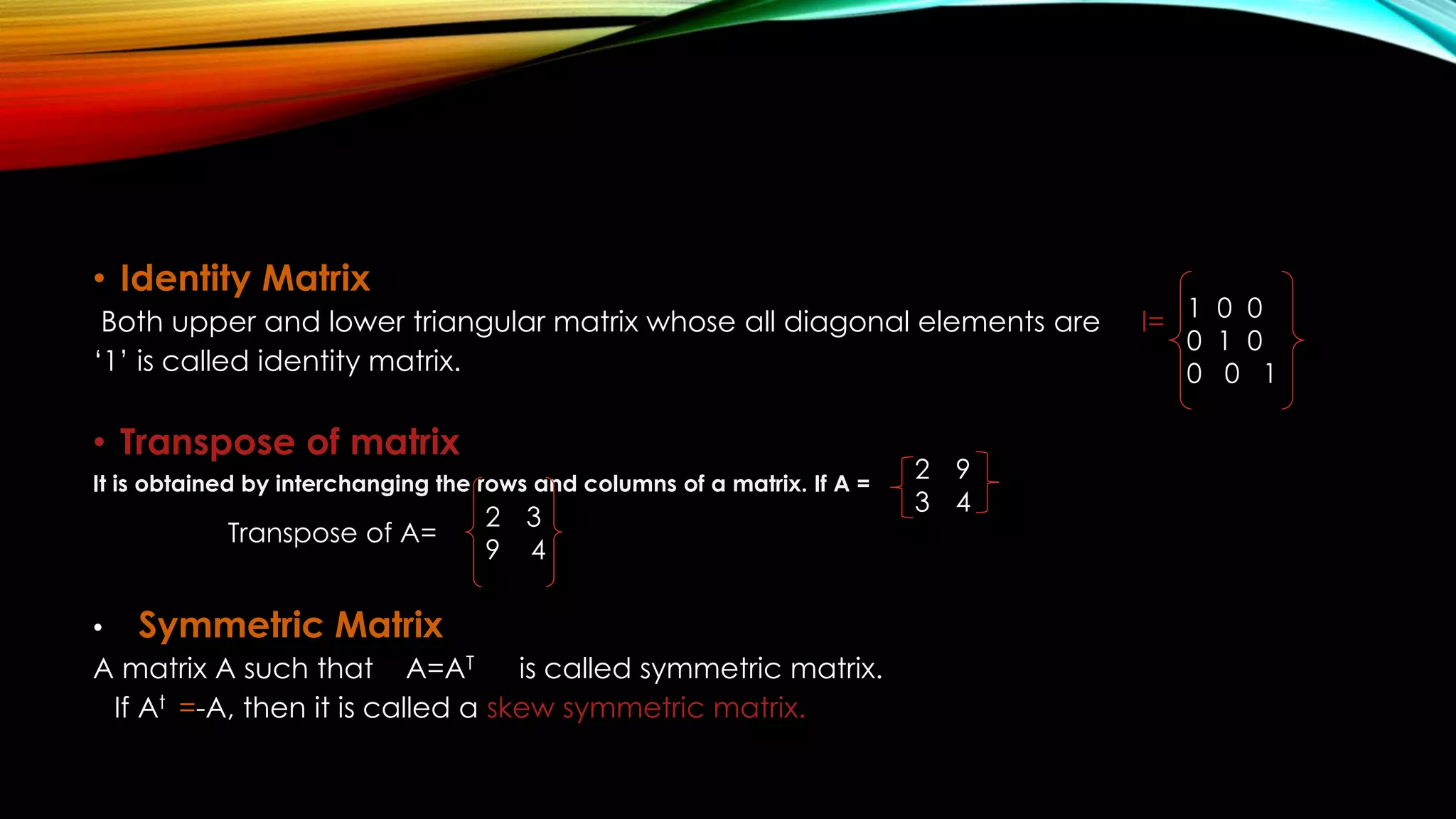
• Identity Matrix
Both upper and lower triangular matrix whose all diagonal elements are I=
‘1’ is called identity matrix.
• Transpose of matrix
It is obtained by interchanging the rows and columns of a matrix. If A =
• Symmetric Matrix
A matrix A such that A=AT is called symmetric matrix.
If At =-A, then it is called a skew symmetric matrix.
1 0 0
0 1 0
0 0 1
2 9
3 4
2 3
9 4
Transpose of A=
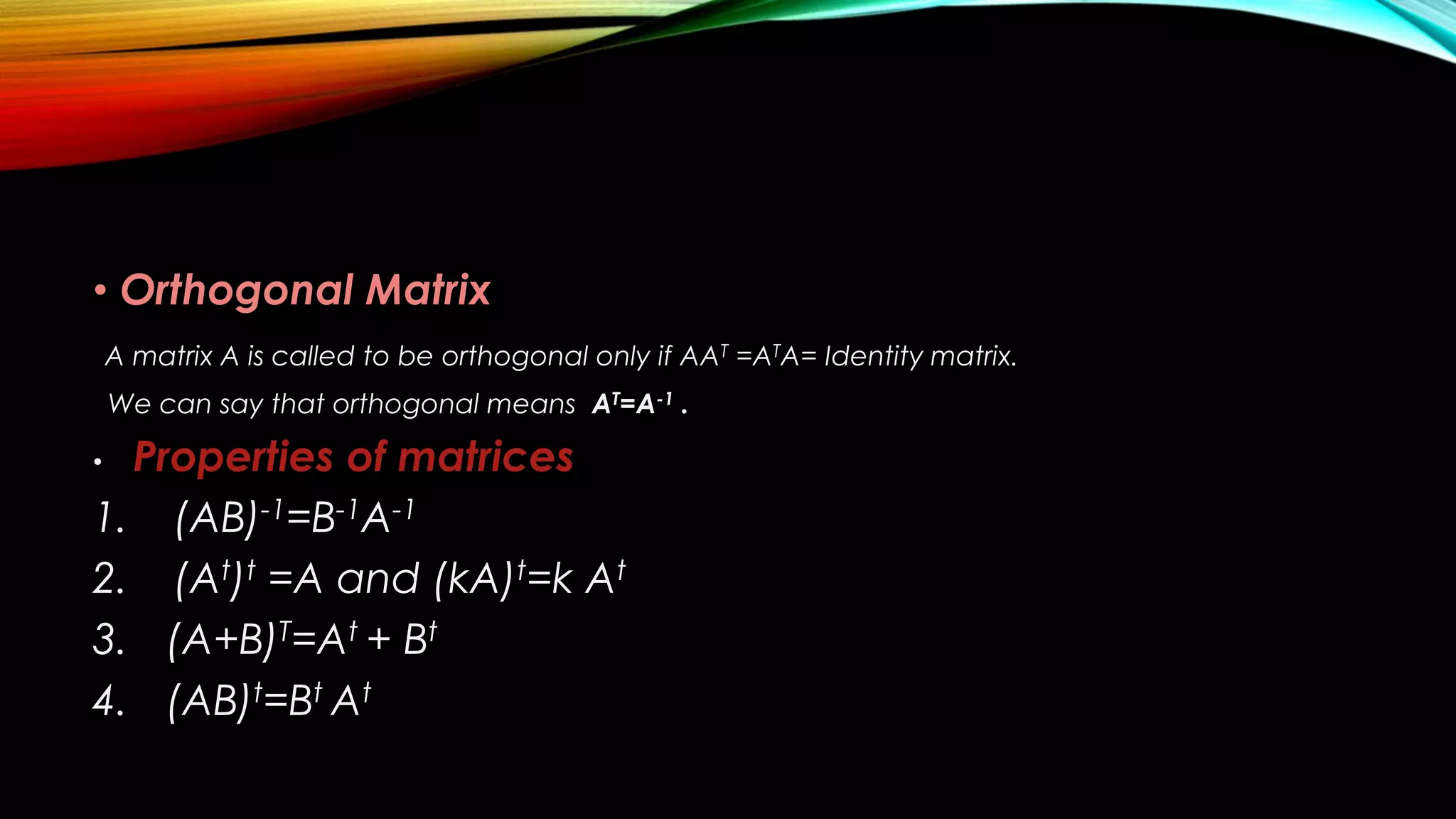
• Orthogonal Matrix
A matrix A is called to be orthogonal only if AAT =ATA= Identity matrix.
We can say that orthogonal means AT=A-1 .
• Properties of matrices
1. (AB)-1=B-1A-1
2. (At)t =A and (kA)t=k At
3. (A+B)T=At + Bt
4. (AB)t=Bt At
DETERMINANTS
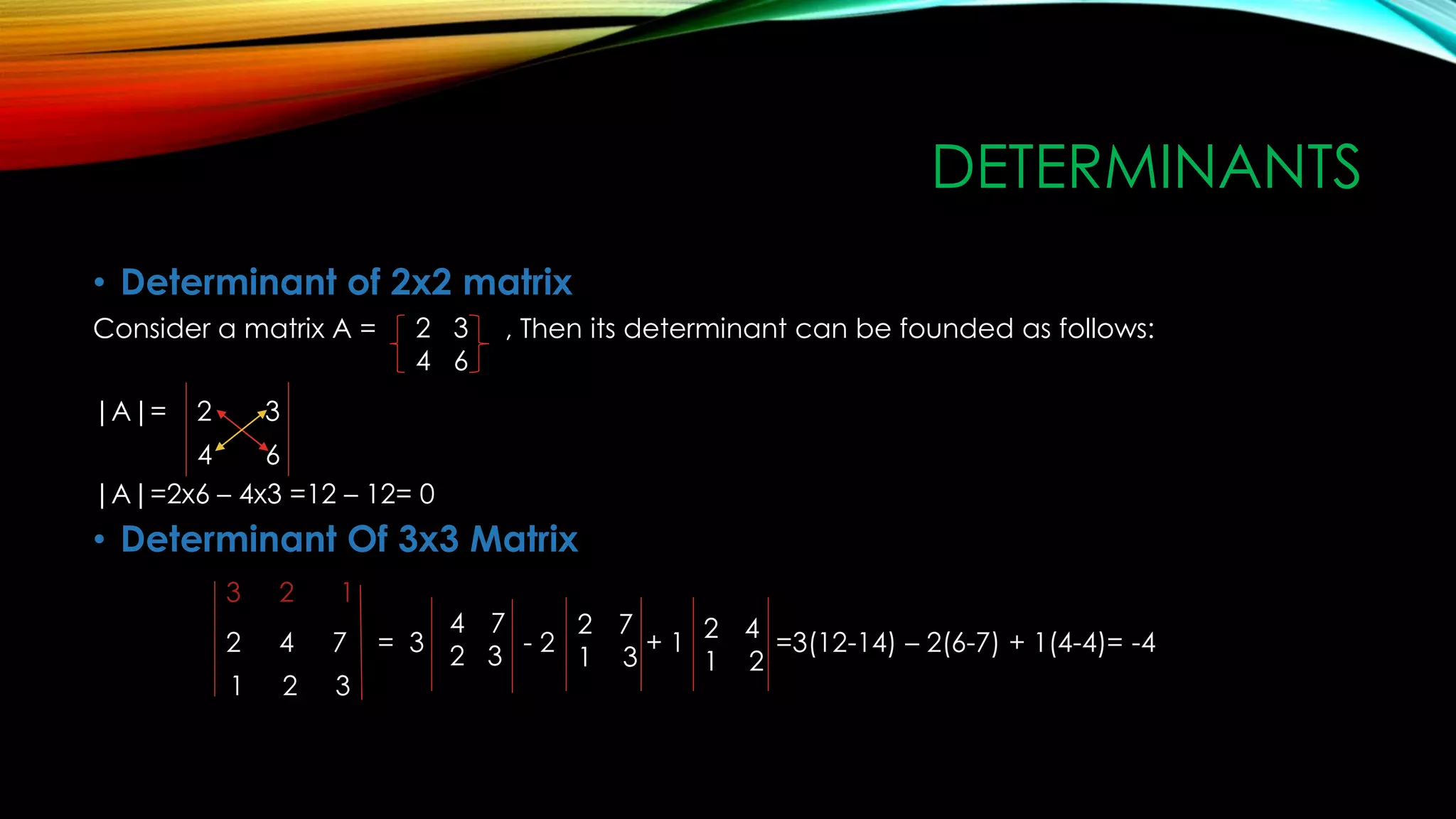
• Determinant of 2x2 matrix
Consider a matrix A = , Then its determinant can be founded as follows:
|A|= 2 3
|A|=2x6 – 4x3 =12 – 12= 0
• Determinant Of 3x3 Matrix
3 2 1
2 4 7 = 3 - 2 + 1 =3(12-14) – 2(6-7) + 1(4-4)= -4
1 2 3
2 3
4 6
4 6
4 7
2 3
2 7
1 3
2 4
1 2
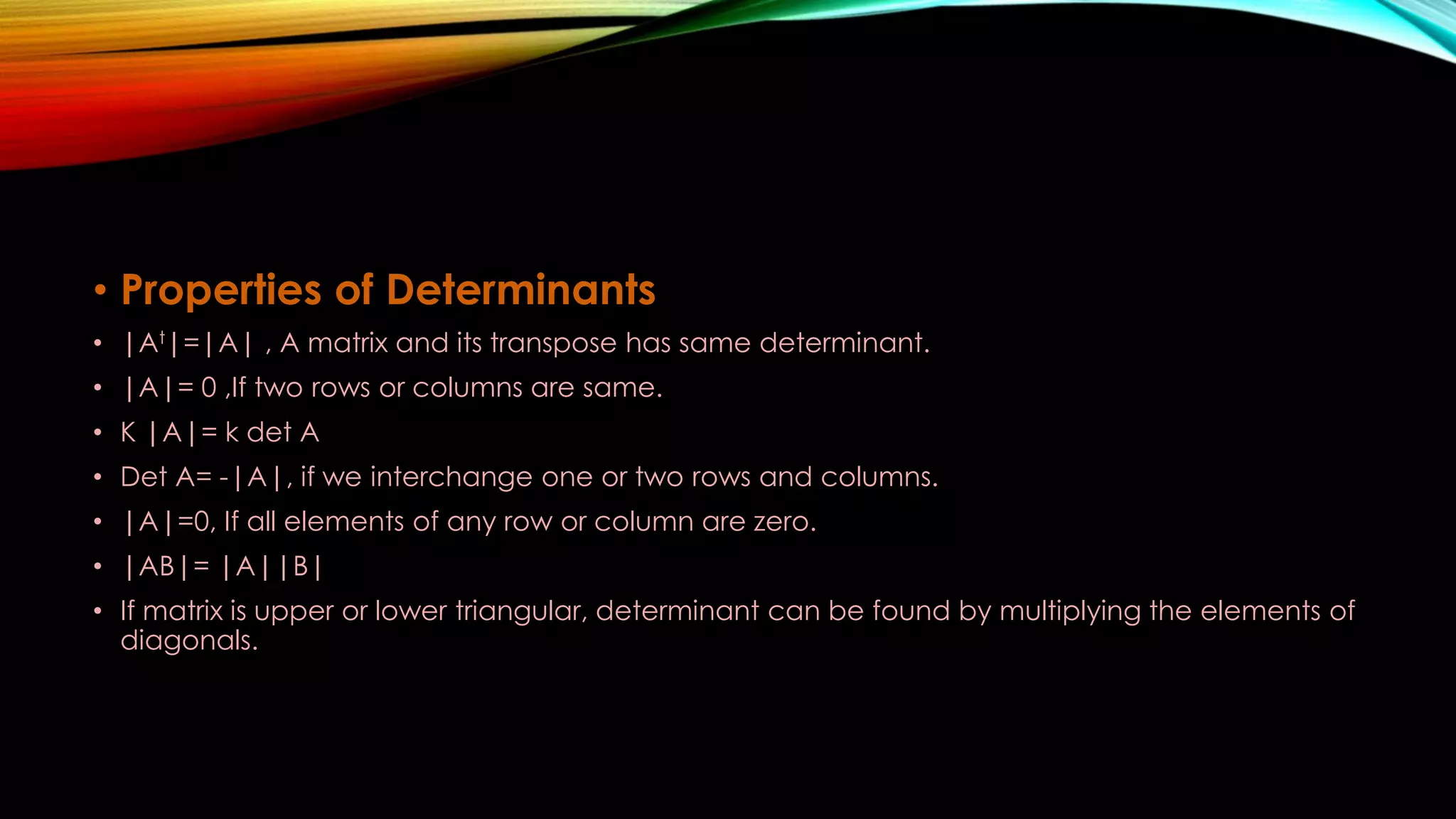
• Properties of Determinants
• |At|=|A| , A matrix and its transpose has same determinant.
• |A|= 0 ,If two rows or columns are same.
• K |A|= k det A
• Det A= -|A|, if we interchange one or two rows and columns.
• |A|=0, If all elements of any row or column are zero.
• |AB|= |A||B|
• If matrix is upper or lower triangular, determinant can be found by multiplying the elements of
diagonals.
Echelon Form
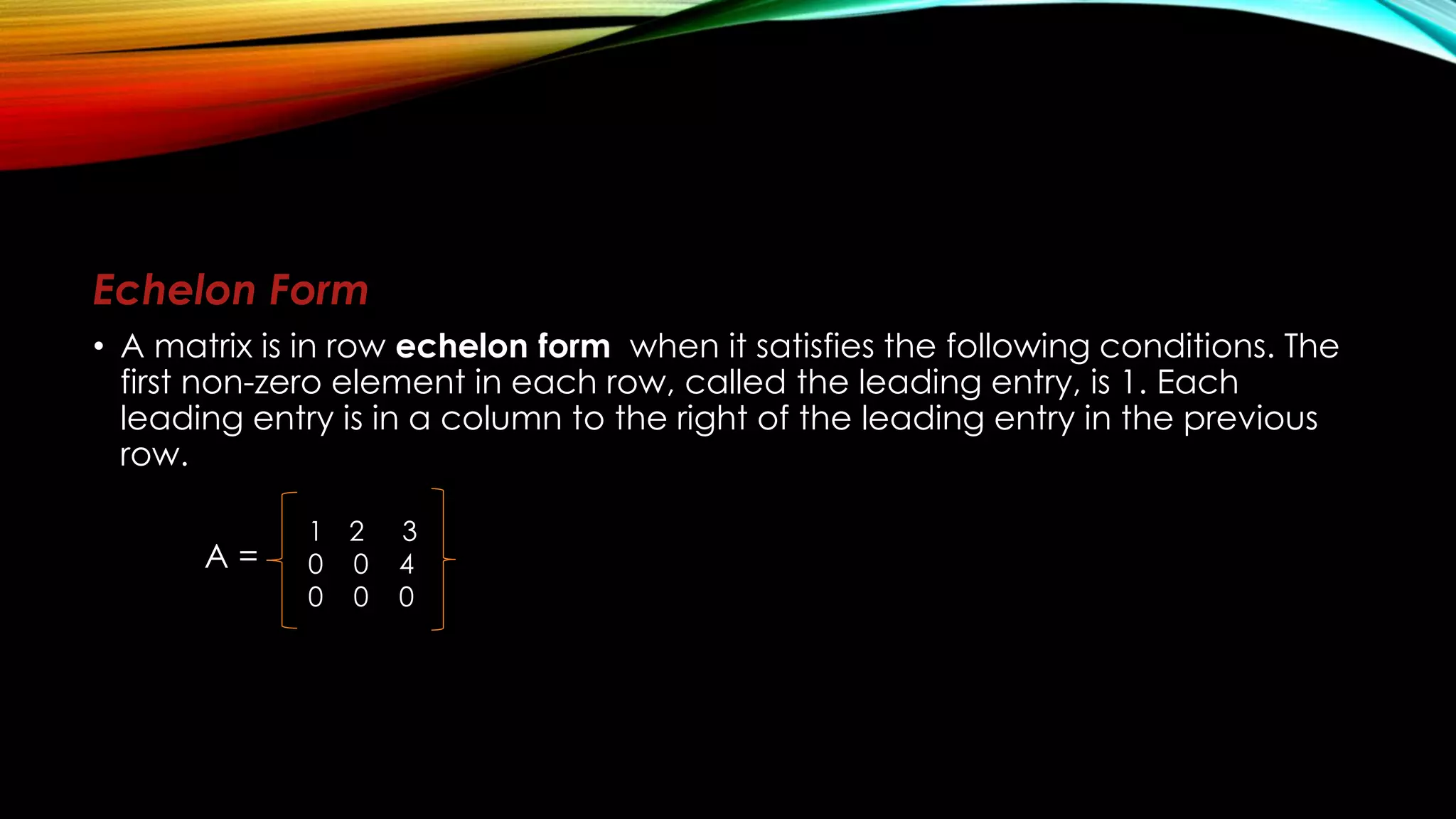
• A matrix is in row echelon form when it satisfies the following conditions. The
first non-zero element in each row, called the leading entry, is 1. Each
leading entry is in a column to the right of the leading entry in the previous
row.
A =
1 2 3
0 0 4
0 0 0
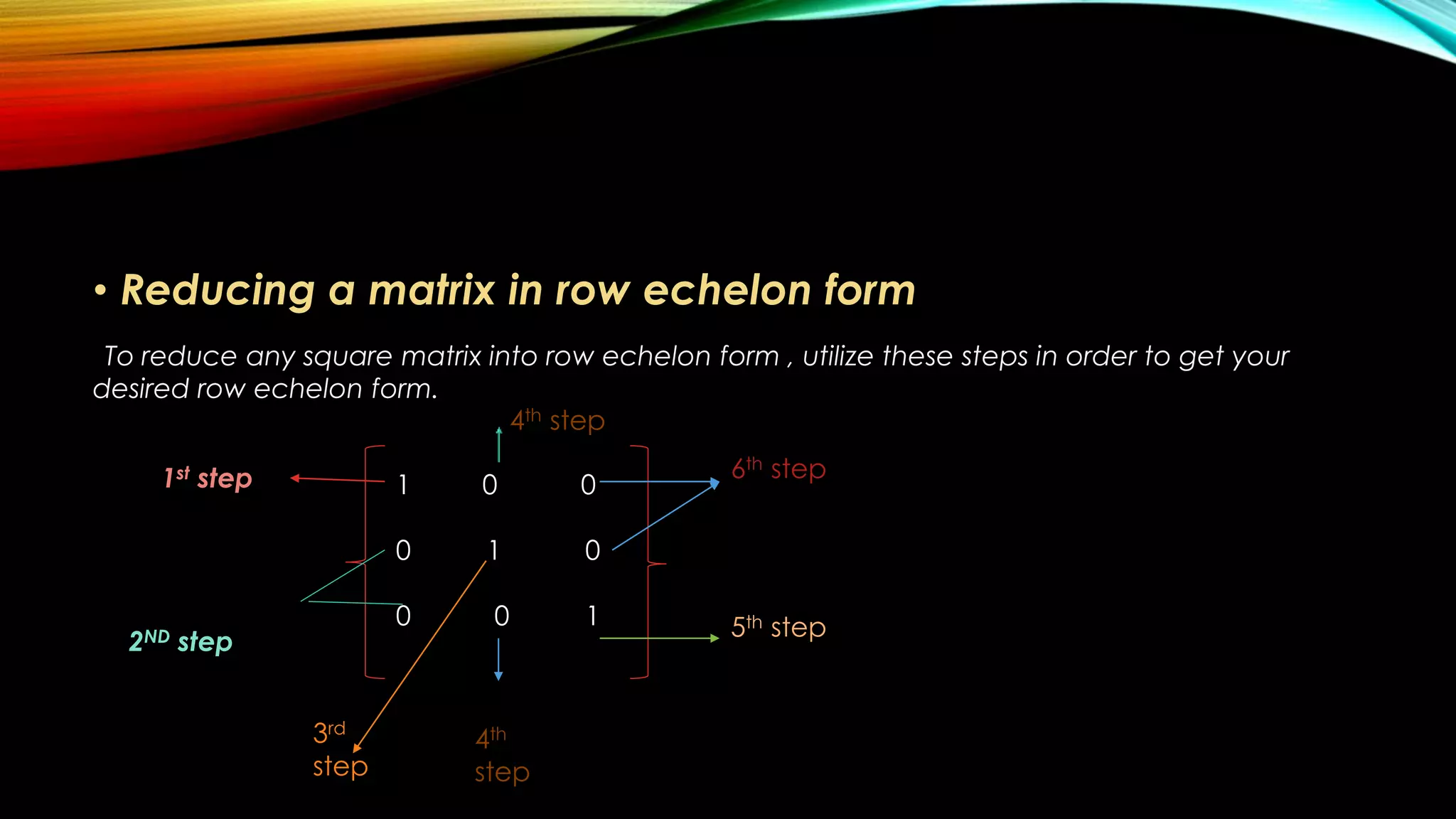
• Reducing a matrix in row echelon form
To reduce any square matrix into row echelon form , utilize these steps in order to get your
desired row echelon form.
1st step
2ND step
1 0 0
0 1 0
0 0 1
3rd
step
4th step
4th
step
5th step
6th step

Matrices and their applications

  • 1.
  • 2.
    WHAT IS AMATRIX ? • A matrix is a set of elements arranged in rows and columns or rectangular array of number enclosed in brackets. 2 3 7 1 -1 5 A= B= 1 2 3 4 4 6 Both A and B are examples of matrices. • Generally they are represented in parenthesis
  • 3.
    ORDER OF MATRIX •Number of rows and columns which a matrix has is called order of matrix. Rows are written horizontally and columns are vertically. 1 5 8 2 6 8 3 7 5 A= Matrix A has 3 rows and 3 columns, so it is matrix of order 3x3.Rows are represented with “m” and columns are with “n”.Generally, m x n is called order of matrix. Similarly, 2 5 3 7 4 9 3 4 7 8 4 3 1 0 5 6 4 5 B= C= B is a matrix of order 3x2 while C is a matrix of order 3x4.
  • 4.
    TYPES OF MATRICES •Square matrix When m=n, a matrix is called square matrix. Example A= where 2,5,7 are called Diagonal elements. • Trace of any matrix is found by adding the elements in diagonal. Trace of A is 2+5+7=14. • Equal matrices Two matrices are said to be equal if each element of first matrix is equal to the corresponding element of second matrix. A= B= A and B are only said to be equal in this type of state. 2 3 7 2 5 8 3 6 7 2 3 3 4 2 3 3 4
  • 5.
    • Zero Matrix Ifevery element of a matrix is zero, then it is called zero or null matrix. N= • Upper triangular matrix is a matrix whose all elements below the diagonal elements are zero. F= 1 2 3 0 5 6 0 0 1 • Lower triangular matrix is a matrix whose all elements upper the diagonal elements are zero. D= 1 0 0 2 5 0 3 6 7 0 0 0 0
  • 6.
    • Identity Matrix Bothupper and lower triangular matrix whose all diagonal elements are I= ‘1’ is called identity matrix. • Transpose of matrix It is obtained by interchanging the rows and columns of a matrix. If A = • Symmetric Matrix A matrix A such that A=AT is called symmetric matrix. If At =-A, then it is called a skew symmetric matrix. 1 0 0 0 1 0 0 0 1 2 9 3 4 2 3 9 4 Transpose of A=
  • 7.
    • Orthogonal Matrix Amatrix A is called to be orthogonal only if AAT =ATA= Identity matrix. We can say that orthogonal means AT=A-1 . • Properties of matrices 1. (AB)-1=B-1A-1 2. (At)t =A and (kA)t=k At 3. (A+B)T=At + Bt 4. (AB)t=Bt At
  • 8.
    DETERMINANTS • Determinant of2x2 matrix Consider a matrix A = , Then its determinant can be founded as follows: |A|= 2 3 |A|=2x6 – 4x3 =12 – 12= 0 • Determinant Of 3x3 Matrix 3 2 1 2 4 7 = 3 - 2 + 1 =3(12-14) – 2(6-7) + 1(4-4)= -4 1 2 3 2 3 4 6 4 6 4 7 2 3 2 7 1 3 2 4 1 2
  • 9.
    • Properties ofDeterminants • |At|=|A| , A matrix and its transpose has same determinant. • |A|= 0 ,If two rows or columns are same. • K |A|= k det A • Det A= -|A|, if we interchange one or two rows and columns. • |A|=0, If all elements of any row or column are zero. • |AB|= |A||B| • If matrix is upper or lower triangular, determinant can be found by multiplying the elements of diagonals.
  • 10.
    Echelon Form • Amatrix is in row echelon form when it satisfies the following conditions. The first non-zero element in each row, called the leading entry, is 1. Each leading entry is in a column to the right of the leading entry in the previous row. A = 1 2 3 0 0 4 0 0 0
  • 11.
    • Reducing amatrix in row echelon form To reduce any square matrix into row echelon form , utilize these steps in order to get your desired row echelon form. 1st step 2ND step 1 0 0 0 1 0 0 0 1 3rd step 4th step 4th step 5th step 6th step