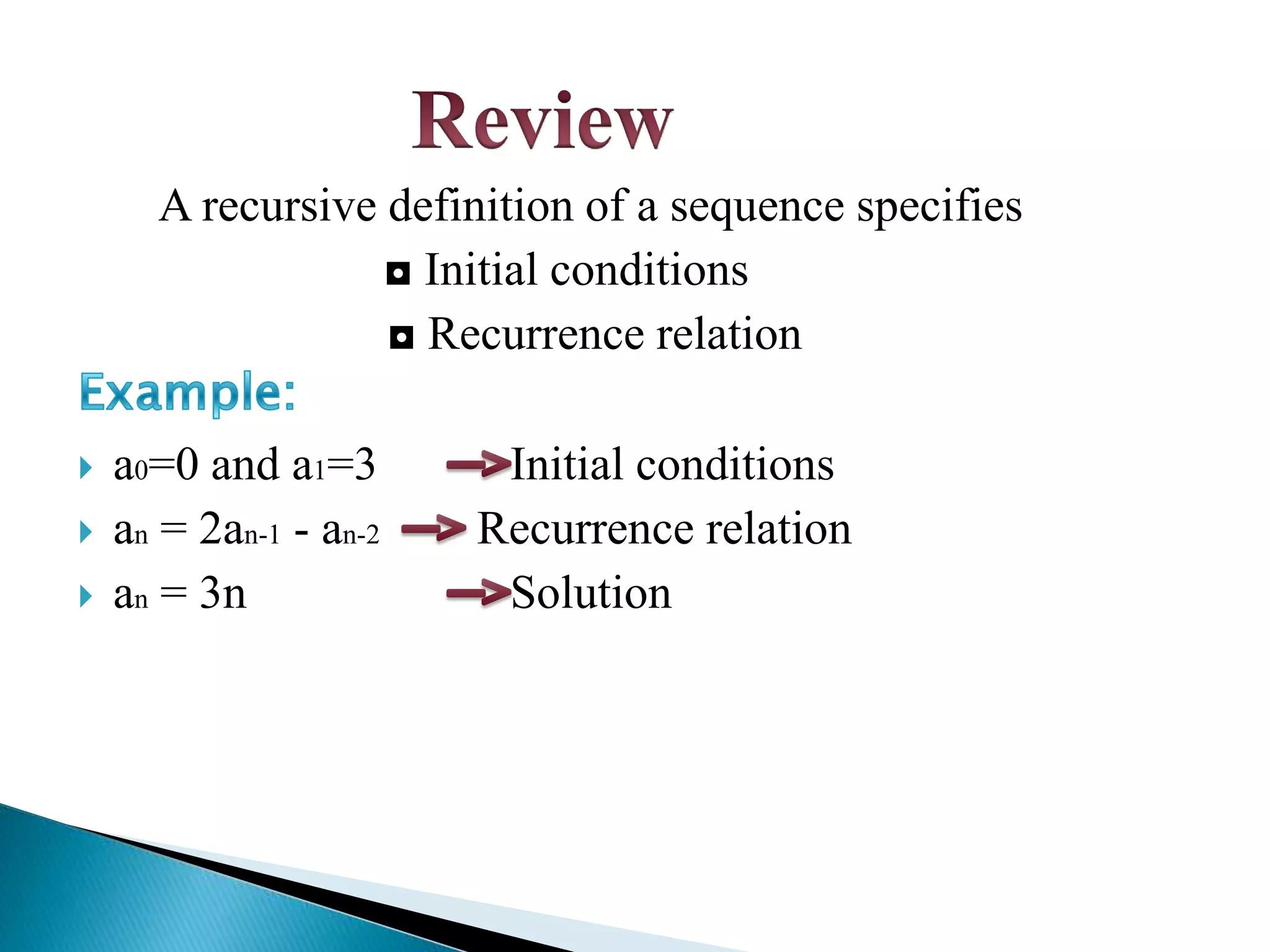
A recursive definition of a sequence specifies
◘ Initial conditions
◘ Recurrence relation
 a0=0 and a1=3 Initial conditions
 an = 2an-1 - an-2 Recurrence relation
 an = 3n Solution
 Each term of a sequence is a linear function of earlier
 terms in the sequence.
 a0 = 1 a1 = 6 a2 = 10
 an = an-1 + 2an-2 + 3an-3
 a3 = a0 + 2a1 + 3a2
= 1 + 2(6) + 3(10) = 43
 1. Linear homogeneous recurrences
 2. Linear non-homogeneous recurrences
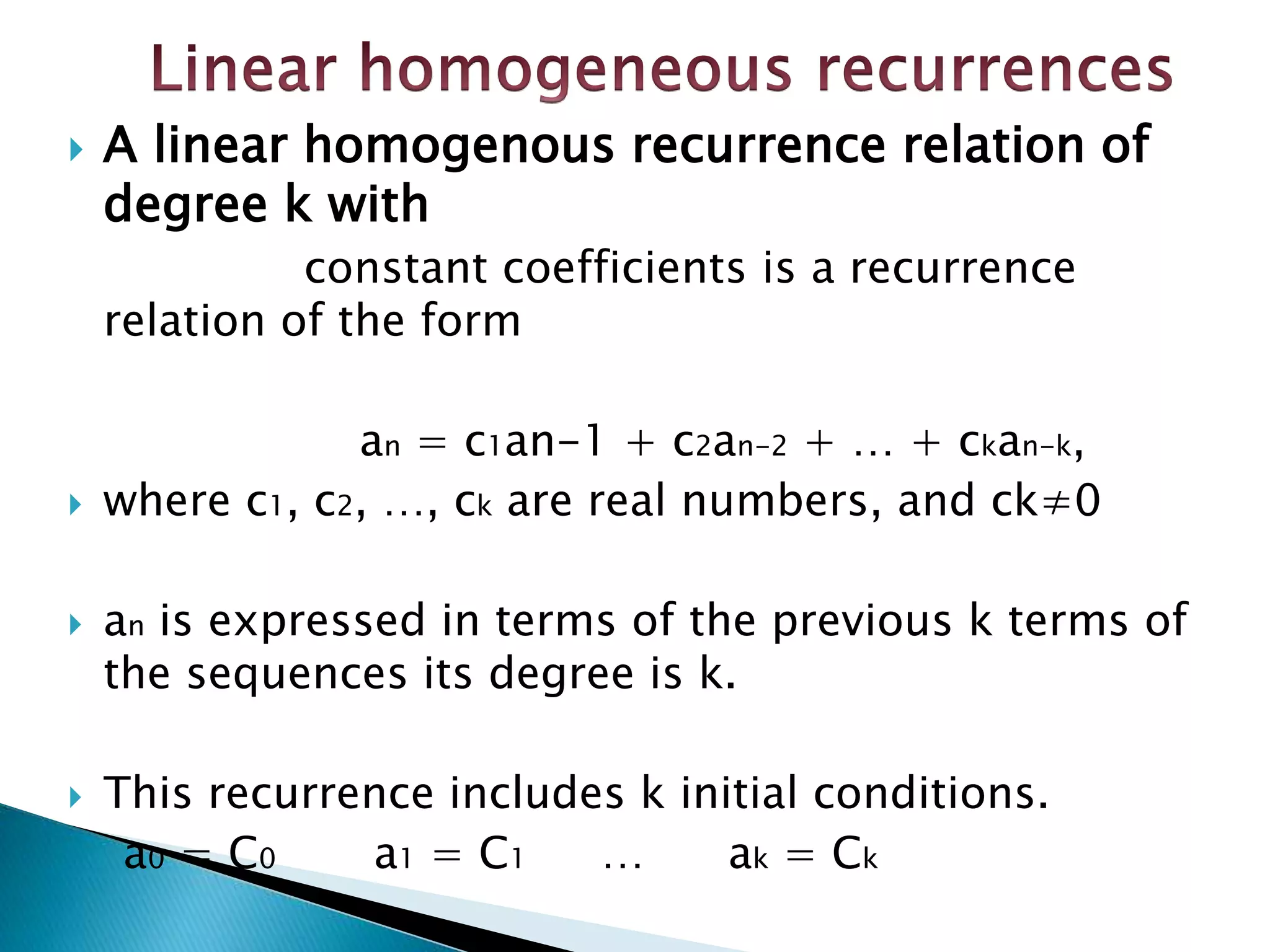
 A linear homogenous recurrence relation of
degree k with
constant coefficients is a recurrence
relation of the form
an = c1an-1 + c2an-2 + … + ckan-k,
 where c1, c2, …, ck are real numbers, and ck≠0
 an is expressed in terms of the previous k terms of
the sequences its degree is k.
 This recurrence includes k initial conditions.
a0 = C0 a1 = C1 … ak = Ck
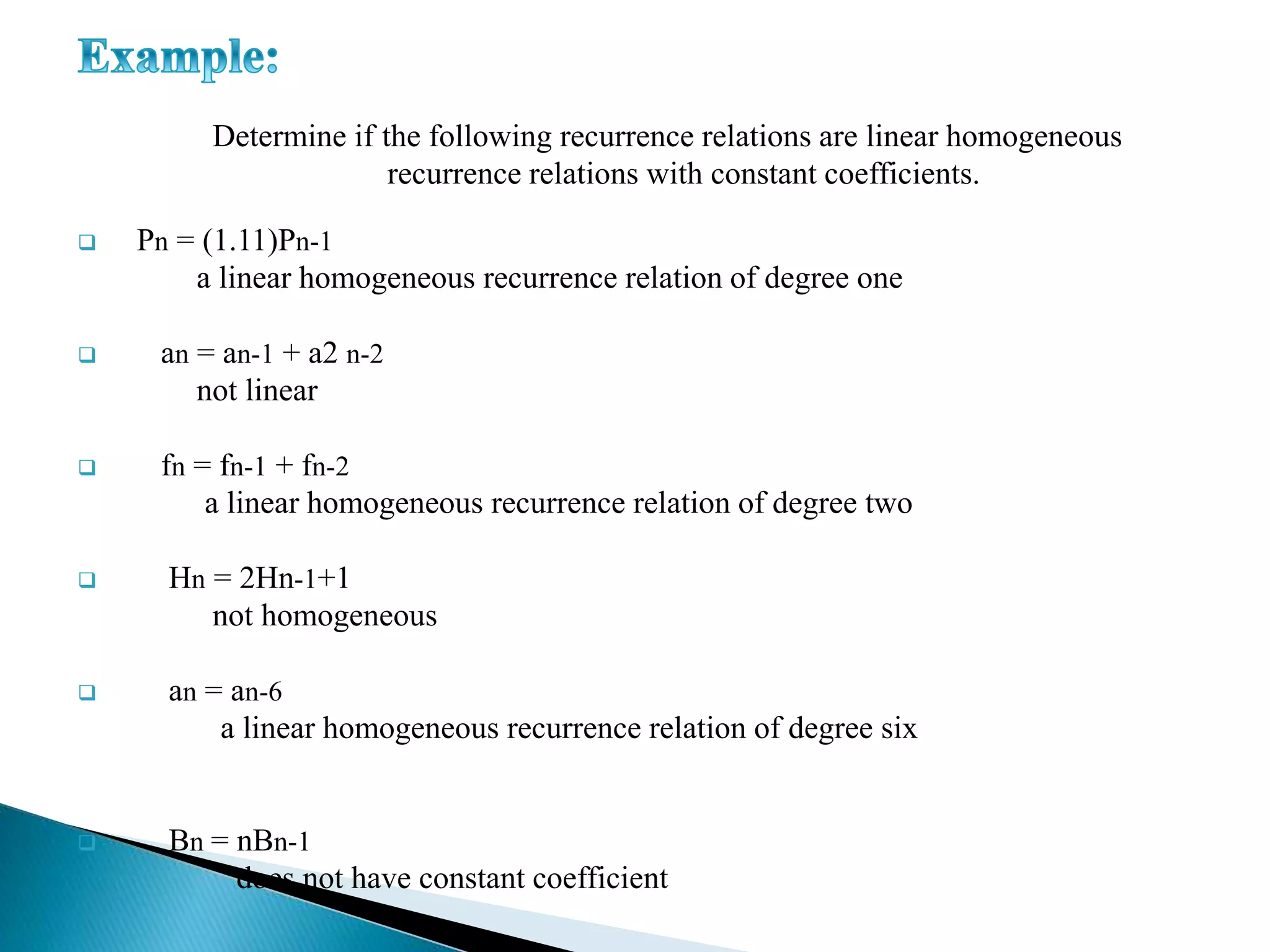
Determine if the following recurrence relations are linear homogeneous
recurrence relations with constant coefficients.
 Pn = (1.11)Pn-1
a linear homogeneous recurrence relation of degree one
 an = an-1 + a2 n-2
not linear
 fn = fn-1 + fn-2
a linear homogeneous recurrence relation of degree two
 Hn = 2Hn-1+1
not homogeneous
 an = an-6
a linear homogeneous recurrence relation of degree six
 Bn = nBn-1
does not have constant coefficient
 Let an = c1an-1 + c2an-2 + … + ckan-k be a linear homogeneous
recurrence.
 Assume the sequence an satisfies the recurrence.
 Assume the sequence a’n also satisfies the recurrence.
 So, bn = an + a’n and dn=􀀁an are also sequences that satisfy the
recurrence.
(α is any constant)
bn = an + a’n
= (c1an-1 + c2an-2 + … + ckan-k) + (c1a’n-1 + c2a’n-2 + … + cka’n-k)
= c1 (an-1+ a’n-1) + c2 (an-2+ a’n-2) + … + ck (an-k + a’n-k)
= c1bn-1 + c2bn-2 + … + ckbn-k
So, bn is a solution of the recurrence.
 Let an = c1an-1 + c2an-2 + … + ckan-k be a linear
homogeneous
recurrence.
 Assume the sequence an satisfies the recurrence.
 Assume the sequence a’n also satisfies the
recurrence.
 So, bn = an + a’n and dn=􀀁an are also sequences
that satisfy the recurrence.
(α is any constant)
dn = α an
= α (c1an-1 + c2an-2 + … + ckan-k)
= c1 (α an-1) + c2 (α an-2) + … + ck (α an-k)
= c1dn-1 + c2dn-2 + … + ckdn-k
So, dn is a solution of the recurrence.
It follows from the previous proposition, if we
find some solutions to a linear
homogeneous recurrence, then any linear
combination of them will also be a solution
To the linear homogeneous recurrence.
Geometric sequences come up a lot when
solving linear homogeneous recurrences.
So, try to find any solution of the form an = rn
that satisfies the recurrence relation.
 Recurrence relation:
an = c1an-1 + c2an-2 + … + ckan-k
 Try to find a solution of form rn
rn = c1rn-1 + c2rn-2 + … + ckrn-k
rn - c1rn-1 - c2rn-2 - … - ckrn-k = 0
rk - c1rk-1 - c2rk-2 - … - ck = 0 (dividing both sides by rn-k)
 This equation is called the characteristic equation
What is the solution of the recurrence relation
an = an-1 + 2an-2
with a0=2 and a1=7?
 Since it is linear homogeneous recurrence, first find its
characteristic equation
r2 - r - 2 = 0
(r+1)(r-2) = 0 r1 = 2 and r2 = -1
 So, by theorem an = α 12n + α 2(-1)n is a solution.
 Now we should find α 1 and α 2 using initial conditions.
a0= α 1 + α 2 = 2
a1= α 12 + α 2(-1) = 7
 So, α 1= 3 and α 2 = -1.
 an = 3 . 2n - (-1)n is a solution.
 If the characteristic equation has k distinct solutions
r1, r2, …, rk, it can be written as
(r - r1)(r - r2)…(r - rk) = 0.
If, after factoring, the equation has m+1 factors of (r -
r1), for example, r1 is called a solution of the
characteristic equation with multiplicity m+1.
 When this happens, not only r1 n is a solution, but also
Nr1n n, n2r1 n, … and nmr1n are solutions of the
recurrence.
When a characteristic equation has fewer than k
distinct solutions:
 We obtain sequences of the form described in
Proposition 3.
 By Proposition 1, we know any combination of
these solutions is also a solution to the recurrence.
 We can find those that satisfies the initial
conditions.
 Consider the characteristic equation rk - c1rk-1 - c2rk-2 -
… -ck = 0 and the recurrence an = c1an-1 + c2an-2 + … +
ckan-k.
 Assume the characteristic equation has t ≤ k distinct
solutions.
 Let Ɐi (1≤ i≤ t) ri with multiplicity mi be a solution of the
equation.
 Let Ɐ i,j (1 ≤ I ≤ t and 0≤j≤mi-1) ɑij be a constant.
So, an = (ɑ 10 + ɑ 11 n+ … + ɑ 1,m1-1 nm1-1 ) r1n
+ (ɑ 20 + ɑ 21 n+ … + ɑ 2,m2-1 nm2-1 ) r2n
+ …
+ (ɑ t0 + ɑ t1 n+ … + ɑ t,mt-1 nmt-1 ) rtn
satisfies the recurrence
What is the solution of the recurrence relation
an = 6an-1 - 9an-2
with a0=1 and a1=6?
 First find its characteristic equation
r2 - 6r + 9 = 0
(r - 3)2 = 0 r1 = 3 (Its multiplicity is 2.)
 So, by theorem an = ( ɑ 10 + ɑ 11n)(3)n is a solution.
 Now we should find constants using initial conditions.
a0= ɑ 10 = 1
a1= 3 ɑ 10 + 3ɑ 11 = 6
 So, ɑ 11= 1 and ɑ 10 = 1.
 an = 3n + n3n is a solution
Maths

Maths

  • 2.
    A recursive definitionof a sequence specifies ◘ Initial conditions ◘ Recurrence relation  a0=0 and a1=3 Initial conditions  an = 2an-1 - an-2 Recurrence relation  an = 3n Solution
  • 3.
     Each termof a sequence is a linear function of earlier  terms in the sequence.  a0 = 1 a1 = 6 a2 = 10  an = an-1 + 2an-2 + 3an-3  a3 = a0 + 2a1 + 3a2 = 1 + 2(6) + 3(10) = 43
  • 4.
     1. Linearhomogeneous recurrences  2. Linear non-homogeneous recurrences
  • 5.
     A linearhomogenous recurrence relation of degree k with constant coefficients is a recurrence relation of the form an = c1an-1 + c2an-2 + … + ckan-k,  where c1, c2, …, ck are real numbers, and ck≠0  an is expressed in terms of the previous k terms of the sequences its degree is k.  This recurrence includes k initial conditions. a0 = C0 a1 = C1 … ak = Ck
  • 6.
    Determine if thefollowing recurrence relations are linear homogeneous recurrence relations with constant coefficients.  Pn = (1.11)Pn-1 a linear homogeneous recurrence relation of degree one  an = an-1 + a2 n-2 not linear  fn = fn-1 + fn-2 a linear homogeneous recurrence relation of degree two  Hn = 2Hn-1+1 not homogeneous  an = an-6 a linear homogeneous recurrence relation of degree six  Bn = nBn-1 does not have constant coefficient
  • 7.
     Let an= c1an-1 + c2an-2 + … + ckan-k be a linear homogeneous recurrence.  Assume the sequence an satisfies the recurrence.  Assume the sequence a’n also satisfies the recurrence.  So, bn = an + a’n and dn=􀀁an are also sequences that satisfy the recurrence. (α is any constant) bn = an + a’n = (c1an-1 + c2an-2 + … + ckan-k) + (c1a’n-1 + c2a’n-2 + … + cka’n-k) = c1 (an-1+ a’n-1) + c2 (an-2+ a’n-2) + … + ck (an-k + a’n-k) = c1bn-1 + c2bn-2 + … + ckbn-k So, bn is a solution of the recurrence.
  • 8.
     Let an= c1an-1 + c2an-2 + … + ckan-k be a linear homogeneous recurrence.  Assume the sequence an satisfies the recurrence.  Assume the sequence a’n also satisfies the recurrence.  So, bn = an + a’n and dn=􀀁an are also sequences that satisfy the recurrence. (α is any constant) dn = α an = α (c1an-1 + c2an-2 + … + ckan-k) = c1 (α an-1) + c2 (α an-2) + … + ck (α an-k) = c1dn-1 + c2dn-2 + … + ckdn-k So, dn is a solution of the recurrence.
  • 9.
    It follows fromthe previous proposition, if we find some solutions to a linear homogeneous recurrence, then any linear combination of them will also be a solution To the linear homogeneous recurrence.
  • 10.
    Geometric sequences comeup a lot when solving linear homogeneous recurrences. So, try to find any solution of the form an = rn that satisfies the recurrence relation.
  • 11.
     Recurrence relation: an= c1an-1 + c2an-2 + … + ckan-k  Try to find a solution of form rn rn = c1rn-1 + c2rn-2 + … + ckrn-k rn - c1rn-1 - c2rn-2 - … - ckrn-k = 0 rk - c1rk-1 - c2rk-2 - … - ck = 0 (dividing both sides by rn-k)  This equation is called the characteristic equation
  • 12.
    What is thesolution of the recurrence relation an = an-1 + 2an-2 with a0=2 and a1=7?  Since it is linear homogeneous recurrence, first find its characteristic equation r2 - r - 2 = 0 (r+1)(r-2) = 0 r1 = 2 and r2 = -1  So, by theorem an = α 12n + α 2(-1)n is a solution.  Now we should find α 1 and α 2 using initial conditions. a0= α 1 + α 2 = 2 a1= α 12 + α 2(-1) = 7  So, α 1= 3 and α 2 = -1.  an = 3 . 2n - (-1)n is a solution.
  • 13.
     If thecharacteristic equation has k distinct solutions r1, r2, …, rk, it can be written as (r - r1)(r - r2)…(r - rk) = 0. If, after factoring, the equation has m+1 factors of (r - r1), for example, r1 is called a solution of the characteristic equation with multiplicity m+1.  When this happens, not only r1 n is a solution, but also Nr1n n, n2r1 n, … and nmr1n are solutions of the recurrence.
  • 14.
    When a characteristicequation has fewer than k distinct solutions:  We obtain sequences of the form described in Proposition 3.  By Proposition 1, we know any combination of these solutions is also a solution to the recurrence.  We can find those that satisfies the initial conditions.
  • 15.
     Consider thecharacteristic equation rk - c1rk-1 - c2rk-2 - … -ck = 0 and the recurrence an = c1an-1 + c2an-2 + … + ckan-k.  Assume the characteristic equation has t ≤ k distinct solutions.  Let Ɐi (1≤ i≤ t) ri with multiplicity mi be a solution of the equation.  Let Ɐ i,j (1 ≤ I ≤ t and 0≤j≤mi-1) ɑij be a constant. So, an = (ɑ 10 + ɑ 11 n+ … + ɑ 1,m1-1 nm1-1 ) r1n + (ɑ 20 + ɑ 21 n+ … + ɑ 2,m2-1 nm2-1 ) r2n + … + (ɑ t0 + ɑ t1 n+ … + ɑ t,mt-1 nmt-1 ) rtn satisfies the recurrence
  • 16.
    What is thesolution of the recurrence relation an = 6an-1 - 9an-2 with a0=1 and a1=6?  First find its characteristic equation r2 - 6r + 9 = 0 (r - 3)2 = 0 r1 = 3 (Its multiplicity is 2.)  So, by theorem an = ( ɑ 10 + ɑ 11n)(3)n is a solution.  Now we should find constants using initial conditions. a0= ɑ 10 = 1 a1= 3 ɑ 10 + 3ɑ 11 = 6  So, ɑ 11= 1 and ɑ 10 = 1.  an = 3n + n3n is a solution