Solving
Recurrences
using
Generating
Functions
To solve the recurrence relation by
generating functions, we have numeric
function for the closed form expression of
generating function
A(z) = a0 + a1z + a2z2 + a3z3 + …
Generating function Numeric function
A(z) =
𝟏
𝟏−𝒂𝒛
A(z) =
1
1−𝑧 2
A(z) =
𝒛
𝟏−𝒛 𝟐
A(z) =
𝒂𝒛
𝟏−𝒂𝒛 𝟐
A(z) = 𝒆 𝒛
A(z) = 𝟏 + 𝒛 𝒏
𝒂 𝒓
(r + 1)
r
rar
𝟏
𝒏!
𝒏 < 𝒓, 𝟎 ≤ 𝒓 ≤ 𝒏
𝟎, 𝒓 > 𝒏
Example 1:
Solve recurrence relation by generating function
1. Multiply both sides by zr
Steps to follow
ar - 2ar-1 - 3ar-2 = 0, for r  2, a0 = 3; a1 = 1
a r - 2 1
r
- 3
2
r
= 0r
z ar-
z ar-
z
Solving Recurrence relation using Generating Functions
ar - 2ar-1 - 3ar-2 = 0, for r  2, a0 = 3; a1 = 1
2. Since r  2, summing for all r, we get
arzr – 2 ar-1zr – 3 ar-2zr = 0
r = 2

r = 2

r = 2

Solving individually
For the 1st term:
 arzr = a2z2 + a3z3 + a4z4 + r = 2

A(z) = a0 + a1z + a2z2 + a3z3 + …
 arzr = A(z) - a0 - a1zr = 2

  
Solving Recurrence relation using Generating Functions
ar - 2ar-1 - 3ar-2 = 0, for r  2, a0 = 3; a1 = 1
For the 2nd term:
 ar-1zr = a1z2 + a2z3 + a3z4 + 
r = 2

Factoring out z:
 ar-1zr = z[A(z) – a0 ]r = 2

A(z) = a0 + a1z + a2z2 + a3z3 + …
Z(a1z + a2z2 + a3z3 + )
Solving Recurrence relation using Generating Functions
ar - 2ar-1 - 3ar-2 = 0, for r  2, a0 = 3; a1 = 1
For the 3rd term:
 ar-2zr = a0z2 + a1z3 + a2z4 + 
r = 2

Factoring out z2:
 ar-2zr = z2[A(z)]r = 2

A(z) = a0 + a1z + a2z2 + a3z3 + …
z2( a0 + a1z + a2z2 + )
Solving Recurrence relation using Generating Functions
ar - 2ar-1 - 3ar-2 = 0, for r  2, a0 = 3; a1 = 1
Substitute
 ar-2zr = z2[A(z)]r = 2
 arzr – 2 ar-1zr – 3  ar-2zr = 0
r = 2

r = 2

r = 2

by
 arzr = A(z) - a0 - a1zr = 2


 ar-1zr = z[A(z) – a0 ]r = 2

Solving Recurrence relation using Generating Functions
ar - 2ar-1 - 3ar-2 = 0, for r  2, a0 = 3; a1 = 1
We get
z2[A(z)]A(z) - a0 - a1z z[A(z) – a0 ]– 2 – 3
Substitute the value of a0 = 3; a1 = 1
A(z) – 3 - (1)z z[A(z) – 3 ]– 2 – 3z2[A(z)]
simplify
A(z) =
𝟑 −𝟓𝒛
𝟏 −𝟐𝒛 −𝟑𝒛 𝟐
Solving Recurrence relation using Generating Functions
ar - 2ar-1 - 3ar-2 = 0, for r  2, a0 = 3; a1 = 1
By partial fraction
A(z) =
𝟑 −𝟓𝒛
𝟏 −𝟐𝒛 −𝟑𝒛 𝟐
A(z) =
𝟑 −𝟓𝒛
(𝟏 −𝟑𝒛)(𝟏+𝒛)
𝟑 −𝟓𝒛
(𝟏 −𝟑𝒛)(𝟏+𝒛)
=
𝟏
(𝟏 −𝟑𝒛)
𝟐
(𝟏 + 𝒛)
+
Solving Recurrence relation using Generating Functions
ar - 2ar-1 - 3ar-2 = 0, for r  2, a0 = 3; a1 = 1
𝟑 −𝟓𝒛
(𝟏 −𝟑𝒛)(𝟏+𝒛)
=
𝟏
(𝟏 −𝟑𝒛)
𝟏
(𝟏 + 𝒛)
+
From the table previously presented:
A(z) =
𝟏
𝟏−𝒂𝒛
𝒂 𝒓
ar = 1  3r + 2  (-1)r
Example 2
G(x) = a0 + a1x + a2x2 +    =  anxn:
Let a0 = 1; a1 = 5, and an = an-1 - 6an-2 for n  2.
Let G(x) be the generating function for the sequence
a0; a1; a2; : : :. That is,
We will use generating functions to obtain a formula
for an.

n=0
Solving Recurrences using Generating Functions
Let a0 = 1; a1 = 5, and an = an-1 - 6an-2 for n  2.
The first step in the process is to use the
recurrence relation to replace
This can only be done when n  2,
an by an-1 - 6an-2.
so the first two terms (arising form the initial
conditions) need to be separated from the
sigma notation to obtain:
G(x) = a0 + a1x +  anxn
= a0 + a1x + (an-1 - 6an-1)xn
= a0 + a1x +  an-1xn- 6an-1xn

n=2

n=2

n=2

n=2
= a0 + a1x + x  an-1xn-1- 6x2an-2xn-2

n=2

n=2
In the last line above, constants and powers of x have
been factored out
Solving Recurrences using Generating Functions
Let a0 = 1; a1 = 5, and an = an-1 - 6an-2 for n  2.
so that the power to which x is raised “inside"
each sum exactly matches the subscript on the
coefficient ai.
which will make it easy to recognize each
summation as being G(x), with a few terms
possibly missing.
The reason for doing this is that the next step is
to make a change of index (on the subscripts),
Solving Recurrences using Generating Functions
Let a0 = 1; a1 = 5, and an = an-1 - 6an-2 for n  2.
In the first sum
When n = 2, k = 1

n=2
Put k = n - 1
 an-1xn-1
As n goes to infinity, so does k.
Solving Recurrences using Generating Functions
Let a0 = 1; a1 = 5, and an = an-1 - 6an-2 for n  2.

k=2
 akxk = G(x) - ao
the sum becomes
With this change of index,
Solving Recurrences using Generating Functions
Let a0 = 1; a1 = 5, and an = an-1 - 6an-2 for n  2.
In the next sum

n=2
 an-2xn-2
When n = 2, k = 0
Put k = n - 2
As n goes to infinity, so does k.
Solving Recurrences using Generating Functions
Let a0 = 1; a1 = 5, and an = an-1 - 6an-2 for n  2.

k=0
 akxk = G(x)
the sum becomes
With this change of index,
Solving Recurrences using Generating Functions
Let a0 = 1; a1 = 5, and an = an-1 - 6an-2 for n  2.
Combining these steps,
we arrive at
G(x) = a0 + a1x + x(G(x) - a0) - 6x2G(x).
After plugging in the known values for
a0 and a1,
then rearranging
Solving Recurrences using Generating Functions
Let a0 = 1; a1 = 5, and an = an-1 - 6an-2 for n  2.
G(x) =
𝟏 + 𝟒𝒙
𝟏 − 𝒙 + 𝟔𝒙 𝟐
this becomes
(1 - x + 6x2)G(x) = 1 + 4x.
Hence, we obtain the closed form
Solving Recurrences using Generating Functions
Let a0 = 1; a1 = 5, and an = an-1 - 6an-2 for n  2.
Notice the similarity of the coefficients in
1 - x + 6x2 and an – an-1 + 6an-2.
The next step is to use partial fractions to
determine the power series representation
of
1
1 − 𝑥 + 6𝑥2
Solving Recurrences using Generating Functions
Let a0 = 1; a1 = 5, and an = an-1 - 6an-2 for n  2.
We will eventually want the
sum of coefficient of xn and
four times the coefficient of xn-1
in this series.
Solving Recurrences using Generating Functions
Let a0 = 1; a1 = 5, and an = an-1 - 6an-2 for n  2.
Next, we want to write
1- x + 6x2
If  and  are integers,
they are positive among the
divisors of 6 and their negatives.
(1- x)(1- x).=
Solving Recurrences using Generating Functions
Let a0 = 1; a1 = 5, and an = an-1 - 6an-2 for n  2.
Multiplying
(1- x)(1- x).
we have,
1 - x - x + x2
 = 6
 = 1- 
lead to
-  - = -1 or
1- x + 6x2
Solving Recurrences using Generating Functions
Let a0 = 1; a1 = 5, and an = an-1 - 6an-2 for n  2.
 = 6
Therefore,
(1- ) = 6
- 2 = 6
and the quadratic formula gives
∝ =
1 ± 𝑖 23
2
Solving Recurrences using Generating Functions
Let a0 = 1; a1 = 5, and an = an-1 - 6an-2 for n  2.
Let,
𝛼 =
1 − 𝑖 23
2
𝛽 =
1 + 𝑖 23
2
So that
If, 1
1 − 𝑥 + 6𝑥2
=
𝐴
1 − 𝛼𝑥
+
𝐵
1 − 𝛽𝑥
=
𝐴 1 − 𝛽𝑥 + 𝐵(1 − 𝛼𝑥)
(1 − 𝛼𝑥)(1 − 𝛽𝑥)
Solving Recurrences using Generating Functions
Let a0 = 1; a1 = 5, and an = an-1 - 6an-2 for n  2.
-A - B = 0
then, equating coefficients of like powers of x
from the leftmost and rightmost expressions
gives the two equations in the two
unknowns A and B:
A + B = 1
Solving Recurrences using Generating Functions
Let a0 = 1; a1 = 5, and an = an-1 - 6an-2 for n  2.
so that ( -  )A =  .
Since  -  = -i 23,
the quantity
𝐴 =
𝛼
−i 23
=
1 − 𝑖 23
−2i 23
𝑖 23
i 23
 =
23 + 𝑖 23
46
B = 1 - A =
and, therefore,
23 − 𝑖 23
46
Solving Recurrences using Generating Functions
Let a0 = 1; a1 = 5, and an = an-1 - 6an-2 for n  2.
Hence,
1
1 − 𝑥 + 6𝑥2
=
𝐴
1 − 𝛼𝑥
+
𝐵
1 − 𝛽𝑥

n=0
A 𝛼nxn= +

n=0
B 𝛽nxn
Solving Recurrences using Generating Functions
Let a0 = 1; a1 = 5, and an = an-1 - 6an-2 for n  2.
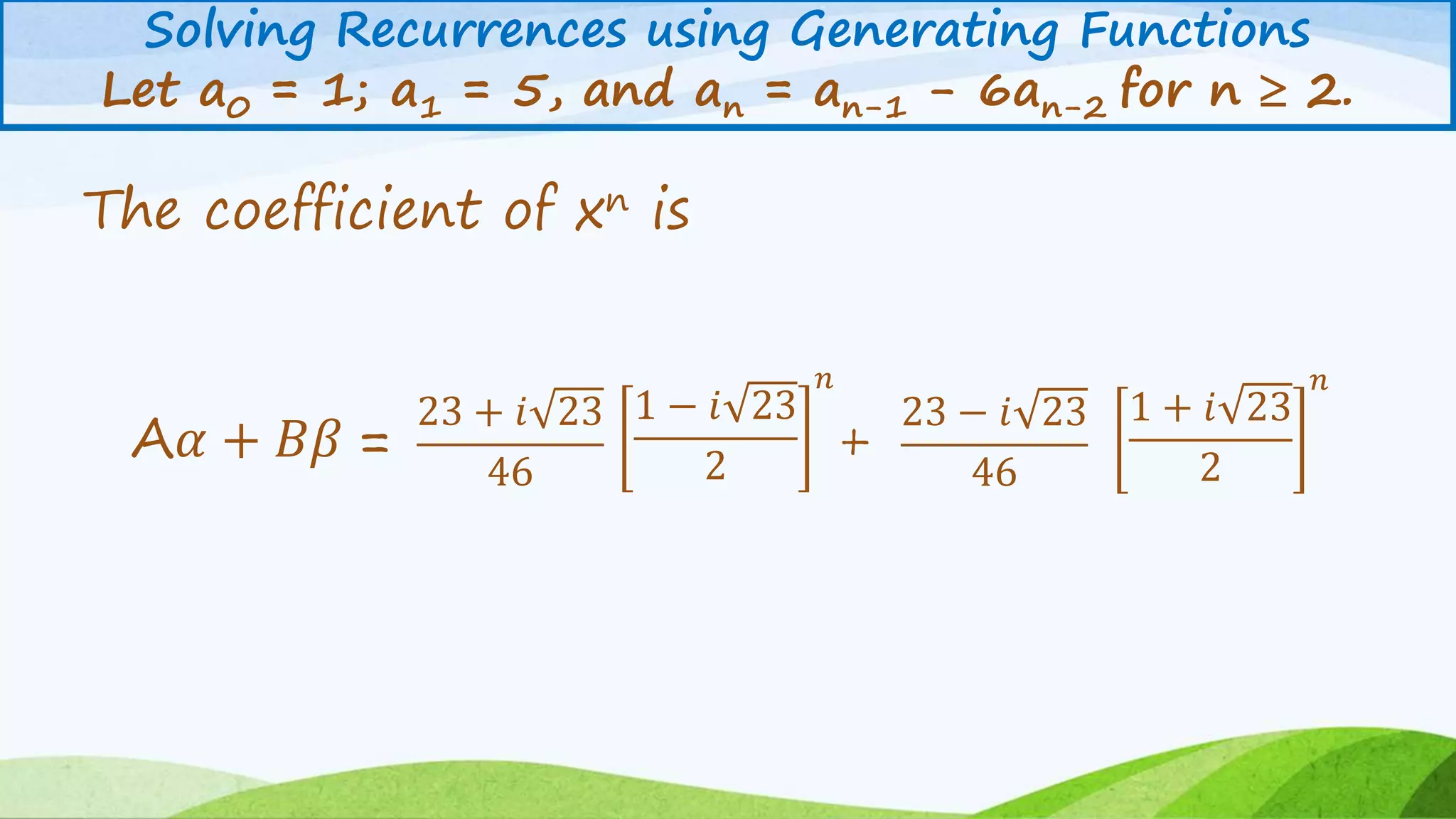
The coefficient of xn is
A𝛼 + 𝐵𝛽 = +
23 + 𝑖 23
46
1 − 𝑖 23
2
𝑛
23 − 𝑖 23
46
1 + 𝑖 23
2
𝑛
Solving Recurrences using Generating Functions
Let a0 = 1; a1 = 5, and an = an-1 - 6an-2 for n  2.
The coefficient of xn in
G(x) =(1+𝟒𝐱)
and 4 times the coefficient of xn-1 in,
is the sum of the coefficient of xn in
1
1 − 𝑥 + 6𝑥2
𝟏
𝟏 − 𝒙 + 𝟔𝒙 𝟐
1
1 − 𝑥 + 6𝑥2
Solving Recurrences using Generating Functions
Let a0 = 1; a1 = 5, and an = an-1 - 6an-2 for n  2.
which equals
+
23 + 𝑖 23
46
1 − 𝑖 23
2
𝑛
23 − 𝑖 23
46
1 + 𝑖 23
2
𝑛
+ +
23 + 𝑖 23
46
1 − 𝑖 23
2
𝑛−1
23 − 𝑖 23
46
1 + 𝑖 23
2
𝑛−1
4  4 
Solving Recurrences using Generating Functions
Let a0 = 1; a1 = 5, and an = an-1 - 6an-2 for n  2.
Generating functions solve recurrence

Generating functions solve recurrence

  • 3.
  • 4.
    To solve therecurrence relation by generating functions, we have numeric function for the closed form expression of generating function A(z) = a0 + a1z + a2z2 + a3z3 + …
  • 5.
    Generating function Numericfunction A(z) = 𝟏 𝟏−𝒂𝒛 A(z) = 1 1−𝑧 2 A(z) = 𝒛 𝟏−𝒛 𝟐 A(z) = 𝒂𝒛 𝟏−𝒂𝒛 𝟐 A(z) = 𝒆 𝒛 A(z) = 𝟏 + 𝒛 𝒏 𝒂 𝒓 (r + 1) r rar 𝟏 𝒏! 𝒏 < 𝒓, 𝟎 ≤ 𝒓 ≤ 𝒏 𝟎, 𝒓 > 𝒏
  • 6.
    Example 1: Solve recurrencerelation by generating function 1. Multiply both sides by zr Steps to follow ar - 2ar-1 - 3ar-2 = 0, for r  2, a0 = 3; a1 = 1 a r - 2 1 r - 3 2 r = 0r z ar- z ar- z
  • 7.
    Solving Recurrence relationusing Generating Functions ar - 2ar-1 - 3ar-2 = 0, for r  2, a0 = 3; a1 = 1 2. Since r  2, summing for all r, we get arzr – 2 ar-1zr – 3 ar-2zr = 0 r = 2  r = 2  r = 2  Solving individually For the 1st term:  arzr = a2z2 + a3z3 + a4z4 + r = 2  A(z) = a0 + a1z + a2z2 + a3z3 + …  arzr = A(z) - a0 - a1zr = 2    
  • 8.
    Solving Recurrence relationusing Generating Functions ar - 2ar-1 - 3ar-2 = 0, for r  2, a0 = 3; a1 = 1 For the 2nd term:  ar-1zr = a1z2 + a2z3 + a3z4 +  r = 2  Factoring out z:  ar-1zr = z[A(z) – a0 ]r = 2  A(z) = a0 + a1z + a2z2 + a3z3 + … Z(a1z + a2z2 + a3z3 + )
  • 9.
    Solving Recurrence relationusing Generating Functions ar - 2ar-1 - 3ar-2 = 0, for r  2, a0 = 3; a1 = 1 For the 3rd term:  ar-2zr = a0z2 + a1z3 + a2z4 +  r = 2  Factoring out z2:  ar-2zr = z2[A(z)]r = 2  A(z) = a0 + a1z + a2z2 + a3z3 + … z2( a0 + a1z + a2z2 + )
  • 10.
    Solving Recurrence relationusing Generating Functions ar - 2ar-1 - 3ar-2 = 0, for r  2, a0 = 3; a1 = 1 Substitute  ar-2zr = z2[A(z)]r = 2  arzr – 2 ar-1zr – 3  ar-2zr = 0 r = 2  r = 2  r = 2  by  arzr = A(z) - a0 - a1zr = 2    ar-1zr = z[A(z) – a0 ]r = 2 
  • 11.
    Solving Recurrence relationusing Generating Functions ar - 2ar-1 - 3ar-2 = 0, for r  2, a0 = 3; a1 = 1 We get z2[A(z)]A(z) - a0 - a1z z[A(z) – a0 ]– 2 – 3 Substitute the value of a0 = 3; a1 = 1 A(z) – 3 - (1)z z[A(z) – 3 ]– 2 – 3z2[A(z)] simplify A(z) = 𝟑 −𝟓𝒛 𝟏 −𝟐𝒛 −𝟑𝒛 𝟐
  • 12.
    Solving Recurrence relationusing Generating Functions ar - 2ar-1 - 3ar-2 = 0, for r  2, a0 = 3; a1 = 1 By partial fraction A(z) = 𝟑 −𝟓𝒛 𝟏 −𝟐𝒛 −𝟑𝒛 𝟐 A(z) = 𝟑 −𝟓𝒛 (𝟏 −𝟑𝒛)(𝟏+𝒛) 𝟑 −𝟓𝒛 (𝟏 −𝟑𝒛)(𝟏+𝒛) = 𝟏 (𝟏 −𝟑𝒛) 𝟐 (𝟏 + 𝒛) +
  • 13.
    Solving Recurrence relationusing Generating Functions ar - 2ar-1 - 3ar-2 = 0, for r  2, a0 = 3; a1 = 1 𝟑 −𝟓𝒛 (𝟏 −𝟑𝒛)(𝟏+𝒛) = 𝟏 (𝟏 −𝟑𝒛) 𝟏 (𝟏 + 𝒛) + From the table previously presented: A(z) = 𝟏 𝟏−𝒂𝒛 𝒂 𝒓 ar = 1  3r + 2  (-1)r
  • 14.
    Example 2 G(x) =a0 + a1x + a2x2 +    =  anxn: Let a0 = 1; a1 = 5, and an = an-1 - 6an-2 for n  2. Let G(x) be the generating function for the sequence a0; a1; a2; : : :. That is, We will use generating functions to obtain a formula for an.  n=0
  • 15.
    Solving Recurrences usingGenerating Functions Let a0 = 1; a1 = 5, and an = an-1 - 6an-2 for n  2. The first step in the process is to use the recurrence relation to replace This can only be done when n  2, an by an-1 - 6an-2. so the first two terms (arising form the initial conditions) need to be separated from the sigma notation to obtain:
  • 16.
    G(x) = a0+ a1x +  anxn = a0 + a1x + (an-1 - 6an-1)xn = a0 + a1x +  an-1xn- 6an-1xn  n=2  n=2  n=2  n=2 = a0 + a1x + x  an-1xn-1- 6x2an-2xn-2  n=2  n=2 In the last line above, constants and powers of x have been factored out Solving Recurrences using Generating Functions Let a0 = 1; a1 = 5, and an = an-1 - 6an-2 for n  2.
  • 17.
    so that thepower to which x is raised “inside" each sum exactly matches the subscript on the coefficient ai. which will make it easy to recognize each summation as being G(x), with a few terms possibly missing. The reason for doing this is that the next step is to make a change of index (on the subscripts), Solving Recurrences using Generating Functions Let a0 = 1; a1 = 5, and an = an-1 - 6an-2 for n  2.
  • 18.
    In the firstsum When n = 2, k = 1  n=2 Put k = n - 1  an-1xn-1 As n goes to infinity, so does k. Solving Recurrences using Generating Functions Let a0 = 1; a1 = 5, and an = an-1 - 6an-2 for n  2.
  • 19.
     k=2  akxk =G(x) - ao the sum becomes With this change of index, Solving Recurrences using Generating Functions Let a0 = 1; a1 = 5, and an = an-1 - 6an-2 for n  2.
  • 20.
    In the nextsum  n=2  an-2xn-2 When n = 2, k = 0 Put k = n - 2 As n goes to infinity, so does k. Solving Recurrences using Generating Functions Let a0 = 1; a1 = 5, and an = an-1 - 6an-2 for n  2.
  • 21.
     k=0  akxk =G(x) the sum becomes With this change of index, Solving Recurrences using Generating Functions Let a0 = 1; a1 = 5, and an = an-1 - 6an-2 for n  2.
  • 22.
    Combining these steps, wearrive at G(x) = a0 + a1x + x(G(x) - a0) - 6x2G(x). After plugging in the known values for a0 and a1, then rearranging Solving Recurrences using Generating Functions Let a0 = 1; a1 = 5, and an = an-1 - 6an-2 for n  2.
  • 23.
    G(x) = 𝟏 +𝟒𝒙 𝟏 − 𝒙 + 𝟔𝒙 𝟐 this becomes (1 - x + 6x2)G(x) = 1 + 4x. Hence, we obtain the closed form Solving Recurrences using Generating Functions Let a0 = 1; a1 = 5, and an = an-1 - 6an-2 for n  2.
  • 24.
    Notice the similarityof the coefficients in 1 - x + 6x2 and an – an-1 + 6an-2. The next step is to use partial fractions to determine the power series representation of 1 1 − 𝑥 + 6𝑥2 Solving Recurrences using Generating Functions Let a0 = 1; a1 = 5, and an = an-1 - 6an-2 for n  2.
  • 25.
    We will eventuallywant the sum of coefficient of xn and four times the coefficient of xn-1 in this series. Solving Recurrences using Generating Functions Let a0 = 1; a1 = 5, and an = an-1 - 6an-2 for n  2.
  • 26.
    Next, we wantto write 1- x + 6x2 If  and  are integers, they are positive among the divisors of 6 and their negatives. (1- x)(1- x).= Solving Recurrences using Generating Functions Let a0 = 1; a1 = 5, and an = an-1 - 6an-2 for n  2.
  • 27.
    Multiplying (1- x)(1- x). wehave, 1 - x - x + x2  = 6  = 1-  lead to -  - = -1 or 1- x + 6x2 Solving Recurrences using Generating Functions Let a0 = 1; a1 = 5, and an = an-1 - 6an-2 for n  2.
  • 28.
     = 6 Therefore, (1-) = 6 - 2 = 6 and the quadratic formula gives ∝ = 1 ± 𝑖 23 2 Solving Recurrences using Generating Functions Let a0 = 1; a1 = 5, and an = an-1 - 6an-2 for n  2.
  • 29.
    Let, 𝛼 = 1 −𝑖 23 2 𝛽 = 1 + 𝑖 23 2 So that If, 1 1 − 𝑥 + 6𝑥2 = 𝐴 1 − 𝛼𝑥 + 𝐵 1 − 𝛽𝑥 = 𝐴 1 − 𝛽𝑥 + 𝐵(1 − 𝛼𝑥) (1 − 𝛼𝑥)(1 − 𝛽𝑥) Solving Recurrences using Generating Functions Let a0 = 1; a1 = 5, and an = an-1 - 6an-2 for n  2.
  • 30.
    -A - B= 0 then, equating coefficients of like powers of x from the leftmost and rightmost expressions gives the two equations in the two unknowns A and B: A + B = 1 Solving Recurrences using Generating Functions Let a0 = 1; a1 = 5, and an = an-1 - 6an-2 for n  2.
  • 31.
    so that (-  )A =  . Since  -  = -i 23, the quantity 𝐴 = 𝛼 −i 23 = 1 − 𝑖 23 −2i 23 𝑖 23 i 23  = 23 + 𝑖 23 46 B = 1 - A = and, therefore, 23 − 𝑖 23 46 Solving Recurrences using Generating Functions Let a0 = 1; a1 = 5, and an = an-1 - 6an-2 for n  2.
  • 32.
    Hence, 1 1 − 𝑥+ 6𝑥2 = 𝐴 1 − 𝛼𝑥 + 𝐵 1 − 𝛽𝑥  n=0 A 𝛼nxn= +  n=0 B 𝛽nxn Solving Recurrences using Generating Functions Let a0 = 1; a1 = 5, and an = an-1 - 6an-2 for n  2.
  • 33.
    The coefficient ofxn is A𝛼 + 𝐵𝛽 = + 23 + 𝑖 23 46 1 − 𝑖 23 2 𝑛 23 − 𝑖 23 46 1 + 𝑖 23 2 𝑛 Solving Recurrences using Generating Functions Let a0 = 1; a1 = 5, and an = an-1 - 6an-2 for n  2.
  • 34.
    The coefficient ofxn in G(x) =(1+𝟒𝐱) and 4 times the coefficient of xn-1 in, is the sum of the coefficient of xn in 1 1 − 𝑥 + 6𝑥2 𝟏 𝟏 − 𝒙 + 𝟔𝒙 𝟐 1 1 − 𝑥 + 6𝑥2 Solving Recurrences using Generating Functions Let a0 = 1; a1 = 5, and an = an-1 - 6an-2 for n  2.
  • 35.
    which equals + 23 +𝑖 23 46 1 − 𝑖 23 2 𝑛 23 − 𝑖 23 46 1 + 𝑖 23 2 𝑛 + + 23 + 𝑖 23 46 1 − 𝑖 23 2 𝑛−1 23 − 𝑖 23 46 1 + 𝑖 23 2 𝑛−1 4  4  Solving Recurrences using Generating Functions Let a0 = 1; a1 = 5, and an = an-1 - 6an-2 for n  2.