Solving Recurrences
The Master Theorem
Recurrence Relations
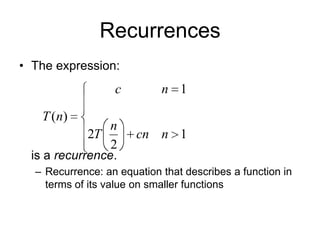
Recurrences
• The expression:

c
T ( n)

n 1

n
2T
2

cn n 1

is a recurrence.

– Recurrence: an equation that describes a function in
terms of its value on smaller functions
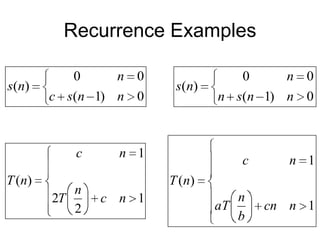
Recurrence Examples
s(n)

0

c s(n 1) n 0

c
T ( n)

n 0

n
2T
2

s(n)

n 1

0

n 0

n s(n 1) n 0

c

n 1

n
aT
b

cn n 1

T ( n)
c n 1
Solving Recurrences
• Substitution method
• Iteration method
• Master method
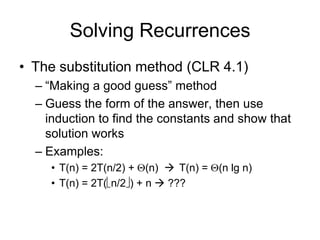
Solving Recurrences
• The substitution method (CLR 4.1)
– “Making a good guess” method
– Guess the form of the answer, then use
induction to find the constants and show that
solution works
– Examples:
• T(n) = 2T(n/2) + (n)  T(n) =
• T(n) = 2T( n/2 ) + n  ???

(n lg n)
The Master Theorem
• Given: a divide and conquer algorithm
– An algorithm that divides the problem of size
n into a subproblems, each of size n/b
– Let the cost of each stage (i.e., the work to
divide the problem + combine solved
subproblems) be described by the function
f(n)

• Then, the Master Theorem gives us a
cookbook for the algorithm’s running time:
The Master Theorem
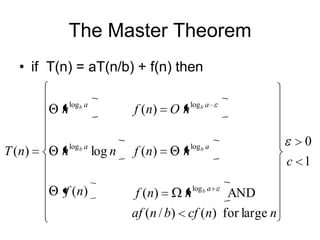
• if T(n) = aT(n/b) + f(n) then
n log b a
T ( n)

f (n) O n log b a

log b a

log b a

n

f ( n)

log n

f ( n)

n

f ( n)
n log b a AND
af (n / b) cf (n) for large n

0
c 1
Using The Master Method
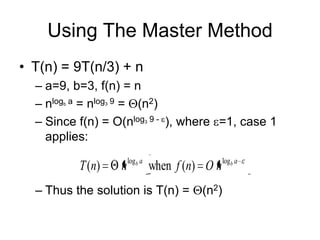
• T(n) = 9T(n/3) + n
– a=9, b=3, f(n) = n
– nlog a = nlog 9 = (n2)
– Since f(n) = O(nlog 9 - ), where =1, case 1
applies:
b

3

3

T ( n)

n

log b a

when f (n) O n

– Thus the solution is T(n) =

(n2)

log b a
Simplified Masters Theorem
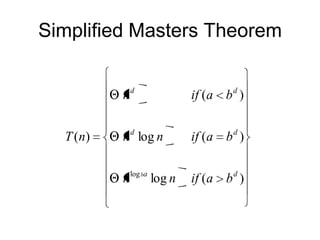
nd
T ( n)

d

if (a b d )
d

n log n

if (a b )

n log ba log n

if (a b d )
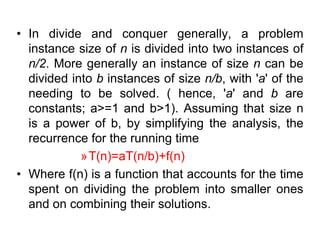
• In divide and conquer generally, a problem
instance size of n is divided into two instances of
n/2. More generally an instance of size n can be
divided into b instances of size n/b, with 'a' of the
needing to be solved. ( hence, 'a' and b are
constants; a>=1 and b>1). Assuming that size n
is a power of b, by simplifying the analysis, the
recurrence for the running time
»T(n)=aT(n/b)+f(n)
• Where f(n) is a function that accounts for the time
spent on dividing the problem into smaller ones
and on combining their solutions.
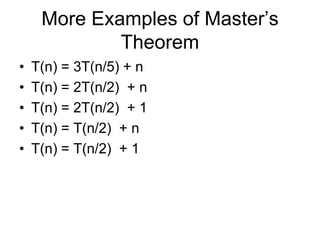
More Examples of Master’s
Theorem
•
•
•
•
•

T(n) = 3T(n/5) + n
T(n) = 2T(n/2) + n
T(n) = 2T(n/2) + 1
T(n) = T(n/2) + n
T(n) = T(n/2) + 1
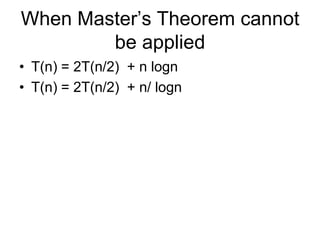
When Master’s Theorem cannot
be applied
• T(n) = 2T(n/2) + n logn
• T(n) = 2T(n/2) + n/ logn

Recurrence relationclass 5

  • 1.
  • 2.
  • 3.
    Recurrences • The expression: c T( n) n 1 n 2T 2 cn n 1 is a recurrence. – Recurrence: an equation that describes a function in terms of its value on smaller functions
  • 4.
    Recurrence Examples s(n) 0 c s(n1) n 0 c T ( n) n 0 n 2T 2 s(n) n 1 0 n 0 n s(n 1) n 0 c n 1 n aT b cn n 1 T ( n) c n 1
  • 5.
    Solving Recurrences • Substitutionmethod • Iteration method • Master method
  • 6.
    Solving Recurrences • Thesubstitution method (CLR 4.1) – “Making a good guess” method – Guess the form of the answer, then use induction to find the constants and show that solution works – Examples: • T(n) = 2T(n/2) + (n)  T(n) = • T(n) = 2T( n/2 ) + n  ??? (n lg n)
  • 7.
    The Master Theorem •Given: a divide and conquer algorithm – An algorithm that divides the problem of size n into a subproblems, each of size n/b – Let the cost of each stage (i.e., the work to divide the problem + combine solved subproblems) be described by the function f(n) • Then, the Master Theorem gives us a cookbook for the algorithm’s running time:
  • 8.
    The Master Theorem •if T(n) = aT(n/b) + f(n) then n log b a T ( n) f (n) O n log b a log b a log b a n f ( n) log n f ( n) n f ( n) n log b a AND af (n / b) cf (n) for large n 0 c 1
  • 9.
    Using The MasterMethod • T(n) = 9T(n/3) + n – a=9, b=3, f(n) = n – nlog a = nlog 9 = (n2) – Since f(n) = O(nlog 9 - ), where =1, case 1 applies: b 3 3 T ( n) n log b a when f (n) O n – Thus the solution is T(n) = (n2) log b a
  • 10.
    Simplified Masters Theorem nd T( n) d if (a b d ) d n log n if (a b ) n log ba log n if (a b d )
  • 11.
    • In divideand conquer generally, a problem instance size of n is divided into two instances of n/2. More generally an instance of size n can be divided into b instances of size n/b, with 'a' of the needing to be solved. ( hence, 'a' and b are constants; a>=1 and b>1). Assuming that size n is a power of b, by simplifying the analysis, the recurrence for the running time »T(n)=aT(n/b)+f(n) • Where f(n) is a function that accounts for the time spent on dividing the problem into smaller ones and on combining their solutions.
  • 12.
    More Examples ofMaster’s Theorem • • • • • T(n) = 3T(n/5) + n T(n) = 2T(n/2) + n T(n) = 2T(n/2) + 1 T(n) = T(n/2) + n T(n) = T(n/2) + 1
  • 13.
    When Master’s Theoremcannot be applied • T(n) = 2T(n/2) + n logn • T(n) = 2T(n/2) + n/ logn