Solving Linear Recurrence
Relations
Niloufar Shafiei
1
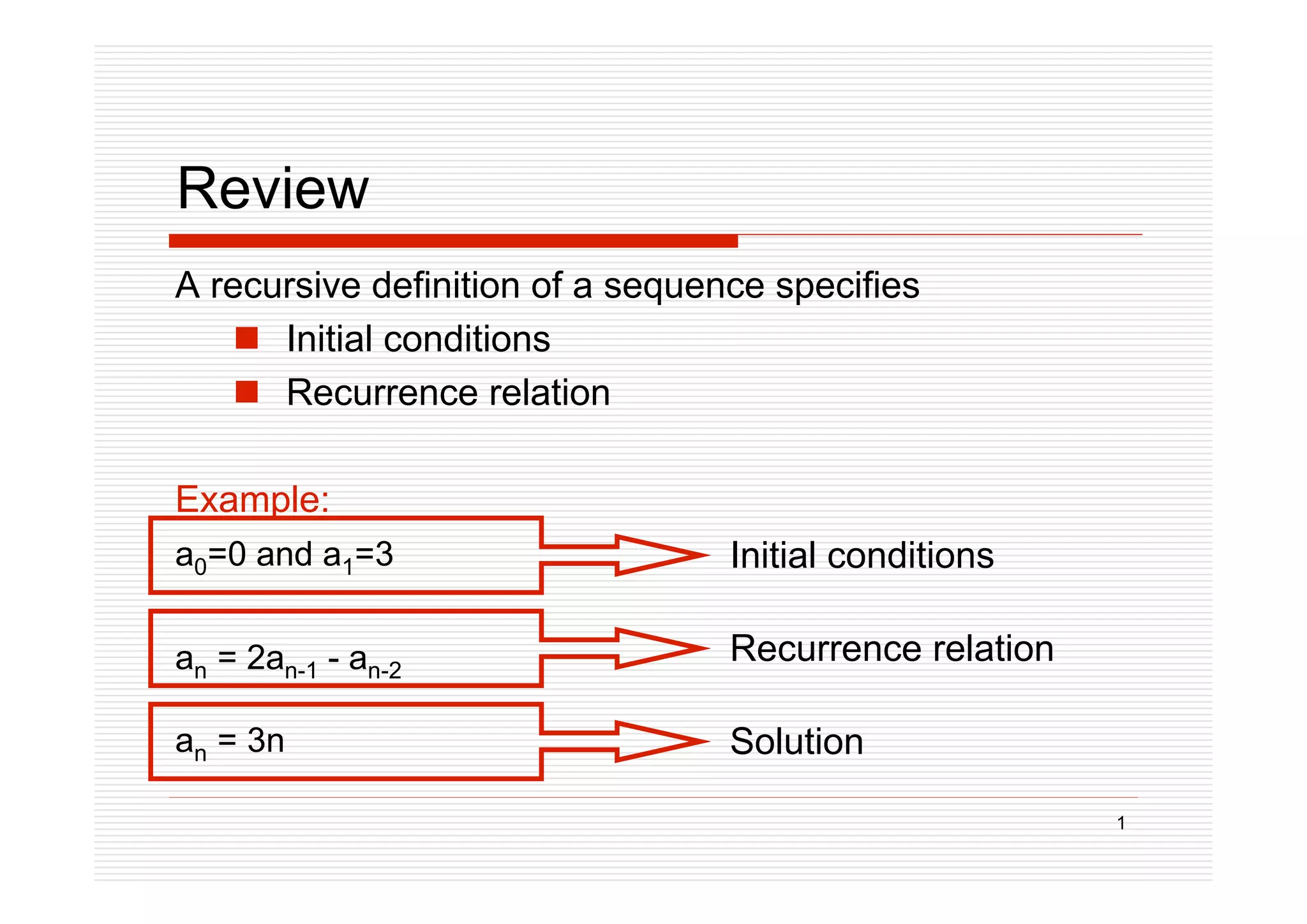
Review
A recursive definition of a sequence specifies
 Initial conditions
 Recurrence relation
Example:
a0=0 and a1=3
an = 2an-1 - an-2
an = 3n
Initial conditions
Recurrence relation
Solution
2
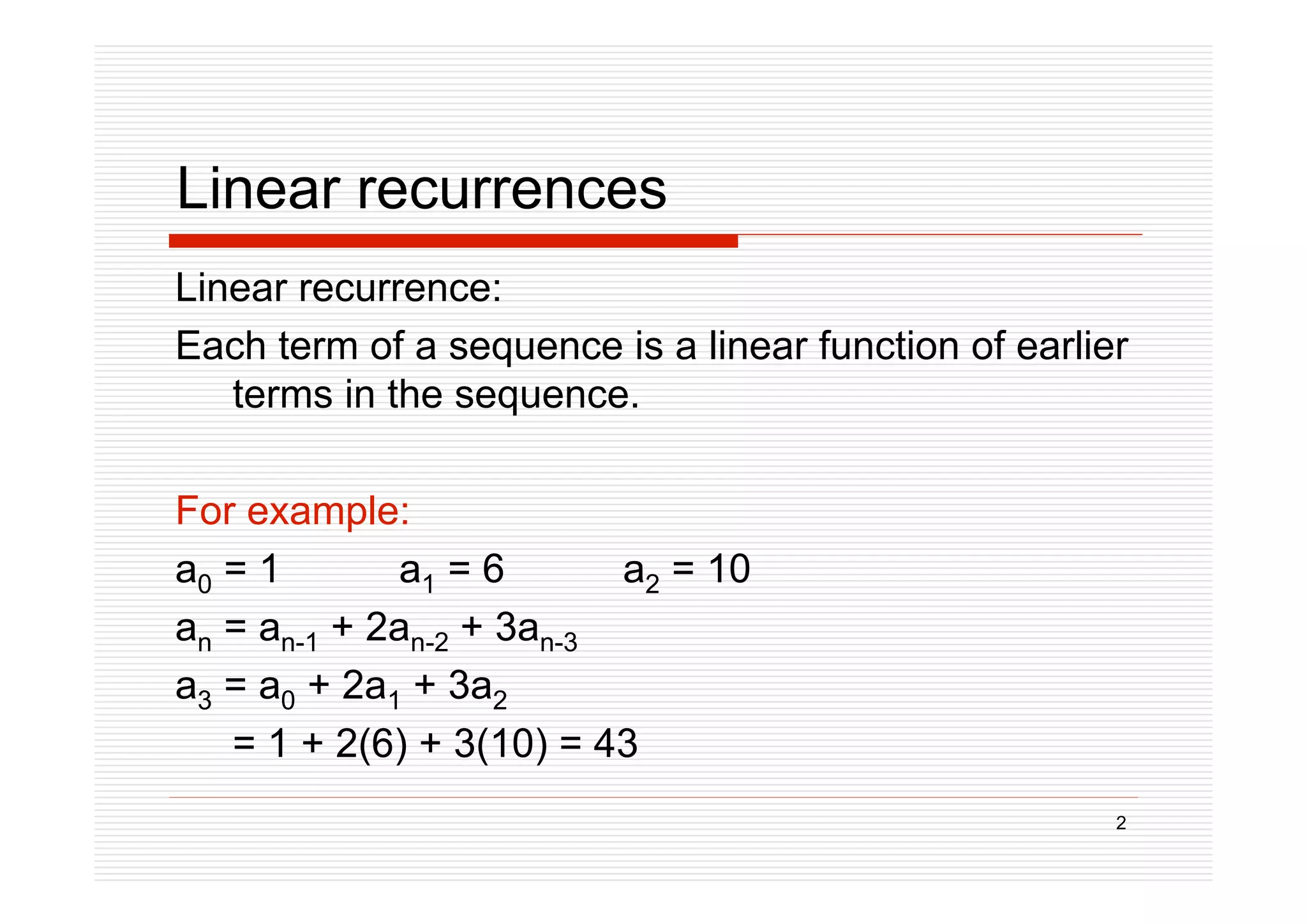
Linear recurrences
Linear recurrence:
Each term of a sequence is a linear function of earlier
terms in the sequence.
For example:
a0 = 1 a1 = 6 a2 = 10
an = an-1 + 2an-2 + 3an-3
a3 = a0 + 2a1 + 3a2
= 1 + 2(6) + 3(10) = 43
3
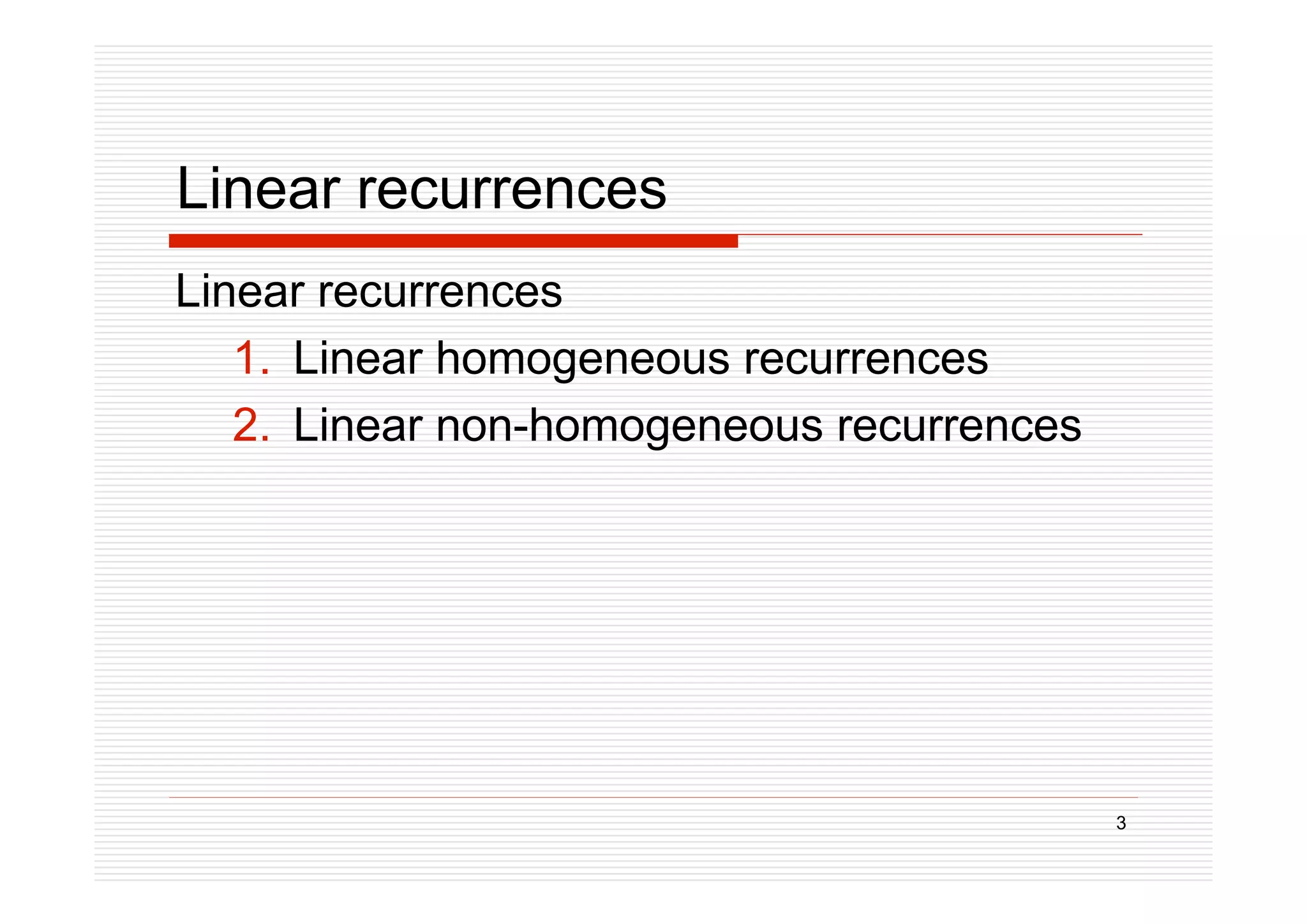
Linear recurrences
Linear recurrences
1. Linear homogeneous recurrences
2. Linear non-homogeneous recurrences
4
Linear homogeneous recurrences
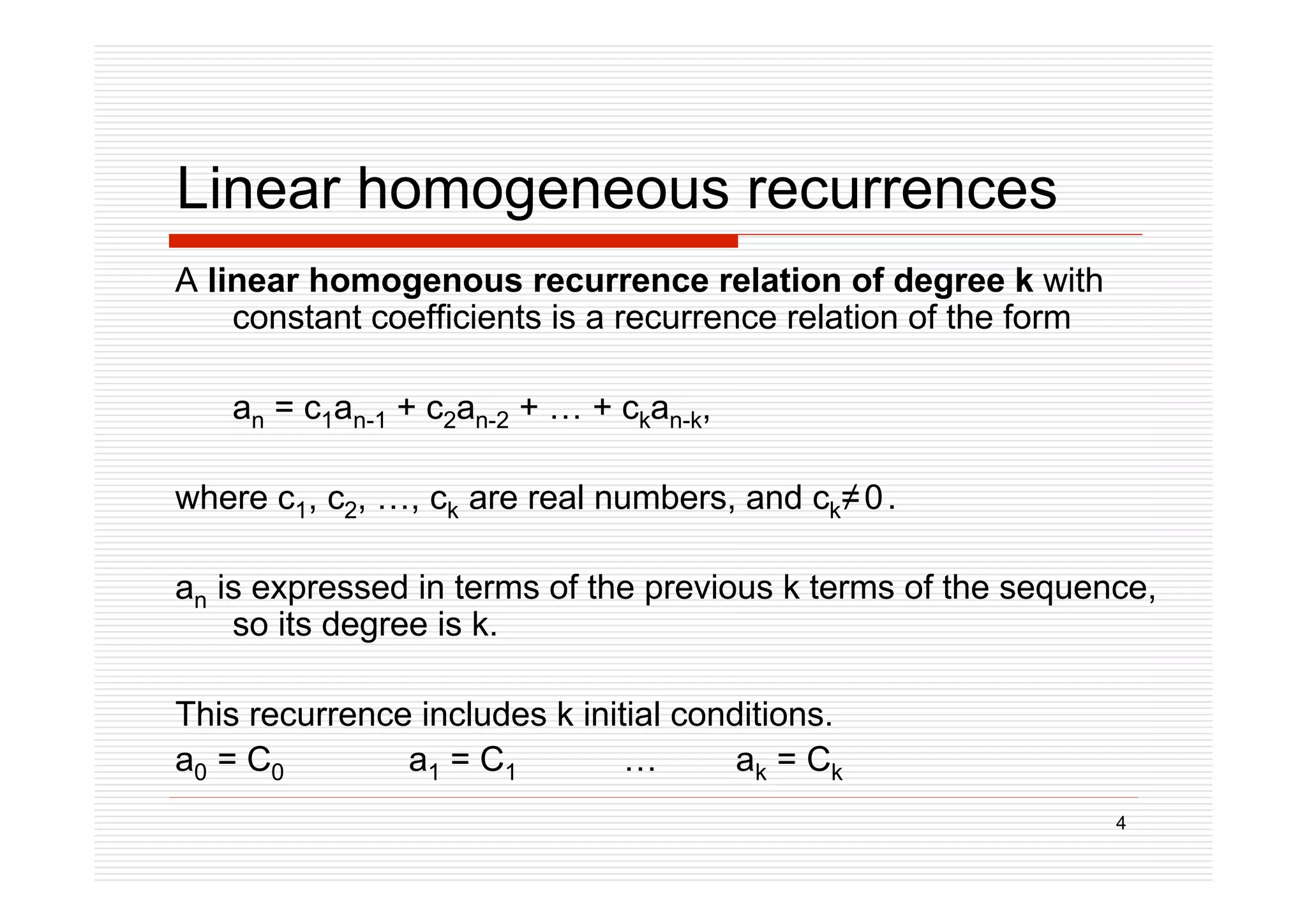
A linear homogenous recurrence relation of degree k with
constant coefficients is a recurrence relation of the form
an = c1an-1 + c2an-2 + … + ckan-k,
where c1, c2, …, ck are real numbers, and ck0.
an is expressed in terms of the previous k terms of the sequence,
so its degree is k.
This recurrence includes k initial conditions.
a0 = C0 a1 = C1 … ak = Ck
5
Example
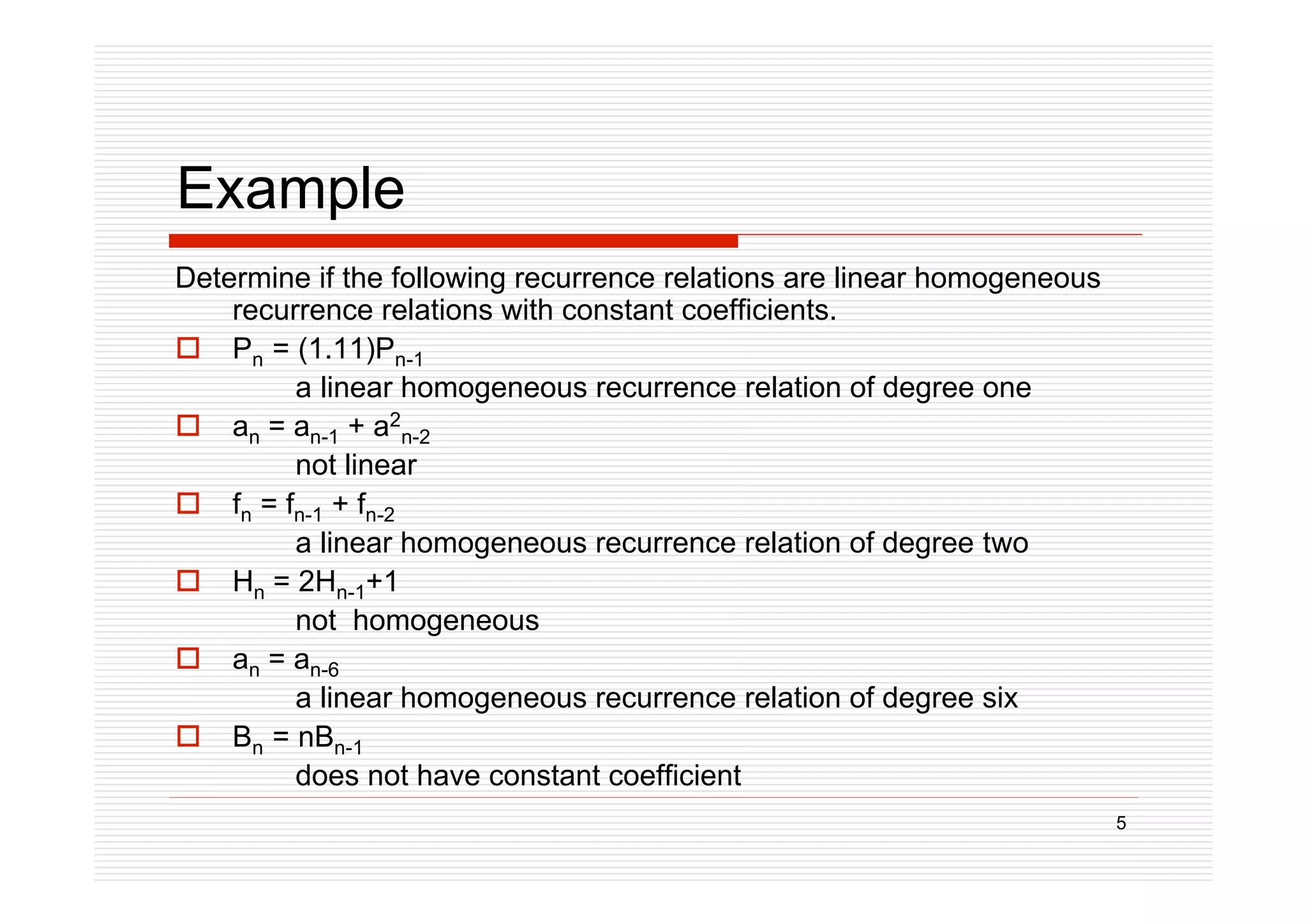
Determine if the following recurrence relations are linear homogeneous
recurrence relations with constant coefficients.
 Pn = (1.11)Pn-1
a linear homogeneous recurrence relation of degree one
 an = an-1 + a2
n-2
not linear
 fn = fn-1 + fn-2
a linear homogeneous recurrence relation of degree two
 Hn = 2Hn-1+1
not homogeneous
 an = an-6
a linear homogeneous recurrence relation of degree six
 Bn = nBn-1
does not have constant coefficient
6
Solving linear homogeneous
recurrences
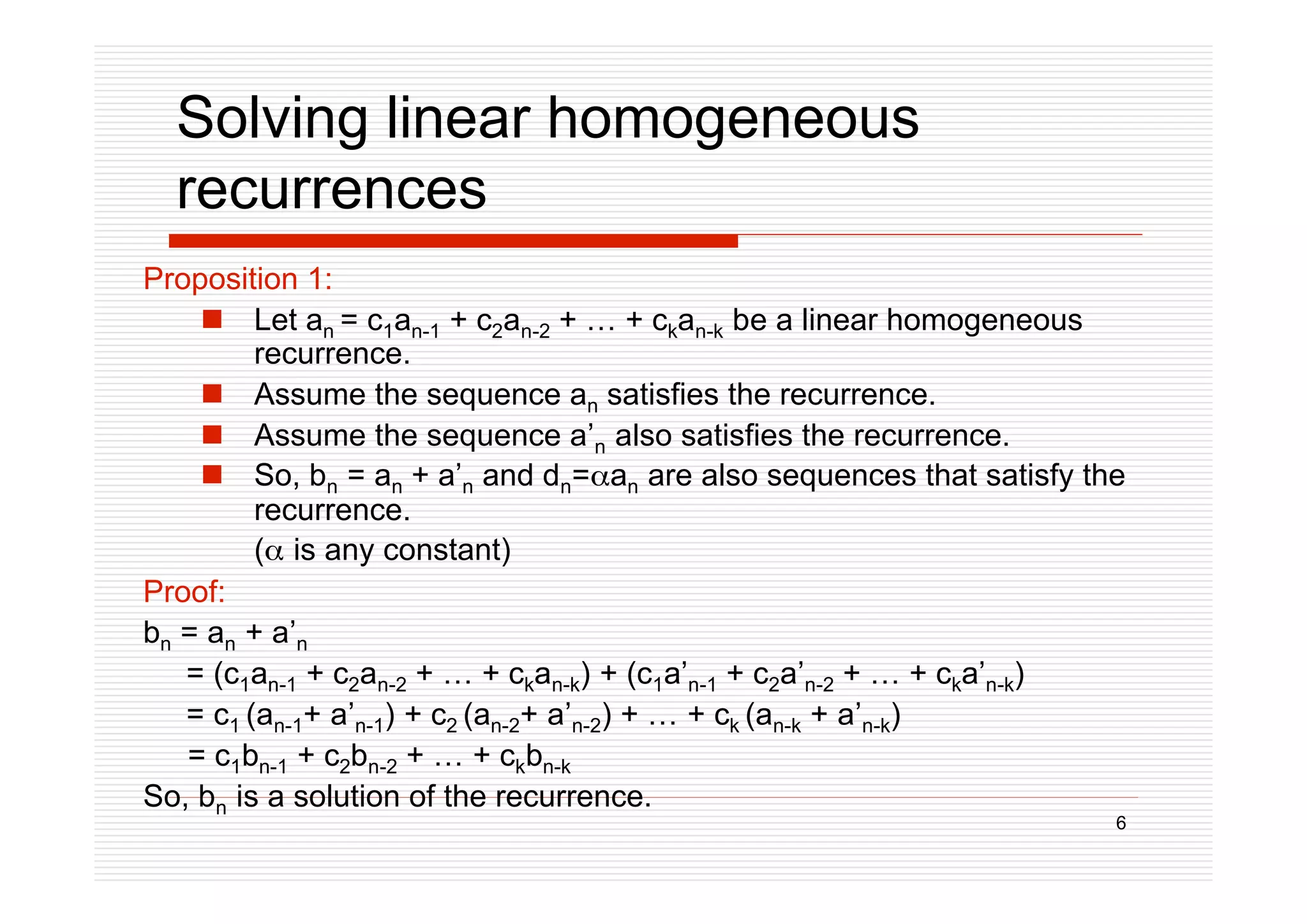
Proposition 1:
 Let an = c1an-1 + c2an-2 + … + ckan-k be a linear homogeneous
recurrence.
 Assume the sequence an satisfies the recurrence.
 Assume the sequence a’n also satisfies the recurrence.
 So, bn = an + a’n and dn=an are also sequences that satisfy the
recurrence.
( is any constant)
Proof:
bn = an + a’n
= (c1an-1 + c2an-2 + … + ckan-k) + (c1a’n-1 + c2a’n-2 + … + cka’n-k)
= c1 (an-1+ a’n-1) + c2 (an-2+ a’n-2) + … + ck (an-k + a’n-k)
= c1bn-1 + c2bn-2 + … + ckbn-k
So, bn is a solution of the recurrence.
7
Solving linear homogeneous
recurrences
Proposition 1:
 Let an = c1an-1 + c2an-2 + … + ckan-k be a linear homogeneous
recurrence.
 Assume the sequence an satisfies the recurrence.
 Assume the sequence a’n also satisfies the recurrence.
 So, bn = an + a’n and dn=an are also sequences that satisfy the
recurrence.
( is any constant)
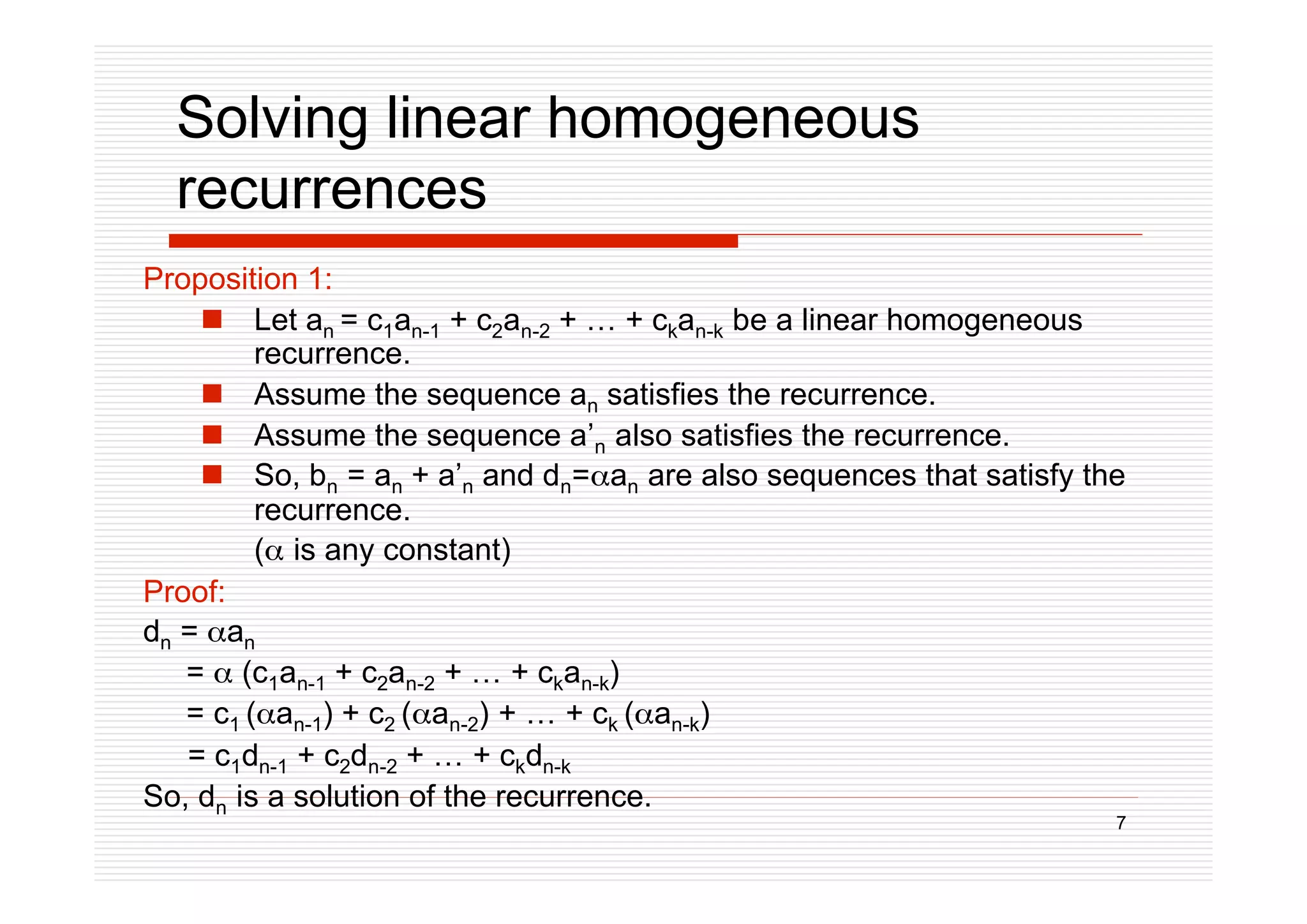
Proof:
dn = an
=  (c1an-1 + c2an-2 + … + ckan-k)
= c1 (an-1) + c2 (an-2) + … + ck (an-k)
= c1dn-1 + c2dn-2 + … + ckdn-k
So, dn is a solution of the recurrence.
8
Solving linear homogeneous
recurrences
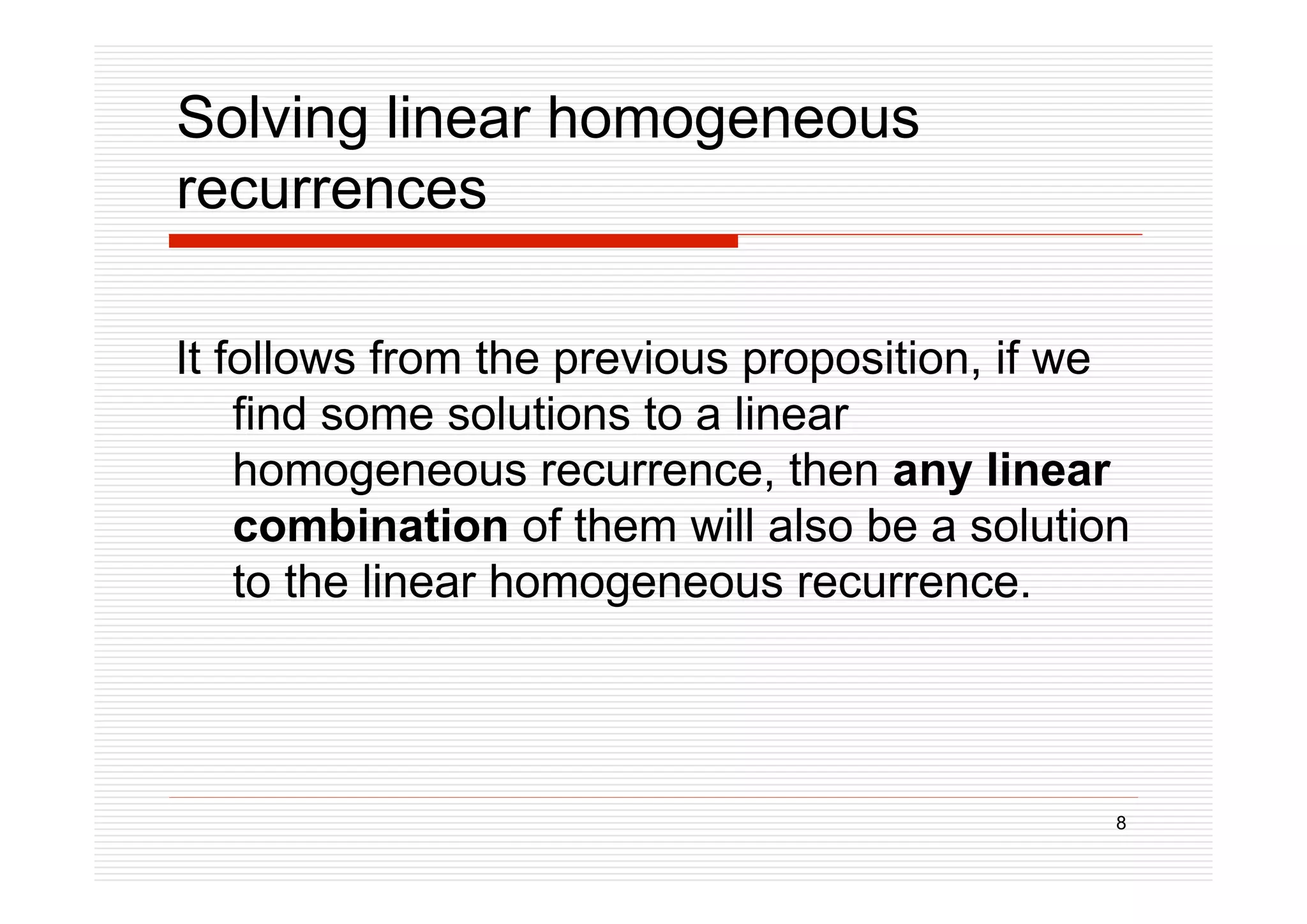
It follows from the previous proposition, if we
find some solutions to a linear
homogeneous recurrence, then any linear
combination of them will also be a solution
to the linear homogeneous recurrence.
9
Solving linear homogeneous
recurrences
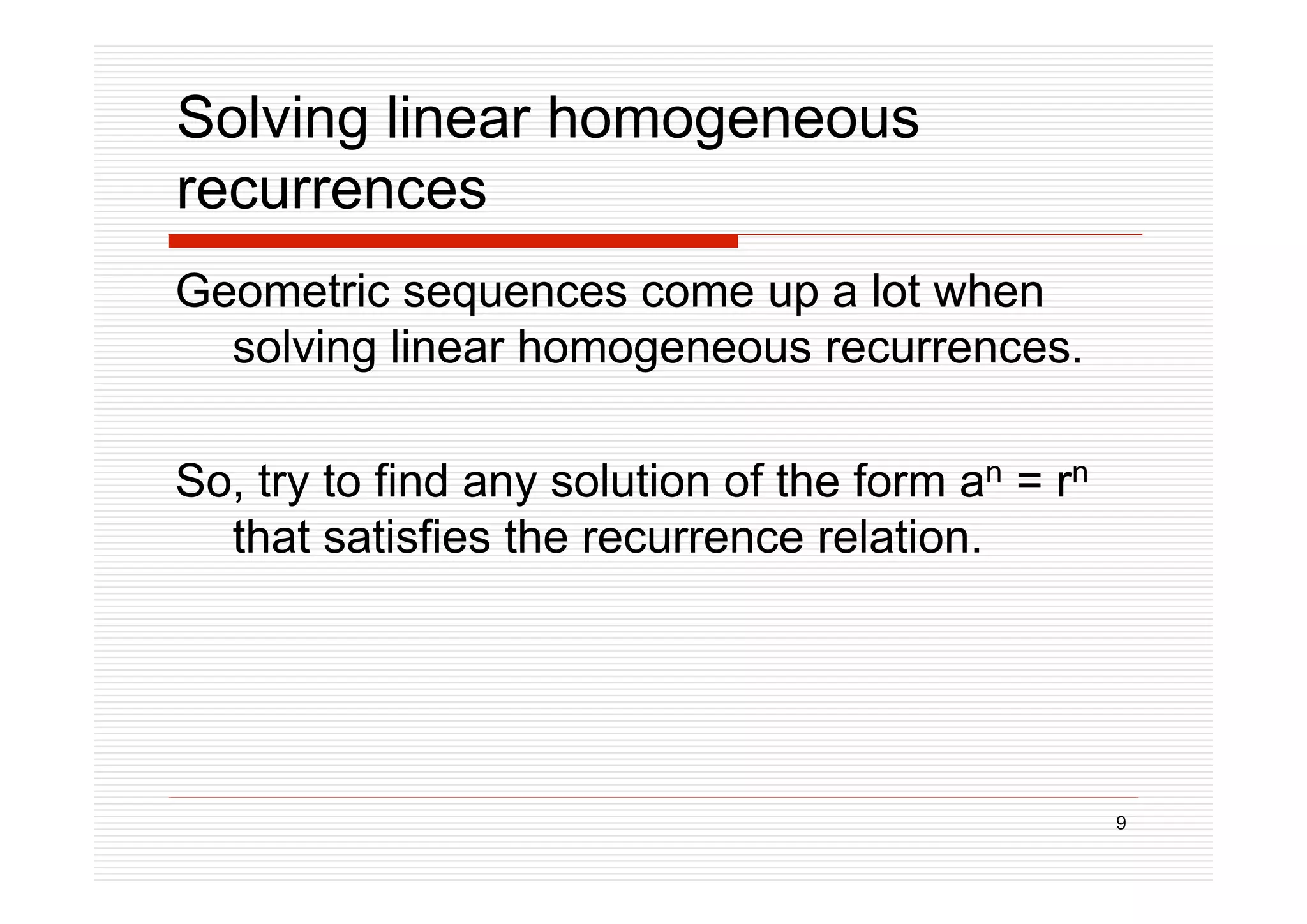
Geometric sequences come up a lot when
solving linear homogeneous recurrences.
So, try to find any solution of the form an = rn
that satisfies the recurrence relation.
10
Solving linear homogeneous
recurrences
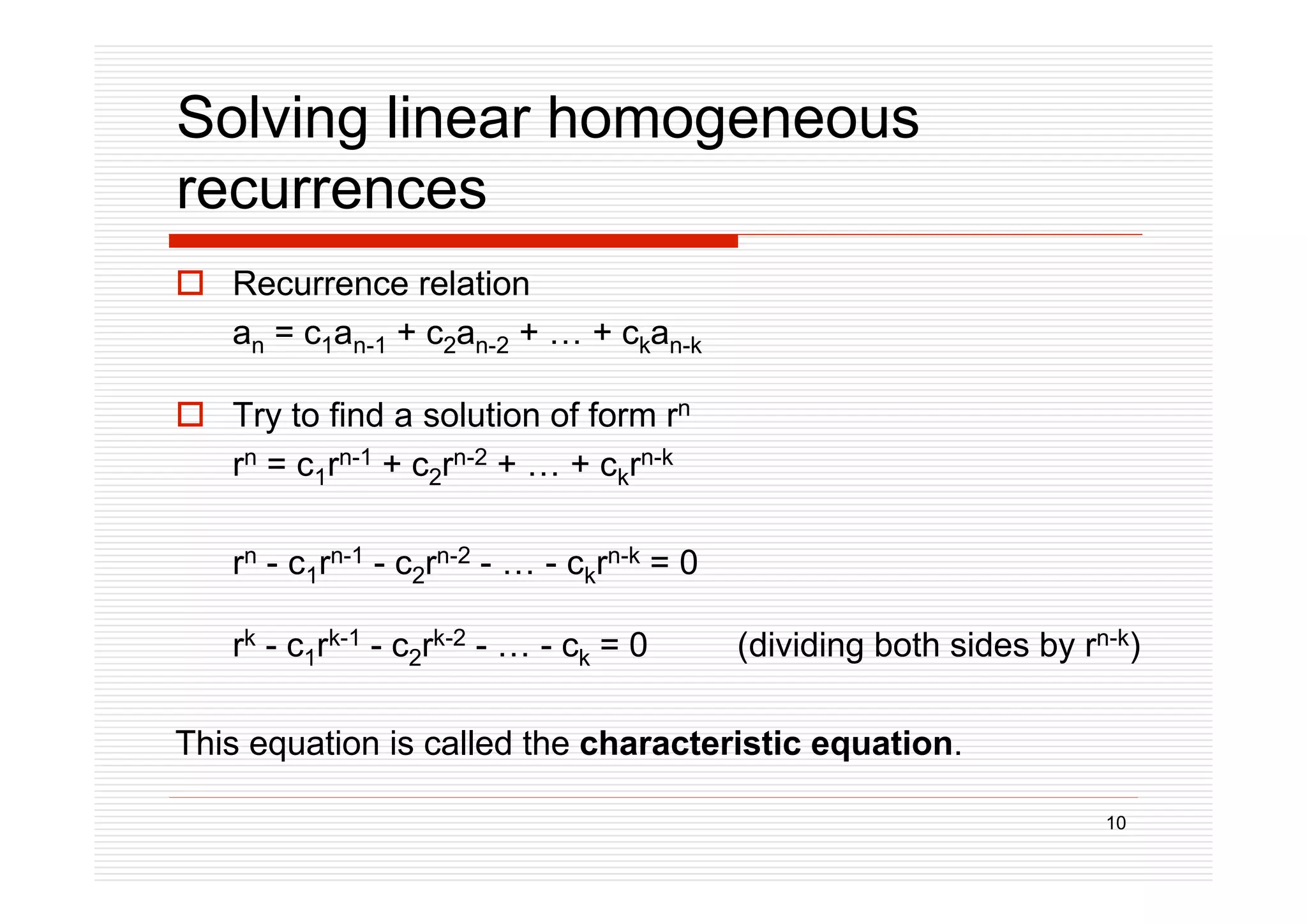
 Recurrence relation
an = c1an-1 + c2an-2 + … + ckan-k
 Try to find a solution of form rn
rn = c1rn-1 + c2rn-2 + … + ckrn-k
rn - c1rn-1 - c2rn-2 - … - ckrn-k = 0
rk - c1rk-1 - c2rk-2 - … - ck = 0 (dividing both sides by rn-k)
This equation is called the characteristic equation.
11
Example
Example:
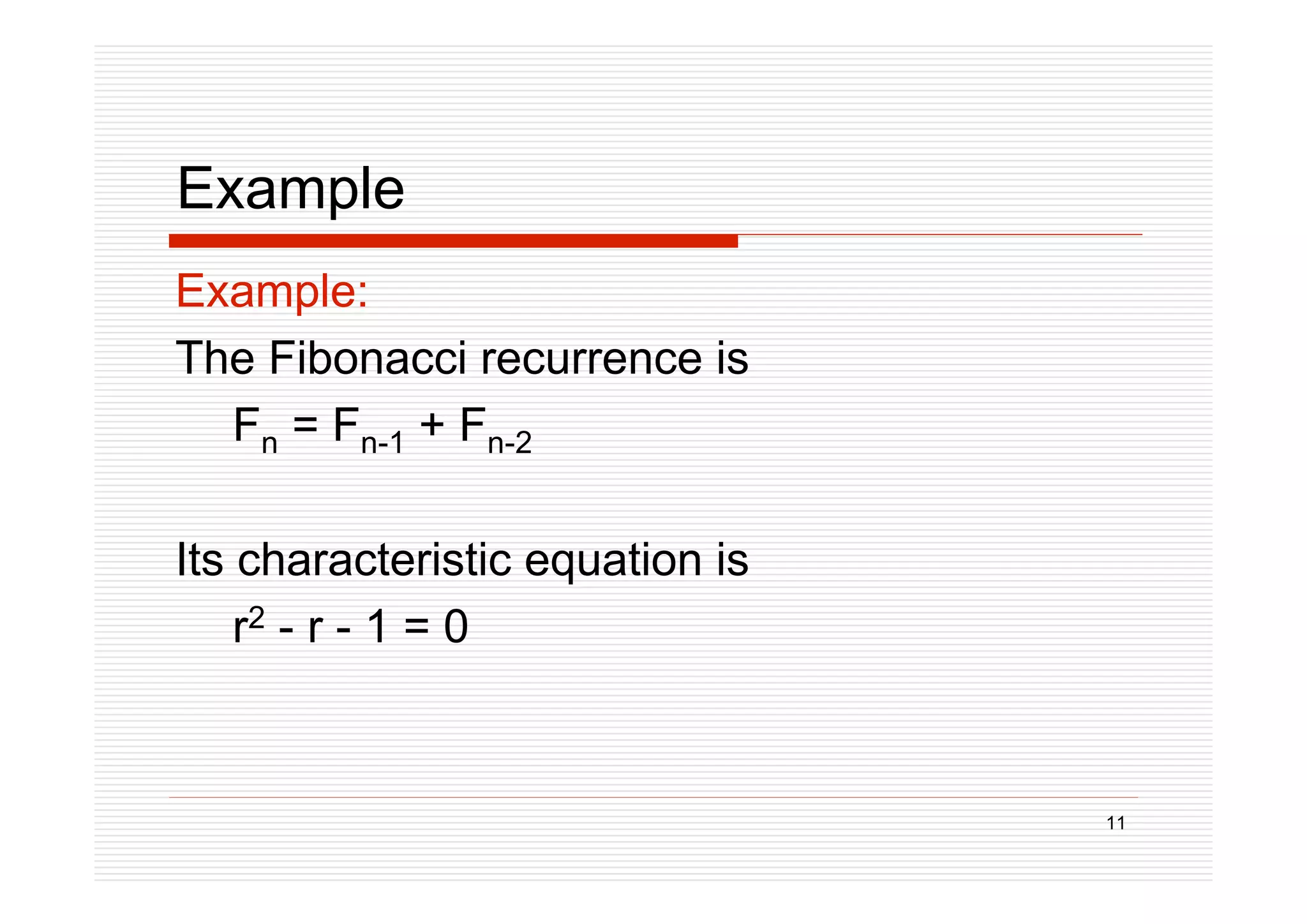
The Fibonacci recurrence is
Fn = Fn-1 + Fn-2
Its characteristic equation is
r2 - r - 1 = 0
12
Solving linear homogeneous
recurrences
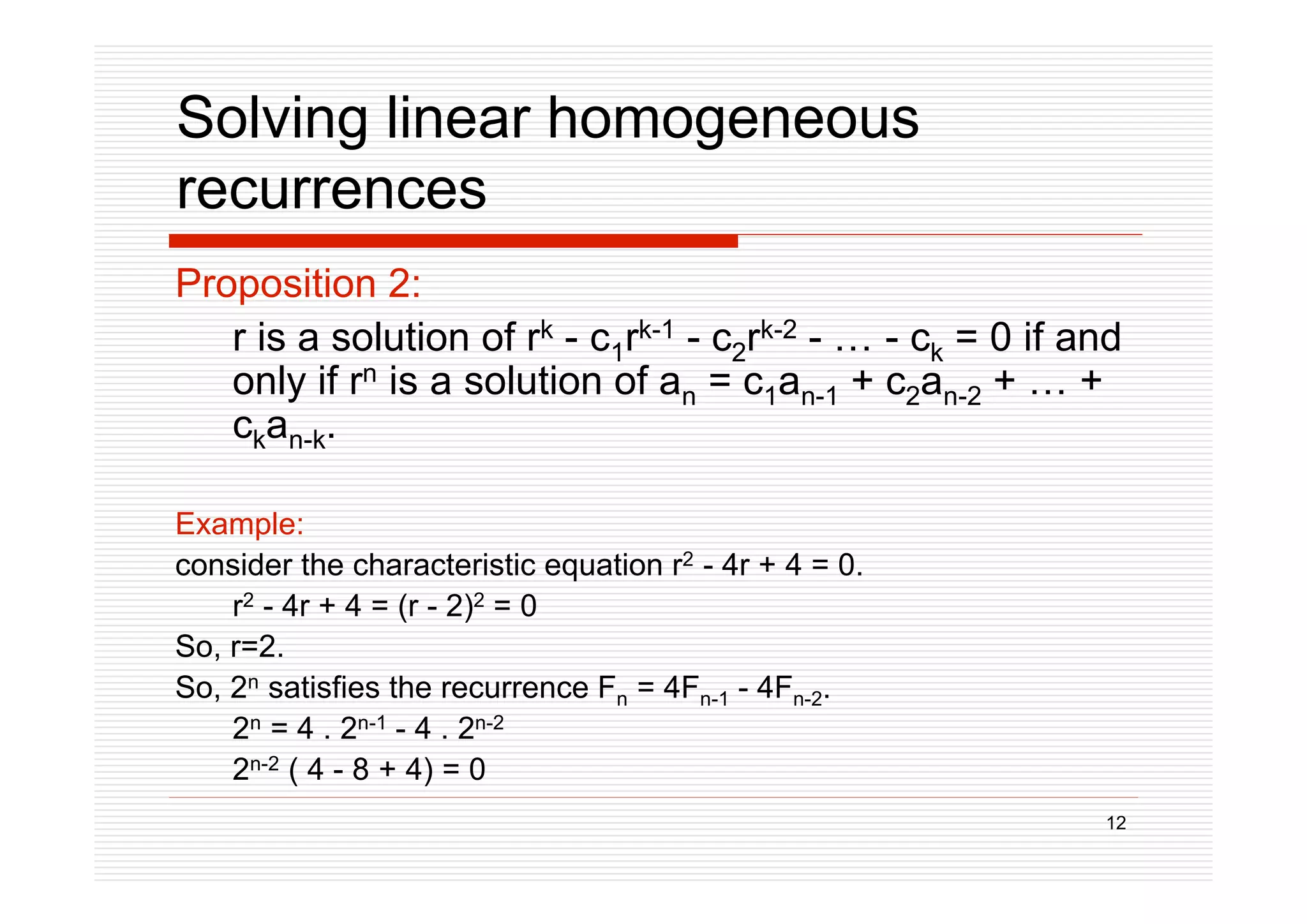
Proposition 2:
r is a solution of rk - c1rk-1 - c2rk-2 - … - ck = 0 if and
only if rn is a solution of an = c1an-1 + c2an-2 + … +
ckan-k.
Example:
consider the characteristic equation r2 - 4r + 4 = 0.
r2 - 4r + 4 = (r - 2)2 = 0
So, r=2.
So, 2n satisfies the recurrence Fn = 4Fn-1 - 4Fn-2.
2n = 4 . 2n-1 - 4 . 2n-2
2n-2 ( 4 - 8 + 4) = 0
13
Solving linear homogeneous
recurrences
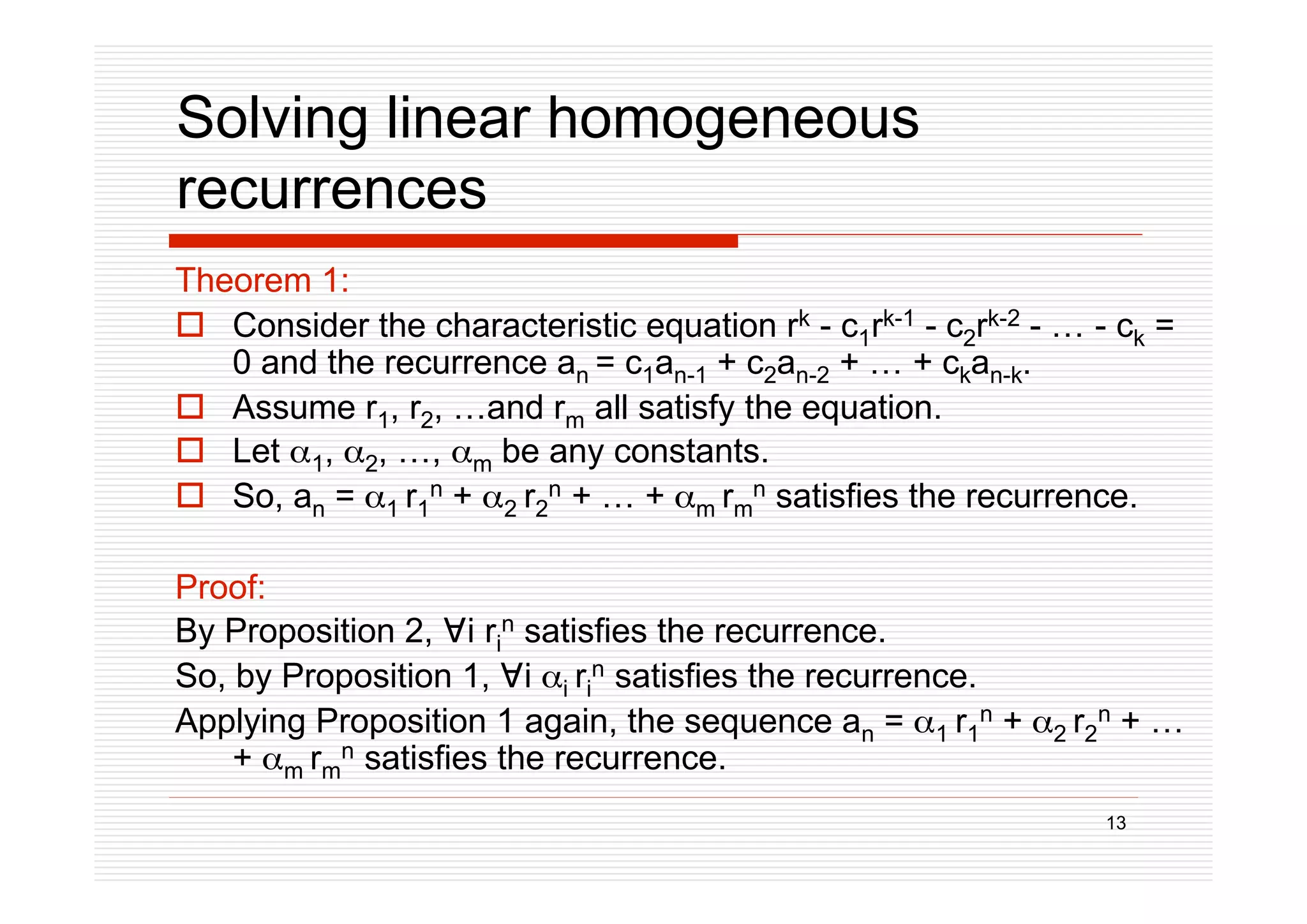
Theorem 1:
 Consider the characteristic equation rk - c1rk-1 - c2rk-2 - … - ck =
0 and the recurrence an = c1an-1 + c2an-2 + … + ckan-k.
 Assume r1, r2, …and rm all satisfy the equation.
 Let 1, 2, …, m be any constants.
 So, an = 1 r1
n + 2 r2
n + … + m rm
n satisfies the recurrence.
Proof:
By Proposition 2, i ri
n satisfies the recurrence.
So, by Proposition 1, i i ri
n satisfies the recurrence.
Applying Proposition 1 again, the sequence an = 1 r1
n + 2 r2
n + …
+ m rm
n satisfies the recurrence.
14
Example
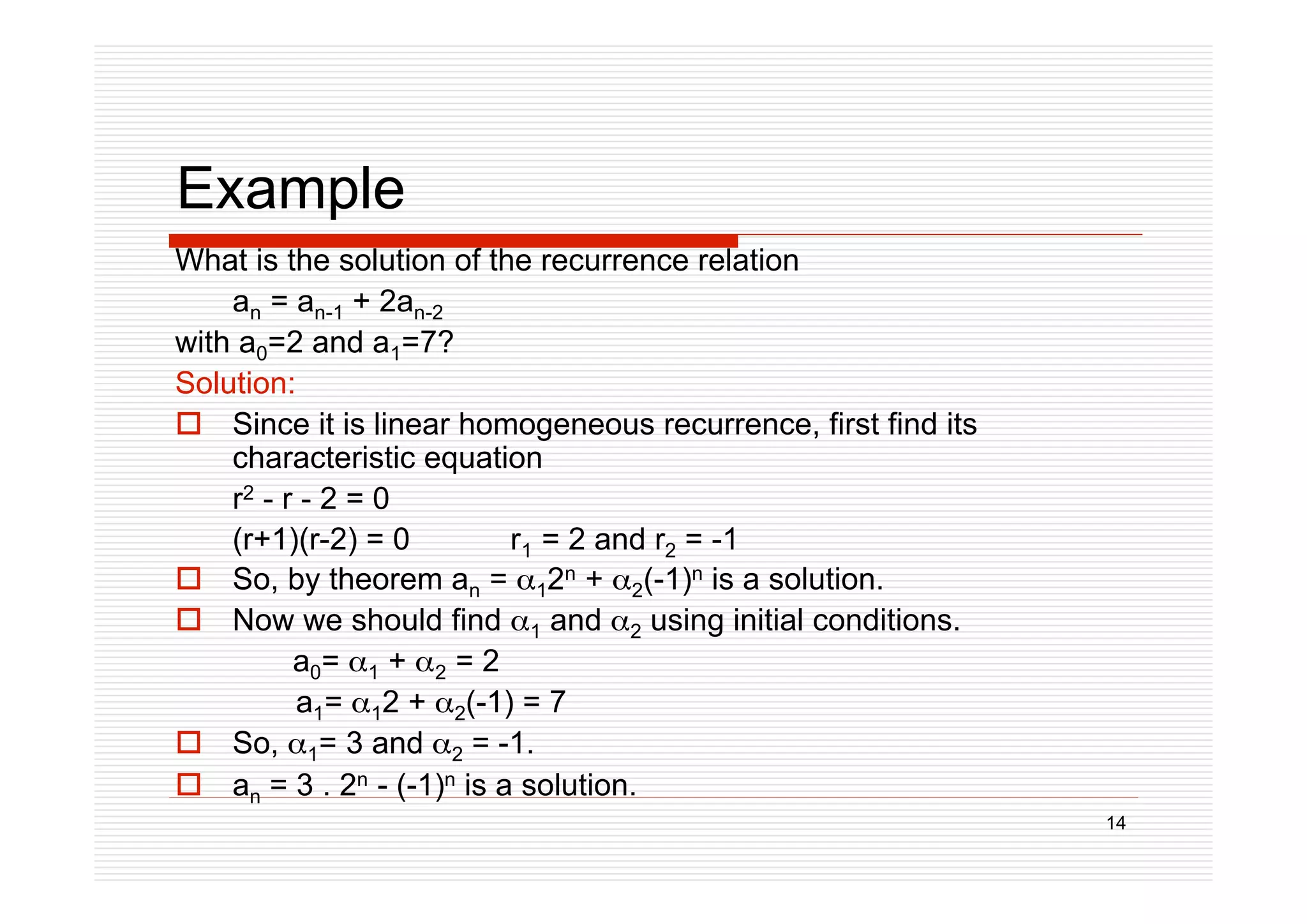
What is the solution of the recurrence relation
an = an-1 + 2an-2
with a0=2 and a1=7?
Solution:
 Since it is linear homogeneous recurrence, first find its
characteristic equation
r2 - r - 2 = 0
(r+1)(r-2) = 0 r1 = 2 and r2 = -1
 So, by theorem an = 12n + 2(-1)n is a solution.
 Now we should find 1 and 2 using initial conditions.
a0= 1 + 2 = 2
a1= 12 + 2(-1) = 7
 So, 1= 3 and 2 = -1.
 an = 3 . 2n - (-1)n is a solution.
15
Example
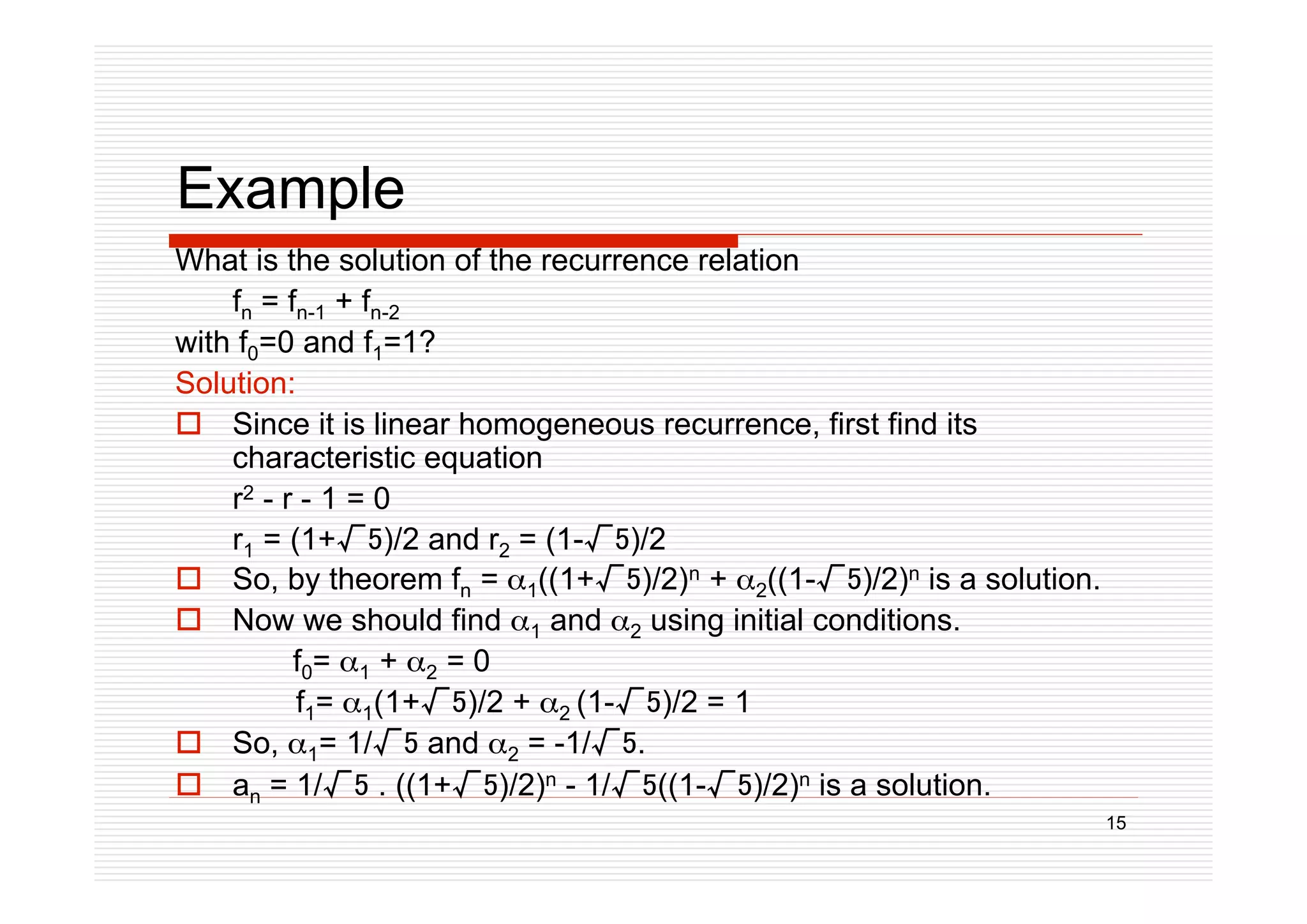
What is the solution of the recurrence relation
fn = fn-1 + fn-2
with f0=0 and f1=1?
Solution:
 Since it is linear homogeneous recurrence, first find its
characteristic equation
r2 - r - 1 = 0
r1 = (1+)/2 and r2 = (1-)/2
 So, by theorem fn = 1((1+)/2)n + 2((1-)/2)n is a solution.
 Now we should find 1 and 2 using initial conditions.
f0= 1 + 2 = 0
f1= 1(1+)/2 + 2 (1-)/2 = 1
 So, 1= 1/ and 2 = -1/.
 an = 1/ . ((1+)/2)n - 1/((1-)/2)n is a solution.
16
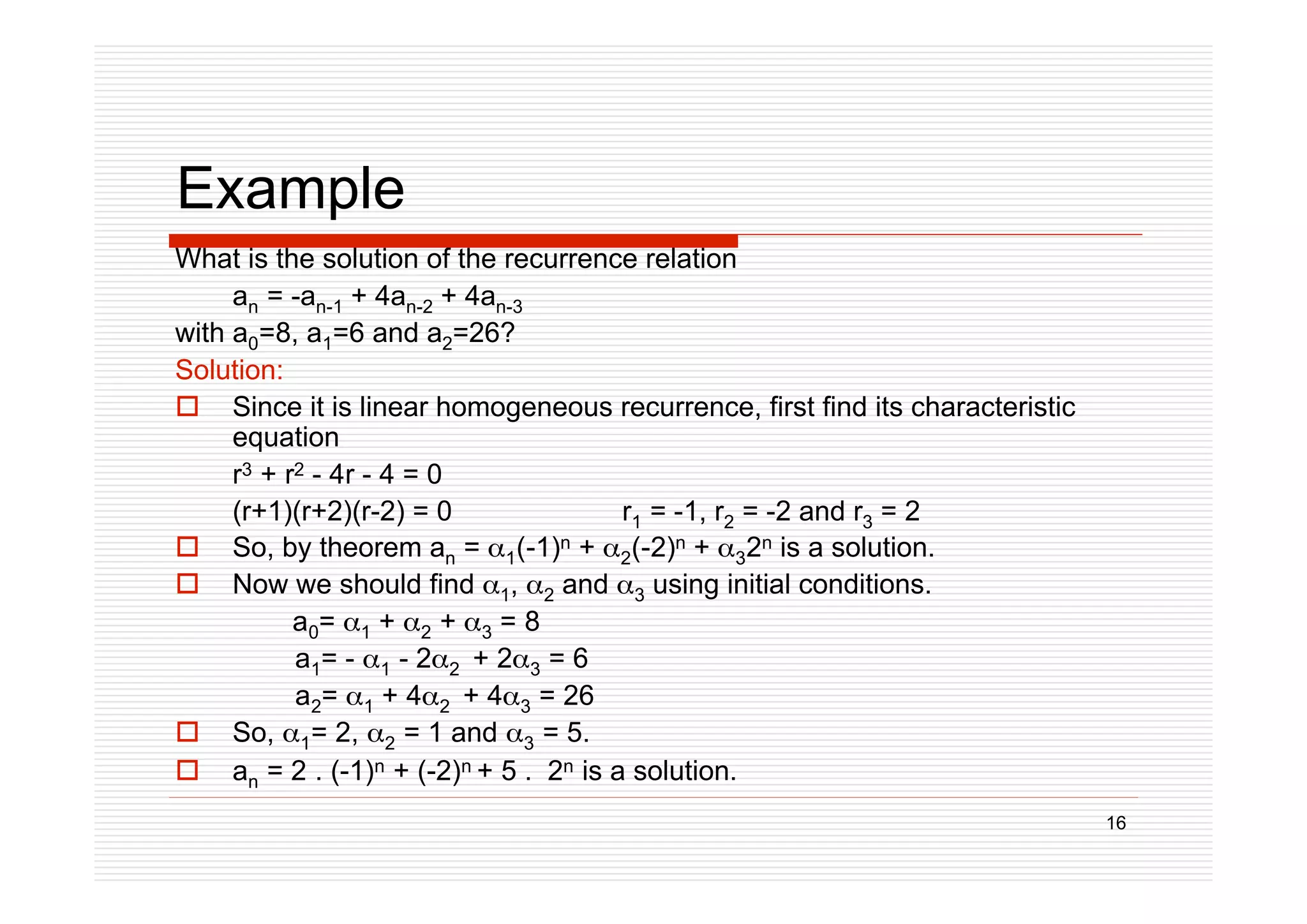
Example
What is the solution of the recurrence relation
an = -an-1 + 4an-2 + 4an-3
with a0=8, a1=6 and a2=26?
Solution:
 Since it is linear homogeneous recurrence, first find its characteristic
equation
r3 + r2 - 4r - 4 = 0
(r+1)(r+2)(r-2) = 0 r1 = -1, r2 = -2 and r3 = 2
 So, by theorem an = 1(-1)n + 2(-2)n + 32n is a solution.
 Now we should find 1, 2 and 3 using initial conditions.
a0= 1 + 2 + 3 = 8
a1= - 1 - 22 + 23 = 6
a2= 1 + 42 + 43 = 26
 So, 1= 2, 2 = 1 and 3 = 5.
 an = 2 . (-1)n + (-2)n + 5 . 2n is a solution.
17
Solving linear homogeneous
recurrences
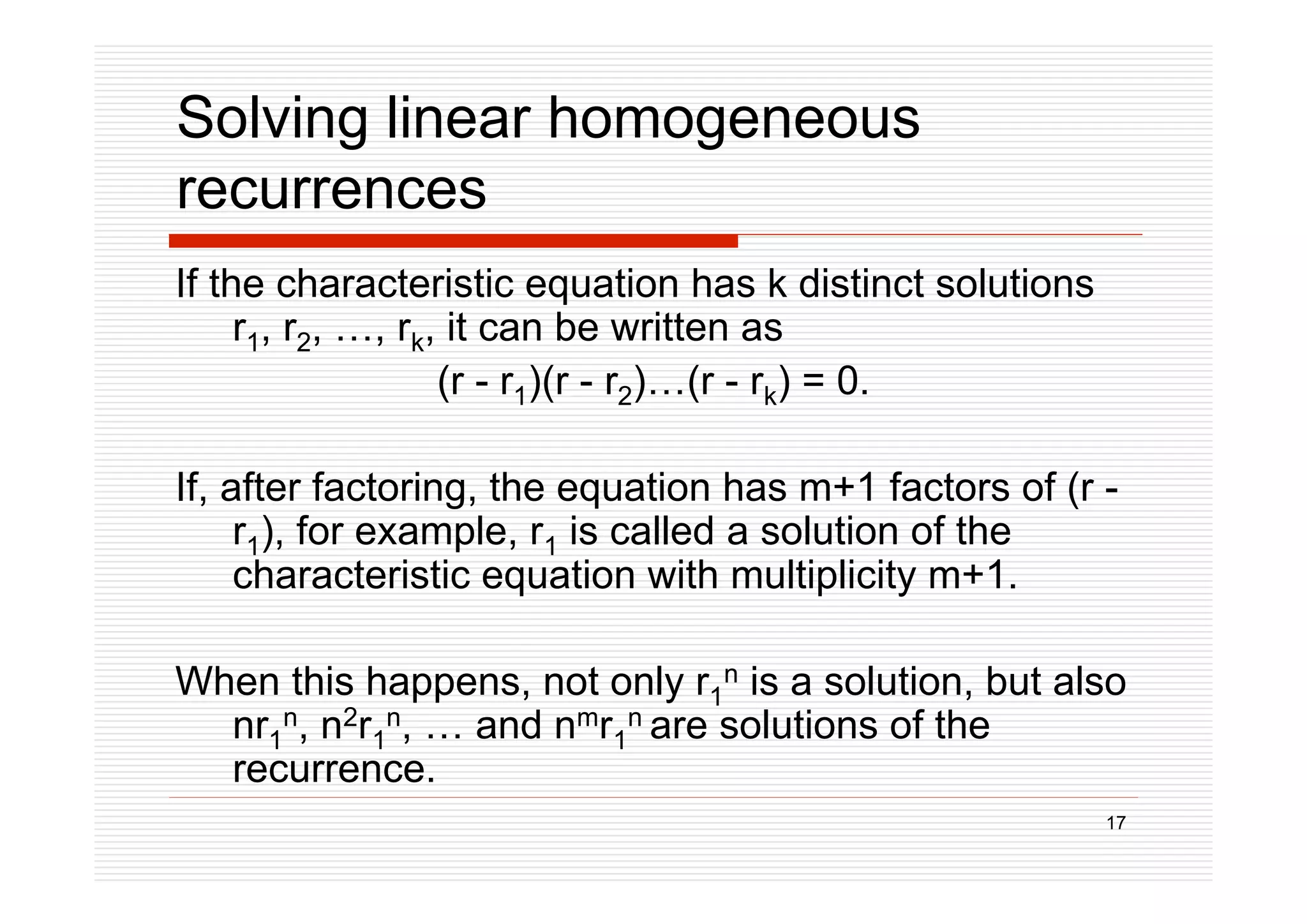
If the characteristic equation has k distinct solutions
r1, r2, …, rk, it can be written as
(r - r1)(r - r2)…(r - rk) = 0.
If, after factoring, the equation has m+1 factors of (r -
r1), for example, r1 is called a solution of the
characteristic equation with multiplicity m+1.
When this happens, not only r1
n is a solution, but also
nr1
n, n2r1
n, … and nmr1
n are solutions of the
recurrence.
18
Solving linear homogeneous
recurrences
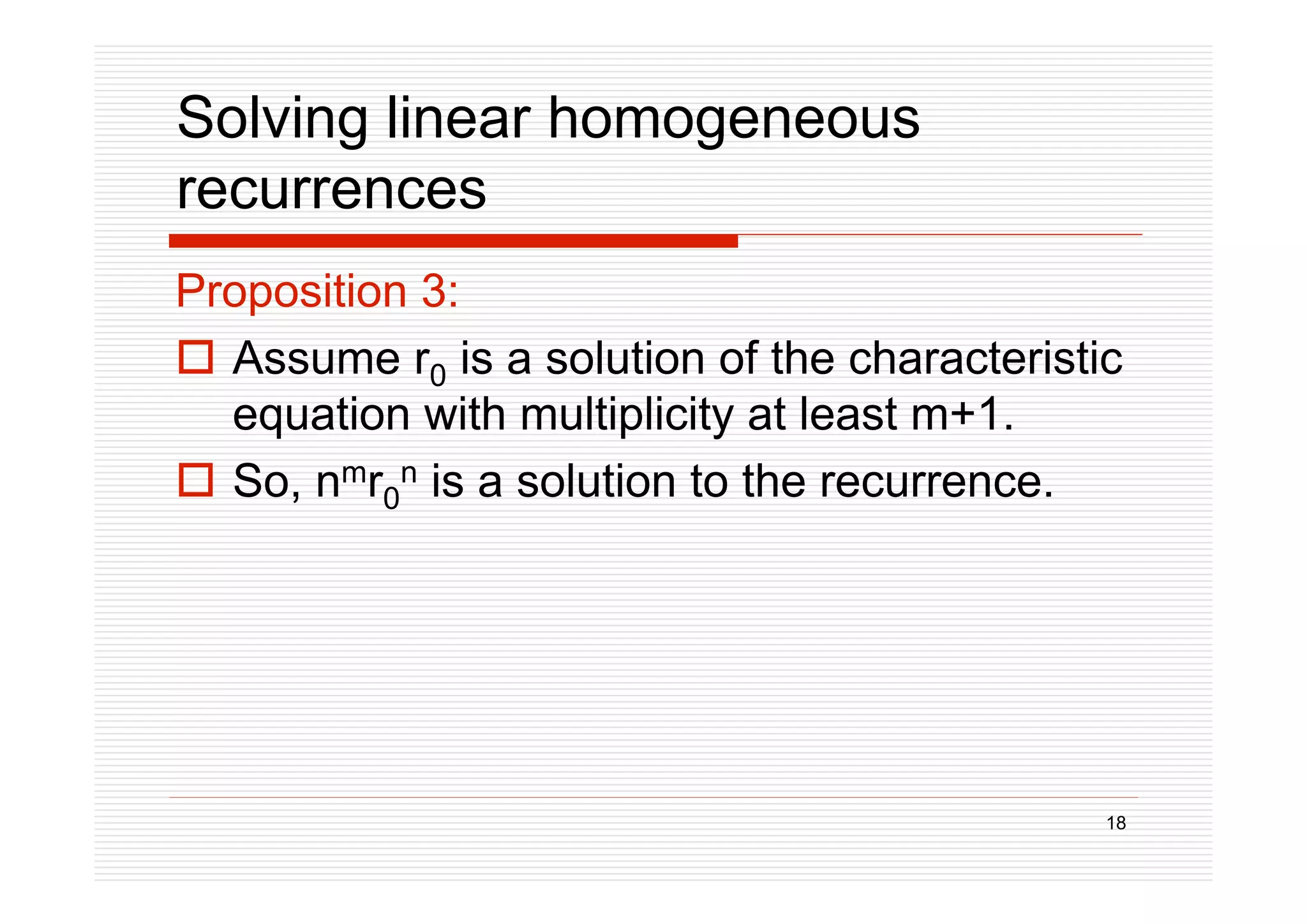
Proposition 3:
 Assume r0 is a solution of the characteristic
equation with multiplicity at least m+1.
 So, nmr0
n is a solution to the recurrence.
19
Solving linear homogeneous
recurrences
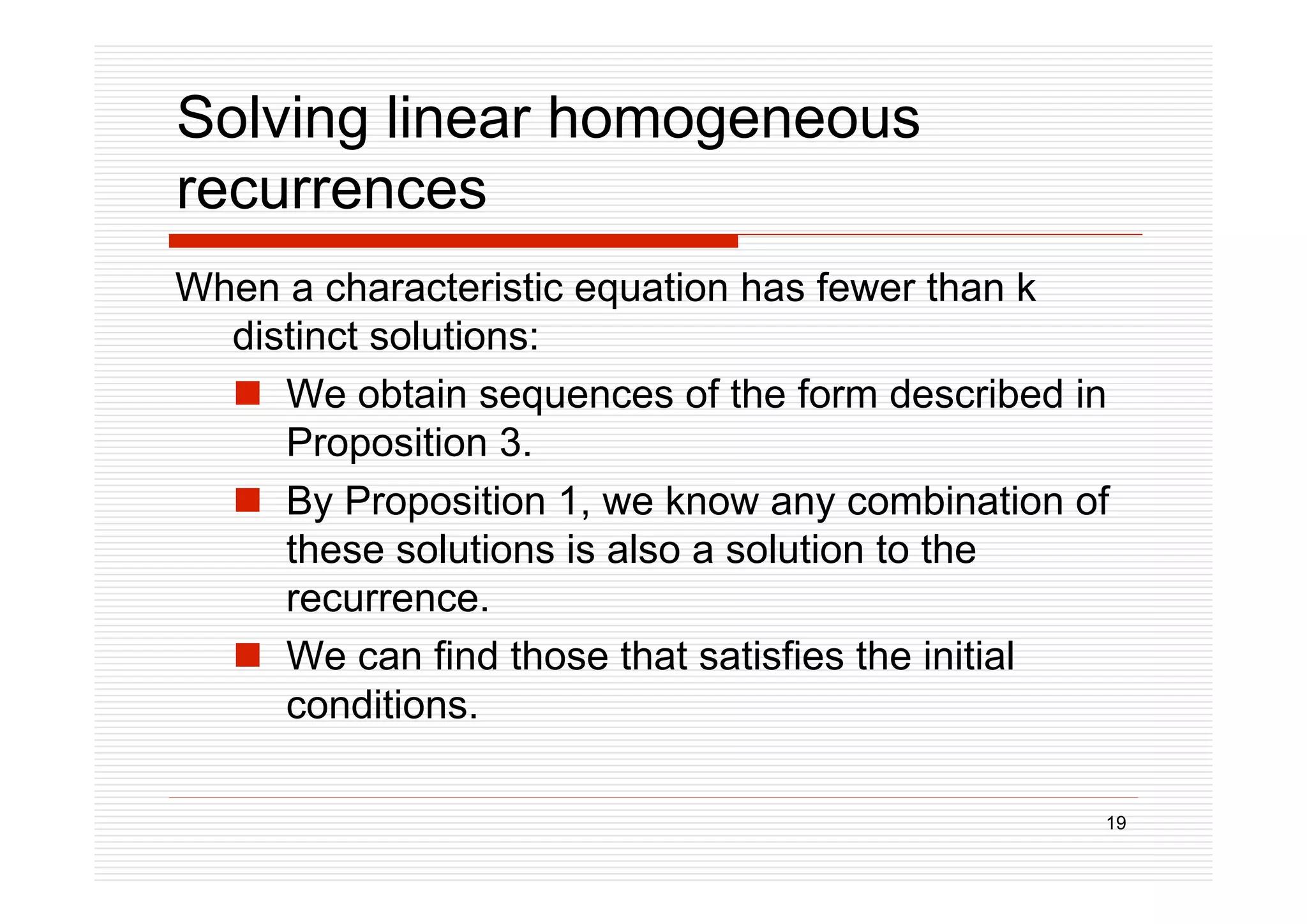
When a characteristic equation has fewer than k
distinct solutions:
 We obtain sequences of the form described in
Proposition 3.
 By Proposition 1, we know any combination of
these solutions is also a solution to the
recurrence.
 We can find those that satisfies the initial
conditions.
20
Solving linear homogeneous
recurrences
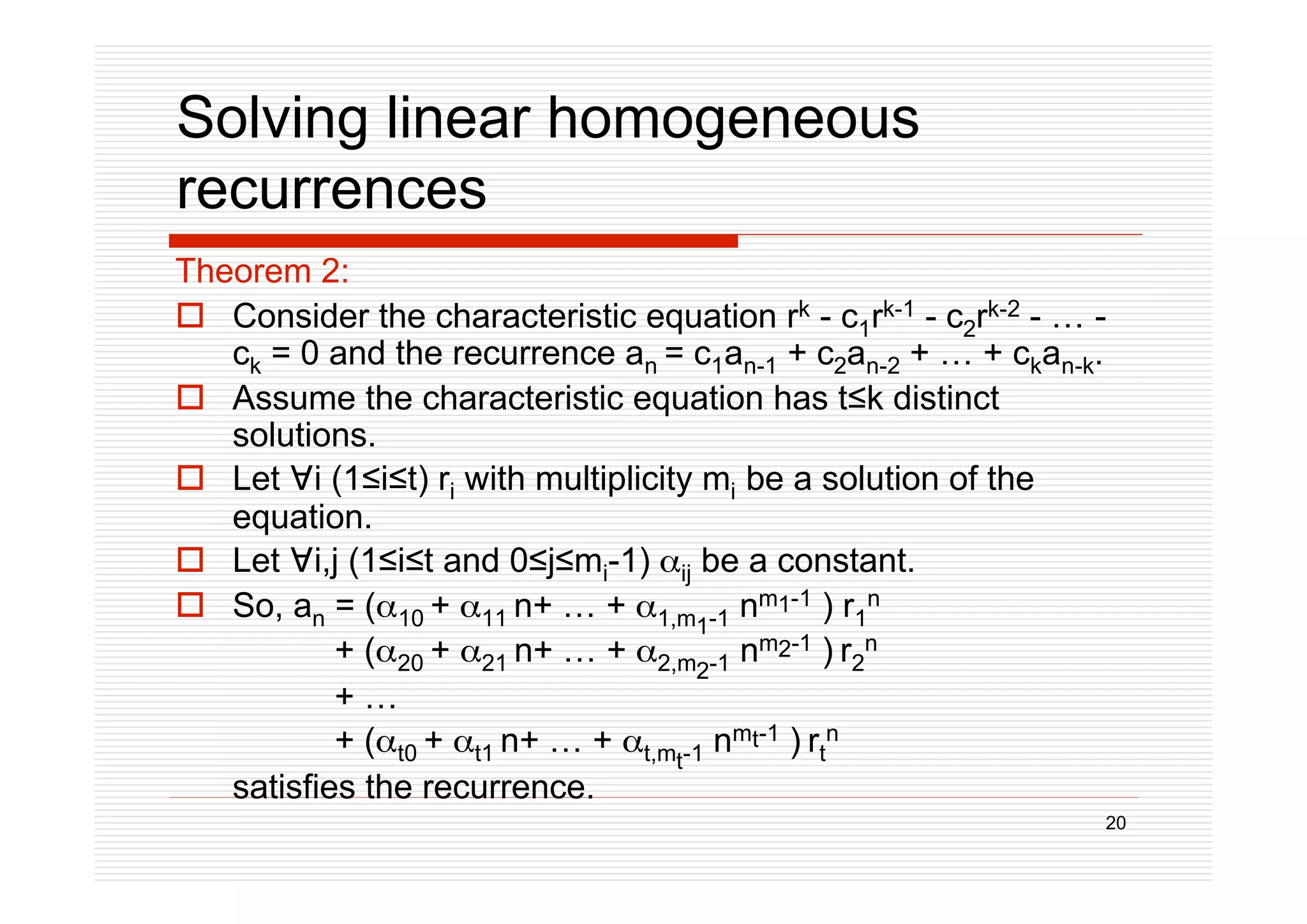
Theorem 2:
 Consider the characteristic equation rk - c1rk-1 - c2rk-2 - … -
ck = 0 and the recurrence an = c1an-1 + c2an-2 + … + ckan-k.
 Assume the characteristic equation has tk distinct
solutions.
 Let i (1it) ri with multiplicity mi be a solution of the
equation.
 Let i,j (1it and 0jmi-1) ij be a constant.
 So, an = (10 + 11 n+ … + 1,m1-1 nm1-1 ) r1
n
+ (20 + 21 n+ … + 2,m2-1 nm2-1 ) r2
n
+ …
+ (t0 + t1 n+ … + t,mt-1 nmt-1 ) rt
n
satisfies the recurrence.
21
Example
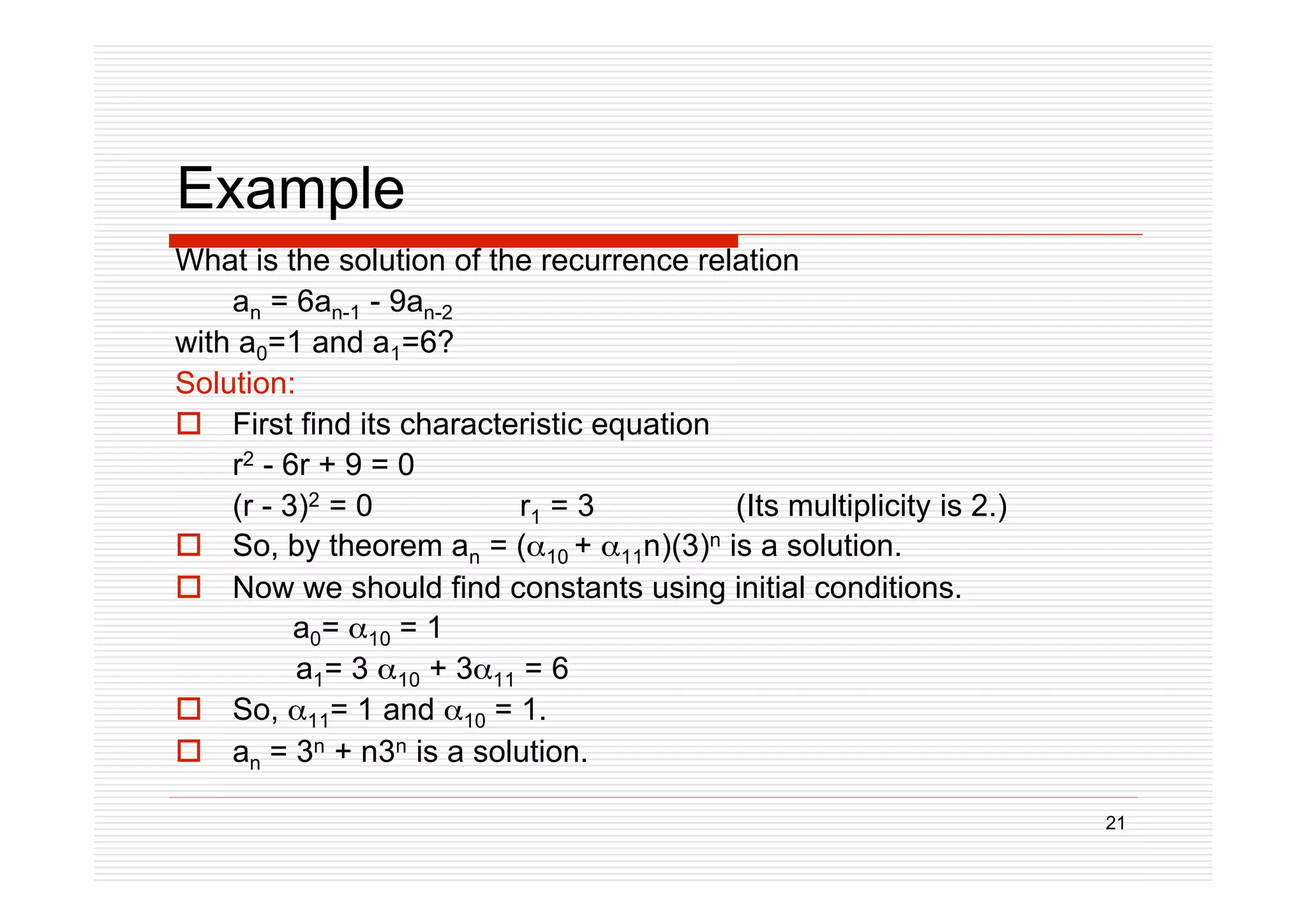
What is the solution of the recurrence relation
an = 6an-1 - 9an-2
with a0=1 and a1=6?
Solution:
 First find its characteristic equation
r2 - 6r + 9 = 0
(r - 3)2 = 0 r1 = 3 (Its multiplicity is 2.)
 So, by theorem an = (10 + 11n)(3)n is a solution.
 Now we should find constants using initial conditions.
a0= 10 = 1
a1= 3 10 + 311 = 6
 So, 11= 1 and 10 = 1.
 an = 3n + n3n is a solution.
22
Example
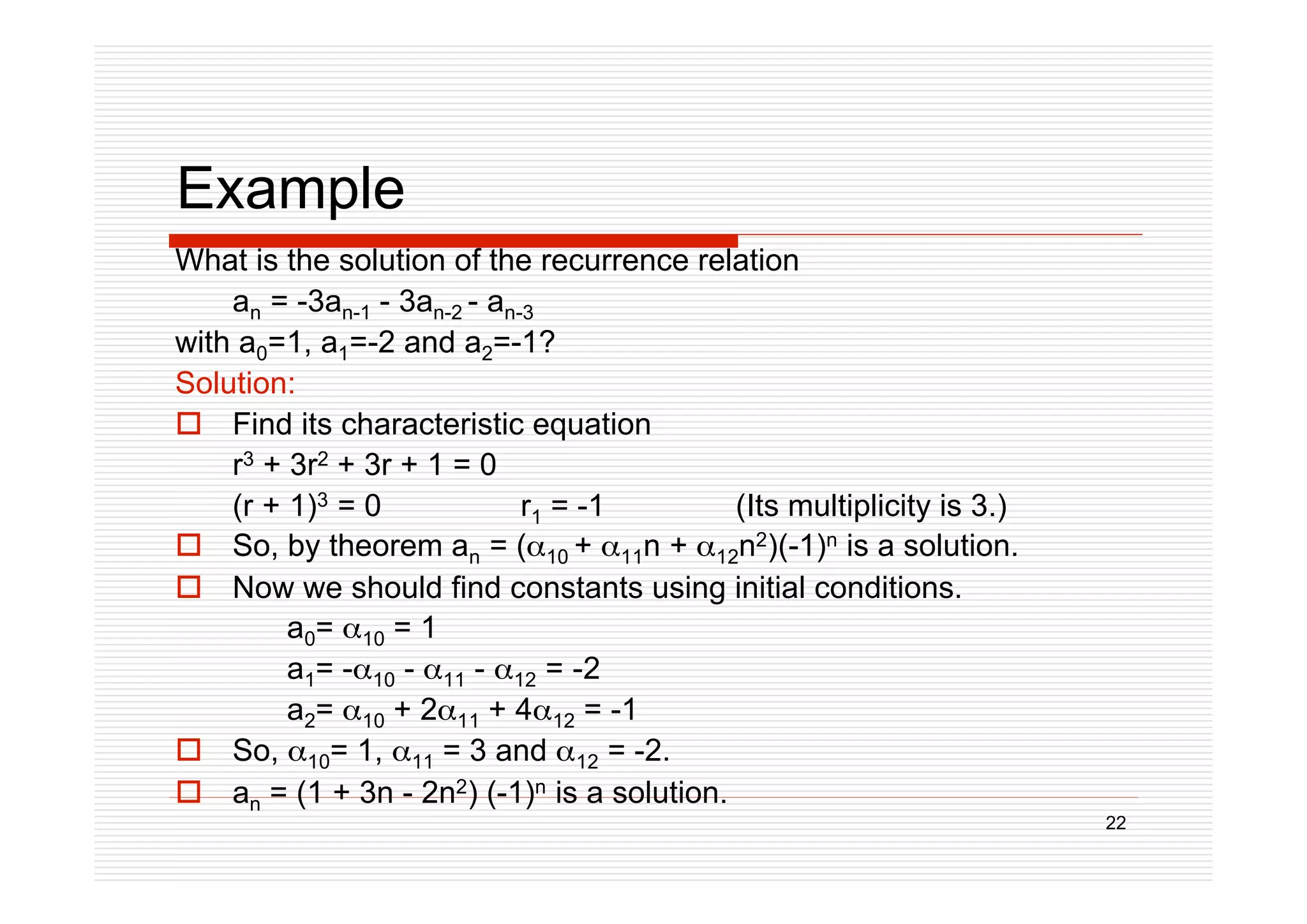
What is the solution of the recurrence relation
an = -3an-1 - 3an-2 - an-3
with a0=1, a1=-2 and a2=-1?
Solution:
 Find its characteristic equation
r3 + 3r2 + 3r + 1 = 0
(r + 1)3 = 0 r1 = -1 (Its multiplicity is 3.)
 So, by theorem an = (10 + 11n + 12n2)(-1)n is a solution.
 Now we should find constants using initial conditions.
a0= 10 = 1
a1= -10 - 11 - 12 = -2
a2= 10 + 211 + 412 = -1
 So, 10= 1, 11 = 3 and 12 = -2.
 an = (1 + 3n - 2n2) (-1)n is a solution.
23
Example
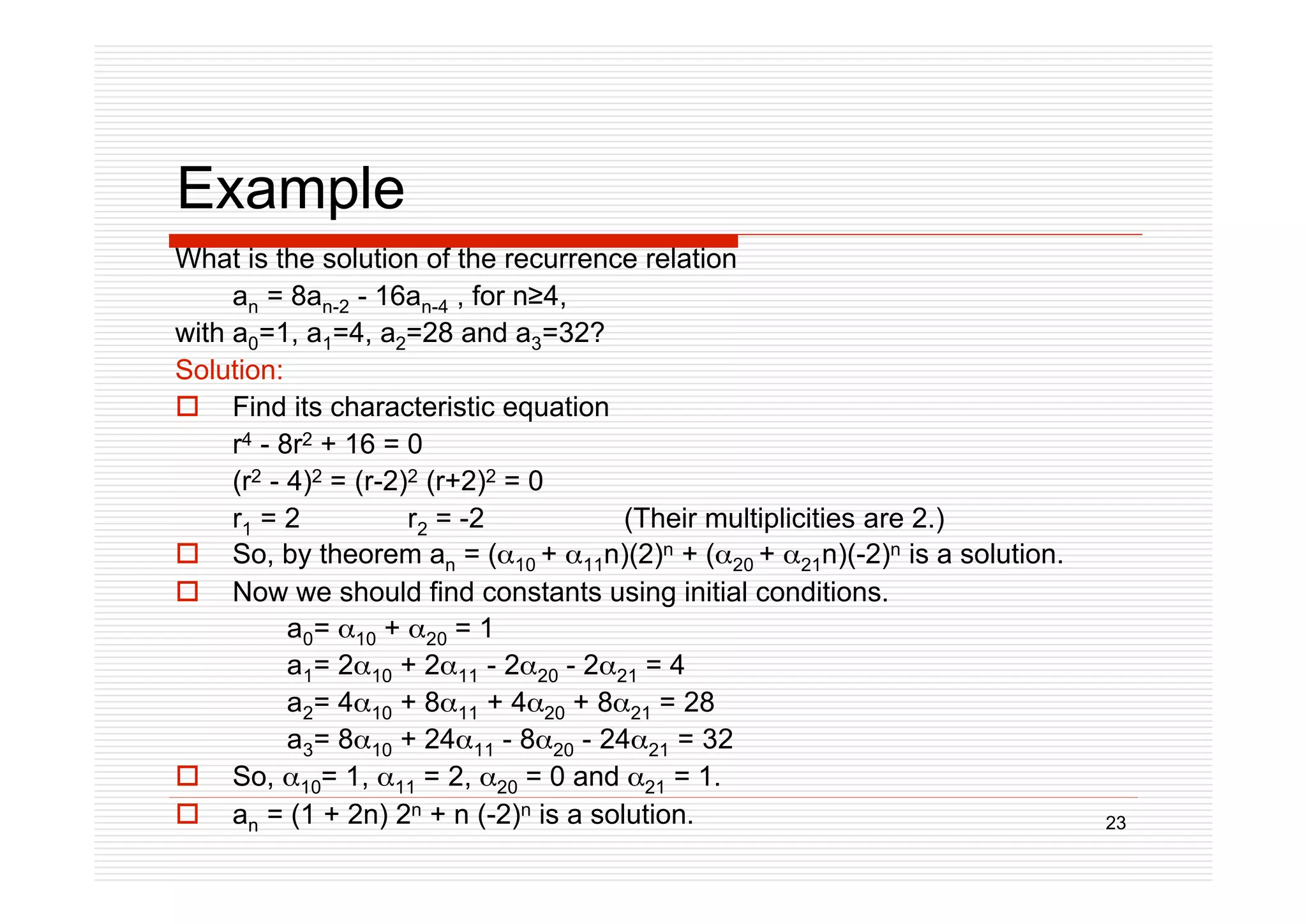
What is the solution of the recurrence relation
an = 8an-2 - 16an-4 , for n4,
with a0=1, a1=4, a2=28 and a3=32?
Solution:
 Find its characteristic equation
r4 - 8r2 + 16 = 0
(r2 - 4)2 = (r-2)2 (r+2)2 = 0
r1 = 2 r2 = -2 (Their multiplicities are 2.)
 So, by theorem an = (10 + 11n)(2)n + (20 + 21n)(-2)n is a solution.
 Now we should find constants using initial conditions.
a0= 10 + 20 = 1
a1= 210 + 211 - 220 - 221 = 4
a2= 410 + 811 + 420 + 821 = 28
a3= 810 + 2411 - 820 - 2421 = 32
 So, 10= 1, 11 = 2, 20 = 0 and 21 = 1.
 an = (1 + 2n) 2n + n (-2)n is a solution.
24
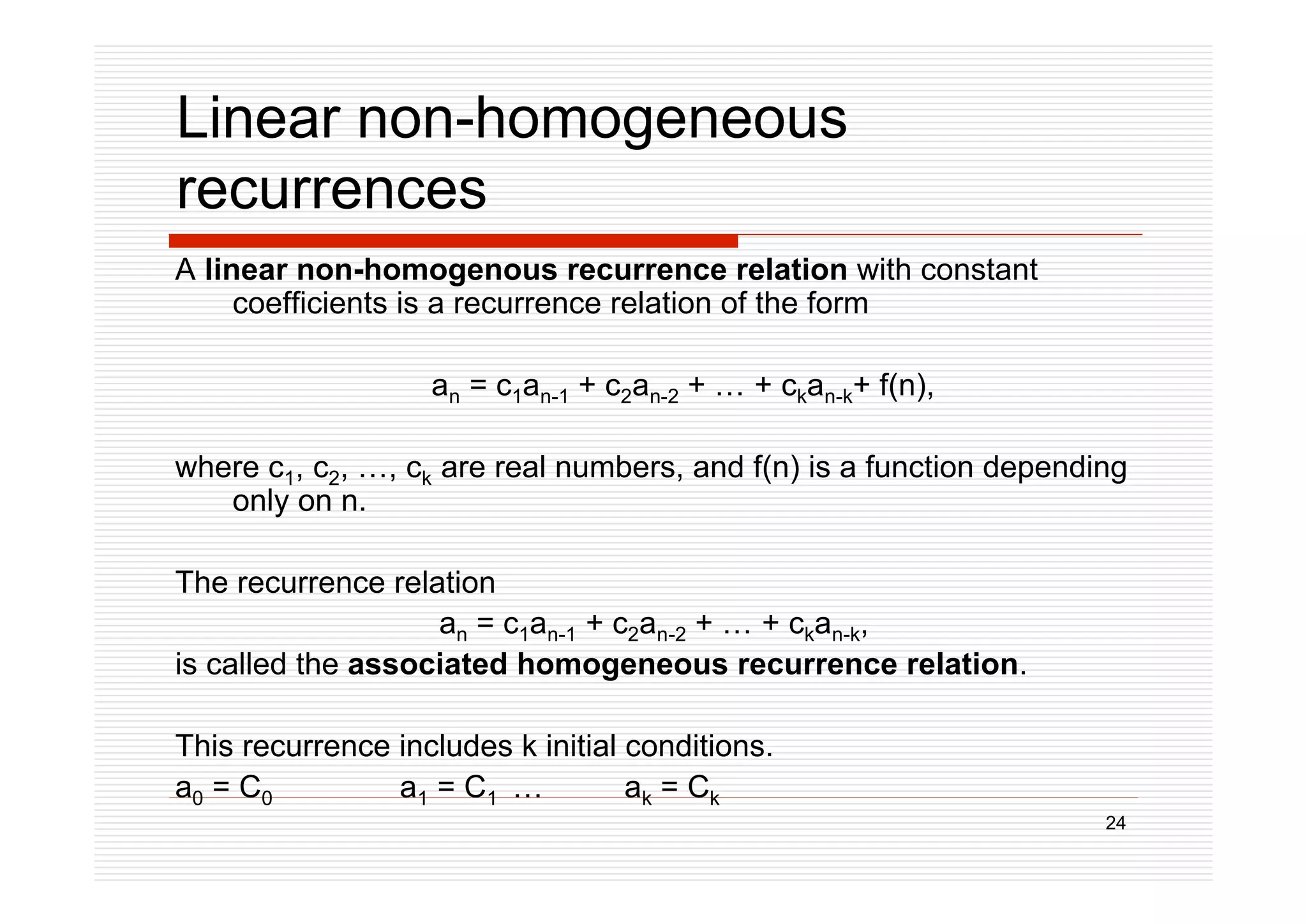
Linear non-homogeneous
recurrences
A linear non-homogenous recurrence relation with constant
coefficients is a recurrence relation of the form
an = c1an-1 + c2an-2 + … + ckan-k+ f(n),
where c1, c2, …, ck are real numbers, and f(n) is a function depending
only on n.
The recurrence relation
an = c1an-1 + c2an-2 + … + ckan-k,
is called the associated homogeneous recurrence relation.
This recurrence includes k initial conditions.
a0 = C0 a1 = C1 … ak = Ck
25
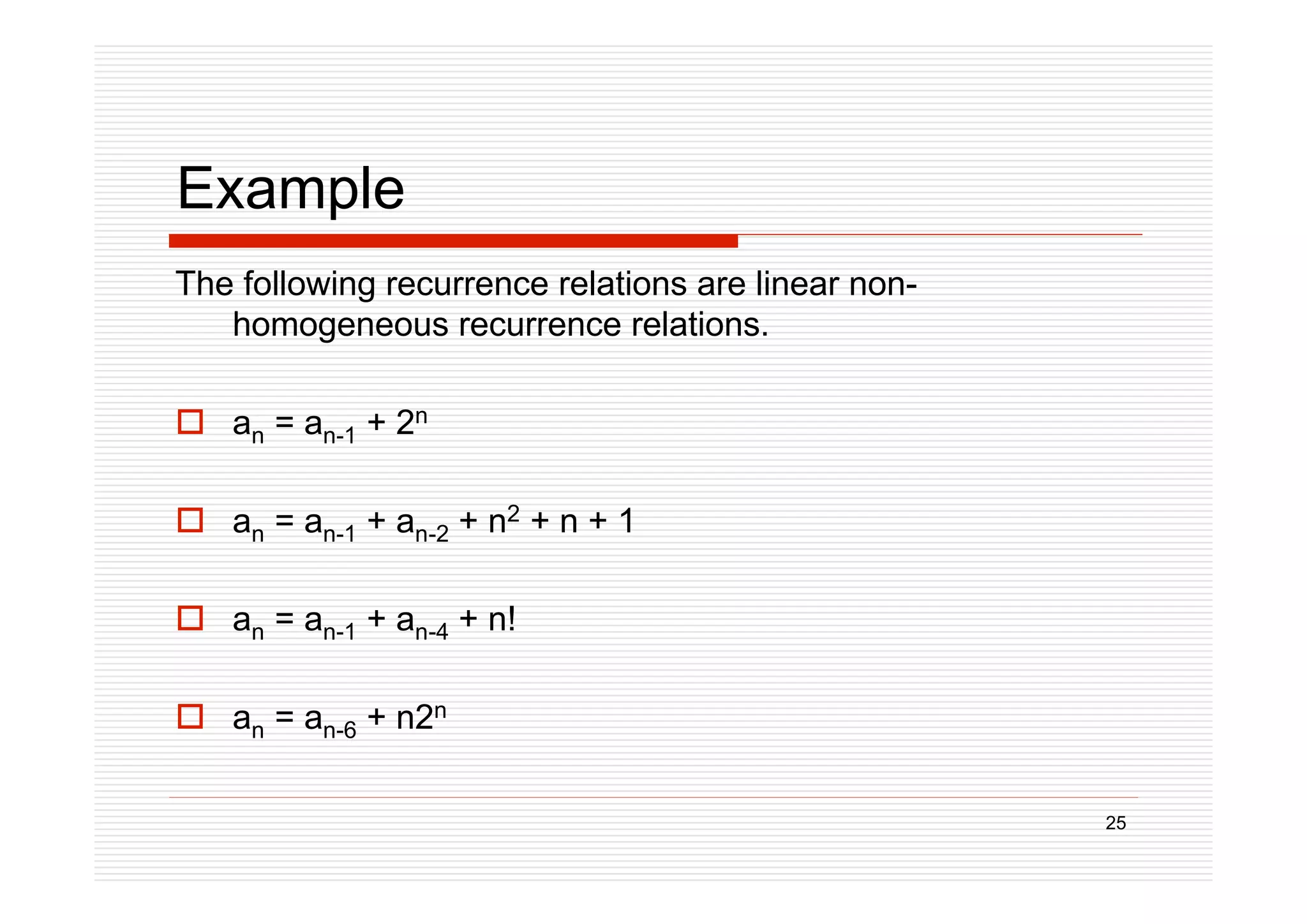
Example
The following recurrence relations are linear non-
homogeneous recurrence relations.
 an = an-1 + 2n
 an = an-1 + an-2 + n2 + n + 1
 an = an-1 + an-4 + n!
 an = an-6 + n2n
26
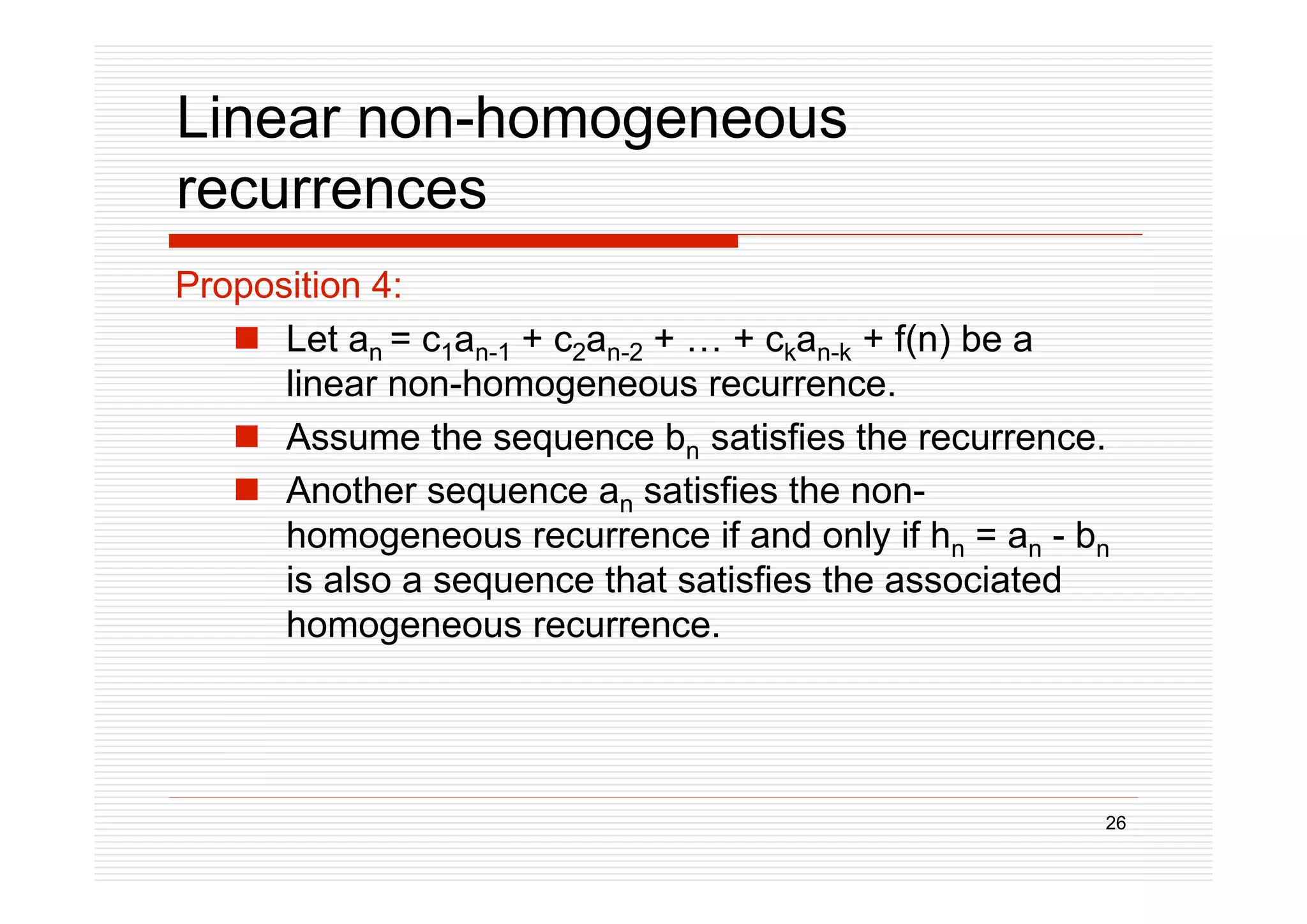
Linear non-homogeneous
recurrences
Proposition 4:
 Let an = c1an-1 + c2an-2 + … + ckan-k + f(n) be a
linear non-homogeneous recurrence.
 Assume the sequence bn satisfies the recurrence.
 Another sequence an satisfies the non-
homogeneous recurrence if and only if hn = an - bn
is also a sequence that satisfies the associated
homogeneous recurrence.
27
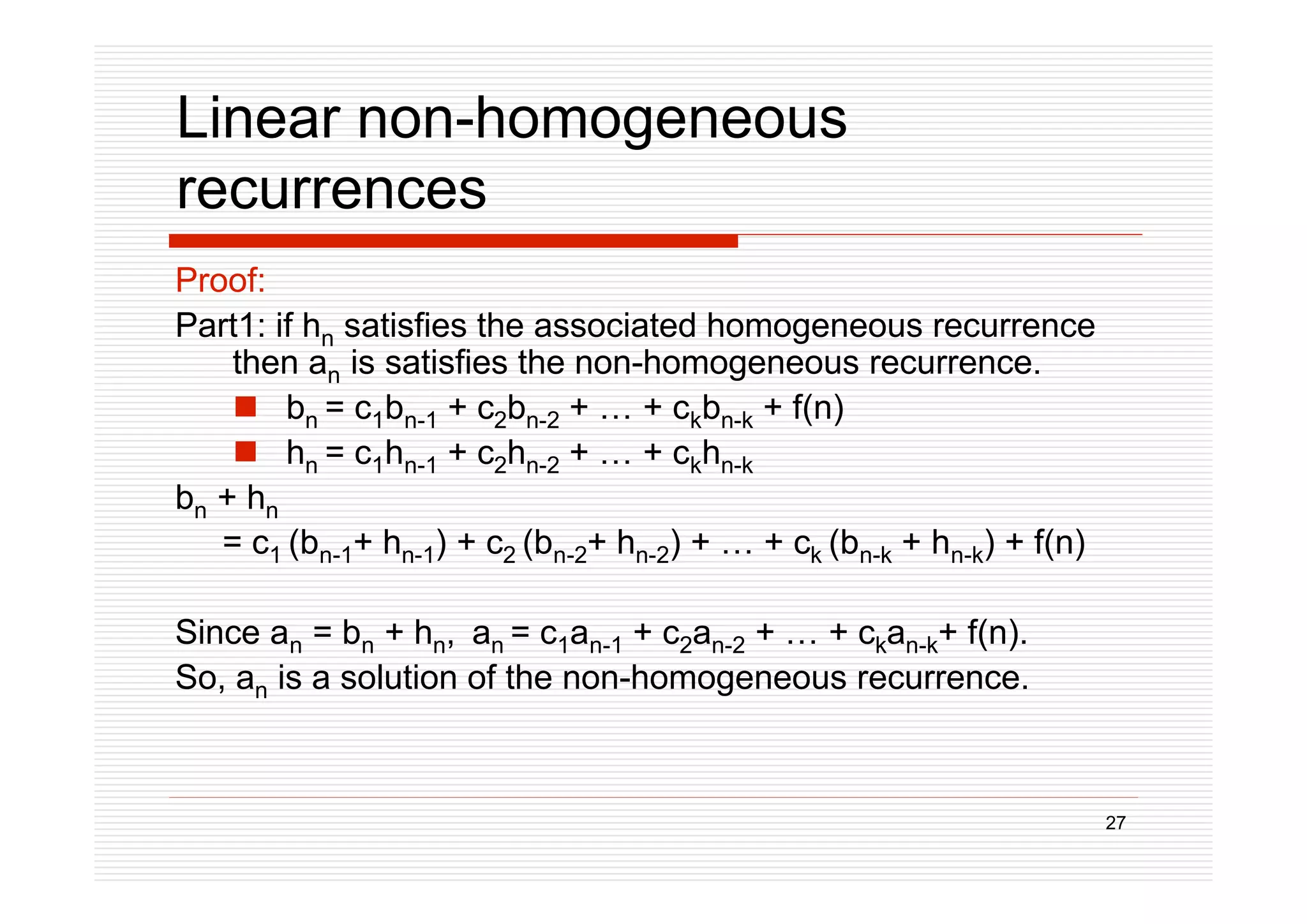
Linear non-homogeneous
recurrences
Proof:
Part1: if hn satisfies the associated homogeneous recurrence
then an is satisfies the non-homogeneous recurrence.
 bn = c1bn-1 + c2bn-2 + … + ckbn-k + f(n)
 hn = c1hn-1 + c2hn-2 + … + ckhn-k
bn + hn
= c1 (bn-1+ hn-1) + c2 (bn-2+ hn-2) + … + ck (bn-k + hn-k) + f(n)
Since an = bn + hn, an = c1an-1 + c2an-2 + … + ckan-k+ f(n).
So, an is a solution of the non-homogeneous recurrence.
28
Linear non-homogeneous
recurrences
Proof:
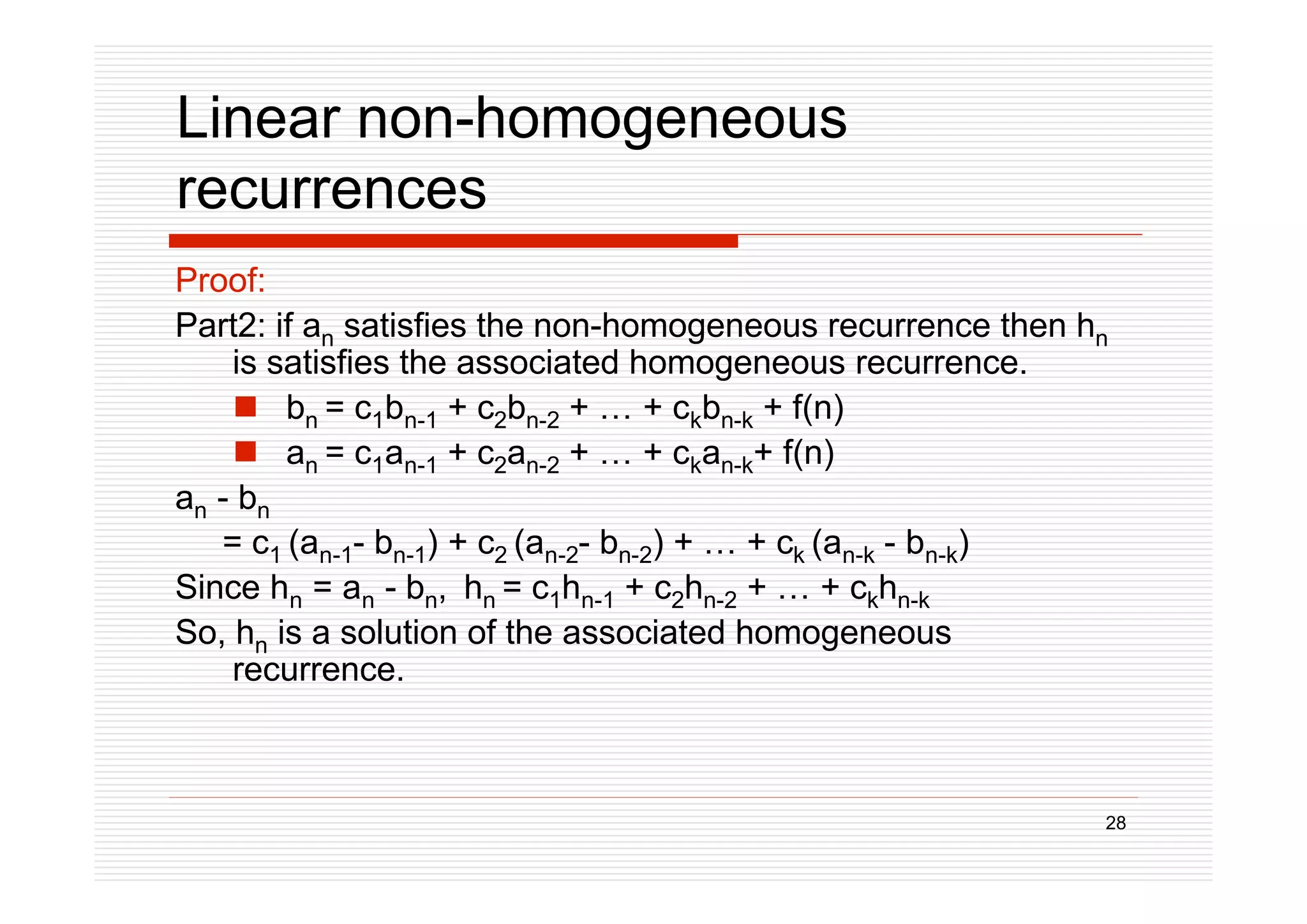
Part2: if an satisfies the non-homogeneous recurrence then hn
is satisfies the associated homogeneous recurrence.
 bn = c1bn-1 + c2bn-2 + … + ckbn-k + f(n)
 an = c1an-1 + c2an-2 + … + ckan-k+ f(n)
an - bn
= c1 (an-1- bn-1) + c2 (an-2- bn-2) + … + ck (an-k - bn-k)
Since hn = an - bn, hn = c1hn-1 + c2hn-2 + … + ckhn-k
So, hn is a solution of the associated homogeneous
recurrence.
29
Linear non-homogeneous
recurrences
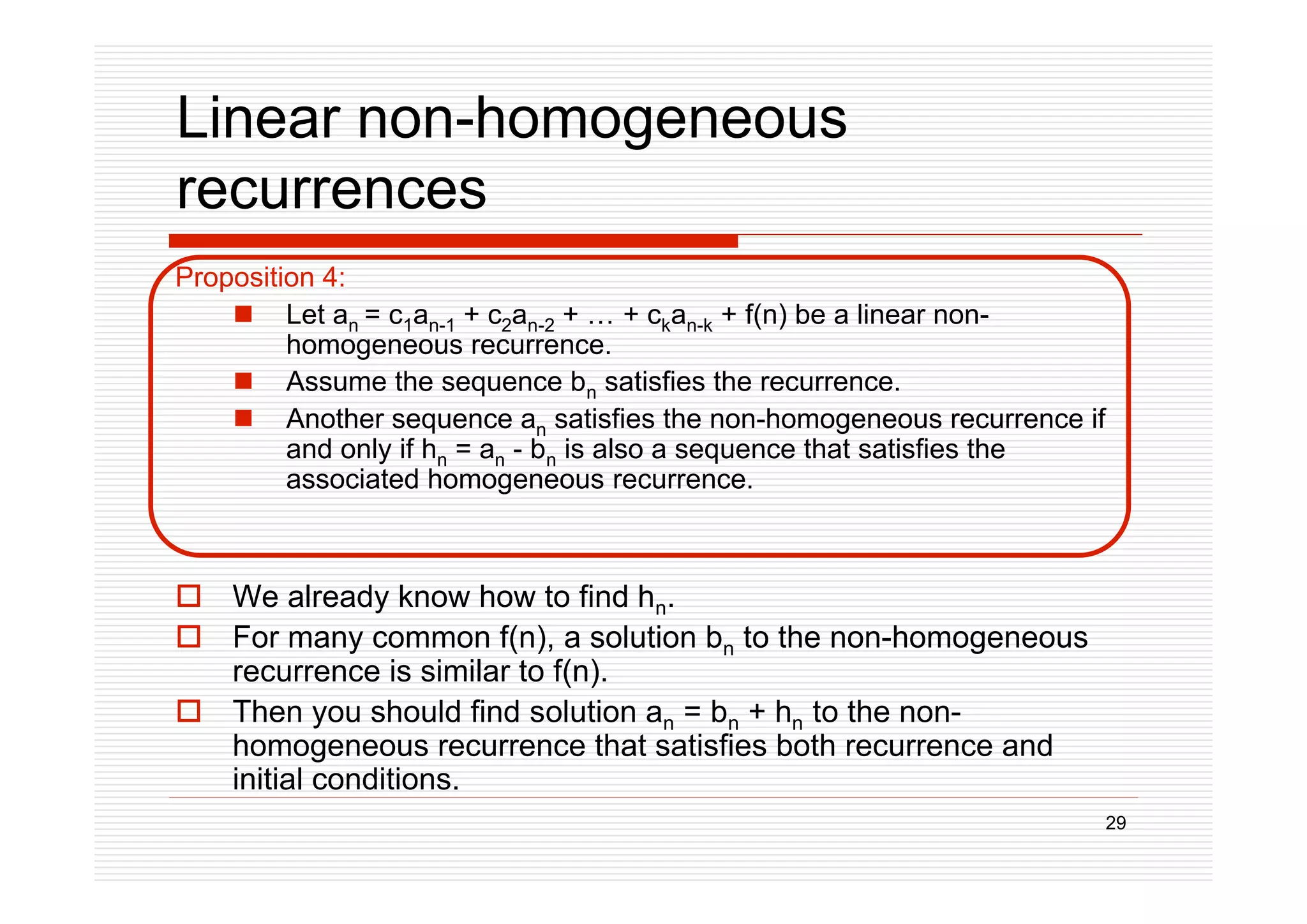
Proposition 4:
 Let an = c1an-1 + c2an-2 + … + ckan-k + f(n) be a linear non-
homogeneous recurrence.
 Assume the sequence bn satisfies the recurrence.
 Another sequence an satisfies the non-homogeneous recurrence if
and only if hn = an - bn is also a sequence that satisfies the
associated homogeneous recurrence.
 We already know how to find hn.
 For many common f(n), a solution bn to the non-homogeneous
recurrence is similar to f(n).
 Then you should find solution an = bn + hn to the non-
homogeneous recurrence that satisfies both recurrence and
initial conditions.
30
Example
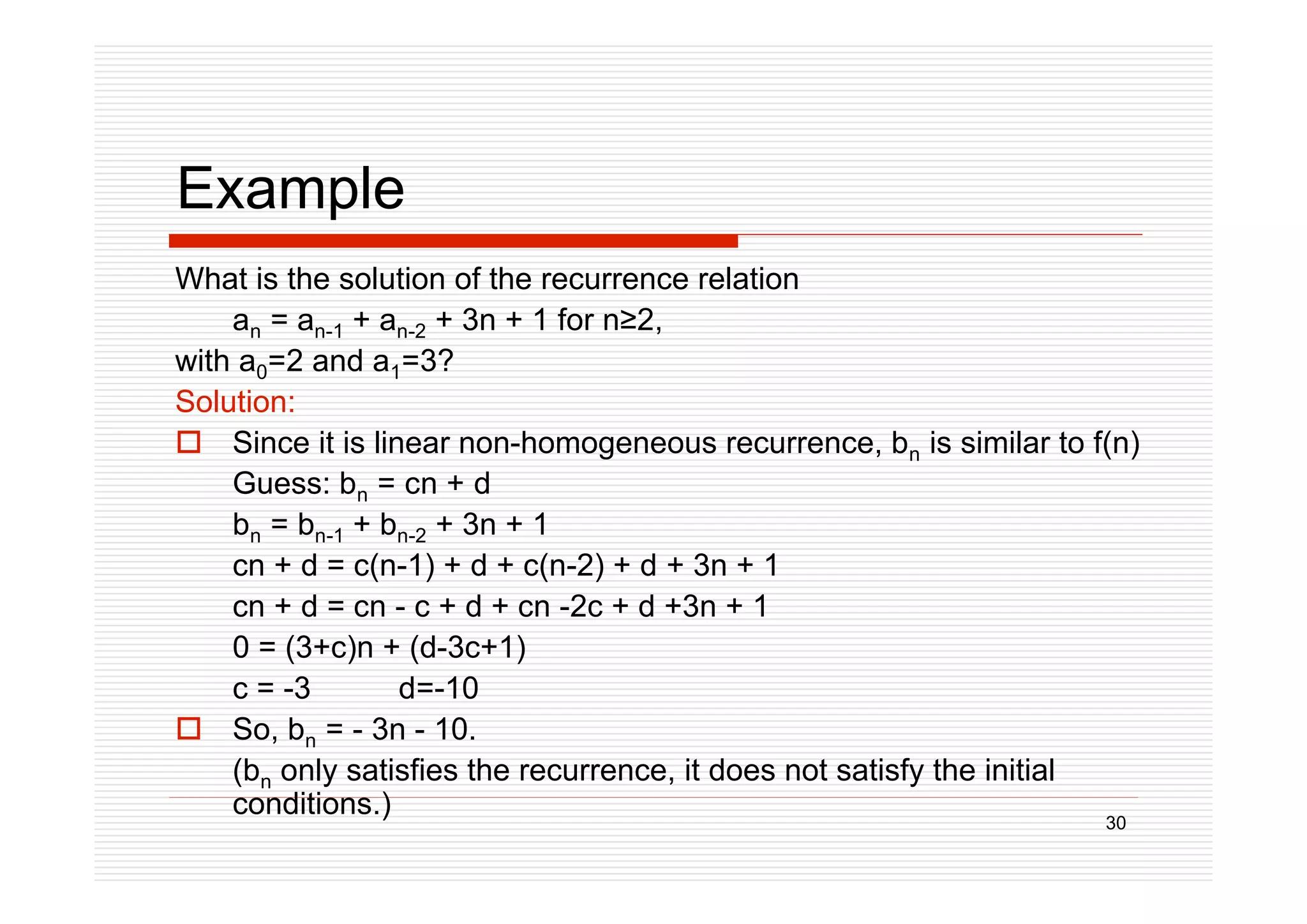
What is the solution of the recurrence relation
an = an-1 + an-2 + 3n + 1 for n2,
with a0=2 and a1=3?
Solution:
 Since it is linear non-homogeneous recurrence, bn is similar to f(n)
Guess: bn = cn + d
bn = bn-1 + bn-2 + 3n + 1
cn + d = c(n-1) + d + c(n-2) + d + 3n + 1
cn + d = cn - c + d + cn -2c + d +3n + 1
0 = (3+c)n + (d-3c+1)
c = -3 d=-10
 So, bn = - 3n - 10.
(bn only satisfies the recurrence, it does not satisfy the initial
conditions.)
31
Example
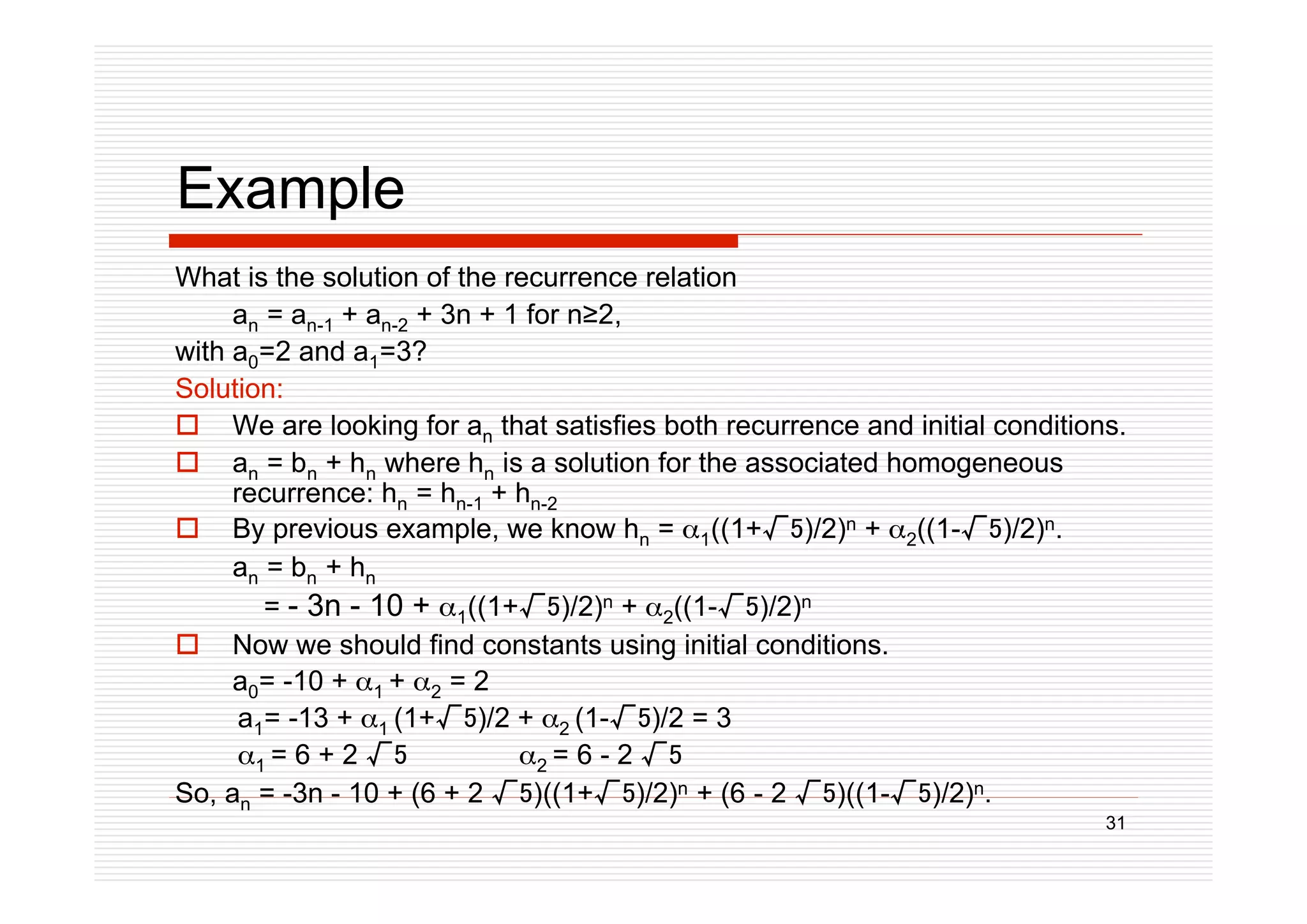
What is the solution of the recurrence relation
an = an-1 + an-2 + 3n + 1 for n2,
with a0=2 and a1=3?
Solution:
 We are looking for an that satisfies both recurrence and initial conditions.
 an = bn + hn where hn is a solution for the associated homogeneous
recurrence: hn = hn-1 + hn-2
 By previous example, we know hn = 1((1+)/2)n + 2((1-)/2)n.
an = bn + hn
= - 3n - 10 + 1((1+)/2)n + 2((1-)/2)n
 Now we should find constants using initial conditions.
a0= -10 + 1 + 2 = 2
a1= -13 + 1 (1+)/2 + 2 (1-)/2 = 3
1 = 6 + 2  2 = 6 - 2 
So, an = -3n - 10 + (6 + 2 )((1+)/2)n + (6 - 2 )((1-)/2)n.
32
Example
What is the solution of the recurrence relation
an = 2an-1 - an-2 + 2n for n2,
with a0=1 and a1=2?
Solution:
 Since it is linear non-homogeneous recurrence, bn is similar to f(n)
Guess: bn = c2n + d
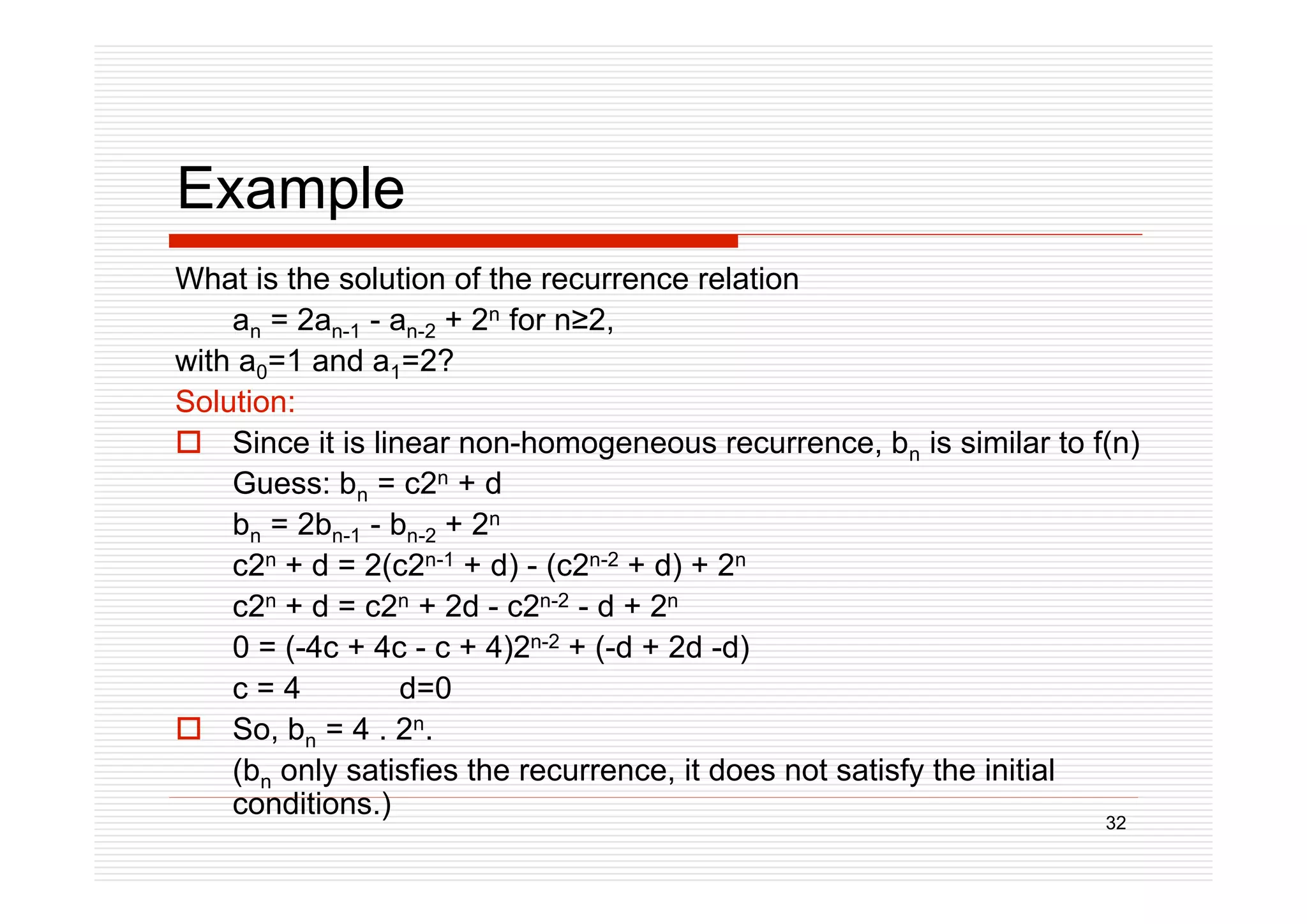
bn = 2bn-1 - bn-2 + 2n
c2n + d = 2(c2n-1 + d) - (c2n-2 + d) + 2n
c2n + d = c2n + 2d - c2n-2 - d + 2n
0 = (-4c + 4c - c + 4)2n-2 + (-d + 2d -d)
c = 4 d=0
 So, bn = 4 . 2n.
(bn only satisfies the recurrence, it does not satisfy the initial
conditions.)
33
Example
What is the solution of the recurrence relation
an = 2an-1 - an-2 + 2n for n2,
with a0=1 and a1=2?
Solution:
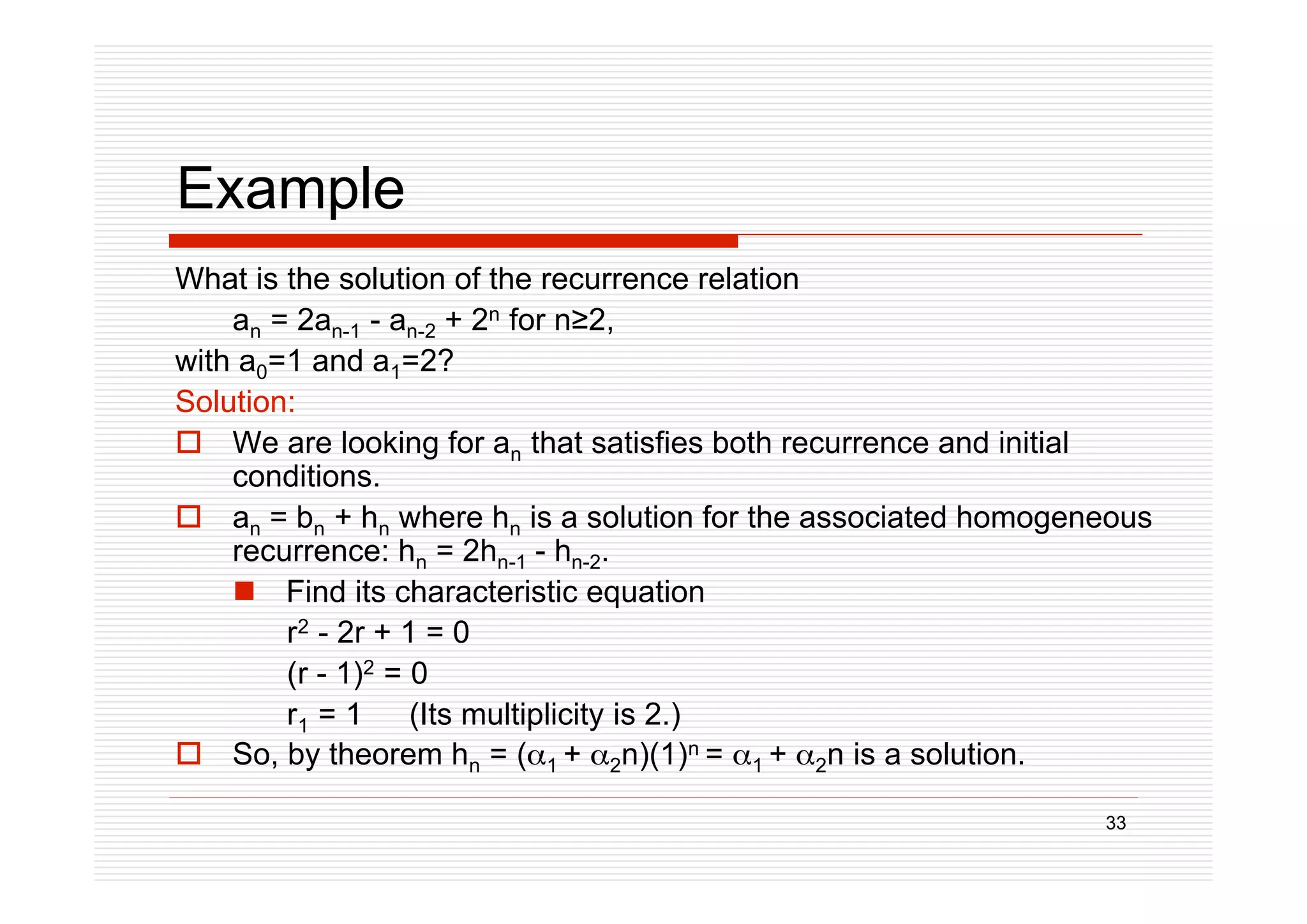
 We are looking for an that satisfies both recurrence and initial
conditions.
 an = bn + hn where hn is a solution for the associated homogeneous
recurrence: hn = 2hn-1 - hn-2.
 Find its characteristic equation
r2 - 2r + 1 = 0
(r - 1)2 = 0
r1 = 1 (Its multiplicity is 2.)
 So, by theorem hn = (1 + 2n)(1)n = 1 + 2n is a solution.
34
Example
What is the solution of the recurrence relation
an = 2an-1 - an-2 + 2n for n2,
with a0=1 and a1=2?
Solution:
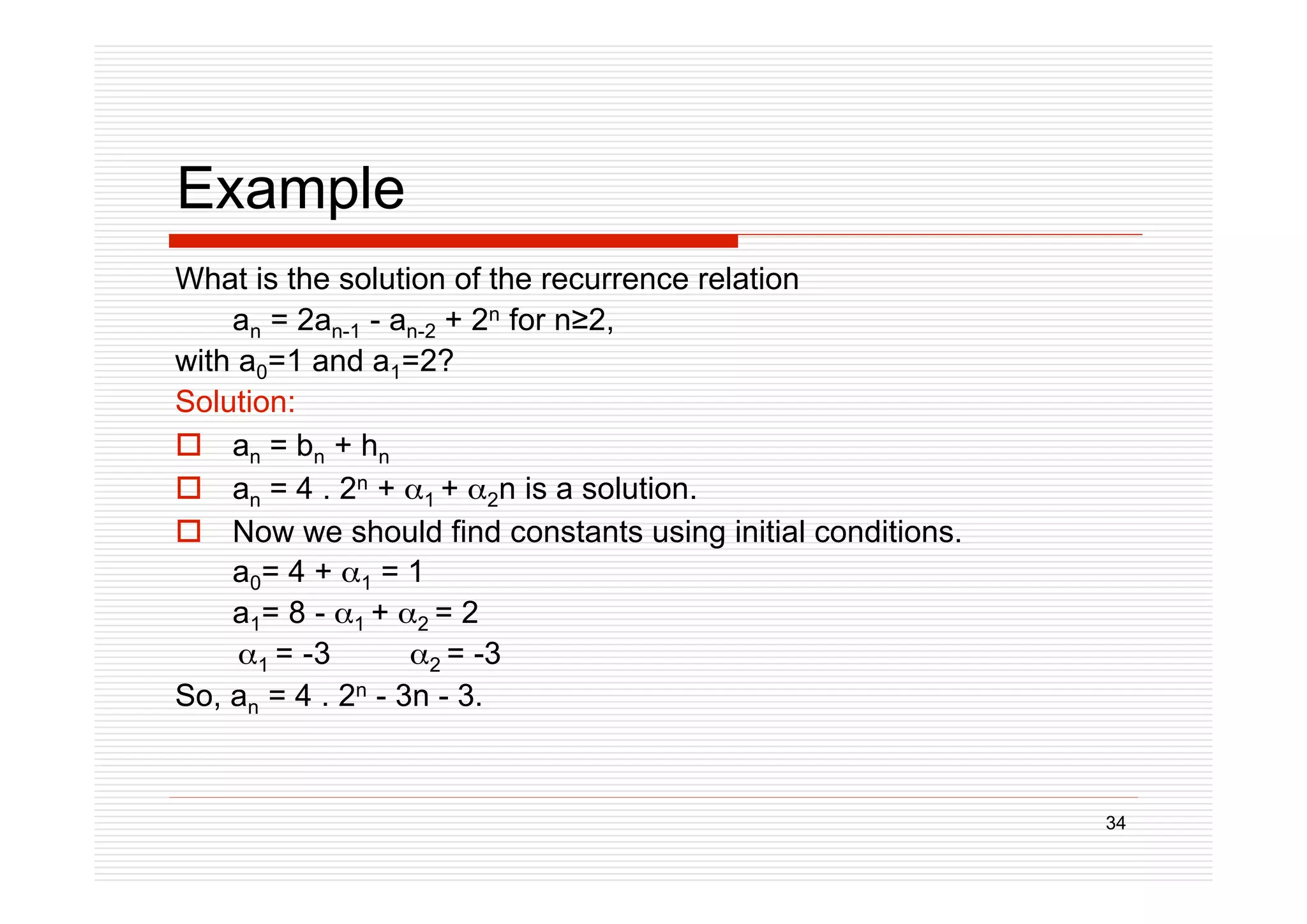
 an = bn + hn
 an = 4 . 2n + 1 + 2n is a solution.
 Now we should find constants using initial conditions.
a0= 4 + 1 = 1
a1= 8 - 1 + 2 = 2
1 = -3 2 = -3
So, an = 4 . 2n - 3n - 3.
35
Recommended exercises
1,3,15,17,19,21,23,25,31,35
Eric Ruppert’s Notes about Solving
Recurrences
(http://www.cse.yorku.ca/course_archive/2007
-08/F/1019/A/recurrence.pdf)

Daa linear recurrences

  • 1.
  • 2.
    1 Review A recursive definitionof a sequence specifies Initial conditions Recurrence relation Example: a0=0 and a1=3 an = 2an-1 - an-2 an = 3n Initial conditions Recurrence relation Solution
  • 3.
    2 Linear recurrences Linear recurrence: Eachterm of a sequence is a linear function of earlier terms in the sequence. For example: a0 = 1 a1 = 6 a2 = 10 an = an-1 + 2an-2 + 3an-3 a3 = a0 + 2a1 + 3a2 = 1 + 2(6) + 3(10) = 43
  • 4.
    3 Linear recurrences Linear recurrences 1.Linear homogeneous recurrences 2. Linear non-homogeneous recurrences
  • 5.
    4 Linear homogeneous recurrences Alinear homogenous recurrence relation of degree k with constant coefficients is a recurrence relation of the form an = c1an-1 + c2an-2 + … + ckan-k, where c1, c2, …, ck are real numbers, and ck0. an is expressed in terms of the previous k terms of the sequence, so its degree is k. This recurrence includes k initial conditions. a0 = C0 a1 = C1 … ak = Ck
  • 6.
    5 Example Determine if thefollowing recurrence relations are linear homogeneous recurrence relations with constant coefficients. Pn = (1.11)Pn-1 a linear homogeneous recurrence relation of degree one an = an-1 + a2 n-2 not linear fn = fn-1 + fn-2 a linear homogeneous recurrence relation of degree two Hn = 2Hn-1+1 not homogeneous an = an-6 a linear homogeneous recurrence relation of degree six Bn = nBn-1 does not have constant coefficient
  • 7.
    6 Solving linear homogeneous recurrences Proposition1: Let an = c1an-1 + c2an-2 + … + ckan-k be a linear homogeneous recurrence. Assume the sequence an satisfies the recurrence. Assume the sequence a’n also satisfies the recurrence. So, bn = an + a’n and dn=an are also sequences that satisfy the recurrence. ( is any constant) Proof: bn = an + a’n = (c1an-1 + c2an-2 + … + ckan-k) + (c1a’n-1 + c2a’n-2 + … + cka’n-k) = c1 (an-1+ a’n-1) + c2 (an-2+ a’n-2) + … + ck (an-k + a’n-k) = c1bn-1 + c2bn-2 + … + ckbn-k So, bn is a solution of the recurrence.
  • 8.
    7 Solving linear homogeneous recurrences Proposition1: Let an = c1an-1 + c2an-2 + … + ckan-k be a linear homogeneous recurrence. Assume the sequence an satisfies the recurrence. Assume the sequence a’n also satisfies the recurrence. So, bn = an + a’n and dn=an are also sequences that satisfy the recurrence. ( is any constant) Proof: dn = an = (c1an-1 + c2an-2 + … + ckan-k) = c1 (an-1) + c2 (an-2) + … + ck (an-k) = c1dn-1 + c2dn-2 + … + ckdn-k So, dn is a solution of the recurrence.
  • 9.
    8 Solving linear homogeneous recurrences Itfollows from the previous proposition, if we find some solutions to a linear homogeneous recurrence, then any linear combination of them will also be a solution to the linear homogeneous recurrence.
  • 10.
    9 Solving linear homogeneous recurrences Geometricsequences come up a lot when solving linear homogeneous recurrences. So, try to find any solution of the form an = rn that satisfies the recurrence relation.
  • 11.
    10 Solving linear homogeneous recurrences Recurrence relation an = c1an-1 + c2an-2 + … + ckan-k Try to find a solution of form rn rn = c1rn-1 + c2rn-2 + … + ckrn-k rn - c1rn-1 - c2rn-2 - … - ckrn-k = 0 rk - c1rk-1 - c2rk-2 - … - ck = 0 (dividing both sides by rn-k) This equation is called the characteristic equation.
  • 12.
    11 Example Example: The Fibonacci recurrenceis Fn = Fn-1 + Fn-2 Its characteristic equation is r2 - r - 1 = 0
  • 13.
    12 Solving linear homogeneous recurrences Proposition2: r is a solution of rk - c1rk-1 - c2rk-2 - … - ck = 0 if and only if rn is a solution of an = c1an-1 + c2an-2 + … + ckan-k. Example: consider the characteristic equation r2 - 4r + 4 = 0. r2 - 4r + 4 = (r - 2)2 = 0 So, r=2. So, 2n satisfies the recurrence Fn = 4Fn-1 - 4Fn-2. 2n = 4 . 2n-1 - 4 . 2n-2 2n-2 ( 4 - 8 + 4) = 0
  • 14.
    13 Solving linear homogeneous recurrences Theorem1: Consider the characteristic equation rk - c1rk-1 - c2rk-2 - … - ck = 0 and the recurrence an = c1an-1 + c2an-2 + … + ckan-k. Assume r1, r2, …and rm all satisfy the equation. Let 1, 2, …, m be any constants. So, an = 1 r1 n + 2 r2 n + … + m rm n satisfies the recurrence. Proof: By Proposition 2, i ri n satisfies the recurrence. So, by Proposition 1, i i ri n satisfies the recurrence. Applying Proposition 1 again, the sequence an = 1 r1 n + 2 r2 n + … + m rm n satisfies the recurrence.
  • 15.
    14 Example What is thesolution of the recurrence relation an = an-1 + 2an-2 with a0=2 and a1=7? Solution: Since it is linear homogeneous recurrence, first find its characteristic equation r2 - r - 2 = 0 (r+1)(r-2) = 0 r1 = 2 and r2 = -1 So, by theorem an = 12n + 2(-1)n is a solution. Now we should find 1 and 2 using initial conditions. a0= 1 + 2 = 2 a1= 12 + 2(-1) = 7 So, 1= 3 and 2 = -1. an = 3 . 2n - (-1)n is a solution.
  • 16.
    15 Example What is thesolution of the recurrence relation fn = fn-1 + fn-2 with f0=0 and f1=1? Solution: Since it is linear homogeneous recurrence, first find its characteristic equation r2 - r - 1 = 0 r1 = (1+)/2 and r2 = (1-)/2 So, by theorem fn = 1((1+)/2)n + 2((1-)/2)n is a solution. Now we should find 1 and 2 using initial conditions. f0= 1 + 2 = 0 f1= 1(1+)/2 + 2 (1-)/2 = 1 So, 1= 1/ and 2 = -1/. an = 1/ . ((1+)/2)n - 1/((1-)/2)n is a solution.
  • 17.
    16 Example What is thesolution of the recurrence relation an = -an-1 + 4an-2 + 4an-3 with a0=8, a1=6 and a2=26? Solution: Since it is linear homogeneous recurrence, first find its characteristic equation r3 + r2 - 4r - 4 = 0 (r+1)(r+2)(r-2) = 0 r1 = -1, r2 = -2 and r3 = 2 So, by theorem an = 1(-1)n + 2(-2)n + 32n is a solution. Now we should find 1, 2 and 3 using initial conditions. a0= 1 + 2 + 3 = 8 a1= - 1 - 22 + 23 = 6 a2= 1 + 42 + 43 = 26 So, 1= 2, 2 = 1 and 3 = 5. an = 2 . (-1)n + (-2)n + 5 . 2n is a solution.
  • 18.
    17 Solving linear homogeneous recurrences Ifthe characteristic equation has k distinct solutions r1, r2, …, rk, it can be written as (r - r1)(r - r2)…(r - rk) = 0. If, after factoring, the equation has m+1 factors of (r - r1), for example, r1 is called a solution of the characteristic equation with multiplicity m+1. When this happens, not only r1 n is a solution, but also nr1 n, n2r1 n, … and nmr1 n are solutions of the recurrence.
  • 19.
    18 Solving linear homogeneous recurrences Proposition3: Assume r0 is a solution of the characteristic equation with multiplicity at least m+1. So, nmr0 n is a solution to the recurrence.
  • 20.
    19 Solving linear homogeneous recurrences Whena characteristic equation has fewer than k distinct solutions: We obtain sequences of the form described in Proposition 3. By Proposition 1, we know any combination of these solutions is also a solution to the recurrence. We can find those that satisfies the initial conditions.
  • 21.
    20 Solving linear homogeneous recurrences Theorem2: Consider the characteristic equation rk - c1rk-1 - c2rk-2 - … - ck = 0 and the recurrence an = c1an-1 + c2an-2 + … + ckan-k. Assume the characteristic equation has tk distinct solutions. Let i (1it) ri with multiplicity mi be a solution of the equation. Let i,j (1it and 0jmi-1) ij be a constant. So, an = (10 + 11 n+ … + 1,m1-1 nm1-1 ) r1 n + (20 + 21 n+ … + 2,m2-1 nm2-1 ) r2 n + … + (t0 + t1 n+ … + t,mt-1 nmt-1 ) rt n satisfies the recurrence.
  • 22.
    21 Example What is thesolution of the recurrence relation an = 6an-1 - 9an-2 with a0=1 and a1=6? Solution: First find its characteristic equation r2 - 6r + 9 = 0 (r - 3)2 = 0 r1 = 3 (Its multiplicity is 2.) So, by theorem an = (10 + 11n)(3)n is a solution. Now we should find constants using initial conditions. a0= 10 = 1 a1= 3 10 + 311 = 6 So, 11= 1 and 10 = 1. an = 3n + n3n is a solution.
  • 23.
    22 Example What is thesolution of the recurrence relation an = -3an-1 - 3an-2 - an-3 with a0=1, a1=-2 and a2=-1? Solution: Find its characteristic equation r3 + 3r2 + 3r + 1 = 0 (r + 1)3 = 0 r1 = -1 (Its multiplicity is 3.) So, by theorem an = (10 + 11n + 12n2)(-1)n is a solution. Now we should find constants using initial conditions. a0= 10 = 1 a1= -10 - 11 - 12 = -2 a2= 10 + 211 + 412 = -1 So, 10= 1, 11 = 3 and 12 = -2. an = (1 + 3n - 2n2) (-1)n is a solution.
  • 24.
    23 Example What is thesolution of the recurrence relation an = 8an-2 - 16an-4 , for n4, with a0=1, a1=4, a2=28 and a3=32? Solution: Find its characteristic equation r4 - 8r2 + 16 = 0 (r2 - 4)2 = (r-2)2 (r+2)2 = 0 r1 = 2 r2 = -2 (Their multiplicities are 2.) So, by theorem an = (10 + 11n)(2)n + (20 + 21n)(-2)n is a solution. Now we should find constants using initial conditions. a0= 10 + 20 = 1 a1= 210 + 211 - 220 - 221 = 4 a2= 410 + 811 + 420 + 821 = 28 a3= 810 + 2411 - 820 - 2421 = 32 So, 10= 1, 11 = 2, 20 = 0 and 21 = 1. an = (1 + 2n) 2n + n (-2)n is a solution.
  • 25.
    24 Linear non-homogeneous recurrences A linearnon-homogenous recurrence relation with constant coefficients is a recurrence relation of the form an = c1an-1 + c2an-2 + … + ckan-k+ f(n), where c1, c2, …, ck are real numbers, and f(n) is a function depending only on n. The recurrence relation an = c1an-1 + c2an-2 + … + ckan-k, is called the associated homogeneous recurrence relation. This recurrence includes k initial conditions. a0 = C0 a1 = C1 … ak = Ck
  • 26.
    25 Example The following recurrencerelations are linear non- homogeneous recurrence relations. an = an-1 + 2n an = an-1 + an-2 + n2 + n + 1 an = an-1 + an-4 + n! an = an-6 + n2n
  • 27.
    26 Linear non-homogeneous recurrences Proposition 4: Let an = c1an-1 + c2an-2 + … + ckan-k + f(n) be a linear non-homogeneous recurrence. Assume the sequence bn satisfies the recurrence. Another sequence an satisfies the non- homogeneous recurrence if and only if hn = an - bn is also a sequence that satisfies the associated homogeneous recurrence.
  • 28.
    27 Linear non-homogeneous recurrences Proof: Part1: ifhn satisfies the associated homogeneous recurrence then an is satisfies the non-homogeneous recurrence. bn = c1bn-1 + c2bn-2 + … + ckbn-k + f(n) hn = c1hn-1 + c2hn-2 + … + ckhn-k bn + hn = c1 (bn-1+ hn-1) + c2 (bn-2+ hn-2) + … + ck (bn-k + hn-k) + f(n) Since an = bn + hn, an = c1an-1 + c2an-2 + … + ckan-k+ f(n). So, an is a solution of the non-homogeneous recurrence.
  • 29.
    28 Linear non-homogeneous recurrences Proof: Part2: ifan satisfies the non-homogeneous recurrence then hn is satisfies the associated homogeneous recurrence. bn = c1bn-1 + c2bn-2 + … + ckbn-k + f(n) an = c1an-1 + c2an-2 + … + ckan-k+ f(n) an - bn = c1 (an-1- bn-1) + c2 (an-2- bn-2) + … + ck (an-k - bn-k) Since hn = an - bn, hn = c1hn-1 + c2hn-2 + … + ckhn-k So, hn is a solution of the associated homogeneous recurrence.
  • 30.
    29 Linear non-homogeneous recurrences Proposition 4: Let an = c1an-1 + c2an-2 + … + ckan-k + f(n) be a linear non- homogeneous recurrence. Assume the sequence bn satisfies the recurrence. Another sequence an satisfies the non-homogeneous recurrence if and only if hn = an - bn is also a sequence that satisfies the associated homogeneous recurrence. We already know how to find hn. For many common f(n), a solution bn to the non-homogeneous recurrence is similar to f(n). Then you should find solution an = bn + hn to the non- homogeneous recurrence that satisfies both recurrence and initial conditions.
  • 31.
    30 Example What is thesolution of the recurrence relation an = an-1 + an-2 + 3n + 1 for n2, with a0=2 and a1=3? Solution: Since it is linear non-homogeneous recurrence, bn is similar to f(n) Guess: bn = cn + d bn = bn-1 + bn-2 + 3n + 1 cn + d = c(n-1) + d + c(n-2) + d + 3n + 1 cn + d = cn - c + d + cn -2c + d +3n + 1 0 = (3+c)n + (d-3c+1) c = -3 d=-10 So, bn = - 3n - 10. (bn only satisfies the recurrence, it does not satisfy the initial conditions.)
  • 32.
    31 Example What is thesolution of the recurrence relation an = an-1 + an-2 + 3n + 1 for n2, with a0=2 and a1=3? Solution: We are looking for an that satisfies both recurrence and initial conditions. an = bn + hn where hn is a solution for the associated homogeneous recurrence: hn = hn-1 + hn-2 By previous example, we know hn = 1((1+)/2)n + 2((1-)/2)n. an = bn + hn = - 3n - 10 + 1((1+)/2)n + 2((1-)/2)n Now we should find constants using initial conditions. a0= -10 + 1 + 2 = 2 a1= -13 + 1 (1+)/2 + 2 (1-)/2 = 3 1 = 6 + 2 2 = 6 - 2 So, an = -3n - 10 + (6 + 2 )((1+)/2)n + (6 - 2 )((1-)/2)n.
  • 33.
    32 Example What is thesolution of the recurrence relation an = 2an-1 - an-2 + 2n for n2, with a0=1 and a1=2? Solution: Since it is linear non-homogeneous recurrence, bn is similar to f(n) Guess: bn = c2n + d bn = 2bn-1 - bn-2 + 2n c2n + d = 2(c2n-1 + d) - (c2n-2 + d) + 2n c2n + d = c2n + 2d - c2n-2 - d + 2n 0 = (-4c + 4c - c + 4)2n-2 + (-d + 2d -d) c = 4 d=0 So, bn = 4 . 2n. (bn only satisfies the recurrence, it does not satisfy the initial conditions.)
  • 34.
    33 Example What is thesolution of the recurrence relation an = 2an-1 - an-2 + 2n for n2, with a0=1 and a1=2? Solution: We are looking for an that satisfies both recurrence and initial conditions. an = bn + hn where hn is a solution for the associated homogeneous recurrence: hn = 2hn-1 - hn-2. Find its characteristic equation r2 - 2r + 1 = 0 (r - 1)2 = 0 r1 = 1 (Its multiplicity is 2.) So, by theorem hn = (1 + 2n)(1)n = 1 + 2n is a solution.
  • 35.
    34 Example What is thesolution of the recurrence relation an = 2an-1 - an-2 + 2n for n2, with a0=1 and a1=2? Solution: an = bn + hn an = 4 . 2n + 1 + 2n is a solution. Now we should find constants using initial conditions. a0= 4 + 1 = 1 a1= 8 - 1 + 2 = 2 1 = -3 2 = -3 So, an = 4 . 2n - 3n - 3.
  • 36.
    35 Recommended exercises 1,3,15,17,19,21,23,25,31,35 Eric Ruppert’sNotes about Solving Recurrences (http://www.cse.yorku.ca/course_archive/2007 -08/F/1019/A/recurrence.pdf)