
SPED 108Psychological and Physical Approach
MATHEMATICAL DISABILITIESPrepared By:Candice Camille  A. Santiago
LEARNING TO CALCULATE
Toddlers have a sense of numbers and can already deal with limited arithmetic operations (e.g. Simple adding and subtracting)
Some children were very adept in mathematical calculations while others struggled despite much effort and motivation.
The percentage of school-age children who experience difficulties in learning mathematics has been steadily growing in the last three decades.
Is the brain’s ability to perform arithmetic calculations declining? If so, why?
Does the brain get less arithmetic practice because technology has shifted computation from brain cells to inexpensive electronic calculators?
Brain scanning studies have revealed clues about how the brain performs mathematical operations.
PARIETAL LOBEFRONTAL LOBE
About 6 percent of school-age children have some form of difficulty with processing mathematics.
The condition that causes persistent problems with processing numerical calculations is often referred to as dyscalculia.
ENVIRONMENTAL CAUSES
Mathematics ability  is  regarded  more  as  a  specialized  function  rather  than  as  a  general  indicator  of  intelligence.
More  than  90  percent of  parents  expect  their children  to  go  to college  and  almost  90  percent  of  kids  want  to  go  to  college,  fully  half  of  those  kids  want  to  drop mathematics  as  soon  as  they  can.
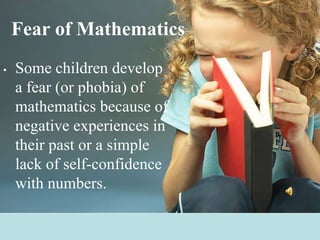
Fear of MathematicsSome children develop a fear (or phobia) of mathematics because of negative experiences in their past or a simple lack of self-confidence with numbers.
Quality of TeachingStudent  achievement  in  mathematics  is  strongly  linked  to  the  teacher’s  expertise  in  mathematics.
NEUROLOGICAL and OTHER CAUSES
The parietal lobe is heavily involved with number operations, damage to this area can result in difficulties.
Individuals with visual processing weaknesses and sequencing difficulties almost always display difficulties with mathematics.
Genetic factors also seem to play a role in causing mathematical disabilities.
MATHEMATICAL DISORDERS
General SymptomsInconsistent results with addition, subtraction, multiplication, and divisionInability to remember mathematical formulas, rules or conceptsDifficulty with abstract concepts of time and directionConsistent errors when recalling numbers including transpositions, omissions, and reversalsDifficulty remembering how to keep score during games
TYPES OF MATHEMATICAL DISORDERS
Number Concept DifficultiesMost children with mathematical disorders nevertheless have their basic number competencies intact.
Children with mathematical disorders have deficits in counting knowledge and counting accuracy. Counting Skill Deficits
Difficulties with Arithmetic SkillsChildren  with mathematical  disorders have  difficulties  in solving  simple  and complex  arithmetic problems.
Procedural Disorders~ use arithmetic procedures (algorithms) that are developmentally immature~ have problems sequencing the steps of multi-step procedures~ have difficulty understanding the concepts associated with procedures~ make frequent mistakes when using procedures
Memory DisordersHave difficulty retrieving arithmetic factsHave a high error rate when they do retrieve arithmetic factsRetrieve incorrect facts that are associated with the correct facts
Visual-Spatial DeficitsHave difficulties in the spatial arrangement of their work, such as aligning the columns in multicolumn additionOften misread numerical signs, rotate and transpose numbers, or bothMisinterpret spatial placement of numerals, resulting in place value errorsHave difficulty with problems involving space in areas, as required in algebra and geometry
What is the Future of Research in Mathematics Disorder?
By learning more about exactly how infants’ brains process arithmetic calculations, we can build on this foundation when exposing children to more complex mathematics.
Researchers need to determine which types of mathematical disorders are simply delays in development and which may represent more fundamental problems.
What genetic factors affect the neural networks and cognitive skills that support mathematical operations?
What types of mathematical disorders are related to reading disorders, and why?
The ultimate goal of research is to develop remedies to help individuals deal with their problems.
What do educators need to consider?
Determining the Source of the ProblemThe first task facing educators who deal with children with mathematics disorder is to determine the nature of the problem.
Prerequisite Skills1. Follow sequential directions.2. Recognize patterns.3. Estimate by forming a reasonable guess about quantity, size, magnitude, and amount.4. Visualize pictures in one’s mind and manipulate them.
5, Have a good sense of spatial orientation and space organization.6. Do deductive reasoning, that is, reason from a general principle to a particular instance, or from a stated premise to a logical conclusion.
7. Do inductive reasoning, that is, come to a natural understanding that is not the result of conscious attention or reasoning, easily detecting the patterns in different situations and the interrelationships between procedures and concepts.
Less is MoreStudents with special needs are likely to be more successful if taught fewer concepts in more time.Students with special needs should focus on mastering a few important ideas and learn to apply them accurately.
Use of ManipulativesStudents with special needs who use manipulatives in their mathematics classes outperform similar students who do not.
Search for PatternsMany children with learning disabilities – including those with mathematical disorders – can learn basic arithmetic concepts.
Build on Students’ StrengthsTeachers can often turn a student’s failure into success if they build on what the student already knows how to do.Most people learn mathematics best in the context of real-world problems.
Mathematics for Students Studying English as a second Language
Mathematics is one of the first subjects where ESL students are mainstreamed.
Although the language of mathematics is precise, it is not always translated accurately by ESL students.
Cultural differences also play a role, especially in the interpretation of story problems.
The algorithms that an ESL student uses to make calculations may be misinterpreted as a mathematics disorder.
STRATEGIES TO CONSIDERMathematical Disabilities
General Guidelines for Teaching Mathematics to Students with Special Needs
Help students develop conceptual understanding and skills.Consider giving more oral and fewer written tests.Develop meaningful (relevant) practice exercises.Maintain reasonable expectations.Build on children’s strengths.
Use manipulative appropriately.Help students make connections.Determine and build on a student’s informal learning strategies.Accommodate individual learning styles as much as practicable.Use technology appropriately.
Diagnostic Tools for Assessing Learning Difficulties in Mathematics
1. Level of Cognitive Awareness.2. Mathematics Learning Profile.Quantitative and Qualitative Learners3. Language of Mathematics4. Prerequisite Skills
5. Levels of Learning MasteryLevel One. Connect new knowledge to existing knowledge and experiences.Level Two. Searches for concrete material to construct a model or show a manifestation of the concept.Level Three. Illustrate the concept by drawing a diagram to  connect the concrete example to a symbolic picture or representation.
Level Four. Translates the concept into mathematical notation using number symbols, operational signs, formulas, and equations.Level Five. Applies the concept correctly to real world situations, projects, and story problems.Level Six. Can teach the concept successfully to others, or can communicate it on a test.
Mathematics for ESL Students with Learning Disabilities
Appraising abilities in Mathematics.Selecting the language of instruction.Moving from concrete experiences to abstract concepts.Using strategies for concept development.Using Mathematics to develop language.Using student’s strengths.
Fin.Presentation by:Candice Santiago

mathematical disabilities

  • 1.
    SPED 108Psychological andPhysical Approach
  • 2.
  • 3.
  • 4.
    Toddlers have asense of numbers and can already deal with limited arithmetic operations (e.g. Simple adding and subtracting)
  • 5.
    Some children werevery adept in mathematical calculations while others struggled despite much effort and motivation.
  • 6.
    The percentage ofschool-age children who experience difficulties in learning mathematics has been steadily growing in the last three decades.
  • 7.
    Is the brain’sability to perform arithmetic calculations declining? If so, why?
  • 8.
    Does the brainget less arithmetic practice because technology has shifted computation from brain cells to inexpensive electronic calculators?
  • 9.
    Brain scanning studieshave revealed clues about how the brain performs mathematical operations.
  • 10.
  • 11.
    About 6 percentof school-age children have some form of difficulty with processing mathematics.
  • 12.
    The condition thatcauses persistent problems with processing numerical calculations is often referred to as dyscalculia.
  • 14.
  • 15.
    Mathematics ability is regarded more as a specialized function rather than as a general indicator of intelligence.
  • 16.
    More than 90 percent of parents expect their children to go to college and almost 90 percent of kids want to go to college, fully half of those kids want to drop mathematics as soon as they can.
  • 17.
    Fear of MathematicsSomechildren develop a fear (or phobia) of mathematics because of negative experiences in their past or a simple lack of self-confidence with numbers.
  • 18.
    Quality of TeachingStudent achievement in mathematics is strongly linked to the teacher’s expertise in mathematics.
  • 19.
  • 20.
    The parietal lobeis heavily involved with number operations, damage to this area can result in difficulties.
  • 21.
    Individuals with visualprocessing weaknesses and sequencing difficulties almost always display difficulties with mathematics.
  • 22.
    Genetic factors alsoseem to play a role in causing mathematical disabilities.
  • 24.
  • 25.
    General SymptomsInconsistent resultswith addition, subtraction, multiplication, and divisionInability to remember mathematical formulas, rules or conceptsDifficulty with abstract concepts of time and directionConsistent errors when recalling numbers including transpositions, omissions, and reversalsDifficulty remembering how to keep score during games
  • 27.
  • 28.
    Number Concept DifficultiesMostchildren with mathematical disorders nevertheless have their basic number competencies intact.
  • 29.
    Children with mathematicaldisorders have deficits in counting knowledge and counting accuracy. Counting Skill Deficits
  • 30.
    Difficulties with ArithmeticSkillsChildren with mathematical disorders have difficulties in solving simple and complex arithmetic problems.
  • 31.
    Procedural Disorders~ usearithmetic procedures (algorithms) that are developmentally immature~ have problems sequencing the steps of multi-step procedures~ have difficulty understanding the concepts associated with procedures~ make frequent mistakes when using procedures
  • 32.
    Memory DisordersHave difficultyretrieving arithmetic factsHave a high error rate when they do retrieve arithmetic factsRetrieve incorrect facts that are associated with the correct facts
  • 33.
    Visual-Spatial DeficitsHave difficultiesin the spatial arrangement of their work, such as aligning the columns in multicolumn additionOften misread numerical signs, rotate and transpose numbers, or bothMisinterpret spatial placement of numerals, resulting in place value errorsHave difficulty with problems involving space in areas, as required in algebra and geometry
  • 34.
    What is theFuture of Research in Mathematics Disorder?
  • 35.
    By learning moreabout exactly how infants’ brains process arithmetic calculations, we can build on this foundation when exposing children to more complex mathematics.
  • 36.
    Researchers need todetermine which types of mathematical disorders are simply delays in development and which may represent more fundamental problems.
  • 37.
    What genetic factorsaffect the neural networks and cognitive skills that support mathematical operations?
  • 38.
    What types ofmathematical disorders are related to reading disorders, and why?
  • 39.
    The ultimate goalof research is to develop remedies to help individuals deal with their problems.
  • 40.
    What do educatorsneed to consider?
  • 41.
    Determining the Sourceof the ProblemThe first task facing educators who deal with children with mathematics disorder is to determine the nature of the problem.
  • 42.
    Prerequisite Skills1. Followsequential directions.2. Recognize patterns.3. Estimate by forming a reasonable guess about quantity, size, magnitude, and amount.4. Visualize pictures in one’s mind and manipulate them.
  • 43.
    5, Have agood sense of spatial orientation and space organization.6. Do deductive reasoning, that is, reason from a general principle to a particular instance, or from a stated premise to a logical conclusion.
  • 44.
    7. Do inductivereasoning, that is, come to a natural understanding that is not the result of conscious attention or reasoning, easily detecting the patterns in different situations and the interrelationships between procedures and concepts.
  • 45.
    Less is MoreStudentswith special needs are likely to be more successful if taught fewer concepts in more time.Students with special needs should focus on mastering a few important ideas and learn to apply them accurately.
  • 46.
    Use of ManipulativesStudentswith special needs who use manipulatives in their mathematics classes outperform similar students who do not.
  • 47.
    Search for PatternsManychildren with learning disabilities – including those with mathematical disorders – can learn basic arithmetic concepts.
  • 48.
    Build on Students’StrengthsTeachers can often turn a student’s failure into success if they build on what the student already knows how to do.Most people learn mathematics best in the context of real-world problems.
  • 49.
    Mathematics for StudentsStudying English as a second Language
  • 50.
    Mathematics is oneof the first subjects where ESL students are mainstreamed.
  • 51.
    Although the languageof mathematics is precise, it is not always translated accurately by ESL students.
  • 52.
    Cultural differences alsoplay a role, especially in the interpretation of story problems.
  • 53.
    The algorithms thatan ESL student uses to make calculations may be misinterpreted as a mathematics disorder.
  • 54.
  • 55.
    General Guidelines forTeaching Mathematics to Students with Special Needs
  • 56.
    Help students developconceptual understanding and skills.Consider giving more oral and fewer written tests.Develop meaningful (relevant) practice exercises.Maintain reasonable expectations.Build on children’s strengths.
  • 57.
    Use manipulative appropriately.Helpstudents make connections.Determine and build on a student’s informal learning strategies.Accommodate individual learning styles as much as practicable.Use technology appropriately.
  • 58.
    Diagnostic Tools forAssessing Learning Difficulties in Mathematics
  • 59.
    1. Level ofCognitive Awareness.2. Mathematics Learning Profile.Quantitative and Qualitative Learners3. Language of Mathematics4. Prerequisite Skills
  • 60.
    5. Levels ofLearning MasteryLevel One. Connect new knowledge to existing knowledge and experiences.Level Two. Searches for concrete material to construct a model or show a manifestation of the concept.Level Three. Illustrate the concept by drawing a diagram to connect the concrete example to a symbolic picture or representation.
  • 61.
    Level Four. Translatesthe concept into mathematical notation using number symbols, operational signs, formulas, and equations.Level Five. Applies the concept correctly to real world situations, projects, and story problems.Level Six. Can teach the concept successfully to others, or can communicate it on a test.
  • 62.
    Mathematics for ESLStudents with Learning Disabilities
  • 63.
    Appraising abilities inMathematics.Selecting the language of instruction.Moving from concrete experiences to abstract concepts.Using strategies for concept development.Using Mathematics to develop language.Using student’s strengths.
  • 64.