INTRODUCTION TO
TEACHING MATH
TO ADULT
STUDENTS
In Adult Basic Education &
High School Equivalency Programs
Presented by:
Rachel Gamarra
Arlington Reads
Arlington Public Library
Why Teach Math to Adults?
“…numeracy is the
one skill revealed to
be highly associated
with employability.”
-Myrna Manly
THE ADULT STUDENT
• The adult student is ALWAYS in charge of their learning.
• The student decides:
• Their level of participation.
• Whether or not they will cooperate.
• How to make the class work for them.
• Whether or not they will continue studying.
Principle of androgogy: Learners are self-directed &
autonomous.
THE ADULT STUDENT
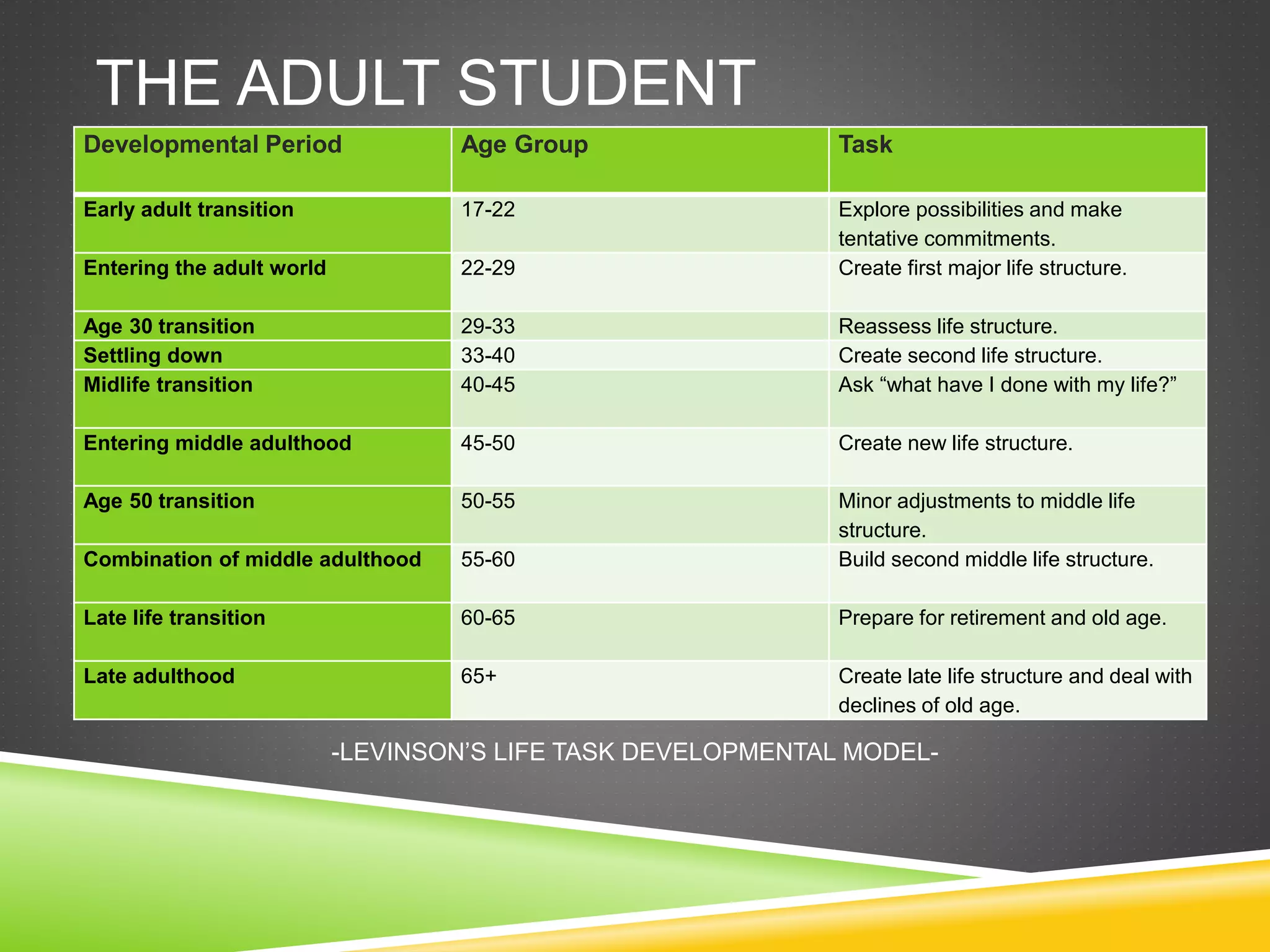
Developmental Period Age Group Task
Early adult transition 17-22 Explore possibilities and make
tentative commitments.
Entering the adult world 22-29 Create first major life structure.
Age 30 transition 29-33 Reassess life structure.
Settling down 33-40 Create second life structure.
Midlife transition 40-45 Ask “what have I done with my life?”
Entering middle adulthood 45-50 Create new life structure.
Age 50 transition 50-55 Minor adjustments to middle life
structure.
Combination of middle adulthood 55-60 Build second middle life structure.
Late life transition 60-65 Prepare for retirement and old age.
Late adulthood 65+ Create late life structure and deal with
declines of old age.
-LEVINSON’S LIFE TASK DEVELOPMENTAL MODEL-
INSTRUCTOR TIP #1
1) Acknowledge that the adult student is responsible for
their own learning. They are free to participate or not
participate at will.
2) Do not involve yourself in a power struggle with the
student. It is a no-win situation for you and your
students.
3) Foster an atmosphere of group cooperation in order
to build allies to help you manage the challenges of a
difficult student.
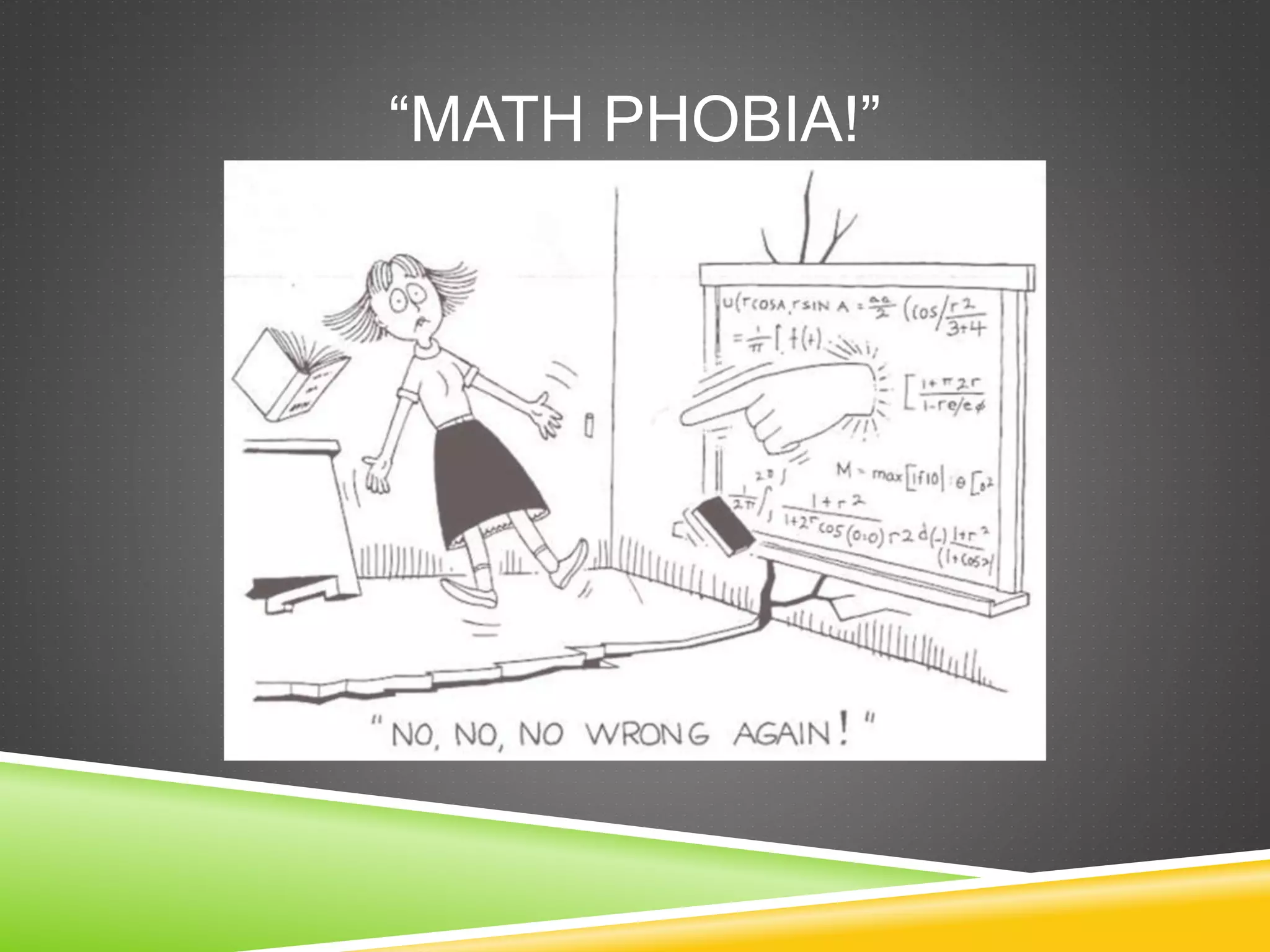
“MATH PHOBIA!”
COMMON “MATH PHOBIC” BELIEFS
• Math is mainly arithmetic!
• Math is a lot of memorization!
• You must follow the procedures set down by the
teacher or textbook only!
• Every problem has only one answer!
• You have to be a genius to do math!
• I hate math!
Source: http://literacy.kent.edu/Oasis/Resc/Educ/comcon.html
REASONS FOR “MATH PHOBIA” IN
ADULTS
• Traditional schooling has taught the adult to be a
dependent learner.
• Previous failure in math courses.
• Negative messages from family members and
teachers.
• The conditioned belief that they are “not a math
person.”
• Inadequate tools and experiences to help manage
frustrations associated with challenging math
concepts.
Principle of androgogy: Self-concept of the learner.
INSTRUCTOR TIP #2
How to mitigate “Math Phobia”:
1) Emphasize sense-making by demystifying
mathematical processes and procedures.
2) Promote collaborative work with peers so students
can discuss & experiment with alternative strategies.
3) Be accepting of mistakes and discuss them openly!
4) Coach students to become flexible problem solvers.
5) Ask students to explain why they are doing what they
are doing to another student or instructor.
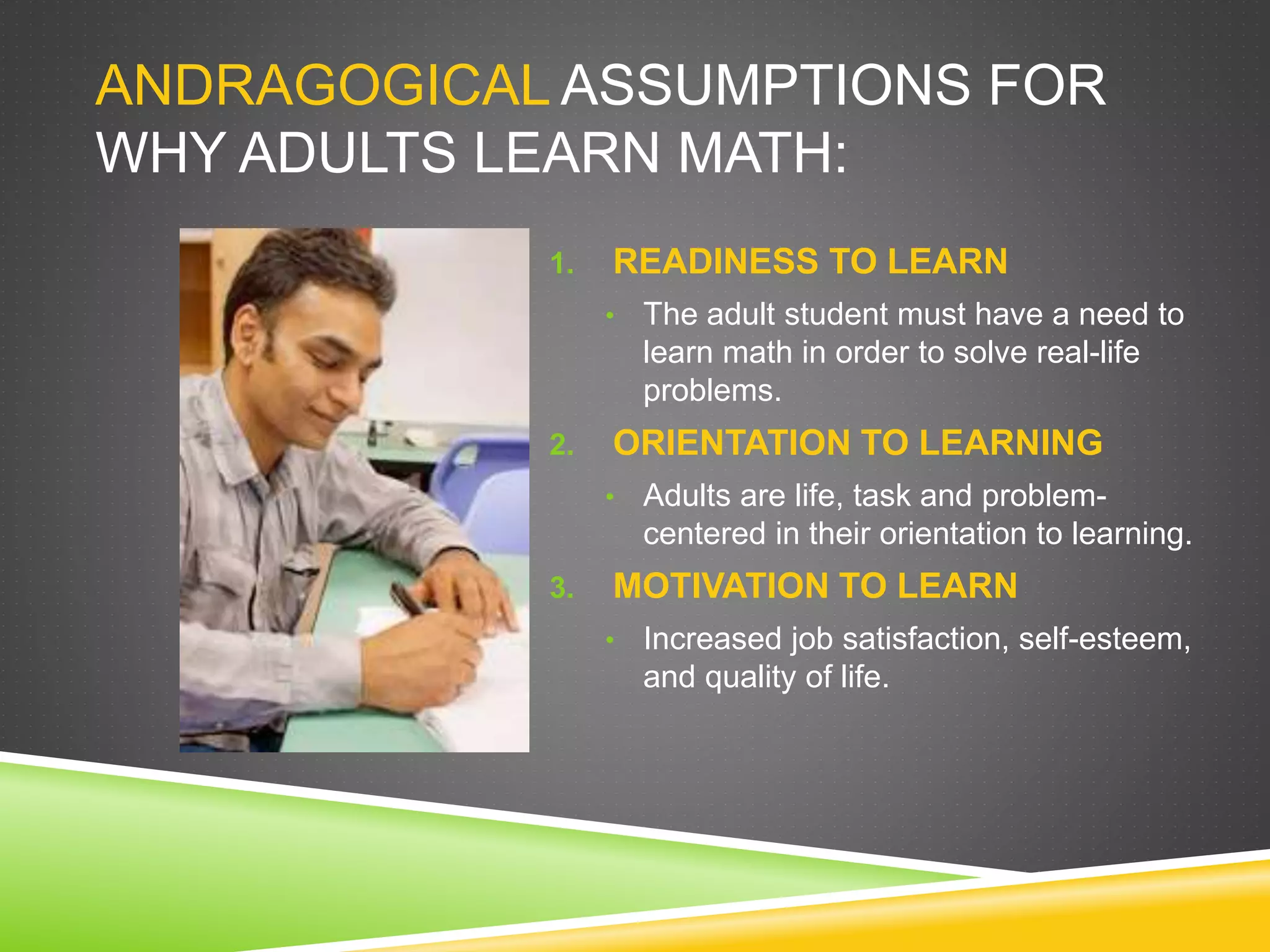
ANDRAGOGICAL ASSUMPTIONS FOR
WHY ADULTS LEARN MATH:
1. READINESS TO LEARN
• The adult student must have a need to
learn math in order to solve real-life
problems.
2. ORIENTATION TO LEARNING
• Adults are life, task and problem-
centered in their orientation to learning.
3. MOTIVATION TO LEARN
• Increased job satisfaction, self-esteem,
and quality of life.
REASONS FOR LEARNING MATH
• Family or Personal: as a parent, household manager,
consumer, financial and health-care decision maker, and
hobbyist.
• Workplace: as a worker able to perform tasks on the job
and to be prepared to adapt to new employment demands.
• Further Learning: as one interested in the more formal
aspects of mathematics necessary for further education or
training.
• Community: as a citizen making interpretations of social
situations with mathematical aspects such as the
environment, crime and politics.
Source: National Center for the Study of Adult Learning and Literacy (NCSALL)
INSTRUCTOR TIP #3
1) Use real-life examples or situations the adult student
may encounter at home or work:
• Example: Replacing a refrigerator in a small kitchen.
• Skills needed: conceptual understanding of measurement,
percentages, fractions, and volume in addition to reasoning,
formulation of mathematical problems, estimation, the
willingness to perform the task with math.
• Reasons: Measuring space, determining fit, comparison
shopping for sales & discounts, finding the best financing
options, finding the best refrigerator at the best value, to be
able to evaluate and find solutions to the problem.
Source: National Center for the Study of Adult Learning and Literacy (NCSALL)
INSTRUCTOR TIP #3 (CONT.)
2) Develop mathematical vocabulary from meaningful
use instead of from worksheets or vocabulary lists.
3) Help adults to make connections to what they already
know and what they need to know (schema building).
4) Invite students to participate in the decision making
process.
• Example: discussing , choosing, and testing the mathematical
strategies they think will work.
5) Use activities that build self-esteem, self-confidence
and a sense of accomplishment.
TRY THIS! A CLASSROOM
ACTIVITY:
Opening Quiz:
• Before regular instruction
begins.
• 3-10 math problems (harder
content has fewer questions
than easier content).
• Timed activity (5-10
minutes).
• Multiple choice.
• Individual work.
• Students must show work (if
calculator is used, they must
show the steps).
Purpose:
• The instructor is able to test for
prior knowledge.
• The instructor can evaluate
student mastery of content
covered in the previous day’s
class.
• The instructor can see the
student’s thought process.
• Students can see what they are
doing right or where they begin
to make mistakes.
• The class can discuss and
review common mistakes
together.
• Students are prepared for
standardized tests.
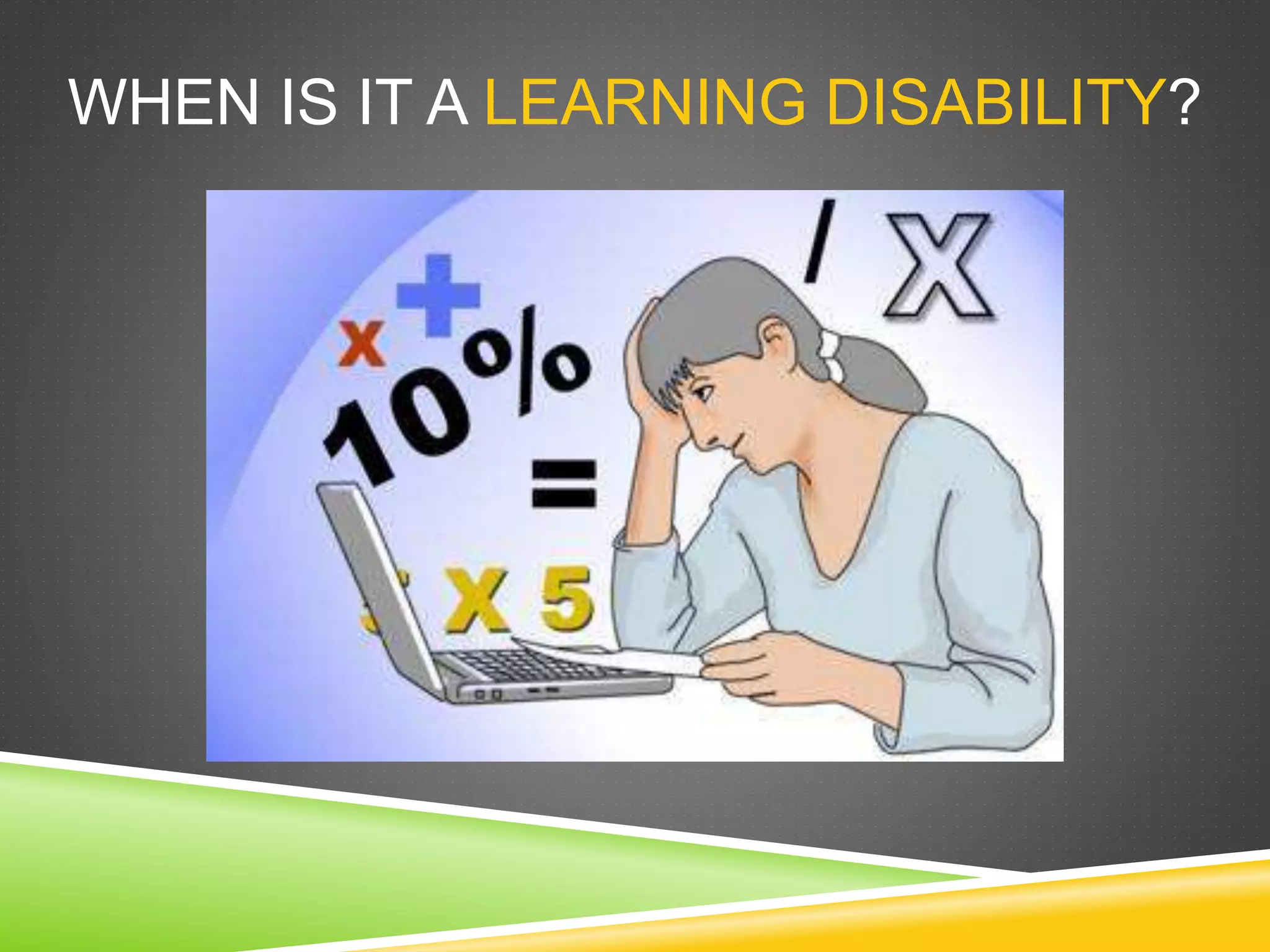
WHEN IS IT A LEARNING DISABILITY?
LEARNING DISABILITIES
Learning disabilities usually fall within four broad categories:
• Spoken language-listening and speaking
• Written language-reading, writing, and spelling
• Arithmetic-calculation and concepts
• Reasoning-organization and integration of ideas and thoughts
Learning disabilities may also be present along with other
disabilities, such as mobility or sensory impairments. Often people
with Attention-Deficit Disorder (ADD) or Attention-
Deficit/Hyperactivity Disorder (ADHD) also have learning disabilities.
Source: DO-IT, University of Washington.
DYSCALCULIA
A person with Dyscalculia has difficulty understanding and using
math concepts and symbols. Signs of dyscalculia may include:
• Mistakes such as number additions, substitutions,
transpositions, omissions, and reversals in writing,
reading, and recalling numbers.
• Difficulty with abstract concepts of time and
direction.
• Inconsistent results in addition, subtraction,
multiplication, and division.
• Difficulty remembering math facts, concepts, rules,
formulas, sequences, and procedures.
Source: DO-IT, University of Washington.
DYSCALCULIA (CONT.)
Signs of dyscalculia may include:
• Inconsistent mastery of math facts.
• Difficulty with left and right orientation.
• Difficulty following sequential procedures and
directions in math steps.
• Slowness in understanding math concepts in word
problems.
• Confusing operations signs or performing them in
wrong order.
Source: DO-IT, University of Washington.
FINDING ASSISTANCE FOR LEARNING
DISABLED ADULTS…
• The Learning Center of North Texas (TCAELC) provides
Assessment Services for adults who may need formal
accommodations on standardized testing.
• Teachers or administrators who notice that a student is struggling
should call the Adult Services Division of TCAELC to arrange a
screening interview.
• VISIT: www.tlcnt.org for more information on assessment services
and resources through TCAELC.
• VISIT: http://www.gedtestingservice.com/testers/computer-
accommodations for more information on available G.E.D. testing
accommodations for qualified individuals.
Source: TCAELC.
HELPFUL RESOURCES FOR
INSTRUCTORS:
National Center for the Study of Adult Literacy
• http://www.ncsall.net/index.php@id=14.html
The Alliance for Students with Disabilities in Science, Technology,
Engineering, and Mathematics
• http://www.washington.edu/doit/Stem/articles?251
The Learning Center of North Texas
• http://www.tlcnt.org/
National Center for Learning Disabilities
• http://www.ncld.org/
Adult Numeracy Network
• http://adultnumeracynetwork.org/links.html
OTHER SOURCES CITED:
Manly, Myrna, and Lynda Ginsburg. "NCSALL: Focus on Basics."
Editorial. NCSALL: Focus on Basics. National Center for the Study
of Adult Basic Education, May 2008. Web. 19 Dec. 2014.
<http://www.ncsall.net/index.html@id=31.html>.
Smith, Carter. "How Do Adults Learn." How Do Adults Learn.
Slideshare, 17 Jan. 2008. Web. 19 Dec. 2014.
<http://www.slideshare.net/carterfsmith/how-do-adults-learn>.

Arlington Reads-Teaching Math to Adults

  • 1.
    INTRODUCTION TO TEACHING MATH TOADULT STUDENTS In Adult Basic Education & High School Equivalency Programs Presented by: Rachel Gamarra Arlington Reads Arlington Public Library
  • 2.
    Why Teach Mathto Adults? “…numeracy is the one skill revealed to be highly associated with employability.” -Myrna Manly
  • 3.
    THE ADULT STUDENT •The adult student is ALWAYS in charge of their learning. • The student decides: • Their level of participation. • Whether or not they will cooperate. • How to make the class work for them. • Whether or not they will continue studying. Principle of androgogy: Learners are self-directed & autonomous.
  • 4.
    THE ADULT STUDENT DevelopmentalPeriod Age Group Task Early adult transition 17-22 Explore possibilities and make tentative commitments. Entering the adult world 22-29 Create first major life structure. Age 30 transition 29-33 Reassess life structure. Settling down 33-40 Create second life structure. Midlife transition 40-45 Ask “what have I done with my life?” Entering middle adulthood 45-50 Create new life structure. Age 50 transition 50-55 Minor adjustments to middle life structure. Combination of middle adulthood 55-60 Build second middle life structure. Late life transition 60-65 Prepare for retirement and old age. Late adulthood 65+ Create late life structure and deal with declines of old age. -LEVINSON’S LIFE TASK DEVELOPMENTAL MODEL-
  • 5.
    INSTRUCTOR TIP #1 1)Acknowledge that the adult student is responsible for their own learning. They are free to participate or not participate at will. 2) Do not involve yourself in a power struggle with the student. It is a no-win situation for you and your students. 3) Foster an atmosphere of group cooperation in order to build allies to help you manage the challenges of a difficult student.
  • 6.
  • 7.
    COMMON “MATH PHOBIC”BELIEFS • Math is mainly arithmetic! • Math is a lot of memorization! • You must follow the procedures set down by the teacher or textbook only! • Every problem has only one answer! • You have to be a genius to do math! • I hate math! Source: http://literacy.kent.edu/Oasis/Resc/Educ/comcon.html
  • 8.
    REASONS FOR “MATHPHOBIA” IN ADULTS • Traditional schooling has taught the adult to be a dependent learner. • Previous failure in math courses. • Negative messages from family members and teachers. • The conditioned belief that they are “not a math person.” • Inadequate tools and experiences to help manage frustrations associated with challenging math concepts. Principle of androgogy: Self-concept of the learner.
  • 9.
    INSTRUCTOR TIP #2 Howto mitigate “Math Phobia”: 1) Emphasize sense-making by demystifying mathematical processes and procedures. 2) Promote collaborative work with peers so students can discuss & experiment with alternative strategies. 3) Be accepting of mistakes and discuss them openly! 4) Coach students to become flexible problem solvers. 5) Ask students to explain why they are doing what they are doing to another student or instructor.
  • 10.
    ANDRAGOGICAL ASSUMPTIONS FOR WHYADULTS LEARN MATH: 1. READINESS TO LEARN • The adult student must have a need to learn math in order to solve real-life problems. 2. ORIENTATION TO LEARNING • Adults are life, task and problem- centered in their orientation to learning. 3. MOTIVATION TO LEARN • Increased job satisfaction, self-esteem, and quality of life.
  • 11.
    REASONS FOR LEARNINGMATH • Family or Personal: as a parent, household manager, consumer, financial and health-care decision maker, and hobbyist. • Workplace: as a worker able to perform tasks on the job and to be prepared to adapt to new employment demands. • Further Learning: as one interested in the more formal aspects of mathematics necessary for further education or training. • Community: as a citizen making interpretations of social situations with mathematical aspects such as the environment, crime and politics. Source: National Center for the Study of Adult Learning and Literacy (NCSALL)
  • 12.
    INSTRUCTOR TIP #3 1)Use real-life examples or situations the adult student may encounter at home or work: • Example: Replacing a refrigerator in a small kitchen. • Skills needed: conceptual understanding of measurement, percentages, fractions, and volume in addition to reasoning, formulation of mathematical problems, estimation, the willingness to perform the task with math. • Reasons: Measuring space, determining fit, comparison shopping for sales & discounts, finding the best financing options, finding the best refrigerator at the best value, to be able to evaluate and find solutions to the problem. Source: National Center for the Study of Adult Learning and Literacy (NCSALL)
  • 13.
    INSTRUCTOR TIP #3(CONT.) 2) Develop mathematical vocabulary from meaningful use instead of from worksheets or vocabulary lists. 3) Help adults to make connections to what they already know and what they need to know (schema building). 4) Invite students to participate in the decision making process. • Example: discussing , choosing, and testing the mathematical strategies they think will work. 5) Use activities that build self-esteem, self-confidence and a sense of accomplishment.
  • 14.
    TRY THIS! ACLASSROOM ACTIVITY: Opening Quiz: • Before regular instruction begins. • 3-10 math problems (harder content has fewer questions than easier content). • Timed activity (5-10 minutes). • Multiple choice. • Individual work. • Students must show work (if calculator is used, they must show the steps). Purpose: • The instructor is able to test for prior knowledge. • The instructor can evaluate student mastery of content covered in the previous day’s class. • The instructor can see the student’s thought process. • Students can see what they are doing right or where they begin to make mistakes. • The class can discuss and review common mistakes together. • Students are prepared for standardized tests.
  • 15.
    WHEN IS ITA LEARNING DISABILITY?
  • 16.
    LEARNING DISABILITIES Learning disabilitiesusually fall within four broad categories: • Spoken language-listening and speaking • Written language-reading, writing, and spelling • Arithmetic-calculation and concepts • Reasoning-organization and integration of ideas and thoughts Learning disabilities may also be present along with other disabilities, such as mobility or sensory impairments. Often people with Attention-Deficit Disorder (ADD) or Attention- Deficit/Hyperactivity Disorder (ADHD) also have learning disabilities. Source: DO-IT, University of Washington.
  • 17.
    DYSCALCULIA A person withDyscalculia has difficulty understanding and using math concepts and symbols. Signs of dyscalculia may include: • Mistakes such as number additions, substitutions, transpositions, omissions, and reversals in writing, reading, and recalling numbers. • Difficulty with abstract concepts of time and direction. • Inconsistent results in addition, subtraction, multiplication, and division. • Difficulty remembering math facts, concepts, rules, formulas, sequences, and procedures. Source: DO-IT, University of Washington.
  • 18.
    DYSCALCULIA (CONT.) Signs ofdyscalculia may include: • Inconsistent mastery of math facts. • Difficulty with left and right orientation. • Difficulty following sequential procedures and directions in math steps. • Slowness in understanding math concepts in word problems. • Confusing operations signs or performing them in wrong order. Source: DO-IT, University of Washington.
  • 19.
    FINDING ASSISTANCE FORLEARNING DISABLED ADULTS… • The Learning Center of North Texas (TCAELC) provides Assessment Services for adults who may need formal accommodations on standardized testing. • Teachers or administrators who notice that a student is struggling should call the Adult Services Division of TCAELC to arrange a screening interview. • VISIT: www.tlcnt.org for more information on assessment services and resources through TCAELC. • VISIT: http://www.gedtestingservice.com/testers/computer- accommodations for more information on available G.E.D. testing accommodations for qualified individuals. Source: TCAELC.
  • 20.
    HELPFUL RESOURCES FOR INSTRUCTORS: NationalCenter for the Study of Adult Literacy • http://www.ncsall.net/index.php@id=14.html The Alliance for Students with Disabilities in Science, Technology, Engineering, and Mathematics • http://www.washington.edu/doit/Stem/articles?251 The Learning Center of North Texas • http://www.tlcnt.org/ National Center for Learning Disabilities • http://www.ncld.org/ Adult Numeracy Network • http://adultnumeracynetwork.org/links.html
  • 21.
    OTHER SOURCES CITED: Manly,Myrna, and Lynda Ginsburg. "NCSALL: Focus on Basics." Editorial. NCSALL: Focus on Basics. National Center for the Study of Adult Basic Education, May 2008. Web. 19 Dec. 2014. <http://www.ncsall.net/index.html@id=31.html>. Smith, Carter. "How Do Adults Learn." How Do Adults Learn. Slideshare, 17 Jan. 2008. Web. 19 Dec. 2014. <http://www.slideshare.net/carterfsmith/how-do-adults-learn>.

Editor's Notes

  • #7 Picture source: http://www.mcny.edu/student_serv/lecblog/math-phobia
  • #8 http://literacy.kent.edu/Oasis/Resc/Educ/comcon.html