Learning Disabilities vs. Mathematics
Cody Reese
SPE-339
Dr. Das
What’s on the Agenda!
• Identify what a learning disability (LD) is.
• Identify the common types of LD’s.
• Identify the different difficulties in math.
• Examine reasons why students with an LD have difficulties in math.
• Explore practices/strategies to teach mathematics to students with LD’s.
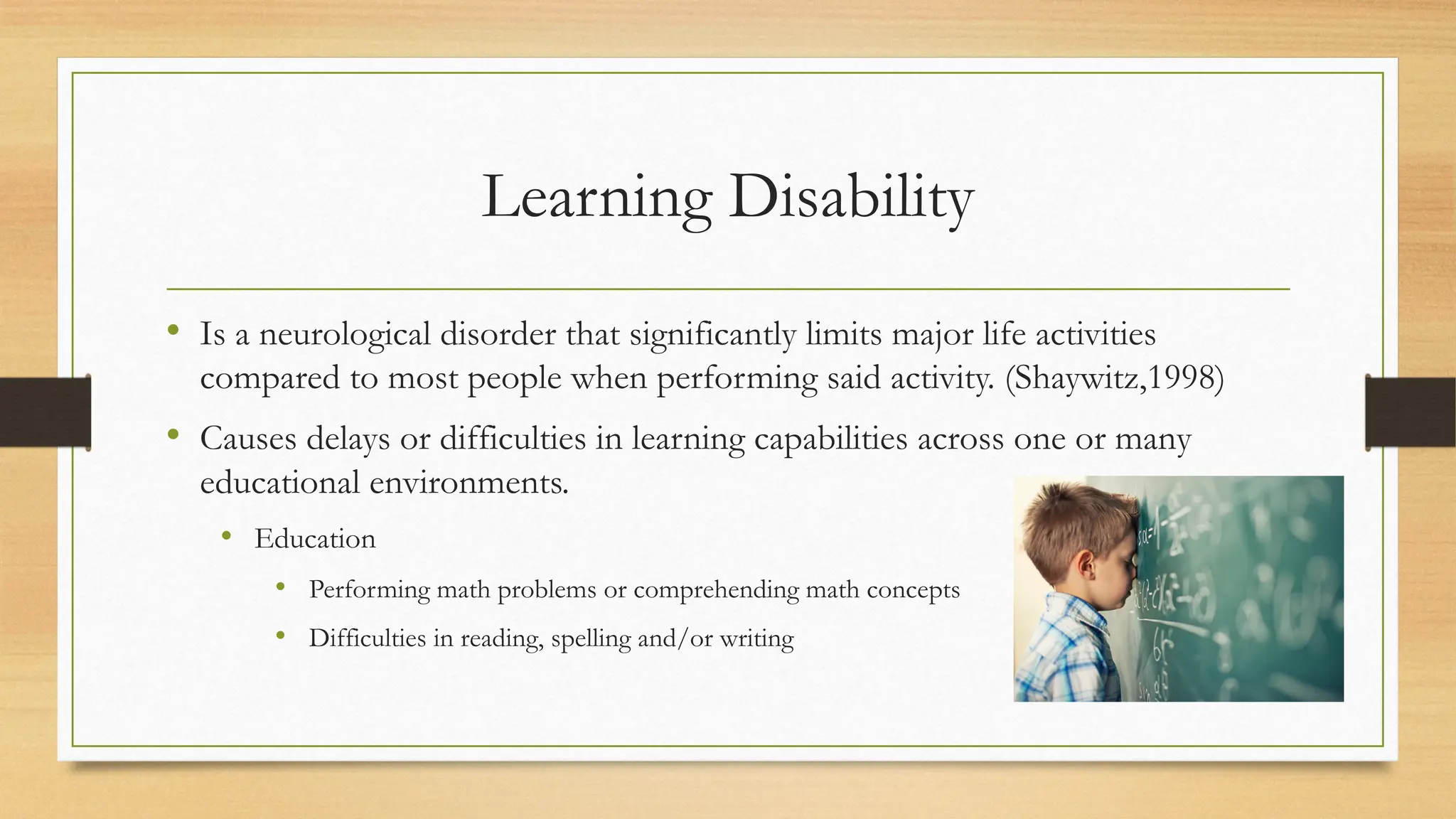
Learning Disability
• Is a neurological disorder that significantly limits major life activities
compared to most people when performing said activity. (Shaywitz,1998)
• Causes delays or difficulties in learning capabilities across one or many
educational environments.
• Education
• Performing math problems or comprehending math concepts
• Difficulties in reading, spelling and/or writing
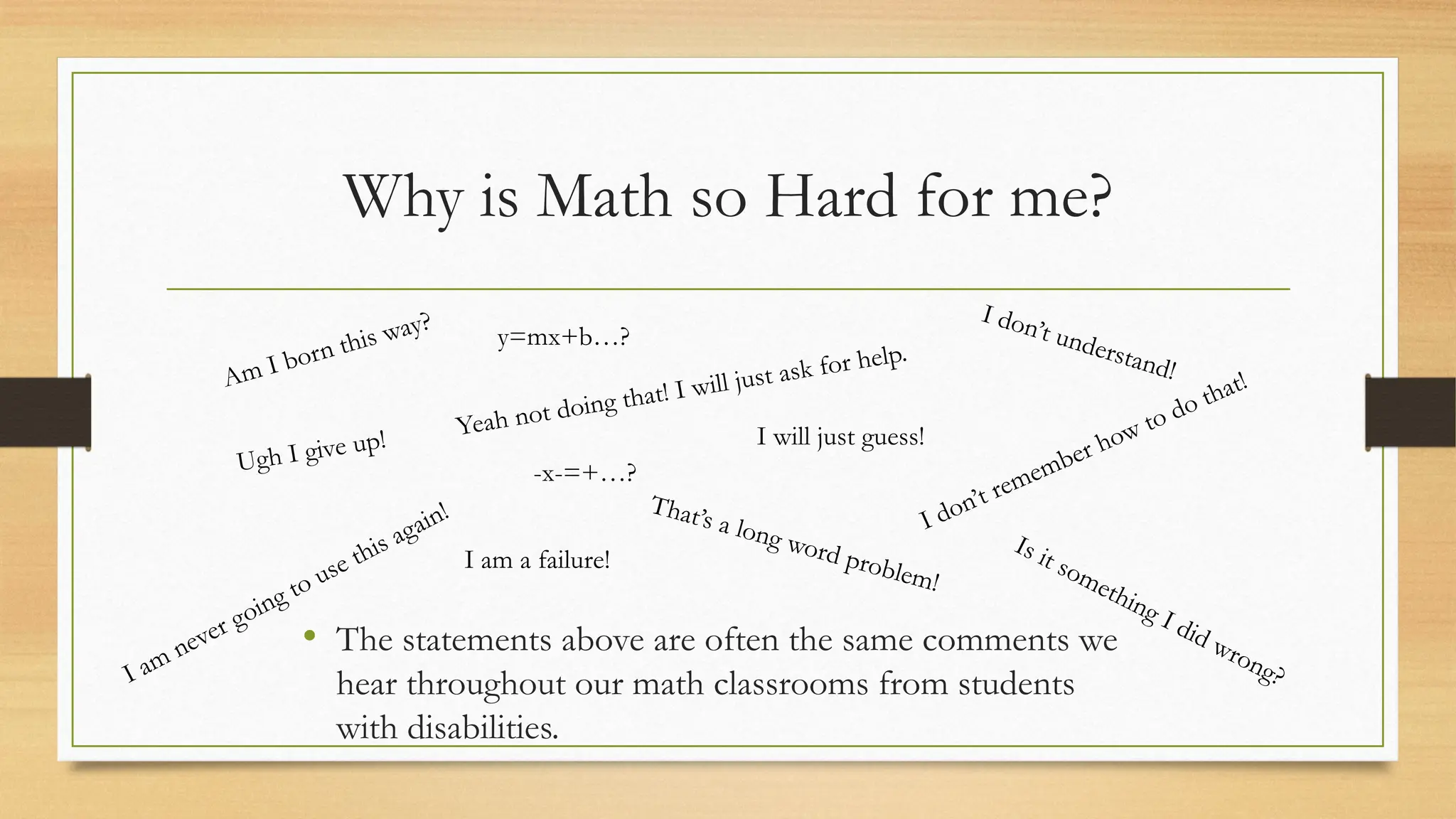
Why is Math so Hard for me?
Am I born this way?
Is it something I did wrong?
I don’t understand!
Yeah not doing that! I will just ask for help.
I don’t remember how to do that!
Ugh I give up!
y=mx+b…?
-x-=+…?
I am never going to use this again!
• The statements above are often the same comments we
hear throughout our math classrooms from students
with disabilities.
I will just guess!
That’s a long word problem!
I am a failure!
Common Types of Learning Disabilities
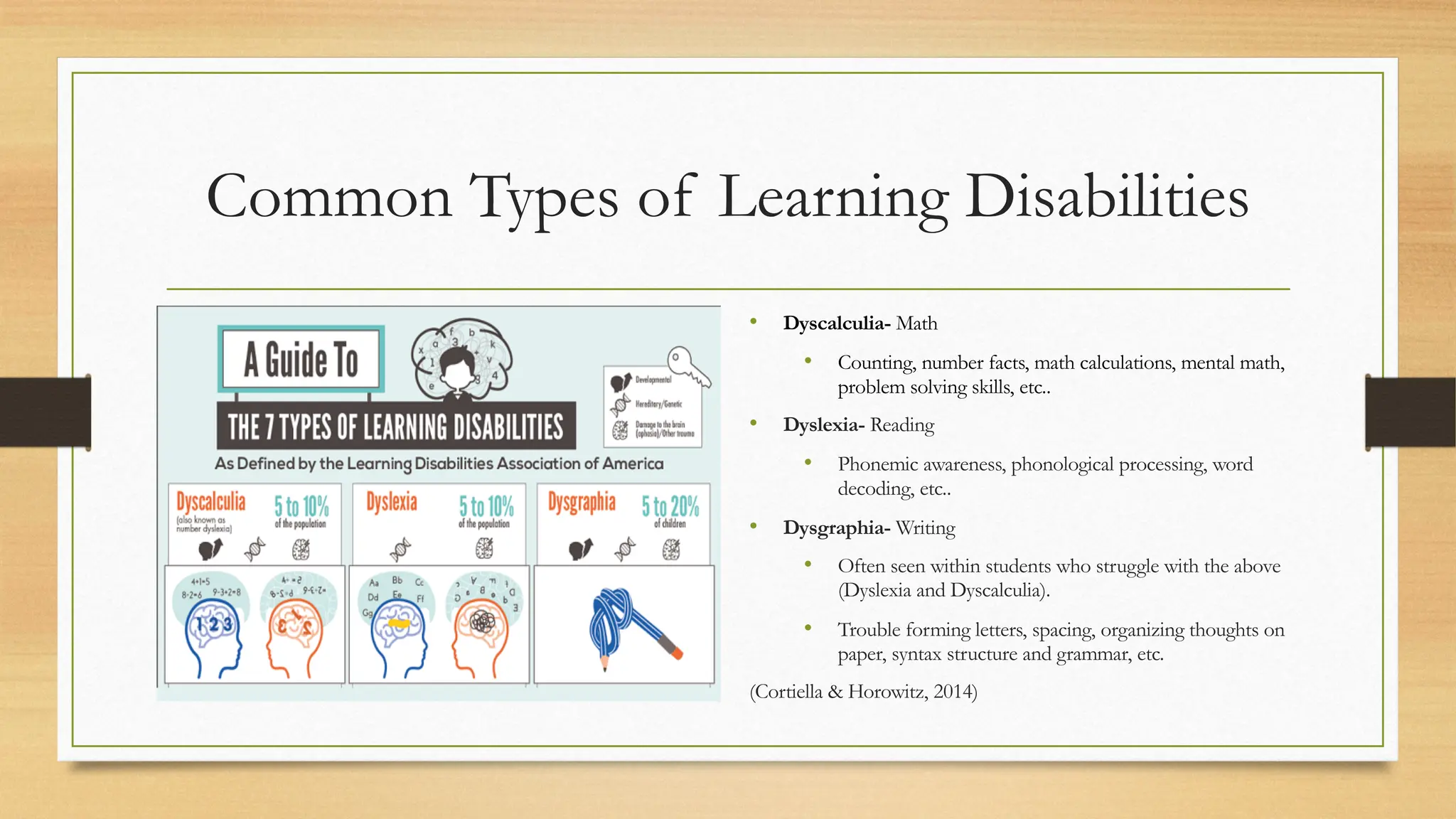
• Dyscalculia- Math
• Counting, number facts, math calculations, mental math,
problem solving skills, etc..
• Dyslexia- Reading
• Phonemic awareness, phonological processing, word
decoding, etc..
• Dysgraphia- Writing
• Often seen within students who struggle with the above
(Dyslexia and Dyscalculia).
• Trouble forming letters, spacing, organizing thoughts on
paper, syntax structure and grammar, etc.
(Cortiella & Horowitz, 2014)
Why do Students with LD’s Struggle in Math?
• General categories that students have
difficulties in math. (Cortiella & Horowitz, 2014)
• Hereditary- Genetic pass down
• Developmental/Learned- improper
instruction or reinforced behaviors toward
math
• Brain Damage/other traumas
• Sub categories of learning characteristics:
(Witzel & Little, 2016, p. 7)
• Cognitive and metacognitive deficits
• Processing deficits
• Memory and attention difficulties
• Math anxiety
• Learned helplessness
• Passivity
• Low level of achievement
LD struggles in Math (Cont.)
• The reasoning our LD students struggle in
math does not solely come from clinical
labels.
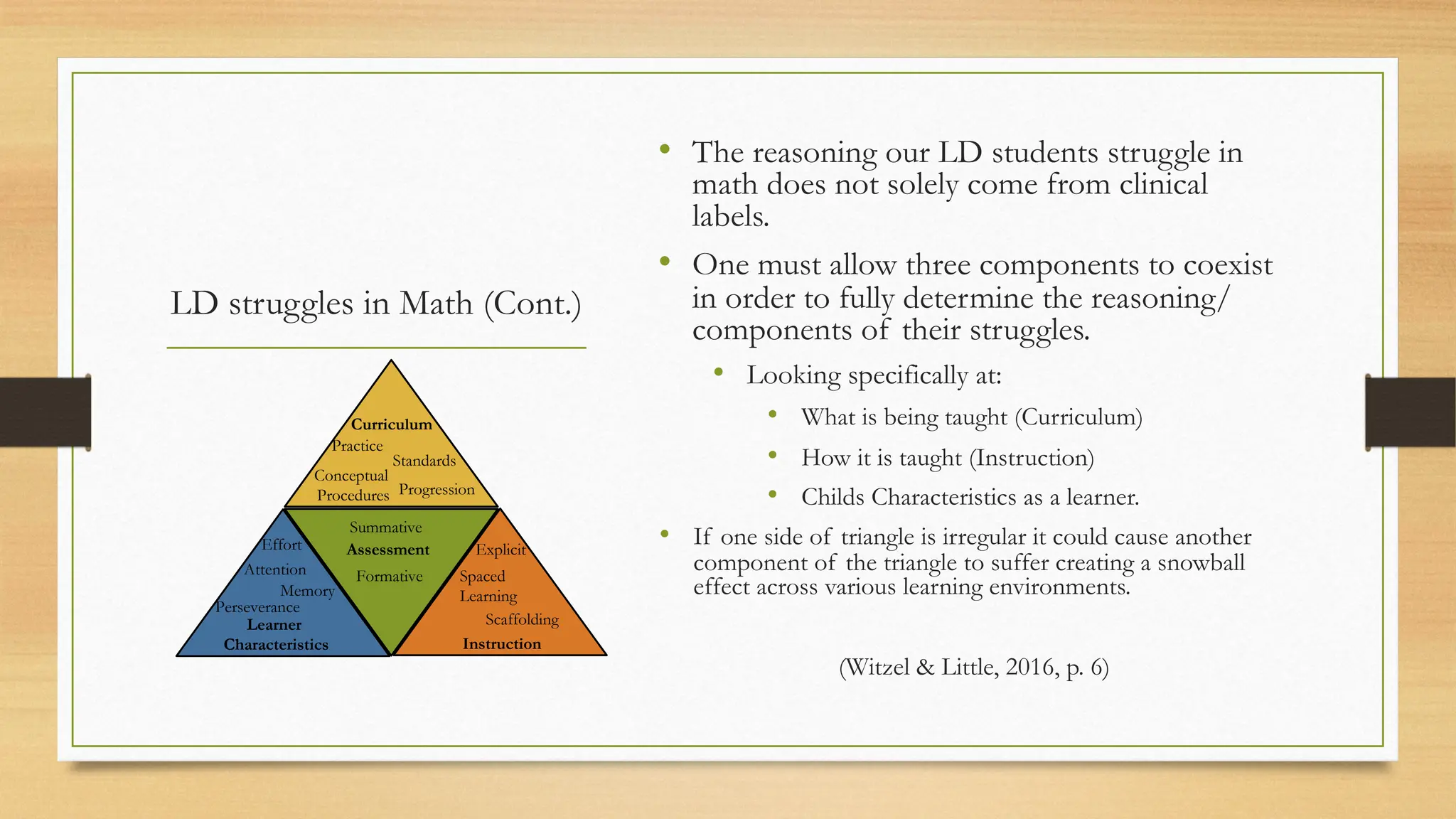
• One must allow three components to coexist
in order to fully determine the reasoning/
components of their struggles.
• Looking specifically at:
• What is being taught (Curriculum)
• How it is taught (Instruction)
• Childs Characteristics as a learner.
• If one side of triangle is irregular it could cause another
component of the triangle to suffer creating a snowball
effect across various learning environments.
(Witzel & Little, 2016, p. 6)
Curriculum
Learner
Characteristics Instruction
Assessment
Effort
Memory
Attention
Scaffolding
Explicit
Spaced
Learning
Standards
Progression
Practice
Conceptual
Procedures
Perseverance
Summative
Formative
What works best?
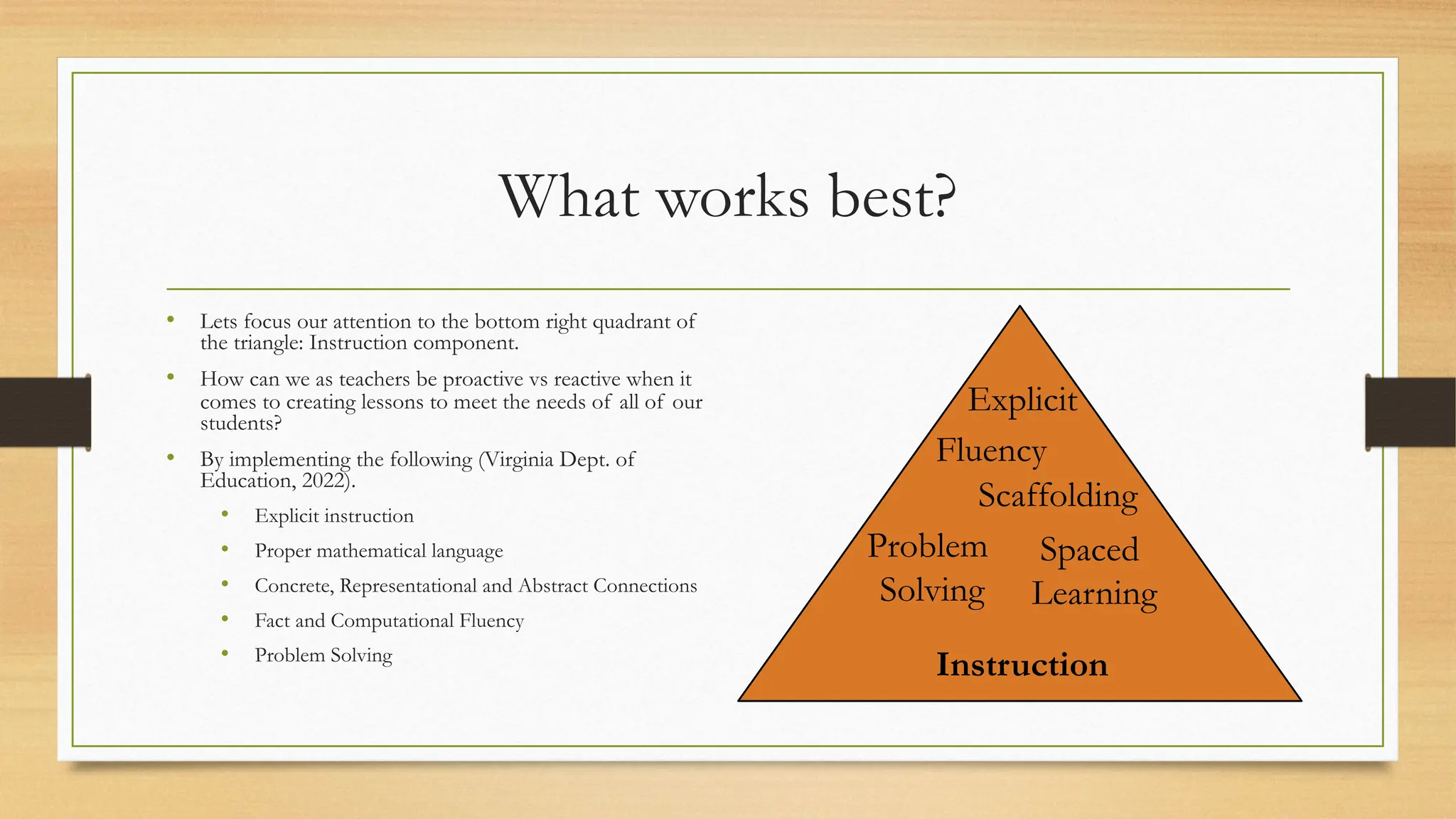
• Lets focus our attention to the bottom right quadrant of
the triangle: Instruction component.
• How can we as teachers be proactive vs reactive when it
comes to creating lessons to meet the needs of all of our
students?
• By implementing the following (Virginia Dept. of
Education, 2022).
• Explicit instruction
• Proper mathematical language
• Concrete, Representational and Abstract Connections
• Fact and Computational Fluency
• Problem Solving
Explicit
Spaced
Learning
Scaffolding
Instruction
Problem
Solving
Fluency
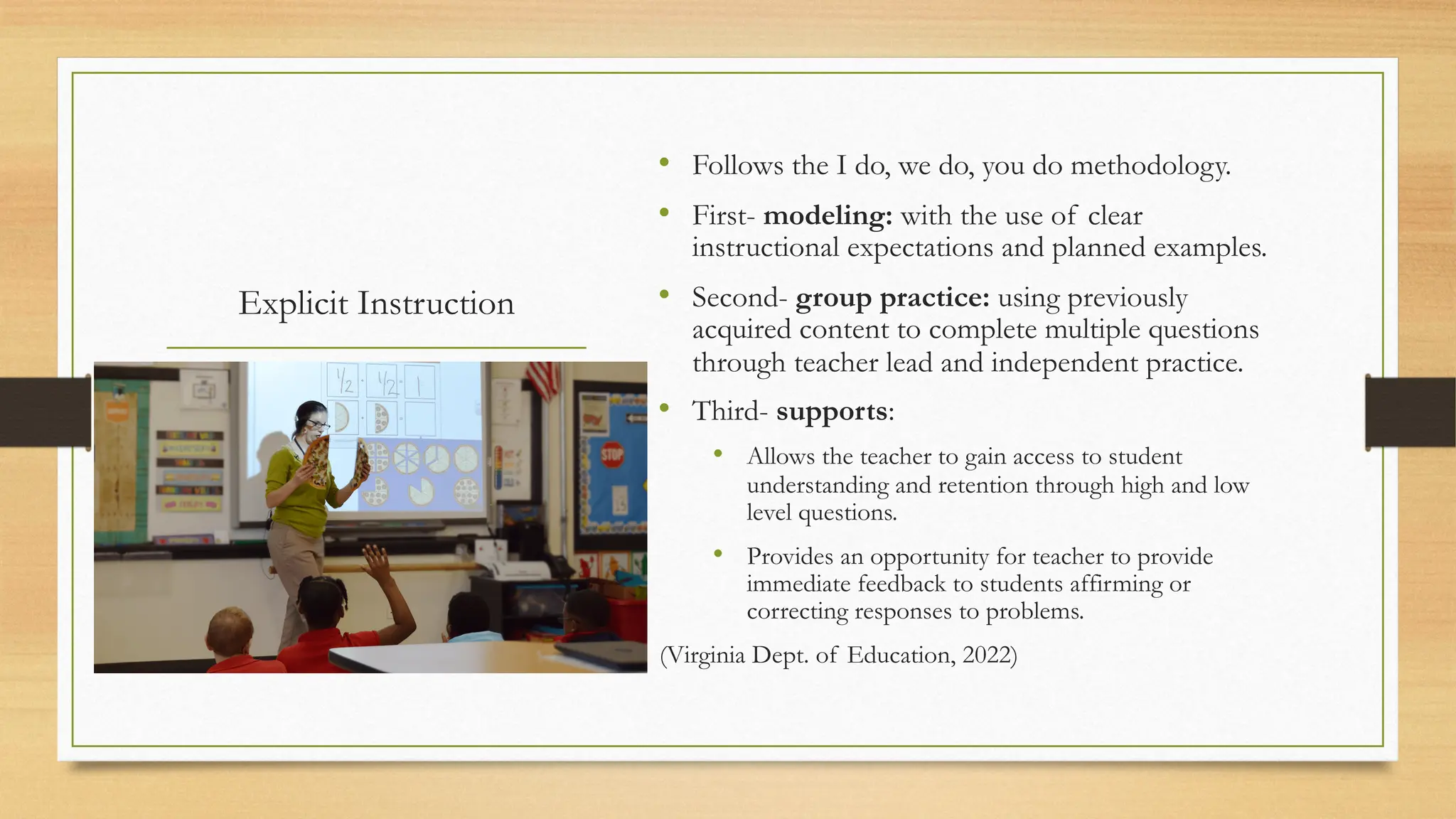
Explicit Instruction
• Follows the I do, we do, you do methodology.
• First- modeling: with the use of clear
instructional expectations and planned examples.
• Second- group practice: using previously
acquired content to complete multiple questions
through teacher lead and independent practice.
• Third- supports:
• Allows the teacher to gain access to student
understanding and retention through high and low
level questions.
• Provides an opportunity for teacher to provide
immediate feedback to students affirming or
correcting responses to problems.
(Virginia Dept. of Education, 2022)
• The use of terms specifically related to
the concepts and procedures in lesson.
• In order to promote understanding:
• Consistently use lesson terms correctly
• Plan appropriate language prior to
lesson
• Incorporate language activities during
direct instruction
• Hold students to high standard when
using mathematical language
• Creating an environment to foster
ones ability to think about the different
strategies in order to solve problems.
• To build a strong computational
fluency:
• Offering spaced practice
• Provide engaging fluency practice
• Utilize explicit instruction to explore
different mathematical problems
Formal Mathematical Language Fact and Computational Fluency
&
(Virginia Dept. of Education, 2022)
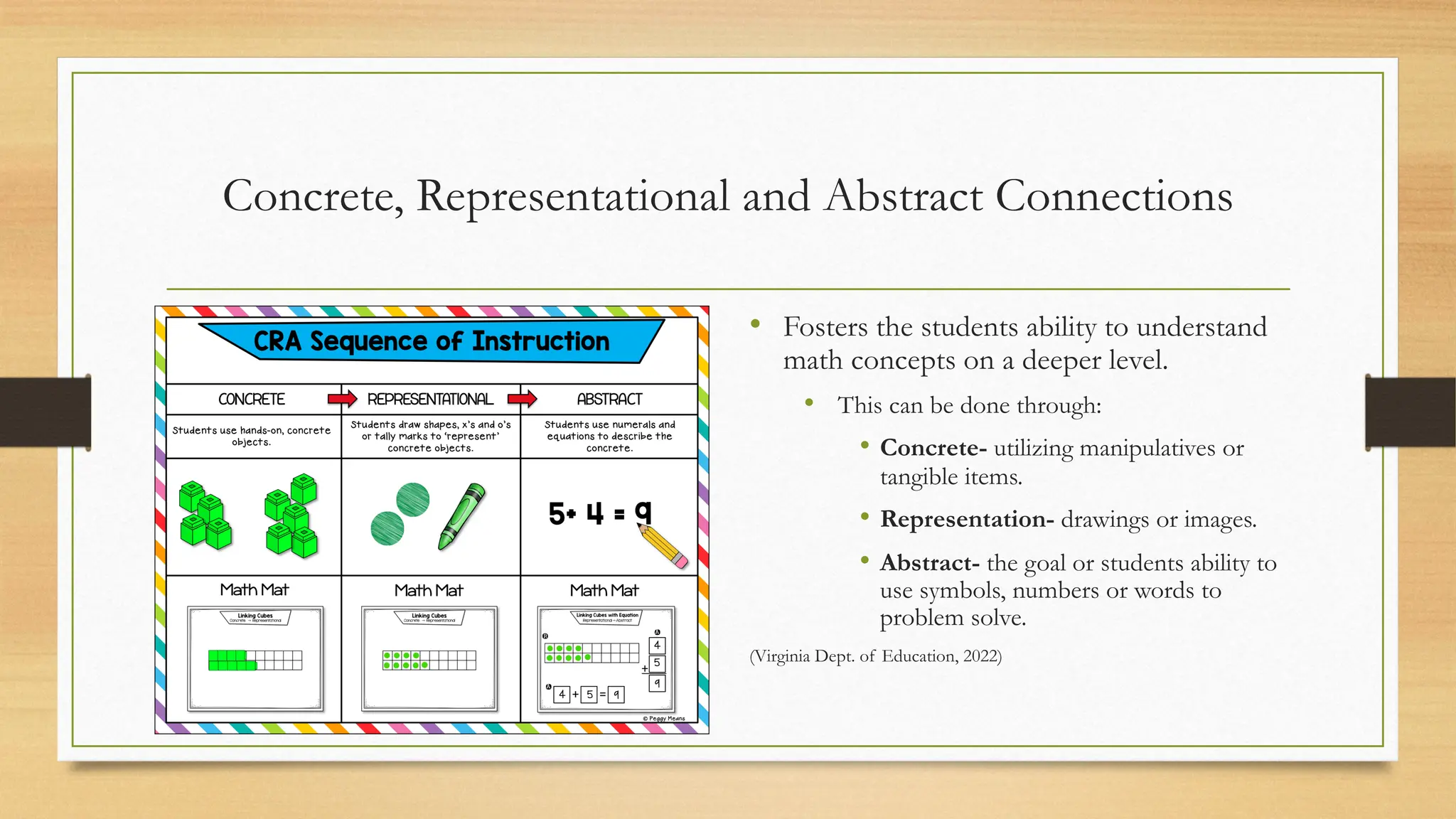
Concrete, Representational and Abstract Connections
• Fosters the students ability to understand
math concepts on a deeper level.
• This can be done through:
• Concrete- utilizing manipulatives or
tangible items.
• Representation- drawings or images.
• Abstract- the goal or students ability to
use symbols, numbers or words to
problem solve.
(Virginia Dept. of Education, 2022)
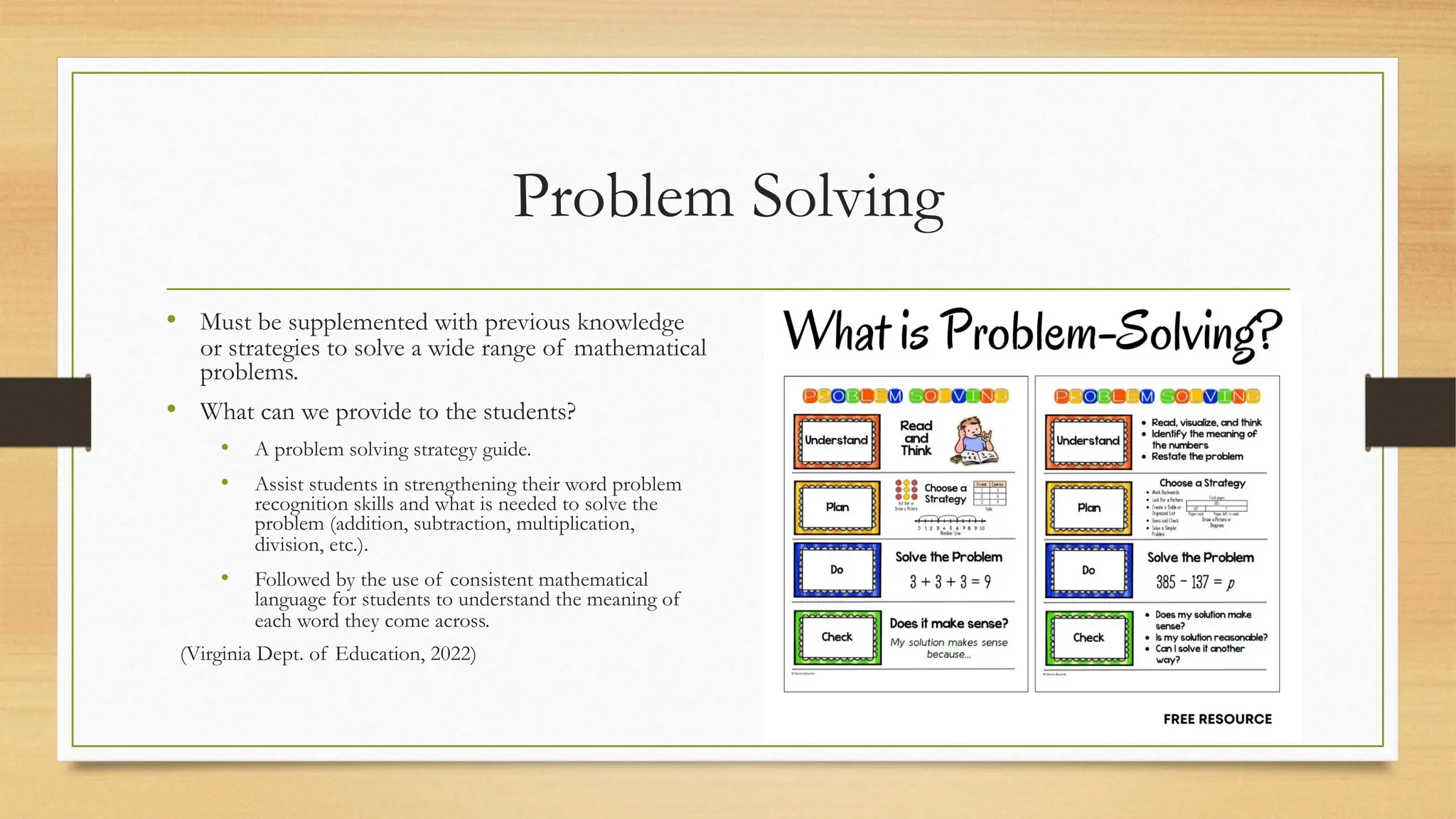
Problem Solving
• Must be supplemented with previous knowledge
or strategies to solve a wide range of mathematical
problems.
• What can we provide to the students?
• A problem solving strategy guide.
• Assist students in strengthening their word problem
recognition skills and what is needed to solve the
problem (addition, subtraction, multiplication,
division, etc.).
• Followed by the use of consistent mathematical
language for students to understand the meaning of
each word they come across.
(Virginia Dept. of Education, 2022)
What Else Can I Do?
• Bring a positive mental attitude!
• Be understanding!
• Be patient!
• Provide precise, immediate and accurate feedback!
• Create a healthy learning environment!
• Keep the triangle strong!
References
• Cortiella, C., & Horowitz, S. H. (2014). The State of Learning Disabilities: Facts Trends and
Emerging Issues. (Third edition). New York: National Center for Learning Disabilities
• Shaywitz, Dr. S. E. (1998). Current concepts: dyslexia. New England Journal of Medicine , 307.
• Virgina Dept. of Education. (2022). Doing what works: Five evidence-based strategies to
Specially Design Mathematics Instruction. Training & Technical Assistance Center at Old
Dominion University. https://ttac.odu.edu/curriculum-and-instruction/math/doing-what-
works-five-evidence-based-strategies-to-specially-design-mathematics-instruction/
• Witzel, B.S. & Little, M.E. (2016). Teaching elementary mathematics to struggling
learners. What Works for Special-Needs Learners. The Guilford Press: New York.

struggling learners in Math vs Learning Disabilities

  • 1.
    Learning Disabilities vs.Mathematics Cody Reese SPE-339 Dr. Das
  • 2.
    What’s on theAgenda! • Identify what a learning disability (LD) is. • Identify the common types of LD’s. • Identify the different difficulties in math. • Examine reasons why students with an LD have difficulties in math. • Explore practices/strategies to teach mathematics to students with LD’s.
  • 3.
    Learning Disability • Isa neurological disorder that significantly limits major life activities compared to most people when performing said activity. (Shaywitz,1998) • Causes delays or difficulties in learning capabilities across one or many educational environments. • Education • Performing math problems or comprehending math concepts • Difficulties in reading, spelling and/or writing
  • 4.
    Why is Mathso Hard for me? Am I born this way? Is it something I did wrong? I don’t understand! Yeah not doing that! I will just ask for help. I don’t remember how to do that! Ugh I give up! y=mx+b…? -x-=+…? I am never going to use this again! • The statements above are often the same comments we hear throughout our math classrooms from students with disabilities. I will just guess! That’s a long word problem! I am a failure!
  • 5.
    Common Types ofLearning Disabilities • Dyscalculia- Math • Counting, number facts, math calculations, mental math, problem solving skills, etc.. • Dyslexia- Reading • Phonemic awareness, phonological processing, word decoding, etc.. • Dysgraphia- Writing • Often seen within students who struggle with the above (Dyslexia and Dyscalculia). • Trouble forming letters, spacing, organizing thoughts on paper, syntax structure and grammar, etc. (Cortiella & Horowitz, 2014)
  • 6.
    Why do Studentswith LD’s Struggle in Math? • General categories that students have difficulties in math. (Cortiella & Horowitz, 2014) • Hereditary- Genetic pass down • Developmental/Learned- improper instruction or reinforced behaviors toward math • Brain Damage/other traumas • Sub categories of learning characteristics: (Witzel & Little, 2016, p. 7) • Cognitive and metacognitive deficits • Processing deficits • Memory and attention difficulties • Math anxiety • Learned helplessness • Passivity • Low level of achievement
  • 7.
    LD struggles inMath (Cont.) • The reasoning our LD students struggle in math does not solely come from clinical labels. • One must allow three components to coexist in order to fully determine the reasoning/ components of their struggles. • Looking specifically at: • What is being taught (Curriculum) • How it is taught (Instruction) • Childs Characteristics as a learner. • If one side of triangle is irregular it could cause another component of the triangle to suffer creating a snowball effect across various learning environments. (Witzel & Little, 2016, p. 6) Curriculum Learner Characteristics Instruction Assessment Effort Memory Attention Scaffolding Explicit Spaced Learning Standards Progression Practice Conceptual Procedures Perseverance Summative Formative
  • 8.
    What works best? •Lets focus our attention to the bottom right quadrant of the triangle: Instruction component. • How can we as teachers be proactive vs reactive when it comes to creating lessons to meet the needs of all of our students? • By implementing the following (Virginia Dept. of Education, 2022). • Explicit instruction • Proper mathematical language • Concrete, Representational and Abstract Connections • Fact and Computational Fluency • Problem Solving Explicit Spaced Learning Scaffolding Instruction Problem Solving Fluency
  • 9.
    Explicit Instruction • Followsthe I do, we do, you do methodology. • First- modeling: with the use of clear instructional expectations and planned examples. • Second- group practice: using previously acquired content to complete multiple questions through teacher lead and independent practice. • Third- supports: • Allows the teacher to gain access to student understanding and retention through high and low level questions. • Provides an opportunity for teacher to provide immediate feedback to students affirming or correcting responses to problems. (Virginia Dept. of Education, 2022)
  • 10.
    • The useof terms specifically related to the concepts and procedures in lesson. • In order to promote understanding: • Consistently use lesson terms correctly • Plan appropriate language prior to lesson • Incorporate language activities during direct instruction • Hold students to high standard when using mathematical language • Creating an environment to foster ones ability to think about the different strategies in order to solve problems. • To build a strong computational fluency: • Offering spaced practice • Provide engaging fluency practice • Utilize explicit instruction to explore different mathematical problems Formal Mathematical Language Fact and Computational Fluency & (Virginia Dept. of Education, 2022)
  • 11.
    Concrete, Representational andAbstract Connections • Fosters the students ability to understand math concepts on a deeper level. • This can be done through: • Concrete- utilizing manipulatives or tangible items. • Representation- drawings or images. • Abstract- the goal or students ability to use symbols, numbers or words to problem solve. (Virginia Dept. of Education, 2022)
  • 12.
    Problem Solving • Mustbe supplemented with previous knowledge or strategies to solve a wide range of mathematical problems. • What can we provide to the students? • A problem solving strategy guide. • Assist students in strengthening their word problem recognition skills and what is needed to solve the problem (addition, subtraction, multiplication, division, etc.). • Followed by the use of consistent mathematical language for students to understand the meaning of each word they come across. (Virginia Dept. of Education, 2022)
  • 13.
    What Else CanI Do? • Bring a positive mental attitude! • Be understanding! • Be patient! • Provide precise, immediate and accurate feedback! • Create a healthy learning environment! • Keep the triangle strong!
  • 14.
    References • Cortiella, C.,& Horowitz, S. H. (2014). The State of Learning Disabilities: Facts Trends and Emerging Issues. (Third edition). New York: National Center for Learning Disabilities • Shaywitz, Dr. S. E. (1998). Current concepts: dyslexia. New England Journal of Medicine , 307. • Virgina Dept. of Education. (2022). Doing what works: Five evidence-based strategies to Specially Design Mathematics Instruction. Training & Technical Assistance Center at Old Dominion University. https://ttac.odu.edu/curriculum-and-instruction/math/doing-what- works-five-evidence-based-strategies-to-specially-design-mathematics-instruction/ • Witzel, B.S. & Little, M.E. (2016). Teaching elementary mathematics to struggling learners. What Works for Special-Needs Learners. The Guilford Press: New York.