


Adaptation, Accommodation and
Modification for Pre academic
Curriculum
By SAYYID MUHAMMED SHAFEEQ
Introduction
The early childhood years (0 to 6 years) are viewed by
many as a critical time for the intellectual and social
development of any child. Children in the age range
of 0 to 3 years receive training in early learning skills
while those children in the age range of 3 to 6 years
pre primary education. The Pre-Primary level
programmes and early intervention programmes aim
at reducing further damage to the child.
The pre-school classes for children with ID emphasize content
areas that are commonly referred to as readiness skills, which
are prerequisites for later learning. Pre Primary classes for these
children start at an early age and the training may take as long as
two or four years. Depending on the level of disability of the
child, primary education can be provided in the regular play
school/nursery schools too. As the curricular content will be
predominantly language, social, personal and motor skills, there
is a possibility that the child with ID will be able to learn with
children without disabilities.
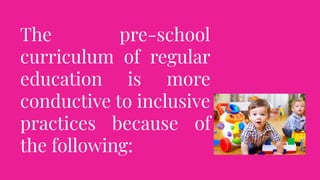
The pre-school
curriculum of regular
education is more
conductive to inclusive
practices because of
the following:
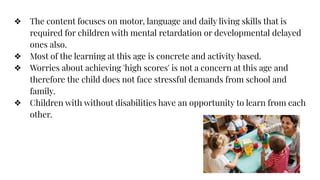
❖ The content focuses on motor, language and daily living skills that is
required for children with mental retardation or developmental delayed
ones also.
❖ Most of the learning at this age is concrete and activity based.
❖ Worries about achieving 'high scores' is not a concern at this age and
therefore the child does not face stressful demands from school and
family.
❖ Children with without disabilities have an opportunity to learn from each
other.
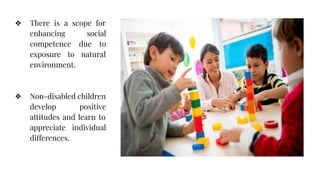
❖ There is a scope for
enhancing social
competence due to
exposure to natural
environment.
❖ Non-disabled children
develop positive
attitudes and learn to
appreciate individual
differences.
Focus of Curriculum
In a regular preschool the
curriculum will focus on skills
needed at pre operational
stages and therefore many of
our students with mild
developmental delays will
benefit from these adaptations
& modifications at regular
preschools.
Readiness skills include the abilities to:
❖ Sit and attend to the
teacher
❖ Discriminate auditory
and visual stimuli
❖ Follow direction
❖ Develop language
skills
❖ Improve gross and fine
motor co-ordination
❖ Develop self-help skills
❖ Interact with peers in a
group situation
❖ Suitable mobility skills
❖ Pre reading, pre writing
and premath skills
Basic Considerations:
While preparing a
training curriculum for
the pre-school level,
the following basic
considerations may be
made.
★ Children learn through imitating people around them. This is a first step in
organizing information from the external world. Hence encourage
interaction between children and their environment.
★ Provide children with experiences that stimulate all sense. Multisensory
approaches to teaching can facilitate assimilation and accommodations.
Assimilation refers to, use of mental schemata to comprehend new objects in
the environments, in older persons it refers to tendencies to see and
interpret things according to the pre-existing ideas. Accommodation on the
other hand, is an adjustment of schemata to new objects, events and ideas.
★ Because the child has difficulty in organizing himself, the teacher must
give stimulation. Children should have an opportunity to become more
aware of their bodies and maintain control over their actions.
★ Programme should be developmental in the most basic areas and should
focus on the child's actual functioning level. Knowledge of the normal
sequence of cognitive development can aid the teacher in providing
appropriate intervention programme.
★ Teaching strategies should be consistent, structured and controlled. Set
goals and plan activities with clear objectives in mind. Action oriented
activities facilitate attainment of the goal
★ Do not waste time to teach the activities that do not have a functional
value in the immediate environment and later stages in life.
Major focus at pre primary
level will include
➔ Self - Body parts, name, gender, family members, daily living skills
➔ Common objects - clothing, food, furniture, toys, dishes, utensils, plants,
animals, holidays
➔ Action Words - sit, stand, walk, run, clap, jump, hop, top, stop, go, drink.
➔ Concept - Shapes, size, color, sound, taste, smell, texture, position,
weight, beauty, same and different, laterality, safety.
➔ Preacademics - readiness skills for reading and writing and math.
Pre-reading may include activities such as seeing picture books, holding
it properly, turning pages and enjoying seeing and naming pictures and
talking about it. Pre writing may include activities such as scribbling,
colouring pictures, tracing pictures and so on. Pre math skills include
concepts such as far-near, up-down, heavy-light, long-short, more-less,
full-empty and so on. All of these pre academic skills lead to preparing
the child for learning academics later.
Adaptation, accommodation and modification for pre academic curriculum

Adaptation, accommodation and modification for pre academic curriculum

  • 1.
    Adaptation, Accommodation and Modificationfor Pre academic Curriculum By SAYYID MUHAMMED SHAFEEQ
  • 2.
    Introduction The early childhoodyears (0 to 6 years) are viewed by many as a critical time for the intellectual and social development of any child. Children in the age range of 0 to 3 years receive training in early learning skills while those children in the age range of 3 to 6 years pre primary education. The Pre-Primary level programmes and early intervention programmes aim at reducing further damage to the child.
  • 3.
    The pre-school classesfor children with ID emphasize content areas that are commonly referred to as readiness skills, which are prerequisites for later learning. Pre Primary classes for these children start at an early age and the training may take as long as two or four years. Depending on the level of disability of the child, primary education can be provided in the regular play school/nursery schools too. As the curricular content will be predominantly language, social, personal and motor skills, there is a possibility that the child with ID will be able to learn with children without disabilities.
  • 4.
    The pre-school curriculum ofregular education is more conductive to inclusive practices because of the following:
  • 5.
    ❖ The contentfocuses on motor, language and daily living skills that is required for children with mental retardation or developmental delayed ones also. ❖ Most of the learning at this age is concrete and activity based. ❖ Worries about achieving 'high scores' is not a concern at this age and therefore the child does not face stressful demands from school and family. ❖ Children with without disabilities have an opportunity to learn from each other.
  • 6.
    ❖ There isa scope for enhancing social competence due to exposure to natural environment. ❖ Non-disabled children develop positive attitudes and learn to appreciate individual differences.
  • 7.
    Focus of Curriculum Ina regular preschool the curriculum will focus on skills needed at pre operational stages and therefore many of our students with mild developmental delays will benefit from these adaptations & modifications at regular preschools.
  • 8.
    Readiness skills includethe abilities to: ❖ Sit and attend to the teacher ❖ Discriminate auditory and visual stimuli ❖ Follow direction ❖ Develop language skills ❖ Improve gross and fine motor co-ordination ❖ Develop self-help skills ❖ Interact with peers in a group situation ❖ Suitable mobility skills ❖ Pre reading, pre writing and premath skills
  • 9.
    Basic Considerations: While preparinga training curriculum for the pre-school level, the following basic considerations may be made.
  • 10.
    ★ Children learnthrough imitating people around them. This is a first step in organizing information from the external world. Hence encourage interaction between children and their environment. ★ Provide children with experiences that stimulate all sense. Multisensory approaches to teaching can facilitate assimilation and accommodations. Assimilation refers to, use of mental schemata to comprehend new objects in the environments, in older persons it refers to tendencies to see and interpret things according to the pre-existing ideas. Accommodation on the other hand, is an adjustment of schemata to new objects, events and ideas.
  • 11.
    ★ Because thechild has difficulty in organizing himself, the teacher must give stimulation. Children should have an opportunity to become more aware of their bodies and maintain control over their actions. ★ Programme should be developmental in the most basic areas and should focus on the child's actual functioning level. Knowledge of the normal sequence of cognitive development can aid the teacher in providing appropriate intervention programme. ★ Teaching strategies should be consistent, structured and controlled. Set goals and plan activities with clear objectives in mind. Action oriented activities facilitate attainment of the goal ★ Do not waste time to teach the activities that do not have a functional value in the immediate environment and later stages in life.
  • 12.
    Major focus atpre primary level will include
  • 13.
    ➔ Self -Body parts, name, gender, family members, daily living skills ➔ Common objects - clothing, food, furniture, toys, dishes, utensils, plants, animals, holidays ➔ Action Words - sit, stand, walk, run, clap, jump, hop, top, stop, go, drink. ➔ Concept - Shapes, size, color, sound, taste, smell, texture, position, weight, beauty, same and different, laterality, safety. ➔ Preacademics - readiness skills for reading and writing and math. Pre-reading may include activities such as seeing picture books, holding it properly, turning pages and enjoying seeing and naming pictures and talking about it. Pre writing may include activities such as scribbling, colouring pictures, tracing pictures and so on. Pre math skills include concepts such as far-near, up-down, heavy-light, long-short, more-less, full-empty and so on. All of these pre academic skills lead to preparing the child for learning academics later.