Mathematical Learning
Difficulties and Dyscalculia

   ‘Enabling every teaching
  assistant, teacher to explain
 maths effectively to all learners’


                           Wirral Dyslexia Association
Contents
• Exploration of Maths Learning Difficulties and Dyscalculia

• Subitising/Numerosity


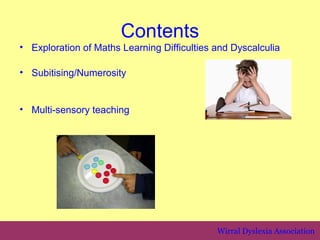
• Multi-sensory teaching


                                             Wirral Dyslexia Association
There are THREE kinds of people in
              the
             world

     Those who can do maths

              and

         Those who can’t

                        Wirral Dyslexia Association
How many children are
          dyscalculic?
4-6% of the population are dyscalculic.

At least one in every class- affects boys and
girls the same!!

Around 6% of children in the UK have
severe difficulties with numeracy
(Gross 2007)
Equates to 180,000 primary school children
(DfE 2010)
                                 Wirral Dyslexia Association
Definition of Dyscalculia
 A condition that affects the ability to
 acquire arithmetical skills. Dyscalculic
 learners may have difficulty understanding
 simple number concepts, lack an intuitive
 grasp of numbers and have problems
 learning number facts and procedures.
 Even if they produce a correct answer or
 use a correct method, they may do so
 mechanically and without confidence.
DFES (2001)
                              Wirral Dyslexia Association
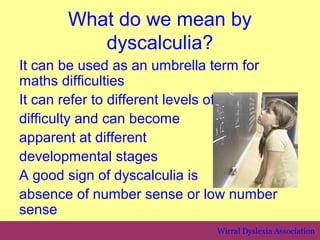
What do we mean by
          dyscalculia?
It can be used as an umbrella term for
maths difficulties
It can refer to different levels of
difficulty and can become
apparent at different
developmental stages
A good sign of dyscalculia is
absence of number sense or low number
sense
                             Wirral Dyslexia Association
What do we mean by number
             sense?
•The ability to determine the number of
objects in a small collection, to count, and to
perform simple addition and subtraction,
without direct instruction.

•Spoken language and number sense are
survival skills but abstract maths is not.


                                 Wirral Dyslexia Association
Why is teaching/learning maths so
           important?
Discuss!!
• Think about all the maths that you would
  use in planning a dinner party- absolutely
  everything


                                Wirral Dyslexia Association
The consequences are profound
Around 20% of the UK have difficulties with
mathematics which cause significant
practical, educational or functional
difficulties
(Parsons & Bynner 2005)

People with poor numeracy skills are more
likely to be unemployed, depressed, ill and
arrested (Butterworth & Yeo 2004)

                               Wirral Dyslexia Association
Two thirds of young prisoners have
numeracy skills at or below the level of an
11-year-old child (Social Exclusion Unit
2002)


Costs the UK exchequer as much as £2.4
billion every year
(Gross et al. 2009)

                                Wirral Dyslexia Association
Wirral Dyslexia Association
Symptoms of Dyscalculia
• An inability to subitise even very small
  quantities
• An inability to estimate whether a numerical
  answer is reasonable
• Weaknesses in both short term and long term
  memory
• An inability to count backwards reliably
• Immature strategies- for example counting all
  instead of counting on
• Weakness in visual and spatial orientation
                                 Wirral Dyslexia Association
Symptoms (cont’d)
• Directional confusion
• Slow processing speed
• Difficulty sequencing
• Difficulty with language
• Inability to notice patterns
• Poor memory for facts and procedures
• Inability to generalise
• Difficulties in word problems and multi step
  calculations
• Problems with all aspects of money
• Marked delay in learning to tell the time

                                      Wirral Dyslexia Association
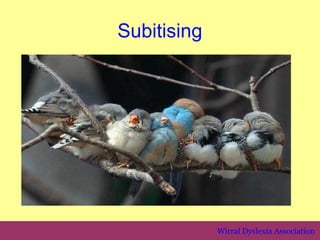
Subitising


             Wirral Dyslexia Association
What do we mean by
   1, 2, 3,… subitising?
• Subitising comes from Latin= ‘Sudden’

• The ability to give the amount of objects in a
  set without counting
• Most people can subitise up to five or six
  objects
• Dyscalculic people do not have this ability
• This is innate, we are born with the ability to
  assess quantity.
• Babies can count!

                                   Wirral Dyslexia Association
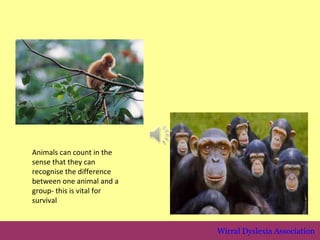
Animals can count in the
sense that they can
recognise the difference
between one animal and a
group- this is vital for
survival


                           Wirral Dyslexia Association
Two types of subitizing

Perceptual
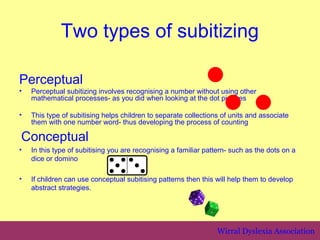
•   Perceptual subitizing involves recognising a number without using other
    mathematical processes- as you did when looking at the dot pictures

•   This type of subitising helps children to separate collections of units and associate
    them with one number word- thus developing the process of counting

Conceptual
•   In this type of subitising you are recognising a familiar pattern- such as the dots on a
    dice or domino

•   If children can use conceptual subitising patterns then this will help them to develop
    abstract strategies.


                                                                 Wirral Dyslexia Association
Dianna Laurillard
           Centre of educational Neuroscience UCL


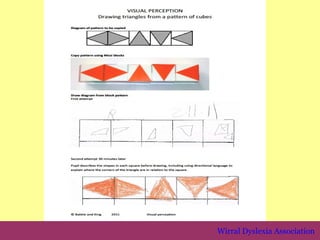
• Manipulations of special materials
  (Cuisenaire, dots, patterns, dice ,number
  lines, beads, counters etc)
• Talk plays a key role; pupil has to
  describe the task , the goal , the action
• Games help to align the pupil-teacher task
  goals


                                           Wirral Dyslexia Association
Wirral Dyslexia Association
Multi-sensory teaching recognises that in order
to learn, the sensory systems are required for
discrimination of sounds and symbols and for
arranging these in a sequential order.
The sensory systems are
Visual
Auditory
Tactile- kinaesthetic
Oral –kinaesthetic
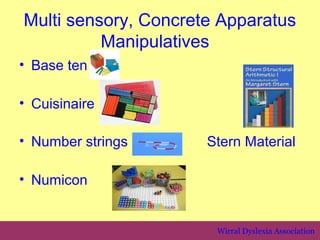
Multi sensory, Concrete Apparatus
          Manipulatives
• Base ten

• Cuisinaire

• Number strings      Stern Material

• Numicon


                       Wirral Dyslexia Association
Must link materials and models to
               language
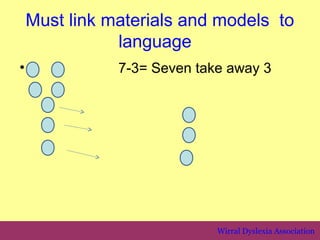
•              7-3= Seven take away 3


                             Wirral Dyslexia Association
Over learning
    Repetition Repetition Repetition!
• Number facts
• Bonds
• Tables
• Definitions
• Procedures After concept and
  understanding
• Cards, Mnemonics, visualisations

                              Wirral Dyslexia Association
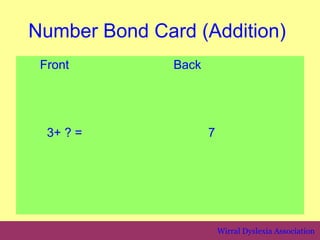
Number Bond Card (Addition)
 Front         Back


  3+ ? =              7


                          Wirral Dyslexia Association
Over Learning/Reasoning
• Support learning of number facts by
  reasoning
• Children not in position of either knowing
  or not knowing a fact as can use
  reasoning strategies
• Two steps for knowing; one just knowing
  the other deriving


                                Wirral Dyslexia Association
Cumulative /structured
• Skills build on each other
• Ideal world master one skill before moving
  on
• Task analysis check which underlying skill
  are needed


                               Wirral Dyslexia Association
Wirral Dyslexia Association

Mathematical Learning Difficulties and Dyscalculia Wirral Dyslexia Association

  • 1.
    Mathematical Learning Difficulties andDyscalculia ‘Enabling every teaching assistant, teacher to explain maths effectively to all learners’ Wirral Dyslexia Association
  • 2.
    Contents • Exploration ofMaths Learning Difficulties and Dyscalculia • Subitising/Numerosity • Multi-sensory teaching Wirral Dyslexia Association
  • 3.
    There are THREEkinds of people in the world Those who can do maths and Those who can’t Wirral Dyslexia Association
  • 4.
    How many childrenare dyscalculic? 4-6% of the population are dyscalculic. At least one in every class- affects boys and girls the same!! Around 6% of children in the UK have severe difficulties with numeracy (Gross 2007) Equates to 180,000 primary school children (DfE 2010) Wirral Dyslexia Association
  • 5.
    Definition of Dyscalculia A condition that affects the ability to acquire arithmetical skills. Dyscalculic learners may have difficulty understanding simple number concepts, lack an intuitive grasp of numbers and have problems learning number facts and procedures. Even if they produce a correct answer or use a correct method, they may do so mechanically and without confidence. DFES (2001) Wirral Dyslexia Association
  • 6.
    What do wemean by dyscalculia? It can be used as an umbrella term for maths difficulties It can refer to different levels of difficulty and can become apparent at different developmental stages A good sign of dyscalculia is absence of number sense or low number sense Wirral Dyslexia Association
  • 7.
    What do wemean by number sense? •The ability to determine the number of objects in a small collection, to count, and to perform simple addition and subtraction, without direct instruction. •Spoken language and number sense are survival skills but abstract maths is not. Wirral Dyslexia Association
  • 8.
    Why is teaching/learningmaths so important? Discuss!! • Think about all the maths that you would use in planning a dinner party- absolutely everything Wirral Dyslexia Association
  • 9.
    The consequences areprofound Around 20% of the UK have difficulties with mathematics which cause significant practical, educational or functional difficulties (Parsons & Bynner 2005) People with poor numeracy skills are more likely to be unemployed, depressed, ill and arrested (Butterworth & Yeo 2004) Wirral Dyslexia Association
  • 10.
    Two thirds ofyoung prisoners have numeracy skills at or below the level of an 11-year-old child (Social Exclusion Unit 2002) Costs the UK exchequer as much as £2.4 billion every year (Gross et al. 2009) Wirral Dyslexia Association
  • 11.
  • 12.
    Symptoms of Dyscalculia •An inability to subitise even very small quantities • An inability to estimate whether a numerical answer is reasonable • Weaknesses in both short term and long term memory • An inability to count backwards reliably • Immature strategies- for example counting all instead of counting on • Weakness in visual and spatial orientation Wirral Dyslexia Association
  • 13.
    Symptoms (cont’d) • Directionalconfusion • Slow processing speed • Difficulty sequencing • Difficulty with language • Inability to notice patterns • Poor memory for facts and procedures • Inability to generalise • Difficulties in word problems and multi step calculations • Problems with all aspects of money • Marked delay in learning to tell the time Wirral Dyslexia Association
  • 14.
    Subitising Wirral Dyslexia Association
  • 15.
    What do wemean by 1, 2, 3,… subitising? • Subitising comes from Latin= ‘Sudden’ • The ability to give the amount of objects in a set without counting • Most people can subitise up to five or six objects • Dyscalculic people do not have this ability • This is innate, we are born with the ability to assess quantity. • Babies can count! Wirral Dyslexia Association
  • 16.
    Animals can countin the sense that they can recognise the difference between one animal and a group- this is vital for survival Wirral Dyslexia Association
  • 17.
    Two types ofsubitizing Perceptual • Perceptual subitizing involves recognising a number without using other mathematical processes- as you did when looking at the dot pictures • This type of subitising helps children to separate collections of units and associate them with one number word- thus developing the process of counting Conceptual • In this type of subitising you are recognising a familiar pattern- such as the dots on a dice or domino • If children can use conceptual subitising patterns then this will help them to develop abstract strategies. Wirral Dyslexia Association
  • 18.
    Dianna Laurillard Centre of educational Neuroscience UCL • Manipulations of special materials (Cuisenaire, dots, patterns, dice ,number lines, beads, counters etc) • Talk plays a key role; pupil has to describe the task , the goal , the action • Games help to align the pupil-teacher task goals Wirral Dyslexia Association
  • 19.
  • 20.
    Multi-sensory teaching recognisesthat in order to learn, the sensory systems are required for discrimination of sounds and symbols and for arranging these in a sequential order. The sensory systems are Visual Auditory Tactile- kinaesthetic Oral –kinaesthetic
  • 21.
    Multi sensory, ConcreteApparatus Manipulatives • Base ten • Cuisinaire • Number strings Stern Material • Numicon Wirral Dyslexia Association
  • 22.
    Must link materialsand models to language • 7-3= Seven take away 3 Wirral Dyslexia Association
  • 23.
    Over learning Repetition Repetition Repetition! • Number facts • Bonds • Tables • Definitions • Procedures After concept and understanding • Cards, Mnemonics, visualisations Wirral Dyslexia Association
  • 24.
    Number Bond Card(Addition) Front Back 3+ ? = 7 Wirral Dyslexia Association
  • 25.
    Over Learning/Reasoning • Supportlearning of number facts by reasoning • Children not in position of either knowing or not knowing a fact as can use reasoning strategies • Two steps for knowing; one just knowing the other deriving Wirral Dyslexia Association
  • 26.
    Cumulative /structured • Skillsbuild on each other • Ideal world master one skill before moving on • Task analysis check which underlying skill are needed Wirral Dyslexia Association
  • 27.

Editor's Notes

  • #4 Is mathematics ability an innate skill- like being able to draw? Are we all born able to do maths but get it taught out of us
  • #5 How common is dyscalculia? There is a general agreement that around 5-8% of pupils suffer from dyscalculia (Geary, 2004). On average, each class of 30 children will have approximately two or three pupils who are affected by it (Hannell, 2005). Though environmental factors play their part in transmission of a talent for, or a difficulty in, mathematics, research has proven that biological influences do play a significant role in dyscalculia. Shalev and Gross-Tsur (2001) found that pupils whose parents have dyscalculia are ten times more likely to have it too compared with members of the general population. Similarly, 50% of dyscalculia sufferers have siblings who are also affected by it.  
  • #6 Compare and contrast the definitions on handout 1 and explore common themes Can group come up with definition
  • #7 What do we mean by number sense? The ability to determine the number of objects in a small collection, to count, and to perform simple addition and subtraction, without direct instruction. Spoken language and number sense are survival skills but abstract maths is not.
  • #9 Sticky notes Think about all the maths that you would use in planning a dinner party- absolutely everything
  • #13 Red ones are the same as dyslexia- so there is a cross over
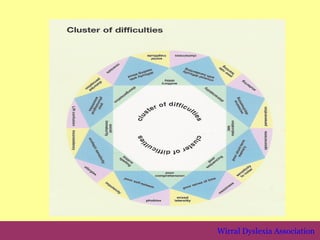
  • #14 See Kate’s cluster of difficulties activity diagram ( need yellow for this) Place on the following for dyscalculia: Poor sense of time An inability to subitise An inability to estimate An inability to count backwards reliably Inability to notice patterns Immature strategies Slow processing speed Difficulties in word problems and multi step calculations Problems with money Learning to tell the time Poor short-term memory left–right confusion Place overlay on the following for dyslexia: poor sense of time left–right confusion poor phonological awareness difficulty reading aloud poor rote learning poor short-term memory poor self-esteem inconsistency bizarre spelling poor comprehension poor sequencing reversals
  • #16 1980 an experiment was carried out by Prentice Starkey- on 72 babies between 16 and 30 weeks old. Shown two dots and three dots- fixation of 1.9 secs for two dots jumped to 2.5 secs for 3 dots. So babies could detect the change from two to three dots Has been repeated with pictures Babies can detect differences in numerical quantities This is called concept of quanitity or ‘Numerosity’ Studies on people who have suffered brain trauma substantiate this- they can remain as normal in all other repsects but they have lost their sense of number.- some people are born without this sense of number Butterworth describes a man with a degree in psychology who has to use his fingers to count- and has no idea of the meaning of the answer
  • #17 Number sense is innate in all of us It stems from the fight or flight reflex We need to know if what we are seeing is a threat or an opportunity for a meal!
  • #18 On whiteboard draw out sets of dots 1 with 2 dots 1 with 3 dots 1 with 9 dots 1 with 11 dots to illustrate the difference between counting and subitising
  • #20 Demonstrates the importance of verbalising task.
  • #22 Manipulative materials are any materials that allow pupils to physically touch, move and rearrange them. Some of the most commonly used materials are introduced and explored below. Counters Counters do not have to be small round plastic objects. I like to use nuggets made of coloured or iridescent glass that are sold as flower vase fillers and table decorations. Alternatives are small cubes, wooden bricks, lolly sticks, plastic shapes, games tokens, beans, beads, pebbles, buttons, shells, etc. Changing the size and shape of counters from one activity to the next can be valuable, larger items being more suitable for younger children and for those with dyspraxia. However, it is best to avoid too much variety of size or colour Cuisenaire rods were invented by the Belgian educator Georges Cuisenaire in the 1930s and developed in the 1940s to teach arithmetic to primary school children. They consist of a set of rods made of wood, now also available in plastic, each with a cross-section measuring 1 centimetre square. The 10 different lengths of rods start at 1 cm long and increase by increments of 1 cm, the largest rod being the orange 10-rod. Cuisenaire rods are compatible with Dienes blocks thereby providing for larger denominations. Each size of Cuisenaire rod has its own distinctive and unvarying colour, which makes its length easy to identify without the need for measuring it against unit cubes and counting the units. This is, indeed, the main advantage of using continuous materials. Because the rods do not carry labels or unit markings, they encourage quantities to be seen as a whole, rather than a collection of single units. This, in turn, encourages the development of efficient calculation methods that do not depend on counting in ones. Professor Sharma is one of the most distinguished American maths educators to champion the use of Cuisenaire rods as an aid to constructing sound and robust cognitive models, especially for children who experience difficulties with maths. In addition to writing papers and articles about maths teaching and maths difficulties, Professor Sharma has produced a Zoltan Dienes produced his ‘attribute blocks’ not long after Cuisenaire produced his rods. The idea has been copied many times since then and Dienes blocks are now often known generically as ‘base-ten materials’. They consist of wooden or plastic blocks, all of the same colour, and are based on 1 cm cubes formed into single cubes (1), longs (10) and square flats (100). Baseten sets nowadays also offer large cubes to represent 1000. Unlike Cuisenaire rods, base-ten materials have scored surfaces to highlight the 1 cm cube units from which they are built. Unlike the rods, there are no blocks to represent the numbers between 1 and 10, which means that the numbers below 10 have to be represented by discrete cubes and counted out one by one. For this reason, I prefer to use Cuisenaire rods, supplemented by the larger Dienes blocks. Remind of every day items eg Money Weights /measuring jugs ruler etc trundle wheel ?? Teach the lesson content by ‘hear it, see it, say it, write it’ and wherever possible ‘do it’ –
  • #23 Materials and models must link to language must link to language
  • #24 All needs regular practise I make maths facts cards – like reading pack
  • #26 Talk through bonds sandwich? + tables Where may this be helpful? Based on Maths reasoning which we are developing