© 2013 Springer Publishing Company, LLC.
Chapter 4
True-False
and Matching
&Oermann Gaberson
Evaluation and Testing in Nursing Education
4th edition
© 2013 Springer Publishing Company, LLC.
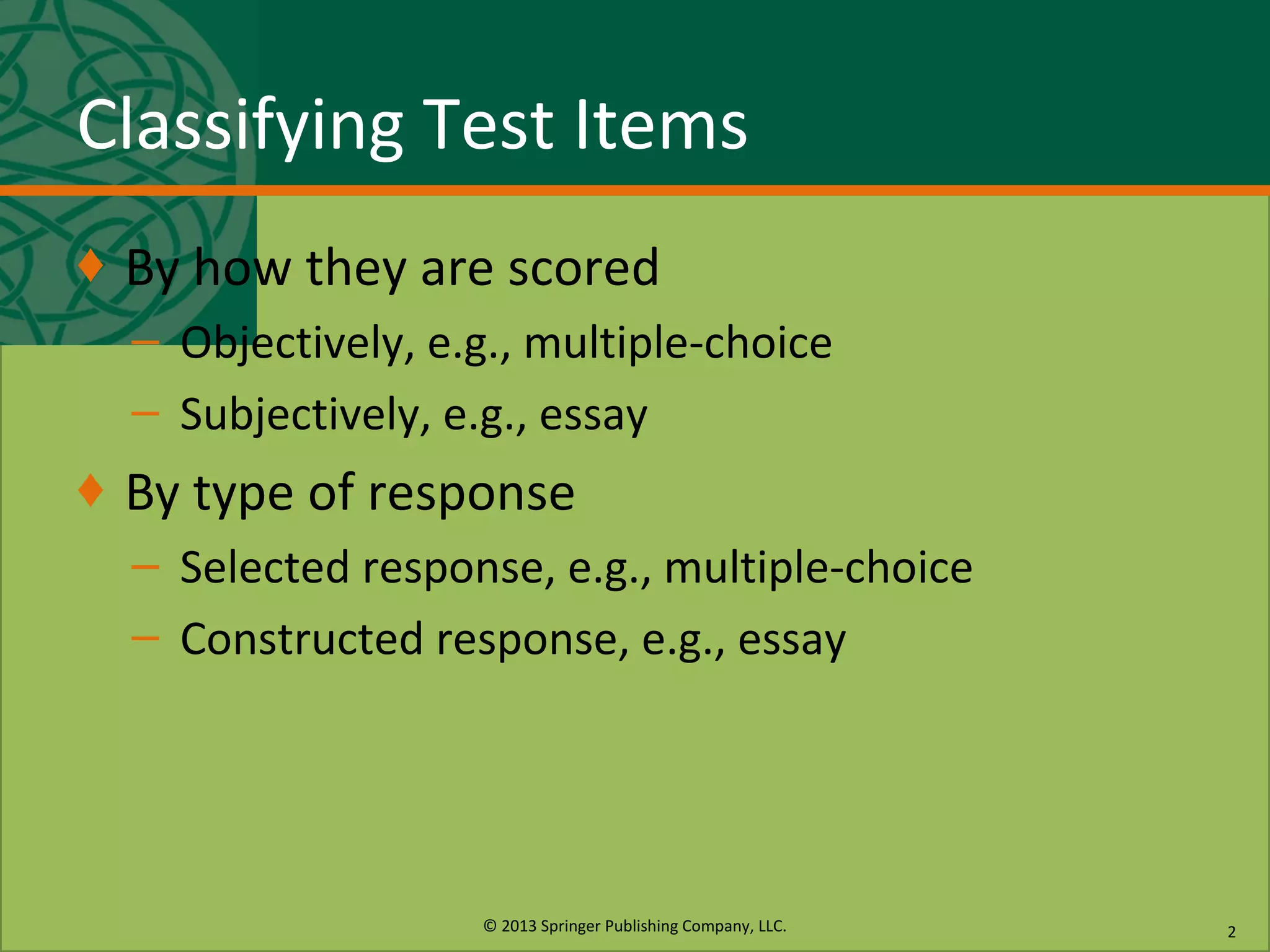
Classifying Test Items
♦ By how they are scored
– Objectively, e.g., multiple-choice
– Subjectively, e.g., essay
♦ By type of response
– Selected response, e.g., multiple-choice
– Constructed response, e.g., essay
2
© 2013 Springer Publishing Company, LLC.
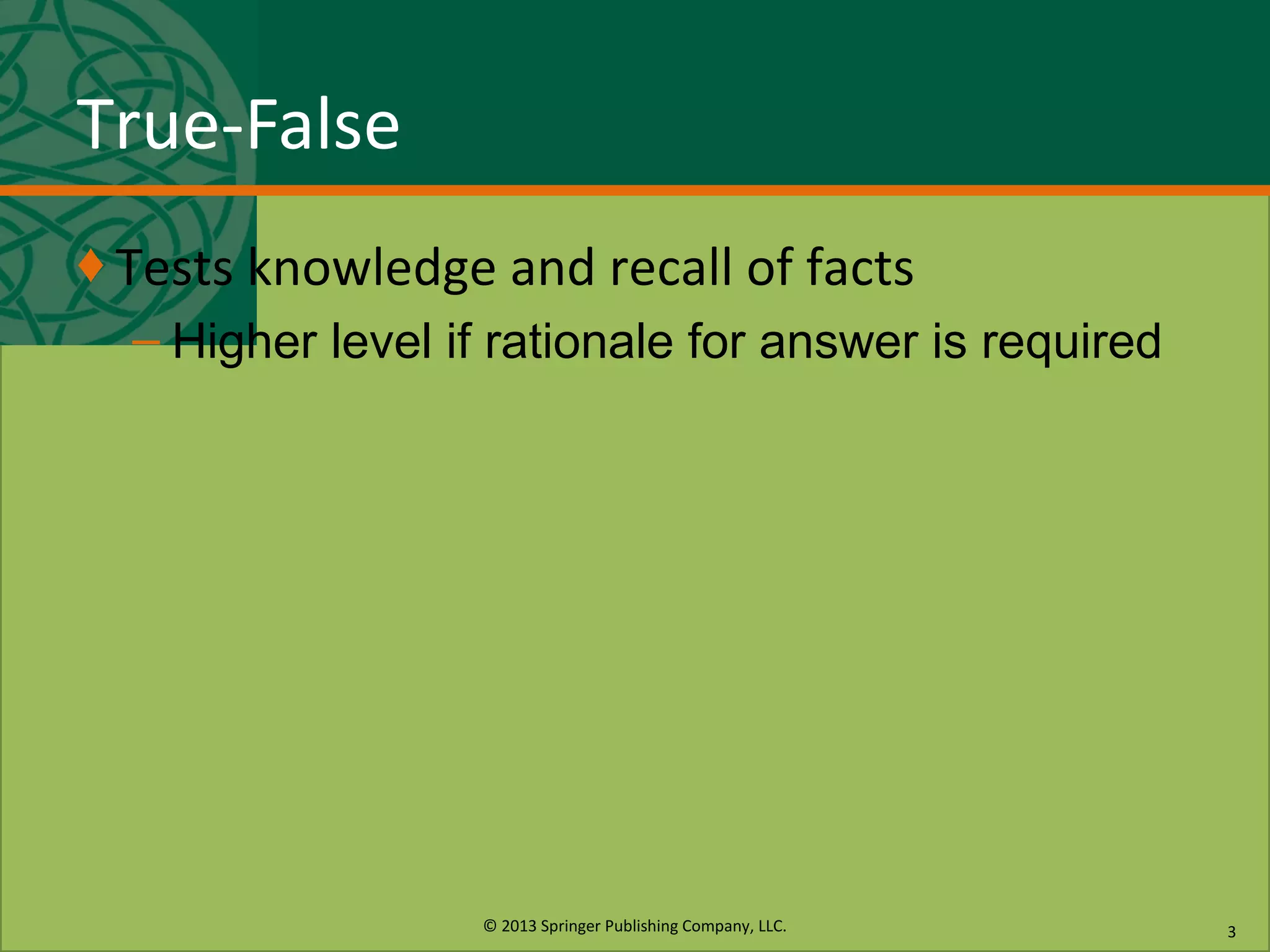
True-False
♦ Tests knowledge and recall of facts
– Higher level if rationale for answer is required
3
© 2013 Springer Publishing Company, LLC.
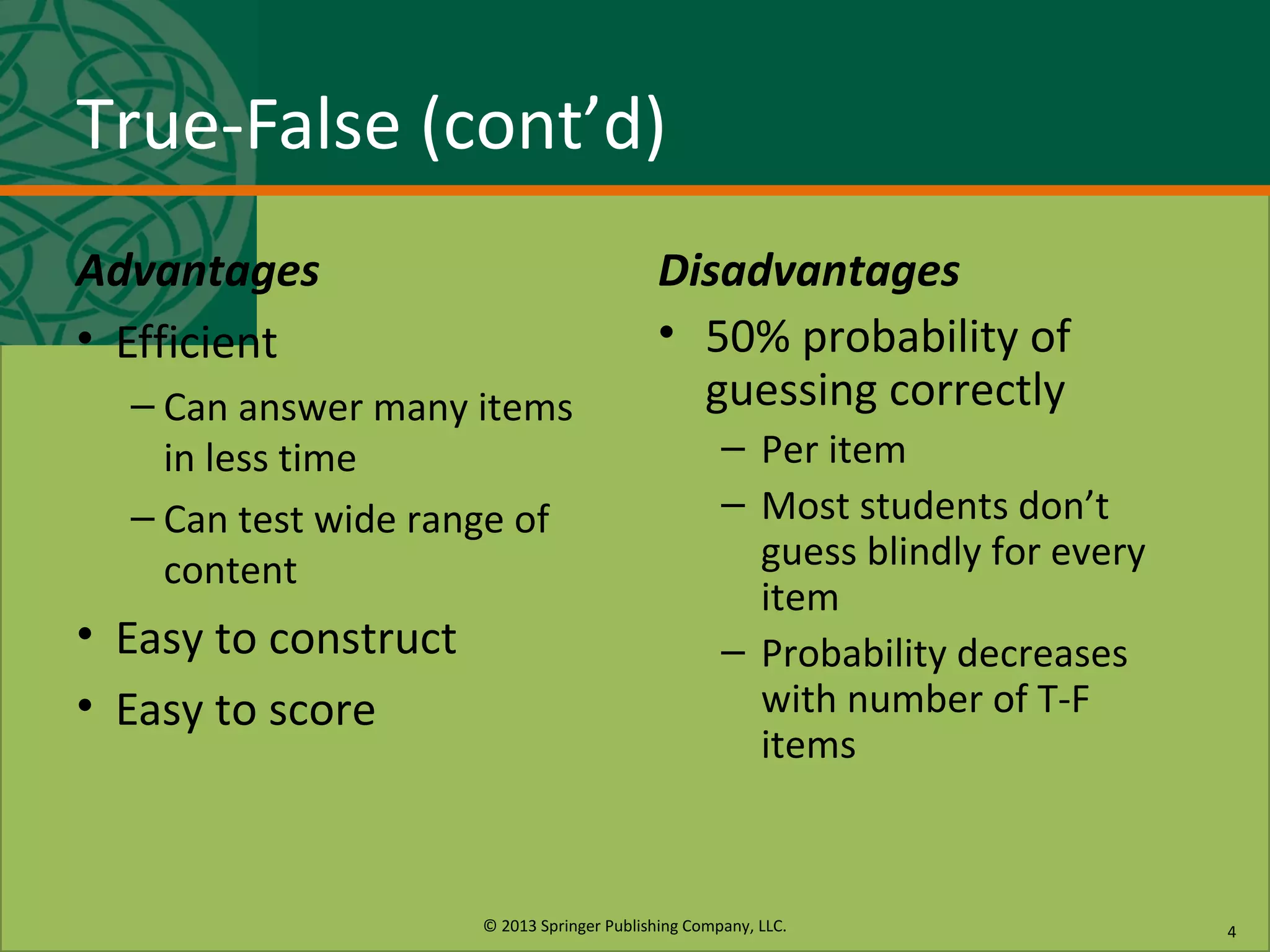
True-False (cont’d)
Advantages
• Efficient
– Can answer many items
in less time
– Can test wide range of
content
• Easy to construct
• Easy to score
Disadvantages
• 50% probability of
guessing correctly
– Per item
– Most students don’t
guess blindly for every
item
– Probability decreases
with number of T-F
items
4
© 2013 Springer Publishing Company, LLC.
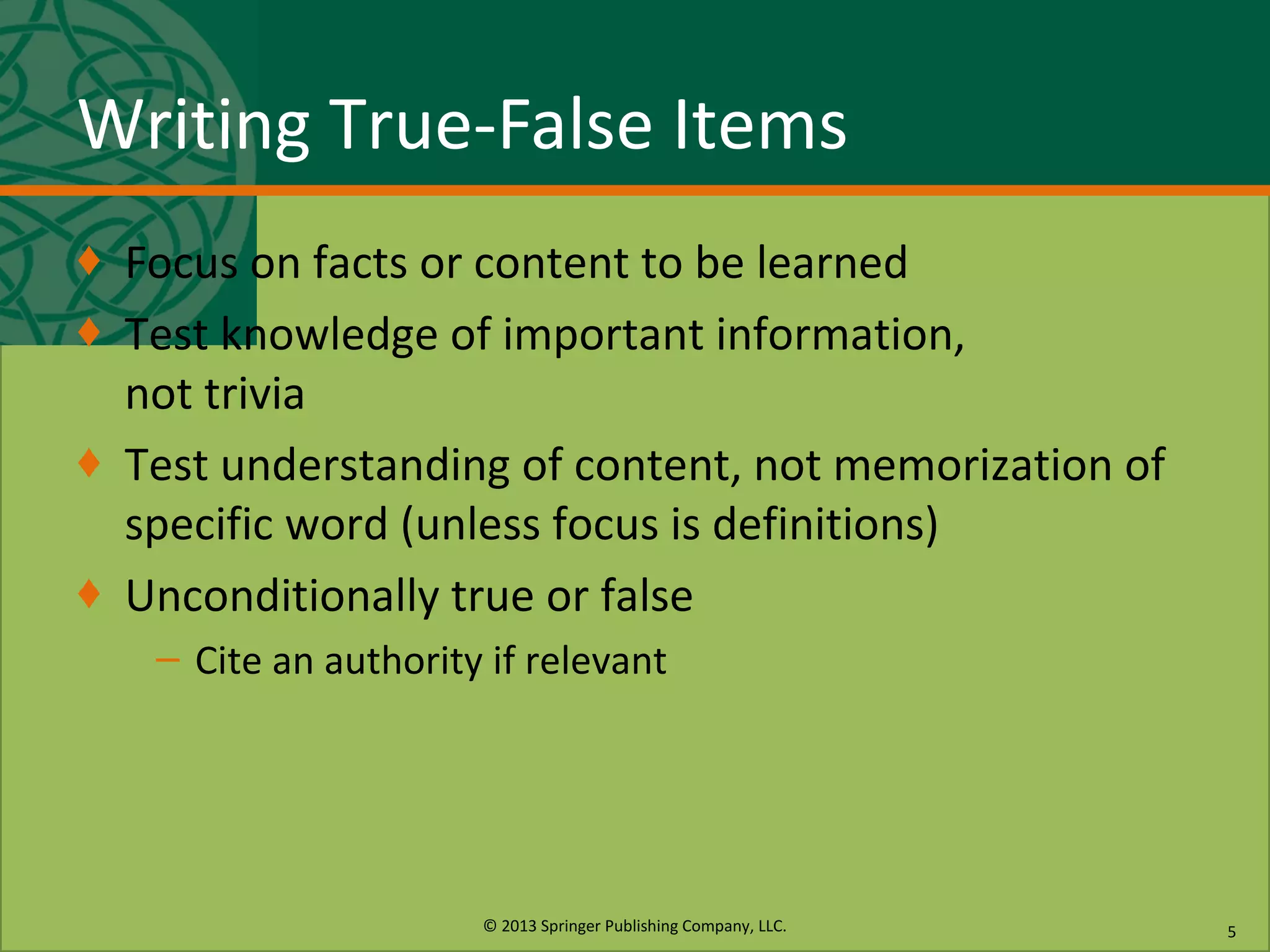
Writing True-False Items
♦ Focus on facts or content to be learned
♦ Test knowledge of important information,
not trivia
♦ Test understanding of content, not memorization of
specific word (unless focus is definitions)
♦ Unconditionally true or false
– Cite an authority if relevant
5
© 2013 Springer Publishing Company, LLC.
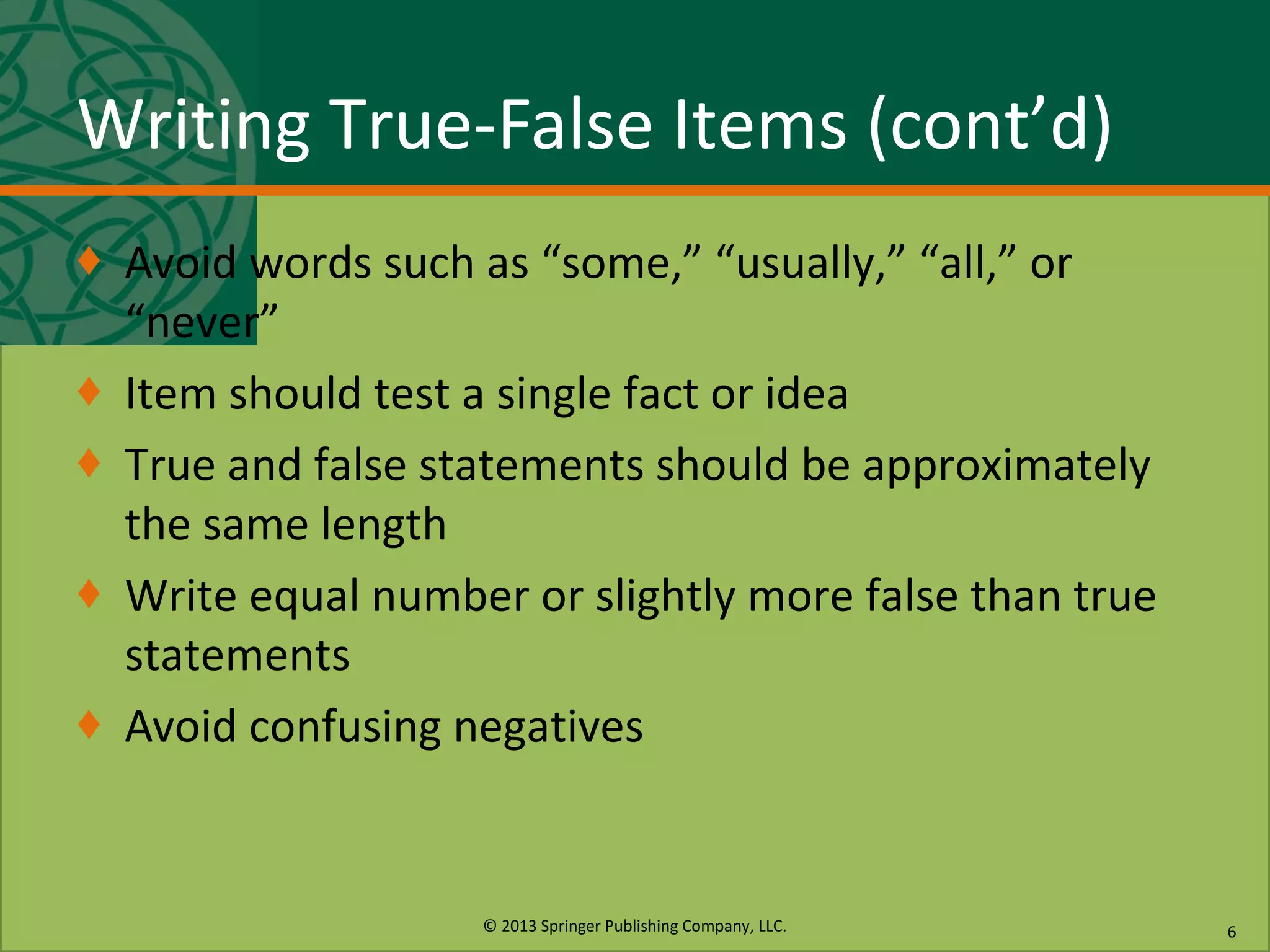
Writing True-False Items (cont’d)
♦ Avoid words such as “some,” “usually,” “all,” or
“never”
♦ Item should test a single fact or idea
♦ True and false statements should be approximately
the same length
♦ Write equal number or slightly more false than true
statements
♦ Avoid confusing negatives
6
© 2013 Springer Publishing Company, LLC.
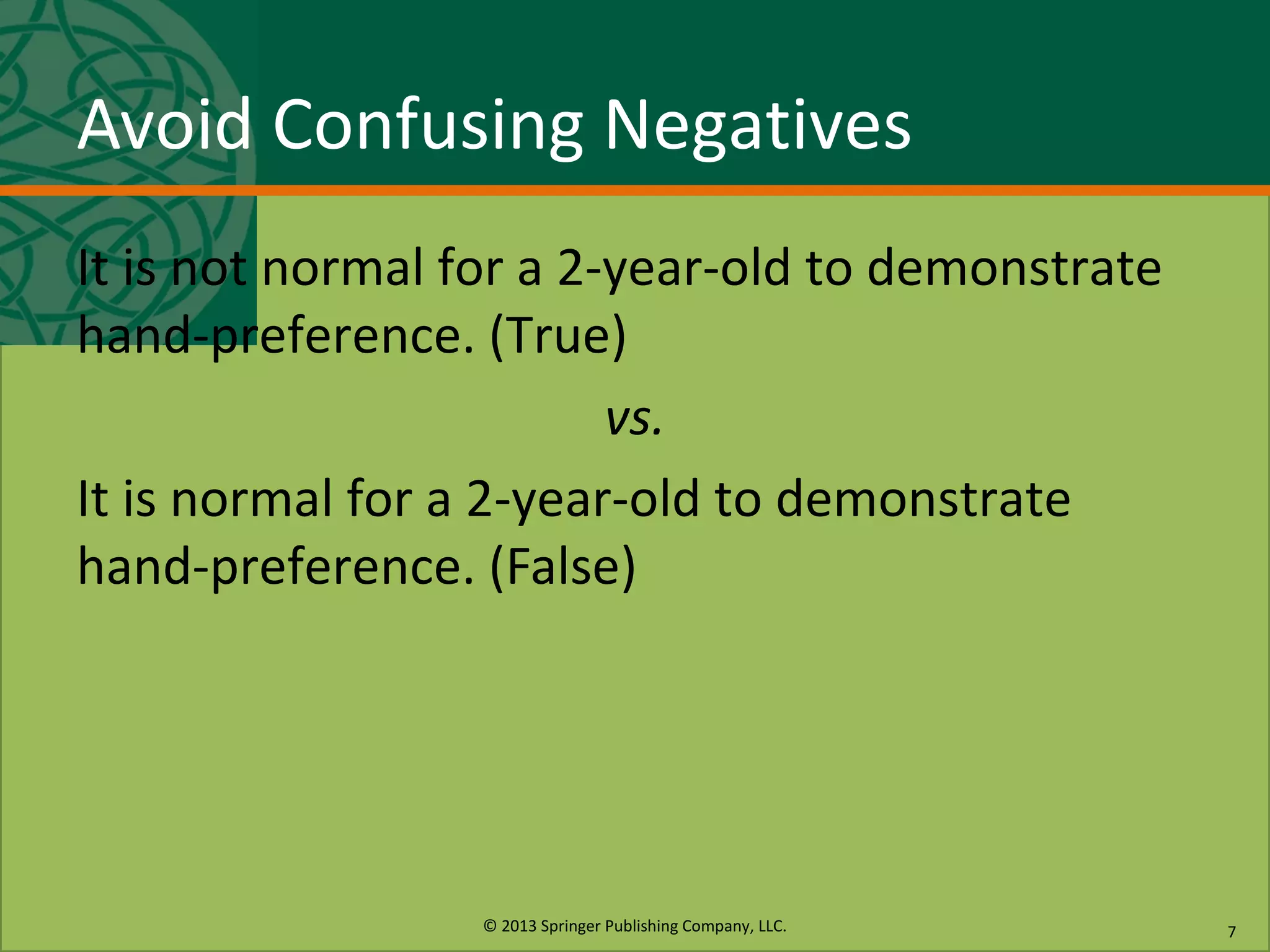
Avoid Confusing Negatives
It is not normal for a 2-year-old to demonstrate
hand-preference. (True)
vs.
It is normal for a 2-year-old to demonstrate
hand-preference. (False)
7
© 2013 Springer Publishing Company, LLC.
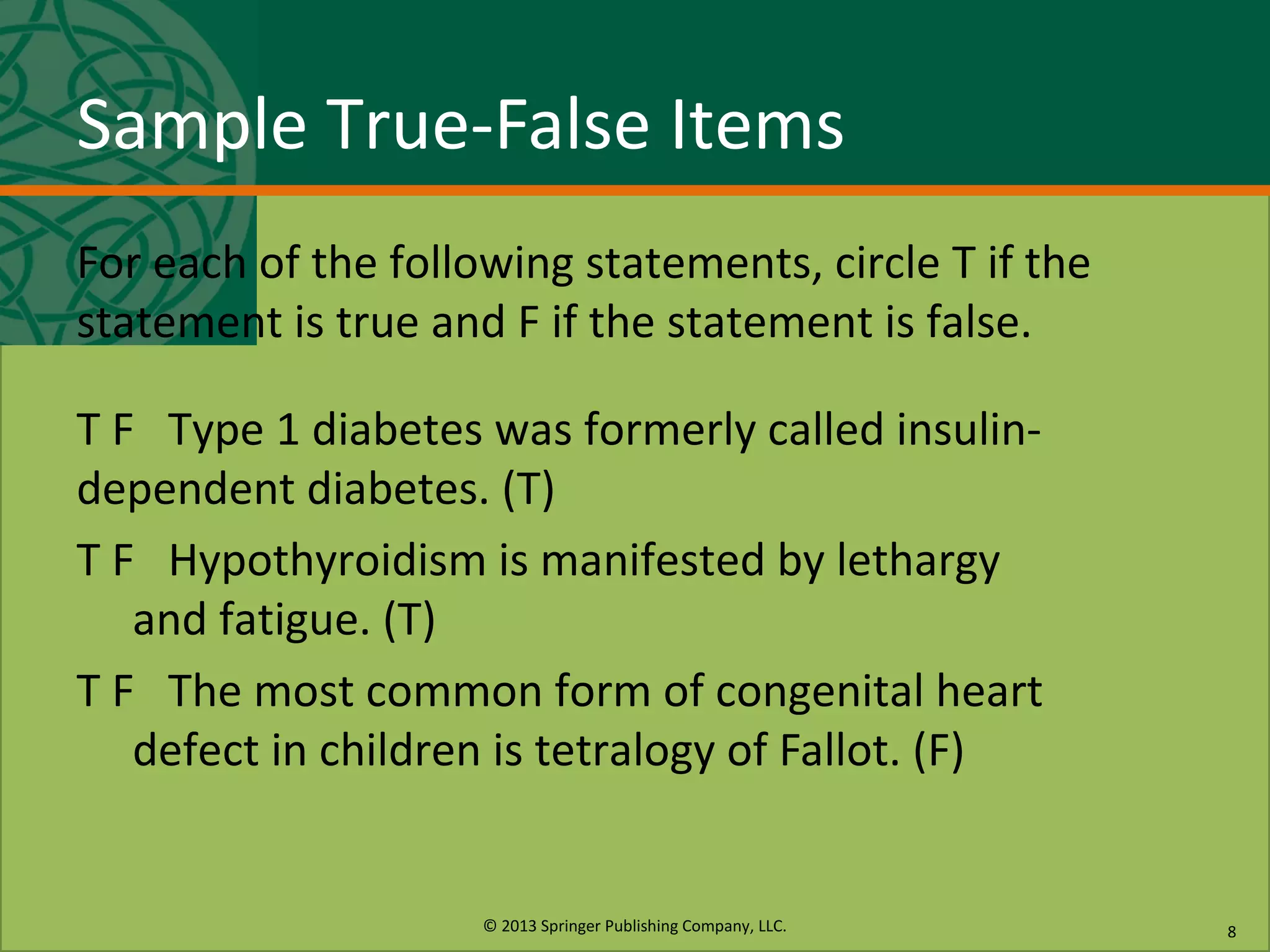
Sample True-False Items
For each of the following statements, circle T if the
statement is true and F if the statement is false.
T F Type 1 diabetes was formerly called insulin-
dependent diabetes. (T)
T F Hypothyroidism is manifested by lethargy
and fatigue. (T)
T F The most common form of congenital heart
defect in children is tetralogy of Fallot. (F)
8
© 2013 Springer Publishing Company, LLC.
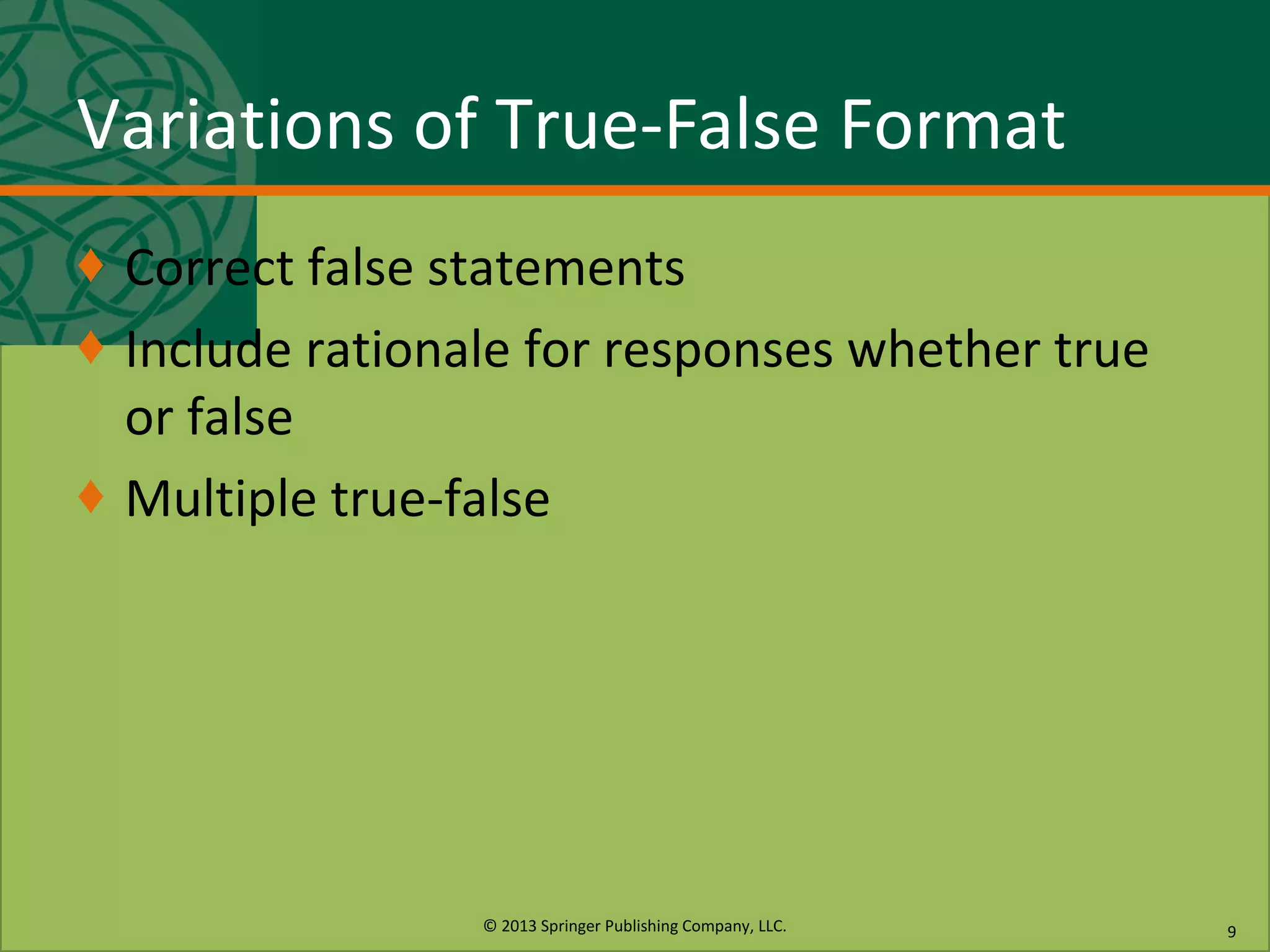
Variations of True-False Format
♦ Correct false statements
♦ Include rationale for responses whether true
or false
♦ Multiple true-false
9
© 2013 Springer Publishing Company, LLC.
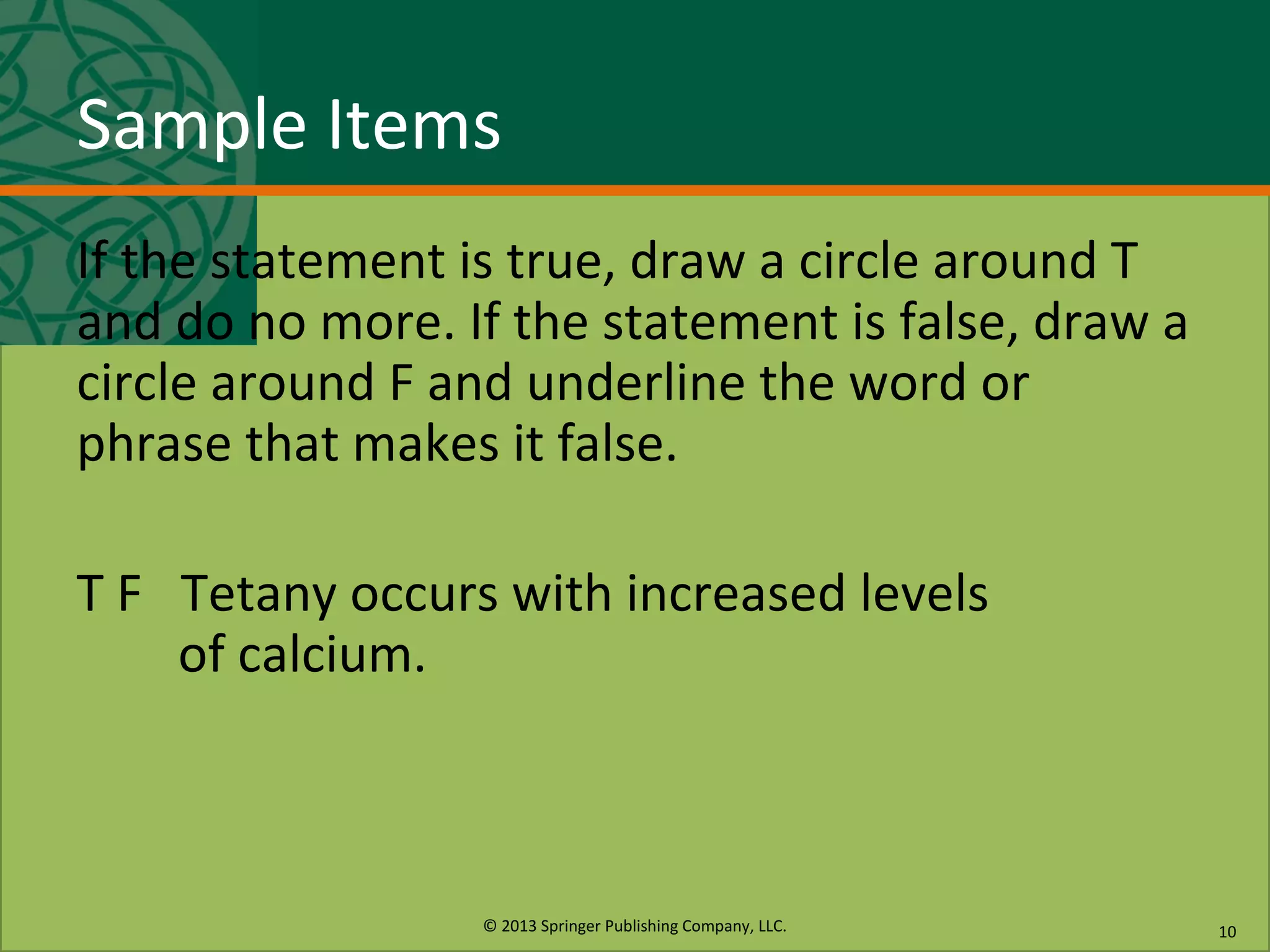
Sample Items
If the statement is true, draw a circle around T
and do no more. If the statement is false, draw a
circle around F and underline the word or
phrase that makes it false.
T F Tetany occurs with increased levels
of calcium.
10
© 2013 Springer Publishing Company, LLC.
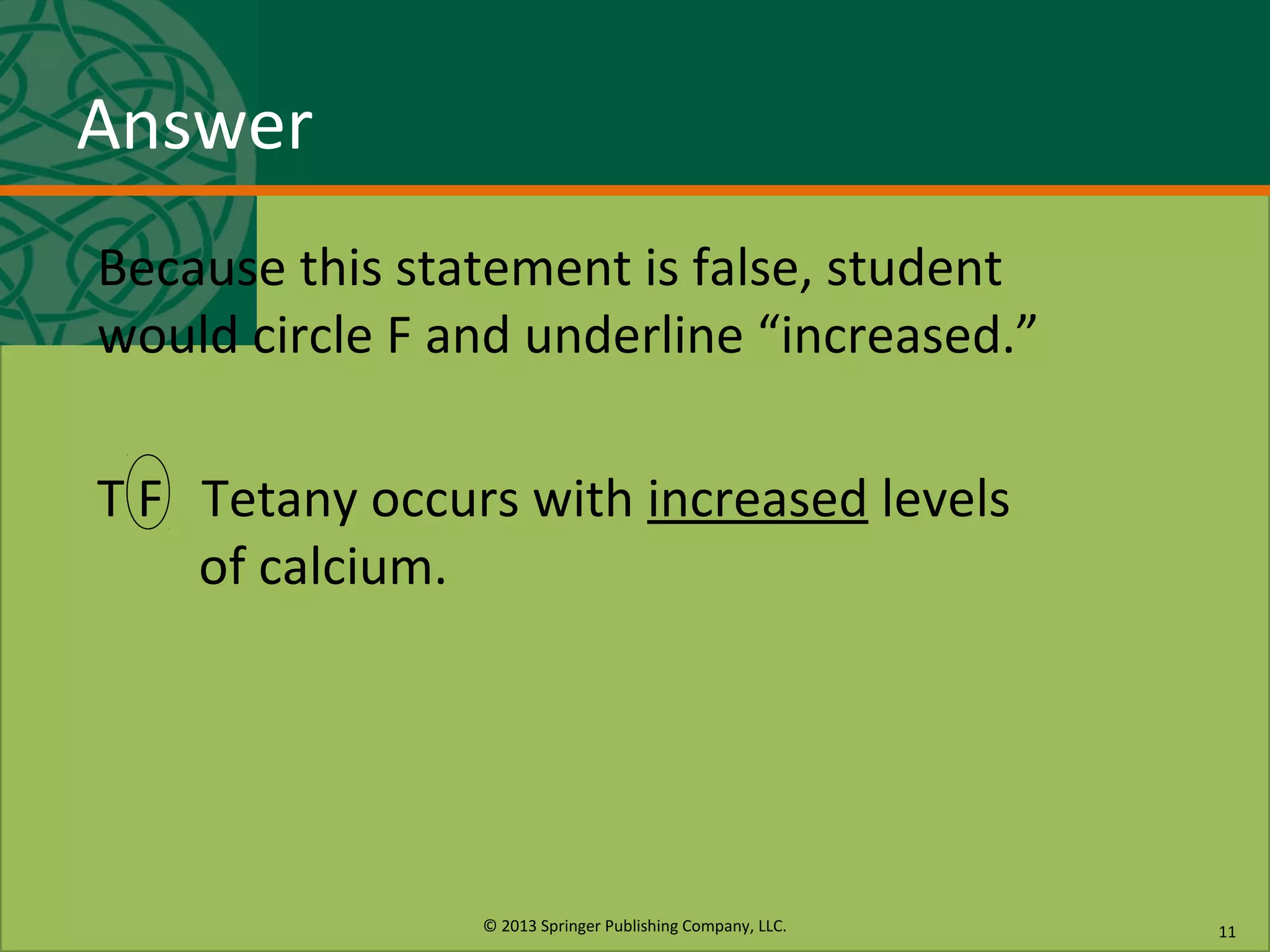
Answer
Because this statement is false, student
would circle F and underline “increased.”
T F Tetany occurs with increased levels
of calcium.
11
© 2013 Springer Publishing Company, LLC.
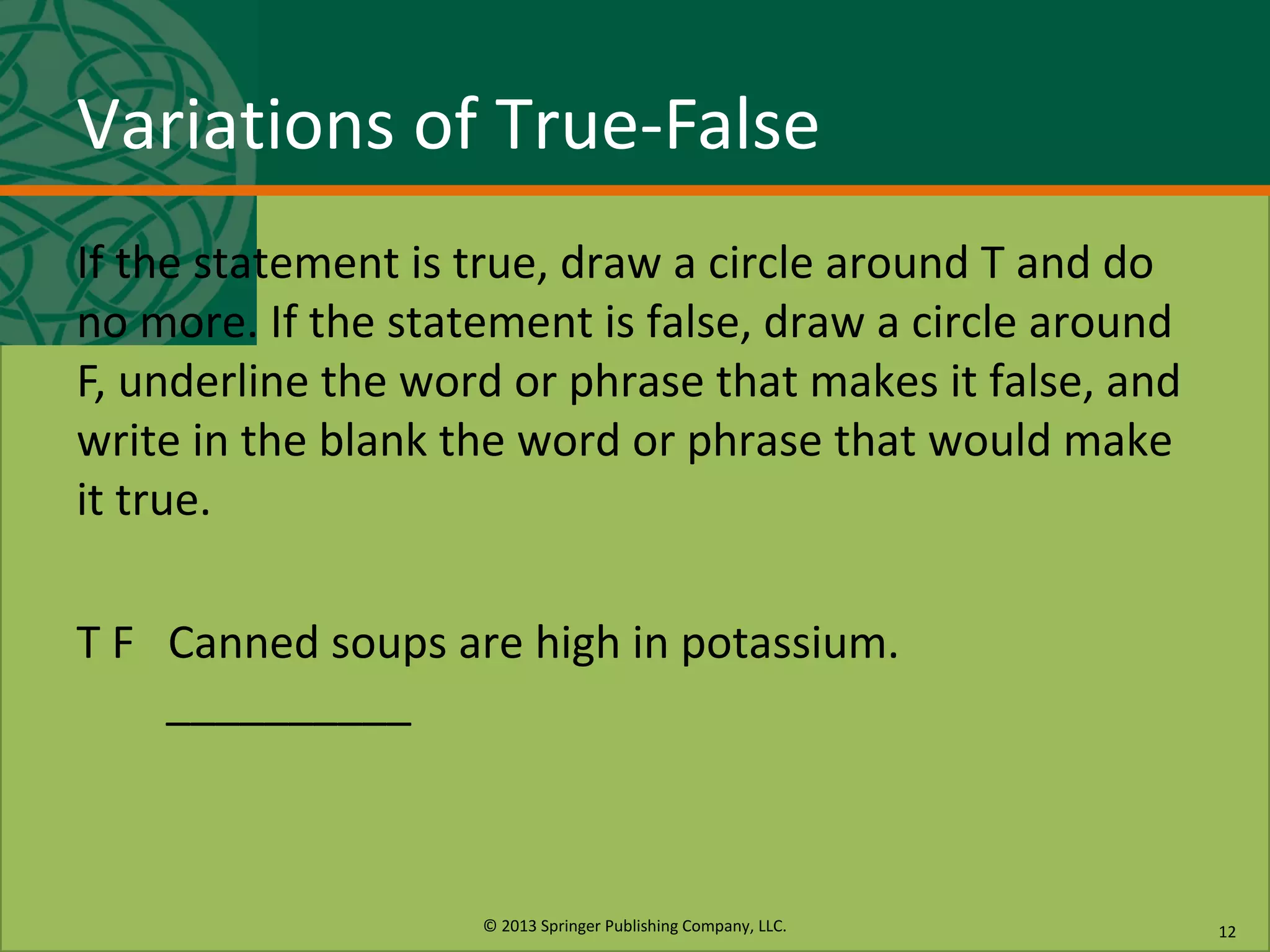
Variations of True-False
If the statement is true, draw a circle around T and do
no more. If the statement is false, draw a circle around
F, underline the word or phrase that makes it false, and
write in the blank the word or phrase that would make
it true.
T F Canned soups are high in potassium.
__________
12
© 2013 Springer Publishing Company, LLC.
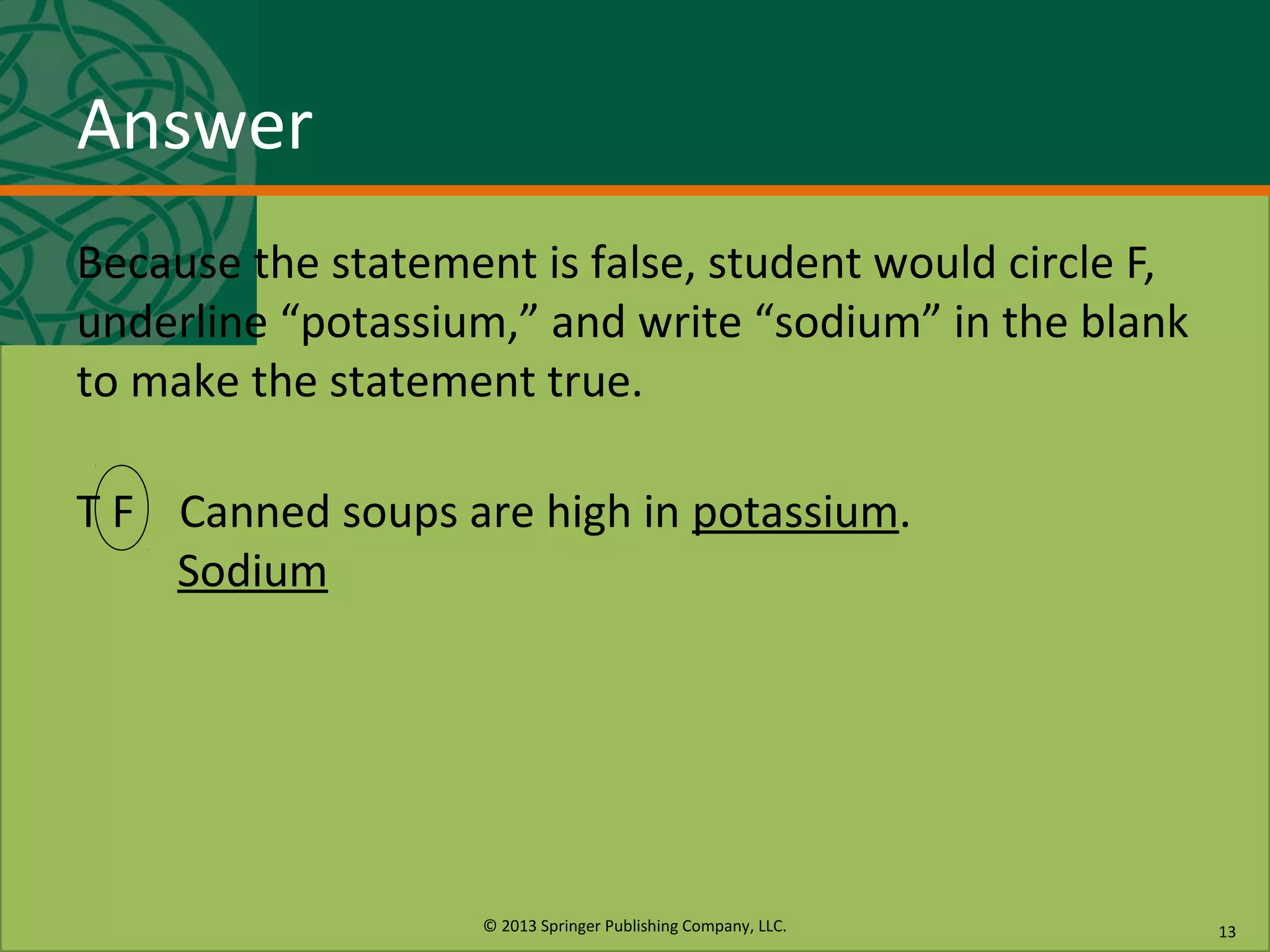
Answer
Because the statement is false, student would circle F,
underline “potassium,” and write “sodium” in the blank
to make the statement true.
T F Canned soups are high in potassium.
Sodium
13
© 2013 Springer Publishing Company, LLC.
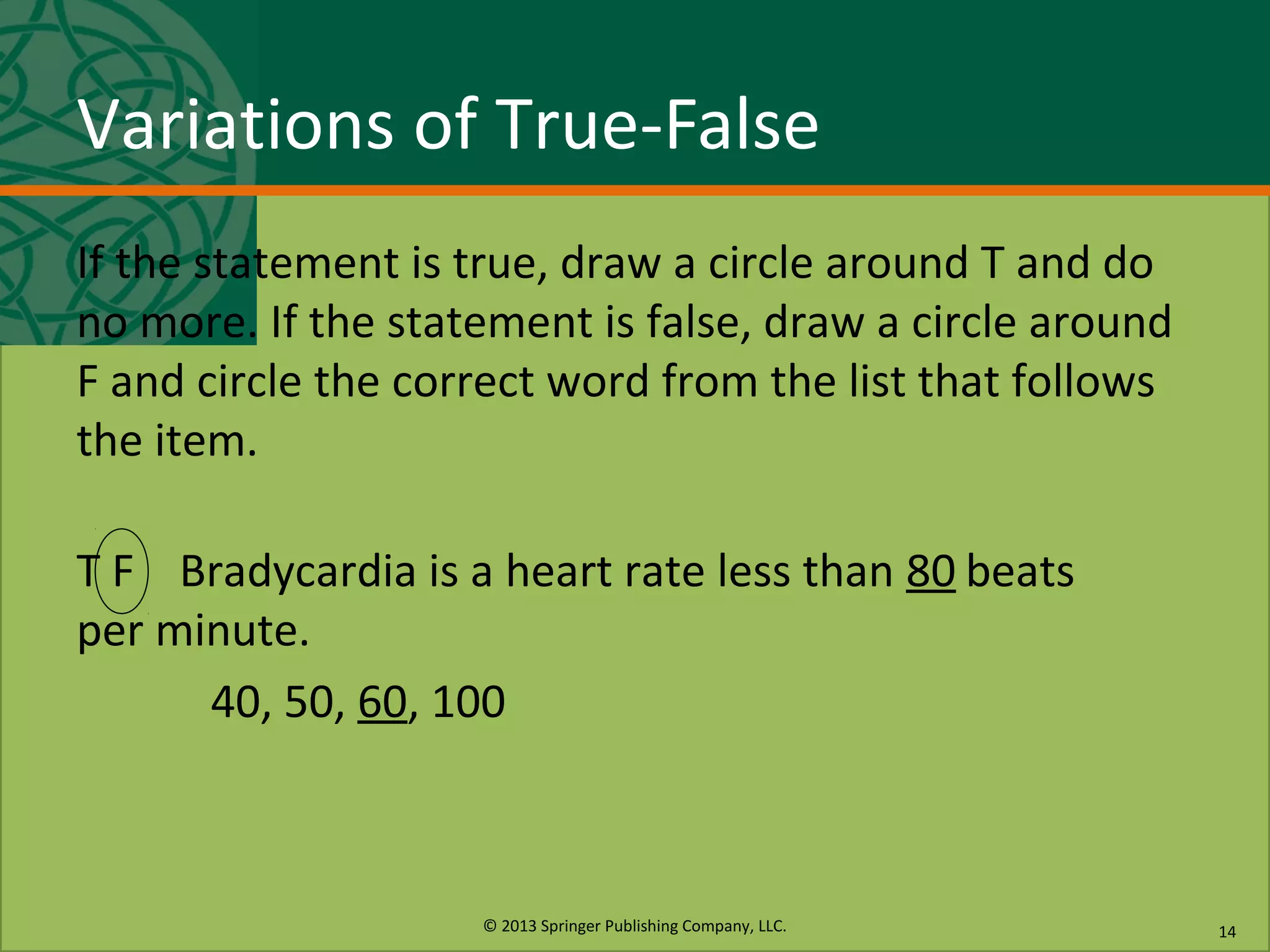
Variations of True-False
If the statement is true, draw a circle around T and do
no more. If the statement is false, draw a circle around
F and circle the correct word from the list that follows
the item.
T F Bradycardia is a heart rate less than 80 beats
per minute.
40, 50, 60, 100
14
© 2013 Springer Publishing Company, LLC.
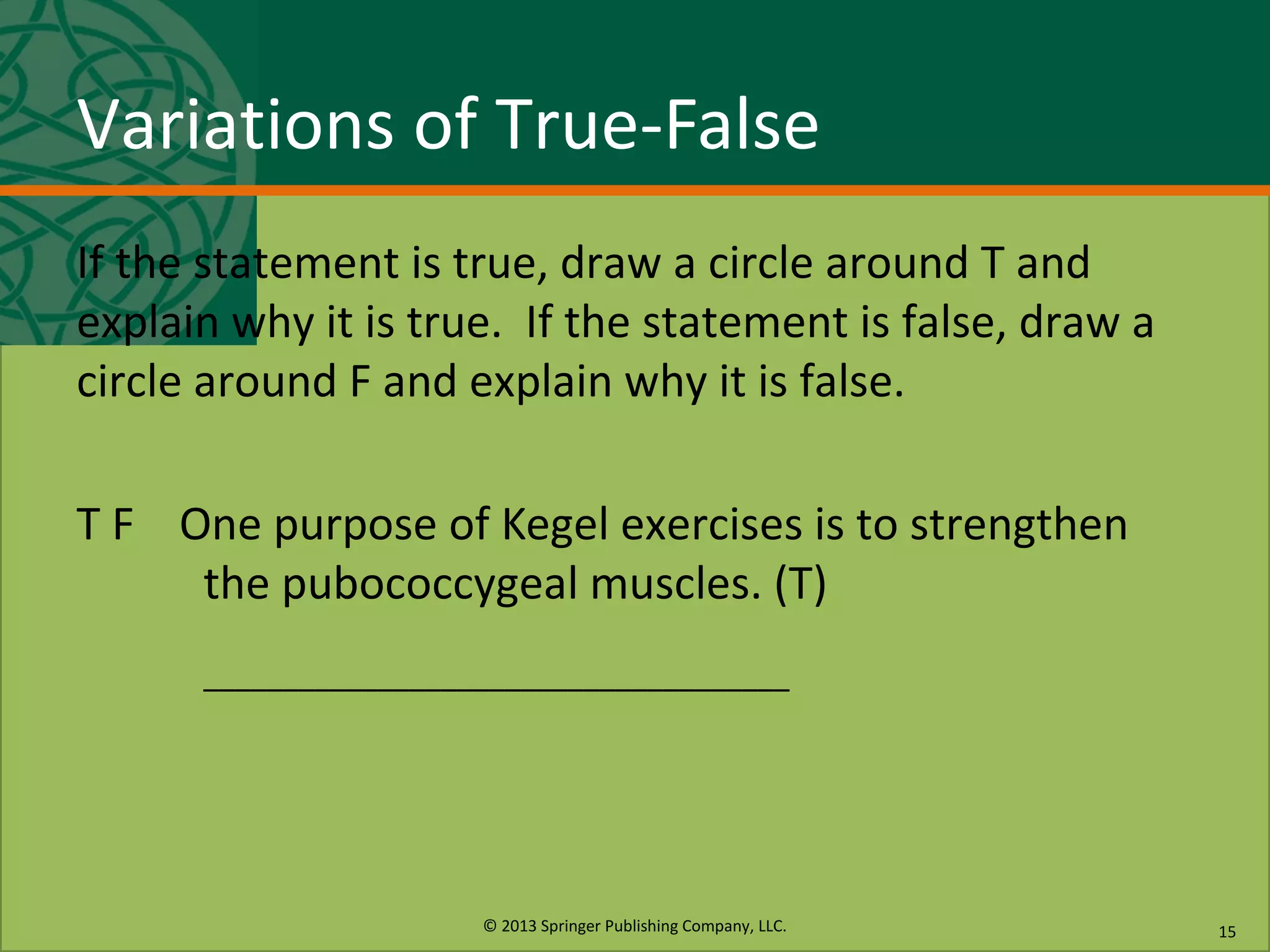
Variations of True-False
If the statement is true, draw a circle around T and
explain why it is true. If the statement is false, draw a
circle around F and explain why it is false.
T F One purpose of Kegel exercises is to strengthen
the pubococcygeal muscles. (T)
–––––––––––––––––––––––––––––––––––––
15
© 2013 Springer Publishing Company, LLC.
Matching Exercise
♦ Short lists of similar items to be matched
♦ Usually tests lower cognitive levels
♦ Designed for categories and classifications
♦ Directions should indicate basis for matching
16
© 2013 Springer Publishing Company, LLC.
Matching Exercise (cont’d)
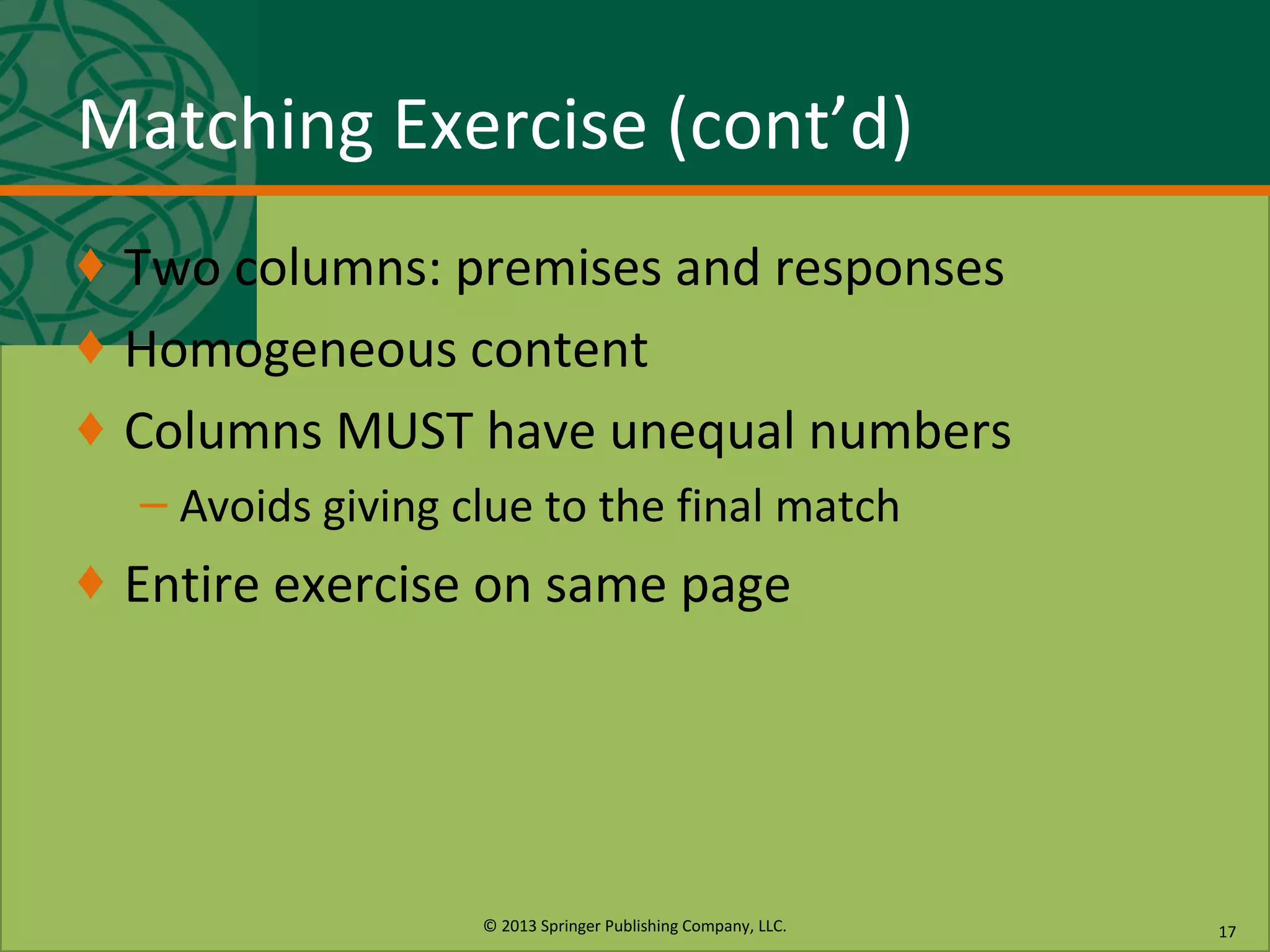
♦ Two columns: premises and responses
♦ Homogeneous content
♦ Columns MUST have unequal numbers
– Avoids giving clue to the final match
♦ Entire exercise on same page
17
© 2013 Springer Publishing Company, LLC.
Matching Exercise (cont’d)
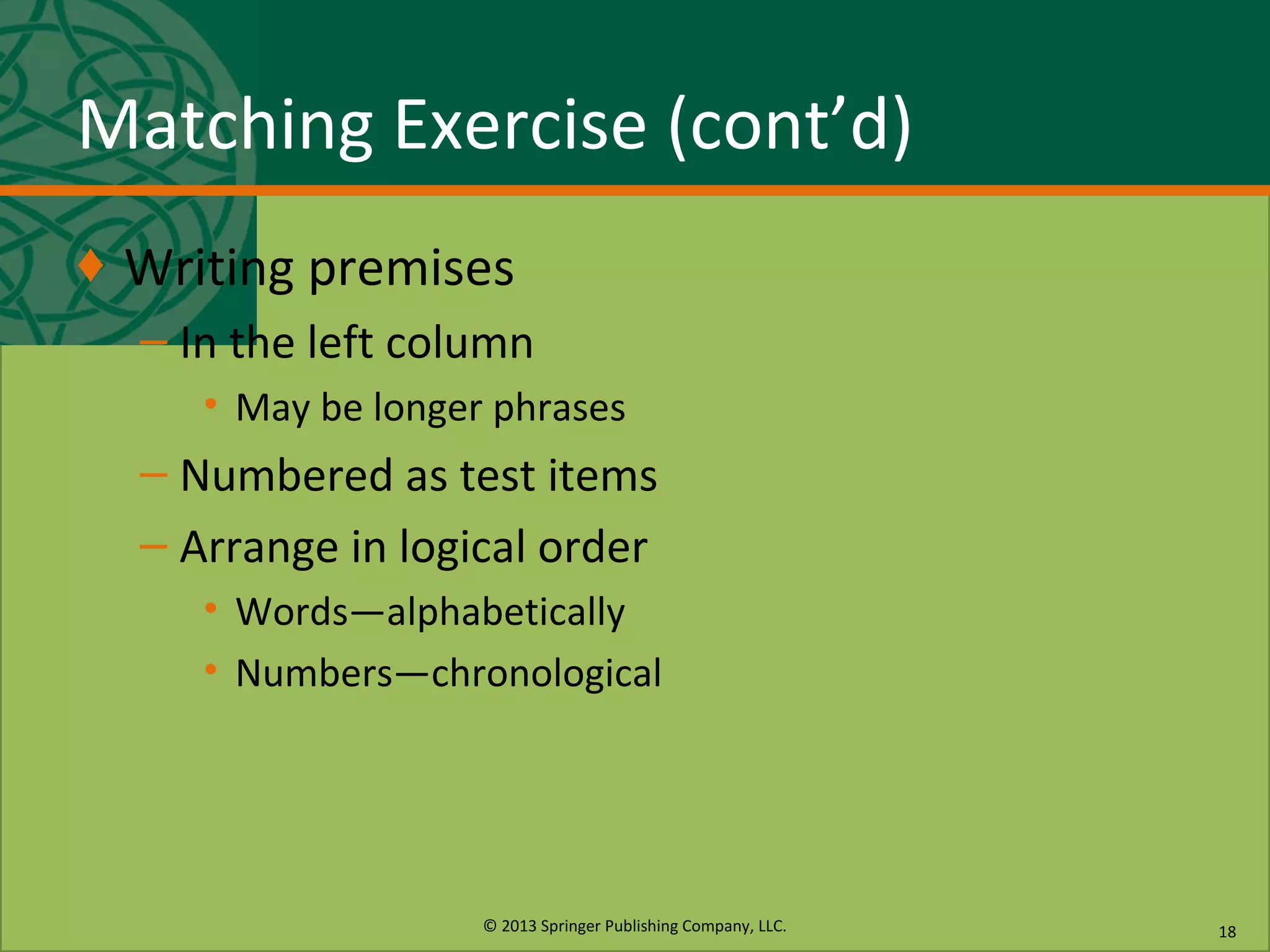
♦ Writing premises
– In the left column
• May be longer phrases
– Numbered as test items
– Arrange in logical order
• Words—alphabetically
• Numbers—chronological
18
© 2013 Springer Publishing Company, LLC.
Matching Exercise (cont’d)
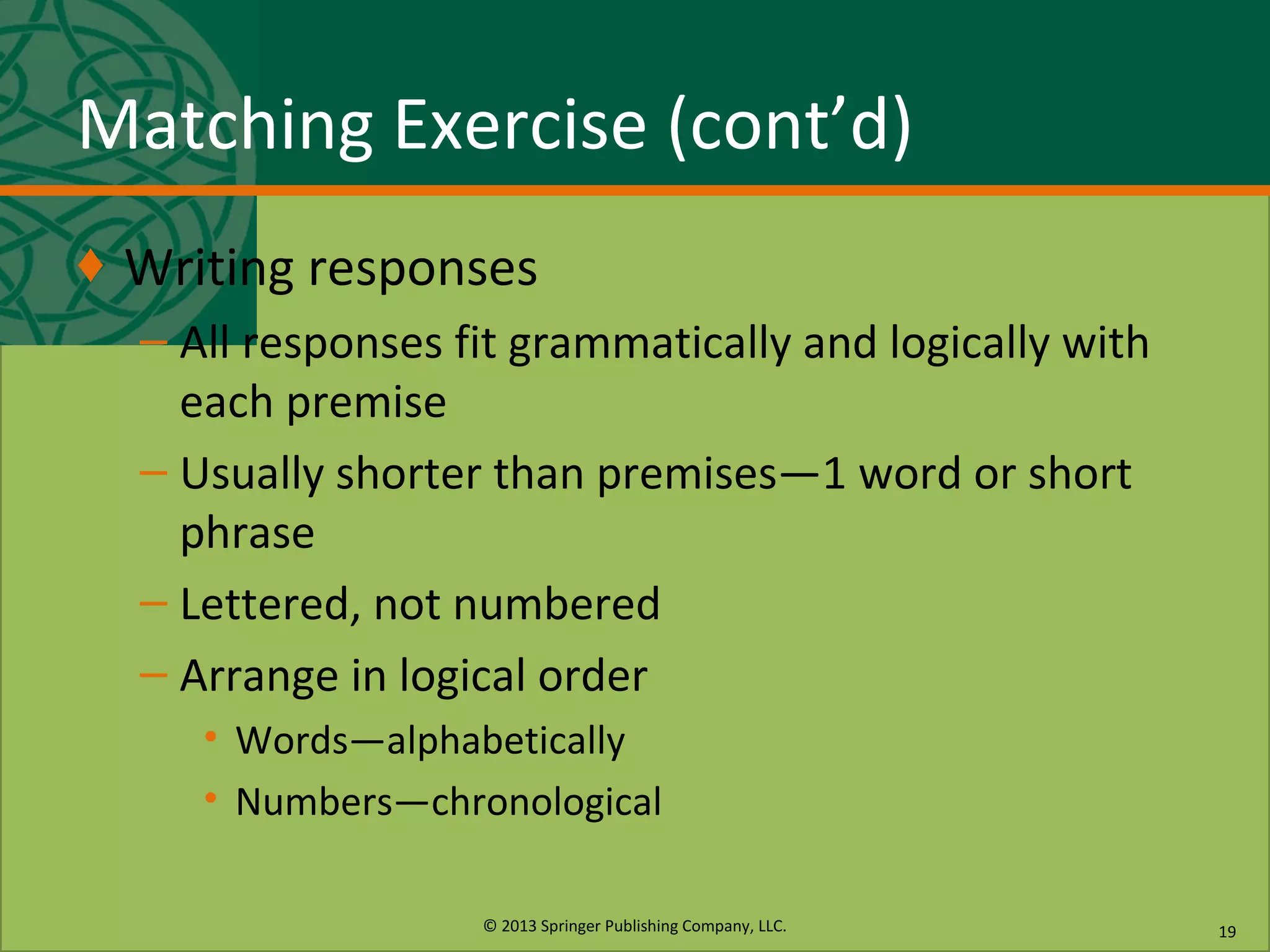
♦ Writing responses
– All responses fit grammatically and logically with
each premise
– Usually shorter than premises—1 word or short
phrase
– Lettered, not numbered
– Arrange in logical order
• Words—alphabetically
• Numbers—chronological
19
© 2013 Springer Publishing Company, LLC.
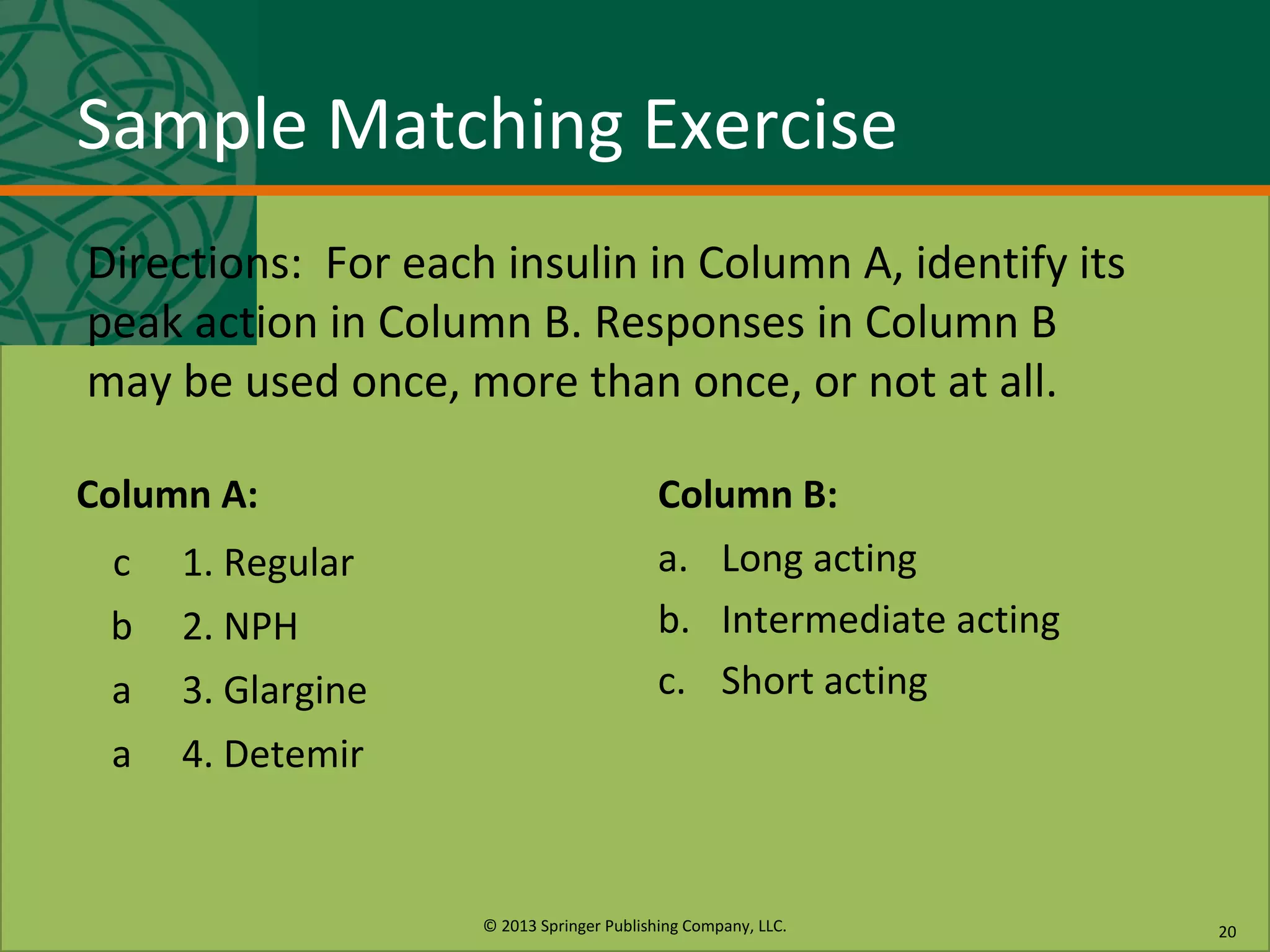
Sample Matching Exercise
Column A: Column B:
a. Long acting
b. Intermediate acting
c. Short acting
Directions: For each insulin in Column A, identify its
peak action in Column B. Responses in Column B
may be used once, more than once, or not at all.
c 1. Regular
b 2. NPH
a 3. Glargine
a 4. Detemir
20

Chapter 4 ppt eval & testing 4e formatted 01.10 mo edits

  • 1.
    © 2013 SpringerPublishing Company, LLC. Chapter 4 True-False and Matching &Oermann Gaberson Evaluation and Testing in Nursing Education 4th edition
  • 2.
    © 2013 SpringerPublishing Company, LLC. Classifying Test Items ♦ By how they are scored – Objectively, e.g., multiple-choice – Subjectively, e.g., essay ♦ By type of response – Selected response, e.g., multiple-choice – Constructed response, e.g., essay 2
  • 3.
    © 2013 SpringerPublishing Company, LLC. True-False ♦ Tests knowledge and recall of facts – Higher level if rationale for answer is required 3
  • 4.
    © 2013 SpringerPublishing Company, LLC. True-False (cont’d) Advantages • Efficient – Can answer many items in less time – Can test wide range of content • Easy to construct • Easy to score Disadvantages • 50% probability of guessing correctly – Per item – Most students don’t guess blindly for every item – Probability decreases with number of T-F items 4
  • 5.
    © 2013 SpringerPublishing Company, LLC. Writing True-False Items ♦ Focus on facts or content to be learned ♦ Test knowledge of important information, not trivia ♦ Test understanding of content, not memorization of specific word (unless focus is definitions) ♦ Unconditionally true or false – Cite an authority if relevant 5
  • 6.
    © 2013 SpringerPublishing Company, LLC. Writing True-False Items (cont’d) ♦ Avoid words such as “some,” “usually,” “all,” or “never” ♦ Item should test a single fact or idea ♦ True and false statements should be approximately the same length ♦ Write equal number or slightly more false than true statements ♦ Avoid confusing negatives 6
  • 7.
    © 2013 SpringerPublishing Company, LLC. Avoid Confusing Negatives It is not normal for a 2-year-old to demonstrate hand-preference. (True) vs. It is normal for a 2-year-old to demonstrate hand-preference. (False) 7
  • 8.
    © 2013 SpringerPublishing Company, LLC. Sample True-False Items For each of the following statements, circle T if the statement is true and F if the statement is false. T F Type 1 diabetes was formerly called insulin- dependent diabetes. (T) T F Hypothyroidism is manifested by lethargy and fatigue. (T) T F The most common form of congenital heart defect in children is tetralogy of Fallot. (F) 8
  • 9.
    © 2013 SpringerPublishing Company, LLC. Variations of True-False Format ♦ Correct false statements ♦ Include rationale for responses whether true or false ♦ Multiple true-false 9
  • 10.
    © 2013 SpringerPublishing Company, LLC. Sample Items If the statement is true, draw a circle around T and do no more. If the statement is false, draw a circle around F and underline the word or phrase that makes it false. T F Tetany occurs with increased levels of calcium. 10
  • 11.
    © 2013 SpringerPublishing Company, LLC. Answer Because this statement is false, student would circle F and underline “increased.” T F Tetany occurs with increased levels of calcium. 11
  • 12.
    © 2013 SpringerPublishing Company, LLC. Variations of True-False If the statement is true, draw a circle around T and do no more. If the statement is false, draw a circle around F, underline the word or phrase that makes it false, and write in the blank the word or phrase that would make it true. T F Canned soups are high in potassium. __________ 12
  • 13.
    © 2013 SpringerPublishing Company, LLC. Answer Because the statement is false, student would circle F, underline “potassium,” and write “sodium” in the blank to make the statement true. T F Canned soups are high in potassium. Sodium 13
  • 14.
    © 2013 SpringerPublishing Company, LLC. Variations of True-False If the statement is true, draw a circle around T and do no more. If the statement is false, draw a circle around F and circle the correct word from the list that follows the item. T F Bradycardia is a heart rate less than 80 beats per minute. 40, 50, 60, 100 14
  • 15.
    © 2013 SpringerPublishing Company, LLC. Variations of True-False If the statement is true, draw a circle around T and explain why it is true. If the statement is false, draw a circle around F and explain why it is false. T F One purpose of Kegel exercises is to strengthen the pubococcygeal muscles. (T) ––––––––––––––––––––––––––––––––––––– 15
  • 16.
    © 2013 SpringerPublishing Company, LLC. Matching Exercise ♦ Short lists of similar items to be matched ♦ Usually tests lower cognitive levels ♦ Designed for categories and classifications ♦ Directions should indicate basis for matching 16
  • 17.
    © 2013 SpringerPublishing Company, LLC. Matching Exercise (cont’d) ♦ Two columns: premises and responses ♦ Homogeneous content ♦ Columns MUST have unequal numbers – Avoids giving clue to the final match ♦ Entire exercise on same page 17
  • 18.
    © 2013 SpringerPublishing Company, LLC. Matching Exercise (cont’d) ♦ Writing premises – In the left column • May be longer phrases – Numbered as test items – Arrange in logical order • Words—alphabetically • Numbers—chronological 18
  • 19.
    © 2013 SpringerPublishing Company, LLC. Matching Exercise (cont’d) ♦ Writing responses – All responses fit grammatically and logically with each premise – Usually shorter than premises—1 word or short phrase – Lettered, not numbered – Arrange in logical order • Words—alphabetically • Numbers—chronological 19
  • 20.
    © 2013 SpringerPublishing Company, LLC. Sample Matching Exercise Column A: Column B: a. Long acting b. Intermediate acting c. Short acting Directions: For each insulin in Column A, identify its peak action in Column B. Responses in Column B may be used once, more than once, or not at all. c 1. Regular b 2. NPH a 3. Glargine a 4. Detemir 20