....Linking Learners Everywhere © 2021 All Rights Reserved
BUSINESS STATISTICS FOR
DECISION MAKING
COURSE CODE: MAT504
Hypothesis Testing &
Confidence Interval
ICDE
LECTURE SLIDE 4
BY
S. K. OKRAH (PhD)
0245899021
sokrah@gctu.edu.gh
Outline
• Introduction
• Steps in Hypothesis Testing
• Large Sample Mean Test
• Small Sample Mean Test
• Proportion Test
Objectives
• Guide students to understand the
definitions used in hypothesis testing.
• State the null and alternative hypotheses.
• Find critical values for the z test.
Objectives
• State the five steps used in hypothesis
testing.
• Test means for large samples using the z
test.
• Test means for small samples using the t
test.
Steps in Hypothesis Testing
 A Statistical hypothesis is a conjecture about a population parameter. This
conjecture may or may not be true.
• Eg.1 If we want to find out whether one method is better than the other, we
first make the statement of no difference. This first statement will be;
• “There is no difference between the two methods.”
• The second statement will be;
• “There is difference between the two methods.”
• Eg.2 In criminal proceedings, the accused is assumed to be innocent unless
his guilt is established beyond reasonable doubt.
 The null hypothesis, symbolized by H0, is a statistical hypothesis that states
that there is no difference between a parameter and a specific value or that
there is no difference between two parameters.
Steps in Hypothesis Testing
 The alternative hypothesis, symbolized by H1, is
a statistical hypothesis that states a specific
difference between a parameter and a specific
value or states that there is a difference between
two parameters.
• Thus, for eg.2,
• H0: The accused is not guilty.
• H1: The accused is guilty.
• For eg.1
• H0: There is no difference between the two methods.
• H1: There is difference between the two methods.
Steps in Hypothesis Testing
• In statistical hypothesis testing, one of the
statements is accepted. Note that in concluding
hypothesis testing, we either reject H0 or we fail
to reject H0 (we don’t say that we accept H1
even though rejecting H0 means accepting H1).
• Example
• A business researcher is interested in finding
out whether a new marketing strategy will have
any effects on customers. The researcher is
particularly concerned with the success rate of
the strategy.
Steps in Hypothesis Testing - Example
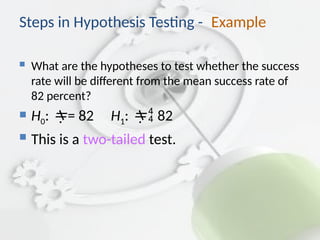
 What are the hypotheses to test whether the success
rate will be different from the mean success rate of
82 percent?
 H0: = 82 H1:  82
 This is a two-tailed test.
Steps in Hypothesis Testing - Example
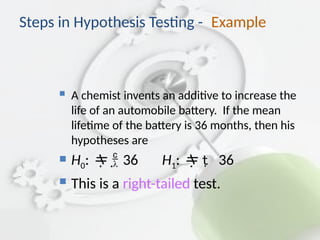
 A chemist invents an additive to increase the
life of an automobile battery. If the mean
lifetime of the battery is 36 months, then his
hypotheses are
 H0:  
 36 H1:   36
 This is a right-tailed test.
Steps in Hypothesis Testing - Example
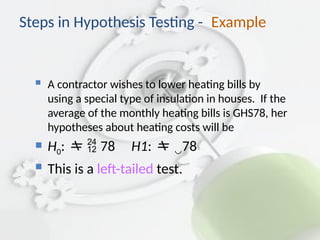
 A contractor wishes to lower heating bills by
using a special type of insulation in houses. If the
average of the monthly heating bills is GHS78, her
hypotheses about heating costs will be
 H0:  78 H1: 78
 This is a left-tailed test.
Steps in Hypothesis Testing
 A statistical test uses the data obtained
from a sample to make a decision about
whether or not the null hypothesis should
be rejected.
Steps in Hypothesis Testing
 The numerical value obtained from a
statistical test is called the test value.
 In the hypothesis-testing situation,
there are four possible outcomes.
Steps in Hypothesis Testing
• In reality, the null hypothesis may or may not be
true, and a decision is made to reject or not to
reject it on the basis of the data obtained from a
sample.
• These decisions may mean two types of error.
• 1. It is possible that H0 may be rejected when in
actual fact H0 is true (i.e. One possible error).
• 2. It is also possible that H0 may not be rejected
when in actual fact H0 is false.
• The first (1) is known as TYPE I ERROR and the
second (2) is known as TYPE II ERROR.
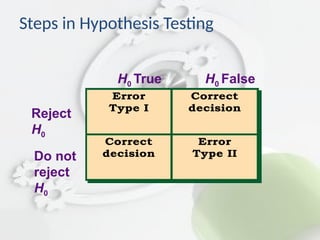
Steps in Hypothesis Testing
Error
Type I
Correct
decision
Correct
decision
Error
Type II
Error
Type I
Correct
decision
Correct
decision
Error
Type II
H0 True H0 False
Reject
H0
Do not
reject
H0
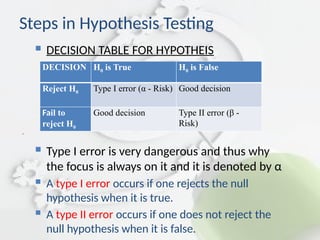
 DECISION TABLE FOR HYPOTHEIS
 Type I error is very dangerous and thus why
the focus is always on it and it is denoted by α
 A type I error occurs if one rejects the null
hypothesis when it is true.
 A type II error occurs if one does not reject the
null hypothesis when it is false.
Steps in Hypothesis Testing
DECISION H0 is True H0 is False
Reject H0 Type I error (α - Risk) Good decision
Fail to
reject H0
Good decision Type II error (β -
Risk)
.
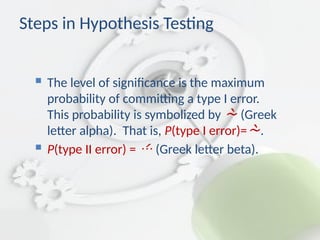
 The level of significance is the maximum
probability of committing a type I error.
This probability is symbolized by  (Greek
letter alpha). That is, P(type I error)=.
 P(type II error) =  (Greek letter beta).
Steps in Hypothesis Testing
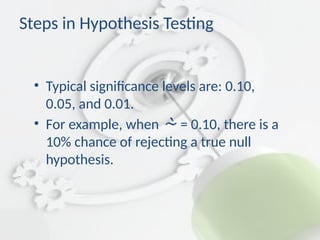
• Typical significance levels are: 0.10,
0.05, and 0.01.
• For example, when  = 0.10, there is a
10% chance of rejecting a true null
hypothesis.
Steps in Hypothesis Testing
 The critical value(s) separates the
critical region from the noncritical
region.
 The symbol for critical value is C.V.
Steps in Hypothesis Testing
 The critical or rejection region is the
range of values of the test value that
indicates that there is a significant
difference and that the null hypothesis
should be rejected.
Steps in Hypothesis Testing
 The noncritical or nonrejection region is
the range of values of the test value
that indicates that the difference was
probably due to chance and that the
null hypothesis should not be rejected.
Steps in Hypothesis Testing
 A one-tailed test (right or left) indicates
that the null hypothesis should be
rejected when the test value is in the
critical region on one side of the mean.
Steps in Hypothesis Testing
Large Sample Mean Test
 The z test is a statistical test for the
mean of a population. It can be used
when n  30, or when the population
is normally distributed and  is
known.
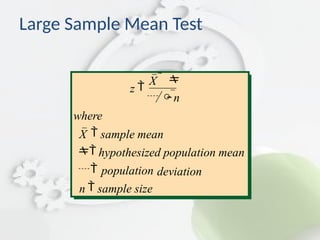
 The formula for the z test is given on
the next slide.
Large Sample Mean Test
z
X
n
where
X sample mean
hypothesized population mean
population deviation
n sample size










• A researcher reports that the average salary of
assistant professors is more than GHS42,000. A
sample of 30 assistant professors has a mean
salary of GHS43,260. At  = 0.05, test the
claim that assistant professors earn more than
GHS42,000 a year. The standard deviation of
the population is GHS5230.
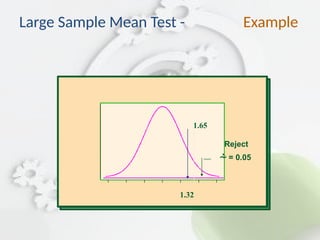
Large Sample Mean Test - Example
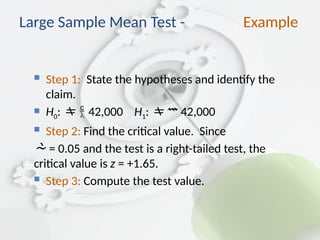
 Step 1: State the hypotheses and identify the
claim.
 H0: 42,000 H1:  42,000
 Step 2: Find the critical value. Since
 = 0.05 and the test is a right-tailed test, the
critical value is z = +1.65.
 Step 3: Compute the test value.
Large Sample Mean Test - Example
 Step 3: z = [43,260 – 42,000]/[5230/30] =
1.32.
 Step 4: Make the decision. Since the test value,
+1.32, is less than the critical value, +1.65, and
not in the critical region, the decision is “Do not
reject the null hypothesis.”
Large Sample Mean Test - Example
 Step 5: Summarize the results. There is not
enough evidence to support the claim that
assistant professors earn more on average than
GHS42,000 a year.
 See the next slide for the figure.
Large Sample Mean Test - Example
1.65
1.32
 = 0.05
Reject
• A national magazine claims that the average
university student watches less television than
the general public. The national average is 29.4
hours per week, with a standard deviation of 2
hours. A sample of 30 university students has a
mean of 27 hours. Is there enough evidence to
support the claim at
 = 0.01?
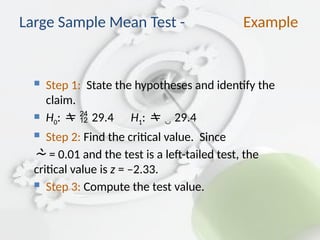
Large Sample Mean Test - Example
 Step 1: State the hypotheses and identify the
claim.
 H0: 29.4 H1:  29.4
 Step 2: Find the critical value. Since
 = 0.01 and the test is a left-tailed test, the
critical value is z = –2.33.
 Step 3: Compute the test value.
Large Sample Mean Test - Example
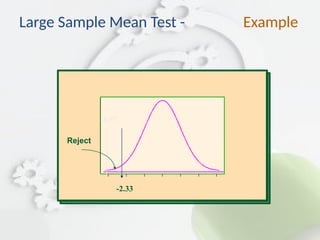
 Step 3: z = [27– 29.4]/[2/30] = –6.57.
 Step 4: Make the decision. Since the test value,
–6.57, falls in the critical region, the decision is
to reject the null hypothesis.
Large Sample Mean Test - Example
 Step 5: Summarize the results. There is enough
evidence to support the claim that university
students watch less television than the general
public.
 See the next slide for the figure.
Large Sample Mean Test - Example
-6.57
-2.33
Reject
• The Ghana Health Service reports that the
average cost of rehabilitation for stroke victims
is GHS24,672. To see if the average cost of
rehabilitation is different at a large hospital, a
researcher selected a random sample of 35
stroke victims and found that the average cost
of their rehabilitation is GHS25,226.
Large Sample Mean Test - Example
 The standard deviation of the population is
GHS3,251. At  = 0.01, can it be concluded
that the average cost at a large hospital is
different from GHS24,672?
 Step 1: State the hypotheses and identify the
claim.
 H0: 24,672 H1:  24,672
Large Sample Mean Test - Example
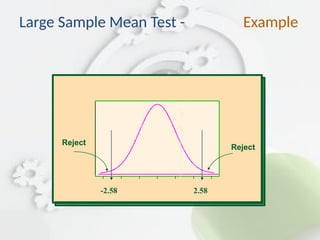
 Step 2: Find the critical values. Since  =
0.01 and the test is a two-tailed test, the critical
values are z = –2.58 and +2.58.
 Step 3: Compute the test value.
 Step 3: z = [25,226 – 24,672]/[3,251/35] =
1.01.
Large Sample Mean Test - Example
 Step 4: Make the decision. Do not reject the
null hypothesis, since the test value falls in the
noncritical region.
 Step 5: Summarize the results. There is not
enough evidence to support the claim that the
average cost of rehabilitation at the large
hospital is different from GHS24,672.
Large Sample Mean Test - Example
-2.58
Reject
2.58

Reject
P-Values
• Besides listing an  value, many computer
statistical packages give a P-value for
hypothesis tests. The P-value is the actual
probability of getting the sample mean value
or a more extreme sample mean value in the
direction of the alternative hypothesis (> or <)
if the null hypothesis is true.
P-Values
• If the P-value is less than  , the null
hypothesis should be rejected
• And if P-value is greater than or equal to ,

you should fail to reject the null hypothesis.
 When the population standard deviation is
unknown and n < 30, the z test is inappropriate
for testing hypotheses involving means.
 The t test is used in this case.
Small Sample Mean Test
Small Sample Mean Test - Formula for t test
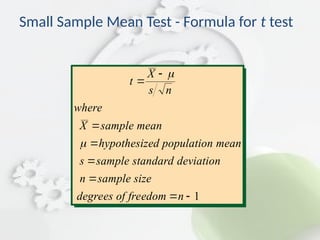
t
X
s n
where
X sample mean
hypothesized population mean
s sample deviation
n sample size
of freedom n






 


standard
degrees 1
• A job placement director claims that the
average starting salary for bankers is different
from GHS24,000. A sample of 10 bankers has a
mean of GHS23,450 and a standard deviation
of GHS400. Is there enough evidence to reject
the director’s claim at  = 0.05?
Small Sample Mean Test - Example
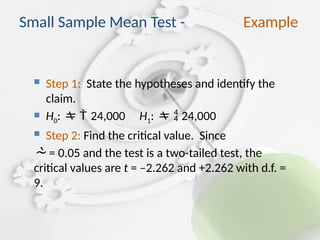
 Step 1: State the hypotheses and identify the
claim.
 H0: 24,000 H1:  24,000
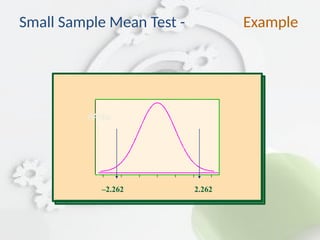
 Step 2: Find the critical value. Since
 = 0.05 and the test is a two-tailed test, the
critical values are t = –2.262 and +2.262 with d.f. =
9.
Small Sample Mean Test - Example
 Step 3: Compute the test value.
t = [23,450 – 24,000]/[400/] = – 4.35.
 Step 4: Reject the null hypothesis, since
– 4.35 < – 2.262.
 Step 5: There is enough evidence to reject the
claim that the starting salary of nurses is
24,000.
Small Sample Mean Test - Example
–2.262 2.262

• Since the normal distribution can be used to
approximate the binomial distribution when np
5 and nq 5, the standard normal
distribution can be used to test hypotheses for
proportions.
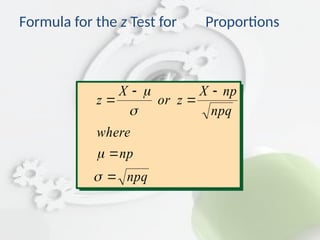
• The formula for the z test for proportions is
given on the next slide.
Proportion Test
Formula for the z Test for Proportions
z
X
or z
X np
npq
where
np
npq










• An educator estimates that the dropout rate for
students at senior high schools in Ghana is
15%. Last year, 38 students from a random
sample of 200 senior high schools withdrew. At
 = 0.05, is there enough evidence to reject
the educator’s claim?
Proportion Test - Example
 Step 1: State the hypotheses and identify the claim.
 H0: p0.15 H1: p 0.15
 Step 2: Find the mean and standard deviation.  =
np = (200)(0.15) = 30 and
 = [
  (200)(0.15)(0.85)] = 5.05.
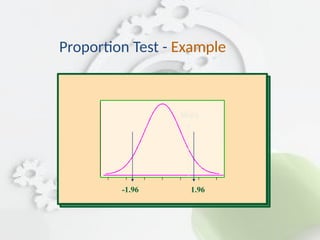
 Step 3: Find the critical values. Since
 = 0.05 and the test is two-tailed the critical
values are z = 1.96.
Proportion Test - Example
 Step 4: Compute the test value. z =
[38 – 30]/[5.05] = 1.58.
 Step 5: Do not reject the null hypothesis,
since the test value falls outside the critical
region.
Proportion Test - Example
 Step 6: Summarize the results. There is not
enough evidence to reject the claim that the
dropout rate for students in senior high schools
in Ghana is 15%.
 Note: For one-tailed test for proportions,
follow procedures for the large sample mean
test.
Proportion Test - Example
-1.96 1.96

Confidence Intervals and Sample Size
Outline
• Introduction
• Confidence Intervals for the Mean [
Known or n 30] and Sample Size
• Confidence Intervals for the Mean [
Unknown and n 30]
Outline
• Confidence Intervals and Sample Size for
Proportions
• Confidence Intervals for Variances and
Standard Deviations
Objectives
• Find the confidence interval for the
mean when  is known or n 30.
• Determine the minimum sample size for
finding a confidence interval for the
mean.
Objectives
• Find the confidence interval for the mean when  is
unknown and n 30.
• Find the confidence interval for a proportion.
• Determine the minimum sample size for finding a
confidence interval for a proportion.
• Find a confidence interval for a variance and a standard
deviation.
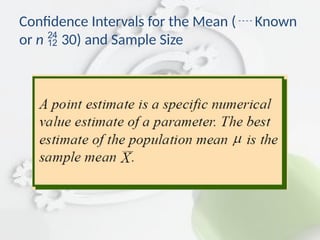
Confidence Intervals for the Mean ( Known
or n  30) and Sample Size
 The estimator must be an unbiased estimator.
That is, the expected value or the mean of the
estimates obtained from samples of a given
size is equal to the parameter being estimated.
Three Properties of a Good Estimator
 The estimator must be consistent. For a
consistent estimator, as sample size
increases, the value of the estimator
approaches the value of the parameter
estimated.
Three Properties of a Good Estimator
 The estimator must be a relatively
efficient estimator. That is, of all the
statistics that can be used to estimate a
parameter, the relatively efficient
estimator has the smallest variance.
Three Properties of a Good Estimator
Confidence Intervals
 An interval estimate of a parameter is an
interval or a range of values used to
estimate the parameter. This estimate
may or may not contain the value of the
parameter being estimated.
Confidence Intervals
 A confidence interval is a specific
interval estimate of a parameter
determined by using data obtained from
a sample and the specific confidence
level of the estimate.
Confidence Intervals
 The confidence level of an interval
estimate of a parameter is the
probability that the interval estimate will
contain the parameter.
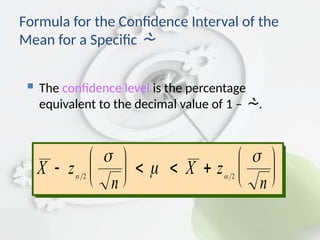
 The confidence level is the percentage
equivalent to the decimal value of 1 – .
Formula for the Confidence Interval of the
Mean for a Specific 
X z
n
X z
n






   






 



2 2
 The maximum error of estimate is the
maximum difference between the point
estimate of a parameter and the actual
value of the parameter.
Maximum Error of Estimate
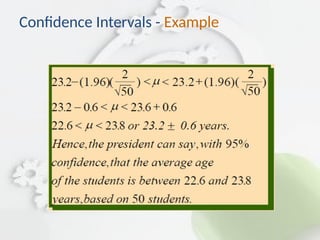
• The VC of a large university wishes to estimate the
average age of the students presently enrolled.
From past studies, the standard deviation is
known to be 2 years. A sample of 50 students is
selected, and the mean is found to be 23.2 years.
Find the 95% confidence interval of the
population mean.
Confidence Intervals - Example
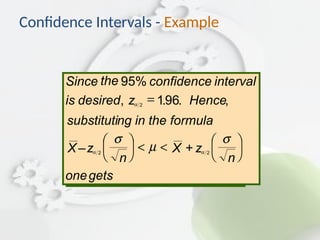
Since the confidence
is desired z Hence
substituting in the formula
X z
n
X z
n
onegets
, ,
– +
2
95%
196
2 2
interval
a
a a
s
m
s
=
æ
è
ç
ö
ø
÷ < < æ
è
ç
ö
ø
÷
. .
Confidence Intervals - Example
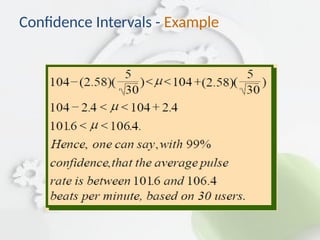
• A certain medication is known to increase
the pulse rate of its users. The standard
deviation of the pulse rate is known to be 5
beats per minute. A sample of 30 users had
an average pulse rate of 104 beats per
minute. Find the 99% confidence interval
of the true mean.
Confidence Intervals - Example
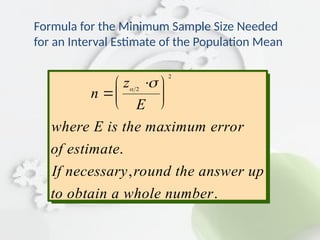
Formula for the Minimum Sample Size Needed
for an Interval Estimate of the Population Mean
.
,
.
n
z
E
where E is the error
of estimate
If necessary round the answer up
to obtain a whole number










2
2
maximum
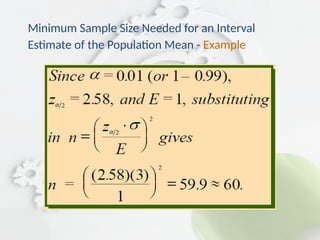
• The VC of a university wants to estimate the
average age of the students at their university.
How large a sample is necessary? He decides the
estimate should be accurate within 1 year and be
99% confident. From a previous study, the
standard deviation of the ages is known to be 3
years.
Minimum Sample Size Needed for an Interval
Estimate of the Population Mean - Example
Minimum Sample Size Needed for an Interval
Estimate of the Population Mean - Example
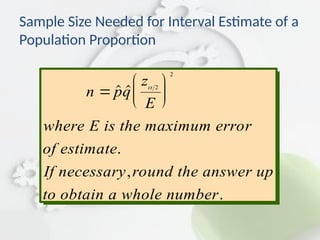
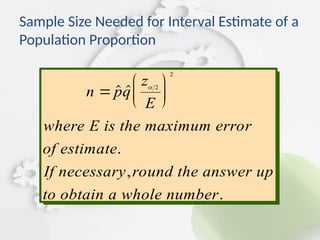
.
,
.
n pq
z
E
where E is the error
of estimate
If necessary round the answer up
to obtain a whole number







   2
2
maximum
Sample Size Needed for Interval Estimate of a
Population Proportion
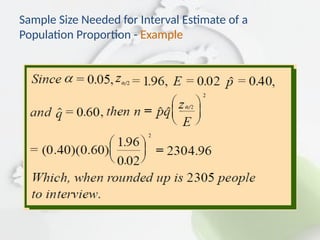
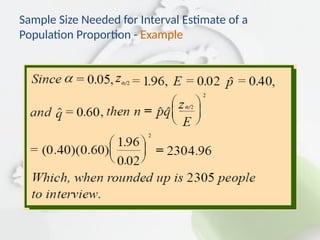
• A researcher wishes to estimate, with 95%
confidence, the number of people who own a
home computer. A previous study shows that
40% of those interviewed had a computer at
home. The researcher wishes to be accurate
within 2% of the true proportion. Find the
minimum sample size necessary.
Sample Size Needed for Interval Estimate of a
Population Proportion - Example
Sample Size Needed for Interval Estimate of a
Population Proportion - Example
• Ten randomly selected automobiles were
stopped, and the tread depth of the right
front tire was measured. The mean was 0.32
inch, and the standard deviation was 0.08
inch. Find the 95% confidence interval of the
mean depth. Assume that the variable is
approximately normally distributed.
Confidence Interval for the Mean
( Unknown and n < 30) - Example
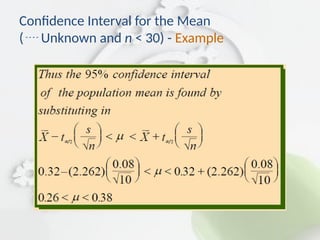
• Since  is unknown and s must replace it,
the t distribution must be used with
 = 0.05. Hence, with 9 degrees of freedom,
t/2 = 2.262 (see the t-distribution Table).
• From the next slide, we can be 95% confident
that the population mean is between 0.26
and 0.38.
Confidence Interval for the Mean
( Unknown and n < 30) - Example
Confidence Interval for the Mean
( Unknown and n < 30) - Example
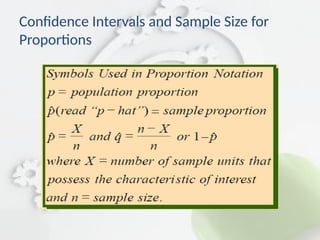
Confidence Intervals and Sample Size for
Proportions
Confidence Intervals and Sample Size for
Proportions - Example
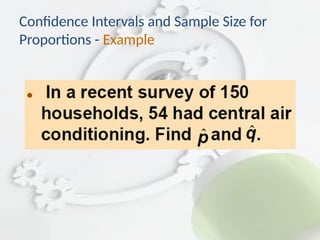
p̂ q̂
Confidence Intervals and Sample Size for
Proportions - Example
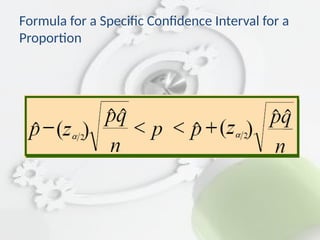
Formula for a Specific Confidence Interval for a
Proportion
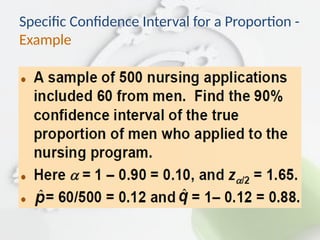
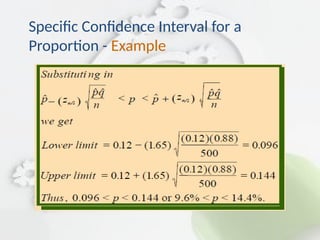
Specific Confidence Interval for a Proportion -
Example
Specific Confidence Interval for a
Proportion - Example
.
,
.
n pq
z
E
where E is the error
of estimate
If necessary round the answer up
to obtain a whole number







   2
2
maximum
Sample Size Needed for Interval Estimate of a
Population Proportion
• A researcher wishes to estimate, with 95%
confidence, the number of people who own a
home computer. A previous study shows that
40% of those interviewed had a computer at
home. The researcher wishes to be accurate
within 2% of the true proportion. Find the
minimum sample size necessary.
Sample Size Needed for Interval Estimate of a
Population Proportion - Example
Sample Size Needed for Interval Estimate of a
Population Proportion - Example

Hypothesis Testing & Confidence Interval.pptx

  • 1.
    ....Linking Learners Everywhere© 2021 All Rights Reserved BUSINESS STATISTICS FOR DECISION MAKING COURSE CODE: MAT504 Hypothesis Testing & Confidence Interval ICDE LECTURE SLIDE 4 BY S. K. OKRAH (PhD) 0245899021 sokrah@gctu.edu.gh
  • 2.
    Outline • Introduction • Stepsin Hypothesis Testing • Large Sample Mean Test • Small Sample Mean Test • Proportion Test
  • 3.
    Objectives • Guide studentsto understand the definitions used in hypothesis testing. • State the null and alternative hypotheses. • Find critical values for the z test.
  • 4.
    Objectives • State thefive steps used in hypothesis testing. • Test means for large samples using the z test. • Test means for small samples using the t test.
  • 5.
    Steps in HypothesisTesting  A Statistical hypothesis is a conjecture about a population parameter. This conjecture may or may not be true. • Eg.1 If we want to find out whether one method is better than the other, we first make the statement of no difference. This first statement will be; • “There is no difference between the two methods.” • The second statement will be; • “There is difference between the two methods.” • Eg.2 In criminal proceedings, the accused is assumed to be innocent unless his guilt is established beyond reasonable doubt.  The null hypothesis, symbolized by H0, is a statistical hypothesis that states that there is no difference between a parameter and a specific value or that there is no difference between two parameters.
  • 6.
    Steps in HypothesisTesting  The alternative hypothesis, symbolized by H1, is a statistical hypothesis that states a specific difference between a parameter and a specific value or states that there is a difference between two parameters. • Thus, for eg.2, • H0: The accused is not guilty. • H1: The accused is guilty. • For eg.1 • H0: There is no difference between the two methods. • H1: There is difference between the two methods.
  • 7.
    Steps in HypothesisTesting • In statistical hypothesis testing, one of the statements is accepted. Note that in concluding hypothesis testing, we either reject H0 or we fail to reject H0 (we don’t say that we accept H1 even though rejecting H0 means accepting H1). • Example • A business researcher is interested in finding out whether a new marketing strategy will have any effects on customers. The researcher is particularly concerned with the success rate of the strategy.
  • 8.
    Steps in HypothesisTesting - Example  What are the hypotheses to test whether the success rate will be different from the mean success rate of 82 percent?  H0: = 82 H1:  82  This is a two-tailed test.
  • 9.
    Steps in HypothesisTesting - Example  A chemist invents an additive to increase the life of an automobile battery. If the mean lifetime of the battery is 36 months, then his hypotheses are  H0:    36 H1:   36  This is a right-tailed test.
  • 10.
    Steps in HypothesisTesting - Example  A contractor wishes to lower heating bills by using a special type of insulation in houses. If the average of the monthly heating bills is GHS78, her hypotheses about heating costs will be  H0:  78 H1: 78  This is a left-tailed test.
  • 11.
    Steps in HypothesisTesting  A statistical test uses the data obtained from a sample to make a decision about whether or not the null hypothesis should be rejected.
  • 12.
    Steps in HypothesisTesting  The numerical value obtained from a statistical test is called the test value.  In the hypothesis-testing situation, there are four possible outcomes.
  • 13.
    Steps in HypothesisTesting • In reality, the null hypothesis may or may not be true, and a decision is made to reject or not to reject it on the basis of the data obtained from a sample. • These decisions may mean two types of error. • 1. It is possible that H0 may be rejected when in actual fact H0 is true (i.e. One possible error). • 2. It is also possible that H0 may not be rejected when in actual fact H0 is false. • The first (1) is known as TYPE I ERROR and the second (2) is known as TYPE II ERROR.
  • 14.
    Steps in HypothesisTesting Error Type I Correct decision Correct decision Error Type II Error Type I Correct decision Correct decision Error Type II H0 True H0 False Reject H0 Do not reject H0
  • 15.
     DECISION TABLEFOR HYPOTHEIS  Type I error is very dangerous and thus why the focus is always on it and it is denoted by α  A type I error occurs if one rejects the null hypothesis when it is true.  A type II error occurs if one does not reject the null hypothesis when it is false. Steps in Hypothesis Testing DECISION H0 is True H0 is False Reject H0 Type I error (α - Risk) Good decision Fail to reject H0 Good decision Type II error (β - Risk) .
  • 16.
     The levelof significance is the maximum probability of committing a type I error. This probability is symbolized by  (Greek letter alpha). That is, P(type I error)=.  P(type II error) =  (Greek letter beta). Steps in Hypothesis Testing
  • 17.
    • Typical significancelevels are: 0.10, 0.05, and 0.01. • For example, when  = 0.10, there is a 10% chance of rejecting a true null hypothesis. Steps in Hypothesis Testing
  • 18.
     The criticalvalue(s) separates the critical region from the noncritical region.  The symbol for critical value is C.V. Steps in Hypothesis Testing
  • 19.
     The criticalor rejection region is the range of values of the test value that indicates that there is a significant difference and that the null hypothesis should be rejected. Steps in Hypothesis Testing
  • 20.
     The noncriticalor nonrejection region is the range of values of the test value that indicates that the difference was probably due to chance and that the null hypothesis should not be rejected. Steps in Hypothesis Testing
  • 21.
     A one-tailedtest (right or left) indicates that the null hypothesis should be rejected when the test value is in the critical region on one side of the mean. Steps in Hypothesis Testing
  • 22.
    Large Sample MeanTest  The z test is a statistical test for the mean of a population. It can be used when n  30, or when the population is normally distributed and  is known.  The formula for the z test is given on the next slide.
  • 23.
    Large Sample MeanTest z X n where X sample mean hypothesized population mean population deviation n sample size          
  • 24.
    • A researcherreports that the average salary of assistant professors is more than GHS42,000. A sample of 30 assistant professors has a mean salary of GHS43,260. At  = 0.05, test the claim that assistant professors earn more than GHS42,000 a year. The standard deviation of the population is GHS5230. Large Sample Mean Test - Example
  • 25.
     Step 1:State the hypotheses and identify the claim.  H0: 42,000 H1:  42,000  Step 2: Find the critical value. Since  = 0.05 and the test is a right-tailed test, the critical value is z = +1.65.  Step 3: Compute the test value. Large Sample Mean Test - Example
  • 26.
     Step 3:z = [43,260 – 42,000]/[5230/30] = 1.32.  Step 4: Make the decision. Since the test value, +1.32, is less than the critical value, +1.65, and not in the critical region, the decision is “Do not reject the null hypothesis.” Large Sample Mean Test - Example
  • 27.
     Step 5:Summarize the results. There is not enough evidence to support the claim that assistant professors earn more on average than GHS42,000 a year.  See the next slide for the figure. Large Sample Mean Test - Example
  • 28.
    Large Sample MeanTest - Example 1.65 1.32  = 0.05 Reject
  • 29.
    • A nationalmagazine claims that the average university student watches less television than the general public. The national average is 29.4 hours per week, with a standard deviation of 2 hours. A sample of 30 university students has a mean of 27 hours. Is there enough evidence to support the claim at  = 0.01? Large Sample Mean Test - Example
  • 30.
     Step 1:State the hypotheses and identify the claim.  H0: 29.4 H1:  29.4  Step 2: Find the critical value. Since  = 0.01 and the test is a left-tailed test, the critical value is z = –2.33.  Step 3: Compute the test value. Large Sample Mean Test - Example
  • 31.
     Step 3:z = [27– 29.4]/[2/30] = –6.57.  Step 4: Make the decision. Since the test value, –6.57, falls in the critical region, the decision is to reject the null hypothesis. Large Sample Mean Test - Example
  • 32.
     Step 5:Summarize the results. There is enough evidence to support the claim that university students watch less television than the general public.  See the next slide for the figure. Large Sample Mean Test - Example
  • 33.
    Large Sample MeanTest - Example -6.57 -2.33 Reject
  • 34.
    • The GhanaHealth Service reports that the average cost of rehabilitation for stroke victims is GHS24,672. To see if the average cost of rehabilitation is different at a large hospital, a researcher selected a random sample of 35 stroke victims and found that the average cost of their rehabilitation is GHS25,226. Large Sample Mean Test - Example
  • 35.
     The standarddeviation of the population is GHS3,251. At  = 0.01, can it be concluded that the average cost at a large hospital is different from GHS24,672?  Step 1: State the hypotheses and identify the claim.  H0: 24,672 H1:  24,672 Large Sample Mean Test - Example
  • 36.
     Step 2:Find the critical values. Since  = 0.01 and the test is a two-tailed test, the critical values are z = –2.58 and +2.58.  Step 3: Compute the test value.  Step 3: z = [25,226 – 24,672]/[3,251/35] = 1.01. Large Sample Mean Test - Example
  • 37.
     Step 4:Make the decision. Do not reject the null hypothesis, since the test value falls in the noncritical region.  Step 5: Summarize the results. There is not enough evidence to support the claim that the average cost of rehabilitation at the large hospital is different from GHS24,672. Large Sample Mean Test - Example
  • 38.
    Large Sample MeanTest - Example -2.58 Reject 2.58  Reject
  • 39.
    P-Values • Besides listingan  value, many computer statistical packages give a P-value for hypothesis tests. The P-value is the actual probability of getting the sample mean value or a more extreme sample mean value in the direction of the alternative hypothesis (> or <) if the null hypothesis is true.
  • 40.
    P-Values • If theP-value is less than  , the null hypothesis should be rejected • And if P-value is greater than or equal to ,  you should fail to reject the null hypothesis.
  • 41.
     When thepopulation standard deviation is unknown and n < 30, the z test is inappropriate for testing hypotheses involving means.  The t test is used in this case. Small Sample Mean Test
  • 42.
    Small Sample MeanTest - Formula for t test t X s n where X sample mean hypothesized population mean s sample deviation n sample size of freedom n           standard degrees 1
  • 43.
    • A jobplacement director claims that the average starting salary for bankers is different from GHS24,000. A sample of 10 bankers has a mean of GHS23,450 and a standard deviation of GHS400. Is there enough evidence to reject the director’s claim at  = 0.05? Small Sample Mean Test - Example
  • 44.
     Step 1:State the hypotheses and identify the claim.  H0: 24,000 H1:  24,000  Step 2: Find the critical value. Since  = 0.05 and the test is a two-tailed test, the critical values are t = –2.262 and +2.262 with d.f. = 9. Small Sample Mean Test - Example
  • 45.
     Step 3:Compute the test value. t = [23,450 – 24,000]/[400/] = – 4.35.  Step 4: Reject the null hypothesis, since – 4.35 < – 2.262.  Step 5: There is enough evidence to reject the claim that the starting salary of nurses is 24,000. Small Sample Mean Test - Example
  • 46.
    Small Sample MeanTest - Example –2.262 2.262 
  • 47.
    • Since thenormal distribution can be used to approximate the binomial distribution when np 5 and nq 5, the standard normal distribution can be used to test hypotheses for proportions. • The formula for the z test for proportions is given on the next slide. Proportion Test
  • 48.
    Formula for thez Test for Proportions z X or z X np npq where np npq          
  • 49.
    • An educatorestimates that the dropout rate for students at senior high schools in Ghana is 15%. Last year, 38 students from a random sample of 200 senior high schools withdrew. At  = 0.05, is there enough evidence to reject the educator’s claim? Proportion Test - Example
  • 50.
     Step 1:State the hypotheses and identify the claim.  H0: p0.15 H1: p 0.15  Step 2: Find the mean and standard deviation.  = np = (200)(0.15) = 30 and  = [   (200)(0.15)(0.85)] = 5.05.  Step 3: Find the critical values. Since  = 0.05 and the test is two-tailed the critical values are z = 1.96. Proportion Test - Example
  • 51.
     Step 4:Compute the test value. z = [38 – 30]/[5.05] = 1.58.  Step 5: Do not reject the null hypothesis, since the test value falls outside the critical region. Proportion Test - Example
  • 52.
     Step 6:Summarize the results. There is not enough evidence to reject the claim that the dropout rate for students in senior high schools in Ghana is 15%.  Note: For one-tailed test for proportions, follow procedures for the large sample mean test. Proportion Test - Example
  • 53.
    Proportion Test -Example -1.96 1.96 
  • 54.
  • 55.
    Outline • Introduction • ConfidenceIntervals for the Mean [ Known or n 30] and Sample Size • Confidence Intervals for the Mean [ Unknown and n 30]
  • 56.
    Outline • Confidence Intervalsand Sample Size for Proportions • Confidence Intervals for Variances and Standard Deviations
  • 57.
    Objectives • Find theconfidence interval for the mean when  is known or n 30. • Determine the minimum sample size for finding a confidence interval for the mean.
  • 58.
    Objectives • Find theconfidence interval for the mean when  is unknown and n 30. • Find the confidence interval for a proportion. • Determine the minimum sample size for finding a confidence interval for a proportion. • Find a confidence interval for a variance and a standard deviation.
  • 59.
    Confidence Intervals forthe Mean ( Known or n  30) and Sample Size
  • 60.
     The estimatormust be an unbiased estimator. That is, the expected value or the mean of the estimates obtained from samples of a given size is equal to the parameter being estimated. Three Properties of a Good Estimator
  • 61.
     The estimatormust be consistent. For a consistent estimator, as sample size increases, the value of the estimator approaches the value of the parameter estimated. Three Properties of a Good Estimator
  • 62.
     The estimatormust be a relatively efficient estimator. That is, of all the statistics that can be used to estimate a parameter, the relatively efficient estimator has the smallest variance. Three Properties of a Good Estimator
  • 63.
    Confidence Intervals  Aninterval estimate of a parameter is an interval or a range of values used to estimate the parameter. This estimate may or may not contain the value of the parameter being estimated.
  • 64.
    Confidence Intervals  Aconfidence interval is a specific interval estimate of a parameter determined by using data obtained from a sample and the specific confidence level of the estimate.
  • 65.
    Confidence Intervals  Theconfidence level of an interval estimate of a parameter is the probability that the interval estimate will contain the parameter.
  • 66.
     The confidencelevel is the percentage equivalent to the decimal value of 1 – . Formula for the Confidence Interval of the Mean for a Specific  X z n X z n                      2 2
  • 67.
     The maximumerror of estimate is the maximum difference between the point estimate of a parameter and the actual value of the parameter. Maximum Error of Estimate
  • 68.
    • The VCof a large university wishes to estimate the average age of the students presently enrolled. From past studies, the standard deviation is known to be 2 years. A sample of 50 students is selected, and the mean is found to be 23.2 years. Find the 95% confidence interval of the population mean. Confidence Intervals - Example
  • 69.
    Since the confidence isdesired z Hence substituting in the formula X z n X z n onegets , , – + 2 95% 196 2 2 interval a a a s m s = æ è ç ö ø ÷ < < æ è ç ö ø ÷ . . Confidence Intervals - Example
  • 70.
  • 71.
    • A certainmedication is known to increase the pulse rate of its users. The standard deviation of the pulse rate is known to be 5 beats per minute. A sample of 30 users had an average pulse rate of 104 beats per minute. Find the 99% confidence interval of the true mean. Confidence Intervals - Example
  • 72.
  • 73.
  • 74.
    Formula for theMinimum Sample Size Needed for an Interval Estimate of the Population Mean . , . n z E where E is the error of estimate If necessary round the answer up to obtain a whole number           2 2 maximum
  • 75.
    • The VCof a university wants to estimate the average age of the students at their university. How large a sample is necessary? He decides the estimate should be accurate within 1 year and be 99% confident. From a previous study, the standard deviation of the ages is known to be 3 years. Minimum Sample Size Needed for an Interval Estimate of the Population Mean - Example
  • 76.
    Minimum Sample SizeNeeded for an Interval Estimate of the Population Mean - Example
  • 77.
    . , . n pq z E where Eis the error of estimate If necessary round the answer up to obtain a whole number           2 2 maximum Sample Size Needed for Interval Estimate of a Population Proportion
  • 78.
    • A researcherwishes to estimate, with 95% confidence, the number of people who own a home computer. A previous study shows that 40% of those interviewed had a computer at home. The researcher wishes to be accurate within 2% of the true proportion. Find the minimum sample size necessary. Sample Size Needed for Interval Estimate of a Population Proportion - Example
  • 79.
    Sample Size Neededfor Interval Estimate of a Population Proportion - Example
  • 80.
    • Ten randomlyselected automobiles were stopped, and the tread depth of the right front tire was measured. The mean was 0.32 inch, and the standard deviation was 0.08 inch. Find the 95% confidence interval of the mean depth. Assume that the variable is approximately normally distributed. Confidence Interval for the Mean ( Unknown and n < 30) - Example
  • 81.
    • Since is unknown and s must replace it, the t distribution must be used with  = 0.05. Hence, with 9 degrees of freedom, t/2 = 2.262 (see the t-distribution Table). • From the next slide, we can be 95% confident that the population mean is between 0.26 and 0.38. Confidence Interval for the Mean ( Unknown and n < 30) - Example
  • 82.
    Confidence Interval forthe Mean ( Unknown and n < 30) - Example
  • 83.
    Confidence Intervals andSample Size for Proportions
  • 84.
    Confidence Intervals andSample Size for Proportions - Example p̂ q̂
  • 85.
    Confidence Intervals andSample Size for Proportions - Example
  • 86.
    Formula for aSpecific Confidence Interval for a Proportion
  • 87.
    Specific Confidence Intervalfor a Proportion - Example
  • 88.
    Specific Confidence Intervalfor a Proportion - Example
  • 89.
    . , . n pq z E where Eis the error of estimate If necessary round the answer up to obtain a whole number           2 2 maximum Sample Size Needed for Interval Estimate of a Population Proportion
  • 90.
    • A researcherwishes to estimate, with 95% confidence, the number of people who own a home computer. A previous study shows that 40% of those interviewed had a computer at home. The researcher wishes to be accurate within 2% of the true proportion. Find the minimum sample size necessary. Sample Size Needed for Interval Estimate of a Population Proportion - Example
  • 91.
    Sample Size Neededfor Interval Estimate of a Population Proportion - Example