Improving InterpersonalImproving Interpersonal
Communication SkillsCommunication Skills
• The concept of communication hasThe concept of communication has
evolved throughout the yearsevolved throughout the years..
Approaches to interpersonalApproaches to interpersonal
communication: brief backgroundcommunication: brief background
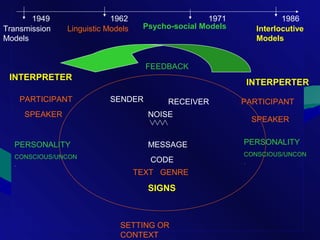
SENDER RECEIVER
NOISE
MESSAGE
CODE
SPEAKER
SPEAKER
PARTICIPANT PARTICIPANT
TEXT GENRE
FEEDBACK
PERSONALITY
CONSCIOUS/UNCON
.
SETTING OR
CONTEXT
SIGNS
INTERPRETER
INTERPERTER
PERSONALITY
CONSCIOUS/UNCON
.
Transmission
Models
Linguistic Models Psycho-social Models Interlocutive
Models
1949 1962 1971 1986
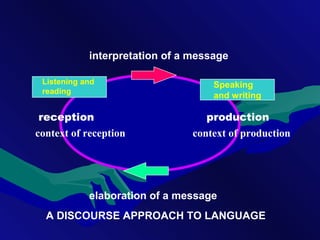
reception production
interpretation of a message
elaboration of a message
context of reception
A DISCOURSE APPROACH TO LANGUAGE
context of production
Speaking
and writing
Listening and
reading
Task:Task:
• Think of someone you would like to improve interpersonalThink of someone you would like to improve interpersonal
communication with in your work environment. It should becommunication with in your work environment. It should be
someone you interact with on a regular basis.someone you interact with on a regular basis.
• 1. What kind of work relationship do you have with this1. What kind of work relationship do you have with this
person: cooperation, interdependence, independence?person: cooperation, interdependence, independence?
• 2. Did/do you have the option of working with him/her?2. Did/do you have the option of working with him/her?
• 3. Has there been any conflict with this person?3. Has there been any conflict with this person?
• 4. What’s the history behind this relationship?4. What’s the history behind this relationship?
• 5. Do you feel any form of affection for him/her?5. Do you feel any form of affection for him/her?
• 6. Who has the power in this relationship?6. Who has the power in this relationship?
• 7. What are the positive traits you see in this person?7. What are the positive traits you see in this person?
• 8. What are the negative traits you see in this person?8. What are the negative traits you see in this person?
• 9. Will you have to interact with each other for a long time?9. Will you have to interact with each other for a long time?
• 10. How much impact could he/she have in your present or10. How much impact could he/she have in your present or
future career?future career?
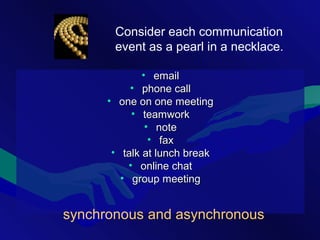
Consider each communication
event as a pearl in a necklace.
• emailemail
• phone callphone call
• one on one meetingone on one meeting
• teamworkteamwork
• notenote
• faxfax
• talk at lunch breaktalk at lunch break
• online chatonline chat
• group meetinggroup meeting
synchronous and asynchronous
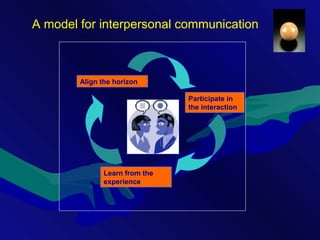
Align the horizon
Participate in
the interaction
Learn from the
experience
A model for interpersonal communication
““Pre” Setting the groundPre” Setting the ground
• 11. What kind of work relationship do you have. What kind of work relationship do you have
with this person: cooperation, interdependence,with this person: cooperation, interdependence,
independence?independence?
• 22. Did/do you have the option of working with. Did/do you have the option of working with
him/her?him/her?
• 66. Who has the power in this relationship?. Who has the power in this relationship?
• 99. Will you have to interact with each other for a. Will you have to interact with each other for a
long time?long time?
• 1010. How much impact could he/she have in your. How much impact could he/she have in your
present or future career?present or future career?
““Pre” Some historyPre” Some history
• 33. Has there been any conflict with this. Has there been any conflict with this
person?person?
• 44. What’s the history behind this. What’s the history behind this
relationship?relationship?
““Pre” What do we have inPre” What do we have in
common?common?
• 55. Do you feel any form of affection for. Do you feel any form of affection for
him/her?him/her?
• 77. What are the positive traits you see in. What are the positive traits you see in
this person?this person?
• 88. What are the negative traits you see in. What are the negative traits you see in
this person?this person?
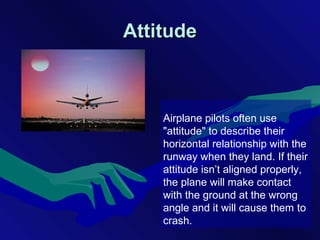
AttitudeAttitude
Airplane pilots often use
"attitude" to describe their
horizontal relationship with the
runway when they land. If their
attitude isn’t aligned properly,
the plane will make contact
with the ground at the wrong
angle and it will cause them to
crash.
STAGE FOCUS STRATEGY
Pre ALIGN THE
HORIZON
Reflect upon the
situation.
Set reasonable
expectations.
Make the right
choices of timing
and channel.
Attitude Memory: Associate, elaborate, use
imagery.
Cognitive: Analyze and reason.
Compensation: Guess intelligently.
Metacognitive: Arrange and plan. Set
goals and objectives.
Affective: Lower anxiety. Encourage
yourself
Social: Develop understanding of the
situation.
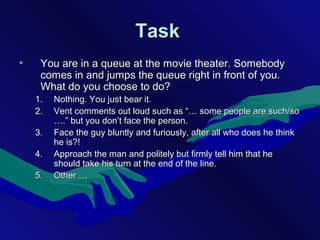
TaskTask
• You are in a queue at the movie theater. SomebodyYou are in a queue at the movie theater. Somebody
comes in and jumps the queue right in front of you.comes in and jumps the queue right in front of you.
What do you choose to do?What do you choose to do?
1.1. Nothing. You just bear it.Nothing. You just bear it.
2.2. Vent comments out loud such as “… some people are such/soVent comments out loud such as “… some people are such/so
….” but you don’t face the person.….” but you don’t face the person.
3.3. Face the guy bluntly and furiously, after all who does he thinkFace the guy bluntly and furiously, after all who does he think
he is?!he is?!
4.4. Approach the man and politely but firmly tell him that heApproach the man and politely but firmly tell him that he
should take his turn at the end of the line.should take his turn at the end of the line.
5.5. Other …Other …
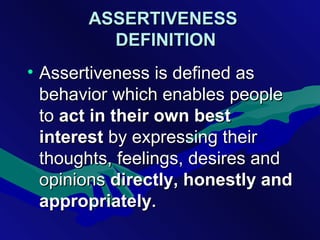
ASSERTIVENESSASSERTIVENESS
DEFINITIONDEFINITION
• Assertiveness is defined asAssertiveness is defined as
behavior which enables peoplebehavior which enables people
toto actact in their own bestin their own best
interestinterest by expressing theirby expressing their
thoughts, feelings, desires andthoughts, feelings, desires and
opinionsopinions directly, honestly anddirectly, honestly and
appropriatelyappropriately..
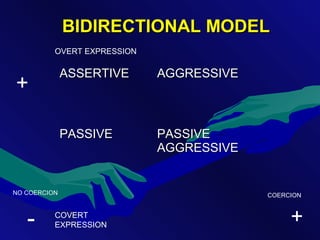
BIDIRECTIONAL MODELBIDIRECTIONAL MODEL
ASSERTIVEASSERTIVE AGGRESSIVEAGGRESSIVE
PASSIVEPASSIVE PASSIVEPASSIVE
AGGRESSIVEAGGRESSIVE
OVERT EXPRESSION
COVERT
EXPRESSION
NO COERCION COERCION
-
+
+
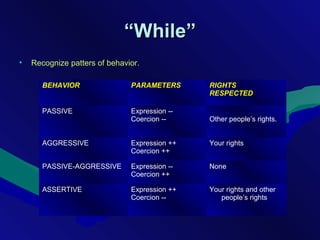
““WhileWhile””
• Recognize patters of behavior.
BEHAVIOR PARAMETERS RIGHTS
RESPECTED
PASSIVE Expression --
Coercion -- Other people’s rights.
AGGRESSIVE Expression ++
Coercion ++
Your rights
PASSIVE-AGGRESSIVE Expression --
Coercion ++
None
ASSERTIVE Expression ++
Coercion --
Your rights and other
people’s rights
Task:Task:
• This chart (see your handbook) showsThis chart (see your handbook) shows
assertive behavior and alternative forms ofassertive behavior and alternative forms of
behavior based on the four quadrantbehavior based on the four quadrant
model. Classify the following examples ofmodel. Classify the following examples of
behavior in the right category:behavior in the right category:
manipulation, humiliation, avoidance.manipulation, humiliation, avoidance.
– Page … in your handbookPage … in your handbook
Task: Identify three very distinct parts inTask: Identify three very distinct parts in
this fragment.this fragment.
"I've noticed that whenever we're preparing to go somewhere,"I've noticed that whenever we're preparing to go somewhere,
you start rushing me to finish dressing as soon as you're readyyou start rushing me to finish dressing as soon as you're ready
even if it's not yet the time we had planned to leave. I know youeven if it's not yet the time we had planned to leave. I know you
get anxious when you're all ready to go and I'm not, but whenget anxious when you're all ready to go and I'm not, but when
you do that, I get all flustered and take even more time. By the time weyou do that, I get all flustered and take even more time. By the time we
get in the car, we're mad at each other and not much in the mood toget in the car, we're mad at each other and not much in the mood to
have a good time. From now on, let's be sure we know what time wehave a good time. From now on, let's be sure we know what time we
want to leave, and if you're ready before I am, will you please just go towant to leave, and if you're ready before I am, will you please just go to
another room and read the paper or watch TV? From now on, if youanother room and read the paper or watch TV? From now on, if you
come into the bedroom or bathroom before it's time to leave and startcome into the bedroom or bathroom before it's time to leave and start
asking me to hurry up, I'm just going to remind you of the time, ask youasking me to hurry up, I'm just going to remind you of the time, ask you
to go to another room, and close the door until I'm ready. I know this isto go to another room, and close the door until I'm ready. I know this is
going to seem weird at first, but I bet we'll enjoy our outings a lot moregoing to seem weird at first, but I bet we'll enjoy our outings a lot more
over the long run."over the long run."
• http://www.uiowa.edu/%7Eucs/asertcom.htmlhttp://www.uiowa.edu/%7Eucs/asertcom.html
• "I've noticed that"I've noticed that whenever we're preparing to gowhenever we're preparing to go
somewhere, you start rushing me to finish dressing assomewhere, you start rushing me to finish dressing as
soon as you're ready, even if it's not yet the time we hadsoon as you're ready, even if it's not yet the time we had
planned to leave.planned to leave. I know you get anxious when you're allI know you get anxious when you're all
ready to go and I'm not,ready to go and I'm not, but when you do that, I get allbut when you do that, I get all
flustered and take even more time. By the time we get influstered and take even more time. By the time we get in
the car, we're mad at each other and not much in thethe car, we're mad at each other and not much in the
mood to have a good time.mood to have a good time. From now onFrom now on, let's be sure, let's be sure
we know what time we want to leave, and if you're readywe know what time we want to leave, and if you're ready
before I am, will you please just go to another room andbefore I am, will you please just go to another room and
read the paper or watch TV? From now on, if you comeread the paper or watch TV? From now on, if you come
into the bedroom or bathroom before it's time to leaveinto the bedroom or bathroom before it's time to leave
and start asking me to hurry up, I'm just going to remindand start asking me to hurry up, I'm just going to remind
you of the time, ask you to go to another room, and closeyou of the time, ask you to go to another room, and close
the door until I'm ready. I know this is going to seemthe door until I'm ready. I know this is going to seem
weird at first, but I bet we'll enjoy our outings a lot moreweird at first, but I bet we'll enjoy our outings a lot more
over the long run."over the long run."
• http://www.uiowa.edu/%7Eucs/asertcom.htmlhttp://www.uiowa.edu/%7Eucs/asertcom.html
““While”While” Apply a variety of techniques to
communicate
1. the art of listening1. the art of listening
• Act like a good listener. Adopt the physical bodyAct like a good listener. Adopt the physical body
language of a receiver.language of a receiver.
• Look at the other person.Look at the other person.
• React to the speaker by sending out non-verbal signals.React to the speaker by sending out non-verbal signals.
• Stop talking and use receptive language instead. Use theStop talking and use receptive language instead. Use the
I see . . . un hunh . . . oh really!I see . . . un hunh . . . oh really!
• Concentrate on what the speaker is saying, skip overConcentrate on what the speaker is saying, skip over
delivery errors and fight distractions.delivery errors and fight distractions.
• Listen between the lines to tones of voice.Listen between the lines to tones of voice.
• Observe.Observe.
• Message pacingMessage pacing
and chunkingand chunking
• ExpressingExpressing
conversationalconversational
intent:intent:
– ““Uh...Maria, do youUh...Maria, do you
have a minute?have a minute?
Right now I’d like toRight now I’d like to
talk to you about... Istalk to you about... Is
that OK?”that OK?”
““While”While”
Apply a variety of techniques to communicate
2. the art of speaking and more …2. the art of speaking and more …
Non verbalNon verbal
components:components:
VocalicsVocalics
KinesicsKinesics
ProxemicsProxemics
ArtifactsArtifacts
TouchTouch
SmellSmell
““While”While” 3. the art of conflict prevention:3. the art of conflict prevention:
What are fire starters?What are fire starters?
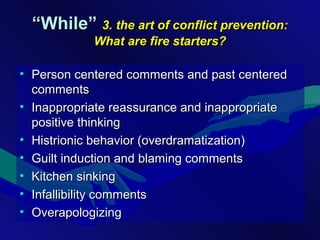
• Person centered comments and past centeredPerson centered comments and past centered
commentscomments
• Inappropriate reassurance and inappropriateInappropriate reassurance and inappropriate
positive thinkingpositive thinking
• Histrionic behavior (overdramatization)Histrionic behavior (overdramatization)
• Guilt induction and blaming commentsGuilt induction and blaming comments
• Kitchen sinkingKitchen sinking
• Infallibility commentsInfallibility comments
• OverapologizingOverapologizing
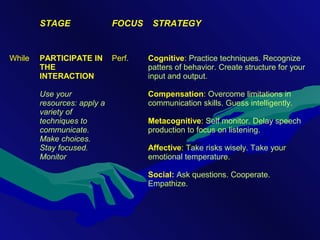
While PARTICIPATE IN
THE
INTERACTION
Use your
resources: apply a
variety of
techniques to
communicate.
Make choices.
Stay focused.
Monitor
Perf. Cognitive: Practice techniques. Recognize
patters of behavior. Create structure for your
input and output.
Compensation: Overcome limitations in
communication skills. Guess intelligently.
Metacognitive: Self monitor. Delay speech
production to focus on listening.
Affective: Take risks wisely. Take your
emotional temperature.
Social: Ask questions. Cooperate.
Empathize.
STAGE FOCUS STRATEGY
To rememberTo remember
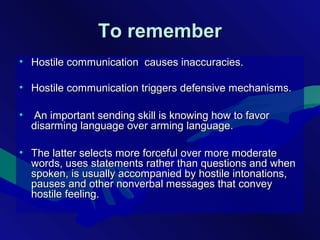
• Hostile communication causes inaccuracies.Hostile communication causes inaccuracies.
• Hostile communication triggers defensive mechanisms.Hostile communication triggers defensive mechanisms.
• An important sending skill is knowing how to favorAn important sending skill is knowing how to favor
disarming language over arming language.disarming language over arming language.
• The latter selects more forceful over more moderateThe latter selects more forceful over more moderate
words, uses statements rather than questions and whenwords, uses statements rather than questions and when
spoken, is usually accompanied by hostile intonations,spoken, is usually accompanied by hostile intonations,
pauses and other nonverbal messages that conveypauses and other nonverbal messages that convey
hostile feeling.hostile feeling.
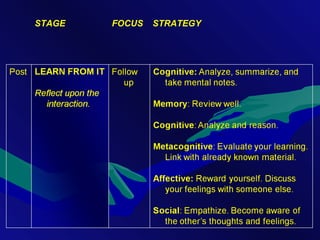
““Post”Post”
Reflect upon the interaction
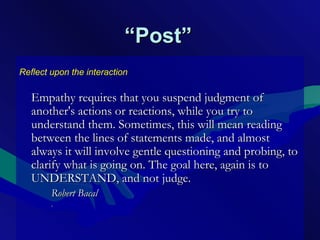
Empathy requires that you suspend judgment ofEmpathy requires that you suspend judgment of
another's actions or reactions, while you try toanother's actions or reactions, while you try to
understand them. Sometimes, this will mean readingunderstand them. Sometimes, this will mean reading
between the lines of statements made, and almostbetween the lines of statements made, and almost
always it will involve gentle questioning and probing, toalways it will involve gentle questioning and probing, to
clarify what is going on. The goal here, again is toclarify what is going on. The goal here, again is to
UNDERSTAND, and not judge.UNDERSTAND, and not judge.
Robert BacalRobert Bacal
.
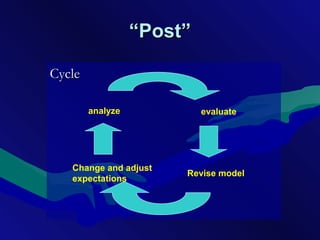
““Post”Post”
CycleCycle
analyze evaluate
Revise model
Change and adjust
expectations
STAGE FOCUS STRATEGY
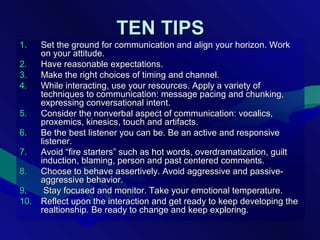
TEN TIPSTEN TIPS
1.1. Set the ground for communication and align your horizon. WorkSet the ground for communication and align your horizon. Work
on your attitude.on your attitude.
2.2. Have reasonable expectations.Have reasonable expectations.
3.3. Make the right choices of timing and channel.Make the right choices of timing and channel.
4.4. While interacting, use your resources. Apply a variety ofWhile interacting, use your resources. Apply a variety of
techniques to communication: message pacing and chunking,techniques to communication: message pacing and chunking,
expressing conversational intent.expressing conversational intent.
5.5. Consider the nonverbal aspect of communication: vocalics,Consider the nonverbal aspect of communication: vocalics,
proxemics, kinesics, touch and artifacts.proxemics, kinesics, touch and artifacts.
6.6. Be the best listener you can be. Be an active and responsiveBe the best listener you can be. Be an active and responsive
listener.listener.
7.7. Avoid “fire starters” such as hot words, overdramatization, guiltAvoid “fire starters” such as hot words, overdramatization, guilt
induction, blaming, person and past centered comments.induction, blaming, person and past centered comments.
8.8. Choose to behave assertively. Avoid aggressive and passive-Choose to behave assertively. Avoid aggressive and passive-
aggressive behavior.aggressive behavior.
9.9. Stay focused and monitor. Take your emotional temperature.Stay focused and monitor. Take your emotional temperature.
10.10. Reflect upon the interaction and get ready to keep developing theReflect upon the interaction and get ready to keep developing the
realtionship. Be ready to change and keep exploring.realtionship. Be ready to change and keep exploring.
THANK YOU!THANK YOU!
• mporta_901@alianza.edu.uymporta_901@alianza.edu.uy
• http://eflprofessionals.blogspot.comhttp://eflprofessionals.blogspot.com

Interpersonal Communication Skills {HR}

  • 1.
  • 2.
    • The conceptof communication hasThe concept of communication has evolved throughout the yearsevolved throughout the years.. Approaches to interpersonalApproaches to interpersonal communication: brief backgroundcommunication: brief background
  • 3.
    SENDER RECEIVER NOISE MESSAGE CODE SPEAKER SPEAKER PARTICIPANT PARTICIPANT TEXTGENRE FEEDBACK PERSONALITY CONSCIOUS/UNCON . SETTING OR CONTEXT SIGNS INTERPRETER INTERPERTER PERSONALITY CONSCIOUS/UNCON . Transmission Models Linguistic Models Psycho-social Models Interlocutive Models 1949 1962 1971 1986
  • 4.
    reception production interpretation ofa message elaboration of a message context of reception A DISCOURSE APPROACH TO LANGUAGE context of production Speaking and writing Listening and reading
  • 5.
    Task:Task: • Think ofsomeone you would like to improve interpersonalThink of someone you would like to improve interpersonal communication with in your work environment. It should becommunication with in your work environment. It should be someone you interact with on a regular basis.someone you interact with on a regular basis. • 1. What kind of work relationship do you have with this1. What kind of work relationship do you have with this person: cooperation, interdependence, independence?person: cooperation, interdependence, independence? • 2. Did/do you have the option of working with him/her?2. Did/do you have the option of working with him/her? • 3. Has there been any conflict with this person?3. Has there been any conflict with this person? • 4. What’s the history behind this relationship?4. What’s the history behind this relationship? • 5. Do you feel any form of affection for him/her?5. Do you feel any form of affection for him/her? • 6. Who has the power in this relationship?6. Who has the power in this relationship? • 7. What are the positive traits you see in this person?7. What are the positive traits you see in this person? • 8. What are the negative traits you see in this person?8. What are the negative traits you see in this person? • 9. Will you have to interact with each other for a long time?9. Will you have to interact with each other for a long time? • 10. How much impact could he/she have in your present or10. How much impact could he/she have in your present or future career?future career?
  • 6.
    Consider each communication eventas a pearl in a necklace. • emailemail • phone callphone call • one on one meetingone on one meeting • teamworkteamwork • notenote • faxfax • talk at lunch breaktalk at lunch break • online chatonline chat • group meetinggroup meeting synchronous and asynchronous
  • 7.
    Align the horizon Participatein the interaction Learn from the experience A model for interpersonal communication
  • 8.
    ““Pre” Setting thegroundPre” Setting the ground • 11. What kind of work relationship do you have. What kind of work relationship do you have with this person: cooperation, interdependence,with this person: cooperation, interdependence, independence?independence? • 22. Did/do you have the option of working with. Did/do you have the option of working with him/her?him/her? • 66. Who has the power in this relationship?. Who has the power in this relationship? • 99. Will you have to interact with each other for a. Will you have to interact with each other for a long time?long time? • 1010. How much impact could he/she have in your. How much impact could he/she have in your present or future career?present or future career?
  • 9.
    ““Pre” Some historyPre”Some history • 33. Has there been any conflict with this. Has there been any conflict with this person?person? • 44. What’s the history behind this. What’s the history behind this relationship?relationship?
  • 10.
    ““Pre” What dowe have inPre” What do we have in common?common? • 55. Do you feel any form of affection for. Do you feel any form of affection for him/her?him/her? • 77. What are the positive traits you see in. What are the positive traits you see in this person?this person? • 88. What are the negative traits you see in. What are the negative traits you see in this person?this person?
  • 11.
    AttitudeAttitude Airplane pilots oftenuse "attitude" to describe their horizontal relationship with the runway when they land. If their attitude isn’t aligned properly, the plane will make contact with the ground at the wrong angle and it will cause them to crash.
  • 12.
    STAGE FOCUS STRATEGY PreALIGN THE HORIZON Reflect upon the situation. Set reasonable expectations. Make the right choices of timing and channel. Attitude Memory: Associate, elaborate, use imagery. Cognitive: Analyze and reason. Compensation: Guess intelligently. Metacognitive: Arrange and plan. Set goals and objectives. Affective: Lower anxiety. Encourage yourself Social: Develop understanding of the situation.
  • 13.
    TaskTask • You arein a queue at the movie theater. SomebodyYou are in a queue at the movie theater. Somebody comes in and jumps the queue right in front of you.comes in and jumps the queue right in front of you. What do you choose to do?What do you choose to do? 1.1. Nothing. You just bear it.Nothing. You just bear it. 2.2. Vent comments out loud such as “… some people are such/soVent comments out loud such as “… some people are such/so ….” but you don’t face the person.….” but you don’t face the person. 3.3. Face the guy bluntly and furiously, after all who does he thinkFace the guy bluntly and furiously, after all who does he think he is?!he is?! 4.4. Approach the man and politely but firmly tell him that heApproach the man and politely but firmly tell him that he should take his turn at the end of the line.should take his turn at the end of the line. 5.5. Other …Other …
  • 14.
    ASSERTIVENESSASSERTIVENESS DEFINITIONDEFINITION • Assertiveness isdefined asAssertiveness is defined as behavior which enables peoplebehavior which enables people toto actact in their own bestin their own best interestinterest by expressing theirby expressing their thoughts, feelings, desires andthoughts, feelings, desires and opinionsopinions directly, honestly anddirectly, honestly and appropriatelyappropriately..
  • 15.
    BIDIRECTIONAL MODELBIDIRECTIONAL MODEL ASSERTIVEASSERTIVEAGGRESSIVEAGGRESSIVE PASSIVEPASSIVE PASSIVEPASSIVE AGGRESSIVEAGGRESSIVE OVERT EXPRESSION COVERT EXPRESSION NO COERCION COERCION - + +
  • 16.
    ““WhileWhile”” • Recognize pattersof behavior. BEHAVIOR PARAMETERS RIGHTS RESPECTED PASSIVE Expression -- Coercion -- Other people’s rights. AGGRESSIVE Expression ++ Coercion ++ Your rights PASSIVE-AGGRESSIVE Expression -- Coercion ++ None ASSERTIVE Expression ++ Coercion -- Your rights and other people’s rights
  • 17.
    Task:Task: • This chart(see your handbook) showsThis chart (see your handbook) shows assertive behavior and alternative forms ofassertive behavior and alternative forms of behavior based on the four quadrantbehavior based on the four quadrant model. Classify the following examples ofmodel. Classify the following examples of behavior in the right category:behavior in the right category: manipulation, humiliation, avoidance.manipulation, humiliation, avoidance. – Page … in your handbookPage … in your handbook
  • 18.
    Task: Identify threevery distinct parts inTask: Identify three very distinct parts in this fragment.this fragment. "I've noticed that whenever we're preparing to go somewhere,"I've noticed that whenever we're preparing to go somewhere, you start rushing me to finish dressing as soon as you're readyyou start rushing me to finish dressing as soon as you're ready even if it's not yet the time we had planned to leave. I know youeven if it's not yet the time we had planned to leave. I know you get anxious when you're all ready to go and I'm not, but whenget anxious when you're all ready to go and I'm not, but when you do that, I get all flustered and take even more time. By the time weyou do that, I get all flustered and take even more time. By the time we get in the car, we're mad at each other and not much in the mood toget in the car, we're mad at each other and not much in the mood to have a good time. From now on, let's be sure we know what time wehave a good time. From now on, let's be sure we know what time we want to leave, and if you're ready before I am, will you please just go towant to leave, and if you're ready before I am, will you please just go to another room and read the paper or watch TV? From now on, if youanother room and read the paper or watch TV? From now on, if you come into the bedroom or bathroom before it's time to leave and startcome into the bedroom or bathroom before it's time to leave and start asking me to hurry up, I'm just going to remind you of the time, ask youasking me to hurry up, I'm just going to remind you of the time, ask you to go to another room, and close the door until I'm ready. I know this isto go to another room, and close the door until I'm ready. I know this is going to seem weird at first, but I bet we'll enjoy our outings a lot moregoing to seem weird at first, but I bet we'll enjoy our outings a lot more over the long run."over the long run." • http://www.uiowa.edu/%7Eucs/asertcom.htmlhttp://www.uiowa.edu/%7Eucs/asertcom.html
  • 19.
    • "I've noticedthat"I've noticed that whenever we're preparing to gowhenever we're preparing to go somewhere, you start rushing me to finish dressing assomewhere, you start rushing me to finish dressing as soon as you're ready, even if it's not yet the time we hadsoon as you're ready, even if it's not yet the time we had planned to leave.planned to leave. I know you get anxious when you're allI know you get anxious when you're all ready to go and I'm not,ready to go and I'm not, but when you do that, I get allbut when you do that, I get all flustered and take even more time. By the time we get influstered and take even more time. By the time we get in the car, we're mad at each other and not much in thethe car, we're mad at each other and not much in the mood to have a good time.mood to have a good time. From now onFrom now on, let's be sure, let's be sure we know what time we want to leave, and if you're readywe know what time we want to leave, and if you're ready before I am, will you please just go to another room andbefore I am, will you please just go to another room and read the paper or watch TV? From now on, if you comeread the paper or watch TV? From now on, if you come into the bedroom or bathroom before it's time to leaveinto the bedroom or bathroom before it's time to leave and start asking me to hurry up, I'm just going to remindand start asking me to hurry up, I'm just going to remind you of the time, ask you to go to another room, and closeyou of the time, ask you to go to another room, and close the door until I'm ready. I know this is going to seemthe door until I'm ready. I know this is going to seem weird at first, but I bet we'll enjoy our outings a lot moreweird at first, but I bet we'll enjoy our outings a lot more over the long run."over the long run." • http://www.uiowa.edu/%7Eucs/asertcom.htmlhttp://www.uiowa.edu/%7Eucs/asertcom.html
  • 20.
    ““While”While” Apply avariety of techniques to communicate 1. the art of listening1. the art of listening • Act like a good listener. Adopt the physical bodyAct like a good listener. Adopt the physical body language of a receiver.language of a receiver. • Look at the other person.Look at the other person. • React to the speaker by sending out non-verbal signals.React to the speaker by sending out non-verbal signals. • Stop talking and use receptive language instead. Use theStop talking and use receptive language instead. Use the I see . . . un hunh . . . oh really!I see . . . un hunh . . . oh really! • Concentrate on what the speaker is saying, skip overConcentrate on what the speaker is saying, skip over delivery errors and fight distractions.delivery errors and fight distractions. • Listen between the lines to tones of voice.Listen between the lines to tones of voice. • Observe.Observe.
  • 21.
    • Message pacingMessagepacing and chunkingand chunking • ExpressingExpressing conversationalconversational intent:intent: – ““Uh...Maria, do youUh...Maria, do you have a minute?have a minute? Right now I’d like toRight now I’d like to talk to you about... Istalk to you about... Is that OK?”that OK?” ““While”While” Apply a variety of techniques to communicate 2. the art of speaking and more …2. the art of speaking and more … Non verbalNon verbal components:components: VocalicsVocalics KinesicsKinesics ProxemicsProxemics ArtifactsArtifacts TouchTouch SmellSmell
  • 22.
    ““While”While” 3. theart of conflict prevention:3. the art of conflict prevention: What are fire starters?What are fire starters? • Person centered comments and past centeredPerson centered comments and past centered commentscomments • Inappropriate reassurance and inappropriateInappropriate reassurance and inappropriate positive thinkingpositive thinking • Histrionic behavior (overdramatization)Histrionic behavior (overdramatization) • Guilt induction and blaming commentsGuilt induction and blaming comments • Kitchen sinkingKitchen sinking • Infallibility commentsInfallibility comments • OverapologizingOverapologizing
  • 23.
    While PARTICIPATE IN THE INTERACTION Useyour resources: apply a variety of techniques to communicate. Make choices. Stay focused. Monitor Perf. Cognitive: Practice techniques. Recognize patters of behavior. Create structure for your input and output. Compensation: Overcome limitations in communication skills. Guess intelligently. Metacognitive: Self monitor. Delay speech production to focus on listening. Affective: Take risks wisely. Take your emotional temperature. Social: Ask questions. Cooperate. Empathize. STAGE FOCUS STRATEGY
  • 24.
    To rememberTo remember •Hostile communication causes inaccuracies.Hostile communication causes inaccuracies. • Hostile communication triggers defensive mechanisms.Hostile communication triggers defensive mechanisms. • An important sending skill is knowing how to favorAn important sending skill is knowing how to favor disarming language over arming language.disarming language over arming language. • The latter selects more forceful over more moderateThe latter selects more forceful over more moderate words, uses statements rather than questions and whenwords, uses statements rather than questions and when spoken, is usually accompanied by hostile intonations,spoken, is usually accompanied by hostile intonations, pauses and other nonverbal messages that conveypauses and other nonverbal messages that convey hostile feeling.hostile feeling.
  • 25.
    ““Post”Post” Reflect upon theinteraction Empathy requires that you suspend judgment ofEmpathy requires that you suspend judgment of another's actions or reactions, while you try toanother's actions or reactions, while you try to understand them. Sometimes, this will mean readingunderstand them. Sometimes, this will mean reading between the lines of statements made, and almostbetween the lines of statements made, and almost always it will involve gentle questioning and probing, toalways it will involve gentle questioning and probing, to clarify what is going on. The goal here, again is toclarify what is going on. The goal here, again is to UNDERSTAND, and not judge.UNDERSTAND, and not judge. Robert BacalRobert Bacal .
  • 26.
  • 27.
  • 28.
    TEN TIPSTEN TIPS 1.1.Set the ground for communication and align your horizon. WorkSet the ground for communication and align your horizon. Work on your attitude.on your attitude. 2.2. Have reasonable expectations.Have reasonable expectations. 3.3. Make the right choices of timing and channel.Make the right choices of timing and channel. 4.4. While interacting, use your resources. Apply a variety ofWhile interacting, use your resources. Apply a variety of techniques to communication: message pacing and chunking,techniques to communication: message pacing and chunking, expressing conversational intent.expressing conversational intent. 5.5. Consider the nonverbal aspect of communication: vocalics,Consider the nonverbal aspect of communication: vocalics, proxemics, kinesics, touch and artifacts.proxemics, kinesics, touch and artifacts. 6.6. Be the best listener you can be. Be an active and responsiveBe the best listener you can be. Be an active and responsive listener.listener. 7.7. Avoid “fire starters” such as hot words, overdramatization, guiltAvoid “fire starters” such as hot words, overdramatization, guilt induction, blaming, person and past centered comments.induction, blaming, person and past centered comments. 8.8. Choose to behave assertively. Avoid aggressive and passive-Choose to behave assertively. Avoid aggressive and passive- aggressive behavior.aggressive behavior. 9.9. Stay focused and monitor. Take your emotional temperature.Stay focused and monitor. Take your emotional temperature. 10.10. Reflect upon the interaction and get ready to keep developing theReflect upon the interaction and get ready to keep developing the realtionship. Be ready to change and keep exploring.realtionship. Be ready to change and keep exploring.
  • 29.
    THANK YOU!THANK YOU! •mporta_901@alianza.edu.uymporta_901@alianza.edu.uy • http://eflprofessionals.blogspot.comhttp://eflprofessionals.blogspot.com

Editor's Notes