CHAPTER TWO
The Structure of
Crystalline Solids
Lecture Two
3.6 POLYMORPHISM AND ALLOTROPY
Polymorphism:- a phenomenon in which some
materials (metal or non-metal)may have more than one
crystal structure.
 When found in elemental solids, the condition is often
termed allotropy.
 The crystal structure depends on both the temperature
and the external pressure.
 Example:
 Pure iron has a BCC crystal structure at room temperature,
which changes to FCC iron at 9120C (16740F)
10/26/2019
Instractor
Israel
Zelalem
2
POLY-CRYSTALLINE MATERIALS
 composed of a collection of many small crystals or
grains.
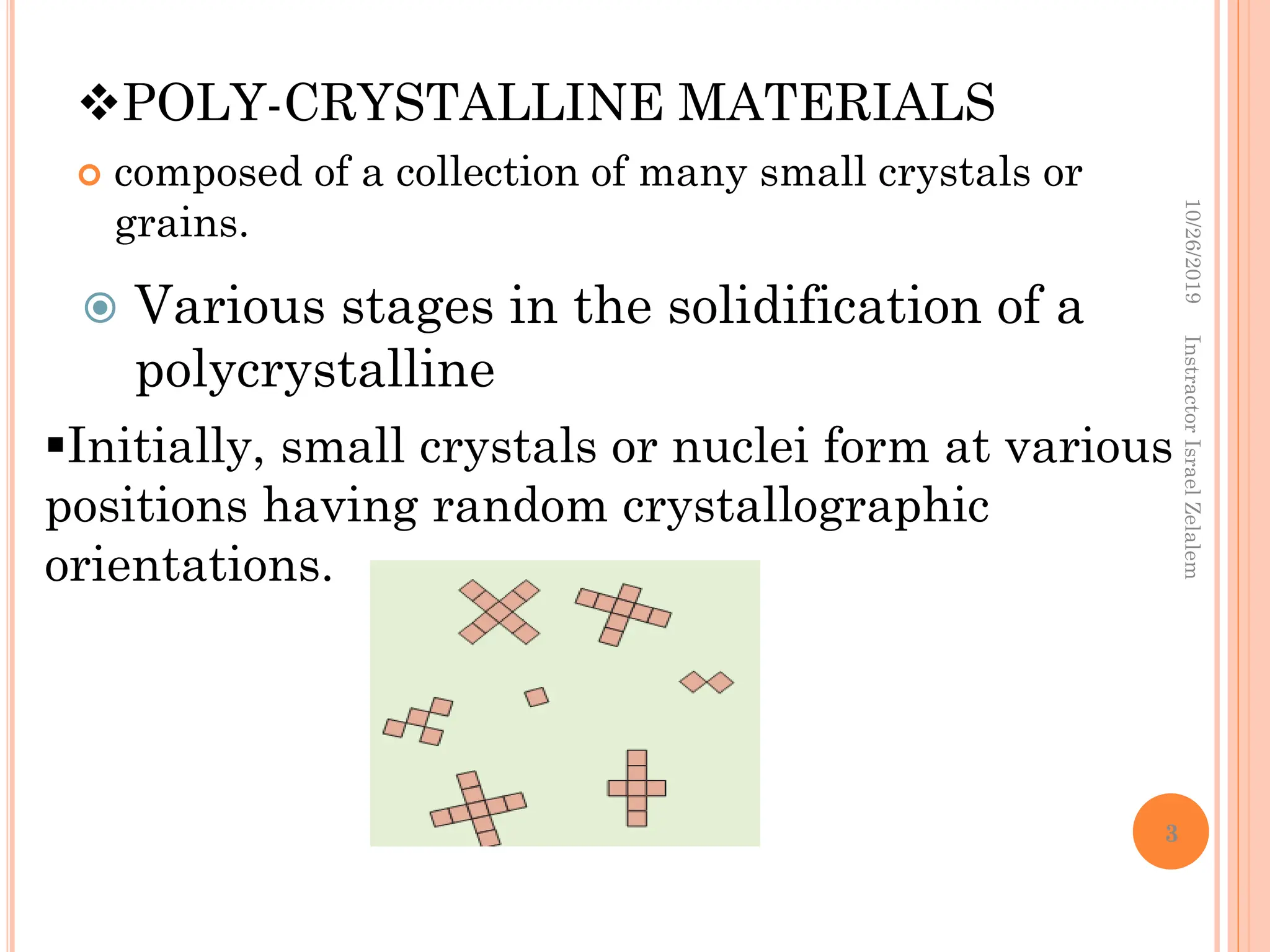
 Various stages in the solidification of a
polycrystalline
Initially, small crystals or nuclei form at various
positions having random crystallographic
orientations.
10/26/2019
Instractor
Israel
Zelalem
3
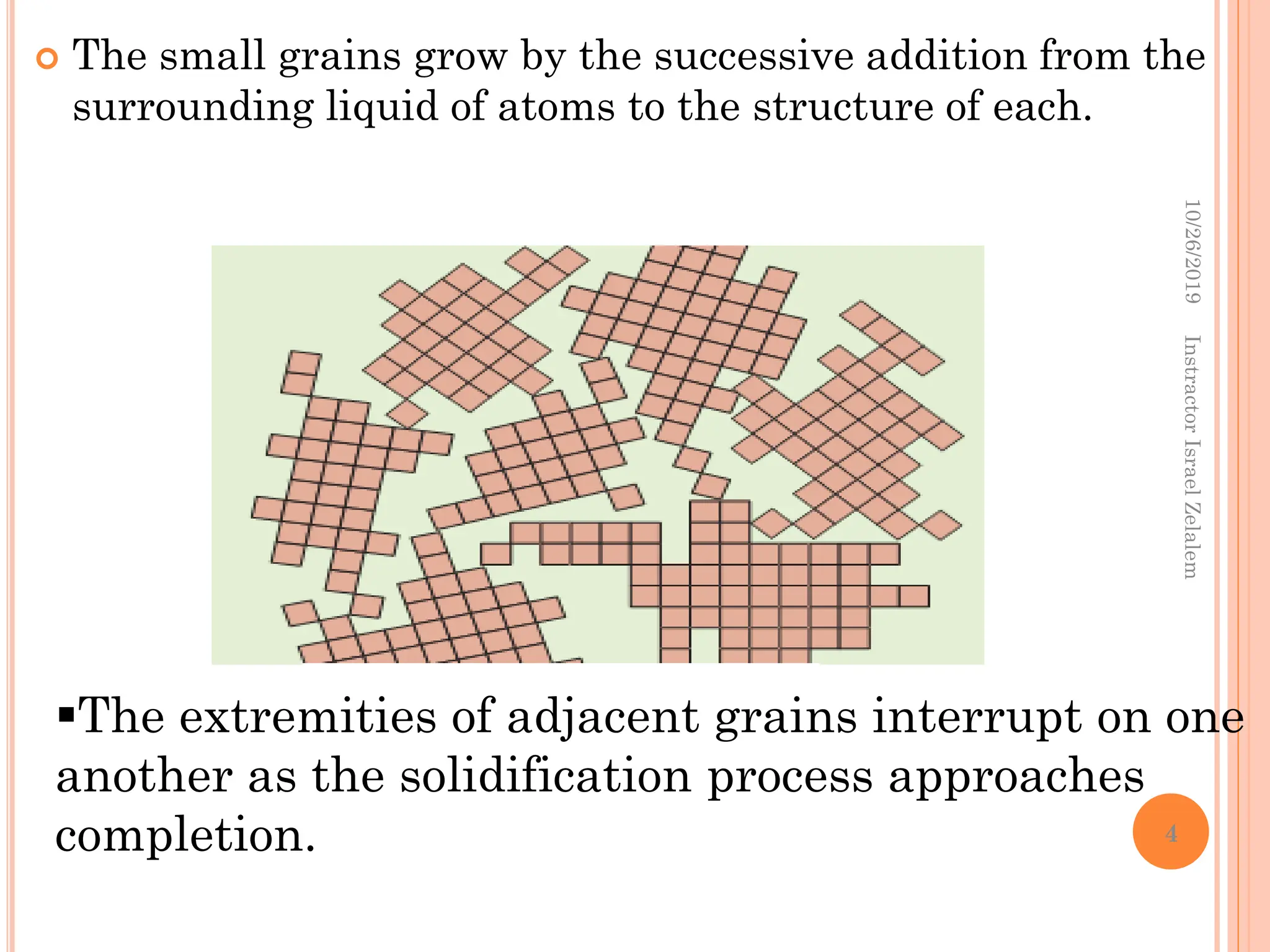
 The small grains grow by the successive addition from the
surrounding liquid of atoms to the structure of each.
The extremities of adjacent grains interrupt on one
another as the solidification process approaches
completion.
10/26/2019
Instractor
Israel
Zelalem
4
 All unit cells interlock in the same way and have the
same orientation.
 Single crystals exist in nature and produced artificially
under carefully controlled env’t.
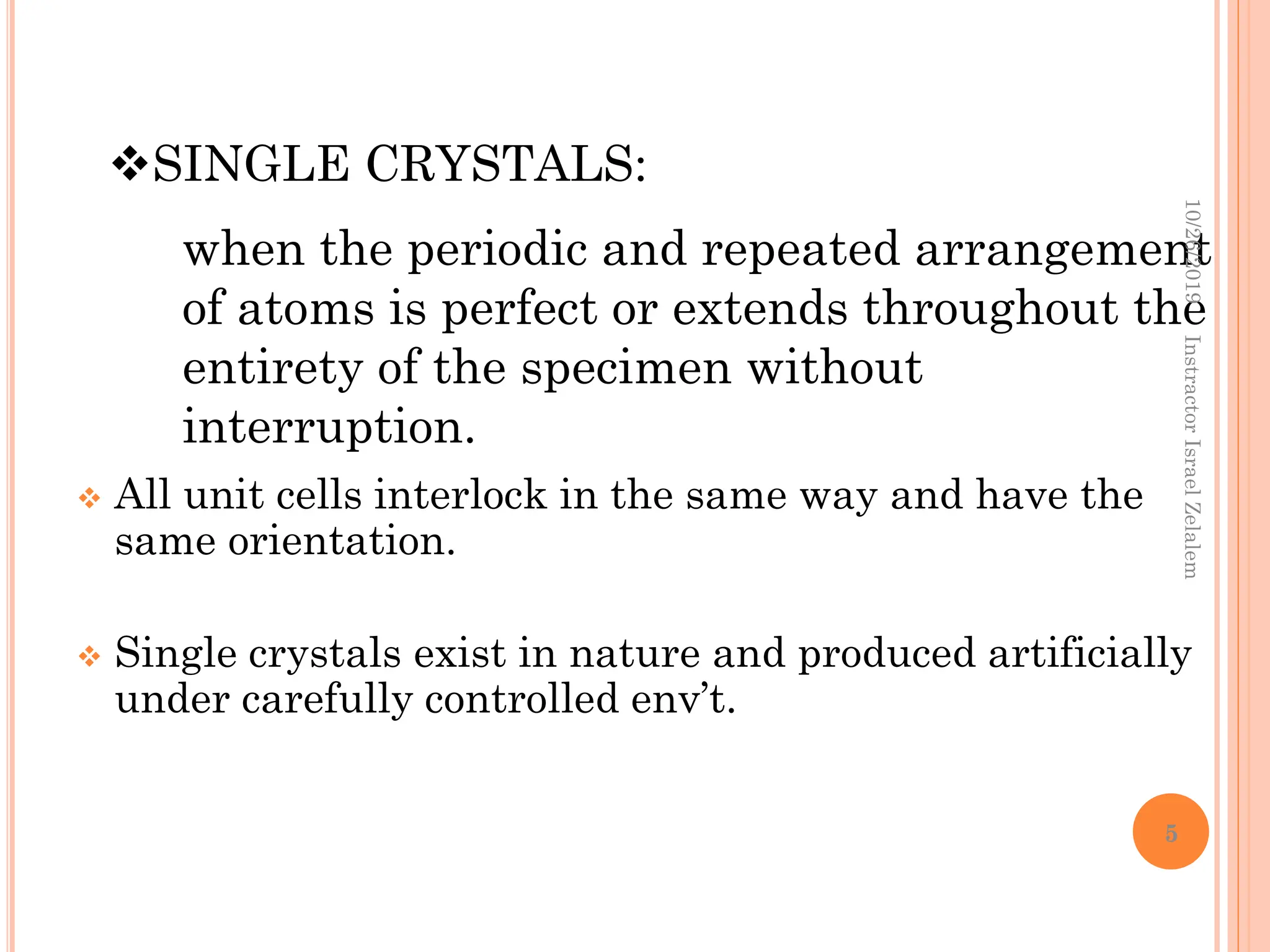
SINGLE CRYSTALS:
when the periodic and repeated arrangement
of atoms is perfect or extends throughout the
entirety of the specimen without
interruption.
10/26/2019
Instractor
Israel
Zelalem
5
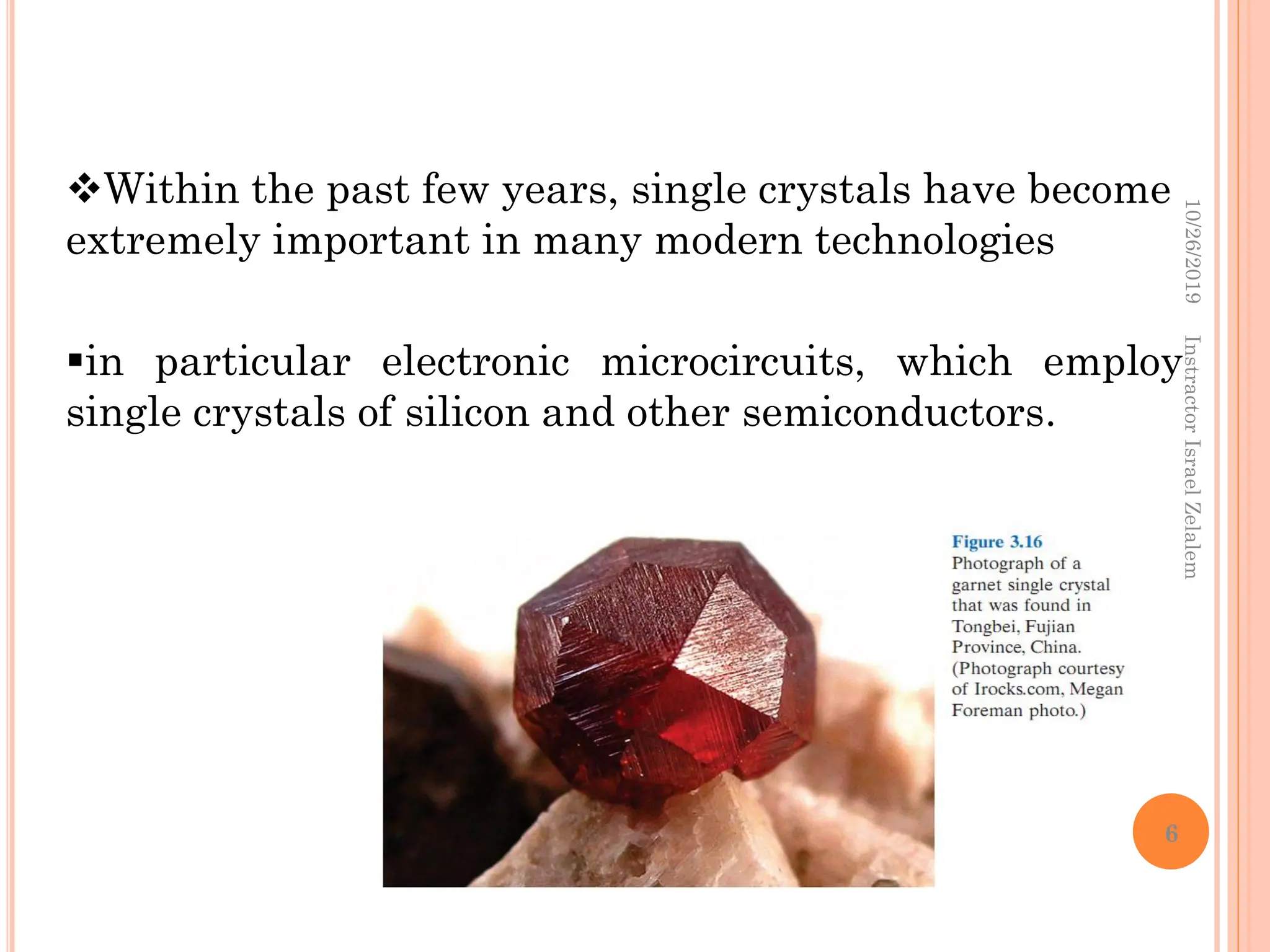
Within the past few years, single crystals have become
extremely important in many modern technologies
in particular electronic microcircuits, which employ
single crystals of silicon and other semiconductors.
10/26/2019
Instractor
Israel
Zelalem
6
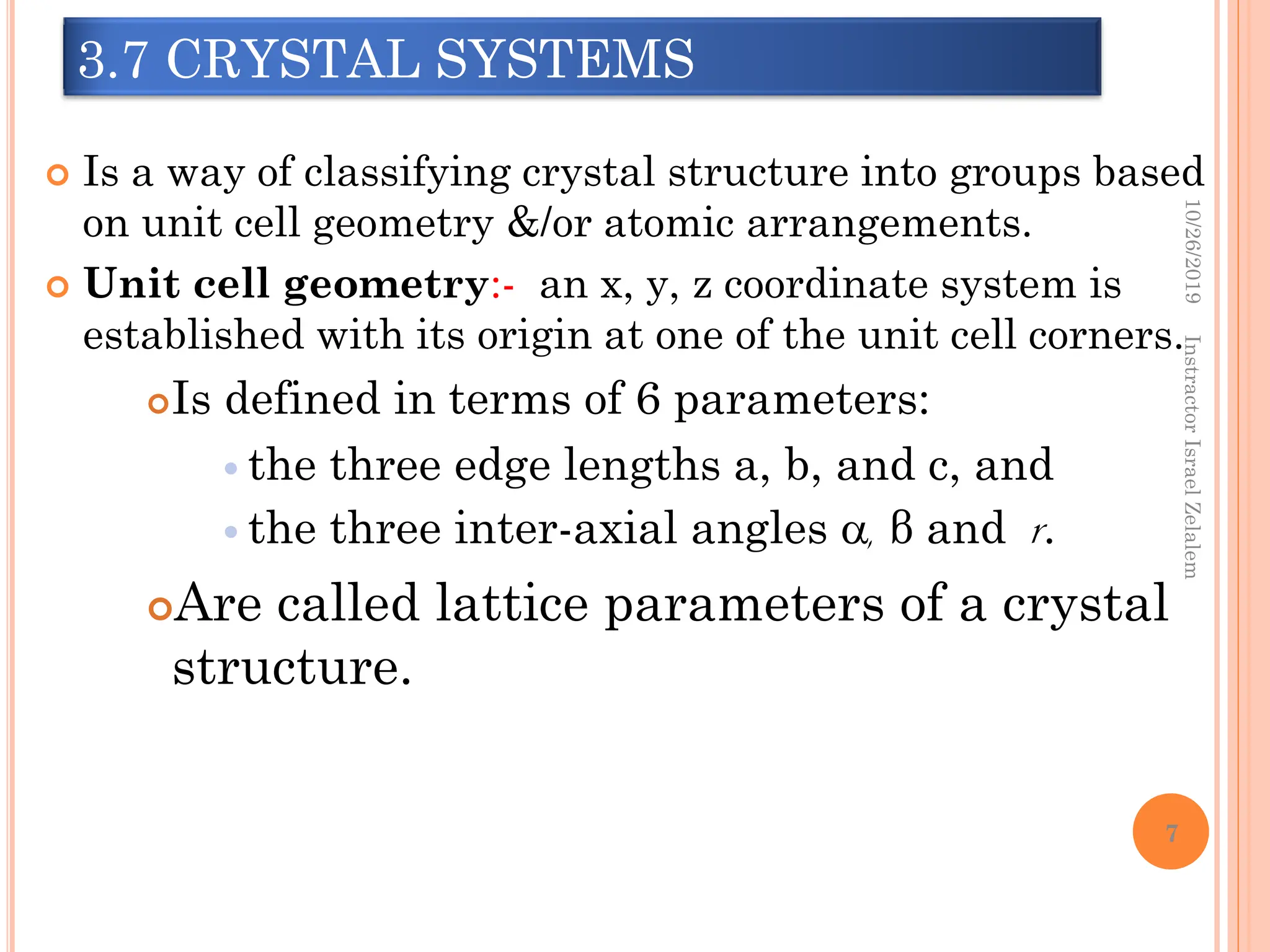
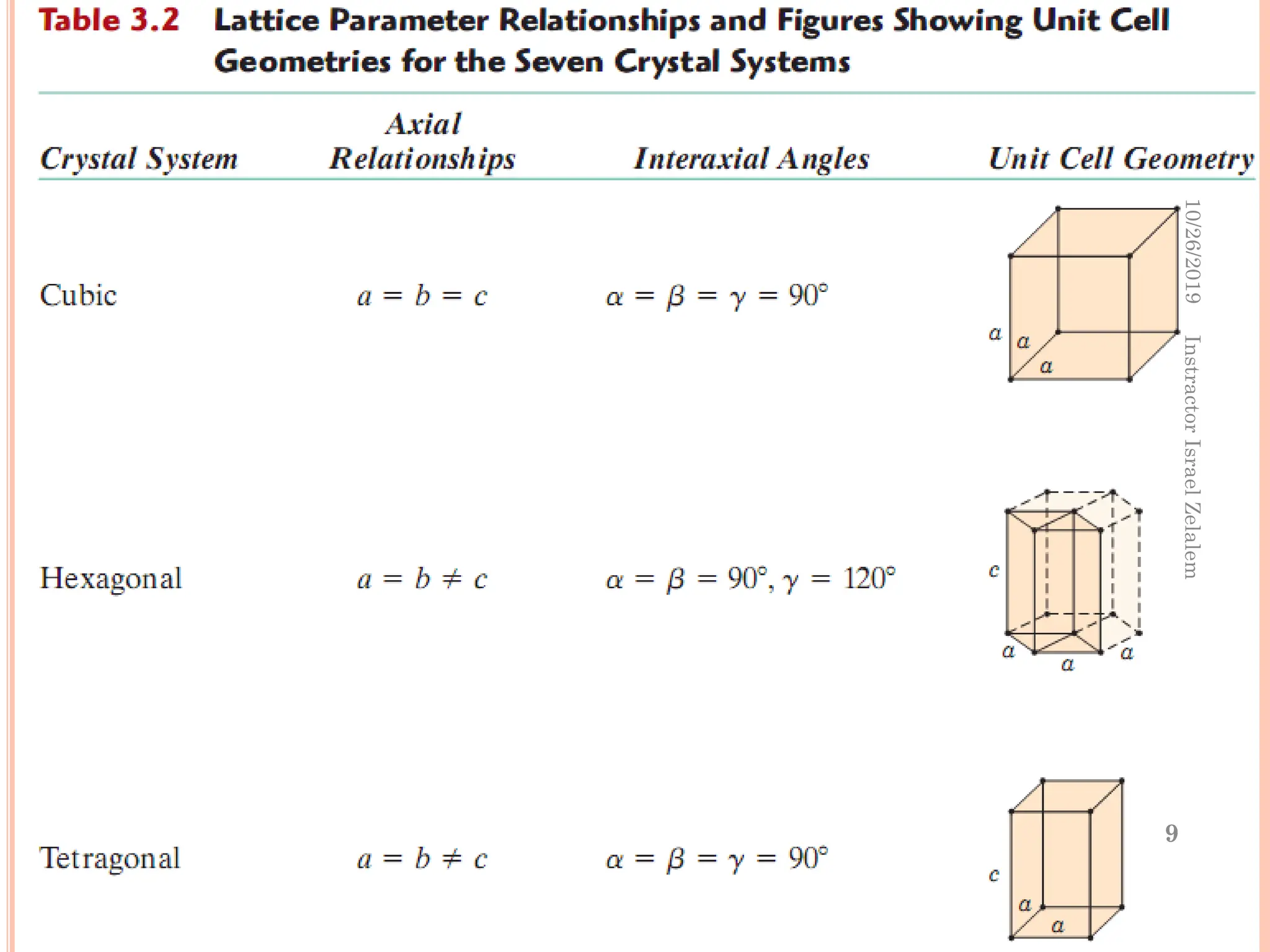
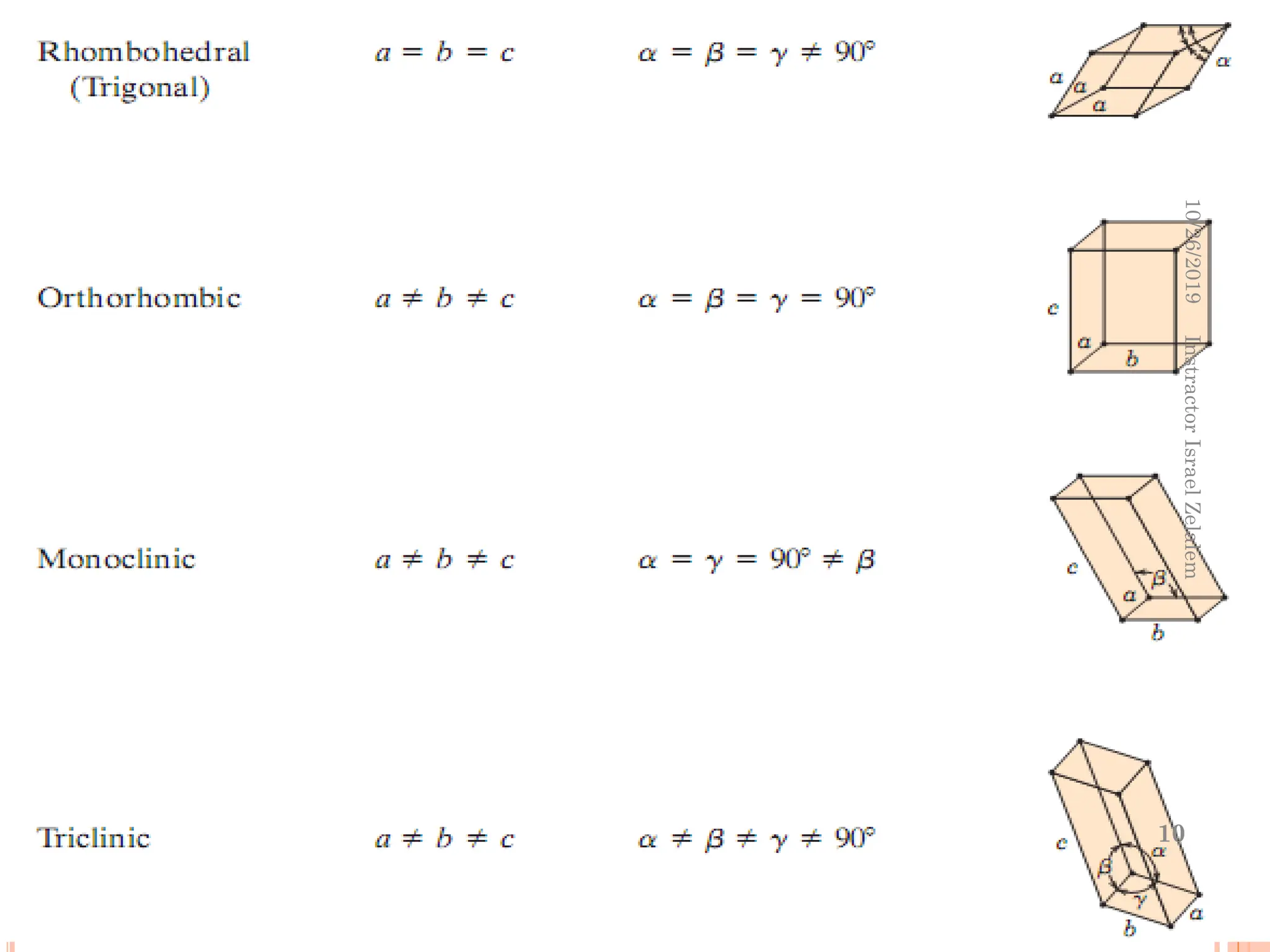
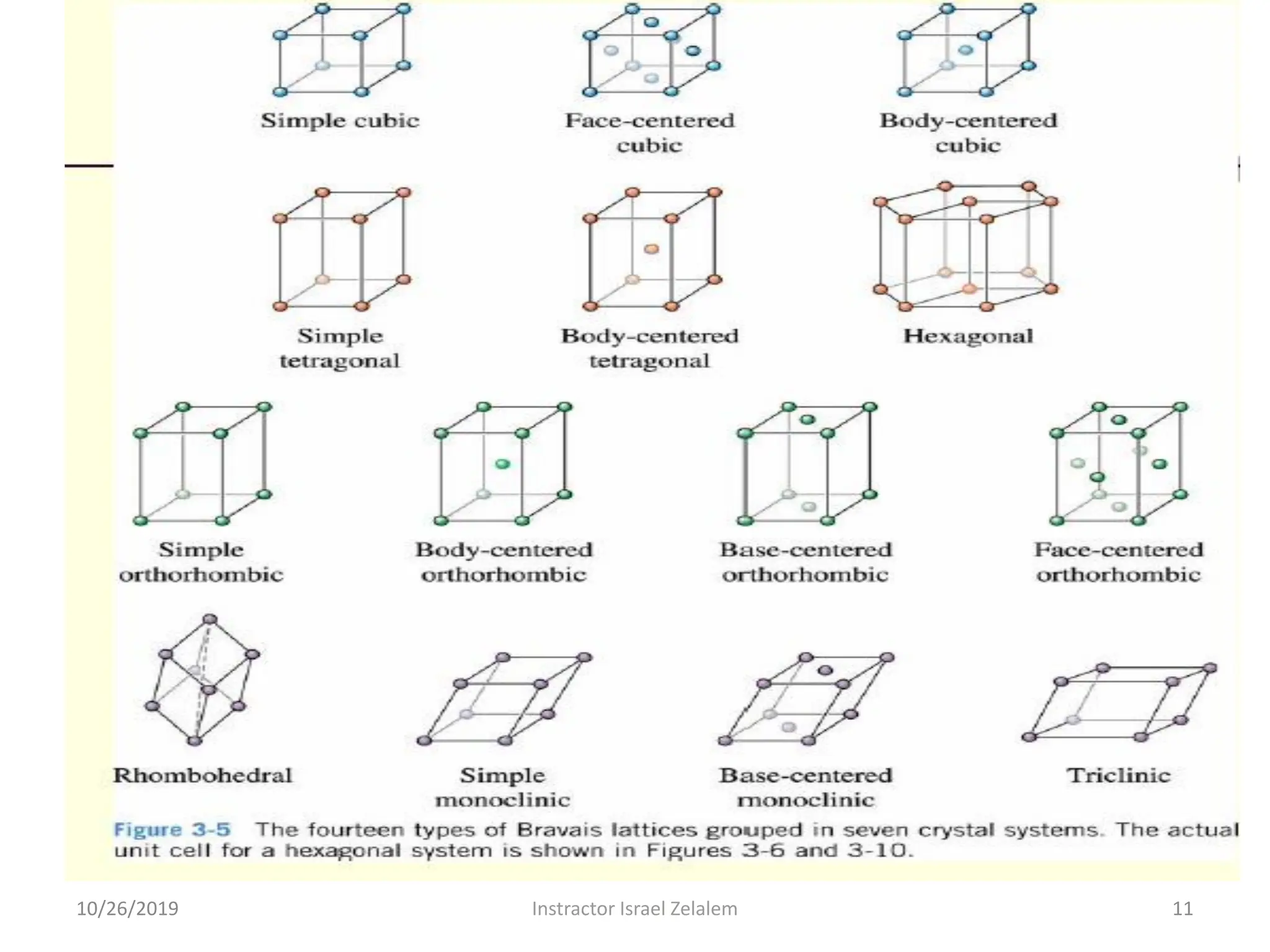
3.7 CRYSTAL SYSTEMS
 Is a way of classifying crystal structure into groups based
on unit cell geometry &/or atomic arrangements.
 Unit cell geometry:- an x, y, z coordinate system is
established with its origin at one of the unit cell corners.
Is defined in terms of 6 parameters:
 the three edge lengths a, b, and c, and
 the three inter-axial angles , β and r.
Are called lattice parameters of a crystal
structure.
10/26/2019
Instractor
Israel
Zelalem
7
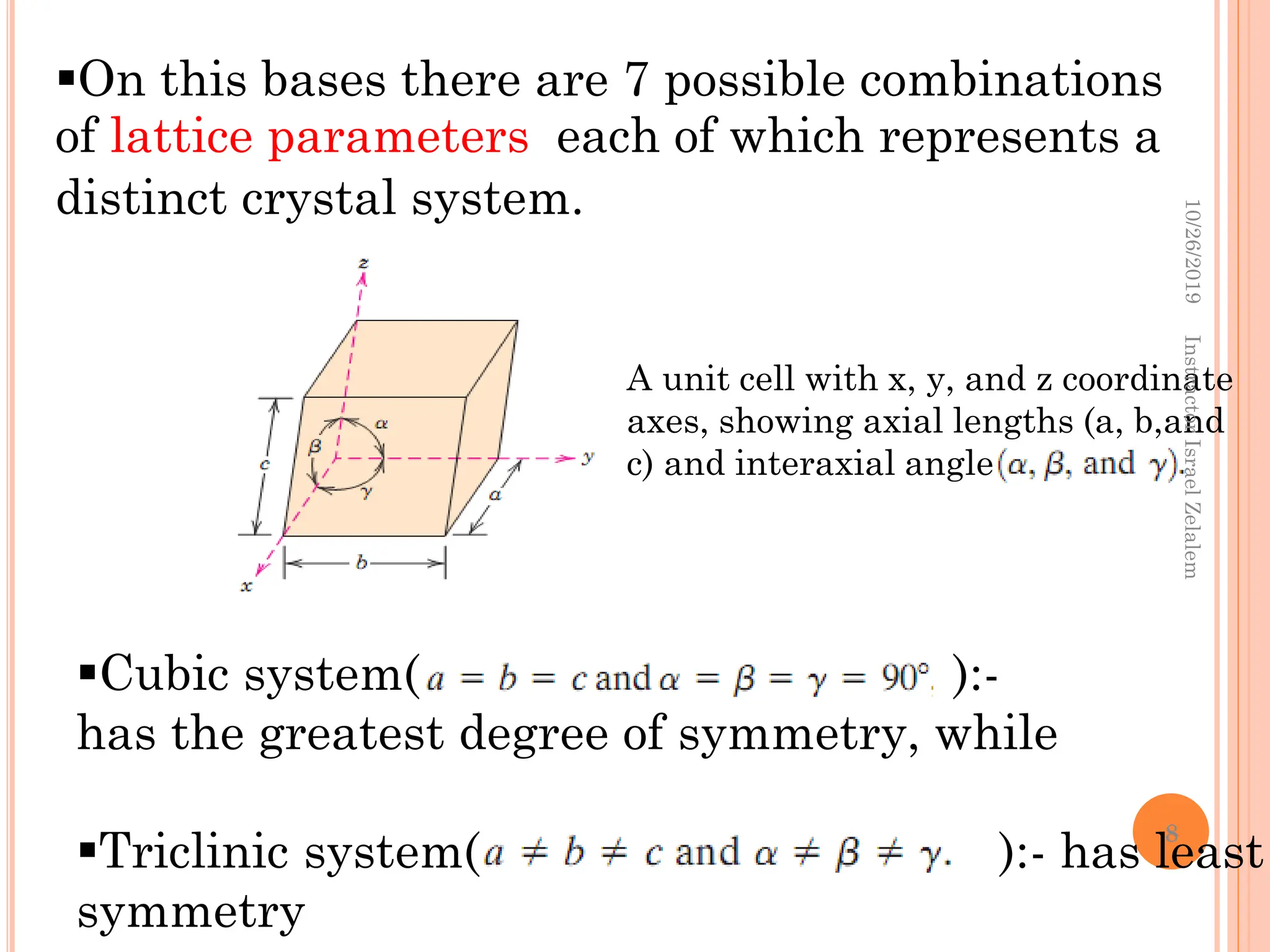
A unit cell with x, y, and z coordinate
axes, showing axial lengths (a, b,and
c) and interaxial angles
On this bases there are 7 possible combinations
of lattice parameters each of which represents a
distinct crystal system.
Cubic system( ):-
has the greatest degree of symmetry, while
Triclinic system( ):- has least
symmetry
10/26/2019
Instractor
Israel
Zelalem
8
10/26/2019
Instractor
Israel
Zelalem
9
10/26/2019
Instractor
Israel
Zelalem
10
10/26/2019 11
Instractor Israel Zelalem
CRYSTALLOGRAPHIC POINTS, DIRECTIONS,
AND PLANES
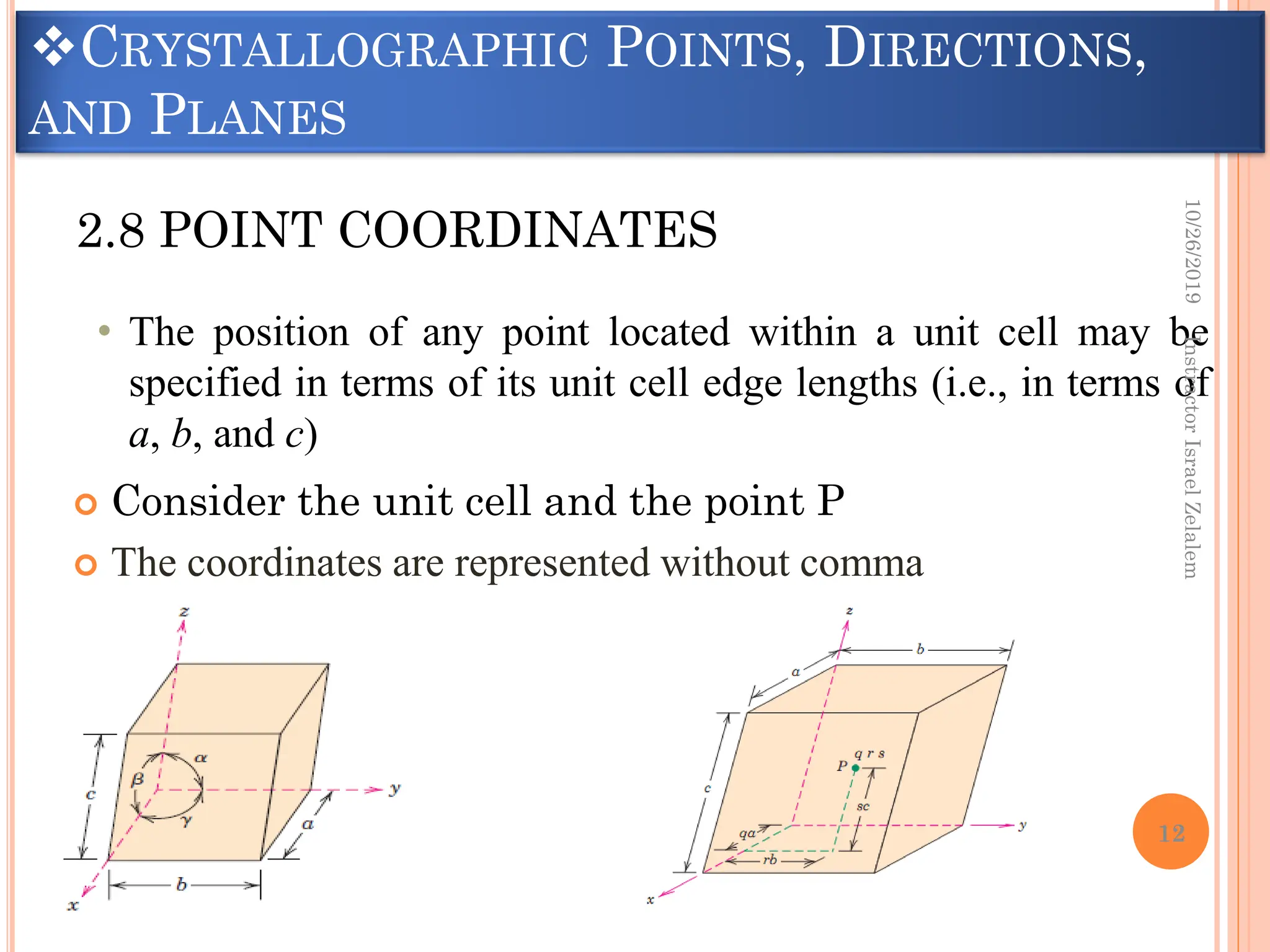
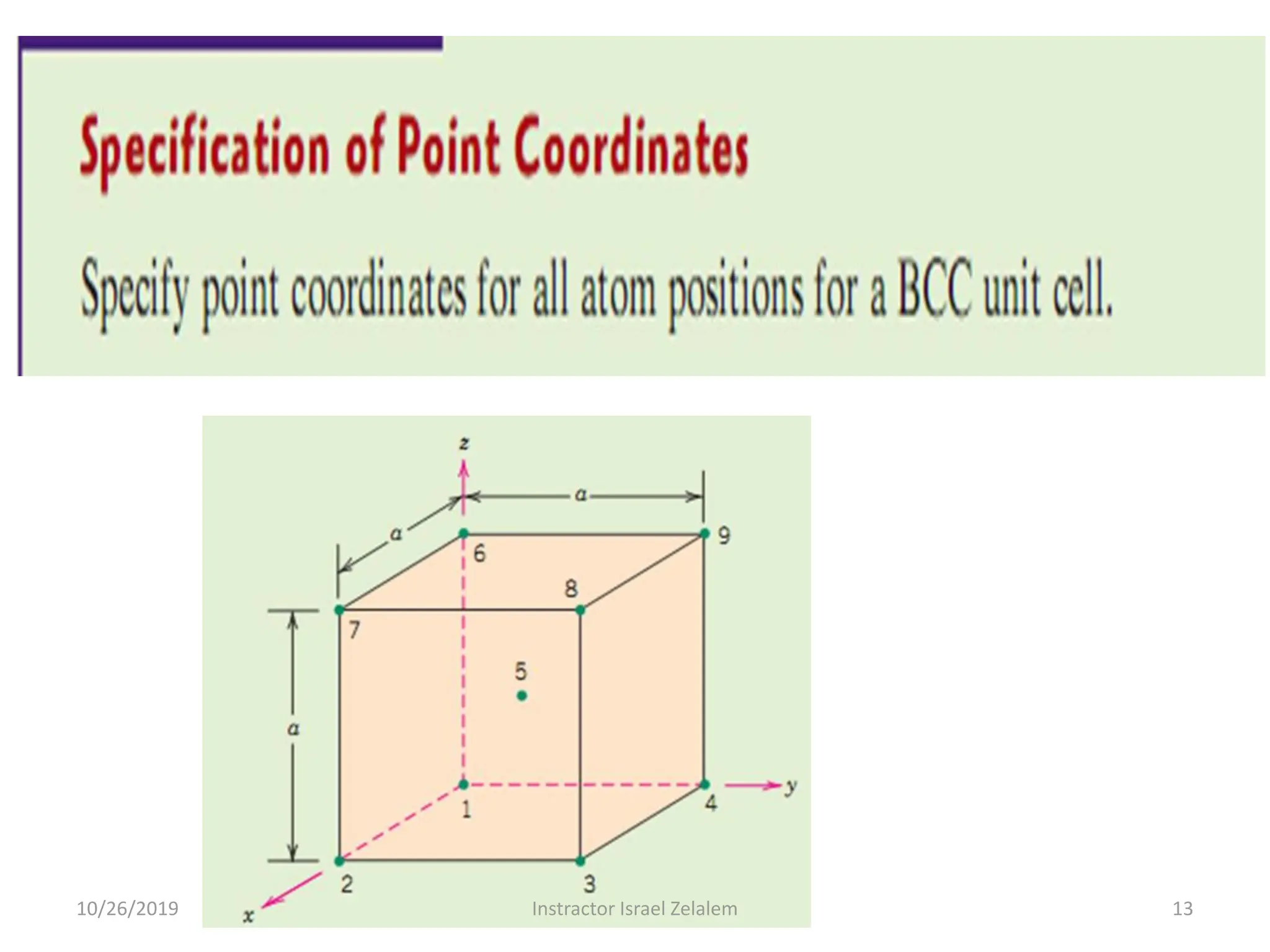
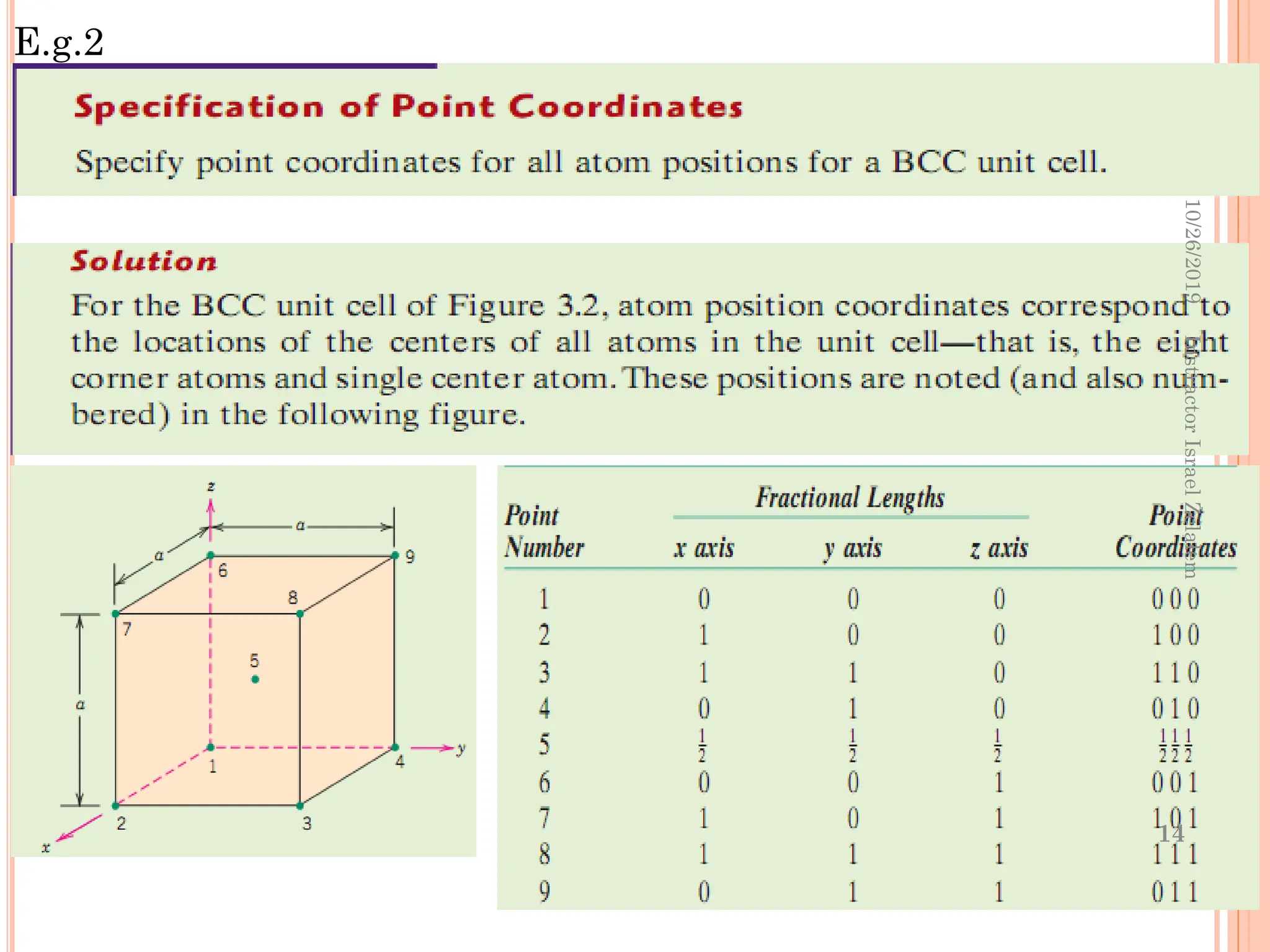
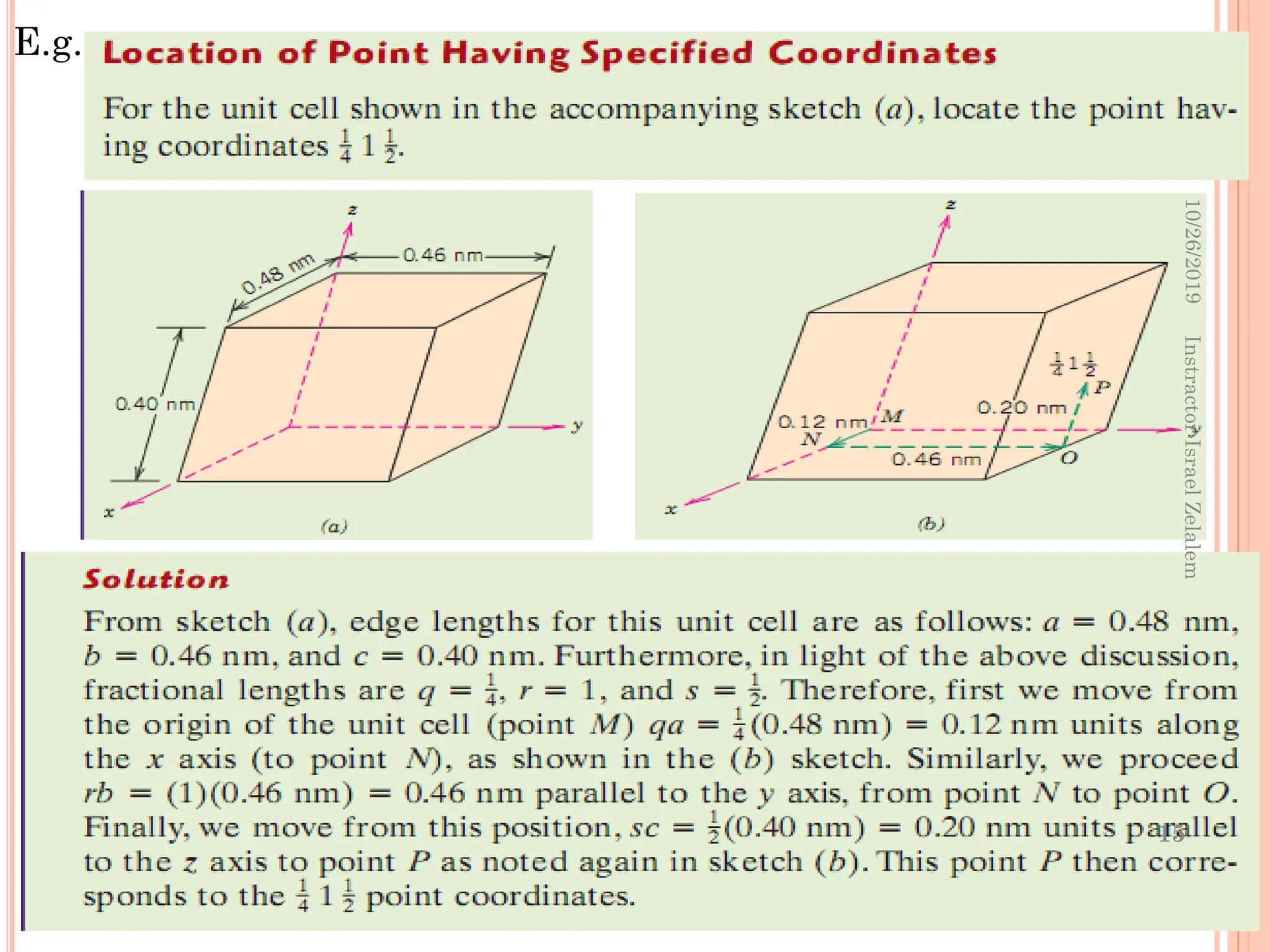
 Consider the unit cell and the point P
 The coordinates are represented without comma
2.8 POINT COORDINATES
• The position of any point located within a unit cell may be
specified in terms of its unit cell edge lengths (i.e., in terms of
a, b, and c)
10/26/2019
Instractor
Israel
Zelalem
12
10/26/2019 Instractor Israel Zelalem 13
E.g.2
10/26/2019
Instractor
Israel
Zelalem
14
E.g.
10/26/2019
Instractor
Israel
Zelalem
15
CRYSTALLOGRAPHIC DIRECTIONS
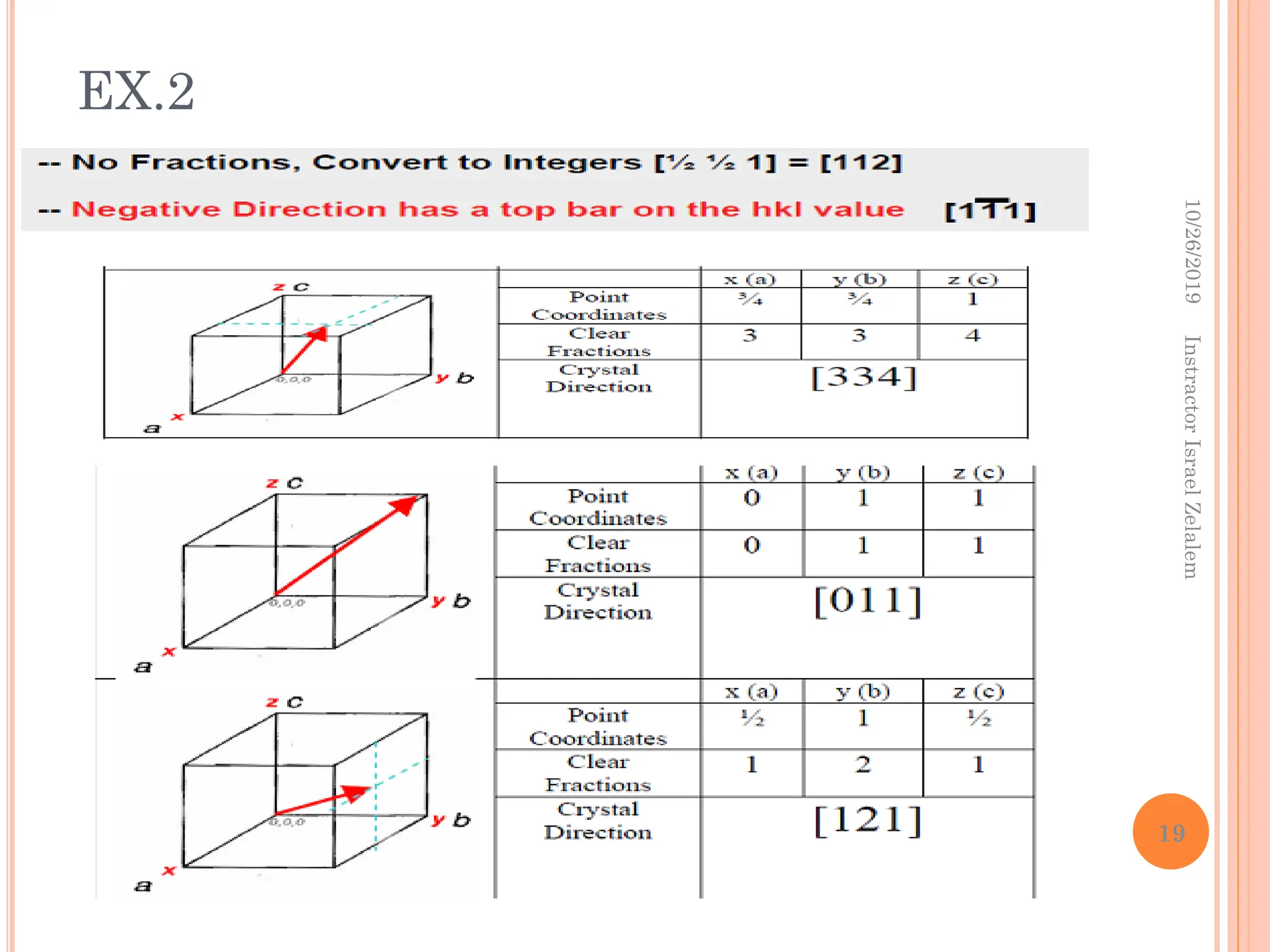
 A crystallographic direction is defined as a line between two
points, or a vector.
 The three indices, not separated by commas, are enclosed in square
brackets, thus: [uvw].
 By convention, the resultant direction components are reduced
to smallest whole numbers and placed in brackets without
commas; the so-called Miller indices
 For example for (½, 1, ½) will be multiplied by 2 and the miller
indices will be [121]
10/26/2019
16
Instractor
Israel
Zelalem
CRYSTALLOGRAPHIC DIRECTIONS
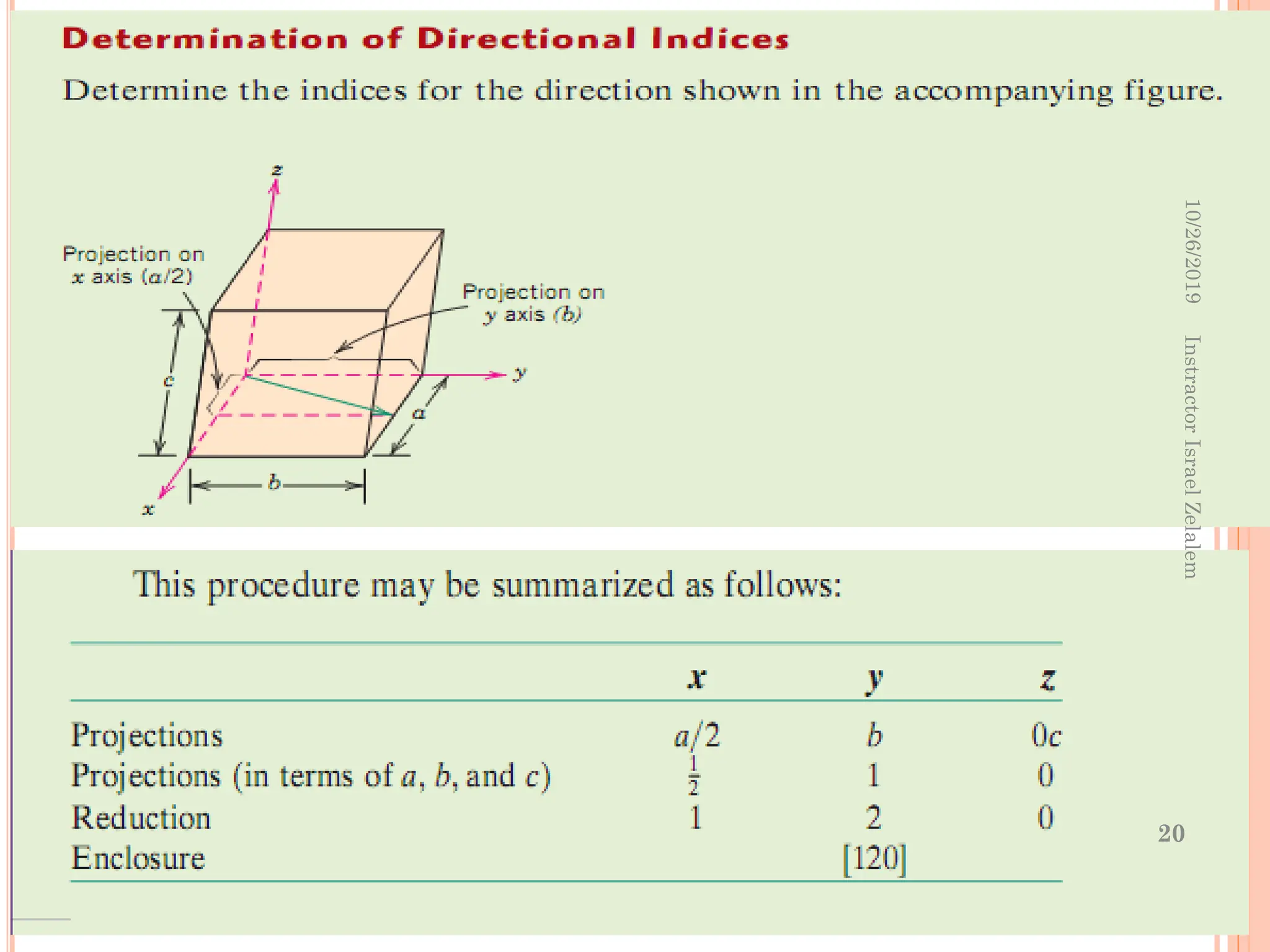
 The following steps in the determination of the three directional
indices:
1. A vector of convenient length is positioned such that it passes through the
origin of the coordinate system.
2. The length of the vector projection on each of the three axes is determined
in terms of the unit cell dimensions a, b, and c.
3. These three numbers are multiplied or divided by a common factor to
reduce them to the smallest whole number values.
4. The three indices, not separated by commas, are enclosed in square
brackets, thus: [uvw].
 The u, v, and w integers correspond to the reduced projections along the
x, y, and z axes, respectively.
10/26/2019
17
Instractor
Israel
Zelalem
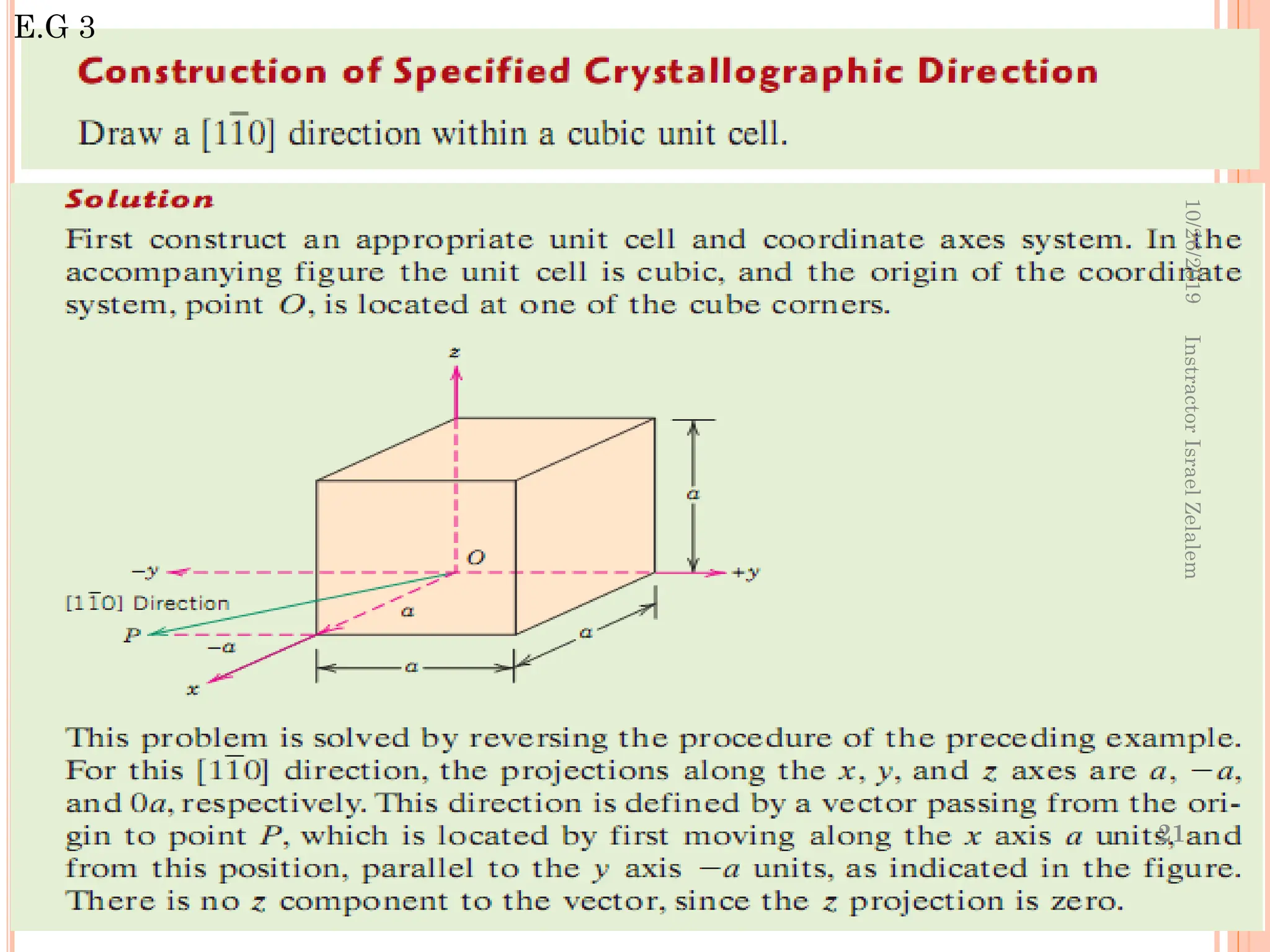
 Negative indices are also possible, which are
represented by a bar over the appropriate index.
 E.g. the direction would have a component
in –y the direction.
The [100], [110], and [111]
directions within a unit cell
10/26/2019
Instractor
Israel
Zelalem
18
EX.1
EX.2
10/26/2019
19
Instractor
Israel
Zelalem
10/26/2019
Instractor
Israel
Zelalem
20
E.G 3
10/26/2019
Instractor
Israel
Zelalem
21
10/26/2019
Instractor
Israel
Zelalem
22
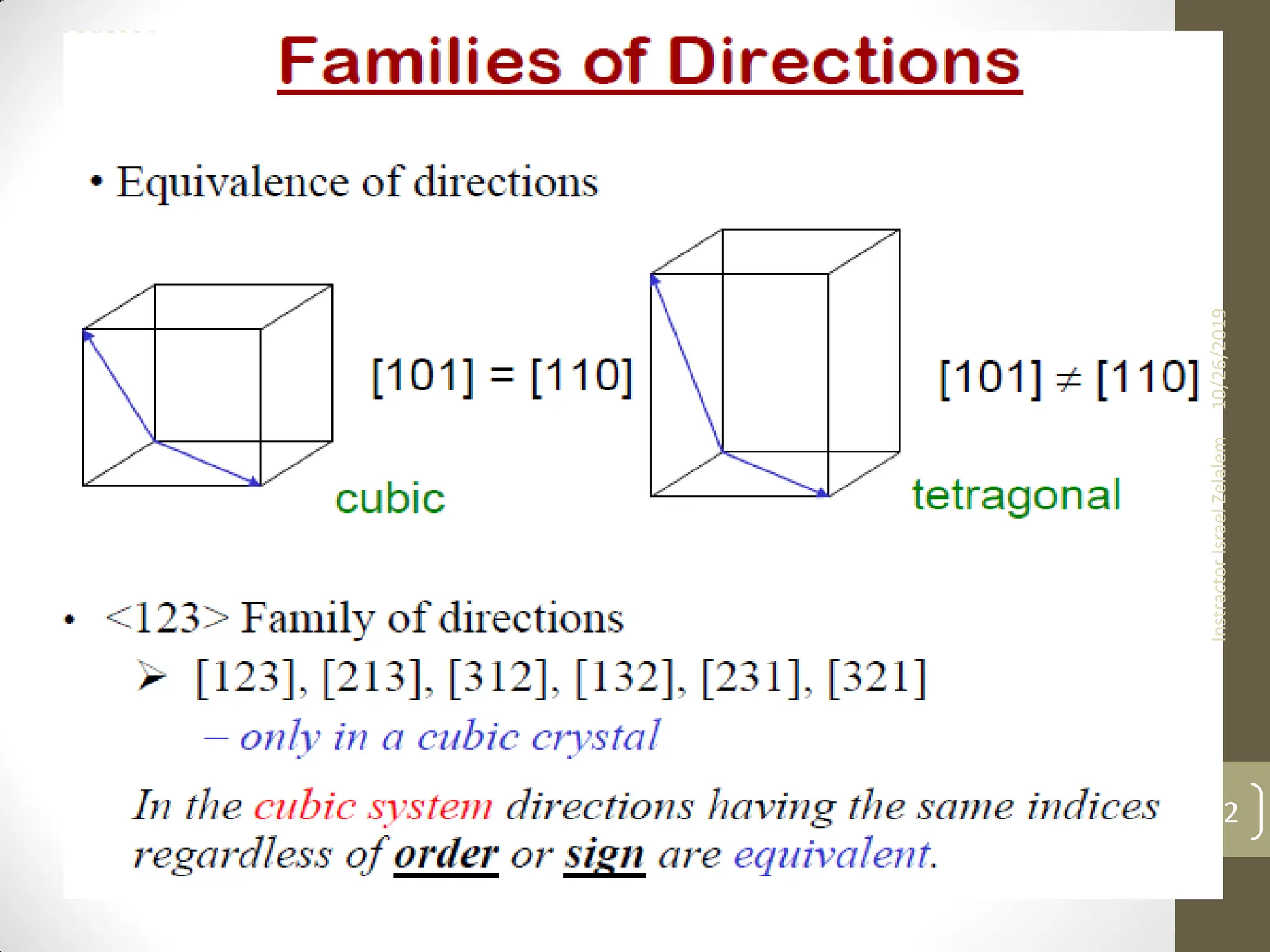
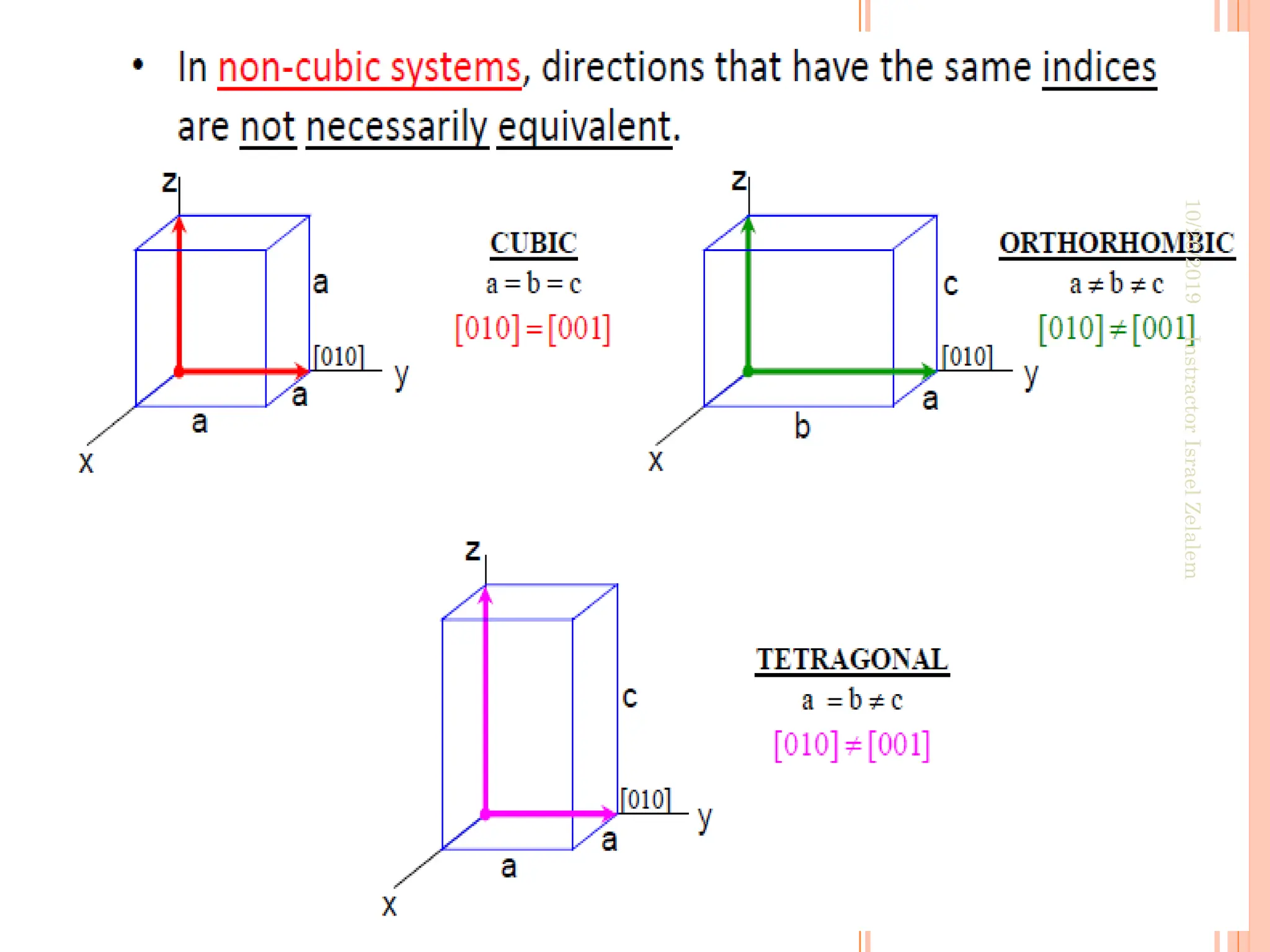
 For some crystal structures, directions with different
indices are actually equivalent;
this means that the spacing of atoms along each
direction is the same.
E.g. in cubic crystals:
The ff. indices are equivalent
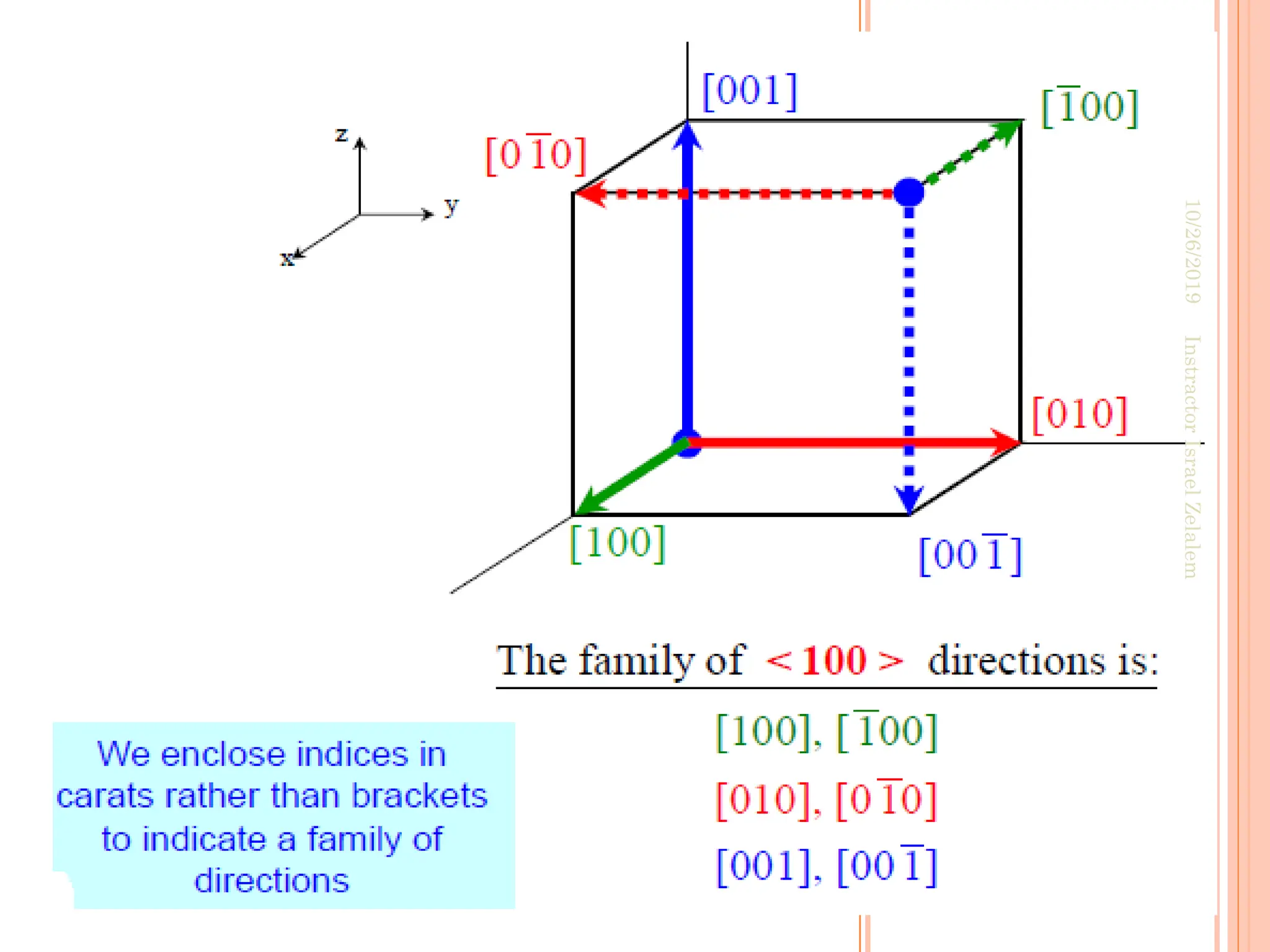
• Equivalent directions are grouped together into a
family, which are enclosed in angle brackets,
In addition, directions in cubic crystals having the
same indices without regard to order or sign are
equivalent. E.g [123] and
This is, in general, not true for other crystal systems
10/26/2019
Instractor
Israel
Zelalem
23
10/26/2019
24
Instractor
Israel
Zelalem
10/26/2019
25
Instractor
Israel
Zelalem
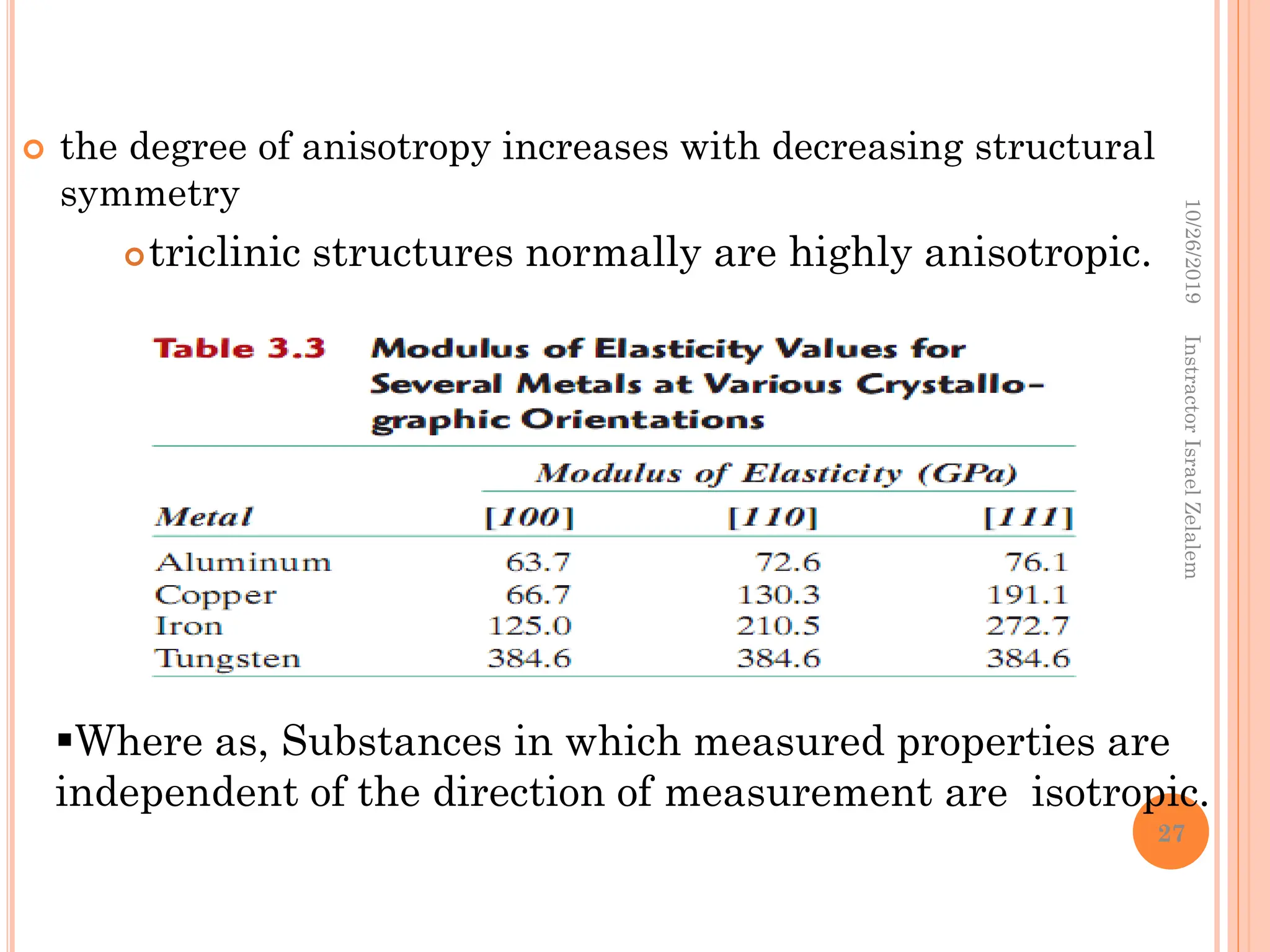
ANISOTROPY
 The directionality of physical properties of
substances.
For example, the elastic modulus, and the electrical
conductivity, may have different values in the [100] and
[111] directions.
it is associated with the variance of atomic or ionic
spacing with crystallographic direction.
The extent and magnitude of anisotropic effects are a
function of symmetry.
10/26/2019
Instractor
Israel
Zelalem
26
 the degree of anisotropy increases with decreasing structural
symmetry
triclinic structures normally are highly anisotropic.
Where as, Substances in which measured properties are
independent of the direction of measurement are isotropic.
10/26/2019
Instractor
Israel
Zelalem
27
2.10 CRYSTALLOGRAPHIC
PLANES
 In all but, the hexagonal crystal system,
crystallographic planes are specified by three Miller
indices as (hkl).
 Any two planes parallel to each other are equivalent
and have identical indices.
 Steps to determination of the h, k, and l index
numbers:
10/26/2019
Instractor
Israel
Zelalem
28
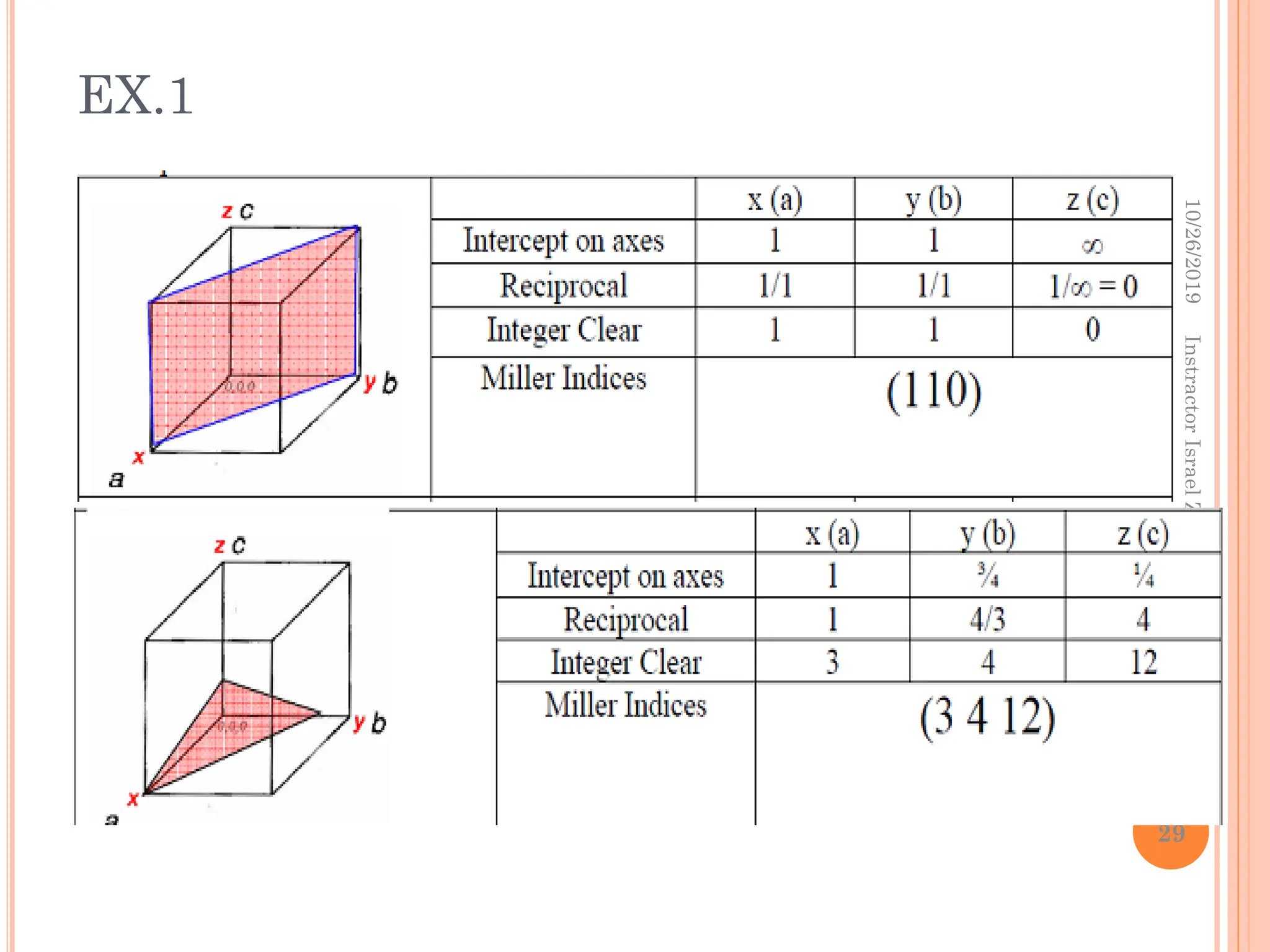
EX.1
10/26/2019
29
Instractor
Israel
Zelalem
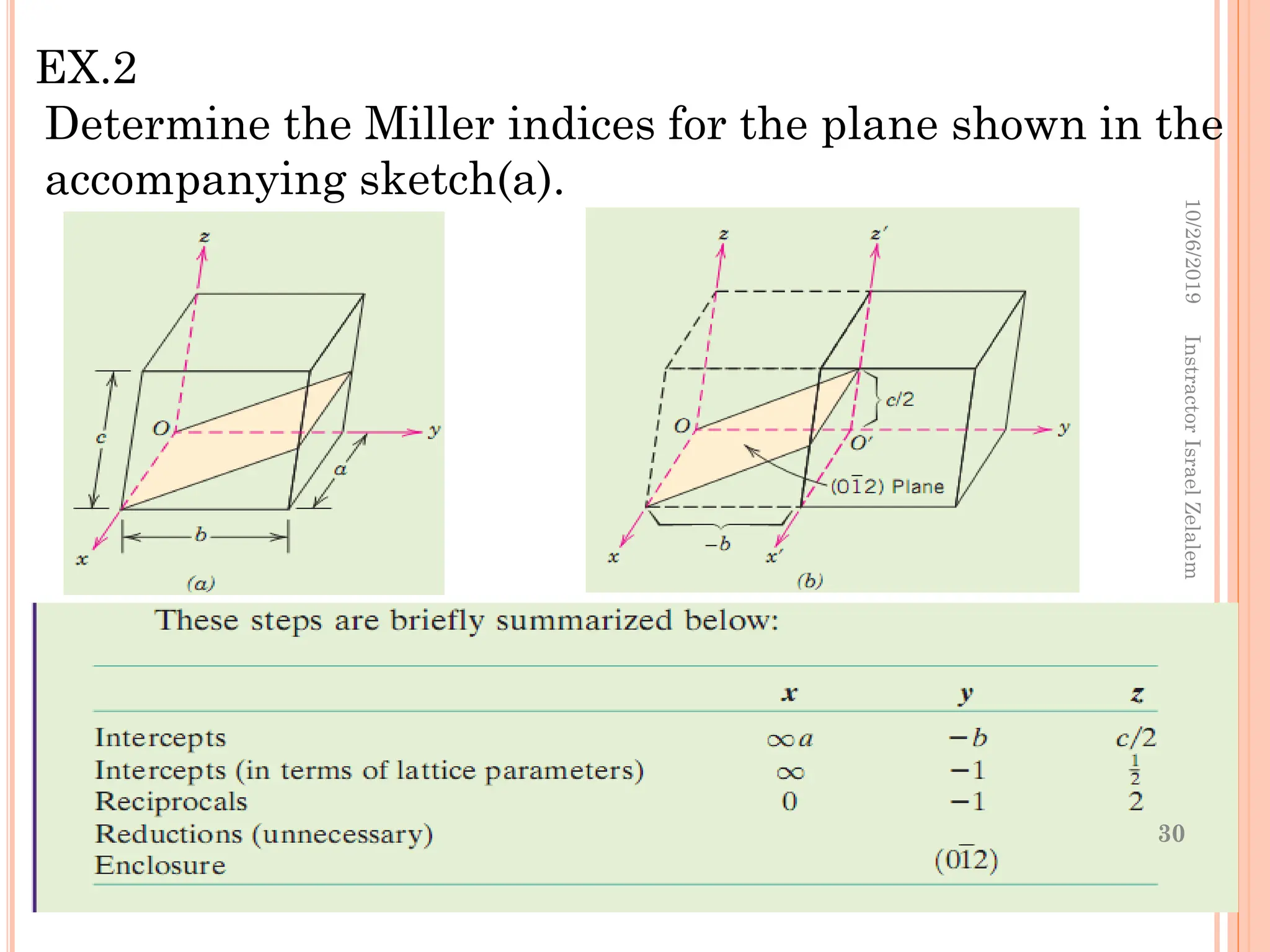
Determine the Miller indices for the plane shown in the
accompanying sketch(a).
EX.2
10/26/2019
Instractor
Israel
Zelalem
30
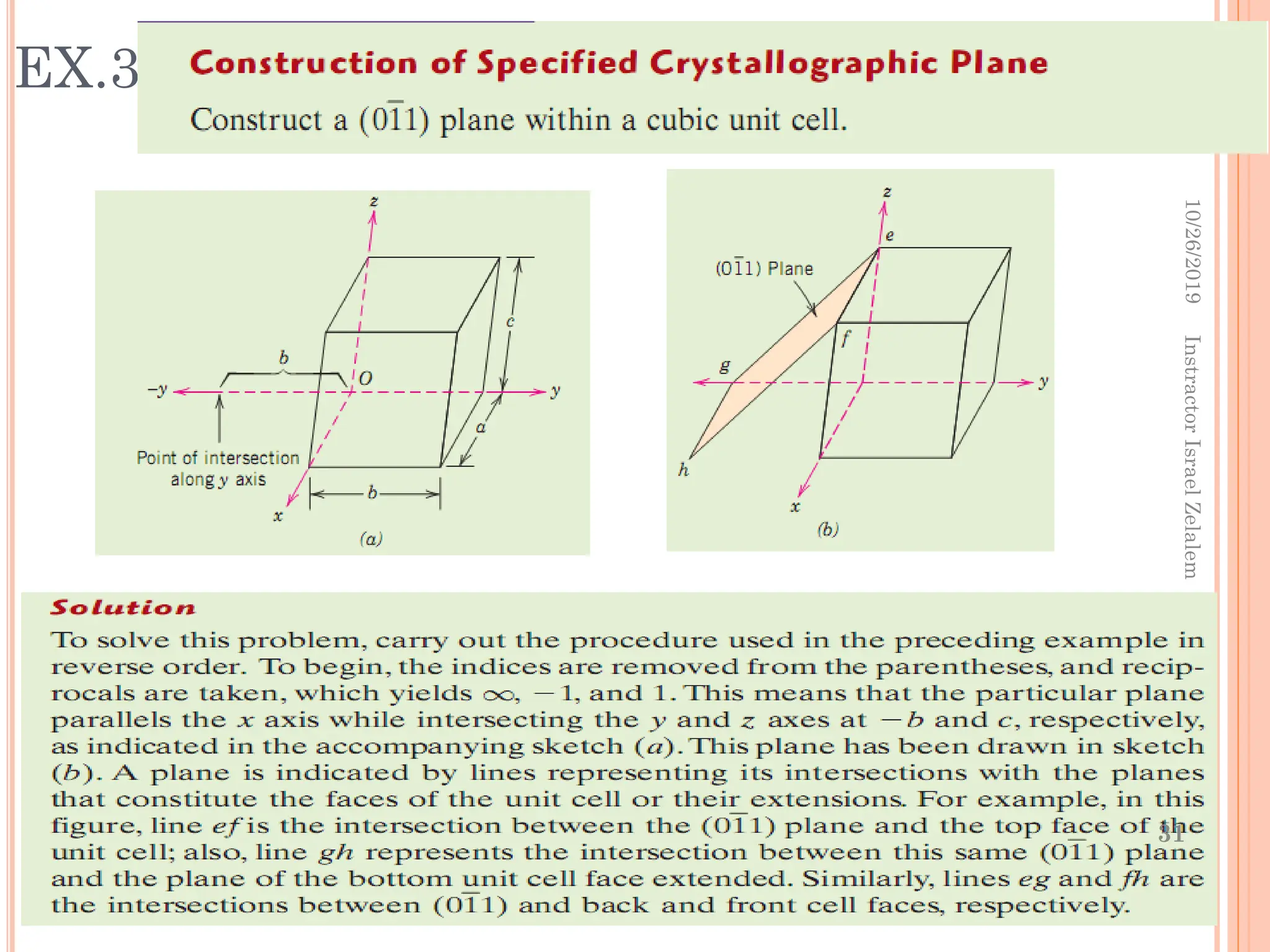
EX.3.
10/26/2019
Instractor
Israel
Zelalem
31
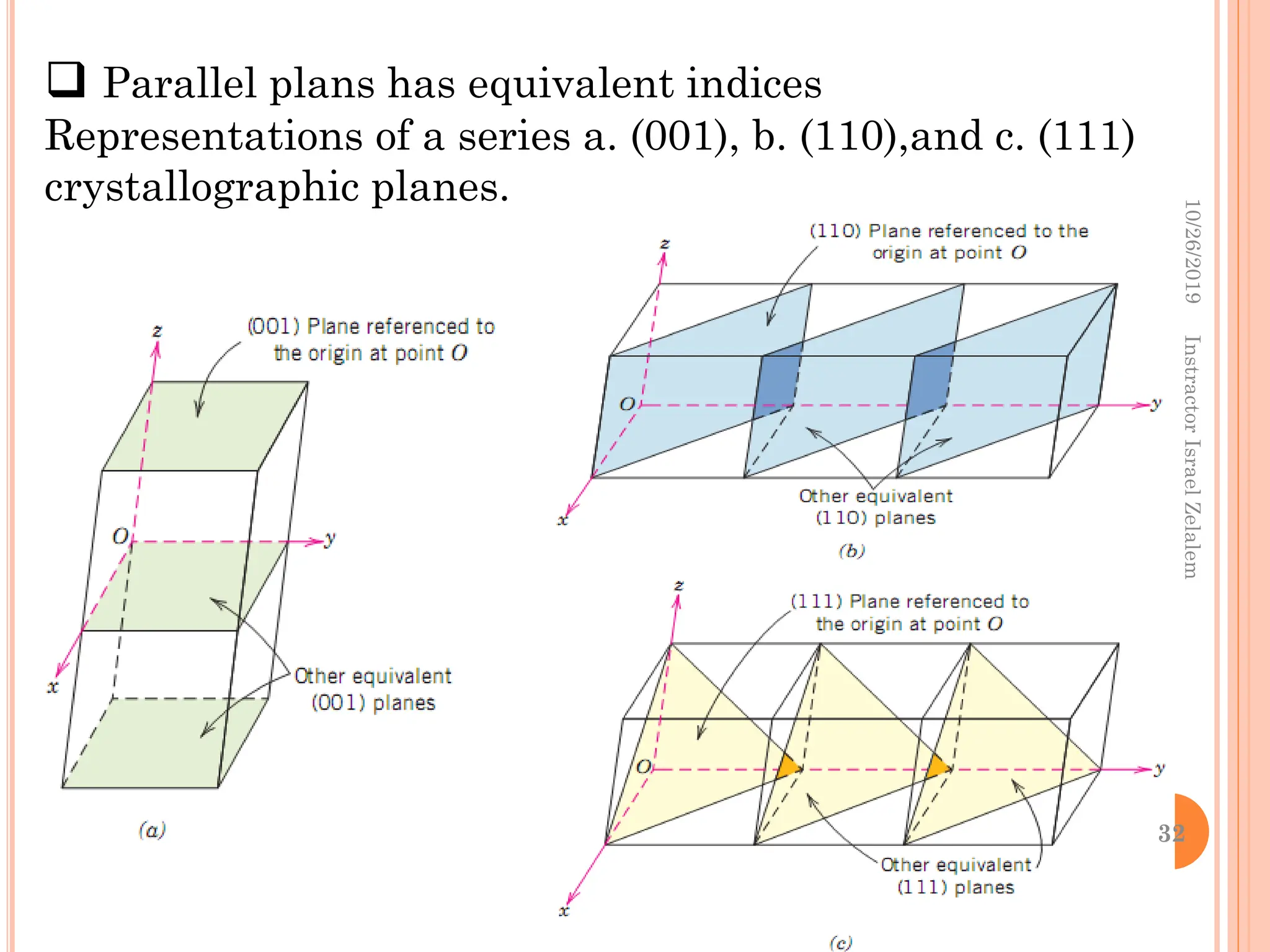
 Parallel plans has equivalent indices
Representations of a series a. (001), b. (110),and c. (111)
crystallographic planes.
10/26/2019
Instractor
Israel
Zelalem
32
ATOMIC ARRANGEMENTS
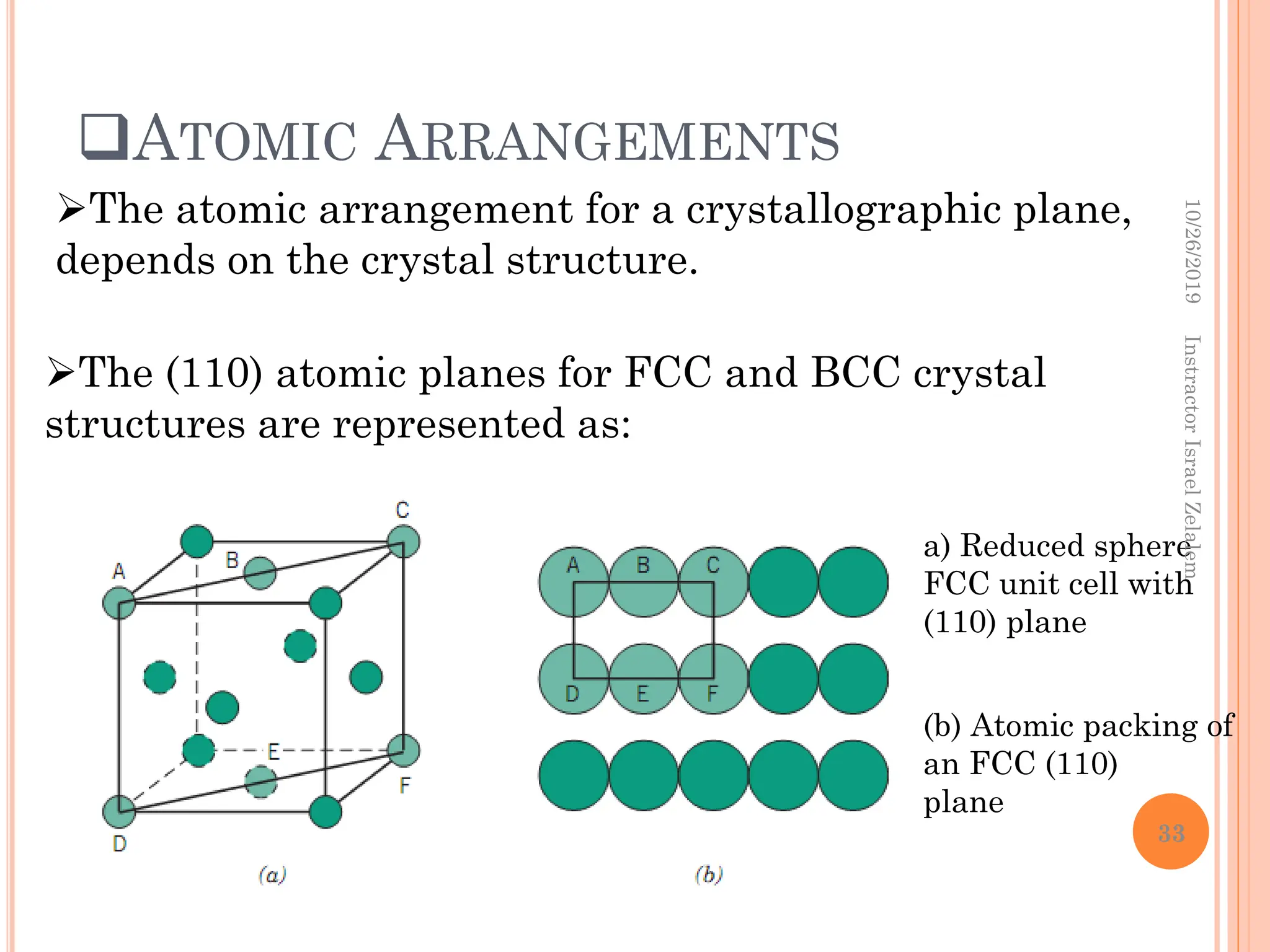
a) Reduced sphere
FCC unit cell with
(110) plane
(b) Atomic packing of
an FCC (110)
plane
The atomic arrangement for a crystallographic plane,
depends on the crystal structure.
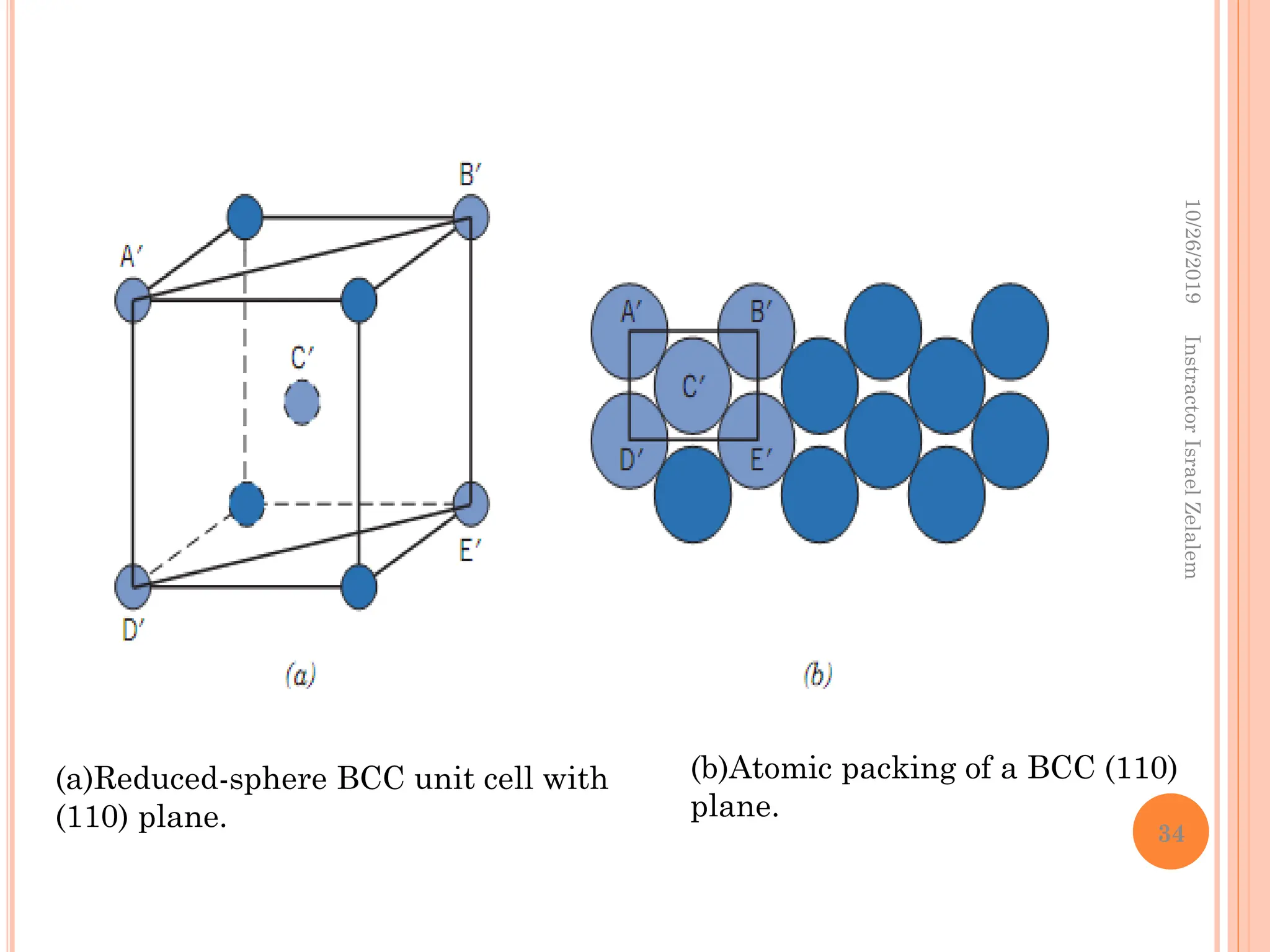
The (110) atomic planes for FCC and BCC crystal
structures are represented as:
10/26/2019
Instractor
Israel
Zelalem
33
(a)Reduced-sphere BCC unit cell with
(110) plane.
(b)Atomic packing of a BCC (110)
plane.
10/26/2019
Instractor
Israel
Zelalem
34
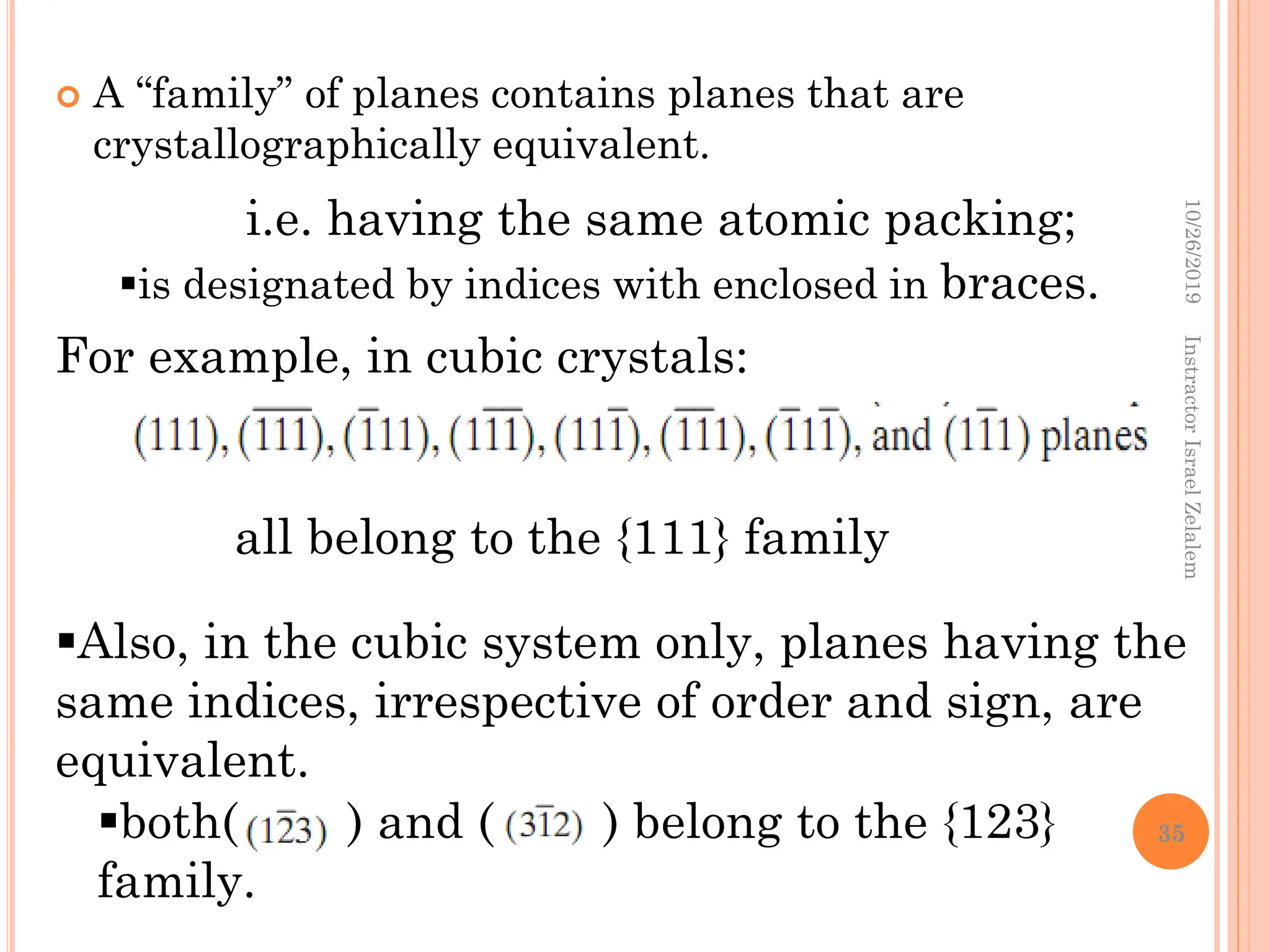
 A “family” of planes contains planes that are
crystallographically equivalent.
i.e. having the same atomic packing;
is designated by indices with enclosed in braces.
For example, in cubic crystals:
all belong to the {111} family
Also, in the cubic system only, planes having the
same indices, irrespective of order and sign, are
equivalent.
both( ) and ( ) belong to the {123}
family.
10/26/2019
Instractor
Israel
Zelalem
35
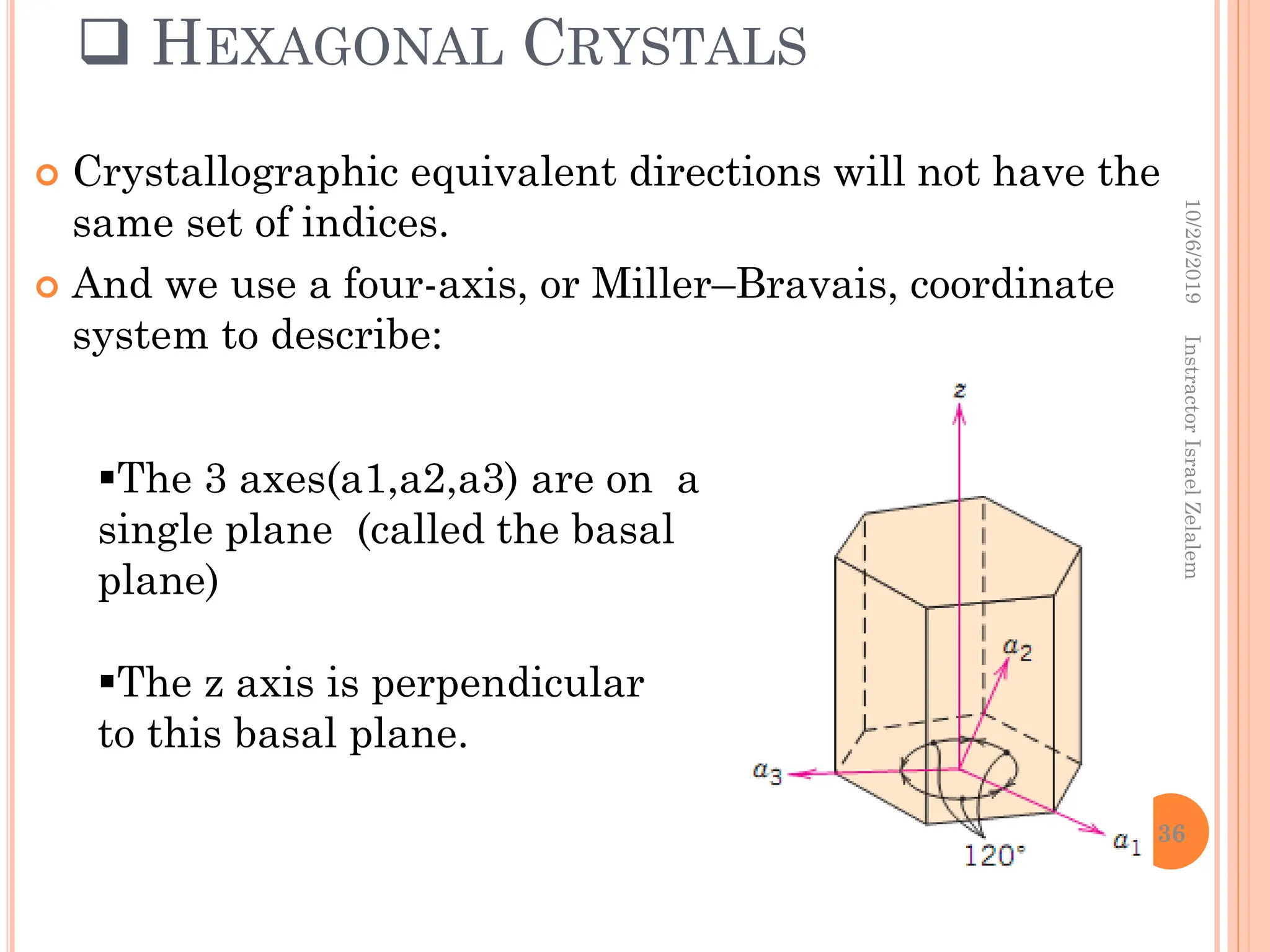
 HEXAGONAL CRYSTALS
 Crystallographic equivalent directions will not have the
same set of indices.
 And we use a four-axis, or Miller–Bravais, coordinate
system to describe:
The 3 axes(a1,a2,a3) are on a
single plane (called the basal
plane)
The z axis is perpendicular
to this basal plane.
10/26/2019
Instractor
Israel
Zelalem
36
DIRECTIONAL INDICES WILL BE DENOTED BY FOUR
INDICES, AS [UVTW];
 And the 4th indices is obtained by the ff. formula:
by convention, the first three indices pertain to
projections along the respective a1,a2,a3 axes in
the basal plane.
E,g, the [010] direction becomes
10/26/2019
Instractor
Israel
Zelalem
37
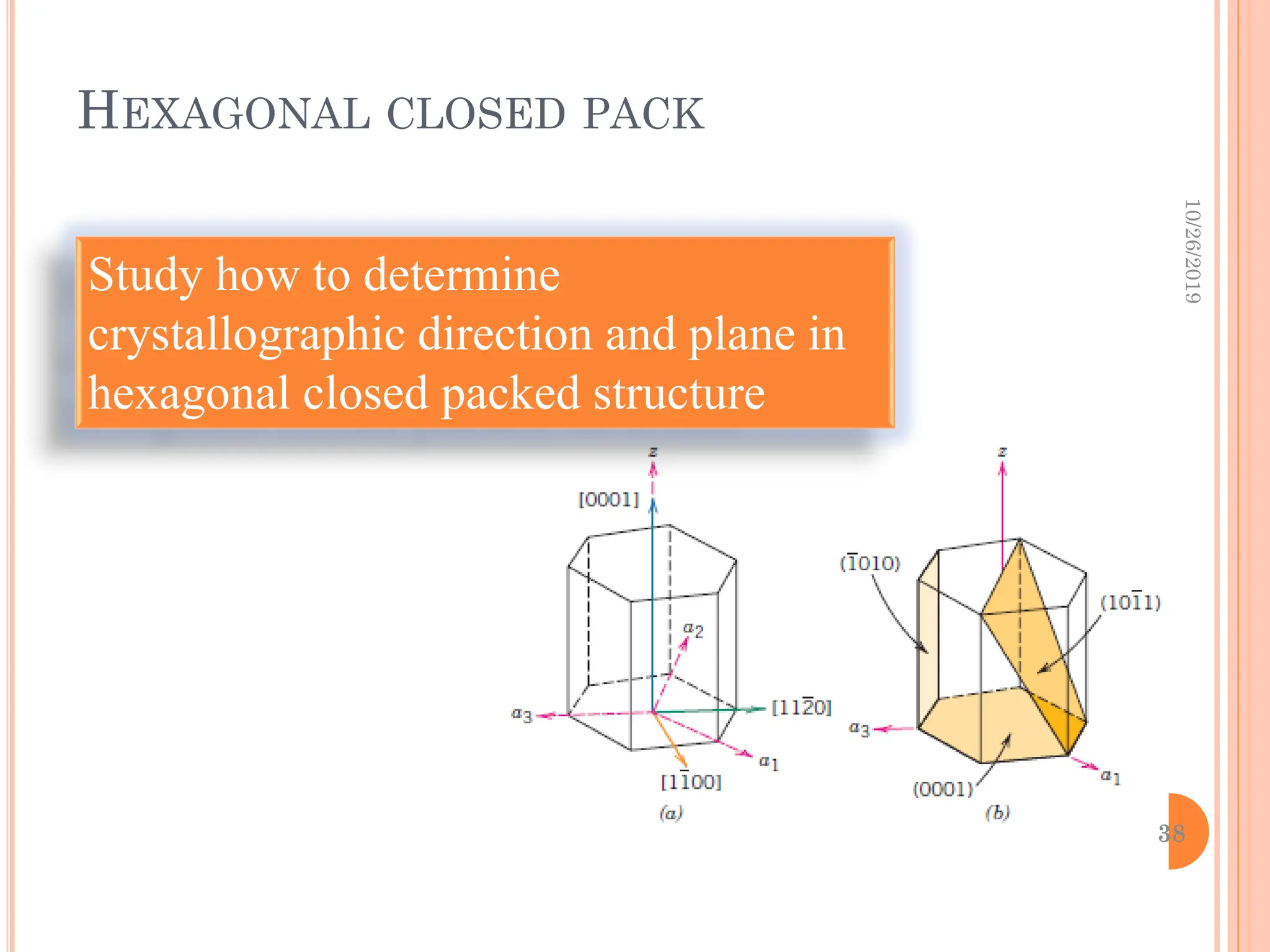
HEXAGONAL CLOSED PACK
10/26/2019
38
Study how to determine
crystallographic direction and plane in
hexagonal closed packed structure
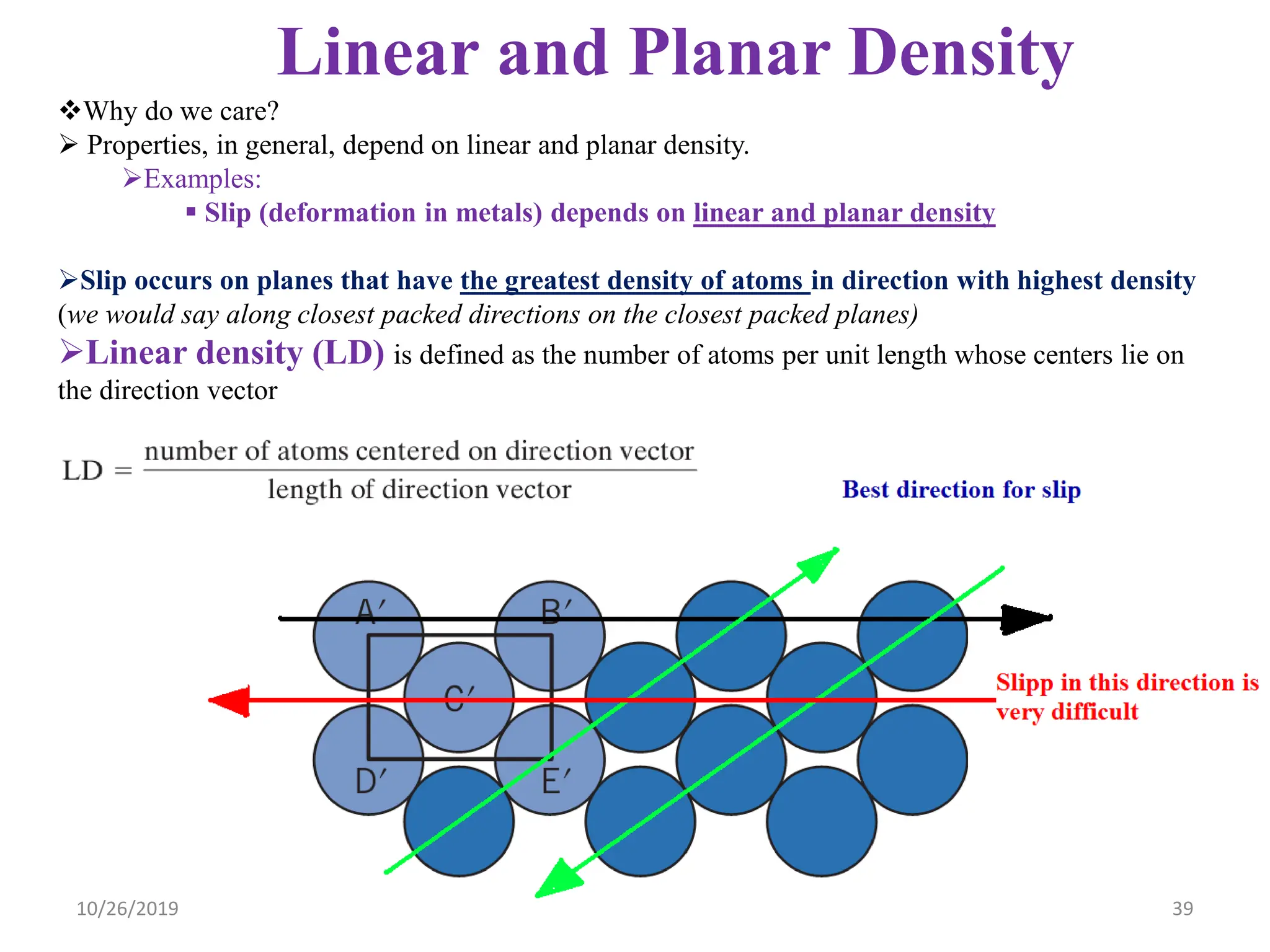
Why do we care?
 Properties, in general, depend on linear and planar density.
Examples:
 Slip (deformation in metals) depends on linear and planar density
Slip occurs on planes that have the greatest density of atoms in direction with highest density
(we would say along closest packed directions on the closest packed planes)
Linear density (LD) is defined as the number of atoms per unit length whose centers lie on
the direction vector
Linear and Planar Density
10/26/2019 39
10/26/2019
40
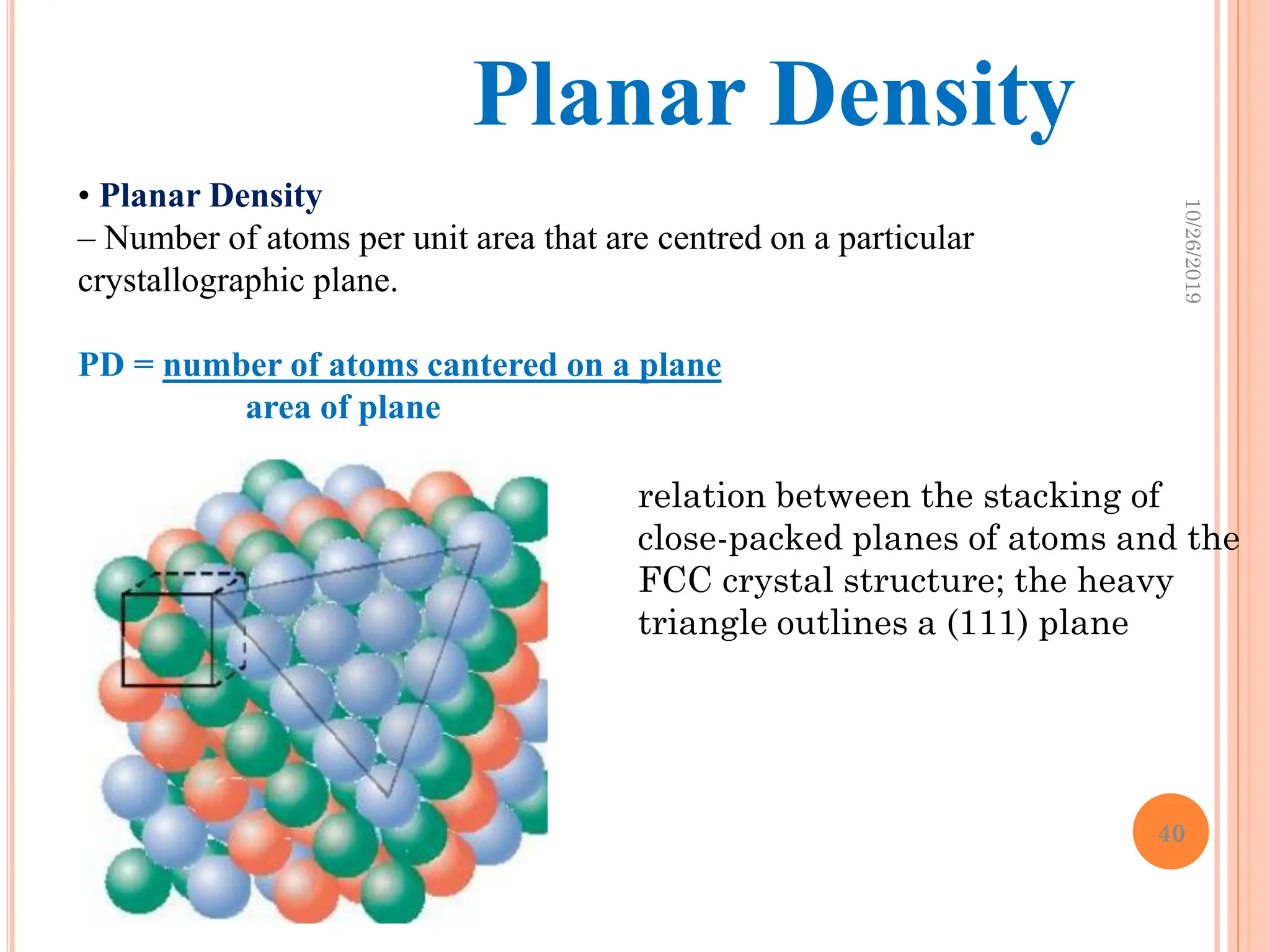
• Planar Density
– Number of atoms per unit area that are centred on a particular
crystallographic plane.
PD = number of atoms cantered on a plane
area of plane
Planar Density
relation between the stacking of
close-packed planes of atoms and the
FCC crystal structure; the heavy
triangle outlines a (111) plane
NONCRYSTALLINE SOLIDS
 Sometimes such materials are also called amorphous
 (meaning literally without form),or
 super cooled liquids, in as much as their atomic
structure resembles that of a liquid.
 lack a systematic and regular arrangement of atoms
over a relatively large atomic distances.
10/26/2019
Instractor
Israel
Zelalem
41
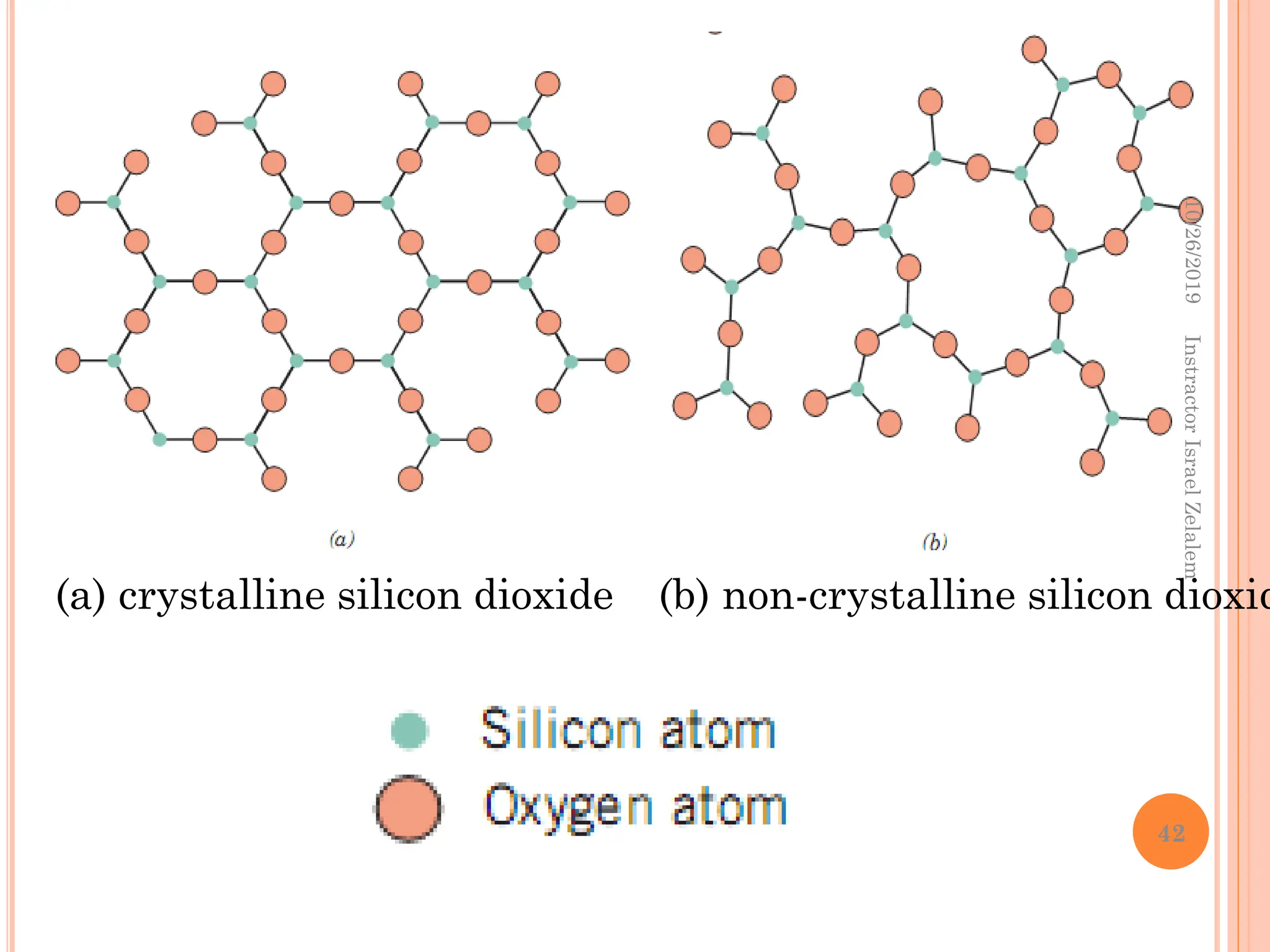
(a) crystalline silicon dioxide (b) non-crystalline silicon dioxid
10/26/2019
Instractor
Israel
Zelalem
42
 Unique characteristic of cubic crystals is that planes and
directions having the same indices are perpendicular to
one another.
 However, for other crystal systems there are no simple
geometrical relationships between planes and directions
having the same indices.
10/26/2019
Instractor
Israel
Zelalem
43

Chapter 2 structure of crystalline solidsLecture II (1).pdf

  • 1.
    CHAPTER TWO The Structureof Crystalline Solids Lecture Two
  • 2.
    3.6 POLYMORPHISM ANDALLOTROPY Polymorphism:- a phenomenon in which some materials (metal or non-metal)may have more than one crystal structure.  When found in elemental solids, the condition is often termed allotropy.  The crystal structure depends on both the temperature and the external pressure.  Example:  Pure iron has a BCC crystal structure at room temperature, which changes to FCC iron at 9120C (16740F) 10/26/2019 Instractor Israel Zelalem 2
  • 3.
    POLY-CRYSTALLINE MATERIALS  composedof a collection of many small crystals or grains.  Various stages in the solidification of a polycrystalline Initially, small crystals or nuclei form at various positions having random crystallographic orientations. 10/26/2019 Instractor Israel Zelalem 3
  • 4.
     The smallgrains grow by the successive addition from the surrounding liquid of atoms to the structure of each. The extremities of adjacent grains interrupt on one another as the solidification process approaches completion. 10/26/2019 Instractor Israel Zelalem 4
  • 5.
     All unitcells interlock in the same way and have the same orientation.  Single crystals exist in nature and produced artificially under carefully controlled env’t. SINGLE CRYSTALS: when the periodic and repeated arrangement of atoms is perfect or extends throughout the entirety of the specimen without interruption. 10/26/2019 Instractor Israel Zelalem 5
  • 6.
    Within the pastfew years, single crystals have become extremely important in many modern technologies in particular electronic microcircuits, which employ single crystals of silicon and other semiconductors. 10/26/2019 Instractor Israel Zelalem 6
  • 7.
    3.7 CRYSTAL SYSTEMS Is a way of classifying crystal structure into groups based on unit cell geometry &/or atomic arrangements.  Unit cell geometry:- an x, y, z coordinate system is established with its origin at one of the unit cell corners. Is defined in terms of 6 parameters:  the three edge lengths a, b, and c, and  the three inter-axial angles , β and r. Are called lattice parameters of a crystal structure. 10/26/2019 Instractor Israel Zelalem 7
  • 8.
    A unit cellwith x, y, and z coordinate axes, showing axial lengths (a, b,and c) and interaxial angles On this bases there are 7 possible combinations of lattice parameters each of which represents a distinct crystal system. Cubic system( ):- has the greatest degree of symmetry, while Triclinic system( ):- has least symmetry 10/26/2019 Instractor Israel Zelalem 8
  • 9.
  • 10.
  • 11.
  • 12.
    CRYSTALLOGRAPHIC POINTS, DIRECTIONS, ANDPLANES  Consider the unit cell and the point P  The coordinates are represented without comma 2.8 POINT COORDINATES • The position of any point located within a unit cell may be specified in terms of its unit cell edge lengths (i.e., in terms of a, b, and c) 10/26/2019 Instractor Israel Zelalem 12
  • 13.
  • 14.
  • 15.
  • 16.
    CRYSTALLOGRAPHIC DIRECTIONS  Acrystallographic direction is defined as a line between two points, or a vector.  The three indices, not separated by commas, are enclosed in square brackets, thus: [uvw].  By convention, the resultant direction components are reduced to smallest whole numbers and placed in brackets without commas; the so-called Miller indices  For example for (½, 1, ½) will be multiplied by 2 and the miller indices will be [121] 10/26/2019 16 Instractor Israel Zelalem
  • 17.
    CRYSTALLOGRAPHIC DIRECTIONS  Thefollowing steps in the determination of the three directional indices: 1. A vector of convenient length is positioned such that it passes through the origin of the coordinate system. 2. The length of the vector projection on each of the three axes is determined in terms of the unit cell dimensions a, b, and c. 3. These three numbers are multiplied or divided by a common factor to reduce them to the smallest whole number values. 4. The three indices, not separated by commas, are enclosed in square brackets, thus: [uvw].  The u, v, and w integers correspond to the reduced projections along the x, y, and z axes, respectively. 10/26/2019 17 Instractor Israel Zelalem
  • 18.
     Negative indicesare also possible, which are represented by a bar over the appropriate index.  E.g. the direction would have a component in –y the direction. The [100], [110], and [111] directions within a unit cell 10/26/2019 Instractor Israel Zelalem 18 EX.1
  • 19.
  • 20.
  • 21.
  • 22.
  • 23.
     For somecrystal structures, directions with different indices are actually equivalent; this means that the spacing of atoms along each direction is the same. E.g. in cubic crystals: The ff. indices are equivalent • Equivalent directions are grouped together into a family, which are enclosed in angle brackets, In addition, directions in cubic crystals having the same indices without regard to order or sign are equivalent. E.g [123] and This is, in general, not true for other crystal systems 10/26/2019 Instractor Israel Zelalem 23
  • 24.
  • 25.
  • 26.
    ANISOTROPY  The directionalityof physical properties of substances. For example, the elastic modulus, and the electrical conductivity, may have different values in the [100] and [111] directions. it is associated with the variance of atomic or ionic spacing with crystallographic direction. The extent and magnitude of anisotropic effects are a function of symmetry. 10/26/2019 Instractor Israel Zelalem 26
  • 27.
     the degreeof anisotropy increases with decreasing structural symmetry triclinic structures normally are highly anisotropic. Where as, Substances in which measured properties are independent of the direction of measurement are isotropic. 10/26/2019 Instractor Israel Zelalem 27
  • 28.
    2.10 CRYSTALLOGRAPHIC PLANES  Inall but, the hexagonal crystal system, crystallographic planes are specified by three Miller indices as (hkl).  Any two planes parallel to each other are equivalent and have identical indices.  Steps to determination of the h, k, and l index numbers: 10/26/2019 Instractor Israel Zelalem 28
  • 29.
  • 30.
    Determine the Millerindices for the plane shown in the accompanying sketch(a). EX.2 10/26/2019 Instractor Israel Zelalem 30
  • 31.
  • 32.
     Parallel planshas equivalent indices Representations of a series a. (001), b. (110),and c. (111) crystallographic planes. 10/26/2019 Instractor Israel Zelalem 32
  • 33.
    ATOMIC ARRANGEMENTS a) Reducedsphere FCC unit cell with (110) plane (b) Atomic packing of an FCC (110) plane The atomic arrangement for a crystallographic plane, depends on the crystal structure. The (110) atomic planes for FCC and BCC crystal structures are represented as: 10/26/2019 Instractor Israel Zelalem 33
  • 34.
    (a)Reduced-sphere BCC unitcell with (110) plane. (b)Atomic packing of a BCC (110) plane. 10/26/2019 Instractor Israel Zelalem 34
  • 35.
     A “family”of planes contains planes that are crystallographically equivalent. i.e. having the same atomic packing; is designated by indices with enclosed in braces. For example, in cubic crystals: all belong to the {111} family Also, in the cubic system only, planes having the same indices, irrespective of order and sign, are equivalent. both( ) and ( ) belong to the {123} family. 10/26/2019 Instractor Israel Zelalem 35
  • 36.
     HEXAGONAL CRYSTALS Crystallographic equivalent directions will not have the same set of indices.  And we use a four-axis, or Miller–Bravais, coordinate system to describe: The 3 axes(a1,a2,a3) are on a single plane (called the basal plane) The z axis is perpendicular to this basal plane. 10/26/2019 Instractor Israel Zelalem 36
  • 37.
    DIRECTIONAL INDICES WILLBE DENOTED BY FOUR INDICES, AS [UVTW];  And the 4th indices is obtained by the ff. formula: by convention, the first three indices pertain to projections along the respective a1,a2,a3 axes in the basal plane. E,g, the [010] direction becomes 10/26/2019 Instractor Israel Zelalem 37
  • 38.
    HEXAGONAL CLOSED PACK 10/26/2019 38 Studyhow to determine crystallographic direction and plane in hexagonal closed packed structure
  • 39.
    Why do wecare?  Properties, in general, depend on linear and planar density. Examples:  Slip (deformation in metals) depends on linear and planar density Slip occurs on planes that have the greatest density of atoms in direction with highest density (we would say along closest packed directions on the closest packed planes) Linear density (LD) is defined as the number of atoms per unit length whose centers lie on the direction vector Linear and Planar Density 10/26/2019 39
  • 40.
    10/26/2019 40 • Planar Density –Number of atoms per unit area that are centred on a particular crystallographic plane. PD = number of atoms cantered on a plane area of plane Planar Density relation between the stacking of close-packed planes of atoms and the FCC crystal structure; the heavy triangle outlines a (111) plane
  • 41.
    NONCRYSTALLINE SOLIDS  Sometimessuch materials are also called amorphous  (meaning literally without form),or  super cooled liquids, in as much as their atomic structure resembles that of a liquid.  lack a systematic and regular arrangement of atoms over a relatively large atomic distances. 10/26/2019 Instractor Israel Zelalem 41
  • 42.
    (a) crystalline silicondioxide (b) non-crystalline silicon dioxid 10/26/2019 Instractor Israel Zelalem 42
  • 43.
     Unique characteristicof cubic crystals is that planes and directions having the same indices are perpendicular to one another.  However, for other crystal systems there are no simple geometrical relationships between planes and directions having the same indices. 10/26/2019 Instractor Israel Zelalem 43