1
ADDIS ABABA UNIVERSITY
ADDIS ABABA INSTITUTE OF TECHNOLOGY
SCHOOL OF CHEMICAL AND BIO ENGINEERING
PLANT DESIGN AND ECONOMICS PROJECT FINAL REPORT
PROJECT ON UNBLEACHED SUGAR PRODUCTION FROM SUGAR CANE
ADVISORS:
1 Mr. ELIAS T.
2 Mr. BROOK T.
SUBMITTED BY:
1 ABNET MENGESHA
2 EYERUSALEM TSEGAYE
3 TIRSIT MENGISTU
4 YORDANOS KIFLU
ADDIS ABABA, ETHIOPIA
JUNE 14, 2017
2
Acknowledgment
At first we would like to thank almighty God who helped us through all our journey. We also wish
to acknowledge and thank all our supporters during our project work for their limitless support and
advice. In particular, we would like to express our deepest gratitude and appreciation to our
advisors and instructors Mr. Brook T. and Mr. Elias T. for their great advice and teaching this
course, which help us on our project.
In closing, we are deeply grateful to our class mate for their willingness and kindness to share
ideas with us about their and ours projects.
3
Executive Summary
This section of the project is written with the aim of providing general information about the
project entitled “UNBLEACHED SUGAR PRODUCTION FROM SUGAR CANE” that we have
been doing, throughout the whole semester. The whole project is divided in to six main chapters
which are:
The first chapter deals with the introduction, it is about sugar general information and sugar in
Ethiopia. The second chapter deals about general literature survey and the whole sugar production
process. In the third chapter material and energy balance and equipment sizing and specifications
are discussed. The fourth chapter deals with raw material and utilities and market study. In the
fifth chapter we have discussed about economic evaluation of the plant. And lastly the conclusion
is draw from the whole process of the project.
Demand projection that the domestic demand for sugar is substantial and is increasing with time.
Accordingly, the planned plant is set to produce21154 tons annually. The total investment cost of
the project including working capital is estimated at Birr 28.136 million and
Birr 1.467 million of income.
The financial result indicates that the project will generate profit beginning from the first year of
operation. Moreover, the project will payback fully the initial investment less working capital in 2
years. The result further shows that the calculated ROI of the project is 52%.
Generally, the project is technically feasible, financially and commercially viable as well as
socially and economically acceptable. Hence the project is worth implementing.
4
List of Abbreviations and Acronym
B: Bagasse
Br: Degree brix
C: Cane
CJ: Clear Juice
E1: Water Evaporated at Evaporation Unit
E2: Water Evaporated at Vacuum Plant Unit
ELPA: Ethiopian Electric Power Authority
FC: Filter Cake
Hva: Hangler Vonder Amsterdam
ICUMSA: International Commission for Uniform Method of Sugar Analysis
Imb: Imbibition
Imp: Impurities
MJ: Mixed Juice
Mo: Molasses
RS: Reducing Sugar
S: Sugar
W: Water
5
Table of Contents
Acknowledgment ............................................................................................................................ 2
Executive Summary........................................................................................................................ 3
List of Abbreviations and Acronym ............................................................................................... 4
List of Table.................................................................................................................................... 8
List of Figure................................................................................................................................... 9
1 Introduction................................................................................................................................ 10
1.1 Background......................................................................................................................... 10
1.2 Sugar History in Ethiopia.................................................................................................... 11
1.3 Problem statement............................................................................................................... 13
1.4 Objectives ........................................................................................................................... 13
1.4.1 General Objectives....................................................................................................... 13
1.4.2 Specific Objectives ...................................................................................................... 13
1.5 Product Description and Application.................................................................................. 13
2 Literature Survey and Production Technique of Sugar.............................................................. 14
2.1 Literature Survey ................................................................................................................ 14
2.1.1 Assumptions/design specifications .............................................................................. 14
2.2 Sugar Production Process and By-products Handling........................................................ 18
2.2.1 Cane Unloading and Cane Preparation........................................................................ 18
2.2.2 Mixed Juice Clarification and Evaporation ................................................................. 18
2.2.3 Pan Boiling................................................................................................................... 18
2.2.4 Cooling Crystallization, Centrifugation and Drying.................................................... 18
2.2.5 By-product handling .................................................................................................... 19
2.3 Plant process flow diagrams ............................................................................................... 20
6
3 Material and Energy Balance and Equipment sizing................................................................. 22
3.1 Material balance.................................................................................................................. 22
3.1.1 General material balance.............................................................................................. 22
3.1.2 Milling plant................................................................................................................. 22
3.1.3 Clarification units......................................................................................................... 23
3.1.4 Evaporation unit........................................................................................................... 24
3.1.5 Crystallizer unit............................................................................................................ 25
3.1.6 Centrifugation unit....................................................................................................... 26
3.1.7 Drier unit...................................................................................................................... 26
3.1.8 Summary on Calculation Results of Material Balance................................................ 27
3.2 Energy Balance................................................................................................................... 29
3.2.1 Heat Balance on Heater ............................................................................................... 29
3.2.2 Heat Balance on Evaporator ........................................................................................ 30
3.2.3 Heat Balance on Crystallizer ....................................................................................... 31
3.2.4 Heat Balance on Drier.................................................................................................. 32
3.3 Equipment Sizing and Specification................................................................................... 34
3.3.1 Heaters ......................................................................................................................... 34
3.3.2 Mixed Juice Storage Tank(s) ....................................................................................... 34
3.3.3 Clarifier(s).................................................................................................................... 35
3.3.4 Clear Juice Storage Tank(s)......................................................................................... 35
3.3.5 Evaporator(s)................................................................................................................ 35
3.3.6 Crystallizer (s).............................................................................................................. 36
3.3.7 Centrifugal Machine .................................................................................................... 36
3.3.8 Drier (s)........................................................................................................................ 36
7
3.3.9 Summary on Equipment Sizing and Equipment Specification.................................... 37
4 Raw Material/Utilities, Market Study, Plant Location &Plant Layout...................................... 38
4.1 Raw Materials and Utilities ................................................................................................ 38
4.1.1 Availability and Source of Raw Materials................................................................... 38
4.1.2 Annual Requirement and Cost of Raw Materials and Utilities.................................... 38
4.2 Market Study....................................................................................................................... 39
4.4.1 Present Demand and Supply........................................................................................ 39
4.2.2 Projected Demand........................................................................................................ 40
4.3 Plant Capacity..................................................................................................................... 40
4.4 Production Program........................................................................................................ 40
4.5 Plant Layout........................................................................................................................ 41
5.5 Plant Location ..................................................................................................................... 42
5.5.1 Land, Water, Climate, Soil and Labor ......................................................................... 42
5 Economic Evaluation................................................................................................................. 44
5.1 Major Equipment/Machinery Cost ..................................................................................... 44
5.2 Estimation of Other Type of Cost....................................................................................... 46
5.3 Production Cost................................................................................................................... 46
5.4 Measures of Profitability..................................................................................................... 48
6 Conclusion ................................................................................................................................. 49
7 References.................................................................................................................................. 51
8
List of Table
Table Title Page Number
1 Some standards for material balance 6
2 Temperature and pressure at different operating point of the plant 7
3 Input to clarification unit 14
4 Inputs to evaporation system 15
5 Input to crystallizer unit 16
6 Input to centrifugation system 17
7 Calculation summery for input and output per hour, day and year in
ton and quintal
19
8 Summary of calculation result on heat/energy balance 24
9 Equipment sizing and specification summary 28
10 Material and Utility Requirement of plant 29
11 Expected Production 30
12 Projected Demand for Sugar (in thousand ton) 31
13 Comparison among seven sugar cane cultivation sites 34
14 Major equipment and their price 35
15 Data relate equipment cost with other type of cost 36
16 Summary of total production cost calculation 37
9
List of Figure
Figure Title Page Number
1 Ethiopia Sugar Map 3
2 General process block diagram of sugar production process 8
3 Simplified process flow diagram of sugar production process 11
4 Detailed process flow diagram of sugar production process 12
5 Heat transfer around evaporators 21
6 Heat transfer around drier 23
7 Plant Layout of Sugar Production Process from Sugar Cane 32
10
CHAPTER ONE
1 Introduction
1.1 Background
Sugar is the generic name for sweet, soluble carbohydrates, many of which are used in food. There
are various types of sugar derived from different sources. Simple sugars are called
monosaccharaides and include glucose (also known as dextrose), fructose, and galactose. The
"table sugar" or "granulated sugar" most customarily used as food is sucrose, a disaccharide of
glucose and fructose. Sugar is used in prepared foods (e.g., cookies and cakes) and it is added to
some foods and beverages (e.g., coffee and tea). In the body, sucrose is hydrolyzed into the simple
sugars fructose and glucose.
Sugars are found in the tissues of most plants and are present in sufficient concentrations for
efficient commercial extraction in sugarcane and sugar beet. The world production of sugar in
2011 was about 168 million tons. The average person consumes about 24 kilograms (53 lb) of
sugar each year (33.1 kg in industrialized countries), equivalent to over 260 food calories per
person, per day. Since the latter part of the twentieth century, it has been questioned whether a diet
high in sugars, especially refined sugars, is good for human health.
The industrial practice in Ethiopia is the production of sugar from sugar cane. The product is
mainly used for direct consumption, but also is used to prepare other types of foods such as,
biscuits, confectioneries, breweries, soft drinks, etc. Sugar has become one of the essential food
consumption items in the country especially in urban areas. Though per capita sugar consumption
in Ethiopia is one of the lowest in the world, the volume of consumption has been growing steadily
since the establishment of the first sugar cane plantations-cum-sugar mills in the Awash Valley in
the early 1950’s. As a sweetening food item, sugar is used in preparing all types of drinks (coffee,
tea, soft drinks, juices, etc.) and foods (pastries, bread of special types, etc.)
11
1.2 Sugar History in Ethiopia
Sugar production in Ethiopia started in 1954/55 when the Wonji Sugar Factory was commissioned
and produced 15,843 tons of white sugar in the first campaign. When sugarcane development
began in 1951, the company was owned by Dutch Company, HVA (Handlers -Vereenging
Amsterdam). The development of the sugarcane plantation was started on 5000 hectares in the
upper reaches of the Awash basin, 100km. Southeast of Addis Ababa.
Currently, there are three large-scale sugar establishments in the country; two of them in the Awash
Basin (Wonji/shewa and Metehara) and one (Finchaa) in the Blue Nile Basin. The present level of
national production from the three-sugar estates is about 261,041 tons of sugar and 87,257 tons of
molasses per annum respectively.
These three sugar factories have a production capacity of 280,000 tons of sugar annually. The total
area developed by these factories is 23,769 hectares. The area developed at Wonji/Shewa is 7050
hectares (5930 hectares’ estate and 1120 hectares out grower farms) capable of producing 80,000
tons of sugar per annum. The Metehara Sugar Factory, which was brought on stream in 1969 by
HVA at Metehara, developed 9919 hectares and has a capacity to process 115,000 tons of sugar
annually. The Finchaa Sugar Factory (in East Wellega zone of the Oromia National Regional State)
which was completed in 1998, developed 6800 hectares and has a production capacity of 85,000
tons of sugar per annum.
These sugar companies presently produce sugar for the local market. White sugar is mainly
imported from the neighboring countries such as Djibouti, Saudi Arabia, Somalia & India in
quantities ranging between10000 to 163,000. At present there are additional three sugar plantations
are developing by the government. Tana beles sugar project is developing in 50,000 hectars with
a production capacity 484,000 tons, Kuraz sugar project is developing in 150,000 hectares with a
production capacity of 556,000 tons, Wolkayit sugar project is developing in 25,000 hectares with
a production capacity of 242,000 tons. And other seven projects are on their completion. Even if
there are several sugar factories are established by the government the greatly increased demand
is still not satisfied. There is large demand supply gap in the country.
12
Figure1: Ethiopia Sugar Map
13
1.3 Problem statement
Here in Ethiopia there are lot of demand and supply gaps in almost all sectors of services, even if
we can contribute in other sectors of service, our attention is greatly attracted to produce sugar
from sugar cane to reduce the demand and supply gap by 0.005%. We are a group of four people
that interested to this sector since there are lots of promising conditions and to contribute our part
to the country as the citizen of the country.
Our company use cane as raw material which is supplied by farmers of the area for the first few
years and we have planned to cultivate the raw cane by ourselves. We have designed the company
to crush 500tonn of cane per day and approximately 21tonn per hour. And the company will work
300 days per year and 24 hours per day. The day divided into 3 shifts.
1.4 Objectives
1.4.1 General Objectives
 To make a preliminary design of plant that process sugar by squeezing sugar cane and
passing through different separating steps.
 To suggest processing method of sugar from sugar cane.
 To show the feasibility of processing sugar from sugar cane.
1.4.2 Specific Objectives
 Economical and financially analysis of processing sugar from sugar cane
 To reduce the foreign currency through filling the demand and supply gap
 To provide quality sugar by minimum cost to the customer
 To use raw material as wise as possible
1.5 Product Description and Application
Sugar has become one of the essential food consumption items in the country especially in urban
areas. Though per capita sugar consumption in Ethiopia is one of the lowest in the world, the
volume of consumption has been growing steadily since the establishment of the first sugar cane
plantations-cum-sugar mills in the Awash Valley in the early 1950‟s. As a sweetening food item,
sugar is used in preparing all types of drinks (coffee, tea, soft drinks, juices, etc.) and foods
(pastries, bread of special types, etc.).
14
CHAPTER TWO
2 Literature Survey and Production Technique of Sugar
2.1 Literature Survey
The literature survey shows the sugar production process from sugar cane as almost physical (non-
reactive), continuous and steady process. Thus the input materials equal to the output materials.
The major physical unit operations are the following:
1. Cane preparation and handling unit
2. Cane juice extraction unit
3. Mixed juice clarification units
4. Mixed juice evaporation unit
5. Syrup crystallization unit
6. Centrifugation unit and
7. Sugar handling and finishing unit
2.1.1 Assumptions/design specifications
 All units we use in the calculation ton per hour
 There is no loss
 Since the amount of sulphur used is very small compared with the total cane introduced it
is negligible
 Neglect the amount of air vent from the system and introduced to the system.
 Imb=25% cane
 Milling and Diffusion efficiency=0.95
 Bagasse moisture content=50%
 Assume efficiency of clarifier to remove impurity=0.96
 Assume 0.92 sucrose is recover as crystal with respect to input sucrose
 And 0.33 reducing sugar is recovered as crystal
 Assume moisture associated with both sucrose and RS is =0.31
 Assume 0.1 molasses is adhering to crystal
 Solubility coefficient=0.97
 Effective solubility=0.97*2.71=2.6287kg sucrose/kg water
 Moisture of % 0.2to 0.5 is removed from the final sugar crystal
 Let take the average of the above values, 0.4%
 TMJ=300
C, to clarification and heating
 TCJ=96 0
C, out to evaporator
 Heating fluid is steam at 1atm and Cp=4.19-2.35x kj/kg.k, x is present of DS
 Assume the inlet steam is saturated steam
15
There are some assumptions and standards that we have taken from literatures to calculate material
and energy balance. The standards are listed in the following table.
Table 1: Some standards for material balance
Standards Values per ton of cane
Fiber content %cane 13%
Sucrose content % cane 14%
Non-sucrose content %cane 0.5%
Water content %cane 70%
Ash and other impurities content % cane 2.5%
Imbibition water % cane 25-30%
Final bagasse moisture content 40-50%
Lime added per ton of cane 0.5 Kg
Sulphur used for both juice and syrup
sulphitation
0.9kg
Evaporator load 80-90%
Design evaporator load 85%
Vacuum pressure of vacuum plant 0.2666 bar
% of sucrose and RS removed with filter cake 1.0%
% of water removed with filter cake 10.0%
Syrup brix (0
Br) 60-65
16
Table 2: Temperature and pressure at different operating point of the plant
Temperature (0
C) and pressure (mmHg) at
different point of operation
Values
Mixed juice temp to clarifier 30
Clear juice temp to evaporator 96
Pan boiling station pressure 580
Sugar to dryer temp 60-80
Final sugar to store temp 35-40
17
cane
mixed juice
water of imbibitions Baggasse
vacuum filter
clear juice
syrup
molasses
crystal sugar
Grinding
Bagging
cane preparation
cane milling
clarification unit
Evaporator
vacuum pan
crystallization
centrifugation
Drier
Finger 2: General process block diagram of sugar production process
18
2.2 Sugar Production Process and By-products Handling
2.2.1 Cane Unloading and Cane Preparation
Cane is transported from field to the cane yard and stored there. The cane from the cane yard is
then unloaded over the cane table over which it is washed and levelled. From the cane table it is
conveyed to size reduction unit operations. The reduced size of the cane is fed to the mill tandem.
The juice is extracted at milling tandem with sucrose recovery of 95%. The mixed juice at 300
C
from the mill tandems with a brix 13-150
Br is transported to measuring tank (servo balance).
2.2.2 Mixed Juice Clarification and Evaporation
The mixed juice which is extracted at the mill tandem is sent to clarification plant. The aim of this
unit is to remove maximum amount of impurities/non sugar and coloring matters to obtain a clear
brilliant juice without inversion of sucrose and destruction of reducing sugars. The clarification
process is done in a Dorr-clarifier with efficiency of 96%. The effluents of this process, clear juice
is sent to evaporator and the muddy juice to rotary vacuum filter. While passing to evaporation
process, the juice passes through heaters to rise the temperature to the desired value. This is done
to reduce evaporation load. The heater rises the temperature of clear juice from 30 – 960
C in
average. Immediately after heating process the juice enters evaporation unit to remove the
maximum amount of water and to increase the brix content to 60-650
Br.The syrup from evaporator
is sent to pan boiling/crystallizer.
2.2.3 Pan Boiling
Syrup from multiple effect evaporator is fed to crystallizing equipment called pan boiling system.
The pan is depressurized to 580mmHg and Super saturation of syrup begins. Crystallization begins
when the brix reach 78o
in average. The crystallization continuous up to the brix raised to 96o
forming massecuite. Then the massecuite is discharged and sent to cooling crystallizer.
2.2.4 Cooling Crystallization, Centrifugation and Drying
The main objectives of cooling crystallizer are:
 For further formation of crystals in the process
 To store the massecuite temporarily until the centrifuge is prepared for operation
19
The main objective of centrifuge is to separate the sugar crystal from molasses. The sugar is
separated using a jacketed screen inside the mother board of the centrifuge. The separation takes
place by purity difference.
Drying takes place to obtain the sugar with the required moisture content, it must have dried to
moisture content of 0.02%.
2.2.5 By-product handling
In sugar production process, there are three main byproducts are obtained. These byproducts are
final molasses, filter cake and bagasse. And also there are other minor byproducts and byproduct’s
byproduct like ash, evaporated water and vinasses. To be economical and environmental friendly
our plant planned to use these byproducts to produce different other products.
 Final molasses used to produce RS (rectifying spirit) that distributed for alcohol producing
company.
 Bagasse used to produce steam for the overall plant energy consumption and electricity
generation that used for different purpose in plant.
 Water evaporated from evaporation and pan boiling unit used as raw water for boiler unit
to reduce water consumption and water treatment cost.
 Filter cake, ash, vinasses and other impurities from cane washing unit used to prepare bio-
compost that used for the cultivation of sugar cane as fertilizer.
20
2.3 Plant process flow diagrams
Figer3: Simplified process flow diagram of sugar production process
21
Figer4: Detailed process flow diagram of sugar production process
22
CHAPTER THREE
3 Material and Energy Balance and Equipment sizing
3.1 Material balance
3.1.1 General material balance
Since the process is continuous, steady and non-reactive the general material balance is look like
this:
Input =output
C+Imb+lime=B+FC+E1+E2+Mo+S
Since direct measurement of these values are very difficult we follow the component method
starting from the starting point. And we discuss the result. But first
The 21ton cane feed per hour contain
Water =21*0.7=14.7
Sucrose=21*0.14=2.94
Non-sucrose/reducing sugar=21*0.005=0.105
Fiber=21*0.13=2.73
Ash and other impurities=21*0.025=0.525
Milk of lime needed per hour=21*0.5kg=0.0105, Sulphur= 21*0.9kg=0.019
3.1.2 Milling plant
Imb =0.25*21=5.25
Sucrose extracted=0.95*2.94. =2.793
Un-Extracted sucrose=2.94-2.793=0.147
Bagasse water content=2.73+0.147=2.877
Bagasse amount= 2.73F+0.147S+2.877B=5.754
23
3.1.3 Clarification units
Table3:1Input to clarification unit
Water= initial water + imbibition water – water lost with bagasse=14.7+5.25-2.872=17.078
Sucrose=2.793
RS=0.105
Impurity=0.5250
Total juice=water+sucroce+RS+impurity=20.501
%DS=16.7
Milk of lime=0.5kg/ton of cane=0.0105
Sulphur for juice sulphitation=0.00945
Sludge removed=0.96*0.525+0.0105+0.00945=0.52395
Total filter cake amount=0.52395+0.02793+0.00105+1.7078=2.26073
Remaining impurities=0.525-0.504=0.021
Remained sucrose= 2.793-2.793*1%=2.76507
Remained RS=0.105-0.105*1%=0.10395
Remained water=17.078-17.078*10%=15.3702
Total CJ=0.021+2.76507+0.10395+15.3702=18.26022
%of solid= ((0.021+2.76507+0.10395)/ (18.26022)) *100=15.8269% this show very good
concentration of sugar.
The remaining sulphur used in syrup sulphitation process. The amount of sulphur attached with
syrup and the amount of syrup released with sulphur is equal. Thus assume as there is no sulphur
that transported to evaporation unit and no change in amount of other components of evaporation
unit inputs.
24
3.1.4 Evaporation unit
Table4: Inputs to evaporation system
Remained sucrose= 2.793-2.793*1%=2.76507
Remained RS=0.105-0.105*1%=0.10395
Remained water=17.078-17.078*10%=15.3702
Total CJ (solution) =0.021+2.76507+0.10395+15.3702=18.26022
%of solid= ((0.021+2.76507+0.10395)/ (18.26022)) *100=15.8269%
Evaporated water=0.85*15.3702= 13.06467=E1
Remained water=15.3702-E1=2.30553
Total CJ (solution) =18.26022-E1=5.19555
Total solid =0.021+2.76507+0.10395=2.89002
%solid= ((0.021+2.76507+0.10395)/ 5.19555) *100=55.625%, this is not satisfactory result
because the brix must be between 60-65 0
Br, to correct this problem we can the following two
measures
 Reduce loss of sucrose with bagasse and filter cake, but has its own cost.
 Increase the evaporation load, this has very large cost of energy. Thus the first method is
preferred
25
3.1.5 Crystallizer unit
Table5: Input to crystallizer unit
Remaining impurities=0.525-0.504=0.021
Remained sucrose= 2.793-2.793*1%=2.76507
Remained RS=0.105-0.105*1%=0.10395
Remained water=15.3702-E1=2.30553
Total CJ (solution) =18.26022-E1=5.19555
Total solid =0.021+2.76507+0.10395=2.89002
%solid= ((0.021+2.76507+0.10395)/ 5.19555) *100=55.625%
The weight of sucrose= 0.92*2.76507=2.5438644
Weight of reducing sugar=0.33*0.10395=0.0343035
Sucrose in molasses=2.76507-2.5438644=0.2212056
Reducing sugar in molasses=0.10395-0.0343035=0.0696465
Total sugar in molasses=0.0696465+0.2212056 =0.2908521
Water required to dissolve this=0.2908521/2.6287=0.110645
Water to be evaporated=E2=2.30553-0.31-0.110645=1.884885
Remained water=0.31+0.110645=0.420645
Total solid crystal= (RS)+(impurity) +(sucrose) =2.5438644+0.0343035+0.021=2.5991679
26
3.1.6 Centrifugation unit
Table6: Input to centrifugation system
Total sugar in molasses=0.0696465+0.2212056 =0.2908521
The weight of sucrose= 0.92*2.76507=2.5438644
Weight of reducing sugar=0.33*0.10395=0.0343035
Sucrose in molasses=2.76507-2.5438644=0.2212056
Reducing sugar in molasses=0.10395-0.0343035=0.0696465
Remained water=0.31+0.110645=0.420645
Total solid crystal= RS+impurity+sucroce=2.5438644+0.0343035+0.021=2.5991679
Solid=total solid crystal+moisture=2.5991679+0.31 =2.90917
Molasses=0.2908521+0.110645=0.4014971
Thus the weight of molasses that added to solid=0.1*0.4014971=0.04014971
Total sugar crystal=0.04014971+2.90917=2.94932
Total molasses=0.4014971-0.04014971=0.36135
3.1.7 Drier unit
Input to the system
Total sugar crystal=0.04014971+2.90917=2.94932
Moisture removed from the crystal=2.94932*4/1000=0.0118
The final sugar crystal =2.94932-0.0118=2.9375
27
3.1.8 Summary on Calculation Results of Material Balance
Now we can calculate the general material balance in both rate form and amount for as following
C+Imb+lime=B+FC+E1+E2+Mo+Sugar
C=21ton/hr.
Imb water=5.25ton/hr.
Milk of lime=0.0105ton/hr.
B=5.754ton/hr.
FC=2.2513ton/hr.
E1=13.0647ton/hr.
E2 =1.885ton/hr.
Mo =0.36113ton/hr.
Sugar crystal =2.938ton/hr.
28
Table7: Calculation summery for input and output per hour, day and year in ton and quintal
Material Input and output
ton per hr.
Input and output
ton per day
Input and
output ton
per year
Quintal per day
Cane 21 504 151200 5040
Imbibition water 5.25 126 37800 1260
Milk of lime 0.0105 0.252 75.6 2.52
Sulphur 0.019 0.456 136.8 4.56
Bagasse 5.754 138.1 41430 1381
Filter cake 2.26073 54.25752 16277.256 542.5752
Water evaporated
at evaporation
plant
13.0647 313.5528 94065.84 3135.528
Water evaporated
at vacuum plant
1.885 45.24 13572 452.4
Final molasses 0.36113 8.66712 2600.14 86.6712
Sugar crystal 2.938 70.512 21153.6 705.12
29
3.2 Energy Balance
3.2.1 Heat Balance on Heater
Assuming the raw juice from milling and diffusion tandems is available at 30 0
C. Before adding
lime to juice, the juice has to be heated. Thus the final temperatures to which juices are heated in
clarification varies from extremes of 90 to 115 0
C, although by far the commonest practice is to
heat slightly above the boiling point. Superheating was advocated by some in earlier studies, but
it is generally believed today that superheating is not advantageous and temperatures just above
the boiling point say 103 0
C are the maximum for good practice. Assume it is heated to 96 0
C and
steam is available at 1 atmosphere for heating. The heat capacity, from Hugot for mixed juice is
calculated by: Cp = 4.19 –2.35 ×X kJ/kg.K.
Heat required to raise the temperature of raw juice from 30 to 96o
C is given by:
Q = MJ ×Cp × ∆T = Ms×Cp*∆T, heat capacity of raw juice = 4.19 –2.35 ×X kJ/kg. K
Where X is fraction of dissolved solids.
Feed to the clarifier is 20.5tons/hr. and % of solids content is (from material balance).
Therefore, Cp= 4.19 –2.35 ×0.16 = 3.814 kJ/kg.
K and MJ = 5.7kg/s.
∆T = 96 –30 = 66o
C.
Q = 5.7kg/s ×3.814 kJ/kg. k×66k = 1434.83KW (this much amount of energy is needed to rise the
temperature of mixed juice from 30 0
C to 96 0
C).
Assume the inlet steam is saturated steam
hv=2257kJ/kg
Steam requirement is: MS = Q/ hv = 0.636kg/s.
30
3.2.2 Heat Balance on Evaporator
Figer5: Heat transfer around evaporators
The energy balance around evaporators is given by:
Ms*hsg + Mj*hj =Ms*hsf + Mv* hv@T1 + Mp@T1 * hf
Where Ms = mass flow rate of steam
hsg and hsf = latent heat of steam for the gas and liquid respectively
Mj and hj = mass flow rate and latent heat of the juice
Mp and hf = mass flow rate and latent heat of product at T1
T1 = operating temperature of the evaporators =110 0
C taken from literature
Mv and hv =mass flow rate and the latent heat of vapors, in our case there is no vapor that escaped
from the evaporator, but it changed into condensate.
Values from Hugot, material balance and steam tables for the above variables
hsg - hsf = hgf =2257kJ/kg, hv = 2690kJ/kg, hj = 254kJ/kg, hf = 304kJ/kg
Mj =18.3ton/hr. = 5.07kg/s, Mc =13.07ton/hr. = 3.63kg/s, Mp =5.2ton/hr. = 1.44kg/s
Then substituting the values to the equation we have:
MS*2257 + 5.07*254=3.63*2690 +1.44*304
Solving for MS gives MS=8914.7/2257= 3.95 kg/s
Heat required (Q) = MS * Cps * ΔT = 3.95x3.85x10 =152.08kw
31
3.2.3 Heat Balance on Crystallizer
As we known from material balance calculation, crystallizer operates at 580 mmHg
vacuum. At this pressure, boiling point of water is 61.42o
C. But boiling point rise (BPR) is 4o
C.
Temperature in crystallizer = 65.42o
C b/c beyond this temperature conversion may occur and also
caramelazation may occur.
Heat balance in crystallizer can be written as:
F*hF+ MS*hS= L*hL+ V*h ……………………………………………………………. (1)
where, F = feed flow rate to crystallizer
5.2ton/hr. = 1.44kg/s
Cpf= 4.19 –2.35 ×X, where X = 0.556
Therefore, Cpf= 2.883 kJ/kg.
K
Feed temperature = Tf= 54 0
C. Taking base temperature as 00
C.
But hF= Cpf × (Tf –0) = 2.883 ×54 = 155.704 kJ/kg
MS= steam flow rate required in kg/s
Assume steam is available at same pressure as that of evaporator.
thus, hs = 2257kJ/kg
L = output of crystallizer = 2.95ton/hr. = 0.82kg/s
Cpl= 4.19 –2.35 ×X
Where X = fraction of solids in crystallizer output, = 0.97
Thus, Cpl= 4.19 –2.35 ×0.97 = 1.91 kJ/kg.
K
Temperature of output of crystallizer = Tl= 65.420
C
But hL= Cpl × (Tl –0) = 1.91 ×65.42 = 125 kJ/kg
V = amount of water evaporated in the crystallizer =1.885ton/hr. = 0.534kg/s
32
h = Hv @65.420
C + (BPR ×Cp steam), hv @65.420
C = 2618 –275.8 = 2342.2 kJ/kg and Cp steam
at65.420
C = 1.928 kJ/kg.
K
Therefore, h = 2342.2 + (4 ×1.928) = 2350 kJ/kg. Now equation (1) becomes,
(1.44×155.704) + (MS ×2257) = (0.82×125) + (0.534×2350)
Hence, MS = 0.502 kg/s
Heat required (Q) = MS * Cps * ΔT = 0.502*1.93*(65.42-35) = 29.5kw
3.2.4 Heat Balance on Drier
Dried sugar
Crystal sugar
Hot air
Figer6: Heat transfer around drier
 The heat necessary to heat the weight of air (at air pre-heater) is given by
Q1= M ×C × (T1 –T0)
M = (1.5*p*h)/(H1-H0) = 6.355kg/s
Where
H1&H0, water contained in saturated air at exit and entry respectively. From figure 35.3 on
Hugot H1=0.082 and H0 = 0.022
P=sugar to be dried = 0.82gk/s
h=sugar moisture content = 0.31
C = specific heat of air = 1 kJ/kg. K
Therefore, Q1= 6.355kg/s ×1kJ/kg. k × (50 –30) = 127kw
 The heat necessary to remove moisture contained in the sugar is given by
Drier
33
Q2= m *moisture content of sugar * [607 + 0.3 ×T1 –T0]
m= amount of sugar to be dried = 0.82kg/s
M = moisture content of sugar *m = 0.25403kg/s
Thus Q2= 0.25403kg/s * [607 + 0.3 ×50 –30] = 654.03kw
Total energy on drier = Q1+Q2 = 781.03kw
Table8: Summary of calculation result on heat/energy balance
Units Steam/vapor flow rate
kg/s
Energy required kw Annual steam
requirement Mw
Heaters 0.636 1434.83 43045
Evaporators 3.95 152.08 4562.4
Crystallizers 0.502 29.5 885
Drier 781.03 23431
Total 2379.5 71923.4
34
3.3 Equipment Sizing and Specification
3.3.1 Heaters
We know from heat transfer principle that the size of the heat exchanger is proportional to Q, log
mean temperature and heat transfer coefficient.
A =Q/(U*∆TLM), we have assumed that in the previous calculation the steam used is as saturated
steam at 1bar and 100 0
C. And the juice enter the heater at 30 and exit at 96 0
C. From literature
heat transfer coefficient for this types of fluid are ranged between 2271.32 –5678.3 W/ (m2.
K) and
the average value is assumed. U=3975 W/ (m2.
K), the log mean temperature calculated as follow:
∆Tlm= [(100 - 30) - (100 - 96)]/ [ln {(100 - 30)/ (100 - 96)}] =53.1k and Q from the above
calculation 1434.83kw. Thus
Total heat transfer area = A = Q/ (U × ∆Tlm) = (1435×1000w)/ (3975 W/ (m2.
K) *53k) = 6.81m2
3.3.2 Mixed Juice Storage Tank(s)
Here we calculate the size of tanks that used in storing mixed juice from mills as primary and
secondary before it sent to the clarifier unit and the pump capacity is also calculated. The maximum
allowable retention time in the tank is 30 min, above this time limit conversion of sucrose to simple
sugar is started which is undesired.
The density of mixed juice from mills (Hugot) ranges from 1.07 – 1.09 kg/dm2
. Assume that the
density = 1.08kg/dm2
= 1080kg/m3
. Thus
Volume flow rate of juice = mass flow rate/density of mixed juice = (20.5ton/hr.)/1080kg/m3
=
19m3
/hr. This also the pump capacity (456m3
/day) and the pump is centrifugal pump. Tank volume
(V=19m3
/2 = 9.5m3
)
35
3.3.3 Clarifier(s)
The maximum allowable retention time in the clarifier is 3-4hr. take 4hr. The density of mixed
juice from mills (Hugot) ranges from 1.07 – 1.09 kg/dm2
. Assume that the density = 1.08kg/dm2
= 1080kg/m3
. Thus
Volume flow rate of juice = mass flow rate/density of mixed juice = (20.5ton/hr.)/1080kg/m3
=
19m3
/hr. This also the pump capacity (456m3
/day) and the pump is centrifugal pump. Tank
(clarifier) volume (V) =19m3
*4 = 76m3
since it is so large we use two equal (38m3
each) clarifier
at one.
3.3.4 Clear Juice Storage Tank(s)
Clarified juice is stored for short period (10-20 min) of time before directly entering into
evaporation unit. Take 20 min as retention time in the storage tank.
Volume flow rate of clear juice = 18.3ton/hr./1080kg/m3
= 17m3
/hr.
V=17*2/6 = 5.65m3
is needed.
3.3.5 Evaporator(s)
The density of the entering juice (Hugot) ranges from 1.07 – 1.09 kg/dm2
VT = Vj+Vs.
Vj= Mj/ƿj = 18300/1080 = 17m3
/hr.
VS = MS/pS = 14220/0.598086 = 23700m3
/hr.
VT = Vj + Vs = 23717m3
/hr. Let assume 80% of the vessel is full and the process is continuous.
To enhance the heat transfer process, we use quadruple effect evaporator with additional vapor
cell. All the vessels are equal (1.32m3
/s each)
Heat transfer area, A
Take U= 2272w/m2
k and log mean temperature is =16.50
C
A =Q/(U*∆Tlm) = 152080w/16.5*2272 = 4.1m2
36
3.3.6 Crystallizer (s)
Material flow into the pan is 5.2 ton/hr. (from material balance) and density is 1080kg/m3
(from
literature). And our plant work 24hour per day, there are 3 shifts per 24 hr. and pan boiling is batch
process, take 3hr. to complete one batch. Consider 80% of the pan is full.
Volume flow rate= 5200kg/hr./(1080kg/m3
) = 4.815m3
/hr. = 115.6m3
/day
V=14.44m3
(this is 80 % of the volume of the pan) and exact volume is 17.33m3
here there is
storage tank for the massecuete.
3.3.7 Centrifugal Machine
Material flow into the machine is 3.315ton/hr. and the volume flow rate is 3.07m3
/hr. the process
is continuous.
3.3.8 Drier (s)
Material flow into the drier is 2.95 ton/hr. and volume flow is 2.73m3
/hr.
37
3.3.9 Summary on Equipment Sizing and Equipment Specification
Table 9: Equipment sizing and specification summary
Equipmen
t
Mass
flow
kg/hr
.
Volum
e flow
m3
/hr.
Retentio
n time
(min)
Volum
e m3
Surfac
e area
m2
Numbe
r of
equip
Material of
constructio
n
Reason to
select
constructio
n material
Juice tank 2050
0
19 30 9.5 1 Carbone
steel
Cheap, corr.
Resistant
Clarifier 2050
0
19 240 38 2 Carbone
steel
Cheap, corr.
Resistant
Preheater 2.27 3 Steel Cheap, corr.
Resistant
Clear
juice tank
1830
0
17 20 5.65 1 Carbone
steel
Cheap, corr.
Resistant
Evaporato
r
23717 16 4.2 5 Carbone
steel
Cheap, corr.
Resistant
Crystalliz
er
5200 4.82 180 17.3 1 Carbone
steel
Cheap, corr.
Resistant
Massecuit
e tank
17.3 1 Carbone
steel
Cheap, corr.
Resistant
Centrifug
e
3315 3.07 1 Carbone
steel
Cheap, corr.
Resistant
Drier 2950 2.73 1 Carbone
steel
Cheap, corr.
resistant
38
CHAPTER FOUR
4 Raw Material/Utilities, Market Study, Plant Location
&Plant Layout
4.1 Raw Materials and Utilities
4.1.1 Availability and Source of Raw Materials
The main raw materials required in production of sugar are water, sugar cane, sulphur, and lime.
Sugar cane will be available from the sugar cane plantation of our plant and from farmers.
Accordingly, the annual demand of the mill is estimated to be 151,200 tons of sugar cane. On the
other hand, sulphur and lime will be imported from abroad. And water from domestic.
4.1.2 Annual Requirement and Cost of Raw Materials and Utilities
The annual raw material and utility requirement and the associated cost for our plant is presented
in the following table.
Table 10: Material and Utility Requirement of plant
Material and Input Quantity
Total Cost /year
L.C. F.C.
Sulphur 136.8ton - 126,403.2
Lime 76 ton - 127680
Sugar cane 151,200ton 151,200,000 -
Total Material Cost 151,200,000 254,083.2
Utility
Electricity 200,000 kwh produced
Process Water 50,000 m3
River
Total Utility Cost 151,200,000 254,083.2
According to table 9, the annual cost of material and utility at full capacity of operation is
estimated to be Birr 302922950.4birr
Where
39
 Ton of sugar cane=1000 birr
 Ton of lime=1680 birr
 Ton of sulphur=924 birr
4.2 Market Study
4.4.1 Present Demand and Supply
Currently the demand for sugar is by far greater than the supply that pushed the market price to a
very high level (birr 10.00/kilo). The gap between demand and supply required the importation of
substantial amount of sugar from abroad. Accordingly, the government has imported 150 thousand
tons of sugar in March 2008 in a bid to stabilize the sugar market. This quantity is half of what the
three state-owned sugar factories produce annually. In view of the increasing demand, the country
plans to increase its annual sugar production to 1.3 million tons by the year 2011. All this suggests
the presence of substantial and growing demand for sugar. Based on this greatly increased demand
for sugar government established ten sugar projects at different area with different capacity. When
all sugar factory that are on construction finalized and start to produce in their full capacity the
country sugar production reach 4-million-ton sugar per annual. According to the projected demand
there is a large gap between demand and supply. This is attractive situation for private investor
like us to invest on the sugar sector. At the time of our starting point to establish our plant (20017),
the gap between demand and supply is about 10%. Out of this our plant fulfil 0.005%.
Table 11: Expected Production
Producti
on
Measurem
ent
2010 2011 2012 2013 2014 2015 2016 2017
Expected
producti
on
annually
Ton 29393
4
37109
2
569980 932542 1326100 2252013 3177926 4000000
Demand
annually
Ton 7070
00
9200
00
1,1960
00
1,5540
00
2,0210
00
2,6270
00
3,4150
00
4,4390
00
Sugar corporation 2011 -2017 strategic plan (2012).
40
4.2.2 Projected Demand
The future demand for sugar is expected to increase substantially given the present demand for
domestic market. Accordingly, experts at the Ministry of Trade and Industry project an annual
increase of 30 percent in demand due to population growth, per capita income increase as well as
expansion of sugar based food production in the country. Therefore, the future demand for sugar
is projected as shown in table 2 below.
Table 12: Projected Demand for Sugar (in thousand ton)
Year Projected demand Year Projected demand
2011/12 1,196 2016/17 4,439
2012/13 1,554 2017/18 5771
2013/14 2,021 2018/19 7502
2014/15 2,627 2019/20 9753
2015/16 3,415 2020/21 12679
4.3 Plant Capacity
Thus, given the expected demand for sugar as presented earlier, and the planned technology and
investment, our plant is set to produce 21.2 thousand tons of sugar annually. Assuming that our
plant starts operation by 2019/20, the above capacity is only 0.05% of the projected demand.
4.4 Production Program
The program is scheduled based on the consideration that our plant will work 300 days in a year
in 3 shifts, where the remaining days will be holidays and for maintenance. During the first year
of operation the plant will operate at 40 percent capacity and then at 60 percent in the 2nd
year and
80 percent in the 3rd
year. The capacity will grow to 100 percent starting from the 4th
year. This
consideration is developed based on the assumption that logistics barriers would be eliminated
gradually within the first three years of operation.
41
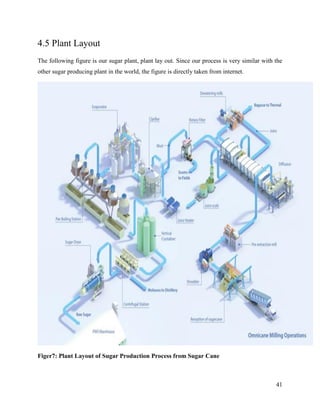
4.5 Plant Layout
The following figure is our sugar plant, plant lay out. Since our process is very similar with the
other sugar producing plant in the world, the figure is directly taken from internet.
Figer7: Plant Layout of Sugar Production Process from Sugar Cane
42
5.5 Plant Location
In the process of locating our plant on the suitable location, we have passed through different
challenging situation, like lack of solid data about different controlling factor of the site, difficulty
in selecting between different sites. Even if there are different challenges in different situations.
We have considered different factors that more importantly affect our plant profit and production
capacity.
5.5.1 Land, Water, Climate, Soil and Labor
There are lots of researches that shows in Ethiopia, there is conducive conditions for the production
of sugar by cultivating sugar cane. The most attractive and the most influential factors are resources
for production, like land, water and suitable climate condition. Even if there is large cultivable
land and it’s associating water source, it must be in warmer (tropic or sub-tropical) region to
cultivate sugar cane. Accordingly, recent research shows that there is 303,500 hectares of already
identified suitable net areas in 7 sites. However, the total area developed for the production of
sugar cane in the country is only about 8% of the total identified suitable areas. Soil is another
factor that must be considered, a soil that has a PH range of 4.5 to 8.5 and low toxic salt
concentration is necessary. Most of the soils of the identified sites are fertile, freely draining and
have good structure with sufficient mechanical strength to support mature sugar cane. Experiences
of existing sugar factories show that because of the suitable soil, adequate water and conducive
climate, an average sugar cane production per hectare per month of the land under irrigation is
very high as compared to other countries (i.e.9-11 tons against 6-8 tons). Finally, labor is more
important in locating our plant site. The research shows that, with a population of over 90-100
million, Ethiopia has abundant, hard-working, inexpensive and easily trainable labor force. The
average wage for unskilled labor generally ranges from Birr 60-80per day. The salaries of fresh
university graduate normally range from Birr 4500-5500 per month. The information is
summarized in the following table.
The less important factors to be considered to decide the right plant location are not discussed here
because their effect is less. Here, these factors may be the most important factor in other type of
plant. These are market, nearness to market, etc.
43
There are some factors that we haven’t mentioned, and have large influence over our plant, these
are like energy and electricity supply, this because we plan to produce all amount of our interest
in our plant. As the summarized information indicates all sites are in our range of interest because
all cane gives the desired amount of sugar cane with the right sucrose concentration. But based on
other factors like suitability of transportation system, nearness to the capital, etc. We have decided
that to locate the plant in Awash Basin around Angelele Balhamo.
Table 13: Comparison among seven sugar cane cultivation sites
Site Water
source
Gross
area
Net suitable
area
Temperature
range 0
C
Mean
annual
rainfall
Basin
Angelele Balhamo Awash 11,000 8,600 25.1-27.5 550 Awash
Upper Beles Beles 65,000 55,300 8-35 470 Blue Nile
Upper Dinder Dinder 80,000 58,300 26-27 1000 Blue Nile
Angereb Angereb 45,600 38,800 14-41 840 Tekeze
Tekeze Setit 68,550 50,550 13.2-40 N.A Tekeze
Abob/Ubala Gilo 46,900 39,400 10.3-44.9 680-2000 Baro
Itang Baro 21,000 28.8 680-2000 Baro
Source: ESISC, Ethiopian Sugar Industry, 2008.
44
CHAPTER FIVE
5 Economic Evaluation
5.1 Major Equipment/Machinery Cost
Table 14: Major equipment and their price
Name of equipment Calculated
size
Standard
size
Number of
equipment
Price/equipment Total price
(birr)
Milling tandem of three
roller
21TCH,
capacity
3 115,306 345,918
Bagasse diffuser 21TCH,
capacity
1 230,456 230,456
Dorr clarifier 38m3
45 2 104,000 208,000
Heat exchanger 2.27m2
2.7 3 57,200 171,600
Quadruple-effect
evaporator & V cell
16m2
19 5 416,000 2,080,000
Vacuum pans 17.3m3
20 3 156,000 468,000
Cooling crystallizer 17.3m3
20 3 624,000 1,872,000
Centrifugal 17.3m3
20 2 33,280 66,560
Rotary drier 1 104,000 104,000
Storage tanks 9.5 ,5.7m3
11 2 21,840 43680
Centrifugal pumps 20m3
/hr. 3 62,400 187,200
Total equipment purchasing cost= 5,777,414 birr
45
Table 15: Data relate equipment cost with other type of cost
46
5.2 Estimation of Other Type of Cost
Since our plant treat both solid and liquid, the fluid solid system of the above data is selected.
Purchased equipment cost 5,777,414 birr Engineering & supervision
cost
1,848,772
Purchased equipment installation
cost
2,253,192 Construction expanses 1,964,321
Instrumentation and control cost 751,064 Total direct and indirect
plant costs
20,740,916
Piping cost 1,790,998 Contractor’s fee 1,039,935
Electrical 577,741.4 Contingency 2,079,869
Building (including services) 1,675,450 Fixed capital investment 23,860,720
Yard improvement 577,741.4 Working capital 4,275,286.4
Service facilities (installed) 3,177,578 Total capital investment 28,136,006.2
Total direct plant cost 16,927,823.02
5.3 Production Cost
From material and energy balance and other cost estimating method the following data are
obtained. Capital gain tax 25%. All calculations here are annual based.
47
Table 16: Summary of total production cost calculation
Production capacity 211,54ton/year
Selling price sugar 10,000ETB/ton
Selling price of final molasses 8000ETB/ton with 2600ton/year capacity
Total product 23,754ton/year
Total sale 232,340,000ETB
Unit average sale 9,781.09ETB/ton product
Operating labor cost 15% of total product cost 34,851,000ETB
Maintenance and repairs 6% of FCI 1,431,643 ETB
Supplies cost 15% maintenance & repair 214,746 ETB
Laboratory charges 10% of operating labor cost 3,485,100 ETB
Property tax and insurance 3%FCI 715,822 ETB
Administrative costs 20% operating labor cost 6,970,200 ETB
Plant overhead costs 50 % operating labor cost 17,425,500ETB
Research and development
costs
2% of sales 4,646,800 ETB
Raw material and utilities cost 151,454,083.2ETB
Total production cost 211,194,894.2 ETB
Unit product cost TPC/TP 8891ETB/ton product
48
5.4 Measures of Profitability
The plant will fully have depreciated in 10 years and operates for 15 years after which it is
dismantled and sold at its salvage values. Let consider cash inflow and cash out flow is similar for
each years
 Discount factor 10%
Measured parameters Formulas Values
Total gross profit (GP) Total sale –total production cost 21,145,106ETB
Depreciation (DEP) FCI/10year 2,386,072ETB
Tax 0.25*(GP-DEP) 4,689,758.5ETB
(Net profit)1-10= NP1 0.75*(GP-DEP) 14,069,276ETB
(Net profit)10-15 = NP2 0.75*GP 15,858,830ETB
Total net profit (10NP1 + 5NP2)/15 14,665,794ETB
Payback period (PBP)
TCI/TNP
2
Return on Investment (ROI)
TNP/TCI
0.52
Net present value (NPV)
49
Chapter Six
6 Conclusion
General conclusion is drawn from the above project work. Even if there are lots of sugar factory
in Ethiopia they still can’t satisfying the growing demand for sugar at different section of the
population. As we have try to find the market demand and supply relation there is a large
difference/gape between these two things and this situation attract our interest to invest in the sugar
sector.
From the material balance and our plant capacity it known as our plant need 21 tons of sugar cane
per hour, large amount of water for different purpose, lime, sulpher and other chemicals and
utilities. The raw materials are supplied from different areas, sugar cane from the farmer for the
first few years, water from Awash River and other raw materials imported from abroad. By using
these raw material, the plant mainly produces unbleached sugar for the domestic market. And also
the plant produces by products like bagasse, filter cake, final molasses and condensate water and
use these by-products for producing other different materials and utilities. This indicate that the
plant is more environmentally friendly since it uses all its waste as raw material to produce other
useful materials.
The plant site is selected as to be Awash Basin based on different selecting criteria, like water
resource, climate, cultivable fertile land, soil type. All suggested site has almost the same potential
to satisfy our interest. But Awash Basin is selected since it is near to the capital and thus to large
market for sugar and by-products.
Generally, sugar production process is a little bit complex and need a sophisticated equipment and
technology and large amount of energy and water. So to effectively produce sugar in this
technology the plant need more skilled and unskilled manpower, reliable energy and water sources.
Thus generally sugar factories need large amount of investment and operation cost, to purchase
large amount and high technology equipment, installation and maintenance of the equipment, raw
material, transportation and for the large amount of man power. In our case, the plant required
around 40 million birr as total investment cost. And around 211 million birr per year as production
cost.
50
From the economic evaluation of the project we know that as the project is economically profitable
and technically feasible. This part show that the plant has the capacity of paying back all its capital
investment within only two years. A rough estimation of profit shows as the company gain net
profit of about 14.7 million birr per annual. Since it need large number of labor and professionals
for its efficient work the plant has socio-economic benefits for the whole country.
51
7 References
1. Hugot. (1986), hand book of cane sugar engineering, third, completely revised, edition.
Elevier-Amsterdam-Oxford-New york-tokyo
2. D.P Kulkarni. (1995), Cane sugar manufacture in India. The sugar technologist association
of India, New Delhi, India
3. Peter Rein. (2007), cane sugar engineering. Verlas Dr. Albert Bartens KG-Berlin
4. Sugar Engineering and Manufacturing Training team. (April,2014), Ethiopian Sugar
corporation training materialson cane handling and preparation, cane juice extraction,
clarification and filtration, evaporation, vacuum plant, centrifugation and sugar finishing
and boiler water. Wonji-shoa, Ethiopia
5. Ethiopian Investment Agency. (2012), Investment opportunity profile for sugar cane
plantation and processing in Ethiopia. Addis Ababa, Ethiopia
6. Investment office ANRS. (2008), project profile on the establishment of sugar plantation
and sugar mill. Addis Ababa, Ethiopia
7. Max S. Peters K.D. Timmerhaus, R.E. West, “Plant Design and Economics for Chemical
Engineers”, 5th
edition, Mc Graw-Hill International Edition
8. Max S. Peters K.D. Timmerhaus, R.E. West, “Plant Design and Economics for Chemical
Engineers”, 4th
edition, Mc Graw-Hill International Edition
https://www.alibaba.com/product-detail/factory-price-6-roller-electric-
sugarcane_60397654648.html
https://www.amazon.com/Sugar-Press-Extractor-Juicer-Juice/dp/B00BCJV81S
http://ethiopiansugar.com/index.php/en/about
https://www.alibaba.com/trade/search?fsb=y&IndexArea=product_en&CatId=&SearchText=sug
ar+processing+equipment+price&isPremium=y
http://economictimes.indiatimes.com/wealth/personal-finance-news/fy-16-17-cost-inflation-
index-out-start-computing-your-indexed-capital-gains/articleshow/52728030.cms
https://projectgaia.com/projects/ethiopia/
http://aigaforum.com/article2016/sugar-factories/041916.htm

Material balance 2017

  • 1.
    1 ADDIS ABABA UNIVERSITY ADDISABABA INSTITUTE OF TECHNOLOGY SCHOOL OF CHEMICAL AND BIO ENGINEERING PLANT DESIGN AND ECONOMICS PROJECT FINAL REPORT PROJECT ON UNBLEACHED SUGAR PRODUCTION FROM SUGAR CANE ADVISORS: 1 Mr. ELIAS T. 2 Mr. BROOK T. SUBMITTED BY: 1 ABNET MENGESHA 2 EYERUSALEM TSEGAYE 3 TIRSIT MENGISTU 4 YORDANOS KIFLU ADDIS ABABA, ETHIOPIA JUNE 14, 2017
  • 2.
    2 Acknowledgment At first wewould like to thank almighty God who helped us through all our journey. We also wish to acknowledge and thank all our supporters during our project work for their limitless support and advice. In particular, we would like to express our deepest gratitude and appreciation to our advisors and instructors Mr. Brook T. and Mr. Elias T. for their great advice and teaching this course, which help us on our project. In closing, we are deeply grateful to our class mate for their willingness and kindness to share ideas with us about their and ours projects.
  • 3.
    3 Executive Summary This sectionof the project is written with the aim of providing general information about the project entitled “UNBLEACHED SUGAR PRODUCTION FROM SUGAR CANE” that we have been doing, throughout the whole semester. The whole project is divided in to six main chapters which are: The first chapter deals with the introduction, it is about sugar general information and sugar in Ethiopia. The second chapter deals about general literature survey and the whole sugar production process. In the third chapter material and energy balance and equipment sizing and specifications are discussed. The fourth chapter deals with raw material and utilities and market study. In the fifth chapter we have discussed about economic evaluation of the plant. And lastly the conclusion is draw from the whole process of the project. Demand projection that the domestic demand for sugar is substantial and is increasing with time. Accordingly, the planned plant is set to produce21154 tons annually. The total investment cost of the project including working capital is estimated at Birr 28.136 million and Birr 1.467 million of income. The financial result indicates that the project will generate profit beginning from the first year of operation. Moreover, the project will payback fully the initial investment less working capital in 2 years. The result further shows that the calculated ROI of the project is 52%. Generally, the project is technically feasible, financially and commercially viable as well as socially and economically acceptable. Hence the project is worth implementing.
  • 4.
    4 List of Abbreviationsand Acronym B: Bagasse Br: Degree brix C: Cane CJ: Clear Juice E1: Water Evaporated at Evaporation Unit E2: Water Evaporated at Vacuum Plant Unit ELPA: Ethiopian Electric Power Authority FC: Filter Cake Hva: Hangler Vonder Amsterdam ICUMSA: International Commission for Uniform Method of Sugar Analysis Imb: Imbibition Imp: Impurities MJ: Mixed Juice Mo: Molasses RS: Reducing Sugar S: Sugar W: Water
  • 5.
    5 Table of Contents Acknowledgment............................................................................................................................ 2 Executive Summary........................................................................................................................ 3 List of Abbreviations and Acronym ............................................................................................... 4 List of Table.................................................................................................................................... 8 List of Figure................................................................................................................................... 9 1 Introduction................................................................................................................................ 10 1.1 Background......................................................................................................................... 10 1.2 Sugar History in Ethiopia.................................................................................................... 11 1.3 Problem statement............................................................................................................... 13 1.4 Objectives ........................................................................................................................... 13 1.4.1 General Objectives....................................................................................................... 13 1.4.2 Specific Objectives ...................................................................................................... 13 1.5 Product Description and Application.................................................................................. 13 2 Literature Survey and Production Technique of Sugar.............................................................. 14 2.1 Literature Survey ................................................................................................................ 14 2.1.1 Assumptions/design specifications .............................................................................. 14 2.2 Sugar Production Process and By-products Handling........................................................ 18 2.2.1 Cane Unloading and Cane Preparation........................................................................ 18 2.2.2 Mixed Juice Clarification and Evaporation ................................................................. 18 2.2.3 Pan Boiling................................................................................................................... 18 2.2.4 Cooling Crystallization, Centrifugation and Drying.................................................... 18 2.2.5 By-product handling .................................................................................................... 19 2.3 Plant process flow diagrams ............................................................................................... 20
  • 6.
    6 3 Material andEnergy Balance and Equipment sizing................................................................. 22 3.1 Material balance.................................................................................................................. 22 3.1.1 General material balance.............................................................................................. 22 3.1.2 Milling plant................................................................................................................. 22 3.1.3 Clarification units......................................................................................................... 23 3.1.4 Evaporation unit........................................................................................................... 24 3.1.5 Crystallizer unit............................................................................................................ 25 3.1.6 Centrifugation unit....................................................................................................... 26 3.1.7 Drier unit...................................................................................................................... 26 3.1.8 Summary on Calculation Results of Material Balance................................................ 27 3.2 Energy Balance................................................................................................................... 29 3.2.1 Heat Balance on Heater ............................................................................................... 29 3.2.2 Heat Balance on Evaporator ........................................................................................ 30 3.2.3 Heat Balance on Crystallizer ....................................................................................... 31 3.2.4 Heat Balance on Drier.................................................................................................. 32 3.3 Equipment Sizing and Specification................................................................................... 34 3.3.1 Heaters ......................................................................................................................... 34 3.3.2 Mixed Juice Storage Tank(s) ....................................................................................... 34 3.3.3 Clarifier(s).................................................................................................................... 35 3.3.4 Clear Juice Storage Tank(s)......................................................................................... 35 3.3.5 Evaporator(s)................................................................................................................ 35 3.3.6 Crystallizer (s).............................................................................................................. 36 3.3.7 Centrifugal Machine .................................................................................................... 36 3.3.8 Drier (s)........................................................................................................................ 36
  • 7.
    7 3.3.9 Summary onEquipment Sizing and Equipment Specification.................................... 37 4 Raw Material/Utilities, Market Study, Plant Location &Plant Layout...................................... 38 4.1 Raw Materials and Utilities ................................................................................................ 38 4.1.1 Availability and Source of Raw Materials................................................................... 38 4.1.2 Annual Requirement and Cost of Raw Materials and Utilities.................................... 38 4.2 Market Study....................................................................................................................... 39 4.4.1 Present Demand and Supply........................................................................................ 39 4.2.2 Projected Demand........................................................................................................ 40 4.3 Plant Capacity..................................................................................................................... 40 4.4 Production Program........................................................................................................ 40 4.5 Plant Layout........................................................................................................................ 41 5.5 Plant Location ..................................................................................................................... 42 5.5.1 Land, Water, Climate, Soil and Labor ......................................................................... 42 5 Economic Evaluation................................................................................................................. 44 5.1 Major Equipment/Machinery Cost ..................................................................................... 44 5.2 Estimation of Other Type of Cost....................................................................................... 46 5.3 Production Cost................................................................................................................... 46 5.4 Measures of Profitability..................................................................................................... 48 6 Conclusion ................................................................................................................................. 49 7 References.................................................................................................................................. 51
  • 8.
    8 List of Table TableTitle Page Number 1 Some standards for material balance 6 2 Temperature and pressure at different operating point of the plant 7 3 Input to clarification unit 14 4 Inputs to evaporation system 15 5 Input to crystallizer unit 16 6 Input to centrifugation system 17 7 Calculation summery for input and output per hour, day and year in ton and quintal 19 8 Summary of calculation result on heat/energy balance 24 9 Equipment sizing and specification summary 28 10 Material and Utility Requirement of plant 29 11 Expected Production 30 12 Projected Demand for Sugar (in thousand ton) 31 13 Comparison among seven sugar cane cultivation sites 34 14 Major equipment and their price 35 15 Data relate equipment cost with other type of cost 36 16 Summary of total production cost calculation 37
  • 9.
    9 List of Figure FigureTitle Page Number 1 Ethiopia Sugar Map 3 2 General process block diagram of sugar production process 8 3 Simplified process flow diagram of sugar production process 11 4 Detailed process flow diagram of sugar production process 12 5 Heat transfer around evaporators 21 6 Heat transfer around drier 23 7 Plant Layout of Sugar Production Process from Sugar Cane 32
  • 10.
    10 CHAPTER ONE 1 Introduction 1.1Background Sugar is the generic name for sweet, soluble carbohydrates, many of which are used in food. There are various types of sugar derived from different sources. Simple sugars are called monosaccharaides and include glucose (also known as dextrose), fructose, and galactose. The "table sugar" or "granulated sugar" most customarily used as food is sucrose, a disaccharide of glucose and fructose. Sugar is used in prepared foods (e.g., cookies and cakes) and it is added to some foods and beverages (e.g., coffee and tea). In the body, sucrose is hydrolyzed into the simple sugars fructose and glucose. Sugars are found in the tissues of most plants and are present in sufficient concentrations for efficient commercial extraction in sugarcane and sugar beet. The world production of sugar in 2011 was about 168 million tons. The average person consumes about 24 kilograms (53 lb) of sugar each year (33.1 kg in industrialized countries), equivalent to over 260 food calories per person, per day. Since the latter part of the twentieth century, it has been questioned whether a diet high in sugars, especially refined sugars, is good for human health. The industrial practice in Ethiopia is the production of sugar from sugar cane. The product is mainly used for direct consumption, but also is used to prepare other types of foods such as, biscuits, confectioneries, breweries, soft drinks, etc. Sugar has become one of the essential food consumption items in the country especially in urban areas. Though per capita sugar consumption in Ethiopia is one of the lowest in the world, the volume of consumption has been growing steadily since the establishment of the first sugar cane plantations-cum-sugar mills in the Awash Valley in the early 1950’s. As a sweetening food item, sugar is used in preparing all types of drinks (coffee, tea, soft drinks, juices, etc.) and foods (pastries, bread of special types, etc.)
  • 11.
    11 1.2 Sugar Historyin Ethiopia Sugar production in Ethiopia started in 1954/55 when the Wonji Sugar Factory was commissioned and produced 15,843 tons of white sugar in the first campaign. When sugarcane development began in 1951, the company was owned by Dutch Company, HVA (Handlers -Vereenging Amsterdam). The development of the sugarcane plantation was started on 5000 hectares in the upper reaches of the Awash basin, 100km. Southeast of Addis Ababa. Currently, there are three large-scale sugar establishments in the country; two of them in the Awash Basin (Wonji/shewa and Metehara) and one (Finchaa) in the Blue Nile Basin. The present level of national production from the three-sugar estates is about 261,041 tons of sugar and 87,257 tons of molasses per annum respectively. These three sugar factories have a production capacity of 280,000 tons of sugar annually. The total area developed by these factories is 23,769 hectares. The area developed at Wonji/Shewa is 7050 hectares (5930 hectares’ estate and 1120 hectares out grower farms) capable of producing 80,000 tons of sugar per annum. The Metehara Sugar Factory, which was brought on stream in 1969 by HVA at Metehara, developed 9919 hectares and has a capacity to process 115,000 tons of sugar annually. The Finchaa Sugar Factory (in East Wellega zone of the Oromia National Regional State) which was completed in 1998, developed 6800 hectares and has a production capacity of 85,000 tons of sugar per annum. These sugar companies presently produce sugar for the local market. White sugar is mainly imported from the neighboring countries such as Djibouti, Saudi Arabia, Somalia & India in quantities ranging between10000 to 163,000. At present there are additional three sugar plantations are developing by the government. Tana beles sugar project is developing in 50,000 hectars with a production capacity 484,000 tons, Kuraz sugar project is developing in 150,000 hectares with a production capacity of 556,000 tons, Wolkayit sugar project is developing in 25,000 hectares with a production capacity of 242,000 tons. And other seven projects are on their completion. Even if there are several sugar factories are established by the government the greatly increased demand is still not satisfied. There is large demand supply gap in the country.
  • 12.
  • 13.
    13 1.3 Problem statement Herein Ethiopia there are lot of demand and supply gaps in almost all sectors of services, even if we can contribute in other sectors of service, our attention is greatly attracted to produce sugar from sugar cane to reduce the demand and supply gap by 0.005%. We are a group of four people that interested to this sector since there are lots of promising conditions and to contribute our part to the country as the citizen of the country. Our company use cane as raw material which is supplied by farmers of the area for the first few years and we have planned to cultivate the raw cane by ourselves. We have designed the company to crush 500tonn of cane per day and approximately 21tonn per hour. And the company will work 300 days per year and 24 hours per day. The day divided into 3 shifts. 1.4 Objectives 1.4.1 General Objectives  To make a preliminary design of plant that process sugar by squeezing sugar cane and passing through different separating steps.  To suggest processing method of sugar from sugar cane.  To show the feasibility of processing sugar from sugar cane. 1.4.2 Specific Objectives  Economical and financially analysis of processing sugar from sugar cane  To reduce the foreign currency through filling the demand and supply gap  To provide quality sugar by minimum cost to the customer  To use raw material as wise as possible 1.5 Product Description and Application Sugar has become one of the essential food consumption items in the country especially in urban areas. Though per capita sugar consumption in Ethiopia is one of the lowest in the world, the volume of consumption has been growing steadily since the establishment of the first sugar cane plantations-cum-sugar mills in the Awash Valley in the early 1950‟s. As a sweetening food item, sugar is used in preparing all types of drinks (coffee, tea, soft drinks, juices, etc.) and foods (pastries, bread of special types, etc.).
  • 14.
    14 CHAPTER TWO 2 LiteratureSurvey and Production Technique of Sugar 2.1 Literature Survey The literature survey shows the sugar production process from sugar cane as almost physical (non- reactive), continuous and steady process. Thus the input materials equal to the output materials. The major physical unit operations are the following: 1. Cane preparation and handling unit 2. Cane juice extraction unit 3. Mixed juice clarification units 4. Mixed juice evaporation unit 5. Syrup crystallization unit 6. Centrifugation unit and 7. Sugar handling and finishing unit 2.1.1 Assumptions/design specifications  All units we use in the calculation ton per hour  There is no loss  Since the amount of sulphur used is very small compared with the total cane introduced it is negligible  Neglect the amount of air vent from the system and introduced to the system.  Imb=25% cane  Milling and Diffusion efficiency=0.95  Bagasse moisture content=50%  Assume efficiency of clarifier to remove impurity=0.96  Assume 0.92 sucrose is recover as crystal with respect to input sucrose  And 0.33 reducing sugar is recovered as crystal  Assume moisture associated with both sucrose and RS is =0.31  Assume 0.1 molasses is adhering to crystal  Solubility coefficient=0.97  Effective solubility=0.97*2.71=2.6287kg sucrose/kg water  Moisture of % 0.2to 0.5 is removed from the final sugar crystal  Let take the average of the above values, 0.4%  TMJ=300 C, to clarification and heating  TCJ=96 0 C, out to evaporator  Heating fluid is steam at 1atm and Cp=4.19-2.35x kj/kg.k, x is present of DS  Assume the inlet steam is saturated steam
  • 15.
    15 There are someassumptions and standards that we have taken from literatures to calculate material and energy balance. The standards are listed in the following table. Table 1: Some standards for material balance Standards Values per ton of cane Fiber content %cane 13% Sucrose content % cane 14% Non-sucrose content %cane 0.5% Water content %cane 70% Ash and other impurities content % cane 2.5% Imbibition water % cane 25-30% Final bagasse moisture content 40-50% Lime added per ton of cane 0.5 Kg Sulphur used for both juice and syrup sulphitation 0.9kg Evaporator load 80-90% Design evaporator load 85% Vacuum pressure of vacuum plant 0.2666 bar % of sucrose and RS removed with filter cake 1.0% % of water removed with filter cake 10.0% Syrup brix (0 Br) 60-65
  • 16.
    16 Table 2: Temperatureand pressure at different operating point of the plant Temperature (0 C) and pressure (mmHg) at different point of operation Values Mixed juice temp to clarifier 30 Clear juice temp to evaporator 96 Pan boiling station pressure 580 Sugar to dryer temp 60-80 Final sugar to store temp 35-40
  • 17.
    17 cane mixed juice water ofimbibitions Baggasse vacuum filter clear juice syrup molasses crystal sugar Grinding Bagging cane preparation cane milling clarification unit Evaporator vacuum pan crystallization centrifugation Drier Finger 2: General process block diagram of sugar production process
  • 18.
    18 2.2 Sugar ProductionProcess and By-products Handling 2.2.1 Cane Unloading and Cane Preparation Cane is transported from field to the cane yard and stored there. The cane from the cane yard is then unloaded over the cane table over which it is washed and levelled. From the cane table it is conveyed to size reduction unit operations. The reduced size of the cane is fed to the mill tandem. The juice is extracted at milling tandem with sucrose recovery of 95%. The mixed juice at 300 C from the mill tandems with a brix 13-150 Br is transported to measuring tank (servo balance). 2.2.2 Mixed Juice Clarification and Evaporation The mixed juice which is extracted at the mill tandem is sent to clarification plant. The aim of this unit is to remove maximum amount of impurities/non sugar and coloring matters to obtain a clear brilliant juice without inversion of sucrose and destruction of reducing sugars. The clarification process is done in a Dorr-clarifier with efficiency of 96%. The effluents of this process, clear juice is sent to evaporator and the muddy juice to rotary vacuum filter. While passing to evaporation process, the juice passes through heaters to rise the temperature to the desired value. This is done to reduce evaporation load. The heater rises the temperature of clear juice from 30 – 960 C in average. Immediately after heating process the juice enters evaporation unit to remove the maximum amount of water and to increase the brix content to 60-650 Br.The syrup from evaporator is sent to pan boiling/crystallizer. 2.2.3 Pan Boiling Syrup from multiple effect evaporator is fed to crystallizing equipment called pan boiling system. The pan is depressurized to 580mmHg and Super saturation of syrup begins. Crystallization begins when the brix reach 78o in average. The crystallization continuous up to the brix raised to 96o forming massecuite. Then the massecuite is discharged and sent to cooling crystallizer. 2.2.4 Cooling Crystallization, Centrifugation and Drying The main objectives of cooling crystallizer are:  For further formation of crystals in the process  To store the massecuite temporarily until the centrifuge is prepared for operation
  • 19.
    19 The main objectiveof centrifuge is to separate the sugar crystal from molasses. The sugar is separated using a jacketed screen inside the mother board of the centrifuge. The separation takes place by purity difference. Drying takes place to obtain the sugar with the required moisture content, it must have dried to moisture content of 0.02%. 2.2.5 By-product handling In sugar production process, there are three main byproducts are obtained. These byproducts are final molasses, filter cake and bagasse. And also there are other minor byproducts and byproduct’s byproduct like ash, evaporated water and vinasses. To be economical and environmental friendly our plant planned to use these byproducts to produce different other products.  Final molasses used to produce RS (rectifying spirit) that distributed for alcohol producing company.  Bagasse used to produce steam for the overall plant energy consumption and electricity generation that used for different purpose in plant.  Water evaporated from evaporation and pan boiling unit used as raw water for boiler unit to reduce water consumption and water treatment cost.  Filter cake, ash, vinasses and other impurities from cane washing unit used to prepare bio- compost that used for the cultivation of sugar cane as fertilizer.
  • 20.
    20 2.3 Plant processflow diagrams Figer3: Simplified process flow diagram of sugar production process
  • 21.
    21 Figer4: Detailed processflow diagram of sugar production process
  • 22.
    22 CHAPTER THREE 3 Materialand Energy Balance and Equipment sizing 3.1 Material balance 3.1.1 General material balance Since the process is continuous, steady and non-reactive the general material balance is look like this: Input =output C+Imb+lime=B+FC+E1+E2+Mo+S Since direct measurement of these values are very difficult we follow the component method starting from the starting point. And we discuss the result. But first The 21ton cane feed per hour contain Water =21*0.7=14.7 Sucrose=21*0.14=2.94 Non-sucrose/reducing sugar=21*0.005=0.105 Fiber=21*0.13=2.73 Ash and other impurities=21*0.025=0.525 Milk of lime needed per hour=21*0.5kg=0.0105, Sulphur= 21*0.9kg=0.019 3.1.2 Milling plant Imb =0.25*21=5.25 Sucrose extracted=0.95*2.94. =2.793 Un-Extracted sucrose=2.94-2.793=0.147 Bagasse water content=2.73+0.147=2.877 Bagasse amount= 2.73F+0.147S+2.877B=5.754
  • 23.
    23 3.1.3 Clarification units Table3:1Inputto clarification unit Water= initial water + imbibition water – water lost with bagasse=14.7+5.25-2.872=17.078 Sucrose=2.793 RS=0.105 Impurity=0.5250 Total juice=water+sucroce+RS+impurity=20.501 %DS=16.7 Milk of lime=0.5kg/ton of cane=0.0105 Sulphur for juice sulphitation=0.00945 Sludge removed=0.96*0.525+0.0105+0.00945=0.52395 Total filter cake amount=0.52395+0.02793+0.00105+1.7078=2.26073 Remaining impurities=0.525-0.504=0.021 Remained sucrose= 2.793-2.793*1%=2.76507 Remained RS=0.105-0.105*1%=0.10395 Remained water=17.078-17.078*10%=15.3702 Total CJ=0.021+2.76507+0.10395+15.3702=18.26022 %of solid= ((0.021+2.76507+0.10395)/ (18.26022)) *100=15.8269% this show very good concentration of sugar. The remaining sulphur used in syrup sulphitation process. The amount of sulphur attached with syrup and the amount of syrup released with sulphur is equal. Thus assume as there is no sulphur that transported to evaporation unit and no change in amount of other components of evaporation unit inputs.
  • 24.
    24 3.1.4 Evaporation unit Table4:Inputs to evaporation system Remained sucrose= 2.793-2.793*1%=2.76507 Remained RS=0.105-0.105*1%=0.10395 Remained water=17.078-17.078*10%=15.3702 Total CJ (solution) =0.021+2.76507+0.10395+15.3702=18.26022 %of solid= ((0.021+2.76507+0.10395)/ (18.26022)) *100=15.8269% Evaporated water=0.85*15.3702= 13.06467=E1 Remained water=15.3702-E1=2.30553 Total CJ (solution) =18.26022-E1=5.19555 Total solid =0.021+2.76507+0.10395=2.89002 %solid= ((0.021+2.76507+0.10395)/ 5.19555) *100=55.625%, this is not satisfactory result because the brix must be between 60-65 0 Br, to correct this problem we can the following two measures  Reduce loss of sucrose with bagasse and filter cake, but has its own cost.  Increase the evaporation load, this has very large cost of energy. Thus the first method is preferred
  • 25.
    25 3.1.5 Crystallizer unit Table5:Input to crystallizer unit Remaining impurities=0.525-0.504=0.021 Remained sucrose= 2.793-2.793*1%=2.76507 Remained RS=0.105-0.105*1%=0.10395 Remained water=15.3702-E1=2.30553 Total CJ (solution) =18.26022-E1=5.19555 Total solid =0.021+2.76507+0.10395=2.89002 %solid= ((0.021+2.76507+0.10395)/ 5.19555) *100=55.625% The weight of sucrose= 0.92*2.76507=2.5438644 Weight of reducing sugar=0.33*0.10395=0.0343035 Sucrose in molasses=2.76507-2.5438644=0.2212056 Reducing sugar in molasses=0.10395-0.0343035=0.0696465 Total sugar in molasses=0.0696465+0.2212056 =0.2908521 Water required to dissolve this=0.2908521/2.6287=0.110645 Water to be evaporated=E2=2.30553-0.31-0.110645=1.884885 Remained water=0.31+0.110645=0.420645 Total solid crystal= (RS)+(impurity) +(sucrose) =2.5438644+0.0343035+0.021=2.5991679
  • 26.
    26 3.1.6 Centrifugation unit Table6:Input to centrifugation system Total sugar in molasses=0.0696465+0.2212056 =0.2908521 The weight of sucrose= 0.92*2.76507=2.5438644 Weight of reducing sugar=0.33*0.10395=0.0343035 Sucrose in molasses=2.76507-2.5438644=0.2212056 Reducing sugar in molasses=0.10395-0.0343035=0.0696465 Remained water=0.31+0.110645=0.420645 Total solid crystal= RS+impurity+sucroce=2.5438644+0.0343035+0.021=2.5991679 Solid=total solid crystal+moisture=2.5991679+0.31 =2.90917 Molasses=0.2908521+0.110645=0.4014971 Thus the weight of molasses that added to solid=0.1*0.4014971=0.04014971 Total sugar crystal=0.04014971+2.90917=2.94932 Total molasses=0.4014971-0.04014971=0.36135 3.1.7 Drier unit Input to the system Total sugar crystal=0.04014971+2.90917=2.94932 Moisture removed from the crystal=2.94932*4/1000=0.0118 The final sugar crystal =2.94932-0.0118=2.9375
  • 27.
    27 3.1.8 Summary onCalculation Results of Material Balance Now we can calculate the general material balance in both rate form and amount for as following C+Imb+lime=B+FC+E1+E2+Mo+Sugar C=21ton/hr. Imb water=5.25ton/hr. Milk of lime=0.0105ton/hr. B=5.754ton/hr. FC=2.2513ton/hr. E1=13.0647ton/hr. E2 =1.885ton/hr. Mo =0.36113ton/hr. Sugar crystal =2.938ton/hr.
  • 28.
    28 Table7: Calculation summeryfor input and output per hour, day and year in ton and quintal Material Input and output ton per hr. Input and output ton per day Input and output ton per year Quintal per day Cane 21 504 151200 5040 Imbibition water 5.25 126 37800 1260 Milk of lime 0.0105 0.252 75.6 2.52 Sulphur 0.019 0.456 136.8 4.56 Bagasse 5.754 138.1 41430 1381 Filter cake 2.26073 54.25752 16277.256 542.5752 Water evaporated at evaporation plant 13.0647 313.5528 94065.84 3135.528 Water evaporated at vacuum plant 1.885 45.24 13572 452.4 Final molasses 0.36113 8.66712 2600.14 86.6712 Sugar crystal 2.938 70.512 21153.6 705.12
  • 29.
    29 3.2 Energy Balance 3.2.1Heat Balance on Heater Assuming the raw juice from milling and diffusion tandems is available at 30 0 C. Before adding lime to juice, the juice has to be heated. Thus the final temperatures to which juices are heated in clarification varies from extremes of 90 to 115 0 C, although by far the commonest practice is to heat slightly above the boiling point. Superheating was advocated by some in earlier studies, but it is generally believed today that superheating is not advantageous and temperatures just above the boiling point say 103 0 C are the maximum for good practice. Assume it is heated to 96 0 C and steam is available at 1 atmosphere for heating. The heat capacity, from Hugot for mixed juice is calculated by: Cp = 4.19 –2.35 ×X kJ/kg.K. Heat required to raise the temperature of raw juice from 30 to 96o C is given by: Q = MJ ×Cp × ∆T = Ms×Cp*∆T, heat capacity of raw juice = 4.19 –2.35 ×X kJ/kg. K Where X is fraction of dissolved solids. Feed to the clarifier is 20.5tons/hr. and % of solids content is (from material balance). Therefore, Cp= 4.19 –2.35 ×0.16 = 3.814 kJ/kg. K and MJ = 5.7kg/s. ∆T = 96 –30 = 66o C. Q = 5.7kg/s ×3.814 kJ/kg. k×66k = 1434.83KW (this much amount of energy is needed to rise the temperature of mixed juice from 30 0 C to 96 0 C). Assume the inlet steam is saturated steam hv=2257kJ/kg Steam requirement is: MS = Q/ hv = 0.636kg/s.
  • 30.
    30 3.2.2 Heat Balanceon Evaporator Figer5: Heat transfer around evaporators The energy balance around evaporators is given by: Ms*hsg + Mj*hj =Ms*hsf + Mv* hv@T1 + Mp@T1 * hf Where Ms = mass flow rate of steam hsg and hsf = latent heat of steam for the gas and liquid respectively Mj and hj = mass flow rate and latent heat of the juice Mp and hf = mass flow rate and latent heat of product at T1 T1 = operating temperature of the evaporators =110 0 C taken from literature Mv and hv =mass flow rate and the latent heat of vapors, in our case there is no vapor that escaped from the evaporator, but it changed into condensate. Values from Hugot, material balance and steam tables for the above variables hsg - hsf = hgf =2257kJ/kg, hv = 2690kJ/kg, hj = 254kJ/kg, hf = 304kJ/kg Mj =18.3ton/hr. = 5.07kg/s, Mc =13.07ton/hr. = 3.63kg/s, Mp =5.2ton/hr. = 1.44kg/s Then substituting the values to the equation we have: MS*2257 + 5.07*254=3.63*2690 +1.44*304 Solving for MS gives MS=8914.7/2257= 3.95 kg/s Heat required (Q) = MS * Cps * ΔT = 3.95x3.85x10 =152.08kw
  • 31.
    31 3.2.3 Heat Balanceon Crystallizer As we known from material balance calculation, crystallizer operates at 580 mmHg vacuum. At this pressure, boiling point of water is 61.42o C. But boiling point rise (BPR) is 4o C. Temperature in crystallizer = 65.42o C b/c beyond this temperature conversion may occur and also caramelazation may occur. Heat balance in crystallizer can be written as: F*hF+ MS*hS= L*hL+ V*h ……………………………………………………………. (1) where, F = feed flow rate to crystallizer 5.2ton/hr. = 1.44kg/s Cpf= 4.19 –2.35 ×X, where X = 0.556 Therefore, Cpf= 2.883 kJ/kg. K Feed temperature = Tf= 54 0 C. Taking base temperature as 00 C. But hF= Cpf × (Tf –0) = 2.883 ×54 = 155.704 kJ/kg MS= steam flow rate required in kg/s Assume steam is available at same pressure as that of evaporator. thus, hs = 2257kJ/kg L = output of crystallizer = 2.95ton/hr. = 0.82kg/s Cpl= 4.19 –2.35 ×X Where X = fraction of solids in crystallizer output, = 0.97 Thus, Cpl= 4.19 –2.35 ×0.97 = 1.91 kJ/kg. K Temperature of output of crystallizer = Tl= 65.420 C But hL= Cpl × (Tl –0) = 1.91 ×65.42 = 125 kJ/kg V = amount of water evaporated in the crystallizer =1.885ton/hr. = 0.534kg/s
  • 32.
    32 h = Hv@65.420 C + (BPR ×Cp steam), hv @65.420 C = 2618 –275.8 = 2342.2 kJ/kg and Cp steam at65.420 C = 1.928 kJ/kg. K Therefore, h = 2342.2 + (4 ×1.928) = 2350 kJ/kg. Now equation (1) becomes, (1.44×155.704) + (MS ×2257) = (0.82×125) + (0.534×2350) Hence, MS = 0.502 kg/s Heat required (Q) = MS * Cps * ΔT = 0.502*1.93*(65.42-35) = 29.5kw 3.2.4 Heat Balance on Drier Dried sugar Crystal sugar Hot air Figer6: Heat transfer around drier  The heat necessary to heat the weight of air (at air pre-heater) is given by Q1= M ×C × (T1 –T0) M = (1.5*p*h)/(H1-H0) = 6.355kg/s Where H1&H0, water contained in saturated air at exit and entry respectively. From figure 35.3 on Hugot H1=0.082 and H0 = 0.022 P=sugar to be dried = 0.82gk/s h=sugar moisture content = 0.31 C = specific heat of air = 1 kJ/kg. K Therefore, Q1= 6.355kg/s ×1kJ/kg. k × (50 –30) = 127kw  The heat necessary to remove moisture contained in the sugar is given by Drier
  • 33.
    33 Q2= m *moisturecontent of sugar * [607 + 0.3 ×T1 –T0] m= amount of sugar to be dried = 0.82kg/s M = moisture content of sugar *m = 0.25403kg/s Thus Q2= 0.25403kg/s * [607 + 0.3 ×50 –30] = 654.03kw Total energy on drier = Q1+Q2 = 781.03kw Table8: Summary of calculation result on heat/energy balance Units Steam/vapor flow rate kg/s Energy required kw Annual steam requirement Mw Heaters 0.636 1434.83 43045 Evaporators 3.95 152.08 4562.4 Crystallizers 0.502 29.5 885 Drier 781.03 23431 Total 2379.5 71923.4
  • 34.
    34 3.3 Equipment Sizingand Specification 3.3.1 Heaters We know from heat transfer principle that the size of the heat exchanger is proportional to Q, log mean temperature and heat transfer coefficient. A =Q/(U*∆TLM), we have assumed that in the previous calculation the steam used is as saturated steam at 1bar and 100 0 C. And the juice enter the heater at 30 and exit at 96 0 C. From literature heat transfer coefficient for this types of fluid are ranged between 2271.32 –5678.3 W/ (m2. K) and the average value is assumed. U=3975 W/ (m2. K), the log mean temperature calculated as follow: ∆Tlm= [(100 - 30) - (100 - 96)]/ [ln {(100 - 30)/ (100 - 96)}] =53.1k and Q from the above calculation 1434.83kw. Thus Total heat transfer area = A = Q/ (U × ∆Tlm) = (1435×1000w)/ (3975 W/ (m2. K) *53k) = 6.81m2 3.3.2 Mixed Juice Storage Tank(s) Here we calculate the size of tanks that used in storing mixed juice from mills as primary and secondary before it sent to the clarifier unit and the pump capacity is also calculated. The maximum allowable retention time in the tank is 30 min, above this time limit conversion of sucrose to simple sugar is started which is undesired. The density of mixed juice from mills (Hugot) ranges from 1.07 – 1.09 kg/dm2 . Assume that the density = 1.08kg/dm2 = 1080kg/m3 . Thus Volume flow rate of juice = mass flow rate/density of mixed juice = (20.5ton/hr.)/1080kg/m3 = 19m3 /hr. This also the pump capacity (456m3 /day) and the pump is centrifugal pump. Tank volume (V=19m3 /2 = 9.5m3 )
  • 35.
    35 3.3.3 Clarifier(s) The maximumallowable retention time in the clarifier is 3-4hr. take 4hr. The density of mixed juice from mills (Hugot) ranges from 1.07 – 1.09 kg/dm2 . Assume that the density = 1.08kg/dm2 = 1080kg/m3 . Thus Volume flow rate of juice = mass flow rate/density of mixed juice = (20.5ton/hr.)/1080kg/m3 = 19m3 /hr. This also the pump capacity (456m3 /day) and the pump is centrifugal pump. Tank (clarifier) volume (V) =19m3 *4 = 76m3 since it is so large we use two equal (38m3 each) clarifier at one. 3.3.4 Clear Juice Storage Tank(s) Clarified juice is stored for short period (10-20 min) of time before directly entering into evaporation unit. Take 20 min as retention time in the storage tank. Volume flow rate of clear juice = 18.3ton/hr./1080kg/m3 = 17m3 /hr. V=17*2/6 = 5.65m3 is needed. 3.3.5 Evaporator(s) The density of the entering juice (Hugot) ranges from 1.07 – 1.09 kg/dm2 VT = Vj+Vs. Vj= Mj/ƿj = 18300/1080 = 17m3 /hr. VS = MS/pS = 14220/0.598086 = 23700m3 /hr. VT = Vj + Vs = 23717m3 /hr. Let assume 80% of the vessel is full and the process is continuous. To enhance the heat transfer process, we use quadruple effect evaporator with additional vapor cell. All the vessels are equal (1.32m3 /s each) Heat transfer area, A Take U= 2272w/m2 k and log mean temperature is =16.50 C A =Q/(U*∆Tlm) = 152080w/16.5*2272 = 4.1m2
  • 36.
    36 3.3.6 Crystallizer (s) Materialflow into the pan is 5.2 ton/hr. (from material balance) and density is 1080kg/m3 (from literature). And our plant work 24hour per day, there are 3 shifts per 24 hr. and pan boiling is batch process, take 3hr. to complete one batch. Consider 80% of the pan is full. Volume flow rate= 5200kg/hr./(1080kg/m3 ) = 4.815m3 /hr. = 115.6m3 /day V=14.44m3 (this is 80 % of the volume of the pan) and exact volume is 17.33m3 here there is storage tank for the massecuete. 3.3.7 Centrifugal Machine Material flow into the machine is 3.315ton/hr. and the volume flow rate is 3.07m3 /hr. the process is continuous. 3.3.8 Drier (s) Material flow into the drier is 2.95 ton/hr. and volume flow is 2.73m3 /hr.
  • 37.
    37 3.3.9 Summary onEquipment Sizing and Equipment Specification Table 9: Equipment sizing and specification summary Equipmen t Mass flow kg/hr . Volum e flow m3 /hr. Retentio n time (min) Volum e m3 Surfac e area m2 Numbe r of equip Material of constructio n Reason to select constructio n material Juice tank 2050 0 19 30 9.5 1 Carbone steel Cheap, corr. Resistant Clarifier 2050 0 19 240 38 2 Carbone steel Cheap, corr. Resistant Preheater 2.27 3 Steel Cheap, corr. Resistant Clear juice tank 1830 0 17 20 5.65 1 Carbone steel Cheap, corr. Resistant Evaporato r 23717 16 4.2 5 Carbone steel Cheap, corr. Resistant Crystalliz er 5200 4.82 180 17.3 1 Carbone steel Cheap, corr. Resistant Massecuit e tank 17.3 1 Carbone steel Cheap, corr. Resistant Centrifug e 3315 3.07 1 Carbone steel Cheap, corr. Resistant Drier 2950 2.73 1 Carbone steel Cheap, corr. resistant
  • 38.
    38 CHAPTER FOUR 4 RawMaterial/Utilities, Market Study, Plant Location &Plant Layout 4.1 Raw Materials and Utilities 4.1.1 Availability and Source of Raw Materials The main raw materials required in production of sugar are water, sugar cane, sulphur, and lime. Sugar cane will be available from the sugar cane plantation of our plant and from farmers. Accordingly, the annual demand of the mill is estimated to be 151,200 tons of sugar cane. On the other hand, sulphur and lime will be imported from abroad. And water from domestic. 4.1.2 Annual Requirement and Cost of Raw Materials and Utilities The annual raw material and utility requirement and the associated cost for our plant is presented in the following table. Table 10: Material and Utility Requirement of plant Material and Input Quantity Total Cost /year L.C. F.C. Sulphur 136.8ton - 126,403.2 Lime 76 ton - 127680 Sugar cane 151,200ton 151,200,000 - Total Material Cost 151,200,000 254,083.2 Utility Electricity 200,000 kwh produced Process Water 50,000 m3 River Total Utility Cost 151,200,000 254,083.2 According to table 9, the annual cost of material and utility at full capacity of operation is estimated to be Birr 302922950.4birr Where
  • 39.
    39  Ton ofsugar cane=1000 birr  Ton of lime=1680 birr  Ton of sulphur=924 birr 4.2 Market Study 4.4.1 Present Demand and Supply Currently the demand for sugar is by far greater than the supply that pushed the market price to a very high level (birr 10.00/kilo). The gap between demand and supply required the importation of substantial amount of sugar from abroad. Accordingly, the government has imported 150 thousand tons of sugar in March 2008 in a bid to stabilize the sugar market. This quantity is half of what the three state-owned sugar factories produce annually. In view of the increasing demand, the country plans to increase its annual sugar production to 1.3 million tons by the year 2011. All this suggests the presence of substantial and growing demand for sugar. Based on this greatly increased demand for sugar government established ten sugar projects at different area with different capacity. When all sugar factory that are on construction finalized and start to produce in their full capacity the country sugar production reach 4-million-ton sugar per annual. According to the projected demand there is a large gap between demand and supply. This is attractive situation for private investor like us to invest on the sugar sector. At the time of our starting point to establish our plant (20017), the gap between demand and supply is about 10%. Out of this our plant fulfil 0.005%. Table 11: Expected Production Producti on Measurem ent 2010 2011 2012 2013 2014 2015 2016 2017 Expected producti on annually Ton 29393 4 37109 2 569980 932542 1326100 2252013 3177926 4000000 Demand annually Ton 7070 00 9200 00 1,1960 00 1,5540 00 2,0210 00 2,6270 00 3,4150 00 4,4390 00 Sugar corporation 2011 -2017 strategic plan (2012).
  • 40.
    40 4.2.2 Projected Demand Thefuture demand for sugar is expected to increase substantially given the present demand for domestic market. Accordingly, experts at the Ministry of Trade and Industry project an annual increase of 30 percent in demand due to population growth, per capita income increase as well as expansion of sugar based food production in the country. Therefore, the future demand for sugar is projected as shown in table 2 below. Table 12: Projected Demand for Sugar (in thousand ton) Year Projected demand Year Projected demand 2011/12 1,196 2016/17 4,439 2012/13 1,554 2017/18 5771 2013/14 2,021 2018/19 7502 2014/15 2,627 2019/20 9753 2015/16 3,415 2020/21 12679 4.3 Plant Capacity Thus, given the expected demand for sugar as presented earlier, and the planned technology and investment, our plant is set to produce 21.2 thousand tons of sugar annually. Assuming that our plant starts operation by 2019/20, the above capacity is only 0.05% of the projected demand. 4.4 Production Program The program is scheduled based on the consideration that our plant will work 300 days in a year in 3 shifts, where the remaining days will be holidays and for maintenance. During the first year of operation the plant will operate at 40 percent capacity and then at 60 percent in the 2nd year and 80 percent in the 3rd year. The capacity will grow to 100 percent starting from the 4th year. This consideration is developed based on the assumption that logistics barriers would be eliminated gradually within the first three years of operation.
  • 41.
    41 4.5 Plant Layout Thefollowing figure is our sugar plant, plant lay out. Since our process is very similar with the other sugar producing plant in the world, the figure is directly taken from internet. Figer7: Plant Layout of Sugar Production Process from Sugar Cane
  • 42.
    42 5.5 Plant Location Inthe process of locating our plant on the suitable location, we have passed through different challenging situation, like lack of solid data about different controlling factor of the site, difficulty in selecting between different sites. Even if there are different challenges in different situations. We have considered different factors that more importantly affect our plant profit and production capacity. 5.5.1 Land, Water, Climate, Soil and Labor There are lots of researches that shows in Ethiopia, there is conducive conditions for the production of sugar by cultivating sugar cane. The most attractive and the most influential factors are resources for production, like land, water and suitable climate condition. Even if there is large cultivable land and it’s associating water source, it must be in warmer (tropic or sub-tropical) region to cultivate sugar cane. Accordingly, recent research shows that there is 303,500 hectares of already identified suitable net areas in 7 sites. However, the total area developed for the production of sugar cane in the country is only about 8% of the total identified suitable areas. Soil is another factor that must be considered, a soil that has a PH range of 4.5 to 8.5 and low toxic salt concentration is necessary. Most of the soils of the identified sites are fertile, freely draining and have good structure with sufficient mechanical strength to support mature sugar cane. Experiences of existing sugar factories show that because of the suitable soil, adequate water and conducive climate, an average sugar cane production per hectare per month of the land under irrigation is very high as compared to other countries (i.e.9-11 tons against 6-8 tons). Finally, labor is more important in locating our plant site. The research shows that, with a population of over 90-100 million, Ethiopia has abundant, hard-working, inexpensive and easily trainable labor force. The average wage for unskilled labor generally ranges from Birr 60-80per day. The salaries of fresh university graduate normally range from Birr 4500-5500 per month. The information is summarized in the following table. The less important factors to be considered to decide the right plant location are not discussed here because their effect is less. Here, these factors may be the most important factor in other type of plant. These are market, nearness to market, etc.
  • 43.
    43 There are somefactors that we haven’t mentioned, and have large influence over our plant, these are like energy and electricity supply, this because we plan to produce all amount of our interest in our plant. As the summarized information indicates all sites are in our range of interest because all cane gives the desired amount of sugar cane with the right sucrose concentration. But based on other factors like suitability of transportation system, nearness to the capital, etc. We have decided that to locate the plant in Awash Basin around Angelele Balhamo. Table 13: Comparison among seven sugar cane cultivation sites Site Water source Gross area Net suitable area Temperature range 0 C Mean annual rainfall Basin Angelele Balhamo Awash 11,000 8,600 25.1-27.5 550 Awash Upper Beles Beles 65,000 55,300 8-35 470 Blue Nile Upper Dinder Dinder 80,000 58,300 26-27 1000 Blue Nile Angereb Angereb 45,600 38,800 14-41 840 Tekeze Tekeze Setit 68,550 50,550 13.2-40 N.A Tekeze Abob/Ubala Gilo 46,900 39,400 10.3-44.9 680-2000 Baro Itang Baro 21,000 28.8 680-2000 Baro Source: ESISC, Ethiopian Sugar Industry, 2008.
  • 44.
    44 CHAPTER FIVE 5 EconomicEvaluation 5.1 Major Equipment/Machinery Cost Table 14: Major equipment and their price Name of equipment Calculated size Standard size Number of equipment Price/equipment Total price (birr) Milling tandem of three roller 21TCH, capacity 3 115,306 345,918 Bagasse diffuser 21TCH, capacity 1 230,456 230,456 Dorr clarifier 38m3 45 2 104,000 208,000 Heat exchanger 2.27m2 2.7 3 57,200 171,600 Quadruple-effect evaporator & V cell 16m2 19 5 416,000 2,080,000 Vacuum pans 17.3m3 20 3 156,000 468,000 Cooling crystallizer 17.3m3 20 3 624,000 1,872,000 Centrifugal 17.3m3 20 2 33,280 66,560 Rotary drier 1 104,000 104,000 Storage tanks 9.5 ,5.7m3 11 2 21,840 43680 Centrifugal pumps 20m3 /hr. 3 62,400 187,200 Total equipment purchasing cost= 5,777,414 birr
  • 45.
    45 Table 15: Datarelate equipment cost with other type of cost
  • 46.
    46 5.2 Estimation ofOther Type of Cost Since our plant treat both solid and liquid, the fluid solid system of the above data is selected. Purchased equipment cost 5,777,414 birr Engineering & supervision cost 1,848,772 Purchased equipment installation cost 2,253,192 Construction expanses 1,964,321 Instrumentation and control cost 751,064 Total direct and indirect plant costs 20,740,916 Piping cost 1,790,998 Contractor’s fee 1,039,935 Electrical 577,741.4 Contingency 2,079,869 Building (including services) 1,675,450 Fixed capital investment 23,860,720 Yard improvement 577,741.4 Working capital 4,275,286.4 Service facilities (installed) 3,177,578 Total capital investment 28,136,006.2 Total direct plant cost 16,927,823.02 5.3 Production Cost From material and energy balance and other cost estimating method the following data are obtained. Capital gain tax 25%. All calculations here are annual based.
  • 47.
    47 Table 16: Summaryof total production cost calculation Production capacity 211,54ton/year Selling price sugar 10,000ETB/ton Selling price of final molasses 8000ETB/ton with 2600ton/year capacity Total product 23,754ton/year Total sale 232,340,000ETB Unit average sale 9,781.09ETB/ton product Operating labor cost 15% of total product cost 34,851,000ETB Maintenance and repairs 6% of FCI 1,431,643 ETB Supplies cost 15% maintenance & repair 214,746 ETB Laboratory charges 10% of operating labor cost 3,485,100 ETB Property tax and insurance 3%FCI 715,822 ETB Administrative costs 20% operating labor cost 6,970,200 ETB Plant overhead costs 50 % operating labor cost 17,425,500ETB Research and development costs 2% of sales 4,646,800 ETB Raw material and utilities cost 151,454,083.2ETB Total production cost 211,194,894.2 ETB Unit product cost TPC/TP 8891ETB/ton product
  • 48.
    48 5.4 Measures ofProfitability The plant will fully have depreciated in 10 years and operates for 15 years after which it is dismantled and sold at its salvage values. Let consider cash inflow and cash out flow is similar for each years  Discount factor 10% Measured parameters Formulas Values Total gross profit (GP) Total sale –total production cost 21,145,106ETB Depreciation (DEP) FCI/10year 2,386,072ETB Tax 0.25*(GP-DEP) 4,689,758.5ETB (Net profit)1-10= NP1 0.75*(GP-DEP) 14,069,276ETB (Net profit)10-15 = NP2 0.75*GP 15,858,830ETB Total net profit (10NP1 + 5NP2)/15 14,665,794ETB Payback period (PBP) TCI/TNP 2 Return on Investment (ROI) TNP/TCI 0.52 Net present value (NPV)
  • 49.
    49 Chapter Six 6 Conclusion Generalconclusion is drawn from the above project work. Even if there are lots of sugar factory in Ethiopia they still can’t satisfying the growing demand for sugar at different section of the population. As we have try to find the market demand and supply relation there is a large difference/gape between these two things and this situation attract our interest to invest in the sugar sector. From the material balance and our plant capacity it known as our plant need 21 tons of sugar cane per hour, large amount of water for different purpose, lime, sulpher and other chemicals and utilities. The raw materials are supplied from different areas, sugar cane from the farmer for the first few years, water from Awash River and other raw materials imported from abroad. By using these raw material, the plant mainly produces unbleached sugar for the domestic market. And also the plant produces by products like bagasse, filter cake, final molasses and condensate water and use these by-products for producing other different materials and utilities. This indicate that the plant is more environmentally friendly since it uses all its waste as raw material to produce other useful materials. The plant site is selected as to be Awash Basin based on different selecting criteria, like water resource, climate, cultivable fertile land, soil type. All suggested site has almost the same potential to satisfy our interest. But Awash Basin is selected since it is near to the capital and thus to large market for sugar and by-products. Generally, sugar production process is a little bit complex and need a sophisticated equipment and technology and large amount of energy and water. So to effectively produce sugar in this technology the plant need more skilled and unskilled manpower, reliable energy and water sources. Thus generally sugar factories need large amount of investment and operation cost, to purchase large amount and high technology equipment, installation and maintenance of the equipment, raw material, transportation and for the large amount of man power. In our case, the plant required around 40 million birr as total investment cost. And around 211 million birr per year as production cost.
  • 50.
    50 From the economicevaluation of the project we know that as the project is economically profitable and technically feasible. This part show that the plant has the capacity of paying back all its capital investment within only two years. A rough estimation of profit shows as the company gain net profit of about 14.7 million birr per annual. Since it need large number of labor and professionals for its efficient work the plant has socio-economic benefits for the whole country.
  • 51.
    51 7 References 1. Hugot.(1986), hand book of cane sugar engineering, third, completely revised, edition. Elevier-Amsterdam-Oxford-New york-tokyo 2. D.P Kulkarni. (1995), Cane sugar manufacture in India. The sugar technologist association of India, New Delhi, India 3. Peter Rein. (2007), cane sugar engineering. Verlas Dr. Albert Bartens KG-Berlin 4. Sugar Engineering and Manufacturing Training team. (April,2014), Ethiopian Sugar corporation training materialson cane handling and preparation, cane juice extraction, clarification and filtration, evaporation, vacuum plant, centrifugation and sugar finishing and boiler water. Wonji-shoa, Ethiopia 5. Ethiopian Investment Agency. (2012), Investment opportunity profile for sugar cane plantation and processing in Ethiopia. Addis Ababa, Ethiopia 6. Investment office ANRS. (2008), project profile on the establishment of sugar plantation and sugar mill. Addis Ababa, Ethiopia 7. Max S. Peters K.D. Timmerhaus, R.E. West, “Plant Design and Economics for Chemical Engineers”, 5th edition, Mc Graw-Hill International Edition 8. Max S. Peters K.D. Timmerhaus, R.E. West, “Plant Design and Economics for Chemical Engineers”, 4th edition, Mc Graw-Hill International Edition https://www.alibaba.com/product-detail/factory-price-6-roller-electric- sugarcane_60397654648.html https://www.amazon.com/Sugar-Press-Extractor-Juicer-Juice/dp/B00BCJV81S http://ethiopiansugar.com/index.php/en/about https://www.alibaba.com/trade/search?fsb=y&IndexArea=product_en&CatId=&SearchText=sug ar+processing+equipment+price&isPremium=y http://economictimes.indiatimes.com/wealth/personal-finance-news/fy-16-17-cost-inflation- index-out-start-computing-your-indexed-capital-gains/articleshow/52728030.cms https://projectgaia.com/projects/ethiopia/ http://aigaforum.com/article2016/sugar-factories/041916.htm