Various terms
 Cane
 Primary juice
 Secondary juice
 Absolute juice
 Mixed juice
 Last mill juice
1
CANE
 Raw material is delivered to the cane carrier
 Raw material for Sugar Industry
 Absolute juice + fibre = cane
2
SECONDARYJUICE
 Diluted juice extracted from the mills in milling tandem
 Addition of water to the juice
3
ABSOLUTE JUICE
 Total juice extracted from the cane in milling
tandem
 Absolute juice = Cane - fibre
4
Mixed juice
 Total juice extracted from the mills
 Mixer of primary juice and secondary juice
 Juice sent out from the mill house.
5
Last mill juice
 Diluted juice extracted by the last mill in milling tandem
 Imbibition water added – extracted juice.
 After extraction of the last mill juice the fiberous product
is called as Bagasse
6
RESIDUAL JUICE
 Juice left in the bagasse
 If juice left over is in bagasse is more pol in bagasse is more
7
CLEAR JUICE
 After clarification juice getting from the clarifier
 Removal of mud in clarifier – getting clear juice
 Settling process taken place in clarifier.
 Clear juice sent to evaporator.
8
Sulphured juice
 Addition of so2 gas to the juice
 So2 gas act as bleaching agent
9
Un diluted juice
 With out addition of water in the juice
 Generally primary juice is undiluted juice.
10
Muddy juice
 Residue (mud along with juice) delivered from the clarifier
 Muddy juice sent to rotary drum vaccum filter for getting
filtered juice and filter cake
11
Syrup
 Concentrated juice coming out from the evaporator
 60 to 80% water evaporated in evaporator
 Addition of So2 gas in sulphitation tank to the syrup
then sent to pans
12
Various terms :
• Massecuite
• Molasses
• Filter cake
• Press cake
• Imbibition
• Maceration
• Bagasse
13
Massecuite
• Mixture of sugar crystals and mother liquor
(Molasses)
• Different types of massecuites named as
Am/c,Bm/c,Cm/c
14
Molasses
• Effluent obtained from the centrifugals
• Different types of molasses obtained
• A-heavy, B-heavy, C-heavy, A-light, B-light, and C-light
molasses
15
Filter cake
 Residue delivered from the vacuum filter
 It is used as a fertilizer
 Used as cattle feed with the combination of
molasses
16
Press Cake
 Residue delivered from the filter press
 Used as manure and fertilizer
 Used as cattle feed
17
Imbibition
 “ Addition of water in the mills to the bagasse” bed
before last mill
 Addition of hot water before the last mill
 The process in which water or juice is applied to
bagasse to enhance the extraction of juice in the
next mill
 Better extraction of juice
 Hot water temperature should be below 70c
18
Advantages of hot water
 Hot water ruptures some cells
 Sanitary and enzymatic reactions
 Efficient juice extraction
19
Advantages of cold water
imbibition
 Reducing gums, waxes and pectin's
 Good for clarification
20
Types of imbibition
21
Two types of imbibition
1.simple
2.compound
Generally compound imbibition is followed in sugar factory
Imbibition water temperature should be around 650c to 750c.
22
Imbibition is the process which is generally adopted in all
the strength milling tandem in one form or other.
Simple Imbibition: The process of adding water alone to
the bagasse is known as simple imbibition.
Hot water addition between 3 and 4 mill
Juice withdrawal by individual mills
No recirculation of juice
Compound Imbibition:
Water is added to the bagasse going to the last mill. The juice from last mill
is added to the bagasse coming to the penultimate mill and the juice from
the penultimate mill is sent to the preceding mill and so on. Depending
upon the number of stages this is also known as double, triple, quadruple
compound imbibition and so on.
23
Maceration
 Raw sugar is produced from juice in sugar cane crushed by a series of mills.
To improve the extraction a liquid bath is applied to the cane between mills.
This liquid bath, commonly called maceration, consists of water and some of
the produced juice. Although the extraction is improved with higher water
content in the maceration, the total juice output is restricted by the storage
capacity of the plant. The aim of maceration control is to manipulate the
added water within the process limits placed by the storage capacity whilst
optimising sugar extraction Steeping of bagasse in excess water
 Generally it is followed in diffusers
24
Bagasse
 “ Insoluble matter (fibre) in the cane.
 After extraction of juice the residue coming out from
the last mill
 Generally used as a fuel in boilers
25
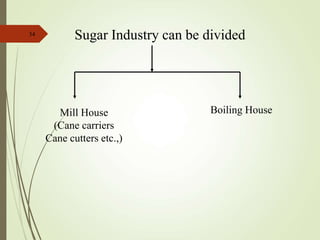
Sugar Industry can be divided into.
1) Mill House.
2) Boiling House.
26
Mill House
1) Cane Carriers
2) Cane Kicker
3) Cane Leveler
4) Cane Cutter
5) Cane Shredder
6) Mills
27
Cane Carrier
Carries the cane
Distant location to mill house
Like a conveyor.
28
Cane Kicker
It kicks the cane
It eliminates choking
To maintain a uniform level
It increases crushing without effecting milling efficiency
29
Cane leveller
It levels the cane in cane carrier
It cuts the cane but levels the cane in cane carrier.
Leveller comprises a set of knives which cut the whole cane
The pitch between the two knives kept three inches apart
The clearance between leveller and cane carrier is 5” – 10”
30
Cane cutter
It cuts the cane into pieces.
It comprises knives of similar design of cane
leveller
The pitch between the two knives is 1.5 in
The clearance between tip of the knife and
cane carrier surface is 3” – 5”
31
Cane shredder
Ruptured the cane.
Improves the preparation of cane and preparatory index
Capacity increased without effecting extraction
It is generally driven by electric motor through flexible
coupling
32
Mills
Extraction of juice from the cane.
Getting mixed juice.
Milling tandem consists of 4to 5 mills
Three rollers present in each mill
Good preparation of cane results better
extraction
33
34
Sugar Industry can be divided
Mill House
(Cane carriers
Cane cutters etc.,)
Boiling House
Boiling House
1. Juice weighing scale.
2. Juice heaters
3. L & S Tank.
4. Clarifier.
5. Evaporator
6. Sulphitation Tank
35
7. Pans
8. Crystallizer
9. Centrifugal
10. Hopper
11. Grader
36
Juice weighing scale
Weighment of mixed juice.
Generally it is a 3 to 5 ton capacity
Mixed juice weighment and counting of weighing tank
37
Juice Heater
 Heating of the juice.
 It is a heat exchanger
 Horizontal and vertical types of juice heaters
 Mixed Juice heats upto 700C
 L & S juice heats upto 1000C – 1050C
38
L & S Tank
 Mixing tank
 Mixing of lime, SO2 with mixed juice.
 To maintain PH 6.8 to 7.2
 SO2 gas for neutralizing and bleaching the juice
 Lime used for PH and settling agent
39
Clarifier
 Clarification of the juice
 Removal of mud
 Getting clear juice
40
Evaporator
 Evaporates water in juice
 Concentrated juice.
 Brix will be raised from 150 to 600 brix
 60 to 80 % of water in the juice will be evaporated
41
Sulphitation tank.
 Addition of SO2 gas.
 SO2 Gas for bleaching purpose
42
Pans
 Crystals preparation
 Massecuite preparation.
 Preparation of A, B & C massecuites
 Massecuite is a mixture of sugar crystals and mother liquor
43
Crystallizers
 Growth of the crystals
 Storage purpose.
 Air cooled, water cooled, vacuum crystallizers
44
Centrifugals
 Separation of crystals and molasses
 Single curing and double curing
 Heavy mollasses and light mollasses are obtained
 B-seed ,C-seed, A-sugar are generated
45
Hopper
 Getting dry sugar
 Removal of slumps.
 Removal of conglomerates
 Removal of moisture
46
Grader
 Sieves the sugar crystals
 Uniform size of sugar crystals
 Grading of Sugar
47
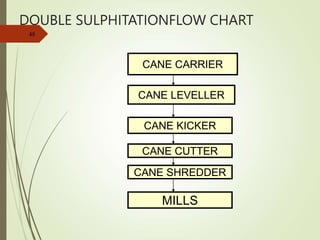
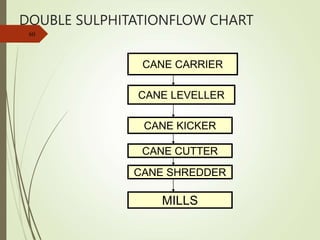
DOUBLE SULPHITATIONFLOW CHART
48
CANE CARRIER
CANE LEVELLER
CANE KICKER
CANE CUTTER
CANE SHREDDER
MILLS
49
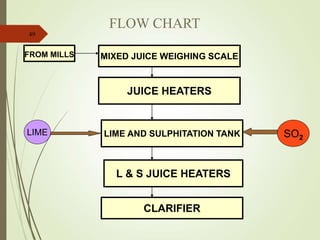
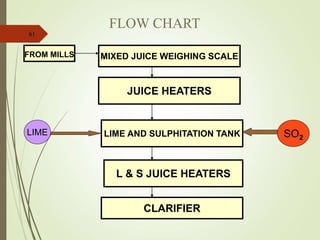
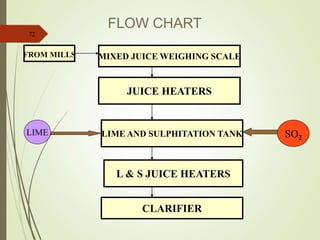
MIXED JUICE WEIGHING SCALE
JUICE HEATERS
LIME AND SULPHITATION TANK
L & S JUICE HEATERS
CLARIFIER
FROM MILLS
LIME SO2
FLOW CHART
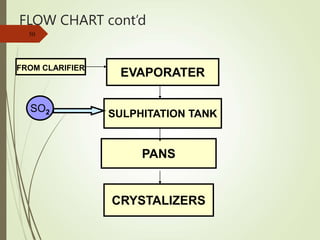
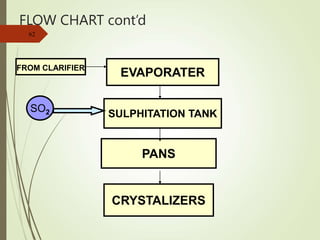
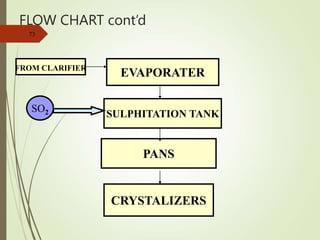
FLOW CHART cont’d
50
EVAPORATER
SULPHITATION TANK
PANS
CRYSTALIZERS
FROM CLARIFIER
SO2
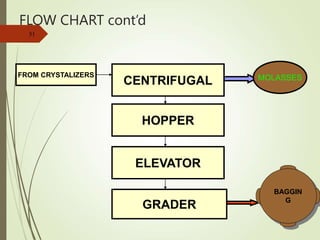
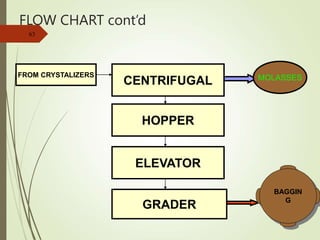
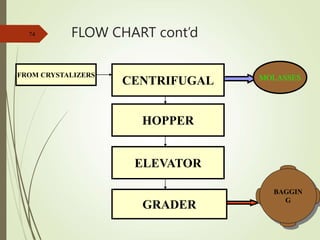
FLOW CHART cont’d
51
CENTRIFUGAL
HOPPER
ELEVATOR
GRADER
FROM CRYSTALIZERS MOLASSES
BAGGIN
G
52
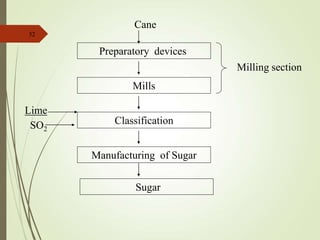
Preparatory devices
Mills
Classification
Manufacturing of Sugar
Sugar
Milling section
Cane
Lime
SO2
53
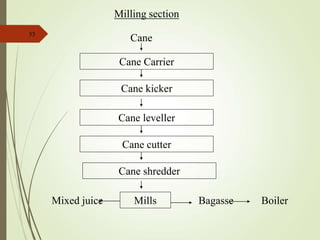
Cane Carrier
Cane kicker
Cane leveller
Cane cutter
Cane shredder
Cane
Mills
Mixed juice Bagasse Boiler
Milling section
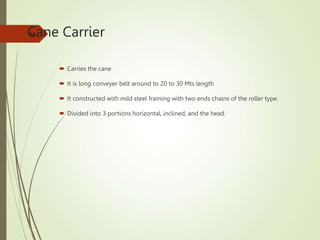
Cane Carrier
 Carries the cane
 It is long conveyer belt around to 20 to 30 Mts length
 It constructed with mild steel framing with two ends chains of the roller type.
 Divided into 3 portions horizontal, inclined, and the head.
54
Cane kicker
 Kicks the cane
 Uniform level in the carrier
 Eliminates choking
 It is increases crushing without effecting milling efficiency.
55
Cane leveller
 Levels the cane
 It helps to maintained uniform level.
 Leveller comprises a set of knives which cut the whole cane into small pieces
56
Cane cutter
 Cuts the cane into fine pieces.
 It comprises knives of similar design of leveller.
 The pitch between two knives is 1½’
57
Cane shredder
 Ruptures the cane.
 It improves preparation of cane and preparation into index.
 Driven by electric motor through a flexible coupling
58
Mills
 Milling tandem consists of 4 – 5 mills
 30 – 40 % juice extracted in first mill.
 Mill consists of a three rollers.
 Good preparation cane results better extraction.
 After extraction remaining cane named as bagasse
 Bagasse used as fuel in boiler.
59
DOUBLE SULPHITATIONFLOW CHART
60
CANE CARRIER
CANE LEVELLER
CANE KICKER
CANE CUTTER
CANE SHREDDER
MILLS
61
MIXED JUICE WEIGHING SCALE
JUICE HEATERS
LIME AND SULPHITATION TANK
L & S JUICE HEATERS
CLARIFIER
FROM MILLS
LIME SO2
FLOW CHART
FLOW CHART cont’d
62
EVAPORATER
SULPHITATION TANK
PANS
CRYSTALIZERS
FROM CLARIFIER
SO2
FLOW CHART cont’d
63
CENTRIFUGAL
HOPPER
ELEVATOR
GRADER
FROM CRYSTALIZERS MOLASSES
BAGGIN
G
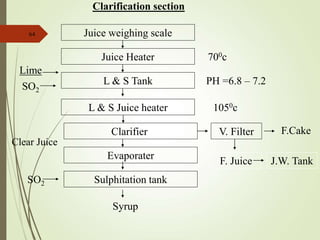
64 Juice weighing scale
Juice Heater
L & S Tank
L & S Juice heater
Clarifier
Clarification section
Evaporater
Sulphitation tank
Syrup
V. Filter F.Cake
F. Juice J.W. Tank
Lime
SO2
PH =6.8 – 7.2
700c
1050c
SO2
Clear Juice
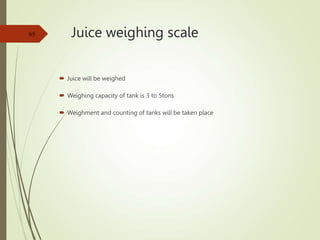
Juice weighing scale
 Juice will be weighed
 Weighing capacity of tank is 3 to 5tons
 Weighment and counting of tanks will be taken place
65
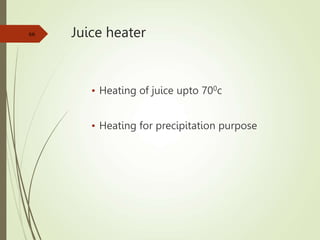
Juice heater
• Heating of juice upto 700c
• Heating for precipitation purpose
66
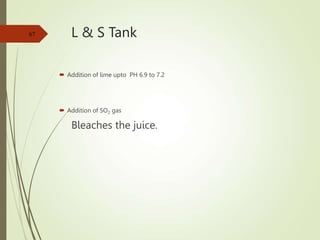
L & S Tank
 Addition of lime upto PH 6.9 to 7.2
 Addition of SO2 gas
Bleaches the juice.
67
L & S Juice heater
 Heating of the juice upto 1100c
68
Clarifier
 Getting clear juice
 Withdrawal of mud
 Mud sent to Rotary drum vacuum filter.
 Getting filter cake, filtered juice
69
Evaporator
 Syrup PH should be 3.8 to 4.2
 Evaporates water
 Getting syrup
70
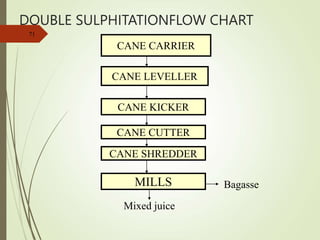
DOUBLE SULPHITATIONFLOW CHART
71
CANE CARRIER
CANE LEVELLER
CANE KICKER
CANE CUTTER
CANE SHREDDER
MILLS Bagasse
Mixed juice
72
MIXED JUICE WEIGHING SCALE
JUICE HEATERS
LIME AND SULPHITATION TANK
L & S JUICE HEATERS
CLARIFIER
FROM MILLS
LIME SO2
FLOW CHART
FLOW CHART cont’d
73
EVAPORATER
SULPHITATION TANK
PANS
CRYSTALIZERS
FROM CLARIFIER
SO2
FLOW CHART cont’d
74
CENTRIFUGAL
HOPPER
ELEVATOR
GRADER
FROM CRYSTALIZERS MOLASSES
BAGGIN
G
Double sulphitation process
 Milling section
 Clarification section
 Manufacture of sugar
75
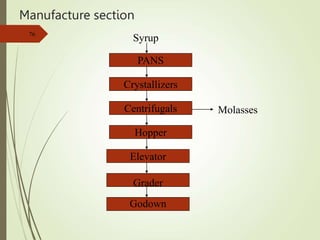
Manufacture section
76
PANS
Crystallizers
Centrifugals
Elevator
Godown
Hopper
Grader
Molasses
Syrup
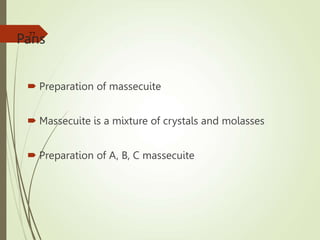
Pans
 Preparation of massecuite
 Massecuite is a mixture of crystals and molasses
 Preparation of A, B, C massecuite
77
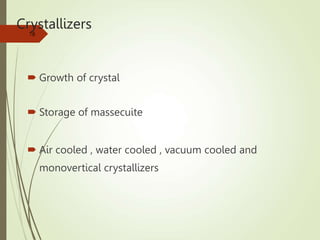
Crystallizers
 Growth of crystal
 Storage of massecuite
 Air cooled , water cooled , vacuum cooled and
monovertical crystallizers
78
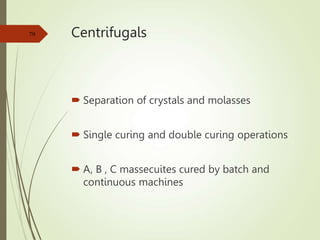
Centrifugals
 Separation of crystals and molasses
 Single curing and double curing operations
 A, B , C massecuites cured by batch and
continuous machines
79
Hopper
 Hot air blower , cold air blower are attached
to the hopper
 It is a vibrating screen
 Wet sugar converted into dry sugar
80
Elevator
 Conveying equipment
 Lifts sugar into some distant height for easy
passage of bagging
81
Grader
 Sieving will be taken place
 Consists of 5 chutes
 Bold sugar and powdered sugars are recirculated
82
Godown
 Bag consists of 100 kgs
 Sugar bags are stored in place called
godown
83
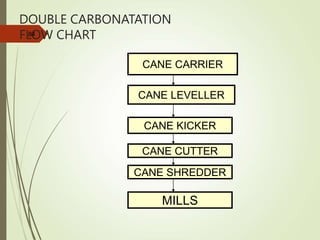
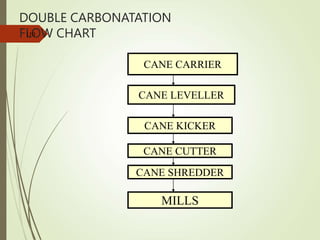
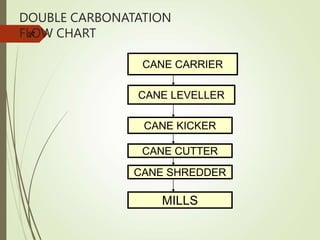
DOUBLE CARBONATATION
FLOW CHART
84
CANE CARRIER
CANE LEVELLER
CANE KICKER
CANE CUTTER
CANE SHREDDER
MILLS
85
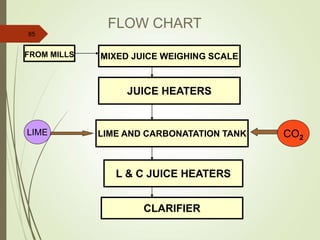
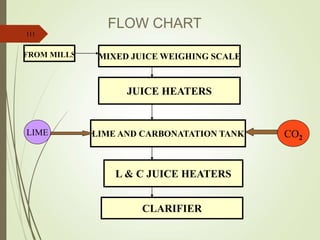
MIXED JUICE WEIGHING SCALE
JUICE HEATERS
LIME AND CARBONATATION TANK
L & C JUICE HEATERS
CLARIFIER
FROM MILLS
LIME CO2
FLOW CHART
FLOW CHART cont’d
86
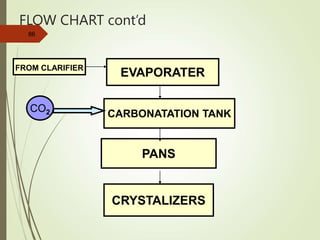
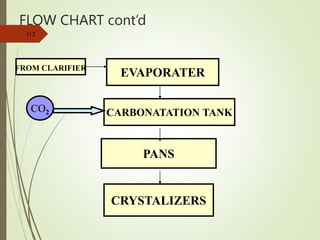
EVAPORATER
CARBONATATION TANK
PANS
CRYSTALIZERS
FROM CLARIFIER
CO2
FLOW CHART cont’d
87
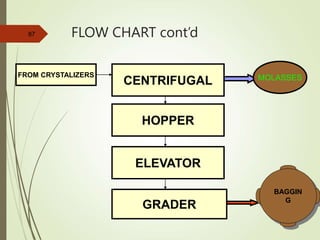
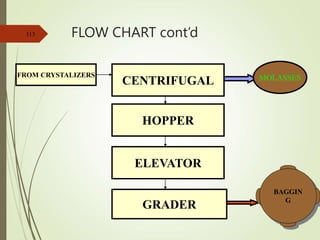
CENTRIFUGAL
HOPPER
ELEVATOR
GRADER
FROM CRYSTALIZERS MOLASSES
BAGGIN
G
88
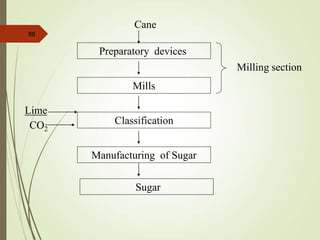
Preparatory devices
Mills
Classification
Manufacturing of Sugar
Sugar
Milling section
Cane
Lime
CO2
89
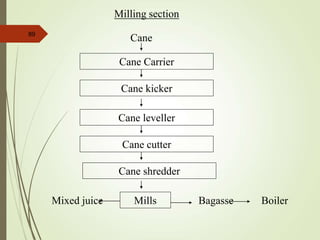
Cane Carrier
Cane kicker
Cane leveller
Cane cutter
Cane shredder
Cane
Mills
Mixed juice Bagasse Boiler
Milling section
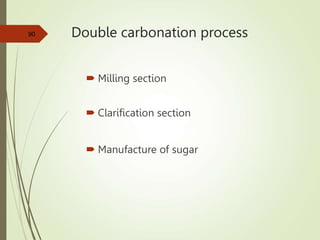
Double carbonation process
 Milling section
 Clarification section
 Manufacture of sugar
90
Cane carrier
 Carries the cane
 Long conveyor belt
 Carrier divided into three portions,
horizontal , inclined and the head
91
Cane kicker
 All steel construction mounting on the cane carrier and fixing
upon the shaft 48 no. of blades welded on it
 It eliminates chocking
 Does not cut the cane but helps to maintain uniform level
92
Cane leveler
 Levels the cane in cane carrier
 Leveler comprises of a set of knives which
cut the whole cane into small pieces
93
Cane cutter
 Cut the cane into fine pieces
 Comprise knives of similar design of leveller
94
Cane shredder
 Cuts the cane into very fine pieces
 It improves the preparation of cane and
preparatory index
95
Mills
 Milling tandem consists of 4 or 5 mills
 60 to 70% juice extracted in first mill
 Good preparation of cane results better
extraction of the juice
96
DOUBLE CARBONATATION
FLOW CHART
97
CANE CARRIER
CANE LEVELLER
CANE KICKER
CANE CUTTER
CANE SHREDDER
MILLS
98
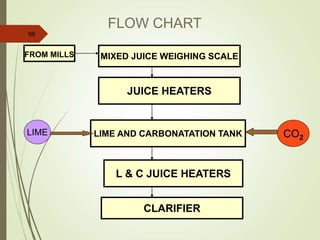
MIXED JUICE WEIGHING SCALE
JUICE HEATERS
LIME AND CARBONATATION TANK
L & C JUICE HEATERS
CLARIFIER
FROM MILLS
LIME CO2
FLOW CHART
FLOW CHART cont’d
99
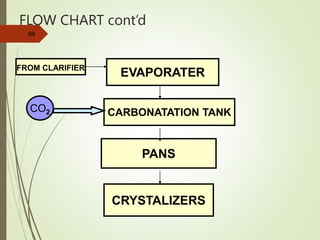
EVAPORATER
CARBONATATION TANK
PANS
CRYSTALIZERS
FROM CLARIFIER
CO2
FLOW CHART cont’d
100
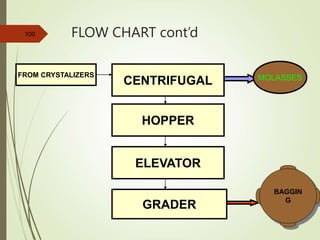
CENTRIFUGAL
HOPPER
ELEVATOR
GRADER
FROM CRYSTALIZERS MOLASSES
BAGGIN
G
 Double carbonatation process can be divided into
 Milling section
 Clarification section
 Manufacture of sugar
101
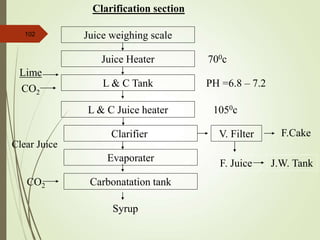
102 Juice weighing scale
Juice Heater
L & C Tank
L & C Juice heater
Clarifier
Clarification section
Evaporater
Carbonatation tank
Syrup
V. Filter F.Cake
F. Juice J.W. Tank
Lime
CO2
PH =6.8 – 7.2
700c
1050c
CO2
Clear Juice
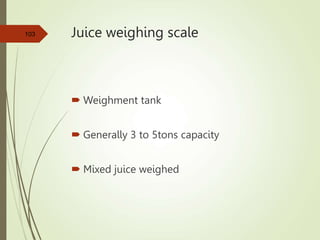
Juice weighing scale
 Weighment tank
 Generally 3 to 5tons capacity
 Mixed juice weighed
103
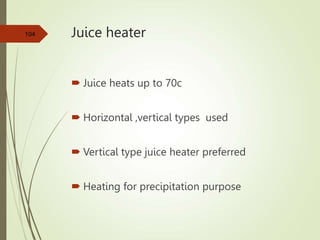
Juice heater
 Juice heats up to 70c
 Horizontal ,vertical types used
 Vertical type juice heater preferred
 Heating for precipitation purpose
104
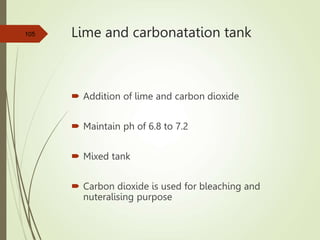
Lime and carbonatation tank
 Addition of lime and carbon dioxide
 Maintain ph of 6.8 to 7.2
 Mixed tank
 Carbon dioxide is used for bleaching and
nuteralising purpose
105
L & C juice heater
 Juice heats up to 110c
 Generally two juice heaters used
106
Clarifier
 Called rapi Dorr
 Four compartments consists of 200 to 300 tons capacity
 Separate juice with drawl and mud with drawls are provided
 Settling process takes place
 Mud is sent to vaccum filter for getting filtered juice and filter
cake
107
Evaporator
 60 to 80% of water evaporated
 Concentrated juice called syrup
108
Carbonatation tank
 Carbon dioxide gas added in second time
 For bleaching purpose
109
DOUBLE CARBONATATION
FLOW CHART
110
CANE CARRIER
CANE LEVELLER
CANE KICKER
CANE CUTTER
CANE SHREDDER
MILLS
111
MIXED JUICE WEIGHING SCALE
JUICE HEATERS
LIME AND CARBONATATION TANK
L & C JUICE HEATERS
CLARIFIER
FROM MILLS
LIME CO2
FLOW CHART
FLOW CHART cont’d
112
EVAPORATER
CARBONATATION TANK
PANS
CRYSTALIZERS
FROM CLARIFIER
CO2
FLOW CHART cont’d
113
CENTRIFUGAL
HOPPER
ELEVATOR
GRADER
FROM CRYSTALIZERS MOLASSES
BAGGIN
G
 Double carbonatation process can be divided into
 Milling section
 Clarification section
 Manufacture section
114
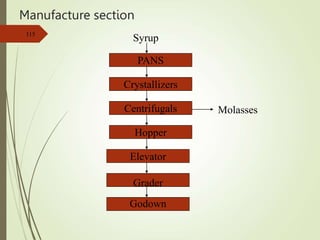
Manufacture section
115
PANS
Crystallizers
Centrifugals
Elevator
Godown
Hopper
Grader
Molasses
Syrup
Pans
 Preparation of massecuite
 Mixture of crystals and mother liquor is called massecuite
 Preparation of A, B and C massecuite.
116
Crystallizers
 Growth of crystals
 Acts as a storage tank
 Different types of crystallizers like air-cooled, water
cooled, vaccum cooled and monovertical crystallizers.
117
Centrifugals
 Separation of crystals and molasses
 Single curing and double curing operations
 Batch type and continuous type centrifugals.
 Batch type used for A – massecuite curing
 Continuous type is used for B & C – massecuite curing
118
Hopper
 Vibrating screen
 Hot air blowers and cold air blowers are attached
 Removing of conglomerates sugar
119
Grader
 Sieving taken place
 4 or 5 chutes are used
 Bold grain and powdered sugar is recirculated
120
Preparatory devices
 Cane kicker
 Cane leveler
 Cane cutter
 Cane shredder
121
CANE KICKER
 All steel construction suitable for mounting on the cane
carrier and fixing upon the shaft the required no. of
blades welded on it.
 Total no.of blades around 48
 Speed of the kicker about 70r.p.m
122
CANE LEVELLER
 It comprises a set of knives which cut the
whole cane into small pieces
 Knives worked with high clearance 4 to 10
inches
 Pitch between two adjacent knife blades is
3inches
123
CANE CUTTER
 It comprises a set of knives which cut the whole cane
into fine pieces
 Clearance of about1” to1.5”
 Pitch between two sets of knives is 2inches
124
CANE SHREDDER
 It driven by an electric motor through a flexible coupling
 Hammers are fixed to shaft they are mild steel about 8’long
2.5” wide each weighing 1.75to 3.5lb.
 Fitted at head of the tandem between crusher and cutter
125
PREPARATORY DEVICES
 Cane kicker
 Cane leveler
 Cane cutter
 Cane shredder
126
Function of Cane Kicker
 It cut the cane and helps to maintain a uniform level
 It eliminates chocking
 Increases crushing
127
Function of Cane Leveler
 It levels the cane in cane carrier
 It cuts the whole cane into small pieces
128
Function of Cane Cutter
 Depending on TCD of plant cane cutters should be 1 to 3
 It cuts the whole cane into fine pices
129
Function of Cane Shredder
 It cuts the whole cane into very fine pieces
 It gives almost the same extraction as a
three roller mill
 It adds both to capacity and extraction
130
FUNCTIONS OF CANE CRUSHER
 Assist intensive preparation of cane
 Extract more juice
131
TYPES OF CRUSHER
 Krajewski crusher
 Splitter or fultron crusher
132
Krawjewski crusher
 It has double helical teeth on the
circumference of the rollers
 Improves extraction
 It has three roll crusher
 Speed 25% greater than the mills
133
SPLITTER or FULTRON CRUSHER
 It has deep circular grooves with spiral
horizontal grooves on the roller
 Improves crushing rate
 Spiral grooves assist feeding
 It has three roll crusher
134
 Pitch of the splitter is in conventional design 1 to 1.5inch
 Increase rate of crushing pitch is usually 3inches
 It runs at a greater speed
 40 to 50% greater speed than the mill
 Provided sometimes messchaert grooving
135
FUNCTIONS OF MILLS
 Three rollers consists a mill
 4 to 6 mills consists of a milling tandem
 Circumferential grooving, messchaert grooving are used
for grooving on mill rollers
136
 Grooves is generally used for increasing juice handling
capacity
 First mill at high pressure –for better extraction
 Last mill is for lowest speed
 Applying for maximum loads for first and last mill
137
 Hydraulic pressure provided to all mill rollers
 Handling and conveying between the mill rollers is
intercane carrier
 Imbibition-hot water provided between 3 and 4 mills
 60 to 70% extraction taken place at first mill itself
138
 Top halves of roller journal brasses should
not rest on the bottom halves while mill is
working
 Mills having higher pressure and lower
speed achieve highest performance
139
CANE CRUSHER
 Crusher have helical teeth on the circumference
 Assist intensive preparation
 Generally it is two roller crusher nowadays it has
three roller crusher
 It assist feeding
140
 It runs at a greater speed
 40 to 50% greater speed than mills
 Sometimes circular grooves and spiral horizontal
grooves are used
141
MILLS
 Generally it has three rollers
 Three rollers consists a mill
 Circumferential grooving,messchaert grooving
are generally used
 Imbibition water used between 3 and 4 mill
142
 Used for crushing and extraction of juice
 Hydraulic pressure is required for rapid extraction
purpose
 Runs slowly
143
Grooving
 Mill rollers were smooth it exists in some countries
 Advantage with smooth rollers wear and tear in them
is much less
 Moisture content of the bagasse is lowered
 Mill rollers with fine, medium or coarse grooving
adopted in most of the sugar industries
144
Advantages of grooving
 Crushing rate is very high
 Facilitate drainage
 Break up the bagasse completely
 Facilitate the extraction of juice
145
Types of grooving
 Circumferential grooving
 Messchaert grooving
146
Circumferential grooving
 These are made along the length of the rollers on
circumference
 Groove forms isosceles triangle with an apical angle
of 550-600
 Pitch of the groove separates the axes of two
successive teeth
 Depth of the groove is slightly less than the pitch
147
Specifications
 Angle is-600
 Height is 0.85”
 Pitch is 0.80”
 Angle of the groove at the top and bottom
rollers is identical
148
Specifications
 Fine grooves is 5-20mm pitch
 Medium grooves is 25-50mm pitch
 Coarse grooves is above 50mm pitch
149
Advantages of circumferential grooving
 They increase gripping effect
 Facilitates drainage of juice
 Cause better rupturing of the pitch of cane cells
150
Messchaert grooving
 Improve gripping effect
 Provided free drainage
 Messchaert grooving rendered 2% higher extraction
 10 to 15% greater mill capacity
151
 Lesser power consumption
 Deep circumferential grooves spaced about
4 inches apart
 Provided on all mill rollers
152
Specifications
 Width is1/2 “to 3/16” on the feed rollers
 Depth 1” and should not deeper than 1.5”
 Pitch is 3” to 4” on the discharge roller
153
Good results
 Apply maximum load on the first and last mill
 Lesser loads on the intermediate mills
154
Factors
 Mills
 Mill rollers
 Imbibitions
 Preparation of cane
155
Good milling
 Feed should enter to avoid choking
 All hydraulics should float freely
 Top halves of roller journal brasses should not rest on
the bottom halves while the mill is working
 Max. lift of crusher top roller is 1.5 inch to 2 inch
156
 Juice should be free flowly down the entire length of the
feed roller in full quantity
 Juice being discharged with considerable force
 Proper imbibition
 Proper maintance
157
 Regrooving according to life of the roller
 Proper lubrication of cane carrier and inter
cane carrier
 No vibration or undue noise from mills
158
Causes of vibration
 Insufficiently strong foundation
 Fault alignment
 Defective lubrication system
159

Sugar Technology notes.ppt

  • 1.
    Various terms  Cane Primary juice  Secondary juice  Absolute juice  Mixed juice  Last mill juice 1
  • 2.
    CANE  Raw materialis delivered to the cane carrier  Raw material for Sugar Industry  Absolute juice + fibre = cane 2
  • 3.
    SECONDARYJUICE  Diluted juiceextracted from the mills in milling tandem  Addition of water to the juice 3
  • 4.
    ABSOLUTE JUICE  Totaljuice extracted from the cane in milling tandem  Absolute juice = Cane - fibre 4
  • 5.
    Mixed juice  Totaljuice extracted from the mills  Mixer of primary juice and secondary juice  Juice sent out from the mill house. 5
  • 6.
    Last mill juice Diluted juice extracted by the last mill in milling tandem  Imbibition water added – extracted juice.  After extraction of the last mill juice the fiberous product is called as Bagasse 6
  • 7.
    RESIDUAL JUICE  Juiceleft in the bagasse  If juice left over is in bagasse is more pol in bagasse is more 7
  • 8.
    CLEAR JUICE  Afterclarification juice getting from the clarifier  Removal of mud in clarifier – getting clear juice  Settling process taken place in clarifier.  Clear juice sent to evaporator. 8
  • 9.
    Sulphured juice  Additionof so2 gas to the juice  So2 gas act as bleaching agent 9
  • 10.
    Un diluted juice With out addition of water in the juice  Generally primary juice is undiluted juice. 10
  • 11.
    Muddy juice  Residue(mud along with juice) delivered from the clarifier  Muddy juice sent to rotary drum vaccum filter for getting filtered juice and filter cake 11
  • 12.
    Syrup  Concentrated juicecoming out from the evaporator  60 to 80% water evaporated in evaporator  Addition of So2 gas in sulphitation tank to the syrup then sent to pans 12
  • 13.
    Various terms : •Massecuite • Molasses • Filter cake • Press cake • Imbibition • Maceration • Bagasse 13
  • 14.
    Massecuite • Mixture ofsugar crystals and mother liquor (Molasses) • Different types of massecuites named as Am/c,Bm/c,Cm/c 14
  • 15.
    Molasses • Effluent obtainedfrom the centrifugals • Different types of molasses obtained • A-heavy, B-heavy, C-heavy, A-light, B-light, and C-light molasses 15
  • 16.
    Filter cake  Residuedelivered from the vacuum filter  It is used as a fertilizer  Used as cattle feed with the combination of molasses 16
  • 17.
    Press Cake  Residuedelivered from the filter press  Used as manure and fertilizer  Used as cattle feed 17
  • 18.
    Imbibition  “ Additionof water in the mills to the bagasse” bed before last mill  Addition of hot water before the last mill  The process in which water or juice is applied to bagasse to enhance the extraction of juice in the next mill  Better extraction of juice  Hot water temperature should be below 70c 18
  • 19.
    Advantages of hotwater  Hot water ruptures some cells  Sanitary and enzymatic reactions  Efficient juice extraction 19
  • 20.
    Advantages of coldwater imbibition  Reducing gums, waxes and pectin's  Good for clarification 20
  • 21.
    Types of imbibition 21 Twotypes of imbibition 1.simple 2.compound Generally compound imbibition is followed in sugar factory Imbibition water temperature should be around 650c to 750c.
  • 22.
    22 Imbibition is theprocess which is generally adopted in all the strength milling tandem in one form or other. Simple Imbibition: The process of adding water alone to the bagasse is known as simple imbibition. Hot water addition between 3 and 4 mill Juice withdrawal by individual mills No recirculation of juice
  • 23.
    Compound Imbibition: Water isadded to the bagasse going to the last mill. The juice from last mill is added to the bagasse coming to the penultimate mill and the juice from the penultimate mill is sent to the preceding mill and so on. Depending upon the number of stages this is also known as double, triple, quadruple compound imbibition and so on. 23
  • 24.
    Maceration  Raw sugaris produced from juice in sugar cane crushed by a series of mills. To improve the extraction a liquid bath is applied to the cane between mills. This liquid bath, commonly called maceration, consists of water and some of the produced juice. Although the extraction is improved with higher water content in the maceration, the total juice output is restricted by the storage capacity of the plant. The aim of maceration control is to manipulate the added water within the process limits placed by the storage capacity whilst optimising sugar extraction Steeping of bagasse in excess water  Generally it is followed in diffusers 24
  • 25.
    Bagasse  “ Insolublematter (fibre) in the cane.  After extraction of juice the residue coming out from the last mill  Generally used as a fuel in boilers 25
  • 26.
    Sugar Industry canbe divided into. 1) Mill House. 2) Boiling House. 26
  • 27.
    Mill House 1) CaneCarriers 2) Cane Kicker 3) Cane Leveler 4) Cane Cutter 5) Cane Shredder 6) Mills 27
  • 28.
    Cane Carrier Carries thecane Distant location to mill house Like a conveyor. 28
  • 29.
    Cane Kicker It kicksthe cane It eliminates choking To maintain a uniform level It increases crushing without effecting milling efficiency 29
  • 30.
    Cane leveller It levelsthe cane in cane carrier It cuts the cane but levels the cane in cane carrier. Leveller comprises a set of knives which cut the whole cane The pitch between the two knives kept three inches apart The clearance between leveller and cane carrier is 5” – 10” 30
  • 31.
    Cane cutter It cutsthe cane into pieces. It comprises knives of similar design of cane leveller The pitch between the two knives is 1.5 in The clearance between tip of the knife and cane carrier surface is 3” – 5” 31
  • 32.
    Cane shredder Ruptured thecane. Improves the preparation of cane and preparatory index Capacity increased without effecting extraction It is generally driven by electric motor through flexible coupling 32
  • 33.
    Mills Extraction of juicefrom the cane. Getting mixed juice. Milling tandem consists of 4to 5 mills Three rollers present in each mill Good preparation of cane results better extraction 33
  • 34.
    34 Sugar Industry canbe divided Mill House (Cane carriers Cane cutters etc.,) Boiling House
  • 35.
    Boiling House 1. Juiceweighing scale. 2. Juice heaters 3. L & S Tank. 4. Clarifier. 5. Evaporator 6. Sulphitation Tank 35
  • 36.
    7. Pans 8. Crystallizer 9.Centrifugal 10. Hopper 11. Grader 36
  • 37.
    Juice weighing scale Weighmentof mixed juice. Generally it is a 3 to 5 ton capacity Mixed juice weighment and counting of weighing tank 37
  • 38.
    Juice Heater  Heatingof the juice.  It is a heat exchanger  Horizontal and vertical types of juice heaters  Mixed Juice heats upto 700C  L & S juice heats upto 1000C – 1050C 38
  • 39.
    L & STank  Mixing tank  Mixing of lime, SO2 with mixed juice.  To maintain PH 6.8 to 7.2  SO2 gas for neutralizing and bleaching the juice  Lime used for PH and settling agent 39
  • 40.
    Clarifier  Clarification ofthe juice  Removal of mud  Getting clear juice 40
  • 41.
    Evaporator  Evaporates waterin juice  Concentrated juice.  Brix will be raised from 150 to 600 brix  60 to 80 % of water in the juice will be evaporated 41
  • 42.
    Sulphitation tank.  Additionof SO2 gas.  SO2 Gas for bleaching purpose 42
  • 43.
    Pans  Crystals preparation Massecuite preparation.  Preparation of A, B & C massecuites  Massecuite is a mixture of sugar crystals and mother liquor 43
  • 44.
    Crystallizers  Growth ofthe crystals  Storage purpose.  Air cooled, water cooled, vacuum crystallizers 44
  • 45.
    Centrifugals  Separation ofcrystals and molasses  Single curing and double curing  Heavy mollasses and light mollasses are obtained  B-seed ,C-seed, A-sugar are generated 45
  • 46.
    Hopper  Getting drysugar  Removal of slumps.  Removal of conglomerates  Removal of moisture 46
  • 47.
    Grader  Sieves thesugar crystals  Uniform size of sugar crystals  Grading of Sugar 47
  • 48.
    DOUBLE SULPHITATIONFLOW CHART 48 CANECARRIER CANE LEVELLER CANE KICKER CANE CUTTER CANE SHREDDER MILLS
  • 49.
    49 MIXED JUICE WEIGHINGSCALE JUICE HEATERS LIME AND SULPHITATION TANK L & S JUICE HEATERS CLARIFIER FROM MILLS LIME SO2 FLOW CHART
  • 50.
    FLOW CHART cont’d 50 EVAPORATER SULPHITATIONTANK PANS CRYSTALIZERS FROM CLARIFIER SO2
  • 51.
  • 52.
    52 Preparatory devices Mills Classification Manufacturing ofSugar Sugar Milling section Cane Lime SO2
  • 53.
    53 Cane Carrier Cane kicker Caneleveller Cane cutter Cane shredder Cane Mills Mixed juice Bagasse Boiler Milling section
  • 54.
    Cane Carrier  Carriesthe cane  It is long conveyer belt around to 20 to 30 Mts length  It constructed with mild steel framing with two ends chains of the roller type.  Divided into 3 portions horizontal, inclined, and the head. 54
  • 55.
    Cane kicker  Kicksthe cane  Uniform level in the carrier  Eliminates choking  It is increases crushing without effecting milling efficiency. 55
  • 56.
    Cane leveller  Levelsthe cane  It helps to maintained uniform level.  Leveller comprises a set of knives which cut the whole cane into small pieces 56
  • 57.
    Cane cutter  Cutsthe cane into fine pieces.  It comprises knives of similar design of leveller.  The pitch between two knives is 1½’ 57
  • 58.
    Cane shredder  Rupturesthe cane.  It improves preparation of cane and preparation into index.  Driven by electric motor through a flexible coupling 58
  • 59.
    Mills  Milling tandemconsists of 4 – 5 mills  30 – 40 % juice extracted in first mill.  Mill consists of a three rollers.  Good preparation cane results better extraction.  After extraction remaining cane named as bagasse  Bagasse used as fuel in boiler. 59
  • 60.
    DOUBLE SULPHITATIONFLOW CHART 60 CANECARRIER CANE LEVELLER CANE KICKER CANE CUTTER CANE SHREDDER MILLS
  • 61.
    61 MIXED JUICE WEIGHINGSCALE JUICE HEATERS LIME AND SULPHITATION TANK L & S JUICE HEATERS CLARIFIER FROM MILLS LIME SO2 FLOW CHART
  • 62.
    FLOW CHART cont’d 62 EVAPORATER SULPHITATIONTANK PANS CRYSTALIZERS FROM CLARIFIER SO2
  • 63.
  • 64.
    64 Juice weighingscale Juice Heater L & S Tank L & S Juice heater Clarifier Clarification section Evaporater Sulphitation tank Syrup V. Filter F.Cake F. Juice J.W. Tank Lime SO2 PH =6.8 – 7.2 700c 1050c SO2 Clear Juice
  • 65.
    Juice weighing scale Juice will be weighed  Weighing capacity of tank is 3 to 5tons  Weighment and counting of tanks will be taken place 65
  • 66.
    Juice heater • Heatingof juice upto 700c • Heating for precipitation purpose 66
  • 67.
    L & STank  Addition of lime upto PH 6.9 to 7.2  Addition of SO2 gas Bleaches the juice. 67
  • 68.
    L & SJuice heater  Heating of the juice upto 1100c 68
  • 69.
    Clarifier  Getting clearjuice  Withdrawal of mud  Mud sent to Rotary drum vacuum filter.  Getting filter cake, filtered juice 69
  • 70.
    Evaporator  Syrup PHshould be 3.8 to 4.2  Evaporates water  Getting syrup 70
  • 71.
    DOUBLE SULPHITATIONFLOW CHART 71 CANECARRIER CANE LEVELLER CANE KICKER CANE CUTTER CANE SHREDDER MILLS Bagasse Mixed juice
  • 72.
    72 MIXED JUICE WEIGHINGSCALE JUICE HEATERS LIME AND SULPHITATION TANK L & S JUICE HEATERS CLARIFIER FROM MILLS LIME SO2 FLOW CHART
  • 73.
    FLOW CHART cont’d 73 EVAPORATER SULPHITATIONTANK PANS CRYSTALIZERS FROM CLARIFIER SO2
  • 74.
  • 75.
    Double sulphitation process Milling section  Clarification section  Manufacture of sugar 75
  • 76.
  • 77.
    Pans  Preparation ofmassecuite  Massecuite is a mixture of crystals and molasses  Preparation of A, B, C massecuite 77
  • 78.
    Crystallizers  Growth ofcrystal  Storage of massecuite  Air cooled , water cooled , vacuum cooled and monovertical crystallizers 78
  • 79.
    Centrifugals  Separation ofcrystals and molasses  Single curing and double curing operations  A, B , C massecuites cured by batch and continuous machines 79
  • 80.
    Hopper  Hot airblower , cold air blower are attached to the hopper  It is a vibrating screen  Wet sugar converted into dry sugar 80
  • 81.
    Elevator  Conveying equipment Lifts sugar into some distant height for easy passage of bagging 81
  • 82.
    Grader  Sieving willbe taken place  Consists of 5 chutes  Bold sugar and powdered sugars are recirculated 82
  • 83.
    Godown  Bag consistsof 100 kgs  Sugar bags are stored in place called godown 83
  • 84.
    DOUBLE CARBONATATION FLOW CHART 84 CANECARRIER CANE LEVELLER CANE KICKER CANE CUTTER CANE SHREDDER MILLS
  • 85.
    85 MIXED JUICE WEIGHINGSCALE JUICE HEATERS LIME AND CARBONATATION TANK L & C JUICE HEATERS CLARIFIER FROM MILLS LIME CO2 FLOW CHART
  • 86.
    FLOW CHART cont’d 86 EVAPORATER CARBONATATIONTANK PANS CRYSTALIZERS FROM CLARIFIER CO2
  • 87.
  • 88.
    88 Preparatory devices Mills Classification Manufacturing ofSugar Sugar Milling section Cane Lime CO2
  • 89.
    89 Cane Carrier Cane kicker Caneleveller Cane cutter Cane shredder Cane Mills Mixed juice Bagasse Boiler Milling section
  • 90.
    Double carbonation process Milling section  Clarification section  Manufacture of sugar 90
  • 91.
    Cane carrier  Carriesthe cane  Long conveyor belt  Carrier divided into three portions, horizontal , inclined and the head 91
  • 92.
    Cane kicker  Allsteel construction mounting on the cane carrier and fixing upon the shaft 48 no. of blades welded on it  It eliminates chocking  Does not cut the cane but helps to maintain uniform level 92
  • 93.
    Cane leveler  Levelsthe cane in cane carrier  Leveler comprises of a set of knives which cut the whole cane into small pieces 93
  • 94.
    Cane cutter  Cutthe cane into fine pieces  Comprise knives of similar design of leveller 94
  • 95.
    Cane shredder  Cutsthe cane into very fine pieces  It improves the preparation of cane and preparatory index 95
  • 96.
    Mills  Milling tandemconsists of 4 or 5 mills  60 to 70% juice extracted in first mill  Good preparation of cane results better extraction of the juice 96
  • 97.
    DOUBLE CARBONATATION FLOW CHART 97 CANECARRIER CANE LEVELLER CANE KICKER CANE CUTTER CANE SHREDDER MILLS
  • 98.
    98 MIXED JUICE WEIGHINGSCALE JUICE HEATERS LIME AND CARBONATATION TANK L & C JUICE HEATERS CLARIFIER FROM MILLS LIME CO2 FLOW CHART
  • 99.
    FLOW CHART cont’d 99 EVAPORATER CARBONATATIONTANK PANS CRYSTALIZERS FROM CLARIFIER CO2
  • 100.
  • 101.
     Double carbonatationprocess can be divided into  Milling section  Clarification section  Manufacture of sugar 101
  • 102.
    102 Juice weighingscale Juice Heater L & C Tank L & C Juice heater Clarifier Clarification section Evaporater Carbonatation tank Syrup V. Filter F.Cake F. Juice J.W. Tank Lime CO2 PH =6.8 – 7.2 700c 1050c CO2 Clear Juice
  • 103.
    Juice weighing scale Weighment tank  Generally 3 to 5tons capacity  Mixed juice weighed 103
  • 104.
    Juice heater  Juiceheats up to 70c  Horizontal ,vertical types used  Vertical type juice heater preferred  Heating for precipitation purpose 104
  • 105.
    Lime and carbonatationtank  Addition of lime and carbon dioxide  Maintain ph of 6.8 to 7.2  Mixed tank  Carbon dioxide is used for bleaching and nuteralising purpose 105
  • 106.
    L & Cjuice heater  Juice heats up to 110c  Generally two juice heaters used 106
  • 107.
    Clarifier  Called rapiDorr  Four compartments consists of 200 to 300 tons capacity  Separate juice with drawl and mud with drawls are provided  Settling process takes place  Mud is sent to vaccum filter for getting filtered juice and filter cake 107
  • 108.
    Evaporator  60 to80% of water evaporated  Concentrated juice called syrup 108
  • 109.
    Carbonatation tank  Carbondioxide gas added in second time  For bleaching purpose 109
  • 110.
    DOUBLE CARBONATATION FLOW CHART 110 CANECARRIER CANE LEVELLER CANE KICKER CANE CUTTER CANE SHREDDER MILLS
  • 111.
    111 MIXED JUICE WEIGHINGSCALE JUICE HEATERS LIME AND CARBONATATION TANK L & C JUICE HEATERS CLARIFIER FROM MILLS LIME CO2 FLOW CHART
  • 112.
    FLOW CHART cont’d 112 EVAPORATER CARBONATATIONTANK PANS CRYSTALIZERS FROM CLARIFIER CO2
  • 113.
  • 114.
     Double carbonatationprocess can be divided into  Milling section  Clarification section  Manufacture section 114
  • 115.
  • 116.
    Pans  Preparation ofmassecuite  Mixture of crystals and mother liquor is called massecuite  Preparation of A, B and C massecuite. 116
  • 117.
    Crystallizers  Growth ofcrystals  Acts as a storage tank  Different types of crystallizers like air-cooled, water cooled, vaccum cooled and monovertical crystallizers. 117
  • 118.
    Centrifugals  Separation ofcrystals and molasses  Single curing and double curing operations  Batch type and continuous type centrifugals.  Batch type used for A – massecuite curing  Continuous type is used for B & C – massecuite curing 118
  • 119.
    Hopper  Vibrating screen Hot air blowers and cold air blowers are attached  Removing of conglomerates sugar 119
  • 120.
    Grader  Sieving takenplace  4 or 5 chutes are used  Bold grain and powdered sugar is recirculated 120
  • 121.
    Preparatory devices  Canekicker  Cane leveler  Cane cutter  Cane shredder 121
  • 122.
    CANE KICKER  Allsteel construction suitable for mounting on the cane carrier and fixing upon the shaft the required no. of blades welded on it.  Total no.of blades around 48  Speed of the kicker about 70r.p.m 122
  • 123.
    CANE LEVELLER  Itcomprises a set of knives which cut the whole cane into small pieces  Knives worked with high clearance 4 to 10 inches  Pitch between two adjacent knife blades is 3inches 123
  • 124.
    CANE CUTTER  Itcomprises a set of knives which cut the whole cane into fine pieces  Clearance of about1” to1.5”  Pitch between two sets of knives is 2inches 124
  • 125.
    CANE SHREDDER  Itdriven by an electric motor through a flexible coupling  Hammers are fixed to shaft they are mild steel about 8’long 2.5” wide each weighing 1.75to 3.5lb.  Fitted at head of the tandem between crusher and cutter 125
  • 126.
    PREPARATORY DEVICES  Canekicker  Cane leveler  Cane cutter  Cane shredder 126
  • 127.
    Function of CaneKicker  It cut the cane and helps to maintain a uniform level  It eliminates chocking  Increases crushing 127
  • 128.
    Function of CaneLeveler  It levels the cane in cane carrier  It cuts the whole cane into small pieces 128
  • 129.
    Function of CaneCutter  Depending on TCD of plant cane cutters should be 1 to 3  It cuts the whole cane into fine pices 129
  • 130.
    Function of CaneShredder  It cuts the whole cane into very fine pieces  It gives almost the same extraction as a three roller mill  It adds both to capacity and extraction 130
  • 131.
    FUNCTIONS OF CANECRUSHER  Assist intensive preparation of cane  Extract more juice 131
  • 132.
    TYPES OF CRUSHER Krajewski crusher  Splitter or fultron crusher 132
  • 133.
    Krawjewski crusher  Ithas double helical teeth on the circumference of the rollers  Improves extraction  It has three roll crusher  Speed 25% greater than the mills 133
  • 134.
    SPLITTER or FULTRONCRUSHER  It has deep circular grooves with spiral horizontal grooves on the roller  Improves crushing rate  Spiral grooves assist feeding  It has three roll crusher 134
  • 135.
     Pitch ofthe splitter is in conventional design 1 to 1.5inch  Increase rate of crushing pitch is usually 3inches  It runs at a greater speed  40 to 50% greater speed than the mill  Provided sometimes messchaert grooving 135
  • 136.
    FUNCTIONS OF MILLS Three rollers consists a mill  4 to 6 mills consists of a milling tandem  Circumferential grooving, messchaert grooving are used for grooving on mill rollers 136
  • 137.
     Grooves isgenerally used for increasing juice handling capacity  First mill at high pressure –for better extraction  Last mill is for lowest speed  Applying for maximum loads for first and last mill 137
  • 138.
     Hydraulic pressureprovided to all mill rollers  Handling and conveying between the mill rollers is intercane carrier  Imbibition-hot water provided between 3 and 4 mills  60 to 70% extraction taken place at first mill itself 138
  • 139.
     Top halvesof roller journal brasses should not rest on the bottom halves while mill is working  Mills having higher pressure and lower speed achieve highest performance 139
  • 140.
    CANE CRUSHER  Crusherhave helical teeth on the circumference  Assist intensive preparation  Generally it is two roller crusher nowadays it has three roller crusher  It assist feeding 140
  • 141.
     It runsat a greater speed  40 to 50% greater speed than mills  Sometimes circular grooves and spiral horizontal grooves are used 141
  • 142.
    MILLS  Generally ithas three rollers  Three rollers consists a mill  Circumferential grooving,messchaert grooving are generally used  Imbibition water used between 3 and 4 mill 142
  • 143.
     Used forcrushing and extraction of juice  Hydraulic pressure is required for rapid extraction purpose  Runs slowly 143
  • 144.
    Grooving  Mill rollerswere smooth it exists in some countries  Advantage with smooth rollers wear and tear in them is much less  Moisture content of the bagasse is lowered  Mill rollers with fine, medium or coarse grooving adopted in most of the sugar industries 144
  • 145.
    Advantages of grooving Crushing rate is very high  Facilitate drainage  Break up the bagasse completely  Facilitate the extraction of juice 145
  • 146.
    Types of grooving Circumferential grooving  Messchaert grooving 146
  • 147.
    Circumferential grooving  Theseare made along the length of the rollers on circumference  Groove forms isosceles triangle with an apical angle of 550-600  Pitch of the groove separates the axes of two successive teeth  Depth of the groove is slightly less than the pitch 147
  • 148.
    Specifications  Angle is-600 Height is 0.85”  Pitch is 0.80”  Angle of the groove at the top and bottom rollers is identical 148
  • 149.
    Specifications  Fine groovesis 5-20mm pitch  Medium grooves is 25-50mm pitch  Coarse grooves is above 50mm pitch 149
  • 150.
    Advantages of circumferentialgrooving  They increase gripping effect  Facilitates drainage of juice  Cause better rupturing of the pitch of cane cells 150
  • 151.
    Messchaert grooving  Improvegripping effect  Provided free drainage  Messchaert grooving rendered 2% higher extraction  10 to 15% greater mill capacity 151
  • 152.
     Lesser powerconsumption  Deep circumferential grooves spaced about 4 inches apart  Provided on all mill rollers 152
  • 153.
    Specifications  Width is1/2“to 3/16” on the feed rollers  Depth 1” and should not deeper than 1.5”  Pitch is 3” to 4” on the discharge roller 153
  • 154.
    Good results  Applymaximum load on the first and last mill  Lesser loads on the intermediate mills 154
  • 155.
    Factors  Mills  Millrollers  Imbibitions  Preparation of cane 155
  • 156.
    Good milling  Feedshould enter to avoid choking  All hydraulics should float freely  Top halves of roller journal brasses should not rest on the bottom halves while the mill is working  Max. lift of crusher top roller is 1.5 inch to 2 inch 156
  • 157.
     Juice shouldbe free flowly down the entire length of the feed roller in full quantity  Juice being discharged with considerable force  Proper imbibition  Proper maintance 157
  • 158.
     Regrooving accordingto life of the roller  Proper lubrication of cane carrier and inter cane carrier  No vibration or undue noise from mills 158
  • 159.
    Causes of vibration Insufficiently strong foundation  Fault alignment  Defective lubrication system 159