CHEMICAL ENGINEERING
ABNET MENGESHA
WHAT IS CHEMICAL ENGINEERING?
Reaction, Reactor Separations, Transport Jobs
ABNET M. @WKU 2
CONT’D
Chemical engineering is a discipline that has an
impact on many different sectors of technology.
Chemical engineers, in general, devise and
design procedures for the manufacture,
transformation, and transportation of materials,
beginning with laboratory testing and progressing
to full-scale manufacturing.
ABNET M. @WKU 3
WHERE DO CHEMICAL ENGINEERS WORK?
ABNET M. @WKU 4
Office Lab
CONT’D
Chemical engineers are in high demand due to the
enormous number of sectors that rely on chemical and
material synthesis and processing.
Chemical engineers have increased prospects in
biotechnology, pharmaceuticals, electronic device
manufacture, and environmental engineering, in addition
to traditional professions in the chemical, energy, and oil
industries.
ABNET M. @WKU 5
CONT’D
When processes entail the
chemical or physical change
of materials, the chemical
engineer's specific training
becomes critical.
ABNET M. @WKU 6
A CHEMICAL ENGINEER MUST HAVE COMPLETED…….
Chemical engineers must have a thorough understanding of both
the engineering and scientific ideas that underpin these
technological processes.
The Chemical Engineering Department's curriculum reflects this,
with courses in applied mathematics, thermodynamics, fluid
mechanics, energy and mass transfer, separation technologies,
chemical reaction kinetics, reactor design, and process design.
These classes are based on chemistry, physics, and biology as a
basis.
ABNET M. @WKU 7
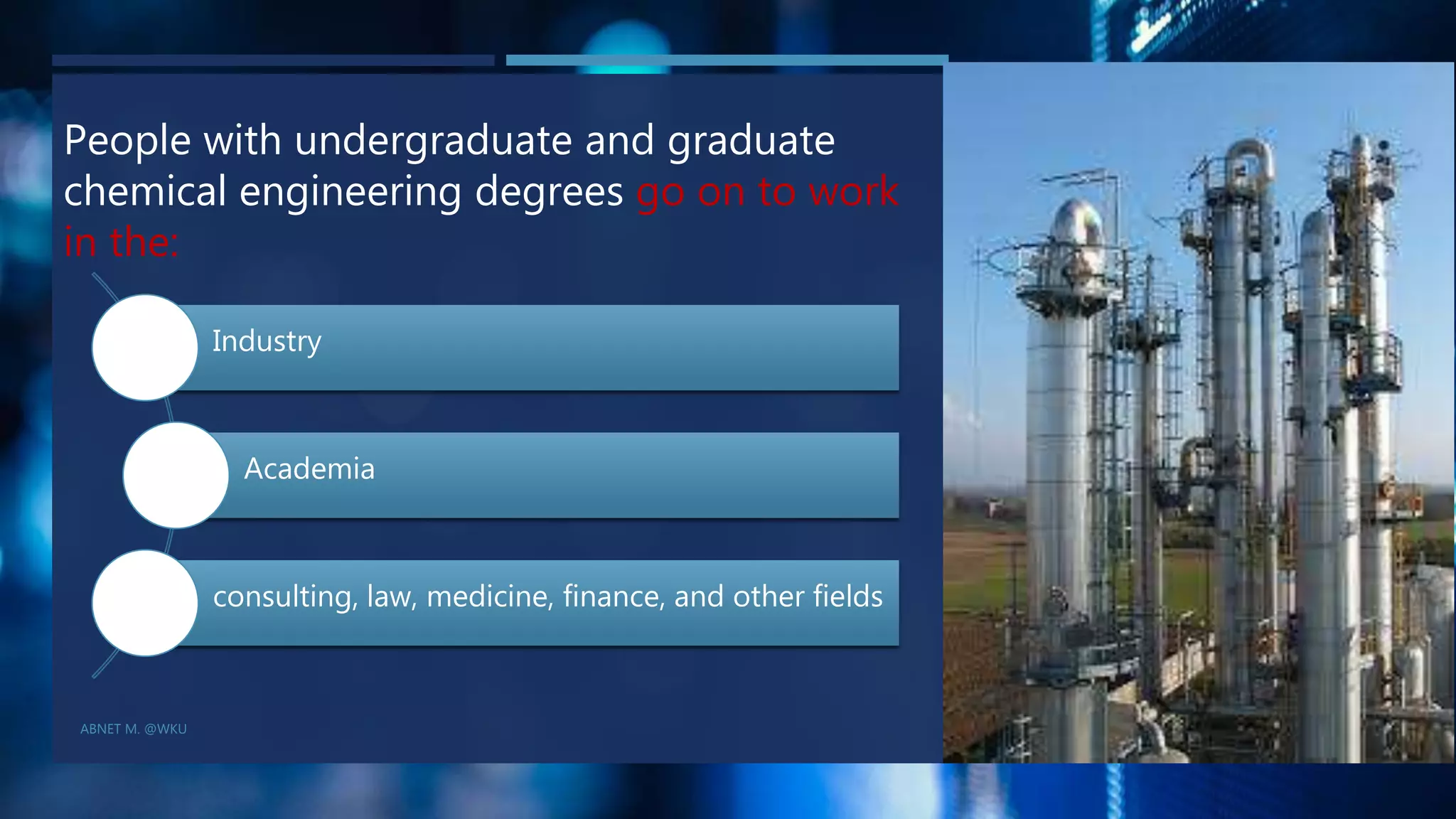
People with undergraduate and graduate
chemical engineering degrees go on to work
in the:
Industry
Academia
consulting, law, medicine, finance, and other fields
ABNET M. @WKU 8
THANK YOU
abnetm817@gmail.com

Chemical engineering.pptx

  • 1.
  • 2.
    WHAT IS CHEMICALENGINEERING? Reaction, Reactor Separations, Transport Jobs ABNET M. @WKU 2
  • 3.
    CONT’D Chemical engineering isa discipline that has an impact on many different sectors of technology. Chemical engineers, in general, devise and design procedures for the manufacture, transformation, and transportation of materials, beginning with laboratory testing and progressing to full-scale manufacturing. ABNET M. @WKU 3
  • 4.
    WHERE DO CHEMICALENGINEERS WORK? ABNET M. @WKU 4 Office Lab
  • 5.
    CONT’D Chemical engineers arein high demand due to the enormous number of sectors that rely on chemical and material synthesis and processing. Chemical engineers have increased prospects in biotechnology, pharmaceuticals, electronic device manufacture, and environmental engineering, in addition to traditional professions in the chemical, energy, and oil industries. ABNET M. @WKU 5
  • 6.
    CONT’D When processes entailthe chemical or physical change of materials, the chemical engineer's specific training becomes critical. ABNET M. @WKU 6
  • 7.
    A CHEMICAL ENGINEERMUST HAVE COMPLETED……. Chemical engineers must have a thorough understanding of both the engineering and scientific ideas that underpin these technological processes. The Chemical Engineering Department's curriculum reflects this, with courses in applied mathematics, thermodynamics, fluid mechanics, energy and mass transfer, separation technologies, chemical reaction kinetics, reactor design, and process design. These classes are based on chemistry, physics, and biology as a basis. ABNET M. @WKU 7
  • 8.
    People with undergraduateand graduate chemical engineering degrees go on to work in the: Industry Academia consulting, law, medicine, finance, and other fields ABNET M. @WKU 8
  • 9.