PRODUCTION 
 Santosh kr. Paswan 
 Roll no 138510 
 ME 3rd year
CONTENTS 
 INTRODUCTION 
 SOURCES OF SUGAR 
 MANUFACTURING PROCESS 
 BY PRODUCTS 
 SUGAR MAP
INTRODUCTION 
 Sugar is an important source of carbohydrate contains no fat or 
cholesterol, 15 calories are contained a tea spoon of it. 
 it is a vital ingredient in most of daily consumption articles. For ex. Cold 
drink, juice, tea, biscuits, sweets, and bakery items etc. 
 India is the largest sugar consumer and second largest producer in the 
world according to foreign agricultural service. 
 Indian sugar industry has total turn over of Rs. 500 billion per annum 
and contributes almost Rs. 22.5 billion to the central and state 
exchequer as taxes and excise duty every according to Ministry of Food 
& Govt. of India. 
 In India according to ISMA 622 sugar industries are established. 
 The sugar industry covers around about 7.5% of total rural population and provides 
employment about 5 lakh people in rural and semi-rural areas.
SOURCES OF SUGAR 
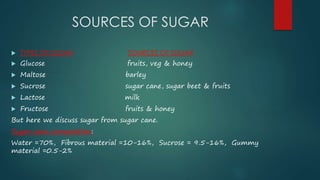
 TYPES OF SUGAR SOURCES OF SUGAR 
 Glucose fruits, veg & honey 
 Maltose barley 
 Sucrose sugar cane, sugar beet & fruits 
 Lactose milk 
 Fructose fruits & honey 
But here we discuss sugar from sugar cane. 
Sugar cane composition: 
Water =70%, Fibrous material =10-16%, Sucrose = 9.5-16%, Gummy 
material =0.5-2%
MANUFACTURING PROCESS 
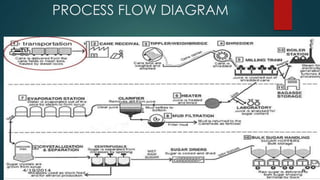
 Harvesting of cane 
 Transport & handling 
 Cutting & shredding 
 Extraction of juice 
 Filtration 
 Evaporation 
 Crystallization 
 Centrifugation 
 Drying and packing 
 Refining of brown sugar
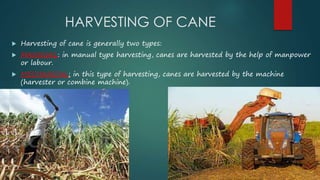
HARVESTING OF CANE 
 Harvesting of cane is generally two types: 
 MANNUAL: in manual type harvesting, canes are harvested by the help of manpower 
or labour. 
 MECHANICAL: in this type of harvesting, canes are harvested by the machine 
(harvester or combine machine).
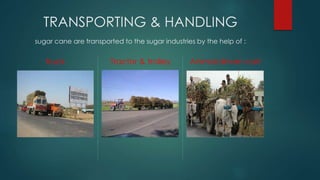
TRANSPORTING & HANDLING 
sugar cane are transported to the sugar industries by the help of : 
truck Tractor & trolley Animal driven cart
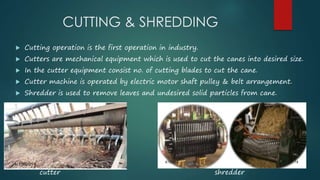
CUTTING & SHREDDING 
 Cutting operation is the first operation in industry. 
 Cutters are mechanical equipment which is used to cut the canes into desired size. 
 In the cutter equipment consist no. of cutting blades to cut the cane. 
 Cutter machine is operated by electric motor shaft pulley & belt arrangement. 
 Shredder is used to remove leaves and undesired solid particles from cane. 
cutter shredder
EXTRACTION OF JUICE 
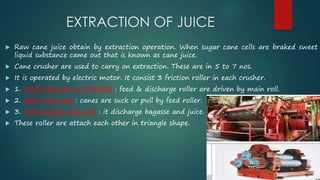
 Raw cane juice obtain by extraction operation. When sugar cane cells are braked sweet 
liquid substance came out that is known as cane juice. 
 Cane crusher are used to carry on extraction. These are in 5 to 7 nos. 
 It is operated by electric motor. It consist 3 friction roller in each crusher. 
 1. MAIN ROLLER or DRIVER : feed & discharge roller are driven by main roll. 
 2. FEED ROLLER : canes are suck or pull by feed roller. 
 3. DISCHARGE ROLLER : it discharge bagasse and juice. 
 These roller are attach each other in triangle shape.
FILTRATION 
Filtration process is the separation of suspended & colloidal particles from raw juice. 
CLARIFICATION: In clarification process sludge, mud, suspended & colloidal particles are 
removes by some chemical compounds. 
 Raw cane juice are filled in clarifier (conical shape vessel), where phosphoric acid, lime & 
sulphur dioxide are mixed with the help of agitator. 
 When these chemicals are mixed, suspended and colloidal particles are collect in flock 
and resulting settled down. 
 Neat and clean juice comes out from the upper section of clarifier, sludge and mud are 
collect in bottom and drainage to rotary filter. 
 Calcium phosphate : as flocculent 
 Lime & SO2 : acts as bleaching agent 
 CO2 : acts as acidifying agent
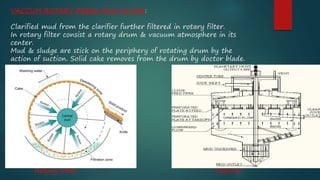
VACCUM ROTARY PRESS MUD FILTER: 
Clarified mud from the clarifier further filtered in rotary filter. 
In rotary filter consist a rotary drum & vacuum atmosphere in its 
center. 
Mud & sludge are stick on the periphery of rotating drum by the 
action of suction. Solid cake removes from the drum by doctor blade. 
Rotary filter Clarifier
EVAPORATION 
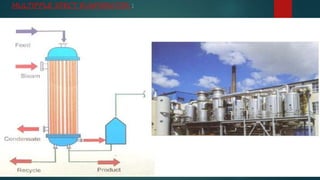
 Evaporation process deals heat and mass transfer operation both. 
 Evaporators are used in process industry to concentrate liquids. 
 The operation is performed normally by use of low pressure, dry & saturated steam. 
 The evaporator consist a heat exchanger in inner section . 
 In the evaporator feed interred at upper section and concentrated thick liquor exit at 
bottom section. 
 Steam used to evaporate juice: 1 liter steam to evaporate 4 liter juice. 
 Steam temperature 113-130 degree Celsius at 1st pan and 55 degree Celsius at last 
pan . 
 Each subsequent vessel with decreasing pressure. 
 Last pan being under almost a total vacuum. 
 Here used 3 to 5 number evaporator known as multiple effect evaporator.
MULTIPPLE EFECT EVAPORATOR :
CRYSTALLIZATION 
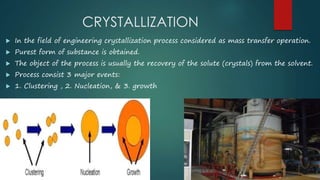
 In the field of engineering crystallization process considered as mass transfer operation. 
 Purest form of substance is obtained. 
 The object of the process is usually the recovery of the solute (crystals) from the solvent. 
 Process consist 3 major events: 
 1. Clustering , 2. Nucleation, & 3. growth
CENTRIFUGATION 
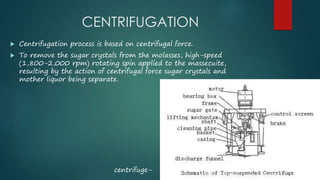
 Centrifugation process is based on centrifugal force. 
 To remove the sugar crystals from the molasses, high-speed 
(1,800-2,000 rpm) rotating spin applied to the massecuite, 
resulting by the action of centrifugal force sugar crystals and 
mother liquor being separate. 
centrifuge-
DRYING & PACKING 
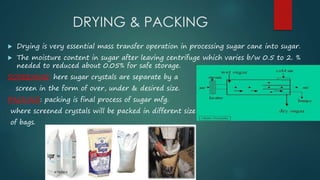
 Drying is very essential mass transfer operation in processing sugar cane into sugar. 
 The moisture content in sugar after leaving centrifuge which varies b/w 0.5 to 2. % 
needed to reduced about 0.05% for safe storage. 
SCREENING: here sugar crystals are separate by a 
screen in the form of over, under & desired size. 
PACKING: packing is final process of sugar mfg. 
where screened crystals will be packed in different size 
of bags.
PROCESS FLOW DIAGRAM
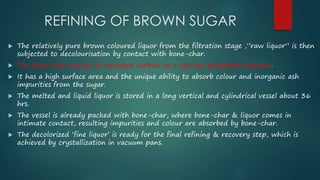
REFINING OF BROWN SUGAR 
 The relatively pure brown coloured liquor from the filtration stage ,”raw liquor” is then 
subjected to decolourisation by contact with bone-char. 
 The bone-char consist of activated carbon on a calcium phosphate skeleton. 
 It has a high surface area and the unique ability to absorb colour and inorganic ash 
impurities from the sugar. 
 The melted and liquid liquor is stored in a long vertical and cylindrical vessel about 36 
hrs. 
 The vessel is already packed with bone-char, where bone-char & liquor comes in 
intimate contact, resulting impurities and colour are absorbed by bone-char. 
 The decolorized ‘fine liquor’ is ready for the final refining & recovery step, which is 
achieved by crystallization in vacuum pans.
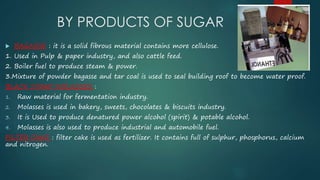
BY PRODUCTS OF SUGAR 
 BAGASSE : it is a solid fibrous material contains more cellulose. 
1. Used in Pulp & paper industry, and also cattle feed. 
2. Boiler fuel to produce steam & power. 
3.Mixture of powder bagasse and tar coal is used to seal building roof to become water proof. 
BLACK STRAP MOLASSES : 
1. Raw material for fermentation industry. 
2. Molasses is used in bakery, sweets, chocolates & biscuits industry. 
3. It is Used to produce denatured power alcohol (spirit) & potable alcohol. 
4. Molasses is also used to produce industrial and automobile fuel. 
FILTER CAKE : filter cake is used as fertilizer. It contains full of sulphur, phosphorus, calcium 
and nitrogen.
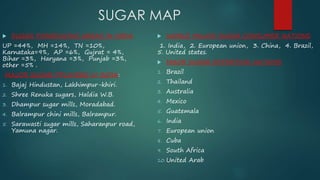
SUGAR MAP 
 SUGAR PORODUCING AREAS IN INDIA 
UP =44%, MH =14%, TN =10%, 
Karnataka=9%, AP =6%, Gujrat = 4%, 
Bihar =3%, Haryana =3%, Punjab =3%, 
other =5% . 
MAJOR SUGAR PPLAYERS IN INDIA: 
1. Bajaj Hindustan, Lakhimpur-khiri. 
2. Shree Renuka sugars, Haldia W.B. 
3. Dhampur sugar mills, Moradabad. 
4. Balrampur chini mills, Balrampur. 
5. Sarawasti sugar mills, Saharanpur road, 
Yamuna nagar. 
 WORLD MAJOR SUGAR CONSUMER NATIONS 
1. India, 2. European union, 3. China, 4. Brazil, 
5. United states. 
 MAOR SUGAR EXPORTING NATIONS 
1. Brazil 
2. Thailand 
3. Australia 
4. Mexico 
5. Guatemala 
6. India 
7. European union 
8. Cuba 
9. South Africa 
10.United Arab
Sugar  production

Sugar production

  • 1.
    PRODUCTION  Santoshkr. Paswan  Roll no 138510  ME 3rd year
  • 2.
    CONTENTS  INTRODUCTION  SOURCES OF SUGAR  MANUFACTURING PROCESS  BY PRODUCTS  SUGAR MAP
  • 3.
    INTRODUCTION  Sugaris an important source of carbohydrate contains no fat or cholesterol, 15 calories are contained a tea spoon of it.  it is a vital ingredient in most of daily consumption articles. For ex. Cold drink, juice, tea, biscuits, sweets, and bakery items etc.  India is the largest sugar consumer and second largest producer in the world according to foreign agricultural service.  Indian sugar industry has total turn over of Rs. 500 billion per annum and contributes almost Rs. 22.5 billion to the central and state exchequer as taxes and excise duty every according to Ministry of Food & Govt. of India.  In India according to ISMA 622 sugar industries are established.  The sugar industry covers around about 7.5% of total rural population and provides employment about 5 lakh people in rural and semi-rural areas.
  • 4.
    SOURCES OF SUGAR  TYPES OF SUGAR SOURCES OF SUGAR  Glucose fruits, veg & honey  Maltose barley  Sucrose sugar cane, sugar beet & fruits  Lactose milk  Fructose fruits & honey But here we discuss sugar from sugar cane. Sugar cane composition: Water =70%, Fibrous material =10-16%, Sucrose = 9.5-16%, Gummy material =0.5-2%
  • 5.
    MANUFACTURING PROCESS Harvesting of cane  Transport & handling  Cutting & shredding  Extraction of juice  Filtration  Evaporation  Crystallization  Centrifugation  Drying and packing  Refining of brown sugar
  • 6.
    HARVESTING OF CANE  Harvesting of cane is generally two types:  MANNUAL: in manual type harvesting, canes are harvested by the help of manpower or labour.  MECHANICAL: in this type of harvesting, canes are harvested by the machine (harvester or combine machine).
  • 7.
    TRANSPORTING & HANDLING sugar cane are transported to the sugar industries by the help of : truck Tractor & trolley Animal driven cart
  • 8.
    CUTTING & SHREDDING  Cutting operation is the first operation in industry.  Cutters are mechanical equipment which is used to cut the canes into desired size.  In the cutter equipment consist no. of cutting blades to cut the cane.  Cutter machine is operated by electric motor shaft pulley & belt arrangement.  Shredder is used to remove leaves and undesired solid particles from cane. cutter shredder
  • 9.
    EXTRACTION OF JUICE  Raw cane juice obtain by extraction operation. When sugar cane cells are braked sweet liquid substance came out that is known as cane juice.  Cane crusher are used to carry on extraction. These are in 5 to 7 nos.  It is operated by electric motor. It consist 3 friction roller in each crusher.  1. MAIN ROLLER or DRIVER : feed & discharge roller are driven by main roll.  2. FEED ROLLER : canes are suck or pull by feed roller.  3. DISCHARGE ROLLER : it discharge bagasse and juice.  These roller are attach each other in triangle shape.
  • 10.
    FILTRATION Filtration processis the separation of suspended & colloidal particles from raw juice. CLARIFICATION: In clarification process sludge, mud, suspended & colloidal particles are removes by some chemical compounds.  Raw cane juice are filled in clarifier (conical shape vessel), where phosphoric acid, lime & sulphur dioxide are mixed with the help of agitator.  When these chemicals are mixed, suspended and colloidal particles are collect in flock and resulting settled down.  Neat and clean juice comes out from the upper section of clarifier, sludge and mud are collect in bottom and drainage to rotary filter.  Calcium phosphate : as flocculent  Lime & SO2 : acts as bleaching agent  CO2 : acts as acidifying agent
  • 11.
    VACCUM ROTARY PRESSMUD FILTER: Clarified mud from the clarifier further filtered in rotary filter. In rotary filter consist a rotary drum & vacuum atmosphere in its center. Mud & sludge are stick on the periphery of rotating drum by the action of suction. Solid cake removes from the drum by doctor blade. Rotary filter Clarifier
  • 12.
    EVAPORATION  Evaporationprocess deals heat and mass transfer operation both.  Evaporators are used in process industry to concentrate liquids.  The operation is performed normally by use of low pressure, dry & saturated steam.  The evaporator consist a heat exchanger in inner section .  In the evaporator feed interred at upper section and concentrated thick liquor exit at bottom section.  Steam used to evaporate juice: 1 liter steam to evaporate 4 liter juice.  Steam temperature 113-130 degree Celsius at 1st pan and 55 degree Celsius at last pan .  Each subsequent vessel with decreasing pressure.  Last pan being under almost a total vacuum.  Here used 3 to 5 number evaporator known as multiple effect evaporator.
  • 13.
  • 14.
    CRYSTALLIZATION  Inthe field of engineering crystallization process considered as mass transfer operation.  Purest form of substance is obtained.  The object of the process is usually the recovery of the solute (crystals) from the solvent.  Process consist 3 major events:  1. Clustering , 2. Nucleation, & 3. growth
  • 15.
    CENTRIFUGATION  Centrifugationprocess is based on centrifugal force.  To remove the sugar crystals from the molasses, high-speed (1,800-2,000 rpm) rotating spin applied to the massecuite, resulting by the action of centrifugal force sugar crystals and mother liquor being separate. centrifuge-
  • 16.
    DRYING & PACKING  Drying is very essential mass transfer operation in processing sugar cane into sugar.  The moisture content in sugar after leaving centrifuge which varies b/w 0.5 to 2. % needed to reduced about 0.05% for safe storage. SCREENING: here sugar crystals are separate by a screen in the form of over, under & desired size. PACKING: packing is final process of sugar mfg. where screened crystals will be packed in different size of bags.
  • 17.
  • 18.
    REFINING OF BROWNSUGAR  The relatively pure brown coloured liquor from the filtration stage ,”raw liquor” is then subjected to decolourisation by contact with bone-char.  The bone-char consist of activated carbon on a calcium phosphate skeleton.  It has a high surface area and the unique ability to absorb colour and inorganic ash impurities from the sugar.  The melted and liquid liquor is stored in a long vertical and cylindrical vessel about 36 hrs.  The vessel is already packed with bone-char, where bone-char & liquor comes in intimate contact, resulting impurities and colour are absorbed by bone-char.  The decolorized ‘fine liquor’ is ready for the final refining & recovery step, which is achieved by crystallization in vacuum pans.
  • 19.
    BY PRODUCTS OFSUGAR  BAGASSE : it is a solid fibrous material contains more cellulose. 1. Used in Pulp & paper industry, and also cattle feed. 2. Boiler fuel to produce steam & power. 3.Mixture of powder bagasse and tar coal is used to seal building roof to become water proof. BLACK STRAP MOLASSES : 1. Raw material for fermentation industry. 2. Molasses is used in bakery, sweets, chocolates & biscuits industry. 3. It is Used to produce denatured power alcohol (spirit) & potable alcohol. 4. Molasses is also used to produce industrial and automobile fuel. FILTER CAKE : filter cake is used as fertilizer. It contains full of sulphur, phosphorus, calcium and nitrogen.
  • 20.
    SUGAR MAP SUGAR PORODUCING AREAS IN INDIA UP =44%, MH =14%, TN =10%, Karnataka=9%, AP =6%, Gujrat = 4%, Bihar =3%, Haryana =3%, Punjab =3%, other =5% . MAJOR SUGAR PPLAYERS IN INDIA: 1. Bajaj Hindustan, Lakhimpur-khiri. 2. Shree Renuka sugars, Haldia W.B. 3. Dhampur sugar mills, Moradabad. 4. Balrampur chini mills, Balrampur. 5. Sarawasti sugar mills, Saharanpur road, Yamuna nagar.  WORLD MAJOR SUGAR CONSUMER NATIONS 1. India, 2. European union, 3. China, 4. Brazil, 5. United states.  MAOR SUGAR EXPORTING NATIONS 1. Brazil 2. Thailand 3. Australia 4. Mexico 5. Guatemala 6. India 7. European union 8. Cuba 9. South Africa 10.United Arab