CONSERVATION OF
ENERGY IN SUGAR
INDUSTRIES
Manohar Tatwawadi
total output power solutions
10/08/2019 total output power solutions 1
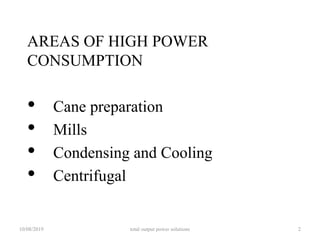
AREAS OF HIGH POWER
CONSUMPTION
• Cane preparation
• Mills
• Condensing and Cooling
• Centrifugal
10/08/2019 total output power solutions 2
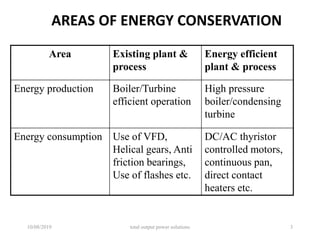
AREAS OF ENERGY CONSERVATION
Area Existing plant &
process
Energy efficient
plant & process
Energy production Boiler/Turbine
efficient operation
High pressure
boiler/condensing
turbine
Energy consumption Use of VFD,
Helical gears, Anti
friction bearings,
Use of flashes etc.
DC/AC thyristor
controlled motors,
continuous pan,
direct contact
heaters etc.
10/08/2019 total output power solutions 3
ENERGY CONSERVATION POTENTIAL IN
SUGAR INDUSTRY
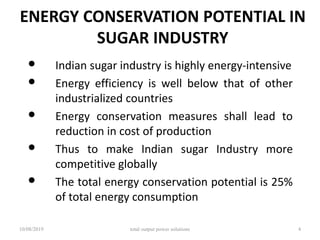
• Indian sugar industry is highly energy-intensive
• Energy efficiency is well below that of other
industrialized countries
• Energy conservation measures shall lead to
reduction in cost of production
• Thus to make Indian sugar Industry more
competitive globally
• The total energy conservation potential is 25%
of total energy consumption
10/08/2019 total output power solutions 4
POTENTIAL FOR REDUCTION IN
STEAM CONSUMPTION
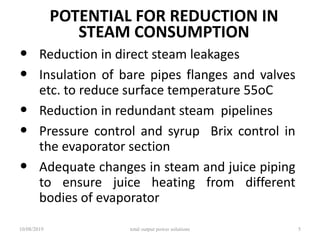
• Reduction in direct steam leakages
• Insulation of bare pipes flanges and valves
etc. to reduce surface temperature 55oC
• Reduction in redundant steam pipelines
• Pressure control and syrup Brix control in
the evaporator section
• Adequate changes in steam and juice piping
to ensure juice heating from different
bodies of evaporator
10/08/2019 total output power solutions 5
POTENTIAL FOR REDUCTION IN
STEAM CONSUMPTION
• Application of continuous crystallizers for A B
& C massecuites and continuous centrifugals
for B & C curing, high gravity/high capacity
batch centrifugals for a curing etc.
• Improved instrumentation and control for
pressure and temperature of exhaust steam
required for process
• Rationalization of operations of minimize
fluctuations in steam demand
10/08/2019 total output power solutions 6
MAJOR ENERGY EFFICIENCY
IMPROVEMENT AREAS IN SUGAR
INDUSTRY
• CANE MILLING
• STEAM GENERATION
• POWER GENERATION
• SUGAR PROCESSING
• LIGHTING SYSTEM
• CO-GENERATION
10/08/2019 total output power solutions 7
CANE MILLING
• Use of antifriction bearings at head and tail
shafts of cane carrier and mill transmission
gears
• Use of HT motors for cane cutter and fibrizer
• Use of VFD at cane carriers, rake carriers
• Use of high efficiency planetary gear drive
• Use of hydraulic motor and AC VFD for mill
drive
10/08/2019 total output power solutions 8
CANE MILLING
• Use of belt conveyor in place of chain and
slat conveyor
• Optimization of imbibition percent
• Adoption of complete mill house automation
• Proper planning to decrease stoppages
/reduce crushing situation due to shortage of
cane
10/08/2019 total output power solutions 9
STEAM GENERATION
• By adopting high efficiency boilers, steam
generation to fuel ratio can be increased
• Reduction in specific steam consumption by
adopting high pressure and high
temperature boilers
• Recovery of heat from flue gas by using
bagasse dryer
• Use of VFD for ID and FD fans
• Use of HP/LP heater for boiler feed water to
increase cycle efficiency
10/08/2019 total output power solutions 10
STEAM GENERATION
• Recovery of heat from blowdown
• The amount of blowdown should be
minimized
• Add waste heat recovery unit to blowdown
for flash steam generation
• Adoption of complete combustion
• Control on excess air supply
10/08/2019 total output power solutions 11
EFFICIENT BOILER OPERATION
• It may means to reduce the heat losses to minimum
so as to increase the efficiency of boiler
• HEAT LOSSES
1. Heat loss in flue gas
2. Heat loss due to moisture in bagasse
3. Heat loss due to Hydrogen present in bagasse
4. Heat loss due to blowdown
5. Heat loss due to radiation/convection
6. Heat loss due to bad combustion of Carbon
7. Losses in unburned solids
10/08/2019 total output power solutions 12
REDUCE STACK TEMPERATURE
• Stack temperature greater than 170 deg. C
indicates potential for recovery of waste heat
• Use of bagasse dryer
• 22deg.C reduction in flue gas temperature
increase boiler efficiency by 1% and reduces
fuel consumption by 1.2%.
10/08/2019 total output power solutions 13
COMBUSTION AIR HEATING
• The rise in combustion air temperature
by 20deg.C will improve thermal
efficiency by 1%
• Similarly improved combustion air temp
will cause reduction in unburnts in
Bottom ash and fly ash can improve the
combustion efficiency and thereby
reduction in fuel.
10/08/2019 total output power solutions 14
INCOMPLETE COMBUSTION
IT MAY BE DUE TO FOLLOWING REASONS
• Shortage of excess air
• Excess of fuel supply
• Poor distribution of fuel
• Furnace air ingress.
10/08/2019 total output power solutions 15
CONTROL ON EXCESS AIR
• The optimum excess air level varies
with furnace design, type of fuel
and process variables
• Excess air % theoretical air should
not exceed to 35%
• For every 1% reduction in excess
air, 0.6% rise in boiler efficiency
10/08/2019 total output power solutions 16
RADIATION AND CONVECTION
HEAT LOSS
• The surfaces lose heat to the
surroundings depending on surface area
and the difference in temperature
between the surface and surroundings
• With modern design boiler this loss may
represent only 1.5% on GCV
• Frequent checks for the heat insulation
can check these losses.
10/08/2019 total output power solutions 17
BLOWDOWN HEAT LOSS
• This loss varies between 1% to 6% and
depends on number of factors
• Total dissolved solids (TDS) allowable in
boiler water
• Quality of makeup water
• Amount of uncontaminated condensate
return
• Boiler load variations
• Correct checking and maintenance of feed
water and boiler water quality, maximising
condensate return and smoothing load
swings will minimise the loss10/08/2019 total output power solutions 18
BLOWDOWN HEAT RECOVERY
• Blowdown of boilers to reduce sludge and
solids contents allows heat to go down the
drain
• The amount of blowdown should be minimised
by allowing a good water treatment program
• Installation of a heat recovery unit (heat
exchanger) in the blowdown line allows the
waste heat to be used in preheating make up
and feed water
10/08/2019 total output power solutions 19
AUTOMATIC BLOWDOWN CONTROL
• Uncontrolled continuous blowdown is
very wasteful
• Automatic blowdown control can be
installed that sense and respond to
boiler water conductivity and pH
10/08/2019 total output power solutions 20
REDUCTION OF SCALING AND SOOT
LOSSES
• Soot build up on tubes acts as an insulator
against heat transfer. Any such deposits
should be removed on a regular basis.
Elevated stack temperature may indicate
excessive soot build up. Also same results will
occur due to scaling on the water side.
• A 1mm thick scale on water side could
increase fuel consumption by 5 to 8%
10/08/2019 total output power solutions 21
REDUCTION OF SCALING AND SOOT
LOSSES
• Stack temperature should be checked and
recorded regularly as an indicator of soot
deposits.
• Every millimeter thickness of soot coating
increases the stack temperature by about 55
deg.C
• 3mm of soot thickness can cause an increase
in fuel consumption by 2.5%
10/08/2019 total output power solutions 22
SUGAR PROCESSING
•Optimization of evaporator design to minimize
exhaust steam needs and maximize vapor
bleeding
•Optimization of syrup Brix
•Stepwise recovery of flash heat from the
condensate of evaporator, juice heaters and
pans
•Use of first condensate for wash water heating
at centrifugals.
•Recovery of waste heat from clarifier flash tank
•Selective incorporation of direct contact heater
•Use of continuous pans for massecuite boiling10/08/2019 total output power solutions 23
SUGAR PROCESSING
•Seed sugar melting by using syrup and very low
temperature vapour in place of exhaust steam
and hot water
•Use of efficient heat exchanger
•Elimination of direct live steam bleeding in
process
•Adoption of process automation and controls
•Discouraging production of bold grain
•Use of low temperature vapour for pan washing
•Heating of air by hot condensate at sugar dryer /
hopper
•Recovery of heat from non condensable gases
10/08/2019 total output power solutions 24
USE OF PLANETARY GEAR DRIVE
• Transmission efficiency is about 90%
• Combined efficiency of conventional
worm and worm wheel with enclosed
worm gear box is hardly 40-50%
10/08/2019 total output power solutions 25
HELICAL GEAR DRIVE
• The efficiency of helical gear drive is
approx. 96-97%
• The efficiency of worm gear box is 70-
80%
10/08/2019 total output power solutions 26
LIGHTING SYSTEM
• Make maximum use of natural light (Use of
translucent sheets / more windows and
opening)
• Switch off when not required
• Modify lighting layout to meet the need
• Provide lighting transformer to operate at
reduced Voltage
• Install energy efficient lamps, luminaries and
controls
10/08/2019 total output power solutions 27
LIGHTING SYSTEM
• Use of gas discharge lamps in place of
incandescent lamps
• Use of Compact Fluorescent lamps (CFL)
• Use of Metal Halide lamps in place of
Mercury/Sodium lamps
• Use of Energy Efficient lights, LED lights etc…
10/08/2019 total output power solutions 28
CO-GENERATION
• Sequential production of process heat and
electricity to export with same fuel is
termed as co-generation
• In sugar industry the co-generation is of
TOPPING CYCLE
• TOPPING CYCLE
The steam generated is fed to the turbo
generator and extracted at desired pressure
for process work
10/08/2019 total output power solutions 29
BENEFITS OF CO-GENERATION
• The fuel, bagasse is renewable source of
energy
• The sugar industry generates additional
power with the bagasse which is used for
generation of steam to meet process
requirements
• Results in reduced emission levels and
global warming and is therefore
environment friendly
10/08/2019 total output power solutions 30
BENEFITS OF CO-GENERATION
• Ensure fuel security
• Co-generation project leads to reduction in
transmission losses considerably and thus
helps in stabilizing the grid voltage because
of their proximity to the load centres
10/08/2019 total output power solutions 31
ENERGY EFFICIENCY IMPROVEMENT
• The system upgradation in the entire sugar
manufacturing process for improved energy
efficiency goes for maximizing exportable power
from co-generation plant
• Energy efficiency improvement and energy
conservation is of great importance for making the
co-generation project viable and sustainable in the
long run.
• Implementing energy conservation measures in
respect of both steam and electricity will reduce
captive consumption and help to save additional
quantity of bagasse/electricity.
10/08/2019 total output power solutions 32
TURBINE COFIGURATIONS FOR CO-
GENERATION
• Pure back pressure turbine
• Single extraction back pressure turbine
• Double extraction back pressure turbine
• Pure condensing turbine
• Single extraction condensing turbine
• Double extraction condensing turbine
10/08/2019 total output power solutions 33
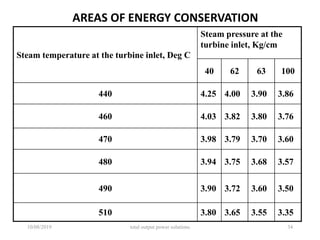
AREAS OF ENERGY CONSERVATION
Steam temperature at the turbine inlet, Deg C
Steam pressure at the
turbine inlet, Kg/cm
40 62 63 100
440 4.25 4.00 3.90 3.86
460 4.03 3.82 3.80 3.76
470 3.98 3.79 3.70 3.60
480 3.94 3.75 3.68 3.57
490 3.90 3.72 3.60 3.50
510 3.80 3.65 3.55 3.35
10/08/2019 total output power solutions 34
RENEWABLE ENERGY
Renewable can create a significant impact in electric
power generation.
Indian Renewable energy programme is the largest
and most extensive among the developing country.
Ministry of Non-conventional energy the nodal
Ministry of the Govt. is entrusted with responsibility of
policy making, planning, information and co-
ordination of various aspects of renewable energy. As
per their draft policy set up for the goal is to be
achieved till 2019 an addition of 10% share I.e. 18000
MW through renewable.
10/08/2019 total output power solutions 35
RENEWABLE ENERGY SOURCES
• Co-generation from bagasse
• Supplementary fuel such as cane trashes,
wood chips, rice husk and other biomass
material
• Hydro-power
• Wind power
• Sea tides
• Pelamis wave power
10/08/2019 total output power solutions 36
10/08/2019 total output power solutions 37

Energy Conservation in Sugar Industry

  • 1.
    CONSERVATION OF ENERGY INSUGAR INDUSTRIES Manohar Tatwawadi total output power solutions 10/08/2019 total output power solutions 1
  • 2.
    AREAS OF HIGHPOWER CONSUMPTION • Cane preparation • Mills • Condensing and Cooling • Centrifugal 10/08/2019 total output power solutions 2
  • 3.
    AREAS OF ENERGYCONSERVATION Area Existing plant & process Energy efficient plant & process Energy production Boiler/Turbine efficient operation High pressure boiler/condensing turbine Energy consumption Use of VFD, Helical gears, Anti friction bearings, Use of flashes etc. DC/AC thyristor controlled motors, continuous pan, direct contact heaters etc. 10/08/2019 total output power solutions 3
  • 4.
    ENERGY CONSERVATION POTENTIALIN SUGAR INDUSTRY • Indian sugar industry is highly energy-intensive • Energy efficiency is well below that of other industrialized countries • Energy conservation measures shall lead to reduction in cost of production • Thus to make Indian sugar Industry more competitive globally • The total energy conservation potential is 25% of total energy consumption 10/08/2019 total output power solutions 4
  • 5.
    POTENTIAL FOR REDUCTIONIN STEAM CONSUMPTION • Reduction in direct steam leakages • Insulation of bare pipes flanges and valves etc. to reduce surface temperature 55oC • Reduction in redundant steam pipelines • Pressure control and syrup Brix control in the evaporator section • Adequate changes in steam and juice piping to ensure juice heating from different bodies of evaporator 10/08/2019 total output power solutions 5
  • 6.
    POTENTIAL FOR REDUCTIONIN STEAM CONSUMPTION • Application of continuous crystallizers for A B & C massecuites and continuous centrifugals for B & C curing, high gravity/high capacity batch centrifugals for a curing etc. • Improved instrumentation and control for pressure and temperature of exhaust steam required for process • Rationalization of operations of minimize fluctuations in steam demand 10/08/2019 total output power solutions 6
  • 7.
    MAJOR ENERGY EFFICIENCY IMPROVEMENTAREAS IN SUGAR INDUSTRY • CANE MILLING • STEAM GENERATION • POWER GENERATION • SUGAR PROCESSING • LIGHTING SYSTEM • CO-GENERATION 10/08/2019 total output power solutions 7
  • 8.
    CANE MILLING • Useof antifriction bearings at head and tail shafts of cane carrier and mill transmission gears • Use of HT motors for cane cutter and fibrizer • Use of VFD at cane carriers, rake carriers • Use of high efficiency planetary gear drive • Use of hydraulic motor and AC VFD for mill drive 10/08/2019 total output power solutions 8
  • 9.
    CANE MILLING • Useof belt conveyor in place of chain and slat conveyor • Optimization of imbibition percent • Adoption of complete mill house automation • Proper planning to decrease stoppages /reduce crushing situation due to shortage of cane 10/08/2019 total output power solutions 9
  • 10.
    STEAM GENERATION • Byadopting high efficiency boilers, steam generation to fuel ratio can be increased • Reduction in specific steam consumption by adopting high pressure and high temperature boilers • Recovery of heat from flue gas by using bagasse dryer • Use of VFD for ID and FD fans • Use of HP/LP heater for boiler feed water to increase cycle efficiency 10/08/2019 total output power solutions 10
  • 11.
    STEAM GENERATION • Recoveryof heat from blowdown • The amount of blowdown should be minimized • Add waste heat recovery unit to blowdown for flash steam generation • Adoption of complete combustion • Control on excess air supply 10/08/2019 total output power solutions 11
  • 12.
    EFFICIENT BOILER OPERATION •It may means to reduce the heat losses to minimum so as to increase the efficiency of boiler • HEAT LOSSES 1. Heat loss in flue gas 2. Heat loss due to moisture in bagasse 3. Heat loss due to Hydrogen present in bagasse 4. Heat loss due to blowdown 5. Heat loss due to radiation/convection 6. Heat loss due to bad combustion of Carbon 7. Losses in unburned solids 10/08/2019 total output power solutions 12
  • 13.
    REDUCE STACK TEMPERATURE •Stack temperature greater than 170 deg. C indicates potential for recovery of waste heat • Use of bagasse dryer • 22deg.C reduction in flue gas temperature increase boiler efficiency by 1% and reduces fuel consumption by 1.2%. 10/08/2019 total output power solutions 13
  • 14.
    COMBUSTION AIR HEATING •The rise in combustion air temperature by 20deg.C will improve thermal efficiency by 1% • Similarly improved combustion air temp will cause reduction in unburnts in Bottom ash and fly ash can improve the combustion efficiency and thereby reduction in fuel. 10/08/2019 total output power solutions 14
  • 15.
    INCOMPLETE COMBUSTION IT MAYBE DUE TO FOLLOWING REASONS • Shortage of excess air • Excess of fuel supply • Poor distribution of fuel • Furnace air ingress. 10/08/2019 total output power solutions 15
  • 16.
    CONTROL ON EXCESSAIR • The optimum excess air level varies with furnace design, type of fuel and process variables • Excess air % theoretical air should not exceed to 35% • For every 1% reduction in excess air, 0.6% rise in boiler efficiency 10/08/2019 total output power solutions 16
  • 17.
    RADIATION AND CONVECTION HEATLOSS • The surfaces lose heat to the surroundings depending on surface area and the difference in temperature between the surface and surroundings • With modern design boiler this loss may represent only 1.5% on GCV • Frequent checks for the heat insulation can check these losses. 10/08/2019 total output power solutions 17
  • 18.
    BLOWDOWN HEAT LOSS •This loss varies between 1% to 6% and depends on number of factors • Total dissolved solids (TDS) allowable in boiler water • Quality of makeup water • Amount of uncontaminated condensate return • Boiler load variations • Correct checking and maintenance of feed water and boiler water quality, maximising condensate return and smoothing load swings will minimise the loss10/08/2019 total output power solutions 18
  • 19.
    BLOWDOWN HEAT RECOVERY •Blowdown of boilers to reduce sludge and solids contents allows heat to go down the drain • The amount of blowdown should be minimised by allowing a good water treatment program • Installation of a heat recovery unit (heat exchanger) in the blowdown line allows the waste heat to be used in preheating make up and feed water 10/08/2019 total output power solutions 19
  • 20.
    AUTOMATIC BLOWDOWN CONTROL •Uncontrolled continuous blowdown is very wasteful • Automatic blowdown control can be installed that sense and respond to boiler water conductivity and pH 10/08/2019 total output power solutions 20
  • 21.
    REDUCTION OF SCALINGAND SOOT LOSSES • Soot build up on tubes acts as an insulator against heat transfer. Any such deposits should be removed on a regular basis. Elevated stack temperature may indicate excessive soot build up. Also same results will occur due to scaling on the water side. • A 1mm thick scale on water side could increase fuel consumption by 5 to 8% 10/08/2019 total output power solutions 21
  • 22.
    REDUCTION OF SCALINGAND SOOT LOSSES • Stack temperature should be checked and recorded regularly as an indicator of soot deposits. • Every millimeter thickness of soot coating increases the stack temperature by about 55 deg.C • 3mm of soot thickness can cause an increase in fuel consumption by 2.5% 10/08/2019 total output power solutions 22
  • 23.
    SUGAR PROCESSING •Optimization ofevaporator design to minimize exhaust steam needs and maximize vapor bleeding •Optimization of syrup Brix •Stepwise recovery of flash heat from the condensate of evaporator, juice heaters and pans •Use of first condensate for wash water heating at centrifugals. •Recovery of waste heat from clarifier flash tank •Selective incorporation of direct contact heater •Use of continuous pans for massecuite boiling10/08/2019 total output power solutions 23
  • 24.
    SUGAR PROCESSING •Seed sugarmelting by using syrup and very low temperature vapour in place of exhaust steam and hot water •Use of efficient heat exchanger •Elimination of direct live steam bleeding in process •Adoption of process automation and controls •Discouraging production of bold grain •Use of low temperature vapour for pan washing •Heating of air by hot condensate at sugar dryer / hopper •Recovery of heat from non condensable gases 10/08/2019 total output power solutions 24
  • 25.
    USE OF PLANETARYGEAR DRIVE • Transmission efficiency is about 90% • Combined efficiency of conventional worm and worm wheel with enclosed worm gear box is hardly 40-50% 10/08/2019 total output power solutions 25
  • 26.
    HELICAL GEAR DRIVE •The efficiency of helical gear drive is approx. 96-97% • The efficiency of worm gear box is 70- 80% 10/08/2019 total output power solutions 26
  • 27.
    LIGHTING SYSTEM • Makemaximum use of natural light (Use of translucent sheets / more windows and opening) • Switch off when not required • Modify lighting layout to meet the need • Provide lighting transformer to operate at reduced Voltage • Install energy efficient lamps, luminaries and controls 10/08/2019 total output power solutions 27
  • 28.
    LIGHTING SYSTEM • Useof gas discharge lamps in place of incandescent lamps • Use of Compact Fluorescent lamps (CFL) • Use of Metal Halide lamps in place of Mercury/Sodium lamps • Use of Energy Efficient lights, LED lights etc… 10/08/2019 total output power solutions 28
  • 29.
    CO-GENERATION • Sequential productionof process heat and electricity to export with same fuel is termed as co-generation • In sugar industry the co-generation is of TOPPING CYCLE • TOPPING CYCLE The steam generated is fed to the turbo generator and extracted at desired pressure for process work 10/08/2019 total output power solutions 29
  • 30.
    BENEFITS OF CO-GENERATION •The fuel, bagasse is renewable source of energy • The sugar industry generates additional power with the bagasse which is used for generation of steam to meet process requirements • Results in reduced emission levels and global warming and is therefore environment friendly 10/08/2019 total output power solutions 30
  • 31.
    BENEFITS OF CO-GENERATION •Ensure fuel security • Co-generation project leads to reduction in transmission losses considerably and thus helps in stabilizing the grid voltage because of their proximity to the load centres 10/08/2019 total output power solutions 31
  • 32.
    ENERGY EFFICIENCY IMPROVEMENT •The system upgradation in the entire sugar manufacturing process for improved energy efficiency goes for maximizing exportable power from co-generation plant • Energy efficiency improvement and energy conservation is of great importance for making the co-generation project viable and sustainable in the long run. • Implementing energy conservation measures in respect of both steam and electricity will reduce captive consumption and help to save additional quantity of bagasse/electricity. 10/08/2019 total output power solutions 32
  • 33.
    TURBINE COFIGURATIONS FORCO- GENERATION • Pure back pressure turbine • Single extraction back pressure turbine • Double extraction back pressure turbine • Pure condensing turbine • Single extraction condensing turbine • Double extraction condensing turbine 10/08/2019 total output power solutions 33
  • 34.
    AREAS OF ENERGYCONSERVATION Steam temperature at the turbine inlet, Deg C Steam pressure at the turbine inlet, Kg/cm 40 62 63 100 440 4.25 4.00 3.90 3.86 460 4.03 3.82 3.80 3.76 470 3.98 3.79 3.70 3.60 480 3.94 3.75 3.68 3.57 490 3.90 3.72 3.60 3.50 510 3.80 3.65 3.55 3.35 10/08/2019 total output power solutions 34
  • 35.
    RENEWABLE ENERGY Renewable cancreate a significant impact in electric power generation. Indian Renewable energy programme is the largest and most extensive among the developing country. Ministry of Non-conventional energy the nodal Ministry of the Govt. is entrusted with responsibility of policy making, planning, information and co- ordination of various aspects of renewable energy. As per their draft policy set up for the goal is to be achieved till 2019 an addition of 10% share I.e. 18000 MW through renewable. 10/08/2019 total output power solutions 35
  • 36.
    RENEWABLE ENERGY SOURCES •Co-generation from bagasse • Supplementary fuel such as cane trashes, wood chips, rice husk and other biomass material • Hydro-power • Wind power • Sea tides • Pelamis wave power 10/08/2019 total output power solutions 36
  • 37.
    10/08/2019 total outputpower solutions 37