In the respect of Sir Hira lal Soni
GROUP MEMBERS
 Junaid korai 14CH03
 Imtiaz Bhurt 14CH17
 Faisal Bhangwar 14CH30
 Abdul Haseeb 14CH34
 Muhammad Saleh 14CH41
 Abdullah Gopang 14CH51
Instrumentation in sugar industry
 Instrumentation is the art and science of
measurement and control of process variables within a
production or manufacturing area. The process
variables used in industries are Level, Pressure,
Temperature, Humidity, Flow, pH, Force, Speed etc.
 When a device is designed to perform without the
need of human inputs for correction it is called
automatic control
Goal Instrumentation
 Instrumentation and control engineers works with the
goal of improving.
 Productivity,
 Optimization,
 Stability,
 Reliability,
 Safety,
 Continuity.
Sensors
 Sensor measure the physical quantity and converts
into signal which can be observed by observer or by an
instrument.
 E.g, thermocouple measure the temperature and
converts it into the voltage which can be observed by
voltmeter.
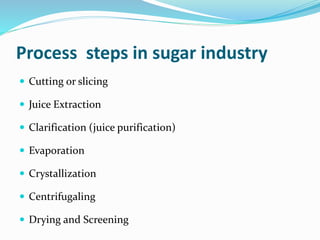
Process steps in sugar industry
 Cutting or slicing
 Juice Extraction
 Clarification (juice purification)
 Evaporation
 Crystallization
 Centrifugaling
 Drying and Screening
CUTTING or SLICING
 The cane is cut into small pieces.
 Here, We control the flow rate of cane towards the cutter
& the size of pieces.
 & the flow rate is depend upon capacity of the cutter.
Juice extraction
 Here the juice is extracted from sugar cane
 Juice extraction is the process of squeezing the juice
from the cane under a set mills using high pressure
between heavy iron rollers. Those mills can have from
3 up to 6 rolls.
 Before , entering in the rollers there is electric
magnetic drum which removes the metallic parts
present in raw material.
Juice extraction
 Its actioning is provided by steam turbines , electric
motors or hydraulic devices.
Juice extraction
 During grinding, hot water is sprayed on to the
sugarcane to dissolve any remaining hard sugar. The
smaller pieces of cane are then spread out on a
conveyer belt.
Roller Mill
Juice clarification
 In juice clarification tank , a PH detector is fitted
which measure the PH of the juice .
 Sugar cane juice has a pH of about 4.0 to 4.5 which is
quite acidic. Calcium hydroxide, also known as Milk of
lime or limewater, is added to the cane juice to adjust
its pH to 7.
 Here the Controlling Variable is PH maintaing.
PH measuring methods
 Measuring PH by using indicator.
 Hydrogen electrode method.
 Semi-conductor sensor method.
 PH imaging.
PH Meter
Juice clarification
Evaporator
• Generally the evaporators are used to remove the
water percentage from the Juice,
• three vacuum-boiling cells or bodies are arranged in
series so that each succeeding body has a higher
vacuum (and therefore boils at a lower temperature).
• The syrup leaves the last body continuously with about
65 percent solids and 35 percent water.
Controlling variable in Evaporator
 The controlling variable in Evaporator are
 Feed flow rate
 Concentration (composition)
 Temperature
 Steam flow rate
Evaporator
Crystallization & Centrifuging
 This syrup is further concentrated under vacuum in a
vacuum boiling pan until it becomes supersaturated.
 This method boils the sugar liquors in three stages,
called A-, B- and C-.
 The mother liquor from the first crystallization step
(A-product) is again crystallized in vacuum pans and
then passed through continuous sugar centrifuges
Crystallization & Centrifuging
 The mother-liquor is again crystallized in vacuum
pans for sufficient to exhaust molasses (called
massecuite).
 Then the massecuite is re-heated in order to reduce its
viscosity and then purged in the C-produced
centrifugals.
 The remaining mixture is a thick mass of large crystals,
which is sent to a centrifuge to spin and dry the
crystals. The dried product is raw sugar
Controlling Variables
 Feed controlling
 Brix Value
 Concentration (Composition)
 Temperature
Dryer
 Dryer removes the Moisture content from sugar
Granulators.
 Controlling variables are
 Feed flow rate,
 Hot air flow rate,
 Moisture
Dryer
Screening
 Here the sieve separates the regular and irregular
granulators.
 The irregular crystals are recycled to the Crystallizer.
 Regular crystals go towards to the Packing section
Solid level measuring sensors
 Vibrating point level sensors
 Ultrasonic level sensors.
 Laser sensors
 Load cell
 Radar sensors
 Microwave level sensors
 float level sensors
 optical level sensors
Process control in sugar industry

Process control in sugar industry

  • 1.
    In the respectof Sir Hira lal Soni
  • 2.
    GROUP MEMBERS  Junaidkorai 14CH03  Imtiaz Bhurt 14CH17  Faisal Bhangwar 14CH30  Abdul Haseeb 14CH34  Muhammad Saleh 14CH41  Abdullah Gopang 14CH51
  • 3.
    Instrumentation in sugarindustry  Instrumentation is the art and science of measurement and control of process variables within a production or manufacturing area. The process variables used in industries are Level, Pressure, Temperature, Humidity, Flow, pH, Force, Speed etc.  When a device is designed to perform without the need of human inputs for correction it is called automatic control
  • 4.
    Goal Instrumentation  Instrumentationand control engineers works with the goal of improving.  Productivity,  Optimization,  Stability,  Reliability,  Safety,  Continuity.
  • 5.
    Sensors  Sensor measurethe physical quantity and converts into signal which can be observed by observer or by an instrument.  E.g, thermocouple measure the temperature and converts it into the voltage which can be observed by voltmeter.
  • 6.
    Process steps insugar industry  Cutting or slicing  Juice Extraction  Clarification (juice purification)  Evaporation  Crystallization  Centrifugaling  Drying and Screening
  • 7.
    CUTTING or SLICING The cane is cut into small pieces.  Here, We control the flow rate of cane towards the cutter & the size of pieces.  & the flow rate is depend upon capacity of the cutter.
  • 9.
    Juice extraction  Herethe juice is extracted from sugar cane  Juice extraction is the process of squeezing the juice from the cane under a set mills using high pressure between heavy iron rollers. Those mills can have from 3 up to 6 rolls.  Before , entering in the rollers there is electric magnetic drum which removes the metallic parts present in raw material.
  • 10.
    Juice extraction  Itsactioning is provided by steam turbines , electric motors or hydraulic devices.
  • 11.
    Juice extraction  Duringgrinding, hot water is sprayed on to the sugarcane to dissolve any remaining hard sugar. The smaller pieces of cane are then spread out on a conveyer belt.
  • 12.
  • 13.
    Juice clarification  Injuice clarification tank , a PH detector is fitted which measure the PH of the juice .  Sugar cane juice has a pH of about 4.0 to 4.5 which is quite acidic. Calcium hydroxide, also known as Milk of lime or limewater, is added to the cane juice to adjust its pH to 7.  Here the Controlling Variable is PH maintaing.
  • 14.
    PH measuring methods Measuring PH by using indicator.  Hydrogen electrode method.  Semi-conductor sensor method.  PH imaging.
  • 15.
  • 16.
  • 17.
    Evaporator • Generally theevaporators are used to remove the water percentage from the Juice, • three vacuum-boiling cells or bodies are arranged in series so that each succeeding body has a higher vacuum (and therefore boils at a lower temperature). • The syrup leaves the last body continuously with about 65 percent solids and 35 percent water.
  • 18.
    Controlling variable inEvaporator  The controlling variable in Evaporator are  Feed flow rate  Concentration (composition)  Temperature  Steam flow rate
  • 19.
  • 20.
    Crystallization & Centrifuging This syrup is further concentrated under vacuum in a vacuum boiling pan until it becomes supersaturated.  This method boils the sugar liquors in three stages, called A-, B- and C-.  The mother liquor from the first crystallization step (A-product) is again crystallized in vacuum pans and then passed through continuous sugar centrifuges
  • 21.
    Crystallization & Centrifuging The mother-liquor is again crystallized in vacuum pans for sufficient to exhaust molasses (called massecuite).  Then the massecuite is re-heated in order to reduce its viscosity and then purged in the C-produced centrifugals.  The remaining mixture is a thick mass of large crystals, which is sent to a centrifuge to spin and dry the crystals. The dried product is raw sugar
  • 22.
    Controlling Variables  Feedcontrolling  Brix Value  Concentration (Composition)  Temperature
  • 23.
    Dryer  Dryer removesthe Moisture content from sugar Granulators.  Controlling variables are  Feed flow rate,  Hot air flow rate,  Moisture
  • 24.
  • 25.
    Screening  Here thesieve separates the regular and irregular granulators.  The irregular crystals are recycled to the Crystallizer.  Regular crystals go towards to the Packing section
  • 26.
    Solid level measuringsensors  Vibrating point level sensors  Ultrasonic level sensors.  Laser sensors  Load cell  Radar sensors  Microwave level sensors  float level sensors  optical level sensors