CLASSIFICATION & SELECTION OF CHEMICAL REACTORS

BASIC CLASSIFICATION

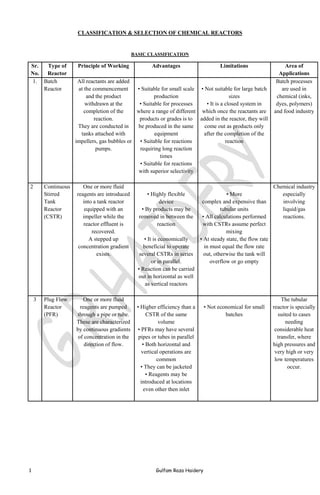
Sr.
Type of
No.
Reactor
1. Batch
Reactor

2

Continuous
Stirred
Tank
Reactor
(CSTR)

3

1

Plug Flow
Reactor
(PFR)

Principle of Working

Advantages

Limitations

All reactants are added
at the commencement
• Suitable for small scale • Not suitable for large batch
and the product
production
sizes
withdrawn at the
• Suitable for processes
• It is a closed system in
completion of the
where a range of different which once the reactants are
reaction.
products or grades is to added in the reactor, they will
They are conducted in
be produced in the same
come out as products only
tanks attached with
equipment
after the completion of the
impellers, gas bubbles or • Suitable for reactions
reaction
pumps.
requiring long reaction
times
• Suitable for reactions
with superior selectivity
One or more fluid
reagents are introduced
into a tank reactor
equipped with an
impeller while the
reactor effluent is
recovered.
A stepped up
concentration gradient
exists.

One or more fluid
reagents are pumped
through a pipe or tube.
These are characterized
by continuous gradients
of concentration in the
direction of flow.

• Highly flexible
device
• By products may be
removed in between the
reaction
• It is economically
beneficial to operate
several CSTRs in series
or in parallel.
• Reaction can be carried
out in horizontal as well
as vertical reactors

• More
complex and expensive than
tubular units
• All calculations performed
with CSTRs assume perfect
mixing
• At steady state, the flow rate
in must equal the flow rate
out, otherwise the tank will
overflow or go empty

• Higher efficiency than a
CSTR of the same
volume
• PFRs may have several
pipes or tubes in parallel
• Both horizontal and
vertical operations are
common
• They can be jacketed
• Reagents may be
introduced at locations
even other then inlet

Gulfam Raza Haidery

• Not economical for small
batches

Area of
Applications
Batch processes
are used in
chemical (inks,
dyes, polymers)
and food industry

Chemical industry
especially
involving
liquid/gas
reactions.

The tubular
reactor is specially
suited to cases
needing
considerable heat
transfer, where
high pressures and
very high or very
low temperatures
occur.
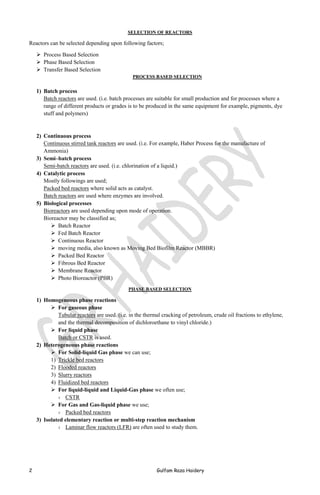
SELECTION OF REACTORS

Reactors can be selected depending upon following factors;
 Process Based Selection
 Phase Based Selection
 Transfer Based Selection
PROCESS BASED SELECTION

1) Batch process
Batch reactors are used. (i.e. batch processes are suitable for small production and for processes where a
range of different products or grades is to be produced in the same equipment for example, pigments, dye
stuff and polymers)

2) Continuous process
Continuous stirred tank reactors are used. (i.e. For example, Haber Process for the manufacture of
Ammonia)
3) Semi–batch process
Semi-batch reactors are used. (i.e. chlorination of a liquid.)
4) Catalytic process
Mostly followings are used;
Packed bed reactors where solid acts as catalyst.
Batch reactors are used where enzymes are involved.
5) Biological processes
Bioreactors are used depending upon mode of operation.
Bioreactor may be classified as;
 Batch Reactor
 Fed Batch Reactor
 Continuous Reactor
 moving media, also known as Moving Bed Biofilm Reactor (MBBR)
 Packed Bed Reactor
 Fibrous Bed Reactor
 Membrane Reactor
 Photo Bioreactor (PBR)
PHASE BASED SELECTION

1) Homogeneous phase reactions
 For gaseous phase
Tubular reactors are used. (i.e. in the thermal cracking of petroleum, crude oil fractions to ethylene,
and the thermal decomposition of dichloroethane to vinyl chloride.)
 For liquid phase
Batch or CSTR is used.
2) Heterogeneous phase reactions
 For Solid-liquid Gas phase we can use;
1) Trickle bed reactors
2) Flooded reactors
3) Slurry reactors
4) Fluidized bed reactors
 For liquid-liquid and Liquid-Gas phase we often use;

CSTR
 For Gas and Gas-liquid phase we use;

Packed bed reactors
3) Isolated elementary reaction or multi-step reaction mechanism

Laminar flow reactors (LFR) are often used to study them.

2

Gulfam Raza Haidery
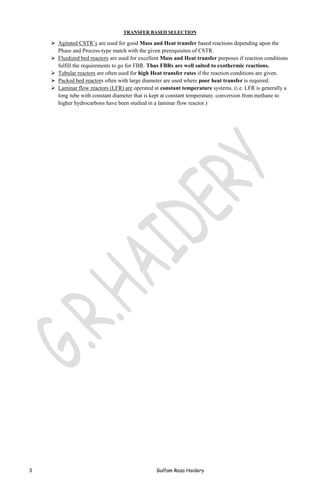
TRANSFER BASED SELECTION

 Agitated CSTR’s are used for good Mass and Heat transfer based reactions depending upon the
Phase and Process-type match with the given prerequisites of CSTR.
 Fluidized bed reactors are used for excellent Mass and Heat transfer purposes if reaction conditions
fulfill the requirements to go for FBR. Thus FBRs are well suited to exothermic reactions.
 Tubular reactors are often used for high Heat transfer rates if the reaction conditions are given.
 Packed bed reactors often with large diameter are used where poor heat transfer is required.
 Laminar flow reactors (LFR) are operated at constant temperature systems. (i.e. LFR is generally a
long tube with constant diameter that is kept at constant temperature. conversion from methane to
higher hydrocarbons have been studied in a laminar flow reactor.)

3

Gulfam Raza Haidery

Classification & Selection of Reactors

  • 1.
    CLASSIFICATION & SELECTIONOF CHEMICAL REACTORS BASIC CLASSIFICATION Sr. Type of No. Reactor 1. Batch Reactor 2 Continuous Stirred Tank Reactor (CSTR) 3 1 Plug Flow Reactor (PFR) Principle of Working Advantages Limitations All reactants are added at the commencement • Suitable for small scale • Not suitable for large batch and the product production sizes withdrawn at the • Suitable for processes • It is a closed system in completion of the where a range of different which once the reactants are reaction. products or grades is to added in the reactor, they will They are conducted in be produced in the same come out as products only tanks attached with equipment after the completion of the impellers, gas bubbles or • Suitable for reactions reaction pumps. requiring long reaction times • Suitable for reactions with superior selectivity One or more fluid reagents are introduced into a tank reactor equipped with an impeller while the reactor effluent is recovered. A stepped up concentration gradient exists. One or more fluid reagents are pumped through a pipe or tube. These are characterized by continuous gradients of concentration in the direction of flow. • Highly flexible device • By products may be removed in between the reaction • It is economically beneficial to operate several CSTRs in series or in parallel. • Reaction can be carried out in horizontal as well as vertical reactors • More complex and expensive than tubular units • All calculations performed with CSTRs assume perfect mixing • At steady state, the flow rate in must equal the flow rate out, otherwise the tank will overflow or go empty • Higher efficiency than a CSTR of the same volume • PFRs may have several pipes or tubes in parallel • Both horizontal and vertical operations are common • They can be jacketed • Reagents may be introduced at locations even other then inlet Gulfam Raza Haidery • Not economical for small batches Area of Applications Batch processes are used in chemical (inks, dyes, polymers) and food industry Chemical industry especially involving liquid/gas reactions. The tubular reactor is specially suited to cases needing considerable heat transfer, where high pressures and very high or very low temperatures occur.
  • 2.
    SELECTION OF REACTORS Reactorscan be selected depending upon following factors;  Process Based Selection  Phase Based Selection  Transfer Based Selection PROCESS BASED SELECTION 1) Batch process Batch reactors are used. (i.e. batch processes are suitable for small production and for processes where a range of different products or grades is to be produced in the same equipment for example, pigments, dye stuff and polymers) 2) Continuous process Continuous stirred tank reactors are used. (i.e. For example, Haber Process for the manufacture of Ammonia) 3) Semi–batch process Semi-batch reactors are used. (i.e. chlorination of a liquid.) 4) Catalytic process Mostly followings are used; Packed bed reactors where solid acts as catalyst. Batch reactors are used where enzymes are involved. 5) Biological processes Bioreactors are used depending upon mode of operation. Bioreactor may be classified as;  Batch Reactor  Fed Batch Reactor  Continuous Reactor  moving media, also known as Moving Bed Biofilm Reactor (MBBR)  Packed Bed Reactor  Fibrous Bed Reactor  Membrane Reactor  Photo Bioreactor (PBR) PHASE BASED SELECTION 1) Homogeneous phase reactions  For gaseous phase Tubular reactors are used. (i.e. in the thermal cracking of petroleum, crude oil fractions to ethylene, and the thermal decomposition of dichloroethane to vinyl chloride.)  For liquid phase Batch or CSTR is used. 2) Heterogeneous phase reactions  For Solid-liquid Gas phase we can use; 1) Trickle bed reactors 2) Flooded reactors 3) Slurry reactors 4) Fluidized bed reactors  For liquid-liquid and Liquid-Gas phase we often use;  CSTR  For Gas and Gas-liquid phase we use;  Packed bed reactors 3) Isolated elementary reaction or multi-step reaction mechanism  Laminar flow reactors (LFR) are often used to study them. 2 Gulfam Raza Haidery
  • 3.
    TRANSFER BASED SELECTION Agitated CSTR’s are used for good Mass and Heat transfer based reactions depending upon the Phase and Process-type match with the given prerequisites of CSTR.  Fluidized bed reactors are used for excellent Mass and Heat transfer purposes if reaction conditions fulfill the requirements to go for FBR. Thus FBRs are well suited to exothermic reactions.  Tubular reactors are often used for high Heat transfer rates if the reaction conditions are given.  Packed bed reactors often with large diameter are used where poor heat transfer is required.  Laminar flow reactors (LFR) are operated at constant temperature systems. (i.e. LFR is generally a long tube with constant diameter that is kept at constant temperature. conversion from methane to higher hydrocarbons have been studied in a laminar flow reactor.) 3 Gulfam Raza Haidery