CHEMICAL PROCESS
TECHNOLOGY
CATUC BAMENDA
INTRODUCTION TO CHEMICAL PROCESS
TECHNOLOGY
• Chemical process technology involves the process of manufacturing or
producing chemicals.
• It involves the full description of process flow, Raw materials used, unit
operation used, reactions involved
• So Basically it's a course dedicated to the various plants with help of flow
sheets and process description.
CHAPTER ONE
SUGAR MANUFACTURING
INTRODUCTION
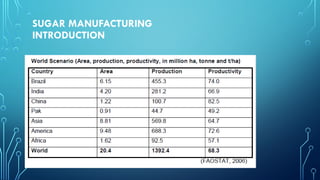
• The sugar industry processes sugar cane and sugar beets to manufacture
edible sugar.
• More than 60% of the world's sugar production is from sugar cane ; the
balance is from sugar beets.
• Sugar manufacturing is a highly seasonal industry, with season lengths of
about 6–18 weeks for beets and 20–32 weeks for cane.
SUGAR MANUFACTURING
INTRODUCTION
SUGAR MANUFACTURING
INTRODUCTION
• There are 3 types of sugar cane namely
• Saccharum officinarum(tropical sugarcane),
• Indian cane(Saccharum barberi or Saccharum sinensis) &
• Saccharum spontaneum/robustum(wild sugarcane).
• The main commercial sugarcane is a hybrid from wild sugar(Saccharum
spontaneum) & it's cultivated in sugarcane production Countries.
BY PRODUCTS IN SUGARCANE INDUSTRY
• The four main byproducts of the sugarcane are:
• Cane tops
• Bagasse
• Filter mud / press mud and Spent Wash
• Molasses
BY PRODUCTS IN SUGARCANE INDUSTRY
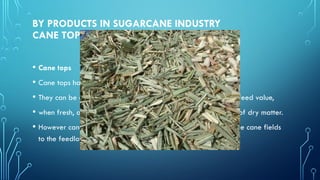
CANE TOPS
• Cane tops
• Cane tops have no real market value
• They can be compared to fair quality fodder with an average feed value,
• when fresh, of about 2.8 MJ of metabolizable energy per kilo of dry matter.
• However cane tops should be collected and transported from the cane fields
to the feedlot
BY PRODUCTS IN SUGARCANE INDUSTRY
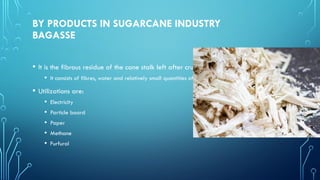
BAGASSE
• It is the fibrous residue of the cane stalk left after crushing and extraction of the juice
• It consists of fibres, water and relatively small quantities of soluble solids - mostly sugar
• Utilizations are:
• Electricity
• Particle board
• Paper
• Methane
• Furfural
BY PRODUCTS IN SUGARCANE INDUSTRY
BAGASSE
• Furfural
• It is a colorless, inflammable, volatile, aromatic liquid
• 25 tonnes of bagasse to produce 1 tonne of furfural
• Furfural has many industrial uses:
• Selective solvent for the refining of lubricating oils
• As an intermediate in the production of nylon and resins
BY PRODUCTS IN SUGARCANE INDUSTRY
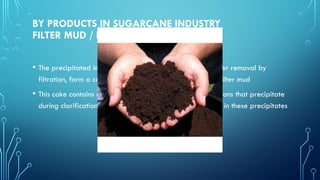
FILTER MUD / PRESSMUD
• The precipitated impurities contained in the cane juice, after removal by
filtration, form a cake of varying moisture content called filter mud
• This cake contains much of the colloidal organic matter anions that precipitate
during clarification, as well as certain non-sugars included in these precipitates
BY PRODUCTS IN SUGARCANE INDUSTRY
FILTER MUD / PRESSMUD
• As animal feed has not proved economically rewarding, the main constraints being the
magnitude of the drying process involved and the low digestibility of the dried scums
• As soil nutrient there is limitations
• Higher values of C.O.D. (chemical oxygen demand) and B.O.D (biochemical oxygen demand)
• Wax percentage in substantial quantity which prevents microbial action
• High concentration of various chemicals which are detrimental to survival of beneficial microflora
• Bio-degradation being exothermic reaction survival of microbes except thermophiles is difficult
• Due to above mentioned difficulties, bio-degradation of pressmud and spent wash is a difficult
process
BY PRODUCTS IN SUGARCANE INDUSTRY
MOLASSES
• Molasses is the final effluent obtained in the preparation of sugar by
repeated crystallization
• It is the residual syrup from which no crystalline sucrose can be obtained by
simple means
• The yield of molasses is approximately 3.0 percent per tonne of cane
• but it is influenced by a number of factors (2.2 to 3.7 percent)
BY PRODUCTS IN SUGARCANE INDUSTRY
MOLASSES
• The composition of molasses varies but, on average, would be as follows:
• Water 20%
• Other carbohydrates 4%
• Sucrose 35%
• Nitrogenous compounds 4.5%
• Fructose 9%
• Non-nitrogenous acids 5%
• Glucose 7%
• Ash 12%
• Other reducing sugars 3%
BY PRODUCTS IN SUGARCANE INDUSTRY
MOLASSES
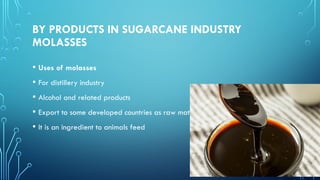
• Uses of molasses
• For distillery industry
• Alcohol and related products
• Export to some developed countries as raw materials
• It is an ingredient to animals feed
SUGAR PROCESSING
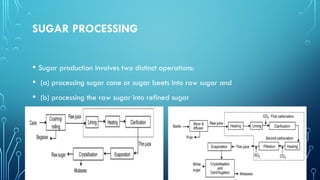
• Sugar production involves two distinct operations:
• (a) processing sugar cane or sugar beets into raw sugar and
• (b) processing the raw sugar into refined sugar
SUGAR PROCESSING
CANE HAVERSTING
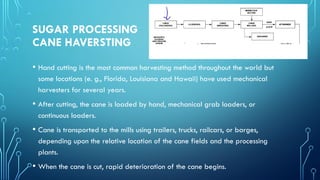
• Hand cutting is the most common harvesting method throughout the world but
some locations (e. g., Florida, Louisiana and Hawaii) have used mechanical
harvesters for several years.
• After cutting, the cane is loaded by hand, mechanical grab loaders, or
continuous loaders.
• Cane is transported to the mills using trailers, trucks, railcars, or barges,
depending upon the relative location of the cane fields and the processing
plants.
• When the cane is cut, rapid deterioration of the cane begins.
SUGAR PROCESSING
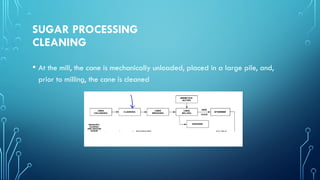
CLEANING
• At the mill, the cane is mechanically unloaded, placed in a large pile, and,
prior to milling, the cane is cleaned
SUGAR PROCESSING
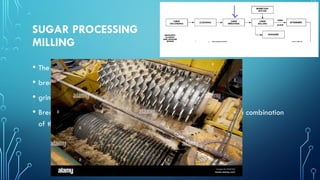
MILLING
• The milling process occurs in two steps:
• breaking the hard structure of the cane and
• grinding the cane
• Breaking the cane uses revolving knives, shredders, crushers, or a combination
of these processes.
SUGAR PROCESSING
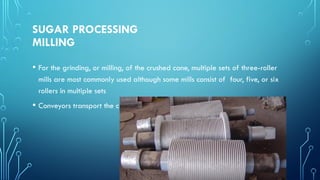
MILLING
• For the grinding, or milling, of the crushed cane, multiple sets of three-roller
mills are most commonly used although some mills consist of four, five, or six
rollers in multiple sets
• Conveyors transport the crushed cane from one mill to the next
SUGAR PROCESSING
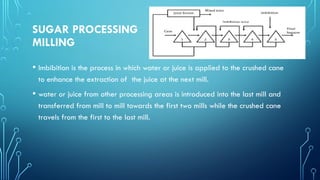
MILLING
• Imbibition is the process in which water or juice is applied to the crushed cane
to enhance the extraction of the juice at the next mill.
• water or juice from other processing areas is introduced into the last mill and
transferred from mill to mill towards the first two mills while the crushed cane
travels from the first to the last mill.
SUGAR PROCESSING
MILLING
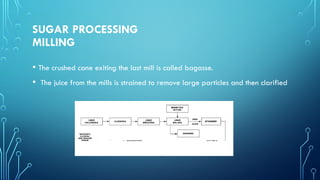
• The crushed cane exiting the last mill is called bagasse.
• The juice from the mills is strained to remove large particles and then clarified
SUGAR PROCESSING
STRAINING AND CLARIFICATION
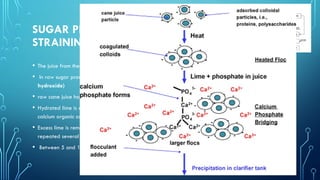
• The juice from the mills is strained to remove large particles and then clarified.
• In raw sugar production, clarification is done almost exclusively with heat about 95°C and lime(Calcium
hydroxide)
• raw cane juice has low pH and contains dissolved impurities.
• Hydrated lime is added to the juice to raise the pH and to react with the impurities to form insoluble
calcium organic compounds that can be removed.
• Excess lime is removed by carbonation or by the addition of phosphoric acid. This process may be
repeated several times depending on the purity of final product required.
• Between 5 and 10 pounds of lime is required for each ton of cane sugar produced.
SUGAR PROCESSING
STRAINING AND CLARIFICATION
• The use of lime in the production of sugar from sugar beets is similar, except
that much more lime is required than for cane sugar, approximately one
quarter ton for each ton of beet sugar produced.
• Because of a large quantities of lime required, many beet sugar refiners
maintain on-site lime kilns to provide their lime requirements. They also reclaim
calcium carbonate from the sugarmaking process for reuse.
SUGAR PROCESSING
CLARIFICATION
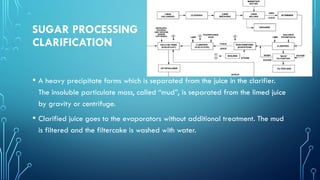
• A heavy precipitate forms which is separated from the juice in the clarifier.
The insoluble particulate mass, called “mud”, is separated from the limed juice
by gravity or centrifuge.
• Clarified juice goes to the evaporators without additional treatment. The mud
is filtered and the filtercake is washed with water.
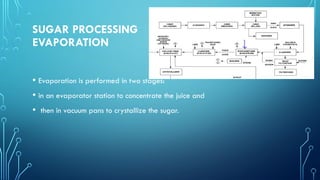
SUGAR PROCESSING
EVAPORATION
• Evaporation is performed in two stages:
• in an evaporator station to concentrate the juice and
• then in vacuum pans to crystallize the sugar.
SUGAR PROCESSING
EVAPORATION
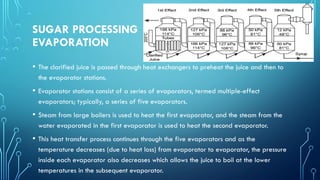
• The clarified juice is passed through heat exchangers to preheat the juice and then to
the evaporator stations.
• Evaporator stations consist of a series of evaporators, termed multiple-effect
evaporators; typically, a series of five evaporators.
• Steam from large boilers is used to heat the first evaporator, and the steam from the
water evaporated in the first evaporator is used to heat the second evaporator.
• This heat transfer process continues through the five evaporators and as the
temperature decreases (due to heat loss) from evaporator to evaporator, the pressure
inside each evaporator also decreases which allows the juice to boil at the lower
temperatures in the subsequent evaporator.
SUGAR PROCESSING
EVAPORATION
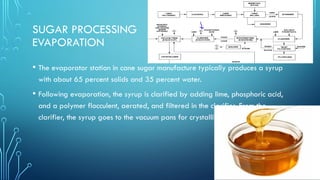
• The evaporator station in cane sugar manufacture typically produces a syrup
with about 65 percent solids and 35 percent water.
• Following evaporation, the syrup is clarified by adding lime, phosphoric acid,
and a polymer flocculent, aerated, and filtered in the clarifier. From the
clarifier, the syrup goes to the vacuum pans for crystallization.
SUGAR PROCESSING
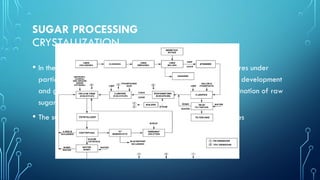
CRYSTALLIZATION
• Crystallization of the sugar starts in the vacuum pans, whose function is to
produce sugar crystals from the syrup.
• In the pan boiling process, the syrup is evaporated until it reaches the
supersaturation stage.
• At this point, the crystallization process is initiated by “seeding” or “shocking”
the solution with isopropyl alcohol and ground sugar
SUGAR PROCESSING
CRYSTALLIZATION
• In the crystallation process the syrup is boiled at low temperatures under
partial vacuum and some seedings are added which causes the development
and growth of sugar crystals called massecuite which is a combination of raw
sugar mixed with molasses
• The sugar crystals and molases are then separated in centrifuges
SUGAR PROCESSING
CRYSTALLIZATION
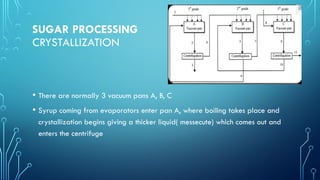
• There are normally 3 vacuum pans A, B, C
• Syrup coming from evaporators enter pan A, where boiling takes place and
crystallization begins giving a thicker liquid( messecute) which comes out and
enters the centrifuge
SUGAR PROCESSING
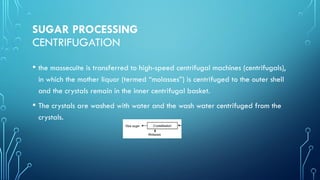
CENTRIFUGATION
• the massecuite is transferred to high-speed centrifugal machines (centrifugals),
in which the mother liquor (termed “molasses”) is centrifuged to the outer shell
and the crystals remain in the inner centrifugal basket.
• The crystals are washed with water and the wash water centrifuged from the
crystals.
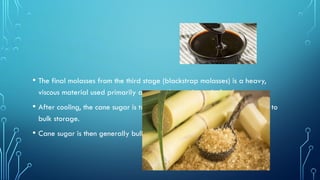
• The final molasses from the third stage (blackstrap molasses) is a heavy,
viscous material used primarily as a supplement in cattle feed.
• After cooling, the cane sugar is transferred to packing bins and then sent to
bulk storage.
• Cane sugar is then generally bulk loaded to trucks, railcars, or barges.
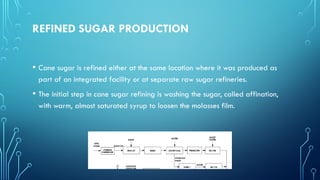
REFINED SUGAR PRODUCTION
• Cane sugar is refined either at the same location where it was produced as
part of an integrated facility or at separate raw sugar refineries.
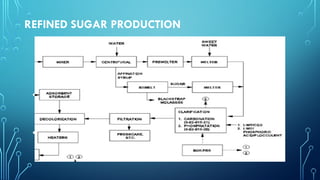
• The initial step in cane sugar refining is washing the sugar, called affination,
with warm, almost saturated syrup to loosen the molasses film.
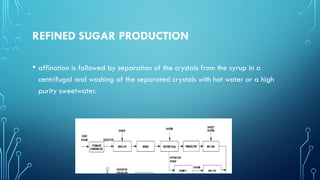
REFINED SUGAR PRODUCTION
• affination is followed by separation of the crystals from the syrup in a
centrifugal and washing of the separated crystals with hot water or a high
purity sweetwater.
REFINED SUGAR PRODUCTION
• The washed raw sugar is sent to a premelter and then to a melter, where it is
mixed with high-purity sweetwaters from other refinery steps and is steam
heated.
• The resultant syrup is passed through a screen to remove any particulate in
the syrup and sent to the clarification step.
REFINED SUGAR PRODUCTION
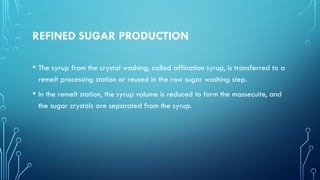
• The syrup from the crystal washing, called affination syrup, is transferred to a
remelt processing station or reused in the raw sugar washing step.
• In the remelt station, the syrup volume is reduced to form the massecuite, and
the sugar crystals are separated from the syrup.
REFINED SUGAR PRODUCTION
• The separated liquor is blackstrap molasses. The sugar crystals are sent to a melter
and then to the clarification step.
• Two clarification methods are commonly used:
• pressure filtration and chemical treatment;
• chemical clarification is the preferred method.
• Two chemical methods are commonly used:
• phosphatation and
• carbonation;
• both processes require the addition of lime.
REFINED SUGAR PRODUCTION
• The phosphatation uses phosphoric acid, lime (as lime sucrate to increase
solubility), and
• polyacrylamide flocculent to produce a calcium phosphate floc.
• Air flotation is usually used to separate the floc from the liquor and the floc
skimmed from the liquor surface.
REFINED SUGAR PRODUCTION
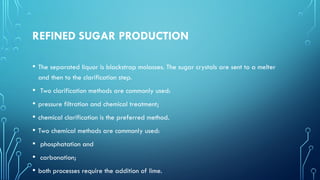
• The clarifier systems yield either presscakes, muds, or scums which are treated
to remove entrapped sugar, and then sent to disposal.
REFINED SUGAR PRODUCTION
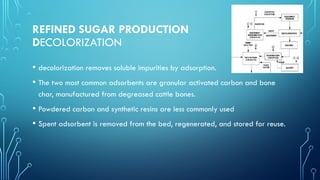
DECOLORIZATION
• decolorization removes soluble impurities by adsorption.
• The two most common adsorbents are granular activated carbon and bone
char, manufactured from degreased cattle bones.
• Powdered carbon and synthetic resins are less commonly used
• Spent adsorbent is removed from the bed, regenerated, and stored for reuse.
REFINED SUGAR PRODUCTION
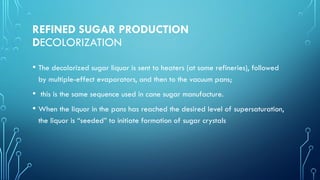
DECOLORIZATION
• The decolorized sugar liquor is sent to heaters (at some refineries), followed
by multiple-effect evaporators, and then to the vacuum pans;
• this is the same sequence used in cane sugar manufacture.
• When the liquor in the pans has reached the desired level of supersaturation,
the liquor is “seeded” to initiate formation of sugar crystals
REFINED SUGAR PRODUCTION
CENTRIFUGAL
• In the centrifugal, the white sugar is retained in the inner basket and the liquor
centrifuged to the outer shell.
• The sugar liquor is returned to a vacuum pan for further volume reduction and
white or brown sugar production
• The white sugar is washed one time in the centrifugal; the separated wash
water, containing liquor and dissolved sugar, is returned to the vacuum pans.
• The moist sugar from the centrifugals contains about 1 percent water by weight.
REFINED SUGAR PRODUCTION
SCREENING
• To produce refined granulated sugar, white sugar is transported by conveyors
and bucket elevators to the sugar dryers.
• Dryer drums typically operate at a temperature of about 110°C (230°F).
• From the granulators, the dried white sugar crystals are mechanically
screened by particle size using a sloping, gyrating wire mesh screen or
perforated plate
REFINED SUGAR PRODUCTION
• From the granulators, the dried white sugar crystals are mechanically
screened by particle size using a sloping, gyrating wire mesh screen or
perforated plate
REFINED SUGAR PRODUCTION
PACKAGING
• After screening, the finished, refined granulated sugar is sent to conditioning
bins, and then to storage bins prior to packaging or bulk loadout.
• Almost all packaged sugar uses either multiwall paper containers, cardboard
cartons, or polyethylene bags; bulk loadout is the loadout of the sugar to
specially designed bulk hopper cars or tank trucks.
REFINED SUGAR PRODUCTION
• In addition to granulated sugar, other common refined sugar products include
confectioners' (powdered) sugar, brown sugar, liquid sugar, and edible
molasses. There are about six other less common sugar products.
CEMENT
INTRODUCTION
• Cement is known to be one of the most important construction materials in the
world. It is primarily used in the manufacture of concrete.
• Concrete is a combination of inert mineral aggregates such as sand, gravel,
crushed stones and cement.
CEMENT
INTRODUCTION
• Cement is a binder, a substance that sets and hardens and can bind other
materials together.
• Cements used in construction can be characterized as being either hydraulic or
non-hydraulic, depending upon the ability of the cement to be used in the
presence of water.
CEMENT
INTRODUCTION
HYDRAULIC OR NON-HYDRAULIC,
• Hydraulic Cement is made out of limestone, clay and gypsum. Non Hydraulic Cement is
composed of lime, gypsum plaster and oxychloride.
• Hydraulic Cement hardens when there is a chemical reaction between anhydrous cement
powder with water. Non hydraulic Cement hardens when there is a reaction due to
carbonation with the carbon di oxide which is naturally present in the air.
• Hydraulic Cement hardens under water or when in contact with wet weather. Hence it is
suitable to work with in any climatic conditions. Non Hydraulic Cement should be kept dry to
attain strength.
• Hydraulic cement is used in multiple applications like concrete, mortar in masonry, swimming
pools, marine construction, foundations, manholes, reservoirs etc Non hydraulic cement is
becoming redundant and obsolete due to the long duration of time taken for setting of cement
CEMENT
INTRODUCTION
USES
• Cement mortar for Masonry work, plaster and pointing etc.
• Concrete for laying floors, roofs and constructing lintels,beams,weather shed,stairs,pillars
etc.
• Construction for important engineering structures such as bridge, culverts, dams, tunnels,
light house, clocks,etc.
• Construction of water,wells, tennis courts,septic tanks, lamp posts, telephone cabins etc.
• Making joint for joints,pipes,etc.
• Manufacturing of precast pipes,garden seats, artistically designed wens, flower posts, etc.
• Preparation of foundation, water tight floors, footpaths, etc.
TYPES OF PORTLAND CEMENT
• Portland cement is a closely controlled chemical combination of
• calcium,
• silicon,
• aluminum,
• iron and
• small amounts of other compounds, to which gypsum is added in the final grinding
process to regulate the setting time of the concrete.
TYPES OF PORTLAND CEMENT
• Some of the raw materials used to manufacture cement are
• limestone,
• shells, and
• chalk or marl,
• combined with shale, clay, slate or blast furnace slag, silica sand, and iron
ore.
• Lime and silica make up approximately 85 percent of the mass.
TYPES OF PORTLAND CEMENT
• The term "Portland" in Portland cement originated in 1824 when an English
mason obtained a patent for his product, which he named Portland Cement. This
was because his cement blend produced concrete that resembled the color of
the natural limestone quarried on the Isle of Portland in the English Channel.
• Many types of cements are available in markets with different compositions and
for use in different environmental conditions and specialized applications.
TYPES OF PORTLAND CEMENT
• Ordinary Portland cement ( type I )
• Ordinary Portland cement is the most common type of cement in general use around the
world. This cement is made by heating limestone (calcium carbonate) with small quantities
of other materials (such as clay) to 1450°C in a kiln, in a process known as calcination,
whereby a molecule of carbon dioxide is liberated from the calcium carbonate to form
calcium oxide, or quicklime, which is then blended with the other materials that have
been included in the mix.
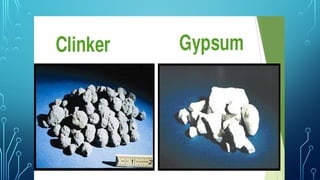
• The resulting hard substance, called 'clinker', is then ground with a small amount of
gypsum into a powder to make 'Ordinary Portland Cement'(often referred to as OPC).
TYPES OF PORTLAND CEMENT
ORDINARY PORTLAND CEMENT ( TYPE I )
• Lime saturation Factor is limited between i.e. 0.66 to 1.02.
• Free lime-cause the Cement to be unsound.
• Percentage of (AL2O3/Fe2O3) is not less than 0.66.
• Insoluble residue not more than 1.5%.
• Percentage of SO3 limited by 2.5% when C3A < 7% and not more than 3% when C3A >7%.
• Loss of ignition -4%(max)
• Percentage of Mg0-5% (max.)
• Fineness -not less than 2250 cm2/g
RAPID HARDENING PORTLAND CEMENT ( TYPE III )
• This type develops strength more rapidly than ordinary Portland cement.
• The initial strength is higher, but they equalize at 2-3 months .Setting time for
this type is similar for that of ordinary Portland cement
• It contains more C3S are less C2S than the ordinary Portland cement.
• Its 3 days strength is same as 7 days strength of ordinary Portland cement.
RAPID HARDENING PORTLAND CEMENT
USES
• a) The uses of this cement is indicated where a rapid strength development is
desired (to develop high early strength, i.e.( its 3 days strength equal that of 7
days ordinary Portland cement), for example:
• Where sufficient strength for further construction is wanted as quickly as
practicable, such as concrete blocks manufacturing, sidewalks and the places that
cannot be closed for a long time, and repair works needed to construct quickly.
• b) For construction at low temperatures, to prevent the frost damage of the
capillary water.
• c) This type of cement is not use at mass concrete constructions
LOW HEAT PORTLAND CEMENT ( TYPE IV)
• Its composition contains less C3S and C3A percentage, and higher percentage
of C2S in comparison with ordinary Portland cement.
• Properties
• 1) Reduce and delay the heat of hydration.
• 2) It has lower early strength compared with ordinary Portland cement.
• 3) Its fineness is not less than 3200 cm2/g
Uses
• It is used in mass concrete constructions:
SULPHATE RESISTING PORTLAND CEMENT ( TYPE V)
• Maximum C3A content by 3.5% and minimum fineness by 2500 cm'/g.
• Firmer than ordinary potland cement.
• Sulphate forms the sulpha-aluminates which have expensive properties and so causes
disintegration of concrete.
• The clinkers of cement are ground with about 60 to 65 percent of slag.
• Properties
•  Low early strength.
•  Its cost is higher than ordinary Portland cement – because of the special requirements
of material composition, including addition of iron powder to the raw materials.
PORTLAND BLAST FURNACE CEMENT ( TYPE IS)
• This type of cement consists of an intimate mixture of Portland cement and
ground granulated blast furnace slag.
• Slag – is a waste product in the manufacture of pig iron.
• Chemically, slag is a mixture of 42% lime, 30% silica, 19% alumina, 5%
magnesia, and 1% alkalis, that is, the same oxides that make up Portland
cement but not in the same proportions.
PORTLAND BLAST FURNACE CEMENT ( TYPE IS)
PROPERTIES
• - Its early strength is lower than that of ordinary cement, but their strength is equal at late ages (about
2 months).
• - The requirements for fineness and setting time and soundness are similar for those of ordinary Cement.
• - The workability is higher than that of ordinary cement.
• - Heat of hydration is lower that of ordinary cement.
• - Its sulfate resistance is high.
• Uses
• - Mass concrete
• - It is possible to be use in constructions subjected to sea water (marine constructions).
• - May not be use in cold weather concreting.
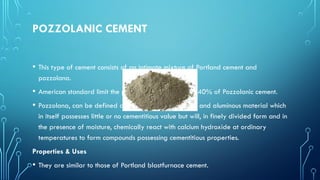
POZZOLANIC CEMENT
• This type of cement consists of an intimate mixture of Portland cement and
pozzolana.
• American standard limit the pozzolana content by 15-40% of Pozzolanic cement.
• Pozzolana, can be defined as – a siliceous or siliceous and aluminous material which
in itself possesses little or no cementitious value but will, in finely divided form and in
the presence of moisture, chemically react with calcium hydroxide at ordinary
temperatures to form compounds possessing cementitious properties.
Properties & Uses
• They are similar to those of Portland blastfurnace cement.
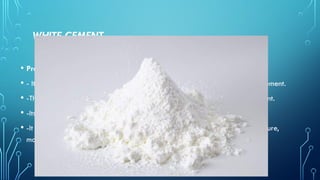
WHITE CEMENT
• White Portland cement is made from raw materials containing very little iron
oxide (less than 0.3% by mass of clinker) and magnesium oxide (which give
the grey color in ordinary Portland cement). white clay is generally used,
together with chalk or limestone, free from specified impurities.
• Its manufacture needs higher firing temperature because of the absence of
iron element that works as a catalyst in the formation process of the clinker
WHITE CEMENT
• Properties
• - It has a slightly lower specific gravity (3.05-3.1), than ordinary Portland cement.
• -The strength is usually somewhat lower than that of ordinary Portland cement.
• -Its fineness is higher (4000-4500 cm2/g) than ordinary Portland cement
• -It used in architectural purposes Swimming pools, for painting garden furniture,
moulding sculptures and statues etc.
COLOURED PORTLAND
• It is prepared by adding special types of pigments to the Portland cement. The pigments added to
the white cement (2-10% by weight of the cement) when needed to obtain light colors, while
• it added to ordinary Portland cement when needed to obtain dark colors.
• Pigment properties
•  It is required that pigments are insoluble and not affected by ambience.
•  They should be chemically inert
•  Don’t contain gypsum that is harmful to the concrete.
•  Don’t affect on strength development of concrete.
EXPANSIVE CEMENT
• This type of cement is produced by adding an expanding medium like
sulphoaluminate and a stabilising agent to the ordinary cement.
• The expanding cement is used for the construction of water retaining structures
and for repairing the damaged concrete surfaces.
HIGH ALUMINA CEMENT
• This cement is produced by grilling clinkers formed by calcining bauxite and
lime. It can stand high temper lures.
• If evolves great heat during setting. It is therefore not affected by frost
THE CEMENT MANUFACTURING PROCESS
PORTLAND CEMENT
• Portland cement is made by mixing substances containing CaCO3 with substances containing
• SiO2, Al2O3, Fe2O3 and heating them to a clinker which is subsequently ground to powder and
mixed with 2-6 % gypsum.
• Raw Materials Necessary for Portland Cement Manufacture Must Provide the Following
• Calcium
• Silica
• Alumina
• Iron
THE CEMENT MANUFACTURING PROCESS
PORTLAND CEMENT
PRODUCTION STEPS
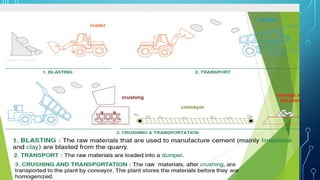
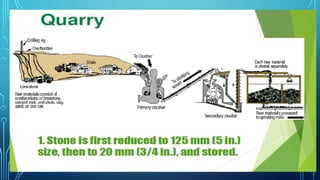
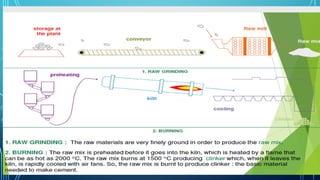
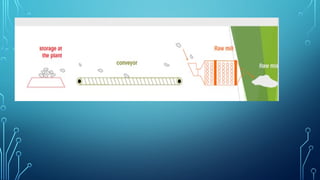
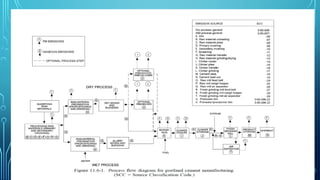
• 1. Raw materials are crushed, screened & stockpiled.
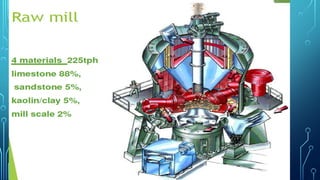
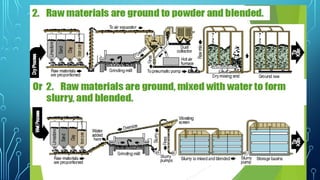
• 2. Raw materials are mixed with definite proportions to obtain “raw mix”. They are mixed either dry
(dry mixing) or by water (wet mixing).
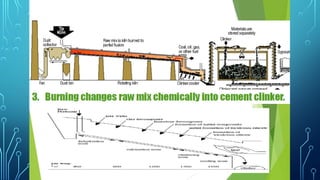
• 3. Prepared raw mix is fed into the rotary kiln.
• 4. As the materials pass through the kiln their temperature is raised up to 1300-1600 °C. The process
of heating is named as “burning”. The output is known as “clinker” which is 0.15-5 cm in diameter.
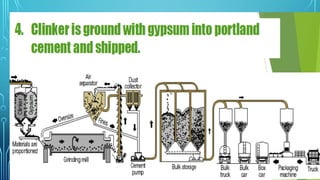
• 5. Clinker is cooled & stored.
• 6. Clinker is ground with gypsum (3-6%) to adjust setting time.
• 7. Packing & marketting.
REACTIONS IN THE KILN
• • ~100°C free water evaporates.
→
• • ~150-350C° loosely bound water is lost from clay.
→
• • ~350-650°C decomposition of clay SiO2&Al2O3
→ →
• • ~600°C decomposition of MgCO3 MgO&CO2 (evaporates)
→ →
• • ~900°C decomposition of CaCO3 CaO&CO2 (evaporates)
→ →
• • ~1250-1280°C liquid formation & start of compound formation.

→
• • ~1280°C clinkering begins.
→
• • ~1400-1500°C clinkering
→
• • ~100°C clinker leaves the kiln & falls into a cooler.
→
•  Sometimes the burning process of raw materials is performed in two stages:
• preheating upto 900°C & rotary kiln
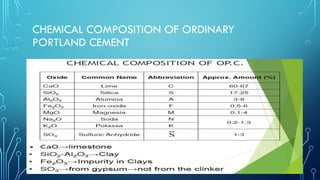
CHEMICAL COMPOSITION OF ORDINARY
PORTLAND CEMENT
CHAPTER THREE
REFINING VEGETABLE
Chemical Process Technology.pptxChemical process technology involves the process of

Chemical Process Technology.pptxChemical process technology involves the process of

  • 1.
  • 2.
    INTRODUCTION TO CHEMICALPROCESS TECHNOLOGY • Chemical process technology involves the process of manufacturing or producing chemicals. • It involves the full description of process flow, Raw materials used, unit operation used, reactions involved • So Basically it's a course dedicated to the various plants with help of flow sheets and process description.

  • 3.
    CHAPTER ONE SUGAR MANUFACTURING INTRODUCTION •The sugar industry processes sugar cane and sugar beets to manufacture edible sugar. • More than 60% of the world's sugar production is from sugar cane ; the balance is from sugar beets. • Sugar manufacturing is a highly seasonal industry, with season lengths of about 6–18 weeks for beets and 20–32 weeks for cane.
  • 4.
  • 5.
    SUGAR MANUFACTURING INTRODUCTION • Thereare 3 types of sugar cane namely • Saccharum officinarum(tropical sugarcane), • Indian cane(Saccharum barberi or Saccharum sinensis) & • Saccharum spontaneum/robustum(wild sugarcane). • The main commercial sugarcane is a hybrid from wild sugar(Saccharum spontaneum) & it's cultivated in sugarcane production Countries.
  • 6.
    BY PRODUCTS INSUGARCANE INDUSTRY • The four main byproducts of the sugarcane are: • Cane tops • Bagasse • Filter mud / press mud and Spent Wash • Molasses
  • 7.
    BY PRODUCTS INSUGARCANE INDUSTRY CANE TOPS • Cane tops • Cane tops have no real market value • They can be compared to fair quality fodder with an average feed value, • when fresh, of about 2.8 MJ of metabolizable energy per kilo of dry matter. • However cane tops should be collected and transported from the cane fields to the feedlot
  • 8.
    BY PRODUCTS INSUGARCANE INDUSTRY BAGASSE • It is the fibrous residue of the cane stalk left after crushing and extraction of the juice • It consists of fibres, water and relatively small quantities of soluble solids - mostly sugar • Utilizations are: • Electricity • Particle board • Paper • Methane • Furfural
  • 9.
    BY PRODUCTS INSUGARCANE INDUSTRY BAGASSE • Furfural • It is a colorless, inflammable, volatile, aromatic liquid • 25 tonnes of bagasse to produce 1 tonne of furfural • Furfural has many industrial uses: • Selective solvent for the refining of lubricating oils • As an intermediate in the production of nylon and resins
  • 10.
    BY PRODUCTS INSUGARCANE INDUSTRY FILTER MUD / PRESSMUD • The precipitated impurities contained in the cane juice, after removal by filtration, form a cake of varying moisture content called filter mud • This cake contains much of the colloidal organic matter anions that precipitate during clarification, as well as certain non-sugars included in these precipitates
  • 11.
    BY PRODUCTS INSUGARCANE INDUSTRY FILTER MUD / PRESSMUD • As animal feed has not proved economically rewarding, the main constraints being the magnitude of the drying process involved and the low digestibility of the dried scums • As soil nutrient there is limitations • Higher values of C.O.D. (chemical oxygen demand) and B.O.D (biochemical oxygen demand) • Wax percentage in substantial quantity which prevents microbial action • High concentration of various chemicals which are detrimental to survival of beneficial microflora • Bio-degradation being exothermic reaction survival of microbes except thermophiles is difficult • Due to above mentioned difficulties, bio-degradation of pressmud and spent wash is a difficult process
  • 12.
    BY PRODUCTS INSUGARCANE INDUSTRY MOLASSES • Molasses is the final effluent obtained in the preparation of sugar by repeated crystallization • It is the residual syrup from which no crystalline sucrose can be obtained by simple means • The yield of molasses is approximately 3.0 percent per tonne of cane • but it is influenced by a number of factors (2.2 to 3.7 percent)
  • 13.
    BY PRODUCTS INSUGARCANE INDUSTRY MOLASSES • The composition of molasses varies but, on average, would be as follows: • Water 20% • Other carbohydrates 4% • Sucrose 35% • Nitrogenous compounds 4.5% • Fructose 9% • Non-nitrogenous acids 5% • Glucose 7% • Ash 12% • Other reducing sugars 3%
  • 14.
    BY PRODUCTS INSUGARCANE INDUSTRY MOLASSES • Uses of molasses • For distillery industry • Alcohol and related products • Export to some developed countries as raw materials • It is an ingredient to animals feed
  • 15.
    SUGAR PROCESSING • Sugarproduction involves two distinct operations: • (a) processing sugar cane or sugar beets into raw sugar and • (b) processing the raw sugar into refined sugar
  • 16.
    SUGAR PROCESSING CANE HAVERSTING •Hand cutting is the most common harvesting method throughout the world but some locations (e. g., Florida, Louisiana and Hawaii) have used mechanical harvesters for several years. • After cutting, the cane is loaded by hand, mechanical grab loaders, or continuous loaders. • Cane is transported to the mills using trailers, trucks, railcars, or barges, depending upon the relative location of the cane fields and the processing plants. • When the cane is cut, rapid deterioration of the cane begins.
  • 17.
    SUGAR PROCESSING CLEANING • Atthe mill, the cane is mechanically unloaded, placed in a large pile, and, prior to milling, the cane is cleaned
  • 18.
    SUGAR PROCESSING MILLING • Themilling process occurs in two steps: • breaking the hard structure of the cane and • grinding the cane • Breaking the cane uses revolving knives, shredders, crushers, or a combination of these processes.
  • 19.
    SUGAR PROCESSING MILLING • Forthe grinding, or milling, of the crushed cane, multiple sets of three-roller mills are most commonly used although some mills consist of four, five, or six rollers in multiple sets • Conveyors transport the crushed cane from one mill to the next
  • 20.
    SUGAR PROCESSING MILLING • Imbibitionis the process in which water or juice is applied to the crushed cane to enhance the extraction of the juice at the next mill. • water or juice from other processing areas is introduced into the last mill and transferred from mill to mill towards the first two mills while the crushed cane travels from the first to the last mill.
  • 21.
    SUGAR PROCESSING MILLING • Thecrushed cane exiting the last mill is called bagasse. • The juice from the mills is strained to remove large particles and then clarified
  • 22.
    SUGAR PROCESSING STRAINING ANDCLARIFICATION • The juice from the mills is strained to remove large particles and then clarified. • In raw sugar production, clarification is done almost exclusively with heat about 95°C and lime(Calcium hydroxide) • raw cane juice has low pH and contains dissolved impurities. • Hydrated lime is added to the juice to raise the pH and to react with the impurities to form insoluble calcium organic compounds that can be removed. • Excess lime is removed by carbonation or by the addition of phosphoric acid. This process may be repeated several times depending on the purity of final product required. • Between 5 and 10 pounds of lime is required for each ton of cane sugar produced.
  • 23.
    SUGAR PROCESSING STRAINING ANDCLARIFICATION • The use of lime in the production of sugar from sugar beets is similar, except that much more lime is required than for cane sugar, approximately one quarter ton for each ton of beet sugar produced. • Because of a large quantities of lime required, many beet sugar refiners maintain on-site lime kilns to provide their lime requirements. They also reclaim calcium carbonate from the sugarmaking process for reuse.
  • 24.
    SUGAR PROCESSING CLARIFICATION • Aheavy precipitate forms which is separated from the juice in the clarifier. The insoluble particulate mass, called “mud”, is separated from the limed juice by gravity or centrifuge. • Clarified juice goes to the evaporators without additional treatment. The mud is filtered and the filtercake is washed with water.
  • 25.
    SUGAR PROCESSING EVAPORATION • Evaporationis performed in two stages: • in an evaporator station to concentrate the juice and • then in vacuum pans to crystallize the sugar.
  • 26.
    SUGAR PROCESSING EVAPORATION • Theclarified juice is passed through heat exchangers to preheat the juice and then to the evaporator stations. • Evaporator stations consist of a series of evaporators, termed multiple-effect evaporators; typically, a series of five evaporators. • Steam from large boilers is used to heat the first evaporator, and the steam from the water evaporated in the first evaporator is used to heat the second evaporator. • This heat transfer process continues through the five evaporators and as the temperature decreases (due to heat loss) from evaporator to evaporator, the pressure inside each evaporator also decreases which allows the juice to boil at the lower temperatures in the subsequent evaporator.
  • 27.
    SUGAR PROCESSING EVAPORATION • Theevaporator station in cane sugar manufacture typically produces a syrup with about 65 percent solids and 35 percent water. • Following evaporation, the syrup is clarified by adding lime, phosphoric acid, and a polymer flocculent, aerated, and filtered in the clarifier. From the clarifier, the syrup goes to the vacuum pans for crystallization.

  • 28.
    SUGAR PROCESSING CRYSTALLIZATION • Crystallizationof the sugar starts in the vacuum pans, whose function is to produce sugar crystals from the syrup. • In the pan boiling process, the syrup is evaporated until it reaches the supersaturation stage. • At this point, the crystallization process is initiated by “seeding” or “shocking” the solution with isopropyl alcohol and ground sugar
  • 29.
    SUGAR PROCESSING CRYSTALLIZATION • Inthe crystallation process the syrup is boiled at low temperatures under partial vacuum and some seedings are added which causes the development and growth of sugar crystals called massecuite which is a combination of raw sugar mixed with molasses • The sugar crystals and molases are then separated in centrifuges
  • 30.
    SUGAR PROCESSING CRYSTALLIZATION • Thereare normally 3 vacuum pans A, B, C • Syrup coming from evaporators enter pan A, where boiling takes place and crystallization begins giving a thicker liquid( messecute) which comes out and enters the centrifuge
  • 31.
    SUGAR PROCESSING CENTRIFUGATION • themassecuite is transferred to high-speed centrifugal machines (centrifugals), in which the mother liquor (termed “molasses”) is centrifuged to the outer shell and the crystals remain in the inner centrifugal basket. • The crystals are washed with water and the wash water centrifuged from the crystals.
  • 32.
    • The finalmolasses from the third stage (blackstrap molasses) is a heavy, viscous material used primarily as a supplement in cattle feed. • After cooling, the cane sugar is transferred to packing bins and then sent to bulk storage. • Cane sugar is then generally bulk loaded to trucks, railcars, or barges.
  • 33.
    REFINED SUGAR PRODUCTION •Cane sugar is refined either at the same location where it was produced as part of an integrated facility or at separate raw sugar refineries. • The initial step in cane sugar refining is washing the sugar, called affination, with warm, almost saturated syrup to loosen the molasses film.
  • 34.
    REFINED SUGAR PRODUCTION •affination is followed by separation of the crystals from the syrup in a centrifugal and washing of the separated crystals with hot water or a high purity sweetwater.
  • 35.
    REFINED SUGAR PRODUCTION •The washed raw sugar is sent to a premelter and then to a melter, where it is mixed with high-purity sweetwaters from other refinery steps and is steam heated. • The resultant syrup is passed through a screen to remove any particulate in the syrup and sent to the clarification step.
  • 36.
    REFINED SUGAR PRODUCTION •The syrup from the crystal washing, called affination syrup, is transferred to a remelt processing station or reused in the raw sugar washing step. • In the remelt station, the syrup volume is reduced to form the massecuite, and the sugar crystals are separated from the syrup.
  • 37.
    REFINED SUGAR PRODUCTION •The separated liquor is blackstrap molasses. The sugar crystals are sent to a melter and then to the clarification step. • Two clarification methods are commonly used: • pressure filtration and chemical treatment; • chemical clarification is the preferred method. • Two chemical methods are commonly used: • phosphatation and • carbonation; • both processes require the addition of lime.
  • 38.
    REFINED SUGAR PRODUCTION •The phosphatation uses phosphoric acid, lime (as lime sucrate to increase solubility), and • polyacrylamide flocculent to produce a calcium phosphate floc. • Air flotation is usually used to separate the floc from the liquor and the floc skimmed from the liquor surface.
  • 39.
    REFINED SUGAR PRODUCTION •The clarifier systems yield either presscakes, muds, or scums which are treated to remove entrapped sugar, and then sent to disposal.
  • 40.
    REFINED SUGAR PRODUCTION DECOLORIZATION •decolorization removes soluble impurities by adsorption. • The two most common adsorbents are granular activated carbon and bone char, manufactured from degreased cattle bones. • Powdered carbon and synthetic resins are less commonly used • Spent adsorbent is removed from the bed, regenerated, and stored for reuse.


  • 41.
    REFINED SUGAR PRODUCTION DECOLORIZATION •The decolorized sugar liquor is sent to heaters (at some refineries), followed by multiple-effect evaporators, and then to the vacuum pans; • this is the same sequence used in cane sugar manufacture. • When the liquor in the pans has reached the desired level of supersaturation, the liquor is “seeded” to initiate formation of sugar crystals
  • 42.
    REFINED SUGAR PRODUCTION CENTRIFUGAL •In the centrifugal, the white sugar is retained in the inner basket and the liquor centrifuged to the outer shell. • The sugar liquor is returned to a vacuum pan for further volume reduction and white or brown sugar production • The white sugar is washed one time in the centrifugal; the separated wash water, containing liquor and dissolved sugar, is returned to the vacuum pans. • The moist sugar from the centrifugals contains about 1 percent water by weight.
  • 43.
    REFINED SUGAR PRODUCTION SCREENING •To produce refined granulated sugar, white sugar is transported by conveyors and bucket elevators to the sugar dryers. • Dryer drums typically operate at a temperature of about 110°C (230°F). • From the granulators, the dried white sugar crystals are mechanically screened by particle size using a sloping, gyrating wire mesh screen or perforated plate
  • 44.
    REFINED SUGAR PRODUCTION •From the granulators, the dried white sugar crystals are mechanically screened by particle size using a sloping, gyrating wire mesh screen or perforated plate
  • 45.
    REFINED SUGAR PRODUCTION PACKAGING •After screening, the finished, refined granulated sugar is sent to conditioning bins, and then to storage bins prior to packaging or bulk loadout. • Almost all packaged sugar uses either multiwall paper containers, cardboard cartons, or polyethylene bags; bulk loadout is the loadout of the sugar to specially designed bulk hopper cars or tank trucks.
  • 46.
    REFINED SUGAR PRODUCTION •In addition to granulated sugar, other common refined sugar products include confectioners' (powdered) sugar, brown sugar, liquid sugar, and edible molasses. There are about six other less common sugar products.
  • 47.
    CEMENT INTRODUCTION • Cement isknown to be one of the most important construction materials in the world. It is primarily used in the manufacture of concrete. • Concrete is a combination of inert mineral aggregates such as sand, gravel, crushed stones and cement.
  • 48.
    CEMENT INTRODUCTION • Cement isa binder, a substance that sets and hardens and can bind other materials together. • Cements used in construction can be characterized as being either hydraulic or non-hydraulic, depending upon the ability of the cement to be used in the presence of water.
  • 49.
    CEMENT INTRODUCTION HYDRAULIC OR NON-HYDRAULIC, •Hydraulic Cement is made out of limestone, clay and gypsum. Non Hydraulic Cement is composed of lime, gypsum plaster and oxychloride. • Hydraulic Cement hardens when there is a chemical reaction between anhydrous cement powder with water. Non hydraulic Cement hardens when there is a reaction due to carbonation with the carbon di oxide which is naturally present in the air. • Hydraulic Cement hardens under water or when in contact with wet weather. Hence it is suitable to work with in any climatic conditions. Non Hydraulic Cement should be kept dry to attain strength. • Hydraulic cement is used in multiple applications like concrete, mortar in masonry, swimming pools, marine construction, foundations, manholes, reservoirs etc Non hydraulic cement is becoming redundant and obsolete due to the long duration of time taken for setting of cement
  • 50.
    CEMENT INTRODUCTION USES • Cement mortarfor Masonry work, plaster and pointing etc. • Concrete for laying floors, roofs and constructing lintels,beams,weather shed,stairs,pillars etc. • Construction for important engineering structures such as bridge, culverts, dams, tunnels, light house, clocks,etc. • Construction of water,wells, tennis courts,septic tanks, lamp posts, telephone cabins etc. • Making joint for joints,pipes,etc. • Manufacturing of precast pipes,garden seats, artistically designed wens, flower posts, etc. • Preparation of foundation, water tight floors, footpaths, etc.
  • 51.
    TYPES OF PORTLANDCEMENT • Portland cement is a closely controlled chemical combination of • calcium, • silicon, • aluminum, • iron and • small amounts of other compounds, to which gypsum is added in the final grinding process to regulate the setting time of the concrete.
  • 52.
    TYPES OF PORTLANDCEMENT • Some of the raw materials used to manufacture cement are • limestone, • shells, and • chalk or marl, • combined with shale, clay, slate or blast furnace slag, silica sand, and iron ore. • Lime and silica make up approximately 85 percent of the mass.
  • 53.
    TYPES OF PORTLANDCEMENT • The term "Portland" in Portland cement originated in 1824 when an English mason obtained a patent for his product, which he named Portland Cement. This was because his cement blend produced concrete that resembled the color of the natural limestone quarried on the Isle of Portland in the English Channel. • Many types of cements are available in markets with different compositions and for use in different environmental conditions and specialized applications.
  • 54.
    TYPES OF PORTLANDCEMENT • Ordinary Portland cement ( type I ) • Ordinary Portland cement is the most common type of cement in general use around the world. This cement is made by heating limestone (calcium carbonate) with small quantities of other materials (such as clay) to 1450°C in a kiln, in a process known as calcination, whereby a molecule of carbon dioxide is liberated from the calcium carbonate to form calcium oxide, or quicklime, which is then blended with the other materials that have been included in the mix. • The resulting hard substance, called 'clinker', is then ground with a small amount of gypsum into a powder to make 'Ordinary Portland Cement'(often referred to as OPC).
  • 55.
    TYPES OF PORTLANDCEMENT ORDINARY PORTLAND CEMENT ( TYPE I ) • Lime saturation Factor is limited between i.e. 0.66 to 1.02. • Free lime-cause the Cement to be unsound. • Percentage of (AL2O3/Fe2O3) is not less than 0.66. • Insoluble residue not more than 1.5%. • Percentage of SO3 limited by 2.5% when C3A < 7% and not more than 3% when C3A >7%. • Loss of ignition -4%(max) • Percentage of Mg0-5% (max.) • Fineness -not less than 2250 cm2/g
  • 56.
    RAPID HARDENING PORTLANDCEMENT ( TYPE III ) • This type develops strength more rapidly than ordinary Portland cement. • The initial strength is higher, but they equalize at 2-3 months .Setting time for this type is similar for that of ordinary Portland cement • It contains more C3S are less C2S than the ordinary Portland cement. • Its 3 days strength is same as 7 days strength of ordinary Portland cement.
  • 57.
    RAPID HARDENING PORTLANDCEMENT USES • a) The uses of this cement is indicated where a rapid strength development is desired (to develop high early strength, i.e.( its 3 days strength equal that of 7 days ordinary Portland cement), for example: • Where sufficient strength for further construction is wanted as quickly as practicable, such as concrete blocks manufacturing, sidewalks and the places that cannot be closed for a long time, and repair works needed to construct quickly. • b) For construction at low temperatures, to prevent the frost damage of the capillary water. • c) This type of cement is not use at mass concrete constructions
  • 58.
    LOW HEAT PORTLANDCEMENT ( TYPE IV) • Its composition contains less C3S and C3A percentage, and higher percentage of C2S in comparison with ordinary Portland cement. • Properties • 1) Reduce and delay the heat of hydration. • 2) It has lower early strength compared with ordinary Portland cement. • 3) Its fineness is not less than 3200 cm2/g Uses • It is used in mass concrete constructions:
  • 59.
    SULPHATE RESISTING PORTLANDCEMENT ( TYPE V) • Maximum C3A content by 3.5% and minimum fineness by 2500 cm'/g. • Firmer than ordinary potland cement. • Sulphate forms the sulpha-aluminates which have expensive properties and so causes disintegration of concrete. • The clinkers of cement are ground with about 60 to 65 percent of slag. • Properties •  Low early strength. •  Its cost is higher than ordinary Portland cement – because of the special requirements of material composition, including addition of iron powder to the raw materials.
  • 60.
    PORTLAND BLAST FURNACECEMENT ( TYPE IS) • This type of cement consists of an intimate mixture of Portland cement and ground granulated blast furnace slag. • Slag – is a waste product in the manufacture of pig iron. • Chemically, slag is a mixture of 42% lime, 30% silica, 19% alumina, 5% magnesia, and 1% alkalis, that is, the same oxides that make up Portland cement but not in the same proportions.
  • 61.
    PORTLAND BLAST FURNACECEMENT ( TYPE IS) PROPERTIES • - Its early strength is lower than that of ordinary cement, but their strength is equal at late ages (about 2 months). • - The requirements for fineness and setting time and soundness are similar for those of ordinary Cement. • - The workability is higher than that of ordinary cement. • - Heat of hydration is lower that of ordinary cement. • - Its sulfate resistance is high. • Uses • - Mass concrete • - It is possible to be use in constructions subjected to sea water (marine constructions). • - May not be use in cold weather concreting.
  • 62.
    POZZOLANIC CEMENT • Thistype of cement consists of an intimate mixture of Portland cement and pozzolana. • American standard limit the pozzolana content by 15-40% of Pozzolanic cement. • Pozzolana, can be defined as – a siliceous or siliceous and aluminous material which in itself possesses little or no cementitious value but will, in finely divided form and in the presence of moisture, chemically react with calcium hydroxide at ordinary temperatures to form compounds possessing cementitious properties. Properties & Uses • They are similar to those of Portland blastfurnace cement.
  • 63.
    WHITE CEMENT • WhitePortland cement is made from raw materials containing very little iron oxide (less than 0.3% by mass of clinker) and magnesium oxide (which give the grey color in ordinary Portland cement). white clay is generally used, together with chalk or limestone, free from specified impurities. • Its manufacture needs higher firing temperature because of the absence of iron element that works as a catalyst in the formation process of the clinker
  • 64.
    WHITE CEMENT • Properties •- It has a slightly lower specific gravity (3.05-3.1), than ordinary Portland cement. • -The strength is usually somewhat lower than that of ordinary Portland cement. • -Its fineness is higher (4000-4500 cm2/g) than ordinary Portland cement • -It used in architectural purposes Swimming pools, for painting garden furniture, moulding sculptures and statues etc.
  • 65.
    COLOURED PORTLAND • Itis prepared by adding special types of pigments to the Portland cement. The pigments added to the white cement (2-10% by weight of the cement) when needed to obtain light colors, while • it added to ordinary Portland cement when needed to obtain dark colors. • Pigment properties •  It is required that pigments are insoluble and not affected by ambience. •  They should be chemically inert •  Don’t contain gypsum that is harmful to the concrete. •  Don’t affect on strength development of concrete.
  • 66.
    EXPANSIVE CEMENT • Thistype of cement is produced by adding an expanding medium like sulphoaluminate and a stabilising agent to the ordinary cement. • The expanding cement is used for the construction of water retaining structures and for repairing the damaged concrete surfaces.
  • 67.
    HIGH ALUMINA CEMENT •This cement is produced by grilling clinkers formed by calcining bauxite and lime. It can stand high temper lures. • If evolves great heat during setting. It is therefore not affected by frost
  • 68.
    THE CEMENT MANUFACTURINGPROCESS PORTLAND CEMENT • Portland cement is made by mixing substances containing CaCO3 with substances containing • SiO2, Al2O3, Fe2O3 and heating them to a clinker which is subsequently ground to powder and mixed with 2-6 % gypsum. • Raw Materials Necessary for Portland Cement Manufacture Must Provide the Following • Calcium • Silica • Alumina • Iron
  • 69.
    THE CEMENT MANUFACTURINGPROCESS PORTLAND CEMENT PRODUCTION STEPS • 1. Raw materials are crushed, screened & stockpiled. • 2. Raw materials are mixed with definite proportions to obtain “raw mix”. They are mixed either dry (dry mixing) or by water (wet mixing). • 3. Prepared raw mix is fed into the rotary kiln. • 4. As the materials pass through the kiln their temperature is raised up to 1300-1600 °C. The process of heating is named as “burning”. The output is known as “clinker” which is 0.15-5 cm in diameter. • 5. Clinker is cooled & stored. • 6. Clinker is ground with gypsum (3-6%) to adjust setting time. • 7. Packing & marketting.
  • 77.
    REACTIONS IN THEKILN • • ~100°C free water evaporates. → • • ~150-350C° loosely bound water is lost from clay. → • • ~350-650°C decomposition of clay SiO2&Al2O3 → → • • ~600°C decomposition of MgCO3 MgO&CO2 (evaporates) → → • • ~900°C decomposition of CaCO3 CaO&CO2 (evaporates) → → • • ~1250-1280°C liquid formation & start of compound formation. → • • ~1280°C clinkering begins. → • • ~1400-1500°C clinkering → • • ~100°C clinker leaves the kiln & falls into a cooler. → •  Sometimes the burning process of raw materials is performed in two stages: • preheating upto 900°C & rotary kiln
  • 80.
    CHEMICAL COMPOSITION OFORDINARY PORTLAND CEMENT
  • 82.