JOSOPHAT MAKAWA
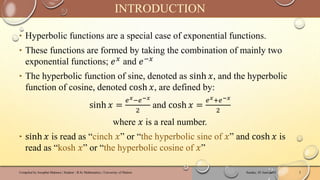
‣ Hyperbolic functions are a special case of exponential functions.
‣ These functions are formed by taking the combination of mainly two
exponential functions; 𝑒𝑥 and 𝑒−𝑥
‣ The hyperbolic function of sine, denoted as sinh 𝑥, and the hyperbolic
function of cosine, denoted cosh 𝑥, are defined by:
sinh 𝑥 =
𝑒𝑥−𝑒−𝑥
2
and cosh 𝑥 =
𝑒𝑥+𝑒−𝑥
2
where 𝑥 is a real number.
‣ sinh 𝑥 is read as “cinch 𝑥” or “the hyperbolic sine of 𝑥” and cosh 𝑥 is
read as “kosh 𝑥” or “the hyperbolic cosine of 𝑥”
Sunday, 02 June 2024
Compiled by Josophat Makawa | Student - B.Sc Mathematics | University of Malawi 2
INTRODUCTION
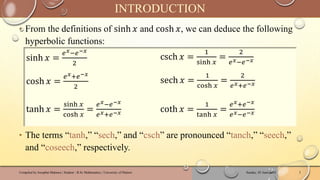
‣ From the definitions of sinh 𝑥 and cosh 𝑥, we can deduce the following
hyperbolic functions:
‣ The terms “tanh,” “sech,” and “csch” are pronounced “tanch,” “seech,”
and “coseech,” respectively.
Sunday, 02 June 2024
Compiled by Josophat Makawa | Student - B.Sc Mathematics | University of Malawi 3
INTRODUCTION
sinh 𝑥 =
𝑒𝑥−𝑒−𝑥
2
csch 𝑥 =
1
sinh 𝑥
=
2
𝑒𝑥−𝑒−𝑥
cosh 𝑥 =
𝑒𝑥+𝑒−𝑥
2
sech 𝑥 =
1
cosh 𝑥
=
2
𝑒𝑥+𝑒−𝑥
tanh 𝑥 =
sinh 𝑥
cosh 𝑥
=
𝑒𝑥−𝑒−𝑥
𝑒𝑥+𝑒−𝑥 coth 𝑥 =
1
tanh 𝑥
=
𝑒𝑥+𝑒−𝑥
𝑒𝑥−𝑒−𝑥
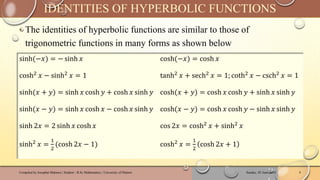
‣ The identities of hyperbolic functions are similar to those of
trigonometric functions in many forms as shown below
Sunday, 02 June 2024
Compiled by Josophat Makawa | Student - B.Sc Mathematics | University of Malawi 4
IDENTITIES OF HYPERBOLIC FUNCTIONS
sinh(−𝑥) = − sinh 𝑥 cosh(−𝑥) = cosh 𝑥
cosh2
𝑥 − sinh2
𝑥 = 1 tanh2
𝑥 + sech2
𝑥 = 1; coth2
𝑥 − csch2
𝑥 = 1
sinh(𝑥 + 𝑦) = sinh 𝑥 cosh 𝑦 + cosh 𝑥 sinh 𝑦 cosh(𝑥 + 𝑦) = cosh 𝑥 cosh 𝑦 + sinh 𝑥 sinh 𝑦
sinh(𝑥 − 𝑦) = sinh 𝑥 cosh 𝑥 − cosh 𝑥 sinh 𝑦 cosh(𝑥 − 𝑦) = cosh 𝑥 cosh 𝑦 − sinh 𝑥 sinh 𝑦
sinh 2𝑥 = 2 sinh 𝑥 cosh 𝑥 cos 2𝑥 = cosh2
𝑥 + sinh2
𝑥
sinh2
𝑥 =
1
2
(cosh 2𝑥 − 1) cosh2
𝑥 =
1
2
cosh 2𝑥 + 1
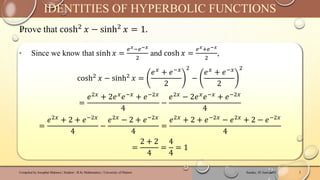
Prove that cosh2
𝑥 − sinh2
𝑥 = 1.
Sunday, 02 June 2024
Compiled by Josophat Makawa | Student - B.Sc Mathematics | University of Malawi 5
IDENTITIES OF HYPERBOLIC FUNCTIONS
‣ Since we know that sinh 𝑥 =
𝑒𝑥−𝑒−𝑥
2
and cosh 𝑥 =
𝑒𝑥+𝑒−𝑥
2
,
cosh2
𝑥 − sinh2
𝑥 =
𝑒𝑥 + 𝑒−𝑥
2
2
−
𝑒𝑥 + 𝑒−𝑥
2
2
=
𝑒2𝑥 + 2𝑒𝑥𝑒−𝑥 + 𝑒−2𝑥
4
−
𝑒2𝑥 − 2𝑒𝑥𝑒−𝑥 + 𝑒−2𝑥
4
=
𝑒2𝑥
+ 2 + 𝑒−2𝑥
4
−
𝑒2𝑥
− 2 + 𝑒−2𝑥
4
=
𝑒2𝑥
+ 2 + 𝑒−2𝑥
− 𝑒2𝑥
+ 2 − 𝑒−2𝑥
4
=
2 + 2
4
=
4
4
= 1
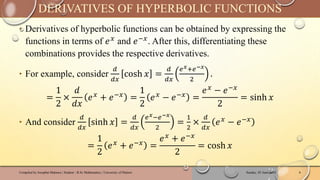
‣ Derivatives of hyperbolic functions can be obtained by expressing the
functions in terms of 𝑒𝑥
and 𝑒−𝑥
. After this, differentiating these
combinations provides the respective derivatives.
‣ For example, consider
𝑑
𝑑𝑥
cosh 𝑥 =
𝑑
𝑑𝑥
𝑒𝑥+𝑒−𝑥
2
.
=
1
2
×
𝑑
𝑑𝑥
𝑒𝑥
+ 𝑒−𝑥
=
1
2
𝑒𝑥
− 𝑒−𝑥
=
𝑒𝑥 − 𝑒−𝑥
2
= sinh 𝑥
‣ And consider
𝑑
𝑑𝑥
sinh 𝑥 =
𝑑
𝑑𝑥
𝑒𝑥−𝑒−𝑥
2
=
1
2
×
𝑑
𝑑𝑥
𝑒𝑥 − 𝑒−𝑥
=
1
2
𝑒𝑥
+ 𝑒−𝑥
=
𝑒𝑥
+ 𝑒−𝑥
2
= cosh 𝑥
Sunday, 02 June 2024
Compiled by Josophat Makawa | Student - B.Sc Mathematics | University of Malawi 6
DERIVATIVES OF HYPERBOLIC FUNCTIONS
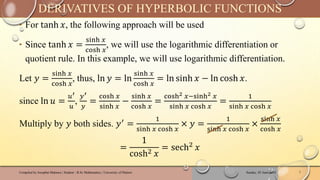
‣ For tanh 𝑥, the following approach will be used
‣ Since tanh 𝑥 =
sinh 𝑥
cosh 𝑥
, we will use the logarithmic differentiation or
quotient rule. In this example, we will use logarithmic differentiation.
Let 𝑦 =
sinh 𝑥
cosh 𝑥
, thus, ln 𝑦 = ln
sinh 𝑥
cosh 𝑥
= ln sinh 𝑥 − ln cosh 𝑥.
since ln 𝑢 =
𝑢′
𝑢
,
𝑦′
𝑦
=
cosh 𝑥
sinh 𝑥
−
sinh 𝑥
cosh 𝑥
=
cosh2 𝑥−sinh2 𝑥
sinh 𝑥 cosh 𝑥
=
1
sinh 𝑥 cosh 𝑥
Multiply by 𝑦 both sides. 𝑦′ =
1
sinh 𝑥 cosh 𝑥
× 𝑦 =
1
sinh 𝑥 cosh 𝑥
×
sinh 𝑥
cosh 𝑥
=
1
cosh2 𝑥
= sech2
𝑥
Sunday, 02 June 2024
Compiled by Josophat Makawa | Student - B.Sc Mathematics | University of Malawi 7
DERIVATIVES OF HYPERBOLIC FUNCTIONS
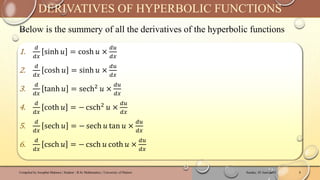
Below is the summery of all the derivatives of the hyperbolic functions
Sunday, 02 June 2024
Compiled by Josophat Makawa | Student - B.Sc Mathematics | University of Malawi 8
DERIVATIVES OF HYPERBOLIC FUNCTIONS
1.
𝑑
𝑑𝑥
sinh 𝑢 = cosh 𝑢 ×
𝑑𝑢
𝑑𝑥
2.
𝑑
𝑑𝑥
cosh 𝑢 = sinh 𝑢 ×
𝑑𝑢
𝑑𝑥
3.
𝑑
𝑑𝑥
tanh 𝑢 = sech2
𝑢 ×
𝑑𝑢
𝑑𝑥
4.
𝑑
𝑑𝑥
coth 𝑢 = − csch2 𝑢 ×
𝑑𝑢
𝑑𝑥
5.
𝑑
𝑑𝑥
sech 𝑢 = − sech 𝑢 tan 𝑢 ×
𝑑𝑢
𝑑𝑥
6.
𝑑
𝑑𝑥
csch 𝑢 = − csch 𝑢 coth 𝑢 ×
𝑑𝑢
𝑑𝑥
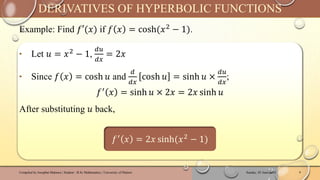
Example: Find 𝑓′(𝑥) if 𝑓 𝑥 = cosh(𝑥2
− 1).
Sunday, 02 June 2024
Compiled by Josophat Makawa | Student - B.Sc Mathematics | University of Malawi 9
DERIVATIVES OF HYPERBOLIC FUNCTIONS
‣ Let 𝑢 = 𝑥2 − 1,
𝑑𝑢
𝑑𝑥
= 2𝑥
‣ Since 𝑓 𝑥 = cosh 𝑢 and
𝑑
𝑑𝑥
cosh 𝑢 = sinh 𝑢 ×
𝑑𝑢
𝑑𝑥
;
𝑓′
𝑥 = sinh 𝑢 × 2𝑥 = 2𝑥 sinh 𝑢
After substituting 𝑢 back,
𝑓′ 𝑥 = 2𝑥 sinh(𝑥2 − 1)
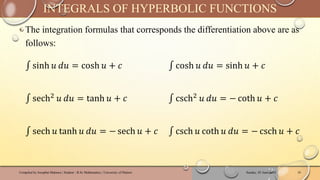
‣ The integration formulas that corresponds the differentiation above are as
follows:
Sunday, 02 June 2024
Compiled by Josophat Makawa | Student - B.Sc Mathematics | University of Malawi 10
INTEGRALS OF HYPERBOLIC FUNCTIONS
‫׬‬ sinh 𝑢 𝑑𝑢 = cosh 𝑢 + 𝑐 ‫׬‬ cosh 𝑢 𝑑𝑢 = sinh 𝑢 + 𝑐
‫׬‬ sech2 𝑢 𝑑𝑢 = tanh 𝑢 + 𝑐 ‫׬‬ csch2 𝑢 𝑑𝑢 = − coth 𝑢 + 𝑐
‫׬‬ sech 𝑢 tanh 𝑢 𝑑𝑢 = − sech 𝑢 + 𝑐 ‫׬‬ csch 𝑢 coth 𝑢 𝑑𝑢 = − csch 𝑢 + 𝑐
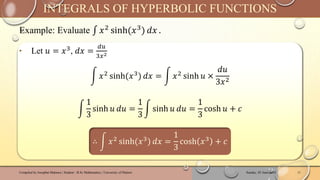
Example: Evaluate ‫׬‬ 𝑥2 sinh(𝑥3) 𝑑𝑥 .
Sunday, 02 June 2024
Compiled by Josophat Makawa | Student - B.Sc Mathematics | University of Malawi 11
INTEGRALS OF HYPERBOLIC FUNCTIONS
‣ Let 𝑢 = 𝑥3, 𝑑𝑥 =
𝑑𝑢
3𝑥2
න 𝑥2 sinh(𝑥3) 𝑑𝑥 = න 𝑥2 sinh 𝑢 ×
𝑑𝑢
3𝑥2
න
1
3
sinh 𝑢 𝑑𝑢 =
1
3
න sinh 𝑢 𝑑𝑢 =
1
3
cosh 𝑢 + 𝑐
∴ න 𝑥2
sinh(𝑥3
) 𝑑𝑥 =
1
3
cosh 𝑥3
+ 𝑐
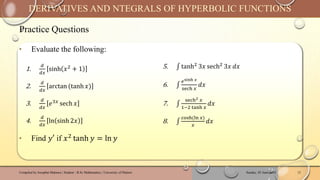
Practice Questions
Sunday, 02 June 2024
Compiled by Josophat Makawa | Student - B.Sc Mathematics | University of Malawi 12
DERIVATIVES AND NTEGRALS OF HYPERBOLIC FUNCTIONS
‣ Evaluate the following:
‣ Find 𝑦′ if 𝑥2
tanh 𝑦 = ln 𝑦
1.
𝑑
𝑑𝑥
sinh 𝑥2 + 1
2.
𝑑
𝑑𝑥
arctan (tanh 𝑥)
3.
𝑑
𝑑𝑥
𝑒3𝑥 sech 𝑥
4.
𝑑
𝑑𝑥
ln sinh 2𝑥
5. ‫׬‬ tanh2 3𝑥 sech2 3𝑥 𝑑𝑥
6. ‫׬‬
𝑒sinh 𝑥
sech 𝑥
𝑑𝑥
7. ‫׬‬
sech2 𝑥
1−2 tanh 𝑥
𝑑𝑥
8. ‫׬‬
cosh(ln 𝑥)
𝑥
𝑑𝑥
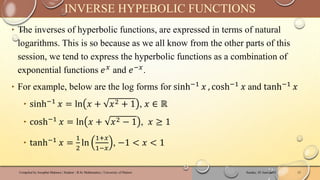
‣ The inverses of hyperbolic functions, are expressed in terms of natural
logarithms. This is so because as we all know from the other parts of this
session, we tend to express the hyperbolic functions as a combination of
exponential functions 𝑒𝑥 and 𝑒−𝑥.
‣ For example, below are the log forms for sinh−1 𝑥 , cosh−1 𝑥 and tanh−1 𝑥
‣ sinh−1 𝑥 = ln 𝑥 + 𝑥2 + 1 , 𝑥 ∈ ℝ
‣ cosh−1 𝑥 = ln 𝑥 + 𝑥2 − 1 , 𝑥 ≥ 1
‣ tanh−1 𝑥 =
1
2
ln
1+𝑥
1−𝑥
, −1 < 𝑥 < 1
Sunday, 02 June 2024
Compiled by Josophat Makawa | Student - B.Sc Mathematics | University of Malawi 13
INVERSE HYPEBOLIC FUNCTIONS
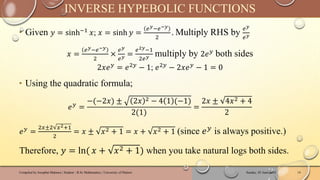
‣ Given 𝑦 = sinh−1 𝑥; 𝑥 = sinh 𝑦 =
𝑒𝑦−𝑒−𝑦
2
. Multiply RHS by
𝑒𝑦
𝑒𝑦
𝑥 =
𝑒𝑦−𝑒−𝑦
2
×
𝑒𝑦
𝑒𝑦 =
𝑒2𝑦−1
2𝑒𝑦 multiply by 2𝑒𝑦
both sides
2𝑥𝑒𝑦
= 𝑒2𝑦
− 1; 𝑒2𝑦
− 2𝑥𝑒𝑦
− 1 = 0
‣ Using the quadratic formula;
𝑒𝑦 =
−(−2𝑥) ± 2𝑥 2 − 4 1 (−1)
2(1)
=
2𝑥 ± 4𝑥2 + 4
2
𝑒𝑦 =
2𝑥±2 𝑥2+1
2
= 𝑥 ± 𝑥2 + 1 = 𝑥 + 𝑥2 + 1 (since 𝑒𝑦 is always positive.)
Therefore, 𝑦 = ln( 𝑥 + 𝑥2 + 1) when you take natural logs both sides.
Sunday, 02 June 2024
Compiled by Josophat Makawa | Student - B.Sc Mathematics | University of Malawi 14
INVERSE HYPEBOLIC FUNCTIONS
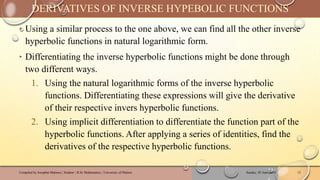
‣ Using a similar process to the one above, we can find all the other inverse
hyperbolic functions in natural logarithmic form.
‣ Differentiating the inverse hyperbolic functions might be done through
two different ways.
1. Using the natural logarithmic forms of the inverse hyperbolic
functions. Differentiating these expressions will give the derivative
of their respective invers hyperbolic functions.
2. Using implicit differentiation to differentiate the function part of the
hyperbolic functions. After applying a series of identities, find the
derivatives of the respective hyperbolic functions.
Sunday, 02 June 2024
Compiled by Josophat Makawa | Student - B.Sc Mathematics | University of Malawi 15
DERIVATIVES OF INVERSE HYPEBOLIC FUNCTIONS
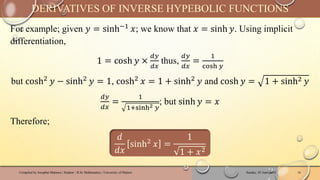
For example; given 𝑦 = sinh−1 𝑥; we know that 𝑥 = sinh 𝑦. Using implicit
differentiation,
1 = cosh 𝑦 ×
𝑑𝑦
𝑑𝑥
thus,
𝑑𝑦
𝑑𝑥
=
1
cosh 𝑦
but cosh2 𝑦 − sinh2 𝑦 = 1, cosh2 𝑥 = 1 + sinh2 𝑦 and cosh 𝑦 = 1 + sinh2 𝑦
𝑑𝑦
𝑑𝑥
=
1
1+sinh2 𝑦
; but sinh 𝑦 = 𝑥
Therefore;
𝑑
𝑑𝑥
sinh2
𝑥 =
1
1 + 𝑥2
Sunday, 02 June 2024
Compiled by Josophat Makawa | Student - B.Sc Mathematics | University of Malawi 16
DERIVATIVES OF INVERSE HYPEBOLIC FUNCTIONS
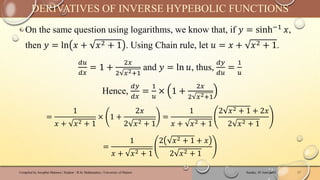
‣ On the same question using logarithms, we know that, if 𝑦 = sinh−1 𝑥,
then 𝑦 = ln 𝑥 + 𝑥2 + 1 . Using Chain rule, let 𝑢 = 𝑥 + 𝑥2 + 1.
𝑑𝑢
𝑑𝑥
= 1 +
2𝑥
2 𝑥2+1
and 𝑦 = ln 𝑢, thus,
𝑑𝑦
𝑑𝑢
=
1
𝑢
Hence,
𝑑𝑦
𝑑𝑥
=
1
𝑢
× 1 +
2𝑥
2 𝑥2+1
=
1
𝑥 + 𝑥2 + 1
× 1 +
2𝑥
2 𝑥2 + 1
=
1
𝑥 + 𝑥2 + 1
2 𝑥2 + 1 + 2𝑥
2 𝑥2 + 1
=
1
𝑥 + 𝑥2 + 1
2 𝑥2 + 1 + 𝑥
2 𝑥2 + 1
Sunday, 02 June 2024
Compiled by Josophat Makawa | Student - B.Sc Mathematics | University of Malawi 17
DERIVATIVES OF INVERSE HYPEBOLIC FUNCTIONS
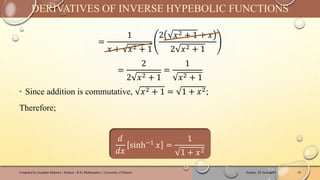
=
1
𝑥 + 𝑥2 + 1
2 𝑥2 + 1 + 𝑥
2 𝑥2 + 1
=
2
2 𝑥2 + 1
=
1
𝑥2 + 1
‣ Since addition is commutative, 𝑥2 + 1 = 1 + 𝑥2;
Therefore;
𝑑
𝑑𝑥
sinh−1
𝑥 =
1
1 + 𝑥2
Sunday, 02 June 2024
Compiled by Josophat Makawa | Student - B.Sc Mathematics | University of Malawi 18
DERIVATIVES OF INVERSE HYPEBOLIC FUNCTIONS
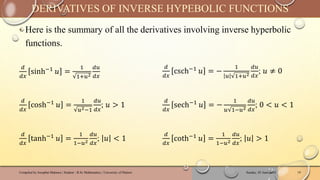
‣ Here is the summary of all the derivatives involving inverse hyperbolic
functions.
Sunday, 02 June 2024
Compiled by Josophat Makawa | Student - B.Sc Mathematics | University of Malawi 19
DERIVATIVES OF INVERSE HYPEBOLIC FUNCTIONS
𝑑
𝑑𝑥
sinh−1 𝑢 =
1
1+𝑢2
𝑑𝑢
𝑑𝑥
𝑑
𝑑𝑥
csch−1 𝑢 = −
1
𝑢 1+𝑢2
𝑑𝑢
𝑑𝑥
; 𝑢 ≠ 0
𝑑
𝑑𝑥
cosh−1 𝑢 =
1
𝑢2−1
𝑑𝑢
𝑑𝑥
; 𝑢 > 1
𝑑
𝑑𝑥
sech−1 𝑢 = −
1
𝑢 1−𝑢2
𝑑𝑢
𝑑𝑥
; 0 < 𝑢 < 1
𝑑
𝑑𝑥
tanh−1
𝑢 =
1
1−𝑢2
𝑑𝑢
𝑑𝑥
; 𝑢 < 1
𝑑
𝑑𝑥
coth−1
𝑢 =
1
1−𝑢2
𝑑𝑢
𝑑𝑥
; 𝑢 > 1
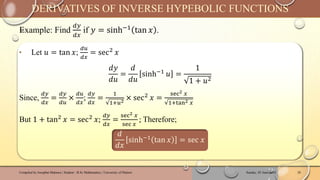
Example: Find
𝑑𝑦
𝑑𝑥
if 𝑦 = sinh−1
tan 𝑥 .
Sunday, 02 June 2024
Compiled by Josophat Makawa | Student - B.Sc Mathematics | University of Malawi 20
DERIVATIVES OF INVERSE HYPEBOLIC FUNCTIONS
‣ Let 𝑢 = tan 𝑥;
𝑑𝑢
𝑑𝑥
= sec2 𝑥
𝑑𝑦
𝑑𝑢
=
𝑑
𝑑𝑢
sinh−1 𝑢 =
1
1 + 𝑢2
Since,
𝑑𝑦
𝑑𝑥
=
𝑑𝑦
𝑑𝑢
×
𝑑𝑢
𝑑𝑥
;
𝑑𝑦
𝑑𝑥
=
1
1+𝑢2
× sec2 𝑥 =
sec2 𝑥
1+tan2 𝑥
But 1 + tan2
𝑥 = sec2
𝑥;
𝑑𝑦
𝑑𝑥
=
sec2 𝑥
sec 𝑥
; Therefore;
𝑑
𝑑𝑥
sinh−1 tan 𝑥 = sec 𝑥
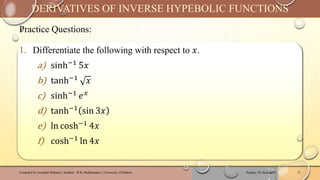
Practice Questions:
Sunday, 02 June 2024
Compiled by Josophat Makawa | Student - B.Sc Mathematics | University of Malawi 21
DERIVATIVES OF INVERSE HYPEBOLIC FUNCTIONS
1. Differentiate the following with respect to 𝑥.
a) sinh−1
5𝑥
b) tanh−1 𝑥
c) sinh−1 𝑒𝑥
d) tanh−1 sin 3𝑥
e) ln cosh−1 4𝑥
f) cosh−1 ln 4𝑥
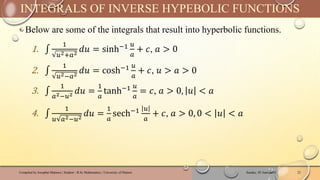
‣ Below are some of the integrals that result into hyperbolic functions.
1. ‫׬‬
1
𝑢2+𝑎2
𝑑𝑢 = sinh−1 𝑢
𝑎
+ 𝑐, 𝑎 > 0
2. ‫׬‬
1
𝑢2−𝑎2
𝑑𝑢 = cosh−1 𝑢
𝑎
+ 𝑐, 𝑢 > 𝑎 > 0
3. ‫׬‬
1
𝑎2−𝑢2 𝑑𝑢 =
1
𝑎
tanh−1 𝑢
𝑎
= 𝑐, 𝑎 > 0, 𝑢 < 𝑎
4. ‫׬‬
1
𝑢 𝑎2−𝑢2
𝑑𝑢 =
1
𝑎
sech−1 𝑢
𝑎
+ 𝑐, 𝑎 > 0, 0 < 𝑢 < 𝑎
Sunday, 02 June 2024
Compiled by Josophat Makawa | Student - B.Sc Mathematics | University of Malawi 22
INTEGRALS OF INVERSE HYPEBOLIC FUNCTIONS
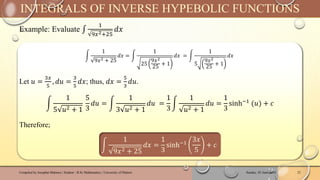
Example: Evaluate ‫׬‬
1
9𝑥2+25
𝑑𝑥
Sunday, 02 June 2024
Compiled by Josophat Makawa | Student - B.Sc Mathematics | University of Malawi 23
INTEGRALS OF INVERSE HYPEBOLIC FUNCTIONS
න
1
9𝑥2 + 25
𝑑𝑥 = න
1
25
9𝑥2
25
+ 1
𝑑𝑥 = න
1
5
9𝑥2
25
+ 1
𝑑𝑥
Let 𝑢 =
3𝑥
5
, 𝑑𝑢 =
3
5
𝑑𝑥; thus, 𝑑𝑥 =
5
3
𝑑𝑢.
න
1
5 𝑢2 + 1
5
3
𝑑𝑢 = න
1
3 𝑢2 + 1
𝑑𝑢 =
1
3
න
1
𝑢2 + 1
𝑑𝑢 =
1
3
sinh−1
(𝑢) + 𝑐
Therefore;
න
1
9𝑥2 + 25
𝑑𝑥 =
1
3
sinh−1
3𝑥
5
+ 𝑐
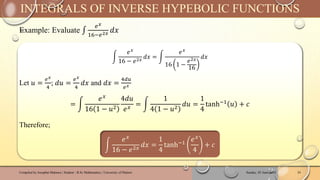
Example: Evaluate ‫׬‬
𝑒𝑥
16−𝑒2𝑥 𝑑𝑥
Sunday, 02 June 2024
Compiled by Josophat Makawa | Student - B.Sc Mathematics | University of Malawi 24
INTEGRALS OF INVERSE HYPEBOLIC FUNCTIONS
න
𝑒𝑥
16 − 𝑒2𝑥
𝑑𝑥 = න
𝑒𝑥
16 1 −
𝑒2𝑥
16
𝑑𝑥
Let 𝑢 =
𝑒𝑥
4
; 𝑑𝑢 =
𝑒𝑥
4
𝑑𝑥 and 𝑑𝑥 =
4𝑑𝑢
𝑒𝑥
= න
𝑒𝑥
16 1 − 𝑢2
4𝑑𝑢
𝑒𝑥
= න
1
4 1 − 𝑢2
𝑑𝑢 =
1
4
tanh−1
𝑢 + 𝑐
Therefore;
න
𝑒𝑥
16 − 𝑒2𝑥 𝑑𝑥 =
1
4
tanh−1
𝑒𝑥
4
+ 𝑐
Practice Questions
Sunday, 02 June 2024
Compiled by Josophat Makawa | Student - B.Sc Mathematics | University of Malawi 25
INTEGRALS OF INVERSE HYPEBOLIC FUNCTIONS
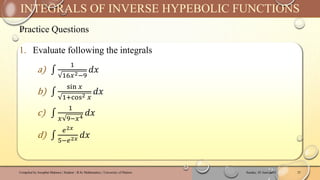
1. Evaluate following the integrals
a) ‫׬‬
1
16𝑥2−9
𝑑𝑥
b) ‫׬‬
sin 𝑥
1+cos2 𝑥
𝑑𝑥
c) ‫׬‬
1
𝑥 9−𝑥4
𝑑𝑥
d) ‫׬‬
𝑒2𝑥
5−𝑒2𝑥 𝑑𝑥
Josophat Makawa
bsc-mat-14-21@unima.ac.mw
+265 999 978 828
+265 880 563 256

MAT221: CALCULUS II - Hyperbolic Functions.pdf

  • 1.
  • 2.
    ‣ Hyperbolic functionsare a special case of exponential functions. ‣ These functions are formed by taking the combination of mainly two exponential functions; 𝑒𝑥 and 𝑒−𝑥 ‣ The hyperbolic function of sine, denoted as sinh 𝑥, and the hyperbolic function of cosine, denoted cosh 𝑥, are defined by: sinh 𝑥 = 𝑒𝑥−𝑒−𝑥 2 and cosh 𝑥 = 𝑒𝑥+𝑒−𝑥 2 where 𝑥 is a real number. ‣ sinh 𝑥 is read as “cinch 𝑥” or “the hyperbolic sine of 𝑥” and cosh 𝑥 is read as “kosh 𝑥” or “the hyperbolic cosine of 𝑥” Sunday, 02 June 2024 Compiled by Josophat Makawa | Student - B.Sc Mathematics | University of Malawi 2 INTRODUCTION
  • 3.
    ‣ From thedefinitions of sinh 𝑥 and cosh 𝑥, we can deduce the following hyperbolic functions: ‣ The terms “tanh,” “sech,” and “csch” are pronounced “tanch,” “seech,” and “coseech,” respectively. Sunday, 02 June 2024 Compiled by Josophat Makawa | Student - B.Sc Mathematics | University of Malawi 3 INTRODUCTION sinh 𝑥 = 𝑒𝑥−𝑒−𝑥 2 csch 𝑥 = 1 sinh 𝑥 = 2 𝑒𝑥−𝑒−𝑥 cosh 𝑥 = 𝑒𝑥+𝑒−𝑥 2 sech 𝑥 = 1 cosh 𝑥 = 2 𝑒𝑥+𝑒−𝑥 tanh 𝑥 = sinh 𝑥 cosh 𝑥 = 𝑒𝑥−𝑒−𝑥 𝑒𝑥+𝑒−𝑥 coth 𝑥 = 1 tanh 𝑥 = 𝑒𝑥+𝑒−𝑥 𝑒𝑥−𝑒−𝑥
  • 4.
    ‣ The identitiesof hyperbolic functions are similar to those of trigonometric functions in many forms as shown below Sunday, 02 June 2024 Compiled by Josophat Makawa | Student - B.Sc Mathematics | University of Malawi 4 IDENTITIES OF HYPERBOLIC FUNCTIONS sinh(−𝑥) = − sinh 𝑥 cosh(−𝑥) = cosh 𝑥 cosh2 𝑥 − sinh2 𝑥 = 1 tanh2 𝑥 + sech2 𝑥 = 1; coth2 𝑥 − csch2 𝑥 = 1 sinh(𝑥 + 𝑦) = sinh 𝑥 cosh 𝑦 + cosh 𝑥 sinh 𝑦 cosh(𝑥 + 𝑦) = cosh 𝑥 cosh 𝑦 + sinh 𝑥 sinh 𝑦 sinh(𝑥 − 𝑦) = sinh 𝑥 cosh 𝑥 − cosh 𝑥 sinh 𝑦 cosh(𝑥 − 𝑦) = cosh 𝑥 cosh 𝑦 − sinh 𝑥 sinh 𝑦 sinh 2𝑥 = 2 sinh 𝑥 cosh 𝑥 cos 2𝑥 = cosh2 𝑥 + sinh2 𝑥 sinh2 𝑥 = 1 2 (cosh 2𝑥 − 1) cosh2 𝑥 = 1 2 cosh 2𝑥 + 1
  • 5.
    Prove that cosh2 𝑥− sinh2 𝑥 = 1. Sunday, 02 June 2024 Compiled by Josophat Makawa | Student - B.Sc Mathematics | University of Malawi 5 IDENTITIES OF HYPERBOLIC FUNCTIONS ‣ Since we know that sinh 𝑥 = 𝑒𝑥−𝑒−𝑥 2 and cosh 𝑥 = 𝑒𝑥+𝑒−𝑥 2 , cosh2 𝑥 − sinh2 𝑥 = 𝑒𝑥 + 𝑒−𝑥 2 2 − 𝑒𝑥 + 𝑒−𝑥 2 2 = 𝑒2𝑥 + 2𝑒𝑥𝑒−𝑥 + 𝑒−2𝑥 4 − 𝑒2𝑥 − 2𝑒𝑥𝑒−𝑥 + 𝑒−2𝑥 4 = 𝑒2𝑥 + 2 + 𝑒−2𝑥 4 − 𝑒2𝑥 − 2 + 𝑒−2𝑥 4 = 𝑒2𝑥 + 2 + 𝑒−2𝑥 − 𝑒2𝑥 + 2 − 𝑒−2𝑥 4 = 2 + 2 4 = 4 4 = 1
  • 6.
    ‣ Derivatives ofhyperbolic functions can be obtained by expressing the functions in terms of 𝑒𝑥 and 𝑒−𝑥 . After this, differentiating these combinations provides the respective derivatives. ‣ For example, consider 𝑑 𝑑𝑥 cosh 𝑥 = 𝑑 𝑑𝑥 𝑒𝑥+𝑒−𝑥 2 . = 1 2 × 𝑑 𝑑𝑥 𝑒𝑥 + 𝑒−𝑥 = 1 2 𝑒𝑥 − 𝑒−𝑥 = 𝑒𝑥 − 𝑒−𝑥 2 = sinh 𝑥 ‣ And consider 𝑑 𝑑𝑥 sinh 𝑥 = 𝑑 𝑑𝑥 𝑒𝑥−𝑒−𝑥 2 = 1 2 × 𝑑 𝑑𝑥 𝑒𝑥 − 𝑒−𝑥 = 1 2 𝑒𝑥 + 𝑒−𝑥 = 𝑒𝑥 + 𝑒−𝑥 2 = cosh 𝑥 Sunday, 02 June 2024 Compiled by Josophat Makawa | Student - B.Sc Mathematics | University of Malawi 6 DERIVATIVES OF HYPERBOLIC FUNCTIONS
  • 7.
    ‣ For tanh𝑥, the following approach will be used ‣ Since tanh 𝑥 = sinh 𝑥 cosh 𝑥 , we will use the logarithmic differentiation or quotient rule. In this example, we will use logarithmic differentiation. Let 𝑦 = sinh 𝑥 cosh 𝑥 , thus, ln 𝑦 = ln sinh 𝑥 cosh 𝑥 = ln sinh 𝑥 − ln cosh 𝑥. since ln 𝑢 = 𝑢′ 𝑢 , 𝑦′ 𝑦 = cosh 𝑥 sinh 𝑥 − sinh 𝑥 cosh 𝑥 = cosh2 𝑥−sinh2 𝑥 sinh 𝑥 cosh 𝑥 = 1 sinh 𝑥 cosh 𝑥 Multiply by 𝑦 both sides. 𝑦′ = 1 sinh 𝑥 cosh 𝑥 × 𝑦 = 1 sinh 𝑥 cosh 𝑥 × sinh 𝑥 cosh 𝑥 = 1 cosh2 𝑥 = sech2 𝑥 Sunday, 02 June 2024 Compiled by Josophat Makawa | Student - B.Sc Mathematics | University of Malawi 7 DERIVATIVES OF HYPERBOLIC FUNCTIONS
  • 8.
    Below is thesummery of all the derivatives of the hyperbolic functions Sunday, 02 June 2024 Compiled by Josophat Makawa | Student - B.Sc Mathematics | University of Malawi 8 DERIVATIVES OF HYPERBOLIC FUNCTIONS 1. 𝑑 𝑑𝑥 sinh 𝑢 = cosh 𝑢 × 𝑑𝑢 𝑑𝑥 2. 𝑑 𝑑𝑥 cosh 𝑢 = sinh 𝑢 × 𝑑𝑢 𝑑𝑥 3. 𝑑 𝑑𝑥 tanh 𝑢 = sech2 𝑢 × 𝑑𝑢 𝑑𝑥 4. 𝑑 𝑑𝑥 coth 𝑢 = − csch2 𝑢 × 𝑑𝑢 𝑑𝑥 5. 𝑑 𝑑𝑥 sech 𝑢 = − sech 𝑢 tan 𝑢 × 𝑑𝑢 𝑑𝑥 6. 𝑑 𝑑𝑥 csch 𝑢 = − csch 𝑢 coth 𝑢 × 𝑑𝑢 𝑑𝑥
  • 9.
    Example: Find 𝑓′(𝑥)if 𝑓 𝑥 = cosh(𝑥2 − 1). Sunday, 02 June 2024 Compiled by Josophat Makawa | Student - B.Sc Mathematics | University of Malawi 9 DERIVATIVES OF HYPERBOLIC FUNCTIONS ‣ Let 𝑢 = 𝑥2 − 1, 𝑑𝑢 𝑑𝑥 = 2𝑥 ‣ Since 𝑓 𝑥 = cosh 𝑢 and 𝑑 𝑑𝑥 cosh 𝑢 = sinh 𝑢 × 𝑑𝑢 𝑑𝑥 ; 𝑓′ 𝑥 = sinh 𝑢 × 2𝑥 = 2𝑥 sinh 𝑢 After substituting 𝑢 back, 𝑓′ 𝑥 = 2𝑥 sinh(𝑥2 − 1)
  • 10.
    ‣ The integrationformulas that corresponds the differentiation above are as follows: Sunday, 02 June 2024 Compiled by Josophat Makawa | Student - B.Sc Mathematics | University of Malawi 10 INTEGRALS OF HYPERBOLIC FUNCTIONS ‫׬‬ sinh 𝑢 𝑑𝑢 = cosh 𝑢 + 𝑐 ‫׬‬ cosh 𝑢 𝑑𝑢 = sinh 𝑢 + 𝑐 ‫׬‬ sech2 𝑢 𝑑𝑢 = tanh 𝑢 + 𝑐 ‫׬‬ csch2 𝑢 𝑑𝑢 = − coth 𝑢 + 𝑐 ‫׬‬ sech 𝑢 tanh 𝑢 𝑑𝑢 = − sech 𝑢 + 𝑐 ‫׬‬ csch 𝑢 coth 𝑢 𝑑𝑢 = − csch 𝑢 + 𝑐
  • 11.
    Example: Evaluate ‫׬‬𝑥2 sinh(𝑥3) 𝑑𝑥 . Sunday, 02 June 2024 Compiled by Josophat Makawa | Student - B.Sc Mathematics | University of Malawi 11 INTEGRALS OF HYPERBOLIC FUNCTIONS ‣ Let 𝑢 = 𝑥3, 𝑑𝑥 = 𝑑𝑢 3𝑥2 න 𝑥2 sinh(𝑥3) 𝑑𝑥 = න 𝑥2 sinh 𝑢 × 𝑑𝑢 3𝑥2 න 1 3 sinh 𝑢 𝑑𝑢 = 1 3 න sinh 𝑢 𝑑𝑢 = 1 3 cosh 𝑢 + 𝑐 ∴ න 𝑥2 sinh(𝑥3 ) 𝑑𝑥 = 1 3 cosh 𝑥3 + 𝑐
  • 12.
    Practice Questions Sunday, 02June 2024 Compiled by Josophat Makawa | Student - B.Sc Mathematics | University of Malawi 12 DERIVATIVES AND NTEGRALS OF HYPERBOLIC FUNCTIONS ‣ Evaluate the following: ‣ Find 𝑦′ if 𝑥2 tanh 𝑦 = ln 𝑦 1. 𝑑 𝑑𝑥 sinh 𝑥2 + 1 2. 𝑑 𝑑𝑥 arctan (tanh 𝑥) 3. 𝑑 𝑑𝑥 𝑒3𝑥 sech 𝑥 4. 𝑑 𝑑𝑥 ln sinh 2𝑥 5. ‫׬‬ tanh2 3𝑥 sech2 3𝑥 𝑑𝑥 6. ‫׬‬ 𝑒sinh 𝑥 sech 𝑥 𝑑𝑥 7. ‫׬‬ sech2 𝑥 1−2 tanh 𝑥 𝑑𝑥 8. ‫׬‬ cosh(ln 𝑥) 𝑥 𝑑𝑥
  • 13.
    ‣ The inversesof hyperbolic functions, are expressed in terms of natural logarithms. This is so because as we all know from the other parts of this session, we tend to express the hyperbolic functions as a combination of exponential functions 𝑒𝑥 and 𝑒−𝑥. ‣ For example, below are the log forms for sinh−1 𝑥 , cosh−1 𝑥 and tanh−1 𝑥 ‣ sinh−1 𝑥 = ln 𝑥 + 𝑥2 + 1 , 𝑥 ∈ ℝ ‣ cosh−1 𝑥 = ln 𝑥 + 𝑥2 − 1 , 𝑥 ≥ 1 ‣ tanh−1 𝑥 = 1 2 ln 1+𝑥 1−𝑥 , −1 < 𝑥 < 1 Sunday, 02 June 2024 Compiled by Josophat Makawa | Student - B.Sc Mathematics | University of Malawi 13 INVERSE HYPEBOLIC FUNCTIONS
  • 14.
    ‣ Given 𝑦= sinh−1 𝑥; 𝑥 = sinh 𝑦 = 𝑒𝑦−𝑒−𝑦 2 . Multiply RHS by 𝑒𝑦 𝑒𝑦 𝑥 = 𝑒𝑦−𝑒−𝑦 2 × 𝑒𝑦 𝑒𝑦 = 𝑒2𝑦−1 2𝑒𝑦 multiply by 2𝑒𝑦 both sides 2𝑥𝑒𝑦 = 𝑒2𝑦 − 1; 𝑒2𝑦 − 2𝑥𝑒𝑦 − 1 = 0 ‣ Using the quadratic formula; 𝑒𝑦 = −(−2𝑥) ± 2𝑥 2 − 4 1 (−1) 2(1) = 2𝑥 ± 4𝑥2 + 4 2 𝑒𝑦 = 2𝑥±2 𝑥2+1 2 = 𝑥 ± 𝑥2 + 1 = 𝑥 + 𝑥2 + 1 (since 𝑒𝑦 is always positive.) Therefore, 𝑦 = ln( 𝑥 + 𝑥2 + 1) when you take natural logs both sides. Sunday, 02 June 2024 Compiled by Josophat Makawa | Student - B.Sc Mathematics | University of Malawi 14 INVERSE HYPEBOLIC FUNCTIONS
  • 15.
    ‣ Using asimilar process to the one above, we can find all the other inverse hyperbolic functions in natural logarithmic form. ‣ Differentiating the inverse hyperbolic functions might be done through two different ways. 1. Using the natural logarithmic forms of the inverse hyperbolic functions. Differentiating these expressions will give the derivative of their respective invers hyperbolic functions. 2. Using implicit differentiation to differentiate the function part of the hyperbolic functions. After applying a series of identities, find the derivatives of the respective hyperbolic functions. Sunday, 02 June 2024 Compiled by Josophat Makawa | Student - B.Sc Mathematics | University of Malawi 15 DERIVATIVES OF INVERSE HYPEBOLIC FUNCTIONS
  • 16.
    For example; given𝑦 = sinh−1 𝑥; we know that 𝑥 = sinh 𝑦. Using implicit differentiation, 1 = cosh 𝑦 × 𝑑𝑦 𝑑𝑥 thus, 𝑑𝑦 𝑑𝑥 = 1 cosh 𝑦 but cosh2 𝑦 − sinh2 𝑦 = 1, cosh2 𝑥 = 1 + sinh2 𝑦 and cosh 𝑦 = 1 + sinh2 𝑦 𝑑𝑦 𝑑𝑥 = 1 1+sinh2 𝑦 ; but sinh 𝑦 = 𝑥 Therefore; 𝑑 𝑑𝑥 sinh2 𝑥 = 1 1 + 𝑥2 Sunday, 02 June 2024 Compiled by Josophat Makawa | Student - B.Sc Mathematics | University of Malawi 16 DERIVATIVES OF INVERSE HYPEBOLIC FUNCTIONS
  • 17.
    ‣ On thesame question using logarithms, we know that, if 𝑦 = sinh−1 𝑥, then 𝑦 = ln 𝑥 + 𝑥2 + 1 . Using Chain rule, let 𝑢 = 𝑥 + 𝑥2 + 1. 𝑑𝑢 𝑑𝑥 = 1 + 2𝑥 2 𝑥2+1 and 𝑦 = ln 𝑢, thus, 𝑑𝑦 𝑑𝑢 = 1 𝑢 Hence, 𝑑𝑦 𝑑𝑥 = 1 𝑢 × 1 + 2𝑥 2 𝑥2+1 = 1 𝑥 + 𝑥2 + 1 × 1 + 2𝑥 2 𝑥2 + 1 = 1 𝑥 + 𝑥2 + 1 2 𝑥2 + 1 + 2𝑥 2 𝑥2 + 1 = 1 𝑥 + 𝑥2 + 1 2 𝑥2 + 1 + 𝑥 2 𝑥2 + 1 Sunday, 02 June 2024 Compiled by Josophat Makawa | Student - B.Sc Mathematics | University of Malawi 17 DERIVATIVES OF INVERSE HYPEBOLIC FUNCTIONS
  • 18.
    = 1 𝑥 + 𝑥2+ 1 2 𝑥2 + 1 + 𝑥 2 𝑥2 + 1 = 2 2 𝑥2 + 1 = 1 𝑥2 + 1 ‣ Since addition is commutative, 𝑥2 + 1 = 1 + 𝑥2; Therefore; 𝑑 𝑑𝑥 sinh−1 𝑥 = 1 1 + 𝑥2 Sunday, 02 June 2024 Compiled by Josophat Makawa | Student - B.Sc Mathematics | University of Malawi 18 DERIVATIVES OF INVERSE HYPEBOLIC FUNCTIONS
  • 19.
    ‣ Here isthe summary of all the derivatives involving inverse hyperbolic functions. Sunday, 02 June 2024 Compiled by Josophat Makawa | Student - B.Sc Mathematics | University of Malawi 19 DERIVATIVES OF INVERSE HYPEBOLIC FUNCTIONS 𝑑 𝑑𝑥 sinh−1 𝑢 = 1 1+𝑢2 𝑑𝑢 𝑑𝑥 𝑑 𝑑𝑥 csch−1 𝑢 = − 1 𝑢 1+𝑢2 𝑑𝑢 𝑑𝑥 ; 𝑢 ≠ 0 𝑑 𝑑𝑥 cosh−1 𝑢 = 1 𝑢2−1 𝑑𝑢 𝑑𝑥 ; 𝑢 > 1 𝑑 𝑑𝑥 sech−1 𝑢 = − 1 𝑢 1−𝑢2 𝑑𝑢 𝑑𝑥 ; 0 < 𝑢 < 1 𝑑 𝑑𝑥 tanh−1 𝑢 = 1 1−𝑢2 𝑑𝑢 𝑑𝑥 ; 𝑢 < 1 𝑑 𝑑𝑥 coth−1 𝑢 = 1 1−𝑢2 𝑑𝑢 𝑑𝑥 ; 𝑢 > 1
  • 20.
    Example: Find 𝑑𝑦 𝑑𝑥 if 𝑦= sinh−1 tan 𝑥 . Sunday, 02 June 2024 Compiled by Josophat Makawa | Student - B.Sc Mathematics | University of Malawi 20 DERIVATIVES OF INVERSE HYPEBOLIC FUNCTIONS ‣ Let 𝑢 = tan 𝑥; 𝑑𝑢 𝑑𝑥 = sec2 𝑥 𝑑𝑦 𝑑𝑢 = 𝑑 𝑑𝑢 sinh−1 𝑢 = 1 1 + 𝑢2 Since, 𝑑𝑦 𝑑𝑥 = 𝑑𝑦 𝑑𝑢 × 𝑑𝑢 𝑑𝑥 ; 𝑑𝑦 𝑑𝑥 = 1 1+𝑢2 × sec2 𝑥 = sec2 𝑥 1+tan2 𝑥 But 1 + tan2 𝑥 = sec2 𝑥; 𝑑𝑦 𝑑𝑥 = sec2 𝑥 sec 𝑥 ; Therefore; 𝑑 𝑑𝑥 sinh−1 tan 𝑥 = sec 𝑥
  • 21.
    Practice Questions: Sunday, 02June 2024 Compiled by Josophat Makawa | Student - B.Sc Mathematics | University of Malawi 21 DERIVATIVES OF INVERSE HYPEBOLIC FUNCTIONS 1. Differentiate the following with respect to 𝑥. a) sinh−1 5𝑥 b) tanh−1 𝑥 c) sinh−1 𝑒𝑥 d) tanh−1 sin 3𝑥 e) ln cosh−1 4𝑥 f) cosh−1 ln 4𝑥
  • 22.
    ‣ Below aresome of the integrals that result into hyperbolic functions. 1. ‫׬‬ 1 𝑢2+𝑎2 𝑑𝑢 = sinh−1 𝑢 𝑎 + 𝑐, 𝑎 > 0 2. ‫׬‬ 1 𝑢2−𝑎2 𝑑𝑢 = cosh−1 𝑢 𝑎 + 𝑐, 𝑢 > 𝑎 > 0 3. ‫׬‬ 1 𝑎2−𝑢2 𝑑𝑢 = 1 𝑎 tanh−1 𝑢 𝑎 = 𝑐, 𝑎 > 0, 𝑢 < 𝑎 4. ‫׬‬ 1 𝑢 𝑎2−𝑢2 𝑑𝑢 = 1 𝑎 sech−1 𝑢 𝑎 + 𝑐, 𝑎 > 0, 0 < 𝑢 < 𝑎 Sunday, 02 June 2024 Compiled by Josophat Makawa | Student - B.Sc Mathematics | University of Malawi 22 INTEGRALS OF INVERSE HYPEBOLIC FUNCTIONS
  • 23.
    Example: Evaluate ‫׬‬ 1 9𝑥2+25 𝑑𝑥 Sunday,02 June 2024 Compiled by Josophat Makawa | Student - B.Sc Mathematics | University of Malawi 23 INTEGRALS OF INVERSE HYPEBOLIC FUNCTIONS න 1 9𝑥2 + 25 𝑑𝑥 = න 1 25 9𝑥2 25 + 1 𝑑𝑥 = න 1 5 9𝑥2 25 + 1 𝑑𝑥 Let 𝑢 = 3𝑥 5 , 𝑑𝑢 = 3 5 𝑑𝑥; thus, 𝑑𝑥 = 5 3 𝑑𝑢. න 1 5 𝑢2 + 1 5 3 𝑑𝑢 = න 1 3 𝑢2 + 1 𝑑𝑢 = 1 3 න 1 𝑢2 + 1 𝑑𝑢 = 1 3 sinh−1 (𝑢) + 𝑐 Therefore; න 1 9𝑥2 + 25 𝑑𝑥 = 1 3 sinh−1 3𝑥 5 + 𝑐
  • 24.
    Example: Evaluate ‫׬‬ 𝑒𝑥 16−𝑒2𝑥𝑑𝑥 Sunday, 02 June 2024 Compiled by Josophat Makawa | Student - B.Sc Mathematics | University of Malawi 24 INTEGRALS OF INVERSE HYPEBOLIC FUNCTIONS න 𝑒𝑥 16 − 𝑒2𝑥 𝑑𝑥 = න 𝑒𝑥 16 1 − 𝑒2𝑥 16 𝑑𝑥 Let 𝑢 = 𝑒𝑥 4 ; 𝑑𝑢 = 𝑒𝑥 4 𝑑𝑥 and 𝑑𝑥 = 4𝑑𝑢 𝑒𝑥 = න 𝑒𝑥 16 1 − 𝑢2 4𝑑𝑢 𝑒𝑥 = න 1 4 1 − 𝑢2 𝑑𝑢 = 1 4 tanh−1 𝑢 + 𝑐 Therefore; න 𝑒𝑥 16 − 𝑒2𝑥 𝑑𝑥 = 1 4 tanh−1 𝑒𝑥 4 + 𝑐
  • 25.
    Practice Questions Sunday, 02June 2024 Compiled by Josophat Makawa | Student - B.Sc Mathematics | University of Malawi 25 INTEGRALS OF INVERSE HYPEBOLIC FUNCTIONS 1. Evaluate following the integrals a) ‫׬‬ 1 16𝑥2−9 𝑑𝑥 b) ‫׬‬ sin 𝑥 1+cos2 𝑥 𝑑𝑥 c) ‫׬‬ 1 𝑥 9−𝑥4 𝑑𝑥 d) ‫׬‬ 𝑒2𝑥 5−𝑒2𝑥 𝑑𝑥
  • 26.