PRESENTATION ON
Difference between pure and mixed state for a density operator
&
Density operator for time evaluation
Presented by:
Group: 4
MS-231703, MS-231709, MS-
231718, MS-231722, MS-231727,
MS-231737, MS-231739, MS-
231740, MS-231745
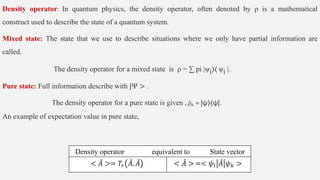
Density operator: In quantum physics, the density operator, often denoted by ρ is a mathematical
construct used to describe the state of a quantum system.
Mixed state: The state that we use to describe situations where we only have partial information are
called.
The density operator for a mixed state is ρ = ∑ pi |ψi⟩⟨ ψi |.
Pure state: Full information describe with |Ψ > .
The density operator for a pure state is given , 𝜌𝑘 = |ψ⟩⟨ψ|.
An example of expectation value in pure state,
Density operator equivalent to State vector
< 𝐴 >= 𝑇𝑟 𝐴. 𝐴 < 𝐴 > =< 𝜓𝑙 𝐴 𝜓𝑘 >
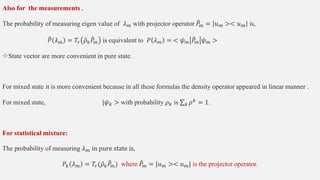
Also for the measurements ,
The probability of measuring eigen value of 𝜆𝑚 with projector operator 𝑃𝑚 = 𝑢𝑚 >< 𝑢𝑚 is,
𝑃 𝜆𝑚 = 𝑇𝑟 𝜌𝑘𝑃𝑚 is equivalent to 𝑃 𝜆𝑚 = < 𝜓𝑚 𝑃
𝑚 𝜓𝑚 >
State vector are more convenient in pure state.
For mixed state it is more convenient because in all these formulas the density operator appeared in linear manner .
For mixed state, |𝜓𝑘 > with probability 𝜌𝑘 is 𝑘 𝜌𝑘 = 1.
For statistical mixture:
The probability of measuring 𝜆𝑚 in pure state is,
𝑃𝑘 𝜆𝑚 = 𝑇𝑟(𝜌𝑘𝑃
𝑚) where 𝑃𝑚 = |𝑢𝑚 >< 𝑢𝑚| is the projector operator.
The total probability of measuring 𝜆𝑚 in statistical mixture is equal to the sum of likelihood of each state
there multiplied the probability 𝜆𝑚.
𝑃 𝜆𝑚 = 𝑘 𝑝𝑘𝑇𝑟(𝜌𝑘𝑃𝑚)
𝑊ℎ𝑒𝑟𝑒 𝑇𝑟 is a linear operation so that 𝑇𝑟 𝑎𝑀 = 𝑎𝑇𝑟 𝑀 = 𝑎𝑇𝑟 𝑀
Now applying this condition above equation,
𝑃 𝜆𝑚 = 𝑇𝑟 𝑘 𝑝𝑘
𝜌𝑘
𝑃𝑚 = 𝑇𝑟 𝜌𝑃𝑚 [ where 𝜌 𝑠𝑐𝑎𝑙𝑎𝑟 𝑚𝑎𝑡𝑟𝑖𝑥]
This is the over all probability of 𝜆𝑚 is mixed state.
Then this is same as the probability outcome of measurement in a pure state.
Normalization:
Pure state: Tr (𝜌𝑘) = 1
Let us write an analogous formula for mixed state.
ρ = 𝑘 𝑝𝑘𝜌𝑘
Tr(ρ) = Tr ( 𝑘 𝑝𝑘𝜌𝑘) = 𝑘 𝑝𝑘𝑇𝑟(𝜌𝑘) [ Applying linearity operation]
= 𝑘 𝑝𝑘
= 1
For statistical mixture seem over all probabilities is equal to 1.
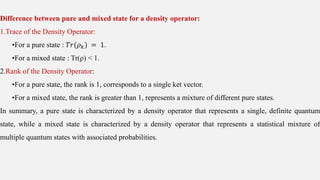
Difference between pure and mixed state for a density operator:
1.Trace of the Density Operator:
•For a pure state : 𝑇𝑟(𝜌𝑘) = 1.
•For a mixed state : Tr(ρ) < 1.
2.Rank of the Density Operator:
•For a pure state, the rank is 1, corresponds to a single ket vector.
•For a mixed state, the rank is greater than 1, represents a mixture of different pure states.
In summary, a pure state is characterized by a density operator that represents a single, definite quantum
state, while a mixed state is characterized by a density operator that represents a statistical mixture of
multiple quantum states with associated probabilities.
Density operator for Time evaluation:
 For pure state, applying Hamiltonian operator,
𝑑
𝑑𝑡
𝜌𝑘 𝑡 =
1
𝑖ℏ
[𝐻 𝑡 , 𝜌𝑘(𝑡)]
 For mixed state, we don’t know what precise state we are in, we know the statistical distribution of
states.
If the Hamiltonian 𝐻 𝑡 of the system is known, then the derivative of the density operator for the mixed
state,
𝑑
𝑑𝑡
𝜌 𝑡 =
𝑘
𝑝𝑘
𝑑
𝑑𝑡
𝜌𝑘 𝑡
= 𝑘 𝑝𝑘
1
𝑖ℏ
𝐻 𝑡 , 𝜌𝑘(𝑡)
=
1
𝑖ℏ
𝐻 𝑡 , 𝑘 𝑝𝑘
𝜌𝑘(𝑡)
∴
𝑑
𝑑𝑡
𝜌 𝑡 =
1
𝑖ℏ
[𝐻 𝑡 , 𝜌(𝑡)]
It is very convenient change the density operator for pure state to the mixed state by this relations ,
𝜌𝑘 = Ψ𝑘 × Ψ𝑘 → 𝜌 = 𝑘 𝑝𝑘 𝜌𝑘
Then for pure state: ⟩
|Ψ𝑘 ⇒ 𝜌𝑘 = Ψ𝑘 × Ψ𝑘
This 𝜌 is a projection operator and it is independent, i.e., 𝜌𝑘
2
= 𝜌𝑘
𝑇𝑟 𝜌𝑘
2
= 𝑇𝑟(𝜌𝑘)
= 1 [as normalization]
For pure state : 𝑇𝑟 𝜌𝑘
2
= 1
For mixed state, 𝜌 = 𝑘 𝑝𝑘 Ψ𝑘 × Ψ𝑘
𝜌2
= 𝑘,𝑙 𝑝𝑘𝑝𝑙 Ψ𝑘 × Ψ𝑘 Ψ𝑙 × Ψ𝑙|
𝜌2 = 𝑘 𝑝𝑘
2
Ψ𝑘 × Ψ𝑘 [different states are orthogonal]
= 𝑘 𝑝𝑘
2
𝜌𝑘
∴ 𝑇𝑟 𝜌2
= 𝑇𝑟 𝑘 𝑝𝑘
2
𝜌𝑘 = 𝑘 𝑝𝑘
2
𝑇𝑟𝜌𝑘 = 𝑘 𝑝𝑘
2
In mixed state at least two different 𝑝𝑘 are nonzero because if we only had one nonzero 𝑝𝑘 , then that
would be a pure state.
For mixed state 𝑘 𝑝𝑘 = 1 [ 0 ≤ 𝑝𝑘 < 1]
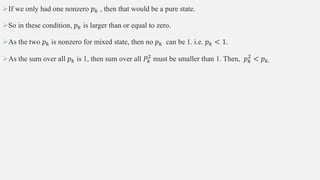
If we only had one nonzero 𝑝𝑘 , then that would be a pure state.
So in these condition, 𝑝𝑘 is larger than or equal to zero.
As the two 𝑝𝑘 is nonzero for mixed state, then no 𝑝𝑘 can be 1. i.e. 𝑝𝑘 < 1.
As the sum over all 𝑝𝑘 is 1, then sum over all 𝑃𝑘
2
must be smaller than 1. Then, 𝑝𝑘
2
< 𝑝𝑘.
THANK YOU

Pure state and mixed state.pptx

  • 1.
    PRESENTATION ON Difference betweenpure and mixed state for a density operator & Density operator for time evaluation Presented by: Group: 4 MS-231703, MS-231709, MS- 231718, MS-231722, MS-231727, MS-231737, MS-231739, MS- 231740, MS-231745
  • 2.
    Density operator: Inquantum physics, the density operator, often denoted by ρ is a mathematical construct used to describe the state of a quantum system. Mixed state: The state that we use to describe situations where we only have partial information are called. The density operator for a mixed state is ρ = ∑ pi |ψi⟩⟨ ψi |. Pure state: Full information describe with |Ψ > . The density operator for a pure state is given , 𝜌𝑘 = |ψ⟩⟨ψ|. An example of expectation value in pure state, Density operator equivalent to State vector < 𝐴 >= 𝑇𝑟 𝐴. 𝐴 < 𝐴 > =< 𝜓𝑙 𝐴 𝜓𝑘 >
  • 3.
    Also for themeasurements , The probability of measuring eigen value of 𝜆𝑚 with projector operator 𝑃𝑚 = 𝑢𝑚 >< 𝑢𝑚 is, 𝑃 𝜆𝑚 = 𝑇𝑟 𝜌𝑘𝑃𝑚 is equivalent to 𝑃 𝜆𝑚 = < 𝜓𝑚 𝑃 𝑚 𝜓𝑚 > State vector are more convenient in pure state. For mixed state it is more convenient because in all these formulas the density operator appeared in linear manner . For mixed state, |𝜓𝑘 > with probability 𝜌𝑘 is 𝑘 𝜌𝑘 = 1. For statistical mixture: The probability of measuring 𝜆𝑚 in pure state is, 𝑃𝑘 𝜆𝑚 = 𝑇𝑟(𝜌𝑘𝑃 𝑚) where 𝑃𝑚 = |𝑢𝑚 >< 𝑢𝑚| is the projector operator.
  • 4.
    The total probabilityof measuring 𝜆𝑚 in statistical mixture is equal to the sum of likelihood of each state there multiplied the probability 𝜆𝑚. 𝑃 𝜆𝑚 = 𝑘 𝑝𝑘𝑇𝑟(𝜌𝑘𝑃𝑚) 𝑊ℎ𝑒𝑟𝑒 𝑇𝑟 is a linear operation so that 𝑇𝑟 𝑎𝑀 = 𝑎𝑇𝑟 𝑀 = 𝑎𝑇𝑟 𝑀 Now applying this condition above equation, 𝑃 𝜆𝑚 = 𝑇𝑟 𝑘 𝑝𝑘 𝜌𝑘 𝑃𝑚 = 𝑇𝑟 𝜌𝑃𝑚 [ where 𝜌 𝑠𝑐𝑎𝑙𝑎𝑟 𝑚𝑎𝑡𝑟𝑖𝑥] This is the over all probability of 𝜆𝑚 is mixed state. Then this is same as the probability outcome of measurement in a pure state.
  • 5.
    Normalization: Pure state: Tr(𝜌𝑘) = 1 Let us write an analogous formula for mixed state. ρ = 𝑘 𝑝𝑘𝜌𝑘 Tr(ρ) = Tr ( 𝑘 𝑝𝑘𝜌𝑘) = 𝑘 𝑝𝑘𝑇𝑟(𝜌𝑘) [ Applying linearity operation] = 𝑘 𝑝𝑘 = 1 For statistical mixture seem over all probabilities is equal to 1.
  • 6.
    Difference between pureand mixed state for a density operator: 1.Trace of the Density Operator: •For a pure state : 𝑇𝑟(𝜌𝑘) = 1. •For a mixed state : Tr(ρ) < 1. 2.Rank of the Density Operator: •For a pure state, the rank is 1, corresponds to a single ket vector. •For a mixed state, the rank is greater than 1, represents a mixture of different pure states. In summary, a pure state is characterized by a density operator that represents a single, definite quantum state, while a mixed state is characterized by a density operator that represents a statistical mixture of multiple quantum states with associated probabilities.
  • 7.
    Density operator forTime evaluation:  For pure state, applying Hamiltonian operator, 𝑑 𝑑𝑡 𝜌𝑘 𝑡 = 1 𝑖ℏ [𝐻 𝑡 , 𝜌𝑘(𝑡)]  For mixed state, we don’t know what precise state we are in, we know the statistical distribution of states. If the Hamiltonian 𝐻 𝑡 of the system is known, then the derivative of the density operator for the mixed state, 𝑑 𝑑𝑡 𝜌 𝑡 = 𝑘 𝑝𝑘 𝑑 𝑑𝑡 𝜌𝑘 𝑡 = 𝑘 𝑝𝑘 1 𝑖ℏ 𝐻 𝑡 , 𝜌𝑘(𝑡) = 1 𝑖ℏ 𝐻 𝑡 , 𝑘 𝑝𝑘 𝜌𝑘(𝑡) ∴ 𝑑 𝑑𝑡 𝜌 𝑡 = 1 𝑖ℏ [𝐻 𝑡 , 𝜌(𝑡)]
  • 8.
    It is veryconvenient change the density operator for pure state to the mixed state by this relations , 𝜌𝑘 = Ψ𝑘 × Ψ𝑘 → 𝜌 = 𝑘 𝑝𝑘 𝜌𝑘 Then for pure state: ⟩ |Ψ𝑘 ⇒ 𝜌𝑘 = Ψ𝑘 × Ψ𝑘 This 𝜌 is a projection operator and it is independent, i.e., 𝜌𝑘 2 = 𝜌𝑘 𝑇𝑟 𝜌𝑘 2 = 𝑇𝑟(𝜌𝑘) = 1 [as normalization]
  • 9.
    For pure state: 𝑇𝑟 𝜌𝑘 2 = 1 For mixed state, 𝜌 = 𝑘 𝑝𝑘 Ψ𝑘 × Ψ𝑘 𝜌2 = 𝑘,𝑙 𝑝𝑘𝑝𝑙 Ψ𝑘 × Ψ𝑘 Ψ𝑙 × Ψ𝑙| 𝜌2 = 𝑘 𝑝𝑘 2 Ψ𝑘 × Ψ𝑘 [different states are orthogonal] = 𝑘 𝑝𝑘 2 𝜌𝑘 ∴ 𝑇𝑟 𝜌2 = 𝑇𝑟 𝑘 𝑝𝑘 2 𝜌𝑘 = 𝑘 𝑝𝑘 2 𝑇𝑟𝜌𝑘 = 𝑘 𝑝𝑘 2 In mixed state at least two different 𝑝𝑘 are nonzero because if we only had one nonzero 𝑝𝑘 , then that would be a pure state. For mixed state 𝑘 𝑝𝑘 = 1 [ 0 ≤ 𝑝𝑘 < 1]
  • 10.
    If we onlyhad one nonzero 𝑝𝑘 , then that would be a pure state. So in these condition, 𝑝𝑘 is larger than or equal to zero. As the two 𝑝𝑘 is nonzero for mixed state, then no 𝑝𝑘 can be 1. i.e. 𝑝𝑘 < 1. As the sum over all 𝑝𝑘 is 1, then sum over all 𝑃𝑘 2 must be smaller than 1. Then, 𝑝𝑘 2 < 𝑝𝑘.
  • 11.