Inverse Functions
Chapter 3
This Photo by Unknown Author is licensed under CC BY
One-to-One Functions
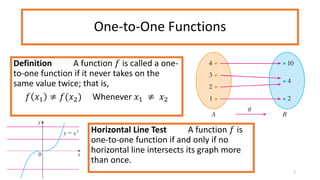
Definition A function 𝑓 is called a one-
to-one function if it never takes on the
same value twice; that is,
𝑓 𝑥1 ≠ 𝑓(𝑥2) Whenever 𝑥1 ≠ 𝑥2
2
Horizontal Line Test A function 𝑓 is
one-to-one function if and only if no
horizontal line intersects its graph more
than once.
Inverse Functions
3
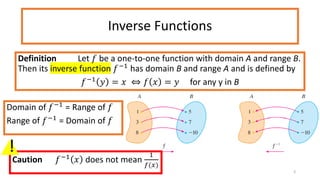
Definition Let 𝑓 be a one-to-one function with domain A and range B.
Then its inverse function 𝑓−1 has domain B and range A and is defined by
𝑓−1
𝑦 = 𝑥 ⇔ 𝑓 𝑥 = 𝑦 for any y in B
Domain of 𝑓−1
= Range of 𝑓
Range of 𝑓−1
= Domain of 𝑓
Caution 𝑓−1 𝑥 does not mean
1
𝑓(𝑥)
!
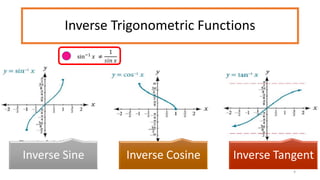
Inverse Trigonometric Functions
Inverse Sine Inverse Cosine Inverse Tangent
4
sin−1 𝑥 ≠
1
𝑠𝑖𝑛 𝑥
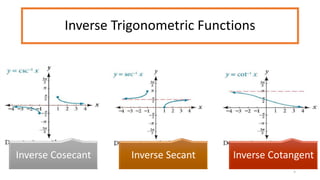
Inverse Trigonometric Functions
Inverse Cosecant Inverse Secant Inverse Cotangent
5
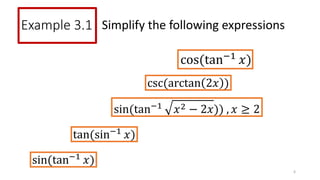
Example 3.1
6
Simplify the following expressions
sin(tan−1
𝑥2 − 2𝑥)) , 𝑥 ≥ 2
csc(arctan 2𝑥 )
tan(sin−1
𝑥)
sin(tan−1
𝑥)
cos(tan−1
𝑥)
7
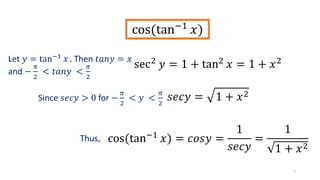
cos(tan−1
𝑥)
sec2
𝑦 = 1 + tan2
𝑥 = 1 + 𝑥2
𝑠𝑒𝑐𝑦 = 1 + 𝑥2
cos(tan−1
𝑥) = 𝑐𝑜𝑠𝑦 =
1
𝑠𝑒𝑐𝑦
=
1
1 + 𝑥2
Let 𝑦 = tan−1 𝑥 . Then 𝑡𝑎𝑛𝑦 = 𝑥
and −
𝜋
2
< 𝑡𝑎𝑛𝑦 <
𝜋
2
Since 𝑠𝑒𝑐𝑦 > 0 for −
𝜋
2
< 𝑦 <
𝜋
2
Thus,
8
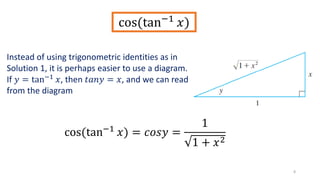
cos(tan−1
𝑥)
cos(tan−1
𝑥) = 𝑐𝑜𝑠𝑦 =
1
1 + 𝑥2
Instead of using trigonometric identities as in
Solution 1, it is perhaps easier to use a diagram.
If 𝑦 = tan−1 𝑥, then 𝑡𝑎𝑛𝑦 = 𝑥, and we can read
from the diagram
9
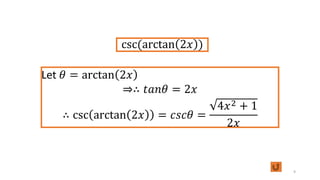
csc(arctan 2𝑥 )
Let 𝜃 = arctan 2𝑥
⇒∴ 𝑡𝑎𝑛𝜃 = 2𝑥
∴ csc arctan 2𝑥 = 𝑐𝑠𝑐𝜃 =
4𝑥2 + 1
2𝑥
10
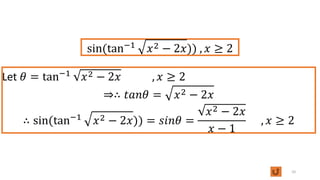
sin(tan−1
𝑥2 − 2𝑥)) , 𝑥 ≥ 2
Let 𝜃 = tan−1
𝑥2 − 2𝑥 , 𝑥 ≥ 2
⇒∴ 𝑡𝑎𝑛𝜃 = 𝑥2 − 2𝑥
∴ sin(tan−1
𝑥2 − 2𝑥)) = 𝑠𝑖𝑛𝜃 =
𝑥2 − 2𝑥
𝑥 − 1
, 𝑥 ≥ 2
11
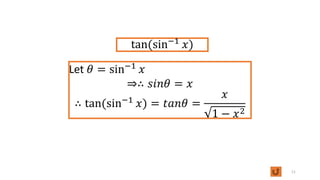
tan(sin−1
𝑥)
Let 𝜃 = sin−1
𝑥
⇒∴ 𝑠𝑖𝑛𝜃 = 𝑥
∴ tan(sin−1
𝑥) = 𝑡𝑎𝑛𝜃 =
𝑥
1 − 𝑥2
12
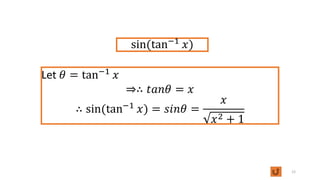
sin(tan−1
𝑥)
Let 𝜃 = tan−1
𝑥
⇒∴ 𝑡𝑎𝑛𝜃 = 𝑥
∴ sin(tan−1
𝑥) = 𝑠𝑖𝑛𝜃 =
𝑥
𝑥2 + 1
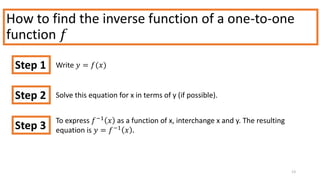
How to find the inverse function of a one-to-one
function 𝑓
13
Step 1
Step 2
Step 3
Write 𝑦 = 𝑓(𝑥)
Solve this equation for x in terms of y (if possible).
To express 𝑓−1 𝑥 as a function of x, interchange x and y. The resulting
equation is 𝑦 = 𝑓−1 𝑥 .
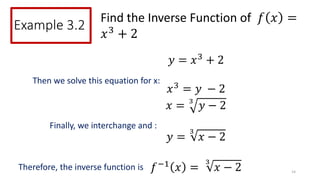
Example 3.2
14
Find the Inverse Function of 𝑓 𝑥 =
𝑥3
+ 2
𝑦 = 𝑥3
+ 2
𝑥3
= 𝑦 − 2
𝑥 = 3
𝑦 − 2
𝑦 =
3
𝑥 − 2
𝑓−1
𝑥 =
3
𝑥 − 2
Then we solve this equation for x:
Finally, we interchange and :
Therefore, the inverse function is
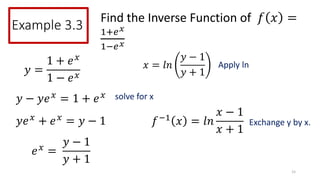
Example 3.3
15
Find the Inverse Function of 𝑓 𝑥 =
1+𝑒𝑥
1−𝑒𝑥
𝑥 = 𝑙𝑛
𝑦 − 1
𝑦 + 1
solve for x
Exchange y by x.
Apply ln
𝑦 =
1 + 𝑒𝑥
1 − 𝑒𝑥
𝑦 − 𝑦𝑒𝑥
= 1 + 𝑒𝑥
𝑦𝑒𝑥
+ 𝑒𝑥
= 𝑦 − 1
𝑒𝑥
=
𝑦 − 1
𝑦 + 1
𝑓−1
𝑥 = 𝑙𝑛
𝑥 − 1
𝑥 + 1
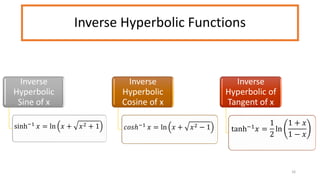
Inverse Hyperbolic Functions
Inverse
Hyperbolic
Sine of x
sinh−1
𝑥 = ln 𝑥 + 𝑥2 + 1
Inverse
Hyperbolic
Cosine of x
𝑐𝑜𝑠ℎ−1 𝑥 = ln 𝑥 + 𝑥2 − 1
Inverse
Hyperbolic of
Tangent of x
tanh−1
𝑥 =
1
2
ln
1 + 𝑥
1 − 𝑥
16
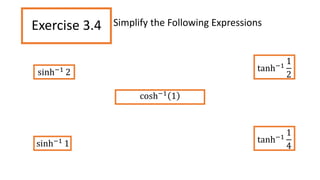
Exercise 3.4
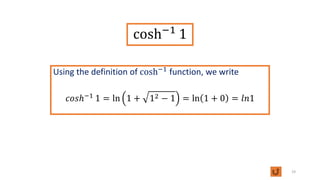
cosh−1 1
Simplify the Following Expressions
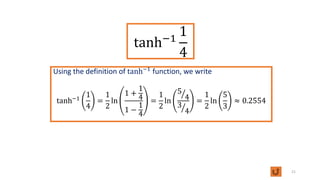
tanh−1
1
4
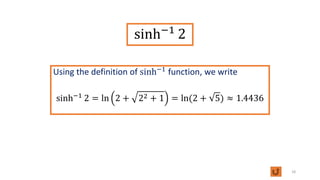
sinh−1 2
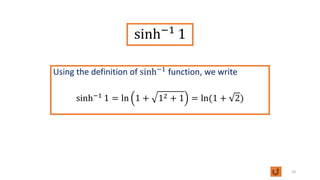
sinh−1 1
tanh−1
1
2
sinh−1
2
Using the definition of sinh−1 function, we write
sinh−1
2 = ln 2 + 22 + 1 = ln(2 + 5) ≈ 1.4436
18
cosh−1
1
Using the definition of cosh−1 function, we write
𝑐𝑜𝑠ℎ−1
1 = ln 1 + 12 − 1 = ln 1 + 0 = 𝑙𝑛1
19
sinh−1
1
Using the definition of sinh−1 function, we write
sinh−1
1 = ln 1 + 12 + 1 = ln(1 + 2)
20
tanh−1
1
4
Using the definition of tanh−1 function, we write
tanh−1
1
4
=
1
2
ln
1 +
1
4
1 −
1
4
=
1
2
ln
ൗ
5
4
ൗ
3
4
=
1
2
ln
5
3
≈ 0.2554
21
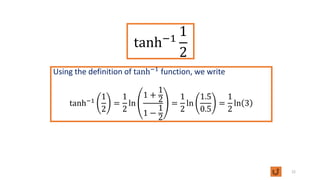
tanh−1
1
2
Using the definition of tanh−1 function, we write
tanh−1
1
2
=
1
2
ln
1 +
1
2
1 −
1
2
=
1
2
ln
1.5
0.5
=
1
2
ln 3
22
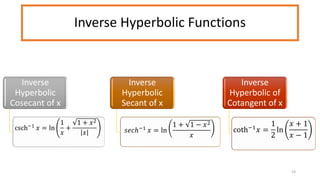
Inverse Hyperbolic Functions
Inverse
Hyperbolic
Cosecant of x
csch−1 𝑥 = ln
1
𝑥
+
1 + 𝑥2
𝑥
Inverse
Hyperbolic
Secant of x
𝑠𝑒𝑐ℎ−1
𝑥 = ln
1 + 1 − 𝑥2
𝑥
Inverse
Hyperbolic of
Cotangent of x
coth−1𝑥 =
1
2
ln
𝑥 + 1
𝑥 − 1
23
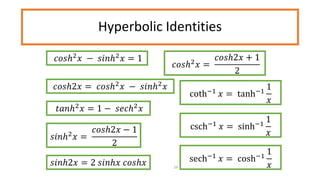
Hyperbolic Identities
24
𝑐𝑜𝑠ℎ2𝑥 − 𝑠𝑖𝑛ℎ2𝑥 = 1
coth−1 𝑥 = tanh−1
1
𝑥
csch−1 𝑥 = sinh−1
1
𝑥
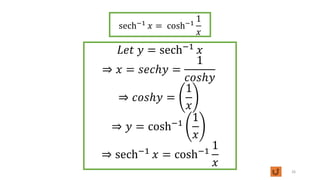
sech−1 𝑥 = cosh−1
1
𝑥
𝑡𝑎𝑛ℎ2𝑥 = 1 − 𝑠𝑒𝑐ℎ2𝑥
𝑠𝑖𝑛ℎ2𝑥 =
𝑐𝑜𝑠ℎ2𝑥 − 1
2
𝑐𝑜𝑠ℎ2𝑥 =
𝑐𝑜𝑠ℎ2𝑥 + 1
2
𝑐𝑜𝑠ℎ2𝑥 = 𝑐𝑜𝑠ℎ2
𝑥 − 𝑠𝑖𝑛ℎ2
𝑥
𝑠𝑖𝑛ℎ2𝑥 = 2 𝑠𝑖𝑛ℎ𝑥 𝑐𝑜𝑠ℎ𝑥
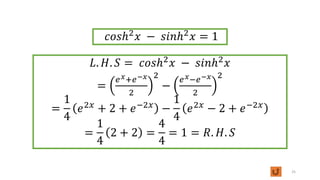
𝐿. 𝐻. 𝑆 = 𝑐𝑜𝑠ℎ2
𝑥 − 𝑠𝑖𝑛ℎ2
𝑥
=
𝑒𝑥+𝑒−𝑥
2
2
−
𝑒𝑥−𝑒−𝑥
2
2
=
1
4
𝑒2𝑥
+ 2 + 𝑒−2𝑥
−
1
4
𝑒2𝑥
− 2 + 𝑒−2𝑥
=
1
4
2 + 2 =
4
4
= 1 = 𝑅. 𝐻. 𝑆
25
𝑐𝑜𝑠ℎ2
𝑥 − 𝑠𝑖𝑛ℎ2
𝑥 = 1
𝐿𝑒𝑡 𝑦 = sech−1
𝑥
⇒ 𝑥 = 𝑠𝑒𝑐ℎ𝑦 =
1
𝑐𝑜𝑠ℎ𝑦
⇒ 𝑐𝑜𝑠ℎ𝑦 =
1
𝑥
⇒ 𝑦 = cosh−1
1
𝑥
⇒ sech−1
𝑥 = cosh−1
1
𝑥
26
sech−1
𝑥 = cosh−1
1
𝑥
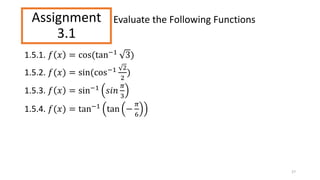
Assignment
3.1
1.5.1. 𝑓 𝑥 = cos(tan−1 3)
1.5.2. 𝑓(𝑥) = sin(cos−1 2
2
)
1.5.3. 𝑓 𝑥 = sin−1 𝑠𝑖𝑛
𝜋
3
1.5.4. 𝑓(𝑥) = tan−1
tan −
𝜋
6
27
Evaluate the Following Functions
Assignment
3.2
1.4.1.1. 𝑓 𝑥 = 𝑥2 − 4 , 𝑥 ≥ 0
1.4.1.2. 𝑓 𝑥 =
3
𝑥 − 4
1.4.1.3. 𝑓 𝑥 = 𝑥3 + 1
1.4.1.4. 𝑓 𝑥 = 𝑥 − 1 2 , 𝑥 ≤ 1
1.4.1.5. 𝑓 𝑥 = 𝑥 − 1
1.4.1.6. 𝑓 𝑥 =
1
𝑥+2
1.4.1.7. 𝑓 𝑥 = 2𝑥 + 𝑙𝑛𝑥, find𝑓−1(2)
28
Find the inverse Functions and their domain
and range of the following expressions
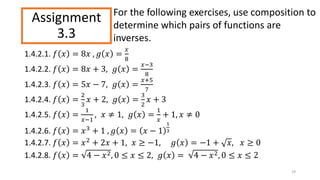
Assignment
3.3
1.4.2.1. 𝑓 𝑥 = 8𝑥 , 𝑔 𝑥 =
𝑥
8
1.4.2.2. 𝑓 𝑥 = 8𝑥 + 3, 𝑔 𝑥 =
𝑥−3
8
1.4.2.3. 𝑓 𝑥 = 5𝑥 − 7, 𝑔 𝑥 =
𝑥+5
7
1.4.2.4. 𝑓 𝑥 =
2
3
𝑥 + 2, 𝑔 𝑥 =
3
2
𝑥 + 3
1.4.2.5. 𝑓 𝑥 =
1
𝑥−1
, 𝑥 ≠ 1, 𝑔 𝑥 =
1
𝑥
+ 1, 𝑥 ≠ 0
1.4.2.6. 𝑓 𝑥 = 𝑥3
+ 1 , 𝑔 𝑥 = 𝑥 − 1
1
3
1.4.2.7. 𝑓 𝑥 = 𝑥2 + 2𝑥 + 1, 𝑥 ≥ −1, 𝑔 𝑥 = −1 + 𝑥, 𝑥 ≥ 0
1.4.2.8. 𝑓 𝑥 = 4 − 𝑥2, 0 ≤ 𝑥 ≤ 2, 𝑔 𝑥 = 4 − 𝑥2, 0 ≤ 𝑥 ≤ 2
29
For the following exercises, use composition to
determine which pairs of functions are
inverses.
Chapter 3 - Inverse Functions.pdf

  • 1.
    Inverse Functions Chapter 3 ThisPhoto by Unknown Author is licensed under CC BY
  • 2.
    One-to-One Functions Definition Afunction 𝑓 is called a one- to-one function if it never takes on the same value twice; that is, 𝑓 𝑥1 ≠ 𝑓(𝑥2) Whenever 𝑥1 ≠ 𝑥2 2 Horizontal Line Test A function 𝑓 is one-to-one function if and only if no horizontal line intersects its graph more than once.
  • 3.
    Inverse Functions 3 Definition Let𝑓 be a one-to-one function with domain A and range B. Then its inverse function 𝑓−1 has domain B and range A and is defined by 𝑓−1 𝑦 = 𝑥 ⇔ 𝑓 𝑥 = 𝑦 for any y in B Domain of 𝑓−1 = Range of 𝑓 Range of 𝑓−1 = Domain of 𝑓 Caution 𝑓−1 𝑥 does not mean 1 𝑓(𝑥) !
  • 4.
    Inverse Trigonometric Functions InverseSine Inverse Cosine Inverse Tangent 4 sin−1 𝑥 ≠ 1 𝑠𝑖𝑛 𝑥
  • 5.
    Inverse Trigonometric Functions InverseCosecant Inverse Secant Inverse Cotangent 5
  • 6.
    Example 3.1 6 Simplify thefollowing expressions sin(tan−1 𝑥2 − 2𝑥)) , 𝑥 ≥ 2 csc(arctan 2𝑥 ) tan(sin−1 𝑥) sin(tan−1 𝑥) cos(tan−1 𝑥)
  • 7.
    7 cos(tan−1 𝑥) sec2 𝑦 = 1+ tan2 𝑥 = 1 + 𝑥2 𝑠𝑒𝑐𝑦 = 1 + 𝑥2 cos(tan−1 𝑥) = 𝑐𝑜𝑠𝑦 = 1 𝑠𝑒𝑐𝑦 = 1 1 + 𝑥2 Let 𝑦 = tan−1 𝑥 . Then 𝑡𝑎𝑛𝑦 = 𝑥 and − 𝜋 2 < 𝑡𝑎𝑛𝑦 < 𝜋 2 Since 𝑠𝑒𝑐𝑦 > 0 for − 𝜋 2 < 𝑦 < 𝜋 2 Thus,
  • 8.
    8 cos(tan−1 𝑥) cos(tan−1 𝑥) = 𝑐𝑜𝑠𝑦= 1 1 + 𝑥2 Instead of using trigonometric identities as in Solution 1, it is perhaps easier to use a diagram. If 𝑦 = tan−1 𝑥, then 𝑡𝑎𝑛𝑦 = 𝑥, and we can read from the diagram
  • 9.
    9 csc(arctan 2𝑥 ) Let𝜃 = arctan 2𝑥 ⇒∴ 𝑡𝑎𝑛𝜃 = 2𝑥 ∴ csc arctan 2𝑥 = 𝑐𝑠𝑐𝜃 = 4𝑥2 + 1 2𝑥
  • 10.
    10 sin(tan−1 𝑥2 − 2𝑥)), 𝑥 ≥ 2 Let 𝜃 = tan−1 𝑥2 − 2𝑥 , 𝑥 ≥ 2 ⇒∴ 𝑡𝑎𝑛𝜃 = 𝑥2 − 2𝑥 ∴ sin(tan−1 𝑥2 − 2𝑥)) = 𝑠𝑖𝑛𝜃 = 𝑥2 − 2𝑥 𝑥 − 1 , 𝑥 ≥ 2
  • 11.
    11 tan(sin−1 𝑥) Let 𝜃 =sin−1 𝑥 ⇒∴ 𝑠𝑖𝑛𝜃 = 𝑥 ∴ tan(sin−1 𝑥) = 𝑡𝑎𝑛𝜃 = 𝑥 1 − 𝑥2
  • 12.
    12 sin(tan−1 𝑥) Let 𝜃 =tan−1 𝑥 ⇒∴ 𝑡𝑎𝑛𝜃 = 𝑥 ∴ sin(tan−1 𝑥) = 𝑠𝑖𝑛𝜃 = 𝑥 𝑥2 + 1
  • 13.
    How to findthe inverse function of a one-to-one function 𝑓 13 Step 1 Step 2 Step 3 Write 𝑦 = 𝑓(𝑥) Solve this equation for x in terms of y (if possible). To express 𝑓−1 𝑥 as a function of x, interchange x and y. The resulting equation is 𝑦 = 𝑓−1 𝑥 .
  • 14.
    Example 3.2 14 Find theInverse Function of 𝑓 𝑥 = 𝑥3 + 2 𝑦 = 𝑥3 + 2 𝑥3 = 𝑦 − 2 𝑥 = 3 𝑦 − 2 𝑦 = 3 𝑥 − 2 𝑓−1 𝑥 = 3 𝑥 − 2 Then we solve this equation for x: Finally, we interchange and : Therefore, the inverse function is
  • 15.
    Example 3.3 15 Find theInverse Function of 𝑓 𝑥 = 1+𝑒𝑥 1−𝑒𝑥 𝑥 = 𝑙𝑛 𝑦 − 1 𝑦 + 1 solve for x Exchange y by x. Apply ln 𝑦 = 1 + 𝑒𝑥 1 − 𝑒𝑥 𝑦 − 𝑦𝑒𝑥 = 1 + 𝑒𝑥 𝑦𝑒𝑥 + 𝑒𝑥 = 𝑦 − 1 𝑒𝑥 = 𝑦 − 1 𝑦 + 1 𝑓−1 𝑥 = 𝑙𝑛 𝑥 − 1 𝑥 + 1
  • 16.
    Inverse Hyperbolic Functions Inverse Hyperbolic Sineof x sinh−1 𝑥 = ln 𝑥 + 𝑥2 + 1 Inverse Hyperbolic Cosine of x 𝑐𝑜𝑠ℎ−1 𝑥 = ln 𝑥 + 𝑥2 − 1 Inverse Hyperbolic of Tangent of x tanh−1 𝑥 = 1 2 ln 1 + 𝑥 1 − 𝑥 16
  • 17.
    Exercise 3.4 cosh−1 1 Simplifythe Following Expressions tanh−1 1 4 sinh−1 2 sinh−1 1 tanh−1 1 2
  • 18.
    sinh−1 2 Using the definitionof sinh−1 function, we write sinh−1 2 = ln 2 + 22 + 1 = ln(2 + 5) ≈ 1.4436 18
  • 19.
    cosh−1 1 Using the definitionof cosh−1 function, we write 𝑐𝑜𝑠ℎ−1 1 = ln 1 + 12 − 1 = ln 1 + 0 = 𝑙𝑛1 19
  • 20.
    sinh−1 1 Using the definitionof sinh−1 function, we write sinh−1 1 = ln 1 + 12 + 1 = ln(1 + 2) 20
  • 21.
    tanh−1 1 4 Using the definitionof tanh−1 function, we write tanh−1 1 4 = 1 2 ln 1 + 1 4 1 − 1 4 = 1 2 ln ൗ 5 4 ൗ 3 4 = 1 2 ln 5 3 ≈ 0.2554 21
  • 22.
    tanh−1 1 2 Using the definitionof tanh−1 function, we write tanh−1 1 2 = 1 2 ln 1 + 1 2 1 − 1 2 = 1 2 ln 1.5 0.5 = 1 2 ln 3 22
  • 23.
    Inverse Hyperbolic Functions Inverse Hyperbolic Cosecantof x csch−1 𝑥 = ln 1 𝑥 + 1 + 𝑥2 𝑥 Inverse Hyperbolic Secant of x 𝑠𝑒𝑐ℎ−1 𝑥 = ln 1 + 1 − 𝑥2 𝑥 Inverse Hyperbolic of Cotangent of x coth−1𝑥 = 1 2 ln 𝑥 + 1 𝑥 − 1 23
  • 24.
    Hyperbolic Identities 24 𝑐𝑜𝑠ℎ2𝑥 −𝑠𝑖𝑛ℎ2𝑥 = 1 coth−1 𝑥 = tanh−1 1 𝑥 csch−1 𝑥 = sinh−1 1 𝑥 sech−1 𝑥 = cosh−1 1 𝑥 𝑡𝑎𝑛ℎ2𝑥 = 1 − 𝑠𝑒𝑐ℎ2𝑥 𝑠𝑖𝑛ℎ2𝑥 = 𝑐𝑜𝑠ℎ2𝑥 − 1 2 𝑐𝑜𝑠ℎ2𝑥 = 𝑐𝑜𝑠ℎ2𝑥 + 1 2 𝑐𝑜𝑠ℎ2𝑥 = 𝑐𝑜𝑠ℎ2 𝑥 − 𝑠𝑖𝑛ℎ2 𝑥 𝑠𝑖𝑛ℎ2𝑥 = 2 𝑠𝑖𝑛ℎ𝑥 𝑐𝑜𝑠ℎ𝑥
  • 25.
    𝐿. 𝐻. 𝑆= 𝑐𝑜𝑠ℎ2 𝑥 − 𝑠𝑖𝑛ℎ2 𝑥 = 𝑒𝑥+𝑒−𝑥 2 2 − 𝑒𝑥−𝑒−𝑥 2 2 = 1 4 𝑒2𝑥 + 2 + 𝑒−2𝑥 − 1 4 𝑒2𝑥 − 2 + 𝑒−2𝑥 = 1 4 2 + 2 = 4 4 = 1 = 𝑅. 𝐻. 𝑆 25 𝑐𝑜𝑠ℎ2 𝑥 − 𝑠𝑖𝑛ℎ2 𝑥 = 1
  • 26.
    𝐿𝑒𝑡 𝑦 =sech−1 𝑥 ⇒ 𝑥 = 𝑠𝑒𝑐ℎ𝑦 = 1 𝑐𝑜𝑠ℎ𝑦 ⇒ 𝑐𝑜𝑠ℎ𝑦 = 1 𝑥 ⇒ 𝑦 = cosh−1 1 𝑥 ⇒ sech−1 𝑥 = cosh−1 1 𝑥 26 sech−1 𝑥 = cosh−1 1 𝑥
  • 27.
    Assignment 3.1 1.5.1. 𝑓 𝑥= cos(tan−1 3) 1.5.2. 𝑓(𝑥) = sin(cos−1 2 2 ) 1.5.3. 𝑓 𝑥 = sin−1 𝑠𝑖𝑛 𝜋 3 1.5.4. 𝑓(𝑥) = tan−1 tan − 𝜋 6 27 Evaluate the Following Functions
  • 28.
    Assignment 3.2 1.4.1.1. 𝑓 𝑥= 𝑥2 − 4 , 𝑥 ≥ 0 1.4.1.2. 𝑓 𝑥 = 3 𝑥 − 4 1.4.1.3. 𝑓 𝑥 = 𝑥3 + 1 1.4.1.4. 𝑓 𝑥 = 𝑥 − 1 2 , 𝑥 ≤ 1 1.4.1.5. 𝑓 𝑥 = 𝑥 − 1 1.4.1.6. 𝑓 𝑥 = 1 𝑥+2 1.4.1.7. 𝑓 𝑥 = 2𝑥 + 𝑙𝑛𝑥, find𝑓−1(2) 28 Find the inverse Functions and their domain and range of the following expressions
  • 29.
    Assignment 3.3 1.4.2.1. 𝑓 𝑥= 8𝑥 , 𝑔 𝑥 = 𝑥 8 1.4.2.2. 𝑓 𝑥 = 8𝑥 + 3, 𝑔 𝑥 = 𝑥−3 8 1.4.2.3. 𝑓 𝑥 = 5𝑥 − 7, 𝑔 𝑥 = 𝑥+5 7 1.4.2.4. 𝑓 𝑥 = 2 3 𝑥 + 2, 𝑔 𝑥 = 3 2 𝑥 + 3 1.4.2.5. 𝑓 𝑥 = 1 𝑥−1 , 𝑥 ≠ 1, 𝑔 𝑥 = 1 𝑥 + 1, 𝑥 ≠ 0 1.4.2.6. 𝑓 𝑥 = 𝑥3 + 1 , 𝑔 𝑥 = 𝑥 − 1 1 3 1.4.2.7. 𝑓 𝑥 = 𝑥2 + 2𝑥 + 1, 𝑥 ≥ −1, 𝑔 𝑥 = −1 + 𝑥, 𝑥 ≥ 0 1.4.2.8. 𝑓 𝑥 = 4 − 𝑥2, 0 ≤ 𝑥 ≤ 2, 𝑔 𝑥 = 4 − 𝑥2, 0 ≤ 𝑥 ≤ 2 29 For the following exercises, use composition to determine which pairs of functions are inverses.