Investigation of students’
    motivation towards
learning secondary school
  Physics through mastery
     learning approach
Type of Study:

The study is quantitative study which analyzes
data to produce statistical results to analyze for
relationships.

The method for this experiment was quasi-
experimental method.
Purpose of study

 This study investigated the effects of
using masterly learning approach
(MLA) on secondary school students’
motivation to learn Physics.
Specific objectives of the study:

• a) To compare the motivation of students
  taught Physics through MLA (masterly learning
  approach) with that of students taught
  through RTM (regular teaching method)

• b) To determine whether students’ motivation
  is affected by gender when students are
  taught Physics through MLA.
Mastery Learning
• In Master learning “the students are helped to
  master each learning unit before proceeding
  to move advanced learning task”.

• The subject matter is divided into small units
  that have predetermined objectives or unit
  expectations.
How does Mastery Learning
             classroom look like?
After beginning a unit, student will be given a formative
assessment .At this point, instruction goes in one of two
directions .
 Students are not competing against each other, but rather
competing against themselves in order to achieve a personal
best.
1)If students has mastered on objective ,he/she will begin on
a path of enrichment activities that correspond to and build
upon the original objective.
2)Students who do not achieve mastery, receive additional
instruction like tutoring, peer monitoring, small group
discussions, or additional homework.
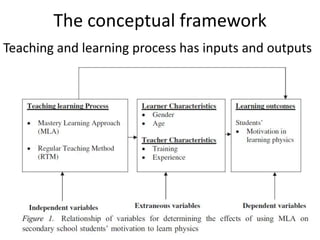
The conceptual framework
Teaching and learning process has inputs and outputs
Mastery learning model:
Bloom taxonomy
                 The application of mastery
                 learning is based on
                 Benjamin Bloom’s
                 • Students are given
                   feedback about their
                   learning and it help both
                   students and teacher to
                   identify what they have
                   learned and the area of
                   weakness.
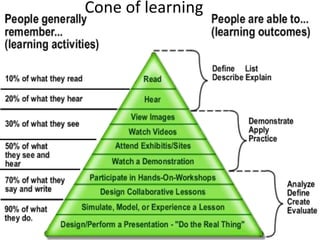
Cone of learning
Several points emerge from these
         successful programs:
Mastery learning provides a model of instruction
that is effective for a wide range of students.

Mastery learning reduces the academic spread
between the slower and faster students without
slowing down the faster students.

The skills and concepts have been internalized and
put to use in other areas of the curriculum.
The Kenya National Examination Council
(KNEC)analysis for last 4 years shows that the
 mean score for Physics has been below 50%
              as given in table 1.
The research was carried out in 4 regular
schools were assigned to the experimental
       and control groups teachers.
• The experimental groups teachers were
  exposed to MLA for 3 weeks.
• The control group teachers were to teach
  regular method.(RTM)
• The total of 161 students was taught the same
  Physics topic of Equilibrium and center of Gravity.

• The Physics Achievement Test (PAT) was used to
  collect the data and the result of the study
  indicate that:
• there is no statistical gender difference in
  motivation level for boys and girls
• MLA teaching method is able to motivate
  students learning of Physics.
conclusions
• MLA teaching method enhances student’s
  motivation to learn Physics as compare to
  regular teaching method.

• The motivation to learning Physics when MLA
  is used is the same for boys and girls.
Summary of the Scenarios- various “g” forces
           “Learning by Doing”
Misconception between mass and weight
              Discussion with     Pre-test             Post test
              students and assess
              their prior
              knowledge &
              misconceptions


Class 1       Regular teaching    27% of students    15% of students still
25students    method (RTM)        have misconception Have problem

Class 2       MLA method          30% of students    4% of students still
30 students                       have misconception have problem

Roya vafaiyan

  • 1.
    Investigation of students’ motivation towards learning secondary school Physics through mastery learning approach
  • 2.
    Type of Study: Thestudy is quantitative study which analyzes data to produce statistical results to analyze for relationships. The method for this experiment was quasi- experimental method.
  • 3.
    Purpose of study This study investigated the effects of using masterly learning approach (MLA) on secondary school students’ motivation to learn Physics.
  • 4.
    Specific objectives ofthe study: • a) To compare the motivation of students taught Physics through MLA (masterly learning approach) with that of students taught through RTM (regular teaching method) • b) To determine whether students’ motivation is affected by gender when students are taught Physics through MLA.
  • 5.
    Mastery Learning • InMaster learning “the students are helped to master each learning unit before proceeding to move advanced learning task”. • The subject matter is divided into small units that have predetermined objectives or unit expectations.
  • 6.
    How does MasteryLearning classroom look like? After beginning a unit, student will be given a formative assessment .At this point, instruction goes in one of two directions . Students are not competing against each other, but rather competing against themselves in order to achieve a personal best. 1)If students has mastered on objective ,he/she will begin on a path of enrichment activities that correspond to and build upon the original objective. 2)Students who do not achieve mastery, receive additional instruction like tutoring, peer monitoring, small group discussions, or additional homework.
  • 7.
    The conceptual framework Teachingand learning process has inputs and outputs
  • 8.
    Mastery learning model: Bloomtaxonomy The application of mastery learning is based on Benjamin Bloom’s • Students are given feedback about their learning and it help both students and teacher to identify what they have learned and the area of weakness.
  • 9.
  • 10.
    Several points emergefrom these successful programs: Mastery learning provides a model of instruction that is effective for a wide range of students. Mastery learning reduces the academic spread between the slower and faster students without slowing down the faster students. The skills and concepts have been internalized and put to use in other areas of the curriculum.
  • 11.
    The Kenya NationalExamination Council (KNEC)analysis for last 4 years shows that the mean score for Physics has been below 50% as given in table 1.
  • 12.
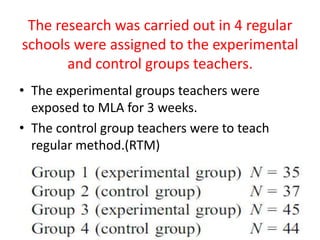
    The research wascarried out in 4 regular schools were assigned to the experimental and control groups teachers. • The experimental groups teachers were exposed to MLA for 3 weeks. • The control group teachers were to teach regular method.(RTM)
  • 14.
    • The totalof 161 students was taught the same Physics topic of Equilibrium and center of Gravity. • The Physics Achievement Test (PAT) was used to collect the data and the result of the study indicate that: • there is no statistical gender difference in motivation level for boys and girls • MLA teaching method is able to motivate students learning of Physics.
  • 15.
    conclusions • MLA teachingmethod enhances student’s motivation to learn Physics as compare to regular teaching method. • The motivation to learning Physics when MLA is used is the same for boys and girls.
  • 16.
    Summary of theScenarios- various “g” forces “Learning by Doing”
  • 17.
    Misconception between massand weight Discussion with Pre-test Post test students and assess their prior knowledge & misconceptions Class 1 Regular teaching 27% of students 15% of students still 25students method (RTM) have misconception Have problem Class 2 MLA method 30% of students 4% of students still 30 students have misconception have problem