Measuring Matter
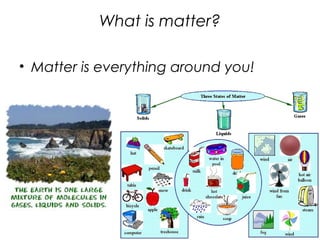
What is matter?
• Matter is everything around you!
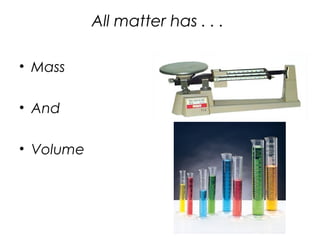
All matter has . . .
• Mass
• And
• Volume
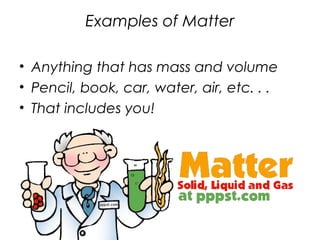
Examples of Matter
• Anything that has mass and volume
• Pencil, book, car, water, air, etc. . .
• That includes you!
What is mass?
• Mass is the amount of matter in an
object.
• Elephant = a lot of matter = LARGE
Mass
• Paperclip = small amount of matter =
SMALL mass
How do we measure mass?
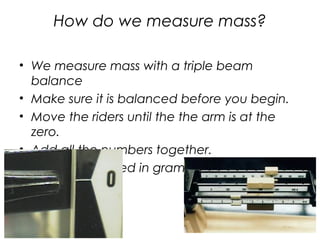
• We measure mass with a triple beam
balance
• Make sure it is balanced before you begin.
• Move the riders until the the arm is at the
zero.
• Add all the numbers together.
• Mass is measured in grams (g).
What is volume?
• The amount of space taken up or
occupied by an object.
How do you find the volume of a
rectangular solid object?
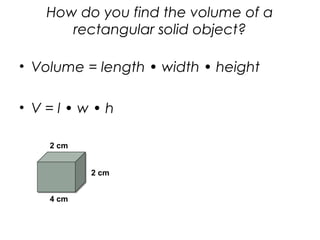
• Volume = length • width • height
• V = l • w • h
2 cm
2 cm
4 cm
Example:
V = 2 cm • 2 cm • 4 cm
V = 16 cm3
How do you find the volume of an
irregular-shaped solid object?
• Water Displacement:
– Fill a graduated cylinder with a certain
amount of water.
– Drop the object into the graduated
cylinder with the water.
– Measure the change in volume of the
water.
• Measure how far the water rose when the
object was placed in the graduated cylinder.
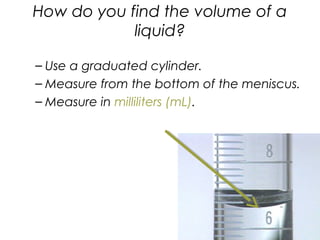
How do you find the volume of a
liquid?
– Use a graduated cylinder.
– Measure from the bottom of the meniscus.
– Measure in milliliters (mL).
How do you find the volume of a
gas?
• A gas will fill the volume of its
container, so find the volume of the
container and you have the volume of
the gas
Reminder…
• 1mL=1cm3
• Write this on your notes in the margins
next to the volume section and put a
box around it!
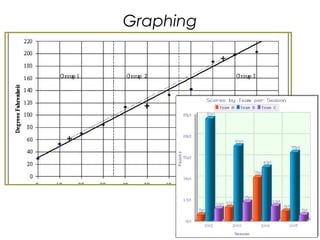
Graphing
Why do we graph data?
• To show the relationship between the
independent and dependent
variable.
• To compare data.
Rules for Graphing:
1. Always use a ruler or computer
program
2. Have your graph take up half a page
to a full page of paper
3. Title your graph descriptively
– Title should relate to what is being shown
in the graph
Rules for Graphing:
4. Label the x (along the bottom) and y
axis (along the left side)
– x-axis should be the independent variable
(the variable we change during the
experiment, ex: time or distance )
– y-axis should be the dependent variable
(the variable we observe/measure in the
experiment, ex: temperature or mass )
Rules for Graphing:
5. Number the x and y axis with
consistent numbers (increasing by 5’s
or 10’s, etc.)
– Use the majority of each axis for your
graph
5. Use different colors/patterns if you are
showing multiple trials.
How do you know which graph to
use?
• Depends on:
– The information (variables) you use
– What you are trying to show
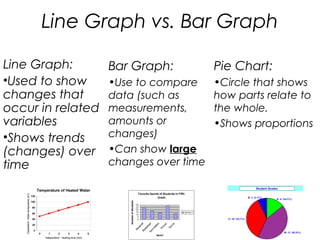
Line Graph vs. Bar Graph
Line Graph:
•Used to show
changes that
occur in related
variables
•Shows trends
(changes) over
time
Bar Graph:
•Use to compare
data (such as
measurements,
amounts or
changes)
•Can show large
changes over time
Pie Chart:
•Circle that shows
how parts relate to
the whole.
•Shows proportions
Which type of graph would you use
for:
• Plant growth over time
• Population of a city over 10 years
• Students preference in food (pizza vs
hamburgers vs hot dogs vs chicken
nuggets)
• Number of people in 4 different towns
• The number of hours spent on
Facebook by students each week
Line Graph
Line or Bar
Pie Chart
Bar Graph
Line Graph

Mass Volume and Graphing

  • 1.
  • 2.
    What is matter? •Matter is everything around you!
  • 3.
    All matter has. . . • Mass • And • Volume
  • 4.
    Examples of Matter •Anything that has mass and volume • Pencil, book, car, water, air, etc. . . • That includes you!
  • 5.
    What is mass? •Mass is the amount of matter in an object. • Elephant = a lot of matter = LARGE Mass • Paperclip = small amount of matter = SMALL mass
  • 6.
    How do wemeasure mass? • We measure mass with a triple beam balance • Make sure it is balanced before you begin. • Move the riders until the the arm is at the zero. • Add all the numbers together. • Mass is measured in grams (g).
  • 7.
    What is volume? •The amount of space taken up or occupied by an object.
  • 8.
    How do youfind the volume of a rectangular solid object? • Volume = length • width • height • V = l • w • h 2 cm 2 cm 4 cm Example: V = 2 cm • 2 cm • 4 cm V = 16 cm3
  • 9.
    How do youfind the volume of an irregular-shaped solid object? • Water Displacement: – Fill a graduated cylinder with a certain amount of water. – Drop the object into the graduated cylinder with the water. – Measure the change in volume of the water. • Measure how far the water rose when the object was placed in the graduated cylinder.
  • 10.
    How do youfind the volume of a liquid? – Use a graduated cylinder. – Measure from the bottom of the meniscus. – Measure in milliliters (mL).
  • 11.
    How do youfind the volume of a gas? • A gas will fill the volume of its container, so find the volume of the container and you have the volume of the gas
  • 12.
    Reminder… • 1mL=1cm3 • Writethis on your notes in the margins next to the volume section and put a box around it!
  • 13.
  • 14.
    Why do wegraph data? • To show the relationship between the independent and dependent variable. • To compare data.
  • 15.
    Rules for Graphing: 1.Always use a ruler or computer program 2. Have your graph take up half a page to a full page of paper 3. Title your graph descriptively – Title should relate to what is being shown in the graph
  • 16.
    Rules for Graphing: 4.Label the x (along the bottom) and y axis (along the left side) – x-axis should be the independent variable (the variable we change during the experiment, ex: time or distance ) – y-axis should be the dependent variable (the variable we observe/measure in the experiment, ex: temperature or mass )
  • 17.
    Rules for Graphing: 5.Number the x and y axis with consistent numbers (increasing by 5’s or 10’s, etc.) – Use the majority of each axis for your graph 5. Use different colors/patterns if you are showing multiple trials.
  • 18.
    How do youknow which graph to use? • Depends on: – The information (variables) you use – What you are trying to show
  • 19.
    Line Graph vs.Bar Graph Line Graph: •Used to show changes that occur in related variables •Shows trends (changes) over time Bar Graph: •Use to compare data (such as measurements, amounts or changes) •Can show large changes over time Pie Chart: •Circle that shows how parts relate to the whole. •Shows proportions
  • 20.
    Which type ofgraph would you use for: • Plant growth over time • Population of a city over 10 years • Students preference in food (pizza vs hamburgers vs hot dogs vs chicken nuggets) • Number of people in 4 different towns • The number of hours spent on Facebook by students each week Line Graph Line or Bar Pie Chart Bar Graph Line Graph