UNIT 1: MATTER, MATERIALS AND FORCES
INTRODUCTION
 Classify these words:
MATTER NOT MATTER
The Universe is made up of matter and
energy and empty space. Everything
around us, living and non-living, is made
up of matter: plants, animals, books,
tables, the food we eat and the water we
drink. Even the air we breathe is made up
of matter.
notebook – fabric – intelligence – plants – happiness –
animals – sadness – glass - cold
MATTER AND ITS PROPERTIES
Matter
Matter is everything around us. Matter is made out of atoms, that are tiny
particles that are too small to see, even with a microscope. Atoms fit
together with other atoms to make up matter. Any time two atoms join
together they make a molecule. All the stuff around you is made up of
molecules. This includes you! You are actually made up of trillions and
trillions of different types of molecules.
There are two different types of substances:
https://www.youtube.com/watch?v=avgFqlNML5o
Properties
 Can you say properties of these objects?
ELEMENTS:
When atoms of the
same type join
together.
IRON
COMPOUNDS:
When atoms of
different type join
together.
WATER
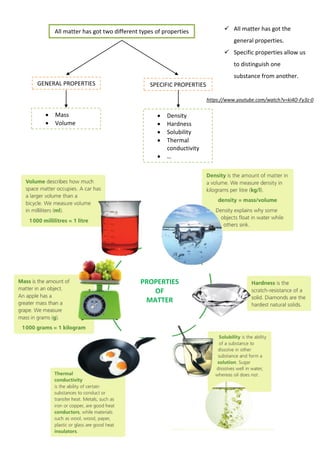
All matter has got two different types of properties
GENERAL PROPERTIES SPECIFIC PROPERTIES
 Mass
 Volume
 Density
 Hardness
 Solubility
 Thermal
conductivity
 …
 All matter has got the
general properties.
 Specific properties allow us
to distinguish one
substance from another.
PROPERTIES
OF
MATTER
https://www.youtube.com/watch?v=ki4O-Fy3z-0
Before experimenting…
How can we weight a solid?
How can we weight a liquid?
How can we measure the volume of a liquid?
How can we measure the volume of a solid?
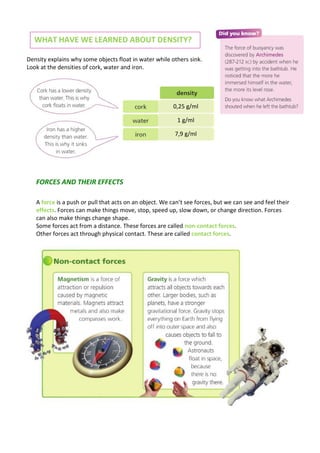
WHAT HAVE WE LEARNED ABOUT DENSITY?
Density explains why some objects float in water while others sink.
Look at the densities of cork, water and iron.
0,25 g/ml
1 g/ml
7,9 g/ml
FORCES AND THEIR EFFECTS
A force is a push or pull that acts on an object. We can’t see forces, but we can see and feel their
effects. Forces can make things move, stop, speed up, slow down, or change direction. Forces
can also make things change shape.
Some forces act from a distance. These forces are called non-contact forces.
Other forces act through physical contact. These are called contact forces.
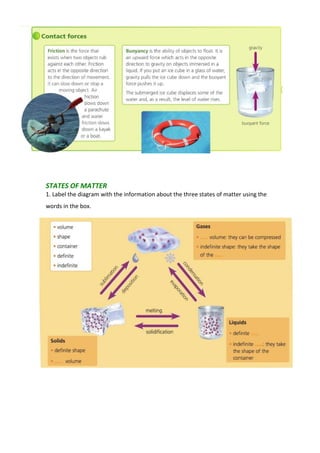
STATES OF MATTER
1. Label the diagram with the information about the three states of matter using the
words in the box.
2. Look at the photos below and identify the three states of matter. Some photos may
show more tan one state of matter.
a.
b.
c.
d.
e.
f.
3. Listen to the recording about changes of state. Complete the missing information.
 In solids, particles are _________ ________ __________forming
a ___________ ____________. They just vibrate __ ________.
 In liquids, particles are _______________________, have a
_________________________ and move ______ ______ _____.
 In gases, particles are _____ _________, have a ___________
_____________ and move __ ___ _________ ______ ________.
 As matter is _________, its particles begin to move
more and more.
 As matter is cooled its particles move
______ _____ ______.
WHAT TYPES OF MATTER ARE THERE?
According to its composition, we can classify matter into pure substances and
mixtures.
 Pure substances, such as table salt or silver, consist of only one type of matter.
 Mixtures are made up of two or more pure substances and can be
homogeneous or heterogeneous.
o In a homogeneous mixture, such as the air we breathe or sea water, we
cannot see the individual substances that make it up.
o In a heterogeneous mixture, such as sand or a salad, we can see the
individual substances that make it up.
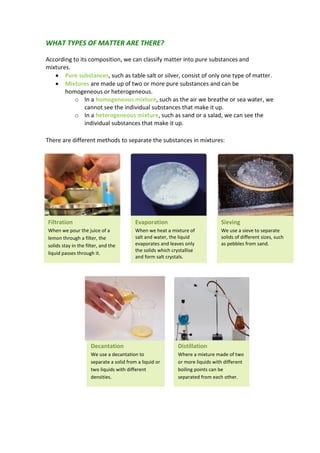
There are different methods to separate the substances in mixtures:
Decantation
We use a decantation to
separate a solid from a liquid or
two liquids with different
densities.
Distillation
Where a mixture made of two
or more liquids with different
boiling points can be
separated from each other.
Filtration
When we pour the juice of a
lemon through a filter, the
solids stay in the filter, and the
liquid passes through it.
Evaporation
When we heat a mixture of
salt and water, the liquid
evaporates and leaves only
the solids which crystallise
and form salt crystals.
Sieving
We use a sieve to separate
solids of different sizes, such
as pebbles from sand.
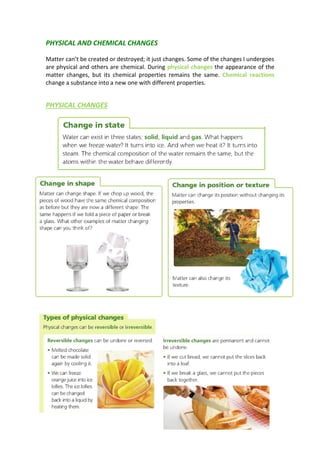
PHYSICAL AND CHEMICAL CHANGES
Matter can’t be created or destroyed; it just changes. Some of the changes I undergoes
are physical and others are chemical. During physical changes the appearance of the
matter changes, but its chemical properties remains the same. Chemical reactions
change a substance into a new one with different properties.
PHYSICAL CHANGES
CHEMICAL CHANGES

Unit 1. Matter and forces

  • 1.
    UNIT 1: MATTER,MATERIALS AND FORCES INTRODUCTION  Classify these words: MATTER NOT MATTER The Universe is made up of matter and energy and empty space. Everything around us, living and non-living, is made up of matter: plants, animals, books, tables, the food we eat and the water we drink. Even the air we breathe is made up of matter. notebook – fabric – intelligence – plants – happiness – animals – sadness – glass - cold
  • 2.
    MATTER AND ITSPROPERTIES Matter Matter is everything around us. Matter is made out of atoms, that are tiny particles that are too small to see, even with a microscope. Atoms fit together with other atoms to make up matter. Any time two atoms join together they make a molecule. All the stuff around you is made up of molecules. This includes you! You are actually made up of trillions and trillions of different types of molecules. There are two different types of substances: https://www.youtube.com/watch?v=avgFqlNML5o Properties  Can you say properties of these objects? ELEMENTS: When atoms of the same type join together. IRON COMPOUNDS: When atoms of different type join together. WATER
  • 3.
    All matter hasgot two different types of properties GENERAL PROPERTIES SPECIFIC PROPERTIES  Mass  Volume  Density  Hardness  Solubility  Thermal conductivity  …  All matter has got the general properties.  Specific properties allow us to distinguish one substance from another. PROPERTIES OF MATTER https://www.youtube.com/watch?v=ki4O-Fy3z-0
  • 4.
    Before experimenting… How canwe weight a solid? How can we weight a liquid?
  • 5.
    How can wemeasure the volume of a liquid? How can we measure the volume of a solid?
  • 6.
    WHAT HAVE WELEARNED ABOUT DENSITY? Density explains why some objects float in water while others sink. Look at the densities of cork, water and iron. 0,25 g/ml 1 g/ml 7,9 g/ml FORCES AND THEIR EFFECTS A force is a push or pull that acts on an object. We can’t see forces, but we can see and feel their effects. Forces can make things move, stop, speed up, slow down, or change direction. Forces can also make things change shape. Some forces act from a distance. These forces are called non-contact forces. Other forces act through physical contact. These are called contact forces.
  • 7.
    STATES OF MATTER 1.Label the diagram with the information about the three states of matter using the words in the box.
  • 8.
    2. Look atthe photos below and identify the three states of matter. Some photos may show more tan one state of matter. a. b. c. d. e. f. 3. Listen to the recording about changes of state. Complete the missing information.  In solids, particles are _________ ________ __________forming a ___________ ____________. They just vibrate __ ________.  In liquids, particles are _______________________, have a _________________________ and move ______ ______ _____.  In gases, particles are _____ _________, have a ___________ _____________ and move __ ___ _________ ______ ________.  As matter is _________, its particles begin to move more and more.  As matter is cooled its particles move ______ _____ ______.
  • 9.
    WHAT TYPES OFMATTER ARE THERE? According to its composition, we can classify matter into pure substances and mixtures.  Pure substances, such as table salt or silver, consist of only one type of matter.  Mixtures are made up of two or more pure substances and can be homogeneous or heterogeneous. o In a homogeneous mixture, such as the air we breathe or sea water, we cannot see the individual substances that make it up. o In a heterogeneous mixture, such as sand or a salad, we can see the individual substances that make it up. There are different methods to separate the substances in mixtures: Decantation We use a decantation to separate a solid from a liquid or two liquids with different densities. Distillation Where a mixture made of two or more liquids with different boiling points can be separated from each other. Filtration When we pour the juice of a lemon through a filter, the solids stay in the filter, and the liquid passes through it. Evaporation When we heat a mixture of salt and water, the liquid evaporates and leaves only the solids which crystallise and form salt crystals. Sieving We use a sieve to separate solids of different sizes, such as pebbles from sand.
  • 10.
    PHYSICAL AND CHEMICALCHANGES Matter can’t be created or destroyed; it just changes. Some of the changes I undergoes are physical and others are chemical. During physical changes the appearance of the matter changes, but its chemical properties remains the same. Chemical reactions change a substance into a new one with different properties. PHYSICAL CHANGES
  • 11.