1.4 THE USE OF1.4 THE USE OF
MEASURING TOOLSMEASURING TOOLS
1.4 THE USE OF MEASURING TOOLS
MEASURING LENGTH
1. Length is the distance between two points.
2. The SI unit and symbol for length is metre (m).
3. Other units for length are kilometer (km), centimeter (cm)
and millimeter (mm) are also commonly used.
4. The relationship between the units of length are as follows :
1cm = 10 mm
1 m = 100 cm = 1 000 mm
1 km = 1 000 m = 1 000 000 cm
Measuring the length of a straight line
a. The length of a straight line is measured by a metre rule. The metre rule
gives an accuracy of 0.1cm .
b. Parallax error occurs if the position of the eye is wrong while taking
the reading.
c. Ways to avoid parallax error:
 Make sure that the position of the eye is vertically above the
mark to be read on the metre rule.
 Place the metre rule on its side so as to touch the object to be
measured.
d. A number of readings are taken to obtain an average length. This is
done to get measurement that is more accurate.
Measuring the length of a curved line
a. The instruments to measure curved lines are a piece of thread and a metre
rule.
b. Technique to measure a curved lines are :
 A knot is tied at one end of the thread to act as a reference point.
 The knot is fixed at one end of the curve as the starting point of the
curve.
 The thread is traced along the curve as that the thread coincides
exactly with the curve. A mark is made on the thread when the
thread reaches the other end of the curve.
 After that, the thread is removed and straightened. The length of the
thread is measured to obtain the actual length of the curve.
 The length of a curved line can also be measured
using an opisometer (map measuring
instrument).
 If the length of the curved line is more than one
metre, a measuring tape can be used.
Measuring diameter
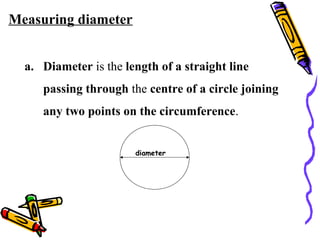
a. Diameter is the length of a straight line
passing through the centre of a circle joining
any two points on the circumference.
diameter
b. A pair of calipers and a ruler is used to measure the
diameter of an object.
c. There are twp types of calipers that are the external
calipers and the internal calipers.
d. The external calipers is used to measure the external
diameter of an object.
e. The internal calipers is used to measure the internal
diameter of an object.
MEASURING AREA
1. Area is measurement of the size of a surface region.
2. The SI unit for area is square metres (m2).
3. Other units of measuring areas are square kilometers
(km2), square centimeters (cm2) and
square millimeters (mm2).
4. The area of an object with a regular shape like a
rectangle, triangle, circle, trapezium, or
parallelogram can be determined by using
mathematical formula.
5. The area object with an irregular shape can be
estimated by tracing the object on a graph paper
and counting the number of completed squares,
half-completed squares and more than half-
completed squares on the graph paper. ( less than
half-completed squares are ignored)
6. A graph paper with smaller squares gives
the area of object more accurately.
7. The area of an object that is measured using
a graph paper is only estimation (not exact),
since less than half-completed squares are
ignored.

Chap1.44

  • 1.
    1.4 THE USEOF1.4 THE USE OF MEASURING TOOLSMEASURING TOOLS
  • 2.
    1.4 THE USEOF MEASURING TOOLS MEASURING LENGTH 1. Length is the distance between two points. 2. The SI unit and symbol for length is metre (m). 3. Other units for length are kilometer (km), centimeter (cm) and millimeter (mm) are also commonly used. 4. The relationship between the units of length are as follows : 1cm = 10 mm 1 m = 100 cm = 1 000 mm 1 km = 1 000 m = 1 000 000 cm
  • 3.
    Measuring the lengthof a straight line a. The length of a straight line is measured by a metre rule. The metre rule gives an accuracy of 0.1cm . b. Parallax error occurs if the position of the eye is wrong while taking the reading. c. Ways to avoid parallax error:  Make sure that the position of the eye is vertically above the mark to be read on the metre rule.  Place the metre rule on its side so as to touch the object to be measured. d. A number of readings are taken to obtain an average length. This is done to get measurement that is more accurate.
  • 4.
    Measuring the lengthof a curved line a. The instruments to measure curved lines are a piece of thread and a metre rule. b. Technique to measure a curved lines are :  A knot is tied at one end of the thread to act as a reference point.  The knot is fixed at one end of the curve as the starting point of the curve.  The thread is traced along the curve as that the thread coincides exactly with the curve. A mark is made on the thread when the thread reaches the other end of the curve.  After that, the thread is removed and straightened. The length of the thread is measured to obtain the actual length of the curve.
  • 5.
     The lengthof a curved line can also be measured using an opisometer (map measuring instrument).  If the length of the curved line is more than one metre, a measuring tape can be used.
  • 6.
    Measuring diameter a. Diameteris the length of a straight line passing through the centre of a circle joining any two points on the circumference. diameter
  • 7.
    b. A pairof calipers and a ruler is used to measure the diameter of an object. c. There are twp types of calipers that are the external calipers and the internal calipers. d. The external calipers is used to measure the external diameter of an object. e. The internal calipers is used to measure the internal diameter of an object.
  • 8.
    MEASURING AREA 1. Areais measurement of the size of a surface region. 2. The SI unit for area is square metres (m2). 3. Other units of measuring areas are square kilometers (km2), square centimeters (cm2) and square millimeters (mm2).
  • 9.
    4. The areaof an object with a regular shape like a rectangle, triangle, circle, trapezium, or parallelogram can be determined by using mathematical formula. 5. The area object with an irregular shape can be estimated by tracing the object on a graph paper and counting the number of completed squares, half-completed squares and more than half- completed squares on the graph paper. ( less than half-completed squares are ignored)
  • 10.
    6. A graphpaper with smaller squares gives the area of object more accurately. 7. The area of an object that is measured using a graph paper is only estimation (not exact), since less than half-completed squares are ignored.