Density Notes #1
What is density?
Density is a comparison of how much
matter there is in a certain amount of
space.
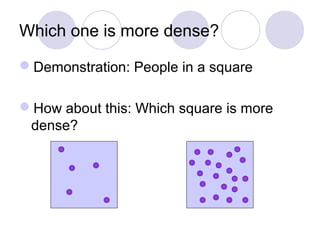
Which one is more dense?
Demonstration: People in a square
How about this: Which square is more
dense?
Which one is more dense?
Now which one is more dense?
DENSITY = MASS
Volume
10 cm

10

cm

10 cm

Mass = 2,000 g

Volume = 10cm x 10 cm x 10 cm = 1,000 cm3
Density = 2,000 g
1,000 cm3

D = 2 g/cm3
Unit for
density
Another Example:
V = 10 mL
M = 30 g
D=M
V
D = 30g
10mL

Another unit
for density

D = 3 g/mL
Let’s try a density problem together
Austin has a paper clip. It has a mass of
9g and a volume of 3cm3. What is its
density?

Austin also has an eraser. It has a mass
of 3g, and a volume of 1cm3. What is its
density?
Work on these problems with your neighbor.
Roman has a rock. The rock has a mass
of 6g and a volume of 3cm 3. What is the
density of the rock?
Jeff has a gel pen. The gel pen has a
mass of 8g and a volume of 2cm 3. What is
the density of the rock?
Now, try these on your own.
Hailey has a watch. It has a mass of 4g
and a volume of 2cm3. What is the density
of the watch?
Abdul has a wallet. It has a mass of 15g
and a volume of 5cm3. What is the density
of the wallet?
density = m
v
Hugo has a pet turkey. It’s name is Turk.
Hugo submerges Turk underwater, noting
the level of water rises by 6,000 mL.
He weighs Turk on his balance (after
blow-drying him), and finds Turk to be 2
kg.
What is Turk the turkey’s density?
mass = 2,000 g
volume = 6,000mL
density = .33 g/mL
Liquid Layers
If you pour together liquids that don’t mix
and have different densities, they will form
liquid layers.
The liquid with the highest density will be
on the bottom.
The liquid with the lowest density will be
on the top.
Liquid Layers
Check out this picture from your
book. Which layer has the
highest density?
Which layer has the lowest
density?
Imagine that the liquids have the
following densities:
 10g/cm3.
 6g/cm3.

3g/cm3.
5g/cm3.

Which number would go with
which layer?
Liquid Layers – Try with your neighbor
Which liquid has the
highest density?
Which liquid has the
lowest density?
Which liquid has the
middle density?
Liquid Layers – Try on your own!
Imagine that the
liquids on the right
have the following
densities:
 15g/cm3
 3g/cm3
 7g/cm3

10g/cm3
9g/cm3
12g/cm3

Match the colors to
the correct densities.

3g/cm3
7g/cm3
9g/cm3
10g/cm3
12g/cm3
15g/cm3
Review
What is the formula for density?
What happens if you pour together liquids
that have different densities?
Will the liquid on the top have the highest
or lowest density?
Will the liquid on the bottom have the
highest or lowest density?
Super Scientist Question of the Day
Jake has a book, a ruler, and a balance.
How can Jake find the density of the
book with the tools he has?

Density notes

  • 1.
  • 2.
    What is density? Densityis a comparison of how much matter there is in a certain amount of space.
  • 3.
    Which one ismore dense? Demonstration: People in a square How about this: Which square is more dense?
  • 4.
    Which one ismore dense? Now which one is more dense?
  • 5.
    DENSITY = MASS Volume 10cm 10 cm 10 cm Mass = 2,000 g Volume = 10cm x 10 cm x 10 cm = 1,000 cm3 Density = 2,000 g 1,000 cm3 D = 2 g/cm3 Unit for density
  • 6.
    Another Example: V =10 mL M = 30 g D=M V D = 30g 10mL Another unit for density D = 3 g/mL
  • 7.
    Let’s try adensity problem together Austin has a paper clip. It has a mass of 9g and a volume of 3cm3. What is its density? Austin also has an eraser. It has a mass of 3g, and a volume of 1cm3. What is its density?
  • 8.
    Work on theseproblems with your neighbor. Roman has a rock. The rock has a mass of 6g and a volume of 3cm 3. What is the density of the rock? Jeff has a gel pen. The gel pen has a mass of 8g and a volume of 2cm 3. What is the density of the rock?
  • 9.
    Now, try theseon your own. Hailey has a watch. It has a mass of 4g and a volume of 2cm3. What is the density of the watch? Abdul has a wallet. It has a mass of 15g and a volume of 5cm3. What is the density of the wallet?
  • 10.
    density = m v Hugohas a pet turkey. It’s name is Turk. Hugo submerges Turk underwater, noting the level of water rises by 6,000 mL. He weighs Turk on his balance (after blow-drying him), and finds Turk to be 2 kg. What is Turk the turkey’s density? mass = 2,000 g volume = 6,000mL density = .33 g/mL
  • 11.
    Liquid Layers If youpour together liquids that don’t mix and have different densities, they will form liquid layers. The liquid with the highest density will be on the bottom. The liquid with the lowest density will be on the top.
  • 12.
    Liquid Layers Check outthis picture from your book. Which layer has the highest density? Which layer has the lowest density? Imagine that the liquids have the following densities:  10g/cm3.  6g/cm3. 3g/cm3. 5g/cm3. Which number would go with which layer?
  • 13.
    Liquid Layers –Try with your neighbor Which liquid has the highest density? Which liquid has the lowest density? Which liquid has the middle density?
  • 14.
    Liquid Layers –Try on your own! Imagine that the liquids on the right have the following densities:  15g/cm3  3g/cm3  7g/cm3 10g/cm3 9g/cm3 12g/cm3 Match the colors to the correct densities. 3g/cm3 7g/cm3 9g/cm3 10g/cm3 12g/cm3 15g/cm3
  • 15.
    Review What is theformula for density? What happens if you pour together liquids that have different densities? Will the liquid on the top have the highest or lowest density? Will the liquid on the bottom have the highest or lowest density?
  • 16.
    Super Scientist Questionof the Day Jake has a book, a ruler, and a balance. How can Jake find the density of the book with the tools he has?