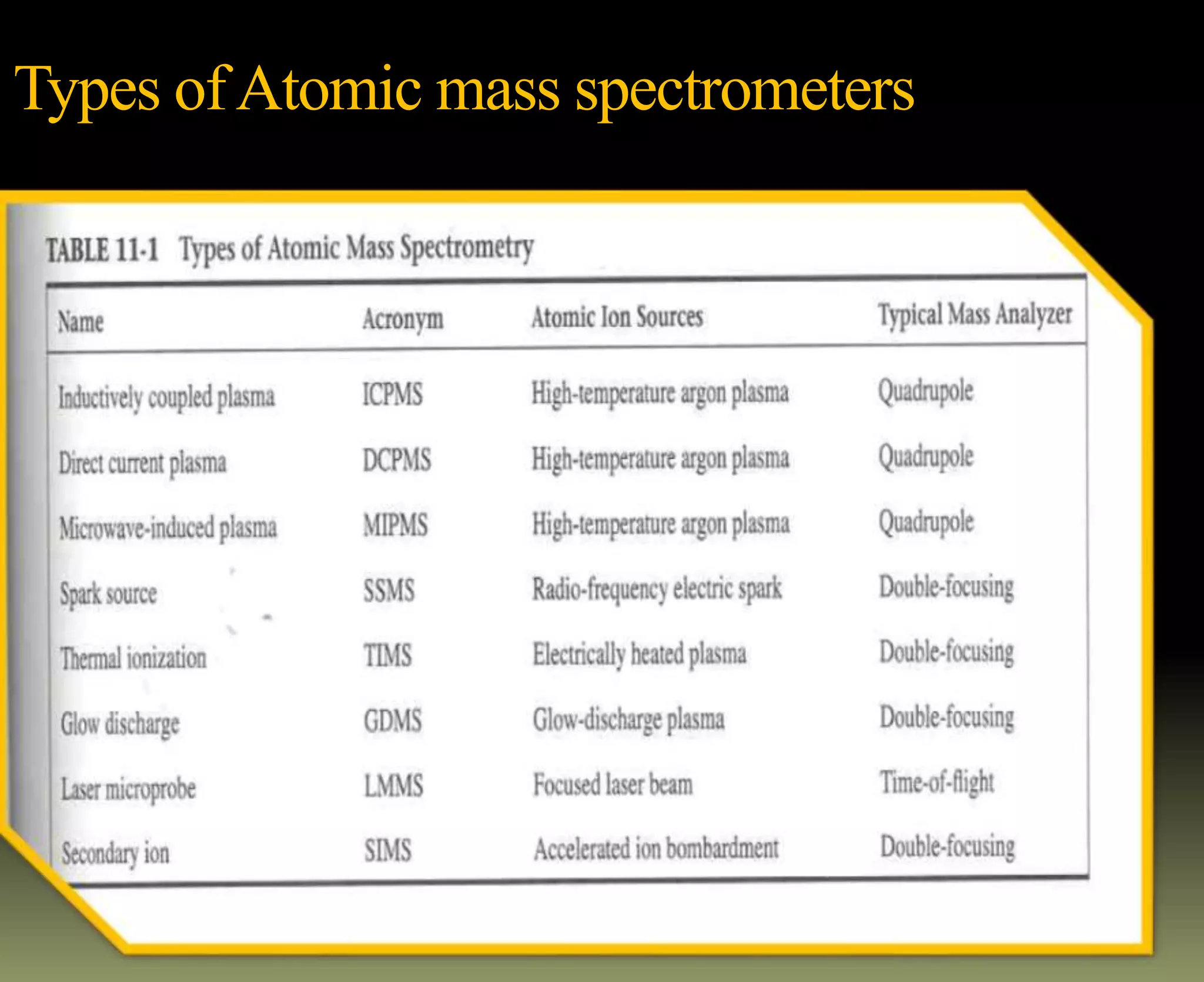
Atomic mass spectrometry offers several advantages over optical spectrometric methods including better detection limits and simpler spectra that are often unique and easily interpretable. It can also measure atomic isotopic ratios. Disadvantages include higher instrument costs, potential instrument drift, and certain interference effects. Mass spectrometry involves atomizing a sample, converting atoms to ions, separating the ions based on mass-to-charge ratio, and detecting the ions. Different types of mass analyzers like quadrupoles, time-of-flight, and double-focusing instruments are used for ion separation.
Introduces atomic mass spectrometry, detailing advantages and disadvantages, and analysis steps.
Discusses atomic and molecular masses, mass-to-charge ratios, and the significance in spectrometry.
Covers different types of mass spectrometers and their mechanisms, notably quadrupole and time-of-flight.
Details mass spectrometer components including transducers like electron multipliers and Faraday cups.
Describes various mass analyzers, focusing on quadrupole mechanics and ion trajectories in quadrupoles.
Explains the functionality of Time-of-Flight analyzers and double-focusing mass spectrometers.
Outlines ICPMS advantages, components, and comparison of mass spectra with optical detection.
Discusses challenges like spectral interferences and matrix effects in mass spectrometry.
Highlights qualitative, quantitative applications, detection limits, and isotope ratio measurements.Describes spark source mass spectrometry and glow discharge mass spectrometry methods and applications.
Discusses methods for surface analysis including secondary-ion mass spectrometry and laser microprobe.Explains the isotope dilution method, its advantages, and applications in analytical chemistry.
Brief mention of double-focusing analyzers and their characteristics in mass spectrometry.
Atomic Mass Spectrometry
Atomicmass spectrometry offers A number of
advantages over the atomic optical spectrometric
methods that we have thus far considered, including
(1)detection limits that are, for many elements, as
great as three orders of magnitude better than
optical methods; (2) remarkably Simple . spectra
that are usually unique and often easily
interpretable (3) the ability to measure atomic
isotopic ratios. Disadvantages include (1)
instrument costs that are two to three times that of
optical atomic instruments, (2) instrument drift that
can be as high as 5% to 10% per hour (3) certain
types of interference effects that are discussed later.
SOME GENERAL FEATURESOF
ATOMIC MASS SPECTROMETRY
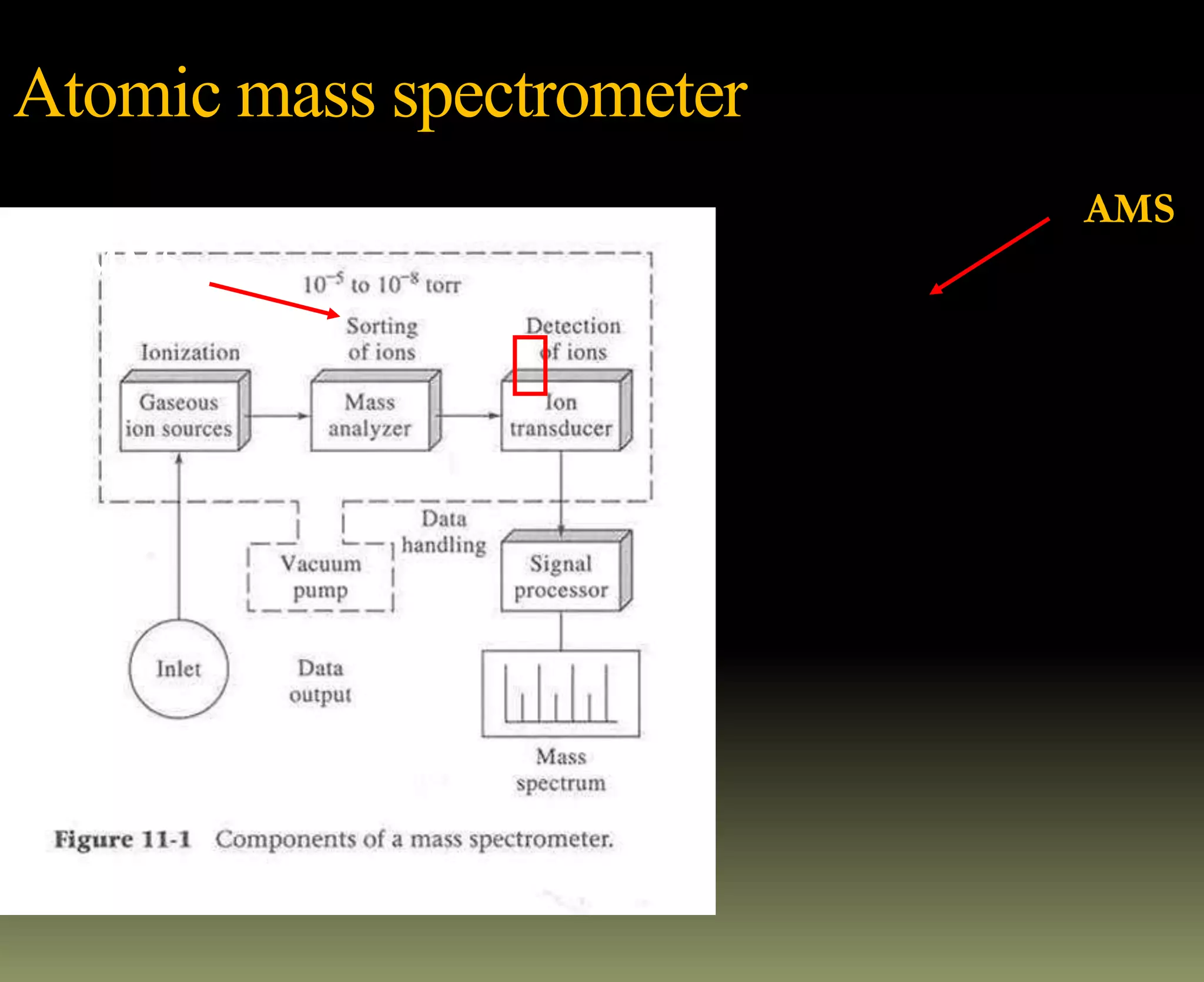
An atomic mass spectrometric analysis 1 involves the
following steps: (1) atomization, (2) conversion of a
substantial fraction of the atoms formed in step I to
a stream of ions (usually singly charged positive
ions), (3) separating the ions formed in step 2 on the
basis of their mass-to-charge ratio (m/z), where m is
the mass number of the ion in atomic mass units and
z is the number of fundamental charges that it bears,
and (4) counting the number of ions of each type or
measuring the ion current produced when the ions
formed from the sample strike a suitable transducer.
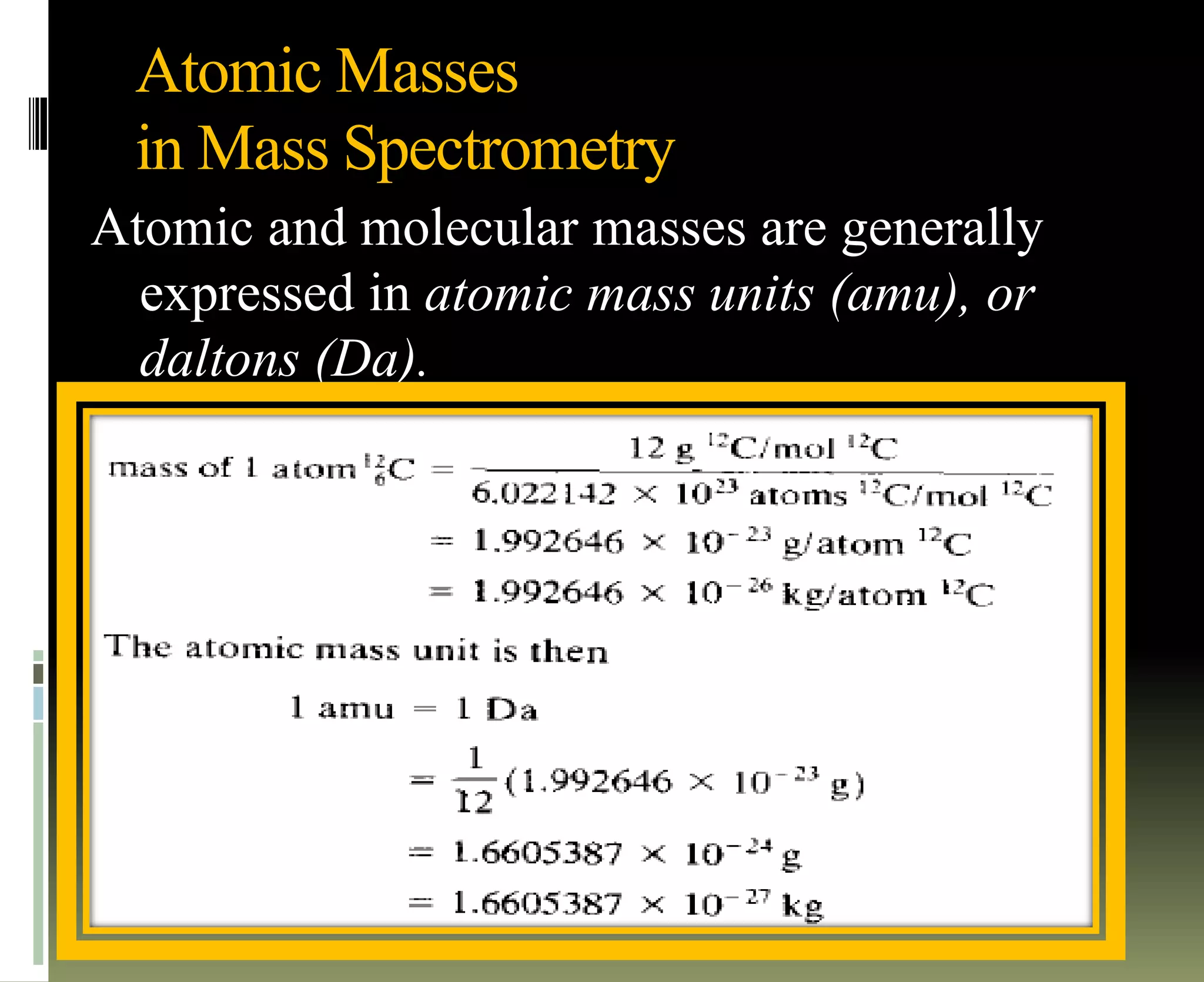
Atomic Masses
in MassSpectrometry
Atomic and molecular masses are generally
expressed in atomic mass units (amu), or
daltons (Da).
7.
Uses of MassSpec
forms ions, usually positive, study
charge/mass ratio
very characteristic fragmentation
pattern in charge/mass ratio
data easier to interpret than IR and/or
NMR
provides accurate MW of sample
used to determine isotopic abundances
8.
Nearly allelements in the periodic table can
be determined by mass spectrometry
More selective and sensitive than optical
instruments
Simple spectra
Isotope ratios
Much more expensive instrumentation
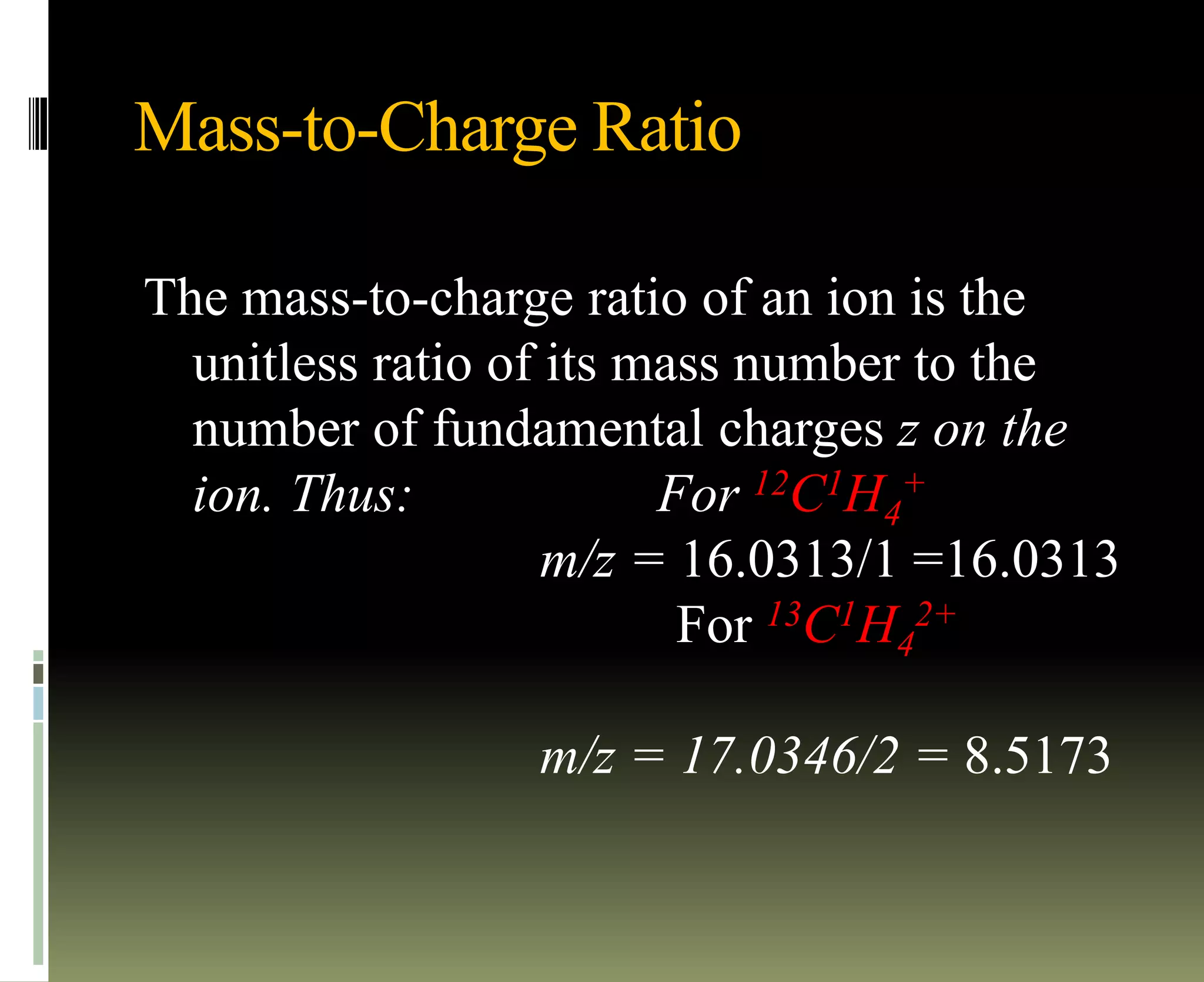
Mass-to-Charge Ratio
The mass-to-chargeratio of an ion is the
unitless ratio of its mass number to the
number of fundamental charges z on the
ion. Thus: For 12C1H4
+
m/z = 16.0313/1 =16.0313
For 13C1H4
2+
m/z = 17.0346/2 = 8.5173
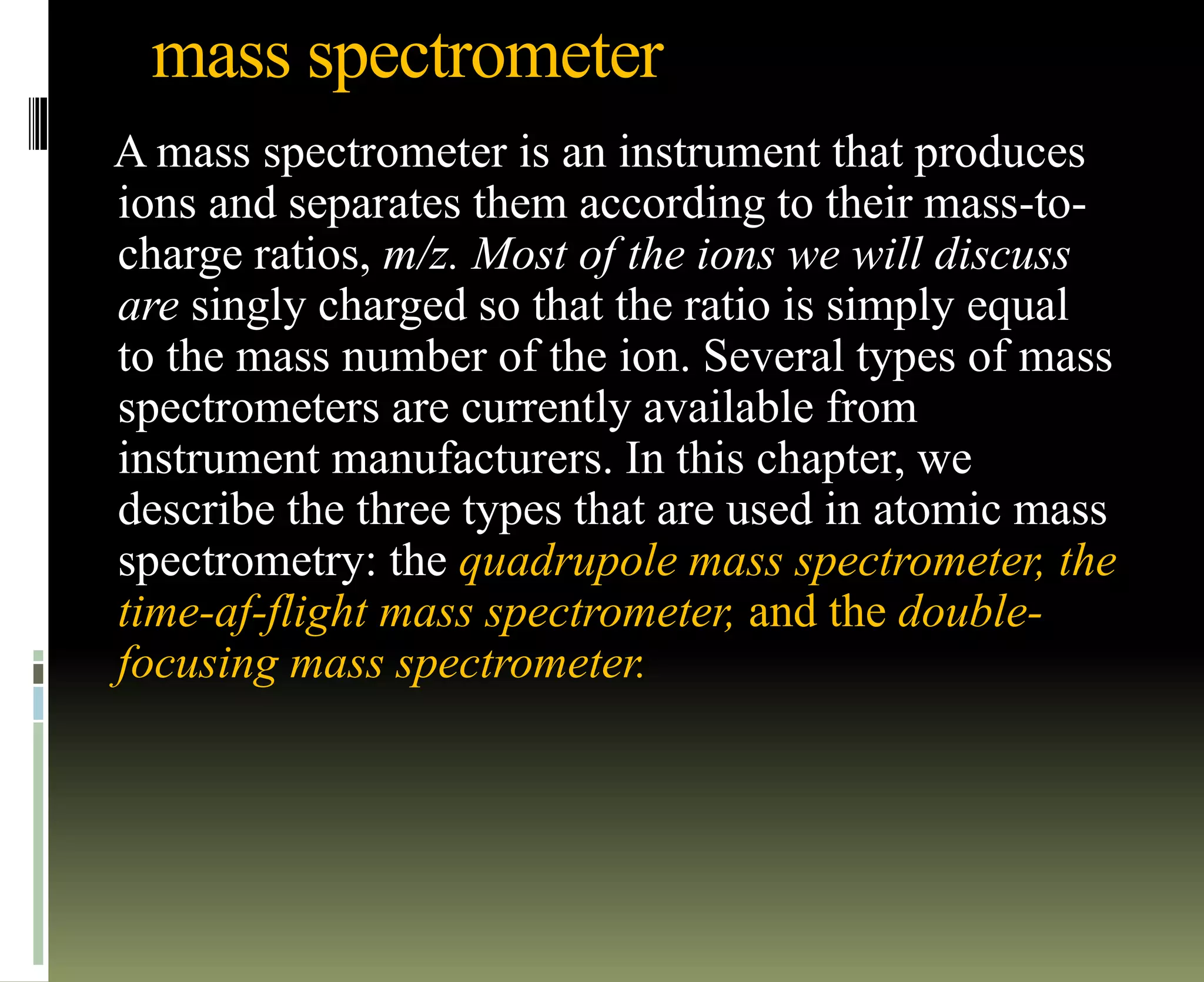
mass spectrometer
A massspectrometer is an instrument that produces
ions and separates them according to their mass-to-
charge ratios, m/z. Most of the ions we will discuss
are singly charged so that the ratio is simply equal
to the mass number of the ion. Several types of mass
spectrometers are currently available from
instrument manufacturers. In this chapter, we
describe the three types that are used in atomic mass
spectrometry: the quadrupole mass spectrometer, the
time-af-flight mass spectrometer, and the double-
focusing mass spectrometer.
15.
Components of MassSpec
Inlet
System
Ion
Source
Mass
Analyzer
Detector
Sample
Signal
Processor
Readout
10-5 - 10-8 torr
Vacuum
System
Wavelength selector
Transducers for MassSpectrometry
Several types of transducers are
commercially available for mass
spectrometers. The electron multiplier is
the transducer of choice for most routine
experiments.
electron multiplier
Figure 11-2ais a schematic of a discrete-
dynode electron multiplier designed for
collecting and converting positive ions into
an electrical signal. This device is very much
like the photomultiplier transducer for
ultraviolet-visible radiation, with each
dynode held at a successively higher voltage.
When energetic ions or electrons strike the
Cu-Be surfaces of the cathode and the
dynodes, bursts of electrons are emitted.
The Faraday Cup
Figure11-3 is a schematic of a Faraday cup collector. The
transducer is aligned so that ions exiting the analyzer strike the
collector electrode. This electrode is
surrounded by a cage that prevents the escape of reflected ions
and ejected secondary electrons. The collector
electrode is inclined with respect to the path of the entering ions
so that particles striking or leaving the electrode are reflected
from the entrance to the
cup. The collector electrode and cage are connected to ground
through a large resistor. The charge of the positive
ions striking the plate is neutralized by a flow of electrons from
ground through the resistor.
FIGURE 11-3 Faraday cup detector. The
voltage on the ion suppressor plates is
adjusted to minimize differential response
as a function of mass.
Quadrupole MassAnalyzers
The mostcommon type of mass spectrometer
used in atomic mass spectroscopy is the
quadrupole mass analyzer shown in Figure
11-6. This instrument is more compact, less
expensive, and more rugged than most other
types of mass spectrometers. It also has the
advantage of high scan rates so that an entire
mass spectrum can be obtained in less than
100 ms.
26.
Mass analyzers
1. Quadrupolemass analyzer
2. Time-of-flight mass analyzers
3. Double Focus Mass analyzers
4. Single Focus Mass analyzers
5. Ion Trap Analyzer (FT Mass spectrometry)
ICPMS
Molecular Mass spectrometers
27.
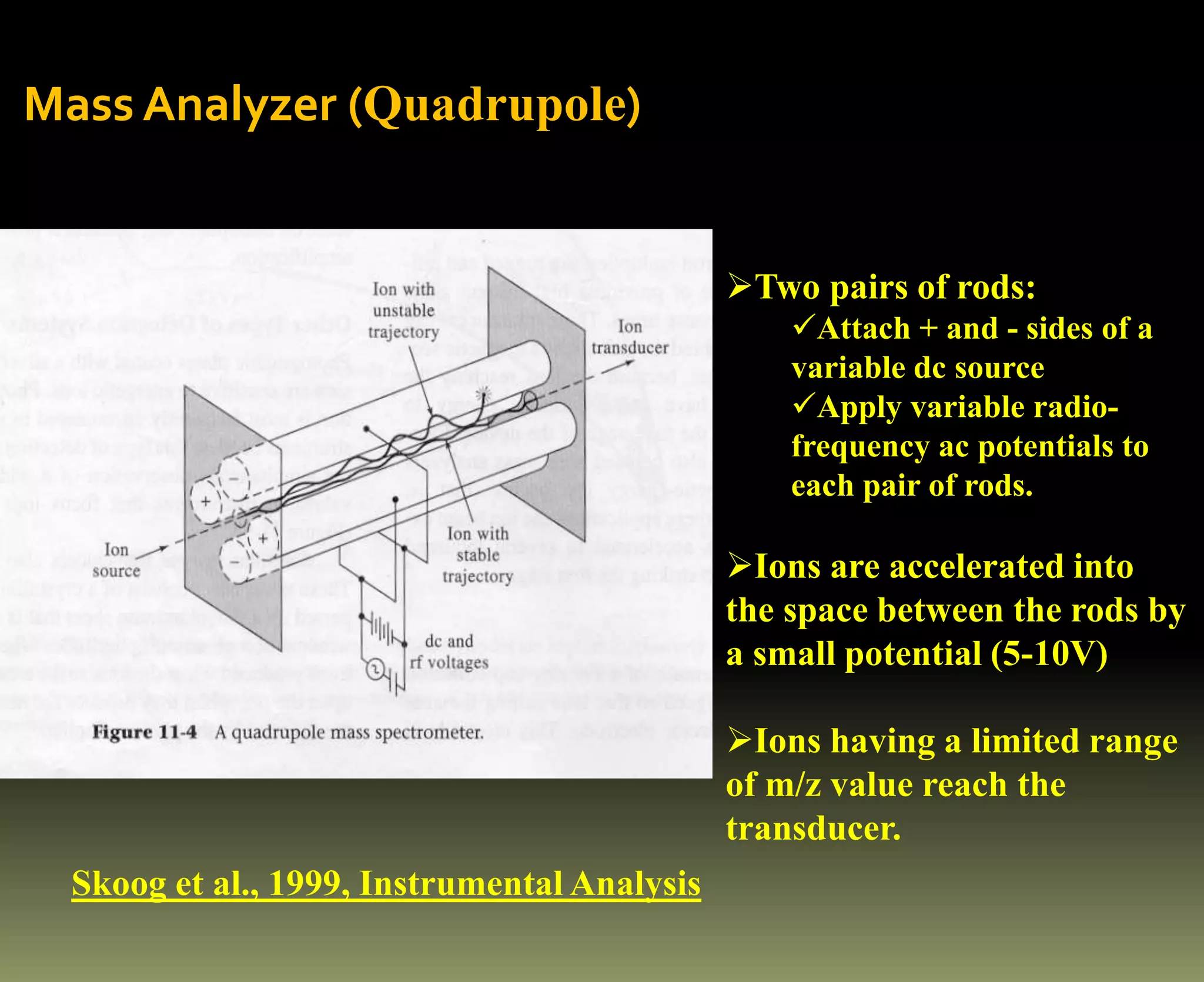
Mass Analyzer (Quadrupole)
Skooget al., 1999, Instrumental Analysis
Two pairs of rods:
Attach + and - sides of a
variable dc source
Apply variable radio-
frequency ac potentials to
each pair of rods.
Ions are accelerated into
the space between the rods by
a small potential (5-10V)
Ions having a limited range
of m/z value reach the
transducer.
Ion Trajectories ina quadrupole
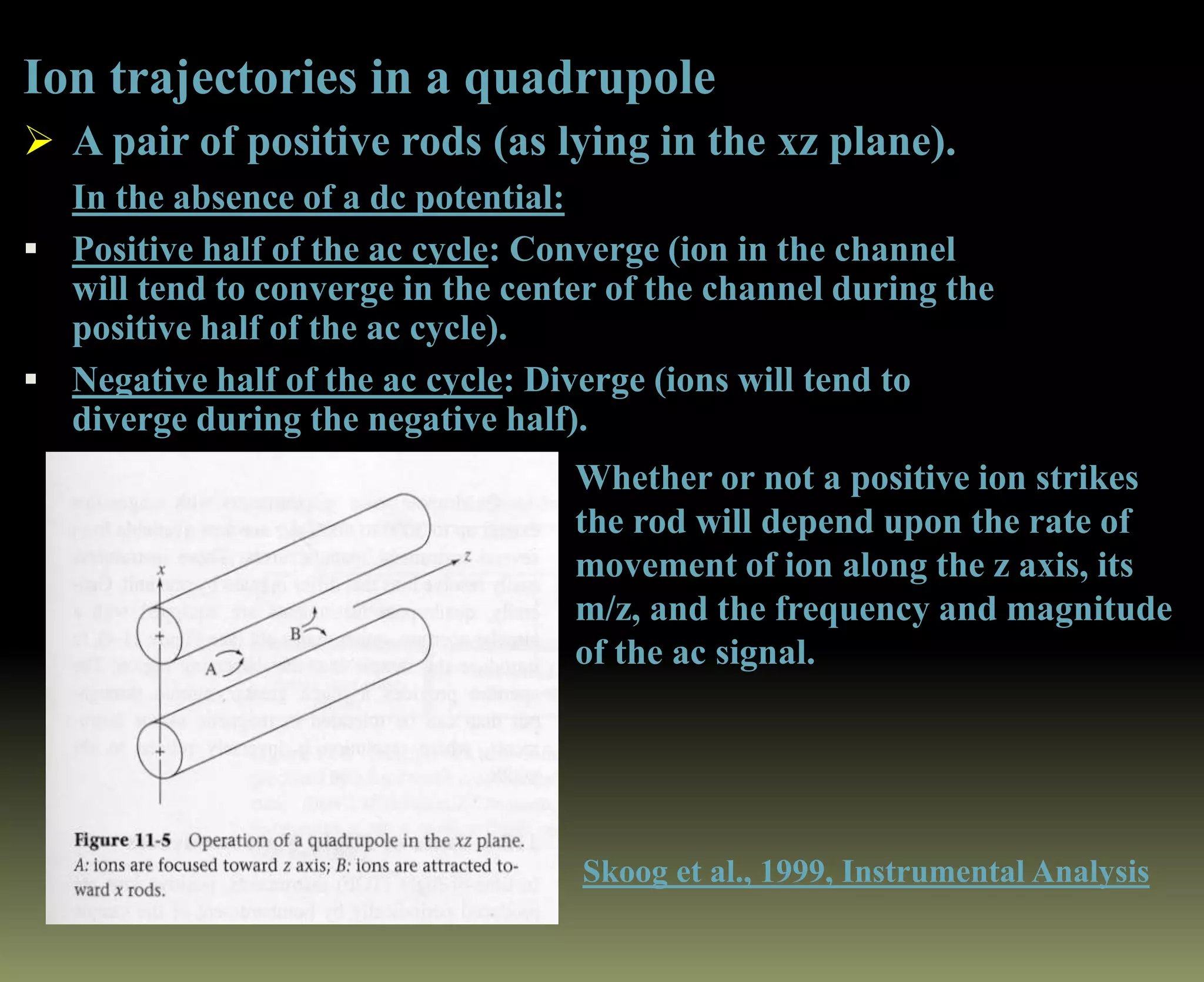
To understand the filtering capability of a quadrupole,
we need to consider the effect of the dc and ac voltages
on the trajectory of ions as they pass through the channel
between the rods. Let us first focus on the pair of
positive rods, which are shown in Figure 11-7 as lying
In the xz plane. In the absence of a dc voltage, ions in
the channel will tend to converge in the center of the
channel during the positive half of the ac cycle and will
tend to diverge during the negative half. This behavior is
illustrated at points A and B in the figure. If during the
negative half cycle an ion strikes the rod, the positive
charge will be neutralized, and the resulting molecule
will be carried away. Whether a positive ion strikes the
rod depends on the rate of movement of the ion along
the z-axis, its mass-to-charge ratio. And the frequency
and magnitude of the ac signal.
30.
Ion trajectories ina quadrupole
A pair of positive rods (as lying in the xz plane).
In the absence of a dc potential:
Positive half of the ac cycle: Converge (ion in the channel
will tend to converge in the center of the channel during the
positive half of the ac cycle).
Negative half of the ac cycle: Diverge (ions will tend to
diverge during the negative half).
Skoog et al., 1999, Instrumental Analysis
Whether or not a positive ion strikes
the rod will depend upon the rate of
movement of ion along the z axis, its
m/z, and the frequency and magnitude
of the ac signal.
32.
~
AC
F = E*ze(E: electric field intensity)
F = am (a: acceleration, m: mass)
Pass high-M
Pass low-M
Like a band-pass filter
Scanning with aquadrupole Filter
To scan a mass spectrum with a quadrupole
instrument, the ac voltage V and the dc
voltage U are increased simultaneously from
zero to some maximum value while their
ratio is maintained at slightly less than 6. The
changes in voltage during a typical scan are
shown in Figure 11-9. The two diverging
straight lines show the variation in the two dc
voltages as a function of time.
35.
Scanning with aquadrupole Filter
FIGURE 11-9 Voltage relationships during a
mass scan with a quadrupole analyzer.
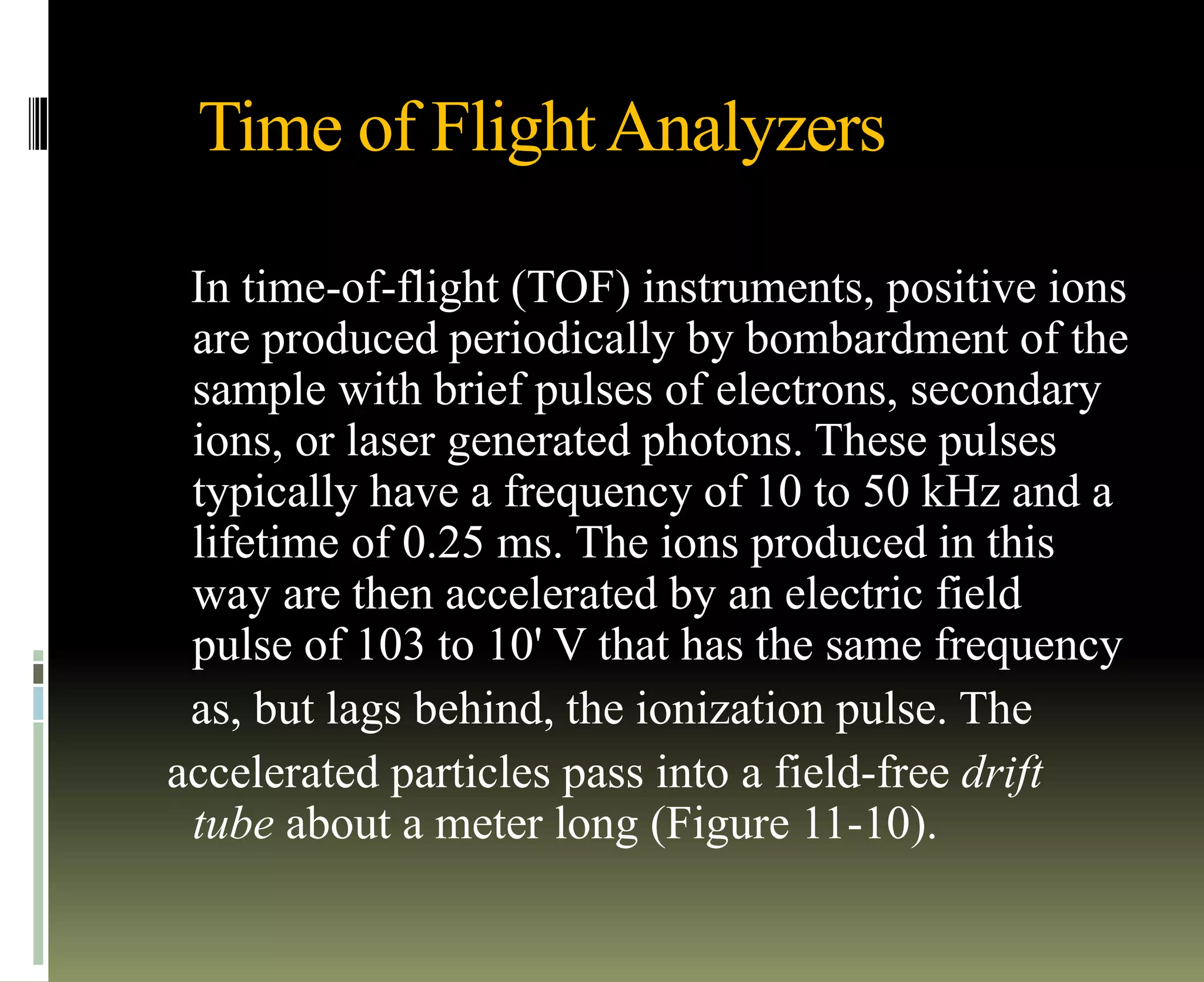
Time of FlightAnalyzers
Intime-of-flight (TOF) instruments, positive ions
are produced periodically by bombardment of the
sample with brief pulses of electrons, secondary
ions, or laser generated photons. These pulses
typically have a frequency of 10 to 50 kHz and a
lifetime of 0.25 ms. The ions produced in this
way are then accelerated by an electric field
pulse of 103 to 10' V that has the same frequency
as, but lags behind, the ionization pulse. The
accelerated particles pass into a field-free drift
tube about a meter long (Figure 11-10).
38.
Time of FlightAnalyzers
non-magnetic separation
detector - electron multiplier tube
instantaneous display of results
Example: (a) calculate the kinetic energy that a singly charged ion
(z=1) Will Acquired if it is accelerated through a potential of 103 V in
an electron-Impact source. (b) Does the kinetic energy is depend
upon its mass? (c) Does the velocity of the ion depend upon its mass?
Double-FocusingAnalyzers
As shown inFigure 11-11, a double-focusing
mass spectrometer contains two devices
for focusing a beam of ions: an
electrostatic analyzer and a magnetic
sector analyzer.
INDUCTIVELYCOUPLED PLASMA
MASS SPECTROMETRY
Sincethe early 1980, ICPMS has grown to
be one of the most important techniques
for elemental analysis because of its low
detection limits for most elements, its high
degree of selectivity, and its reasonably
good precision and accuracy. In these
applications an ICP torch serves as an
atomizer and ionizer.
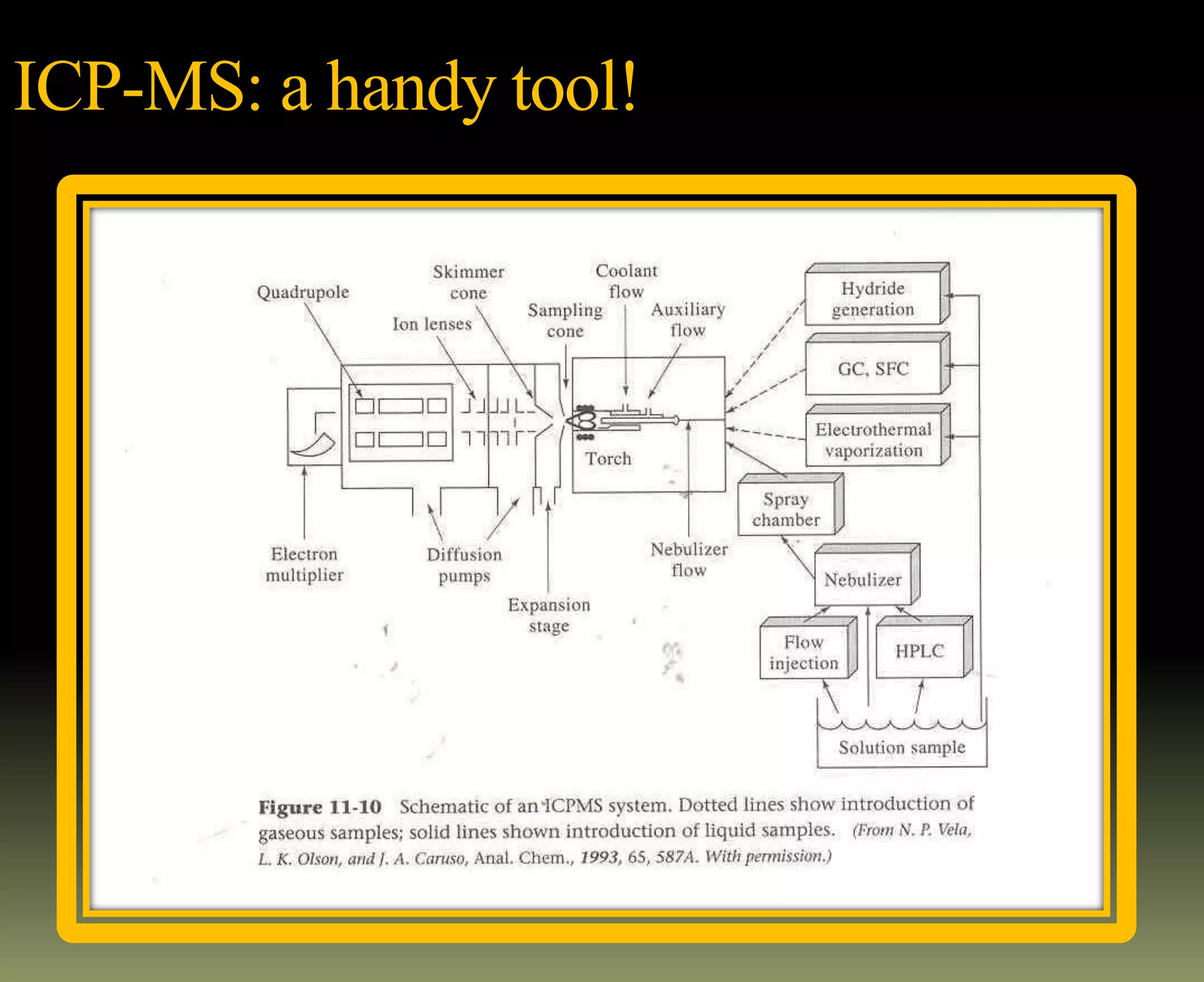
Instruments for ICPMS
Figure11-12 shows schematically the
components of a commercial ICPMS
systemI2 A critical part of the instrument
is the interface that couples the ICP torch,
which operates at atmospheric pressure
with the mass spectrometer that requires a
pressure of less than 10-4 torr.
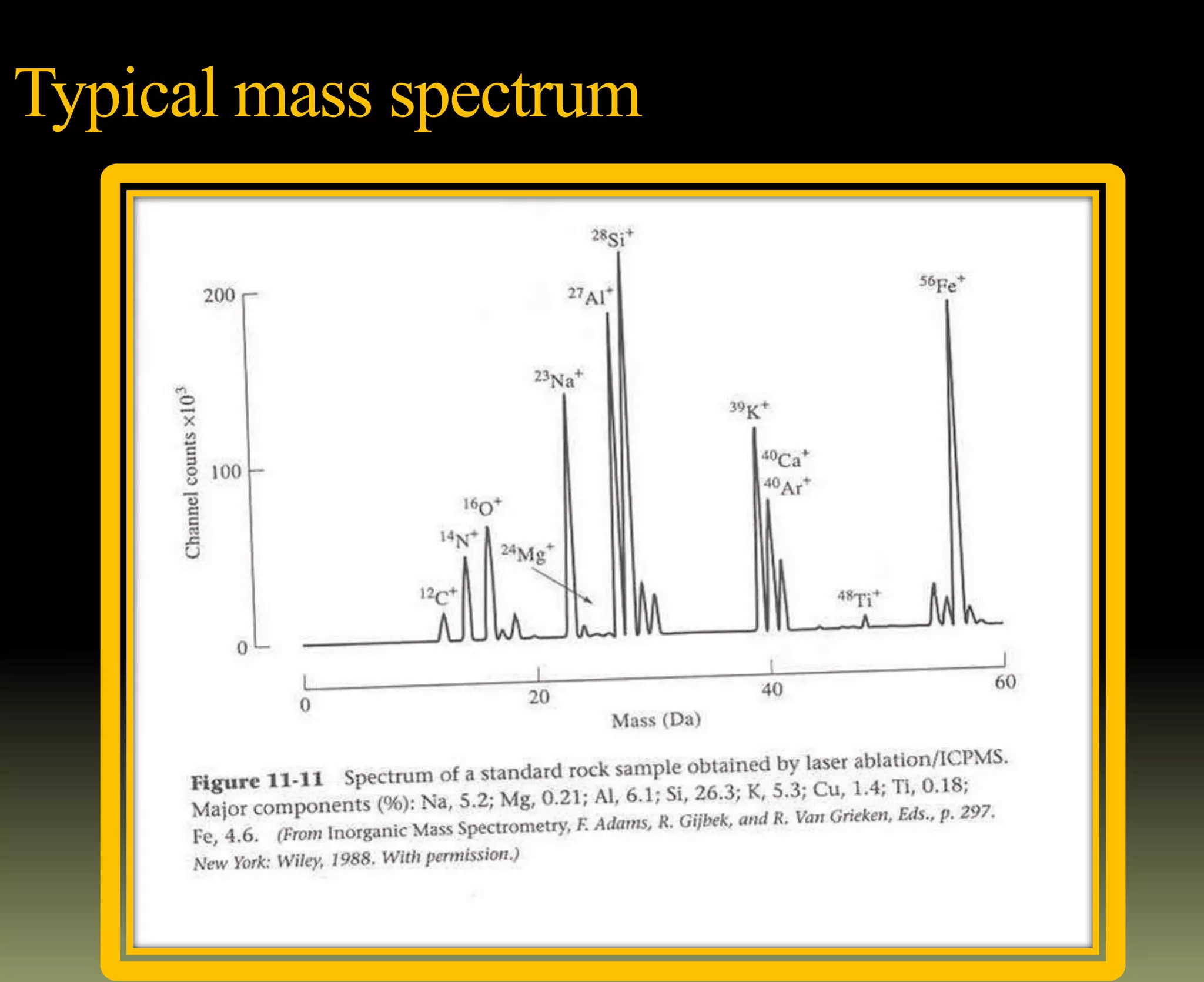
Atomic Mass Spectra
andInterferences
One of the advantages of using mass
spectrometric detection with ICPs as
opposed to optical detection is that mass
spectra are usually much simpler and
easier to interpret than corresponding
optical spectra, This property is especially
true for those elements such as the rare
earths that may exhibit thousands of
emission lines.
Spectral Interferences?
Refractoryoxide
As a result of incomplete dissociation of the sample
matrix or from recombination in the plasma tail
MO+, MO2+, MO3+
Doubly charged ions
53.
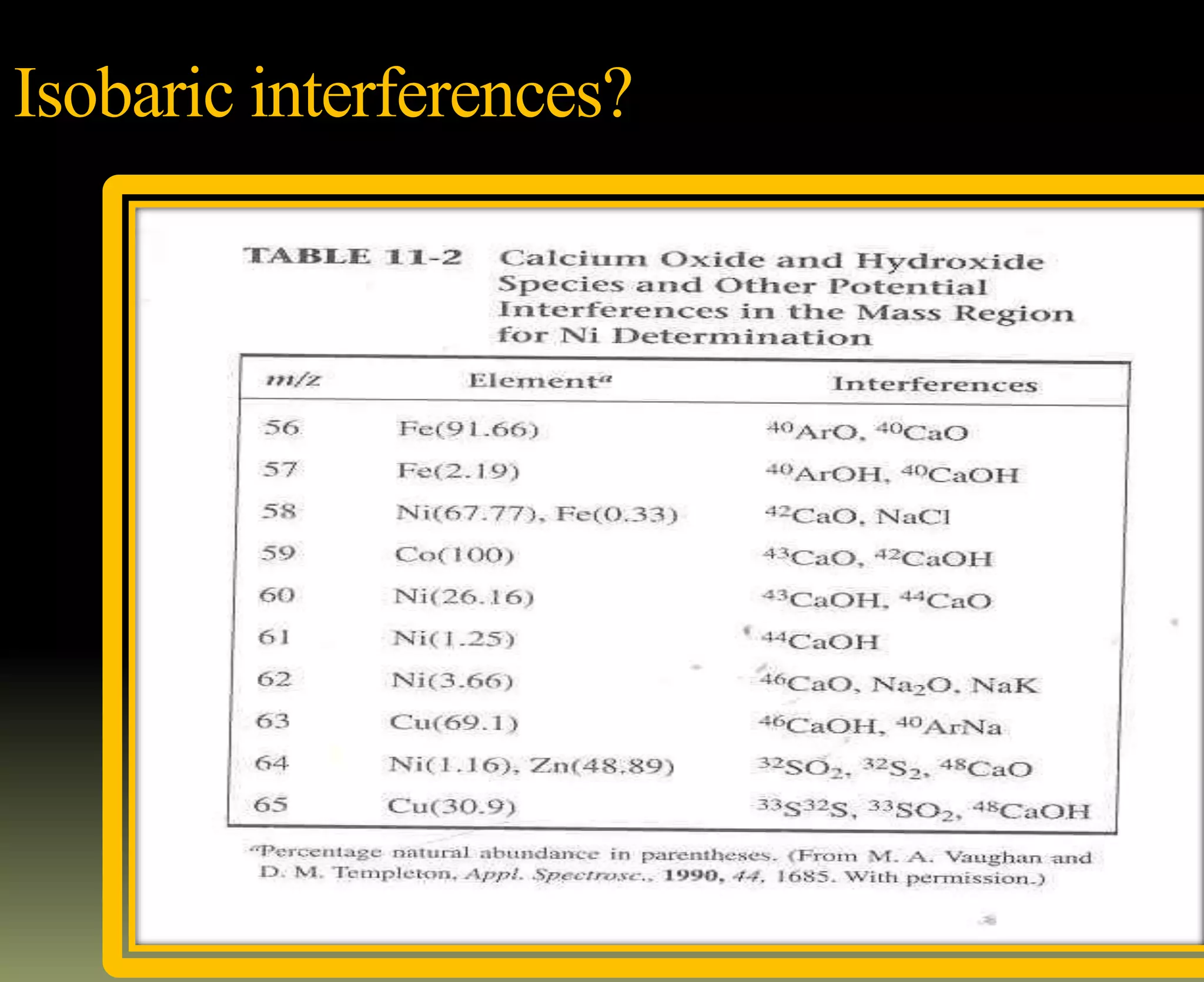
Spectral Interferences?
Isobaricoverlap
Due to two elements that have isotopes having
substantially the same mass
40Ar+ and 40Ca+
Poly atomic
Due to interactions between species in the plasma
and species in matrix or atmosphere
56Fe and 40Ar16O
44Ca and 12C16O16O.
Matrix Effects
In ICPMS,matrix effects become
noticeable at concomitant concentrations
of greater than about 500 to 1000 mg/mL.
Usually these effects cause a reduction in
the analyte signal, although under certain
experimental conditions signal
enhancement is observed.
Detection Limits
One ofthe main attractions of ICPMS lies
with the lower detection limits attainable
with mass spectrometric detection than
with optical detection. These limits in
many cases equal and sometimes exceed
those that can be realized by
electrothermal atomic absorption
methods.
63.
Detection Limits
FIGURE11-17 Detectionlimits for selected elements by ICPMS (black bars)
compared with those for ICP-OES (blue bars) and ETMS (gray bars), plotted
on a logarithmic scale in concentrations of ppb (or mg/L).
Because ETMS detection limits are inherently in mass units (pg), they have
been converted to concentration by assuming a 20-JLLsample. (From M. Selby
and G. M. Hieftje,Amer. Lab., 1987 (8),20. With permission.)
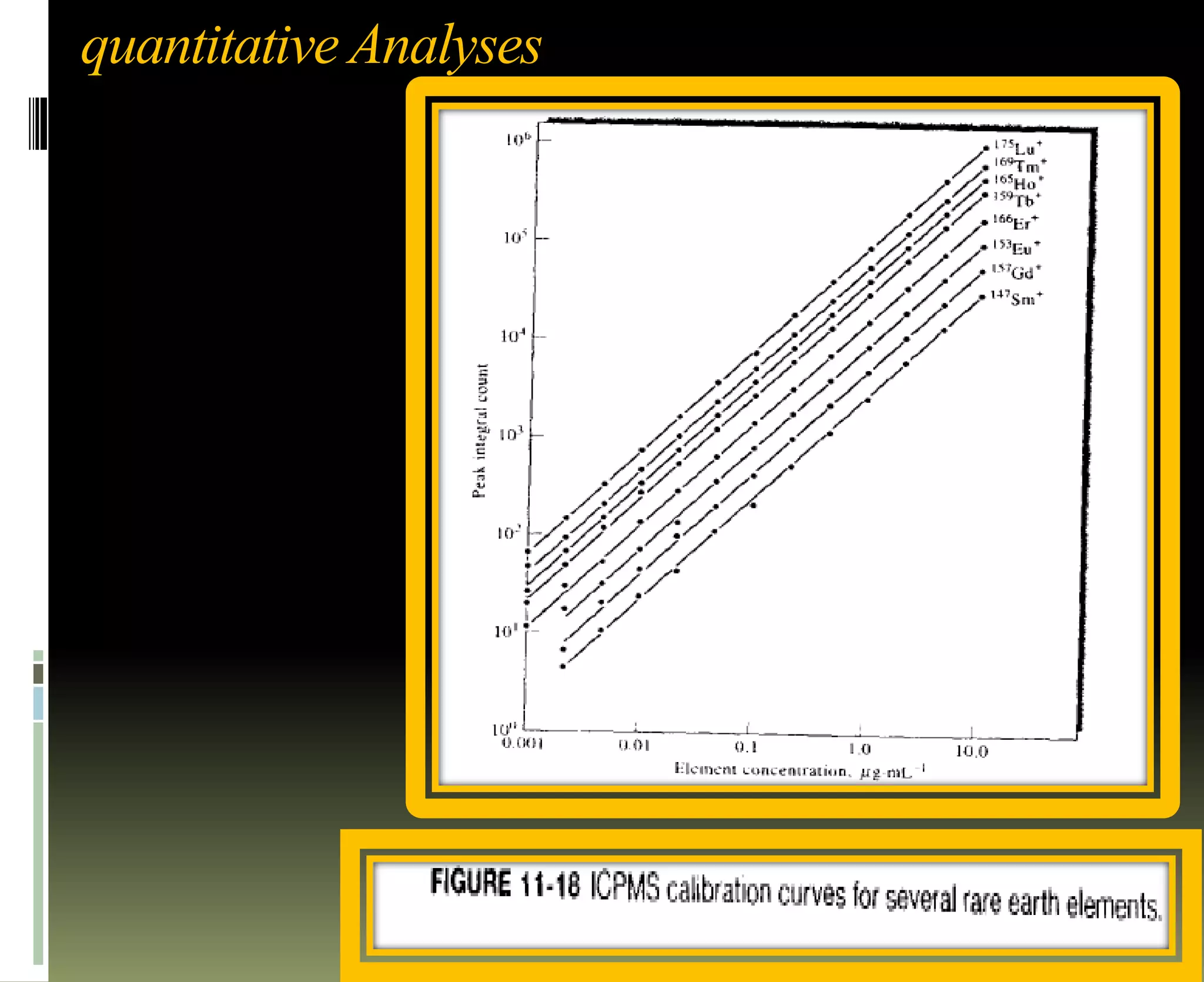
quantitative Analyses
The mostwidely used quantitative method
of ICPMSuses a set of calibration
standards for preparing a calibrationcurve.
Simple aqueous standards are usually
adequate if the unknown solutions are
sufjiciently dilute - less than 2000 g/mL of
total dissolved solid.
Isotope Ratio Measurements
Themeasurement of isotope ratios is of
considerable importance in several fields
of science and medicine. For example,
archeologists and geologists use such data
to establish the age of artifacts and various
types of deposits. Chemists and clinicians
use isotopically enriched materials as
tracers in various types of studies. The
outcome of these studies is based on
isotope ratio measurements.
SPARK SOURCE MASSSPECTROMETRY
In SSMS. the atomic constituents of a sample are
converted by a high-voltage (-30 kv), radio-frequency
spark to gaseous ions for mass analysis. The spark is
housed in a vacuum chamber located immediately
adjacent to the mass analyzer. The chamber is
equipped with a separate high-speed pumping system
that quickly reduces the internal pressure to about 10-8
torr after sample changes. Often, the sample serves as
one or both electrodes. Alternatively. it is mixed with
graphite and loaded into a cup-shape electrode. The
gaseous positive ions formed in the spark plasma arc
drawn into the analyzer by a de voltage.
spectra
Like ICP massspectra, spark source mass
spectra are much simpler than atomic
emission spectra, consisting of one major
peak for each isotope of an element as
well as a few weaker lines corresponding
to multiply charged ions and ionized oxide
and hydroxide species. The presence of
these additional ions creates the potential
for interference just as in ICPMS.
QualitativeApplications
SSMS is apowerful tool for qualitative and
semiquantitaative analysis. All elements in the
periodic table from 7Li through 238Ucan be identified
in a single excitation. By varying data-acquisition
parameters, it is possible to determine order of
magnitude concentrations for major constituents of a
sample as well as for constituents in the parts-per-
billion concentration range. Interpretation of spectra
does require skill and experience, however, because
of the presence of multiply charged species,
polymeric species, and molecular ions.
76.
Quantitative Applications
A radio-frequencyspark is not a very
reproducible source over short periods. As
a consequence. it is necessary to integrate
the output signals from a spark for periods
that range from several seconds to
hundreds of seconds if good quantitative
data are to be obtained .The detection
system must be capable of electronic
signal integration,
GLOW DISCHARGE MASSSPECTROMETRY
As shown in Section 8C-2, a glow-discharge
source is used as an atomization device for various
types of atomic spectroscopy.In addition to
atomizing samples, it also produces a cloud of
positive analyte ions from solid samples. This
device consists of a simple two electrode closed
system containing argon at a pressure of 0.1 to
10torr. A voltage of 5 to 15 kv from a pulsed dc
power supply is applied between the electrodes,
causing the formation of positive argon ions,
which are then accelerated toward the cathode.
Methods for elementalsurface analysis
Two atomic mass spectrometric methods
are often used to determine the elemental
composition of solid surfaces: secondary-
ion mass spectrometry and laser
microprobe mass spectrometry.
81.
Advanced Analytical Chemistry– CHM 6157 ® Y. CAI Florida International
University
Updated on 9/13/2006 Chapter 3 ICPMS
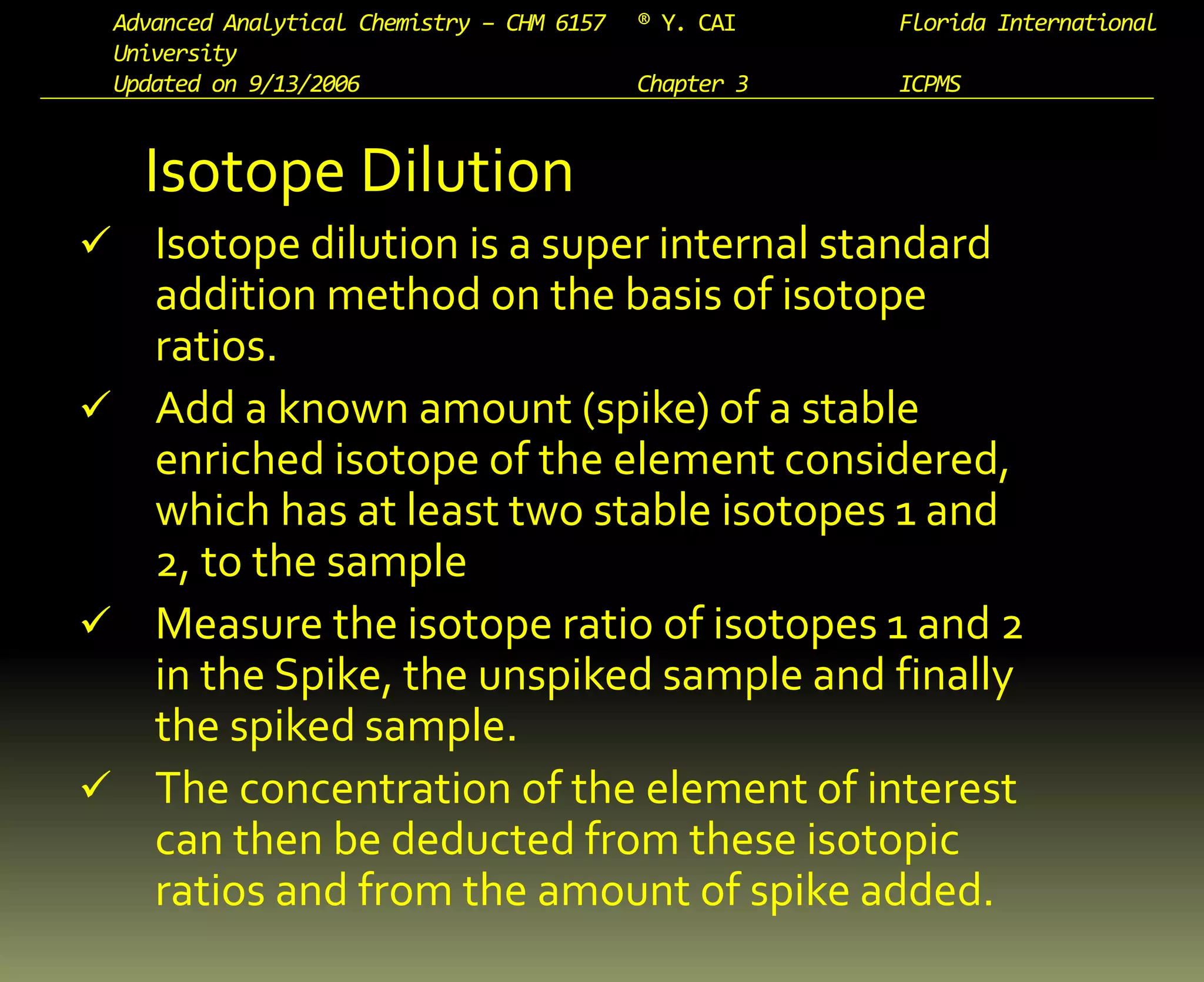
Isotope Dilution
Isotope dilution is a super internal standard
addition method on the basis of isotope
ratios.
Add a known amount (spike) of a stable
enriched isotope of the element considered,
which has at least two stable isotopes 1 and
2, to the sample
Measure the isotope ratio of isotopes 1 and 2
in the Spike, the unspiked sample and finally
the spiked sample.
The concentration of the element of interest
can then be deducted from these isotopic
ratios and from the amount of spike added.
82.
Advanced Analytical Chemistry– CHM 6157 ® Y. CAI Florida International
University
Updated on 9/13/2006 Chapter 3 ICPMS
Advantages:
Simplified chemical and physical separation
procedures
Elimination (reduction) of matrix effects
Elimination of the effect of instrumental drift
83.
Advanced Analytical Chemistry– CHM 6157 ® Y. CAI Florida International
University
Updated on 9/13/2006 Chapter 3 ICPMS
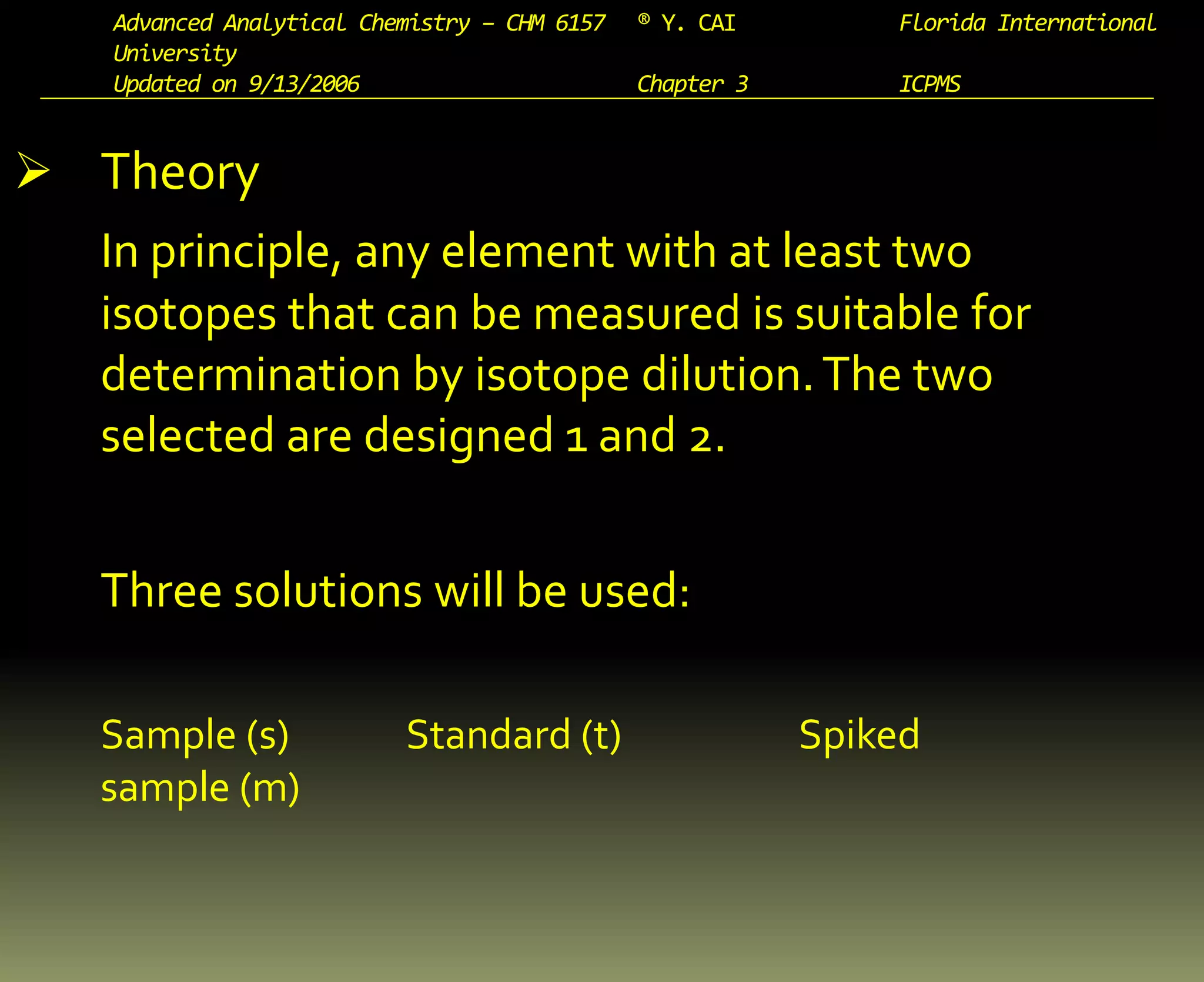
Theory
In principle, any element with at least two
isotopes that can be measured is suitable for
determination by isotope dilution.The two
selected are designed 1 and 2.
Three solutions will be used:
Sample (s) Standard (t) Spiked
sample (m)
84.
Advanced Analytical Chemistry– CHM 6157 ® Y. CAI Florida International
University
Updated on 9/13/2006 Chapter 3 ICPMS
1ns is the number of moles of isotope 1 in the
sample.
2ns is the number of moles of isotope 2 in the
sample.
1nt is the number of moles of isotope 1 in the
standard.
2nt is the number of moles of isotope 2 in the
standard.
Rs is the ratio of isotope 1 to isotope 2 in the
sample solution.
Rt is the ratio of isotope 1 to isotope 2 in the
standard.
Rm is the ratio of isotope 1 to isotope 2 in the
spiked sample.









































![FOURIER -TRANSFORM INFRARED SPECTROMETER [FTIR]](https://cdn.slidesharecdn.com/ss_thumbnails/ftir-160604063055-thumbnail.jpg?width=640&height=640&fit=bounds)


