Definition
The research design refers to the overall strategy.
 To integrate the different components of the study in a coherent and
logical way and ensuring that you will effectively address the research
problem;
 It constitutes the blueprint for the collection, measurement, and
analysis of data.
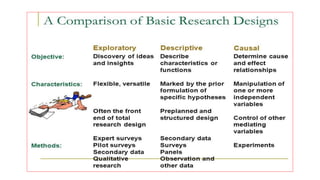
Exploratory research is defined as a research used to investigate a problem which is not clearly defined.
It is conducted to have a better understanding of the existing problem, but will not provide conclusive
results. For such a research, a researcher starts with a general idea and uses this research as a medium
to identify issues, that can be the focus for future research. An important aspect here is that the
researcher should be willing to change his/her direction subject to the revelation of new data or insight.
Such a research is usually carried out when the problem is at a preliminary stage.
Examples of Exploratory Research Design
The following are some examples for studies with exploratory research design in business studies:
 A study into the role of social networking sites as an effective marketing communication channel.
 An investigation into the ways of improvement of quality of customer services within hospitality
sector in India.
 An assessment of the role of corporate social responsibility on consumer behavior in pharmaceutical
industry in India.
 Consider a scenario where a juice bar owner feels that increasing the variety of juices will enable
increase in customers, however he is not sure and needs more information. The owner intends to
carry out an exploratory research to find out and hence decides to do an exploratory research to find
out if expanding their juices selection will enable him to get more customers of if there is a better idea.
Examples of Exploratory Research Design
The favorite crime investigation TV programs (e.g., Crime Patrol, Arjun, Savdhaan India, etc) give
a pretty good example of the research design. These shows typically start with a crime that needs to
be investigated. The initial step is to look for hints which can help establish what has happened
(exploratory). The clues found in the exploratory phase of the research usually point in the direction
of a specific hypothesis or explanation of the events which happened, and investigators start
focusing their efforts in this direction, performing interviews with witnesses and suspects
(descriptive).
An XYZ website, which provides paid online courses conducts a survey to find out how they can
increase the number of users for their newly introduced course. For this, they take feedback from
their existing users as well as from other potential users. The data collection from the feedback can be
used to find out what can be done to increase the number of users who take their course.
Types and Methodologies of Exploratory Research
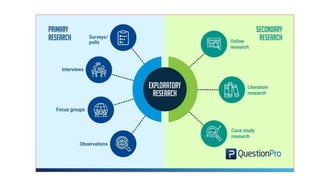
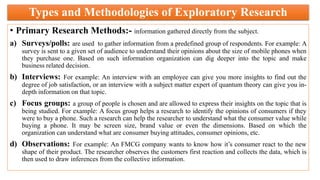
• Primary Research Methods:- information gathered directly from the subject.
a) Surveys/polls: are used to gather information from a predefined group of respondents. For example: A
survey is sent to a given set of audience to understand their opinions about the size of mobile phones when
they purchase one. Based on such information organization can dig deeper into the topic and make
business related decision.
b) Interviews: For example: An interview with an employee can give you more insights to find out the
degree of job satisfaction, or an interview with a subject matter expert of quantum theory can give you in-
depth information on that topic.
c) Focus groups: a group of people is chosen and are allowed to express their insights on the topic that is
being studied. For example: A focus group helps a research to identify the opinions of consumers if they
were to buy a phone. Such a research can help the researcher to understand what the consumer value while
buying a phone. It may be screen size, brand value or even the dimensions. Based on which the
organization can understand what are consumer buying attitudes, consumer opinions, etc.
d) Observations: For example: An FMCG company wants to know how it’s consumer react to the new
shape of their product. The researcher observes the customers first reaction and collects the data, which is
then used to draw inferences from the collective information.
Types and Methodologies of Exploratory Research
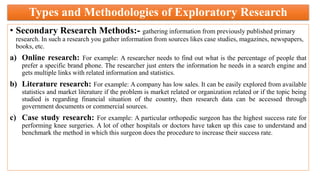
• Secondary Research Methods:- gathering information from previously published primary
research. In such a research you gather information from sources likes case studies, magazines, newspapers,
books, etc.
a) Online research: For example: A researcher needs to find out what is the percentage of people that
prefer a specific brand phone. The researcher just enters the information he needs in a search engine and
gets multiple links with related information and statistics.
b) Literature research: For example: A company has low sales. It can be easily explored from available
statistics and market literature if the problem is market related or organization related or if the topic being
studied is regarding financial situation of the country, then research data can be accessed through
government documents or commercial sources.
c) Case study research: For example: A particular orthopedic surgeon has the highest success rate for
performing knee surgeries. A lot of other hospitals or doctors have taken up this case to understand and
benchmark the method in which this surgeon does the procedure to increase their success rate.
Conclusive Research Design
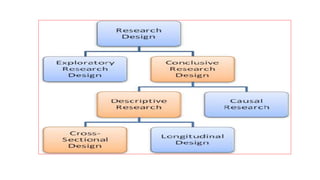
• Conclusive research design is applied to generate findings that are
practically useful in reaching conclusions or decision-making. In this
type of studies research objectives and data requirements need to be
clearly defined. Findings of conclusive studies usually have specific
uses and are used as an input by managers in the decision making
process. Conclusive research can be of two types: descriptive or
causal.
Descriptive Research Design
Descriptive research is defined as a research method that describes the characteristics of
the population or phenomenon studied. This methodology focuses more on the “what”
of the research subject than the “why” of the research subject. It can answer what,
where, when and how questions, but not why questions.
Descriptive research can be used to investigate the background of a research problem
and get the required information needed to carry out further research.
It is used to determine the characteristics of the subjects, including their traits, behavior,
opinion, etc.
For example, a survey evaluating the number of hours millennials in a community
spends on the internet weekly, will help a service provider make informed business
decisions regarding the market potential of the community.
The descriptive research method primarily focuses on describing the nature of a
demographic segment, without focusing on “why” a particular phenomenon occurs. In
other words, it “describes” the subject of the research, without covering “why” it
happens.
Descriptive Research Design Examples
For example, an apparel brand that wants to understand the fashion purchasing
trends among Indian buyers will conduct a demographic survey, gather data and
then conduct descriptive research on this demographic segment. The study will
then uncover details on “what is the purchasing pattern of Indian buyers,” but not
cover any investigative information about “why” the patterns exits. Because the
apparel brand trying to break into this market, understanding the nature of their
market is the study’s objective.
An apparel company researches different demographics like age groups from 24-
35 and 36-45 on a new range launch of autumn wear. If one of these groups
doesn’t take too well to the new launch, it provides insight into what clothes are
like and what is not. The brand drops the clothes and apparel that customers don’t
like.
Descriptive Research Design Examples
• Research questions in descriptive studies typically start with ‘What is…”.
Examples of research questions in descriptive studies are as follows:
a. What are the most effective intangible employee motivation tools in service
industry in the 21st century?
b. What is the impact of viral marketing on consumer behaviour?
c. Do corporate leaders of multinational companies in the 21st century possess
moral rights to receive multi-million bonuses?
d. What are the main distinctive traits of organisational culture of McDonald’s at
USA?
e. What is the impact of the global financial crisis of 2007 – 2009 on Indian stock
markets?
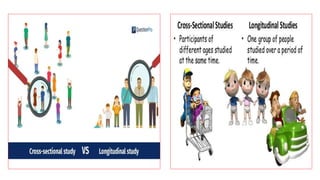
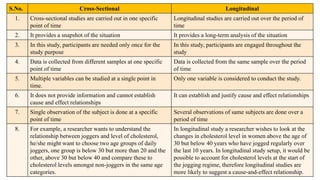
S.No. Cross-Sectional Longitudinal
1. Cross-sectional studies are carried out in one specific
point of time
Longitudinal studies are carried out over the period of
time
2. It provides a snapshot of the situation It provides a long-term analysis of the situation
3. In this study, participants are needed only once for the
study purpose
In this study, participants are engaged throughout the
study
4. Data is collected from different samples at one specific
point of time
Data is collected from the same sample over the period
of time
5. Multiple variables can be studied at a single point in
time.
Only one variable is considered to conduct the study.
6. It does not provide information and cannot establish
cause and effect relationships
It can establish and justify cause and effect relationships
7. Single observation of the subject is done at a specific
point of time
Several observations of same subjects are done over a
period of time
8. For example, a researcher wants to understand the
relationship between joggers and level of cholesterol,
he/she might want to choose two age groups of daily
joggers, one group is below 30 but more than 20 and the
other, above 30 but below 40 and compare these to
cholesterol levels amongst non-joggers in the same age
categories.
In longitudinal study a researcher wishes to look at the
changes in cholesterol level in women above the age of
30 but below 40 years who have jogged regularly over
the last 10 years. In longitudinal study setup, it would be
possible to account for cholesterol levels at the start of
the jogging regime, therefore longitudinal studies are
more likely to suggest a cause-and-effect relationship.
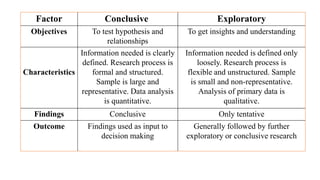
Factor Conclusive Exploratory
Objectives To test hypothesis and
relationships
To get insights and understanding
Characteristics
Information needed is clearly
defined. Research process is
formal and structured.
Sample is large and
representative. Data analysis
is quantitative.
Information needed is defined only
loosely. Research process is
flexible and unstructured. Sample
is small and non-representative.
Analysis of primary data is
qualitative.
Findings Conclusive Only tentative
Outcome Findings used as input to
decision making
Generally followed by further
exploratory or conclusive research
Research design

Research design

  • 2.
    Definition The research designrefers to the overall strategy.  To integrate the different components of the study in a coherent and logical way and ensuring that you will effectively address the research problem;  It constitutes the blueprint for the collection, measurement, and analysis of data.
  • 4.
    Exploratory research isdefined as a research used to investigate a problem which is not clearly defined. It is conducted to have a better understanding of the existing problem, but will not provide conclusive results. For such a research, a researcher starts with a general idea and uses this research as a medium to identify issues, that can be the focus for future research. An important aspect here is that the researcher should be willing to change his/her direction subject to the revelation of new data or insight. Such a research is usually carried out when the problem is at a preliminary stage. Examples of Exploratory Research Design The following are some examples for studies with exploratory research design in business studies:  A study into the role of social networking sites as an effective marketing communication channel.  An investigation into the ways of improvement of quality of customer services within hospitality sector in India.  An assessment of the role of corporate social responsibility on consumer behavior in pharmaceutical industry in India.  Consider a scenario where a juice bar owner feels that increasing the variety of juices will enable increase in customers, however he is not sure and needs more information. The owner intends to carry out an exploratory research to find out and hence decides to do an exploratory research to find out if expanding their juices selection will enable him to get more customers of if there is a better idea.
  • 5.
    Examples of ExploratoryResearch Design The favorite crime investigation TV programs (e.g., Crime Patrol, Arjun, Savdhaan India, etc) give a pretty good example of the research design. These shows typically start with a crime that needs to be investigated. The initial step is to look for hints which can help establish what has happened (exploratory). The clues found in the exploratory phase of the research usually point in the direction of a specific hypothesis or explanation of the events which happened, and investigators start focusing their efforts in this direction, performing interviews with witnesses and suspects (descriptive). An XYZ website, which provides paid online courses conducts a survey to find out how they can increase the number of users for their newly introduced course. For this, they take feedback from their existing users as well as from other potential users. The data collection from the feedback can be used to find out what can be done to increase the number of users who take their course.
  • 7.
    Types and Methodologiesof Exploratory Research • Primary Research Methods:- information gathered directly from the subject. a) Surveys/polls: are used to gather information from a predefined group of respondents. For example: A survey is sent to a given set of audience to understand their opinions about the size of mobile phones when they purchase one. Based on such information organization can dig deeper into the topic and make business related decision. b) Interviews: For example: An interview with an employee can give you more insights to find out the degree of job satisfaction, or an interview with a subject matter expert of quantum theory can give you in- depth information on that topic. c) Focus groups: a group of people is chosen and are allowed to express their insights on the topic that is being studied. For example: A focus group helps a research to identify the opinions of consumers if they were to buy a phone. Such a research can help the researcher to understand what the consumer value while buying a phone. It may be screen size, brand value or even the dimensions. Based on which the organization can understand what are consumer buying attitudes, consumer opinions, etc. d) Observations: For example: An FMCG company wants to know how it’s consumer react to the new shape of their product. The researcher observes the customers first reaction and collects the data, which is then used to draw inferences from the collective information.
  • 8.
    Types and Methodologiesof Exploratory Research • Secondary Research Methods:- gathering information from previously published primary research. In such a research you gather information from sources likes case studies, magazines, newspapers, books, etc. a) Online research: For example: A researcher needs to find out what is the percentage of people that prefer a specific brand phone. The researcher just enters the information he needs in a search engine and gets multiple links with related information and statistics. b) Literature research: For example: A company has low sales. It can be easily explored from available statistics and market literature if the problem is market related or organization related or if the topic being studied is regarding financial situation of the country, then research data can be accessed through government documents or commercial sources. c) Case study research: For example: A particular orthopedic surgeon has the highest success rate for performing knee surgeries. A lot of other hospitals or doctors have taken up this case to understand and benchmark the method in which this surgeon does the procedure to increase their success rate.
  • 9.
    Conclusive Research Design •Conclusive research design is applied to generate findings that are practically useful in reaching conclusions or decision-making. In this type of studies research objectives and data requirements need to be clearly defined. Findings of conclusive studies usually have specific uses and are used as an input by managers in the decision making process. Conclusive research can be of two types: descriptive or causal.
  • 10.
    Descriptive Research Design Descriptiveresearch is defined as a research method that describes the characteristics of the population or phenomenon studied. This methodology focuses more on the “what” of the research subject than the “why” of the research subject. It can answer what, where, when and how questions, but not why questions. Descriptive research can be used to investigate the background of a research problem and get the required information needed to carry out further research. It is used to determine the characteristics of the subjects, including their traits, behavior, opinion, etc. For example, a survey evaluating the number of hours millennials in a community spends on the internet weekly, will help a service provider make informed business decisions regarding the market potential of the community. The descriptive research method primarily focuses on describing the nature of a demographic segment, without focusing on “why” a particular phenomenon occurs. In other words, it “describes” the subject of the research, without covering “why” it happens.
  • 11.
    Descriptive Research DesignExamples For example, an apparel brand that wants to understand the fashion purchasing trends among Indian buyers will conduct a demographic survey, gather data and then conduct descriptive research on this demographic segment. The study will then uncover details on “what is the purchasing pattern of Indian buyers,” but not cover any investigative information about “why” the patterns exits. Because the apparel brand trying to break into this market, understanding the nature of their market is the study’s objective. An apparel company researches different demographics like age groups from 24- 35 and 36-45 on a new range launch of autumn wear. If one of these groups doesn’t take too well to the new launch, it provides insight into what clothes are like and what is not. The brand drops the clothes and apparel that customers don’t like.
  • 12.
    Descriptive Research DesignExamples • Research questions in descriptive studies typically start with ‘What is…”. Examples of research questions in descriptive studies are as follows: a. What are the most effective intangible employee motivation tools in service industry in the 21st century? b. What is the impact of viral marketing on consumer behaviour? c. Do corporate leaders of multinational companies in the 21st century possess moral rights to receive multi-million bonuses? d. What are the main distinctive traits of organisational culture of McDonald’s at USA? e. What is the impact of the global financial crisis of 2007 – 2009 on Indian stock markets?
  • 14.
    S.No. Cross-Sectional Longitudinal 1.Cross-sectional studies are carried out in one specific point of time Longitudinal studies are carried out over the period of time 2. It provides a snapshot of the situation It provides a long-term analysis of the situation 3. In this study, participants are needed only once for the study purpose In this study, participants are engaged throughout the study 4. Data is collected from different samples at one specific point of time Data is collected from the same sample over the period of time 5. Multiple variables can be studied at a single point in time. Only one variable is considered to conduct the study. 6. It does not provide information and cannot establish cause and effect relationships It can establish and justify cause and effect relationships 7. Single observation of the subject is done at a specific point of time Several observations of same subjects are done over a period of time 8. For example, a researcher wants to understand the relationship between joggers and level of cholesterol, he/she might want to choose two age groups of daily joggers, one group is below 30 but more than 20 and the other, above 30 but below 40 and compare these to cholesterol levels amongst non-joggers in the same age categories. In longitudinal study a researcher wishes to look at the changes in cholesterol level in women above the age of 30 but below 40 years who have jogged regularly over the last 10 years. In longitudinal study setup, it would be possible to account for cholesterol levels at the start of the jogging regime, therefore longitudinal studies are more likely to suggest a cause-and-effect relationship.
  • 16.
    Factor Conclusive Exploratory ObjectivesTo test hypothesis and relationships To get insights and understanding Characteristics Information needed is clearly defined. Research process is formal and structured. Sample is large and representative. Data analysis is quantitative. Information needed is defined only loosely. Research process is flexible and unstructured. Sample is small and non-representative. Analysis of primary data is qualitative. Findings Conclusive Only tentative Outcome Findings used as input to decision making Generally followed by further exploratory or conclusive research