What is a habitat?
an environment that has all necessary
requirements for an organism to live.
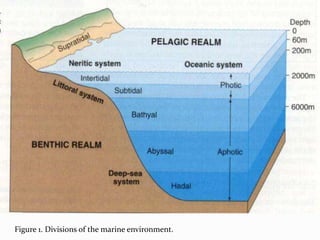
Figure 1. Divisions of the marine environment.
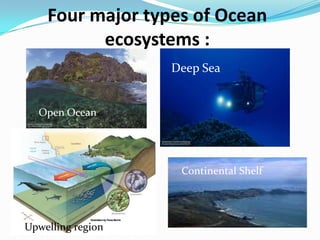
Four major types of Ocean
ecosystems :
Open Ocean
Deep Sea
Upwelling region
Continental Shelf
Open Ocean
 areas away from the coastal boundaries and above
the seabed.
 encompasses the entire water column of the seas and
the oceans and lies beyond the edge of
the continental shelf.
 extends from the tropics to the polar regions and
from the sea surface to the abyssal depths.
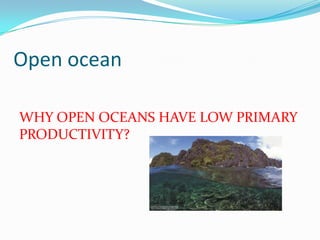
Open ocean
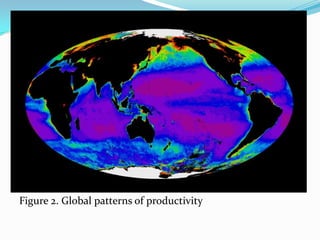
WHY OPEN OCEANS HAVE LOW PRIMARY
PRODUCTIVITY?
Figure 2. Global patterns of productivity
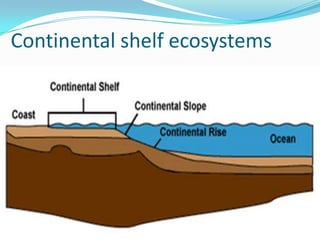
Continental shelf ecosystems
 is characterized by a very gentle slope less than 1 degree.
The average depth is about 150 m and it has an average
width of 70 km.
 local variations are common, ranging from more than 1000
km in the Arctic Ocean to a few kilometers along the
Pacific coast of North and South America.
 The water above the continental shelf is called neritic
water
Continental shelf ecosystems
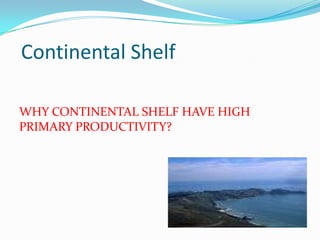
Continental Shelf
WHY CONTINENTAL SHELF HAVE HIGH
PRIMARY PRODUCTIVITY?
 Tend to have relatively high concentrations of nitrate
and other nutrients, averaged over the year.
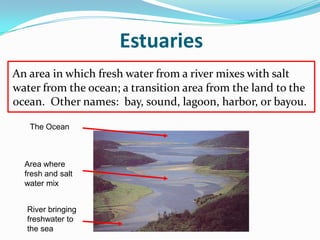
Estuaries
An area in which fresh water from a river mixes with salt
water from the ocean; a transition area from the land to the
ocean. Other names: bay, sound, lagoon, harbor, or bayou.
River bringing
freshwater to
the sea
The Ocean
Area where
fresh and salt
water mix
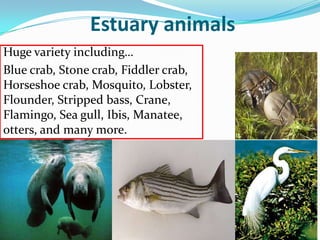
Estuary animals
Huge variety including…
Blue crab, Stone crab, Fiddler crab,
Horseshoe crab, Mosquito, Lobster,
Flounder, Stripped bass, Crane,
Flamingo, Sea gull, Ibis, Manatee,
otters, and many more.
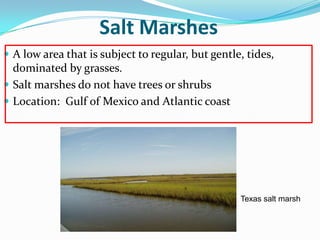
Salt Marshes
 A low area that is subject to regular, but gentle, tides,
dominated by grasses.
 Salt marshes do not have trees or shrubs
 Location: Gulf of Mexico and Atlantic coast
Texas salt marsh
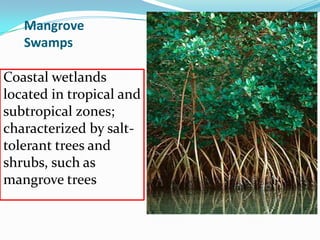
Mangrove
Swamps
Coastal wetlands
located in tropical and
subtropical zones;
characterized by salt-
tolerant trees and
shrubs, such as
mangrove trees
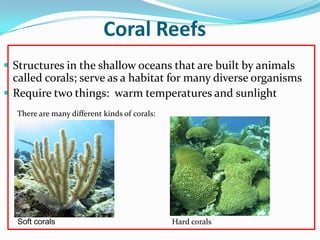
Coral Reefs
 Structures in the shallow oceans that are built by animals
called corals; serve as a habitat for many diverse organisms
 Require two things: warm temperatures and sunlight
There are many different kinds of corals:
Soft corals Hard corals
Upwelling regions
bring nutrient-rich deep water to the
surface, fueling primary productivity.
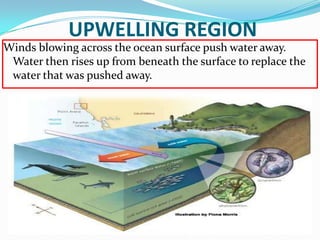
UPWELLING REGION
Winds blowing across the ocean surface push water away.
Water then rises up from beneath the surface to replace the
water that was pushed away.
Three Major Mechanisms:
Coastal upwelling
Equatorial upwelling
Island mass effects
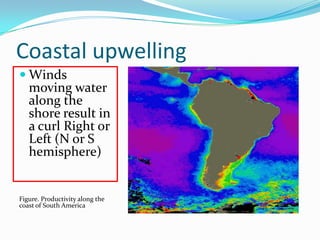
Coastal upwelling
 Winds
moving water
along the
shore result in
a curl Right or
Left (N or S
hemisphere)
Figure. Productivity along the
coast of South America
EL NINO
a warm phase of the interannual climate
oscillation called El Niño Southern
Oscillation (ENSO) event, an example of
large-scale ocean-atmosphere interaction,
and is characterized by large-scale warming
of the surface tropical Pacific Ocean.
Equatorial Upwelling
The net flow of the westward currents
are north on north side of the equator,
and south on the south side, and this
water is replaced by deeper water
Island Mass Effect
As currents encounter islands, deeper
nutrient rich water is forced toward the
surface.
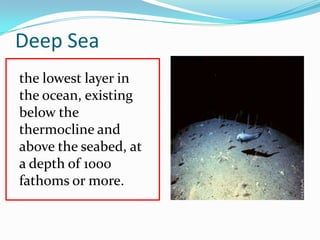
Deep Sea
the lowest layer in
the ocean, existing
below the
thermocline and
above the seabed, at
a depth of 1000
fathoms or more.
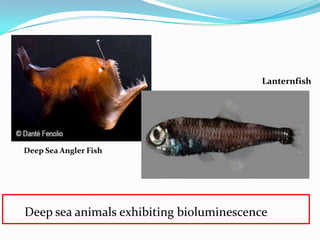
Deep sea animals exhibiting bioluminescence
Deep Sea Angler Fish
Lanternfish
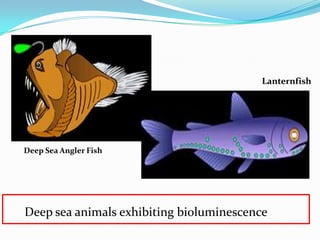
Deep sea animals exhibiting bioluminescence
Deep Sea Angler Fish
Lanternfish
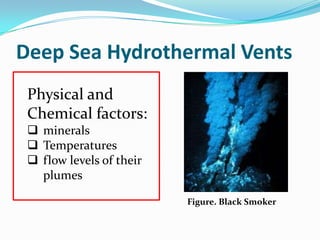
Deep Sea Hydrothermal Vents
Figure. Black Smoker
Physical and
Chemical factors:
 minerals
 Temperatures
 flow levels of their
plumes
THANK YOU ! 

Marine habitats

  • 2.
    What is ahabitat? an environment that has all necessary requirements for an organism to live.
  • 3.
    Figure 1. Divisionsof the marine environment.
  • 4.
    Four major typesof Ocean ecosystems : Open Ocean Deep Sea Upwelling region Continental Shelf
  • 5.
    Open Ocean  areasaway from the coastal boundaries and above the seabed.  encompasses the entire water column of the seas and the oceans and lies beyond the edge of the continental shelf.  extends from the tropics to the polar regions and from the sea surface to the abyssal depths.
  • 6.
    Open ocean WHY OPENOCEANS HAVE LOW PRIMARY PRODUCTIVITY?
  • 7.
    Figure 2. Globalpatterns of productivity
  • 8.
    Continental shelf ecosystems is characterized by a very gentle slope less than 1 degree. The average depth is about 150 m and it has an average width of 70 km.  local variations are common, ranging from more than 1000 km in the Arctic Ocean to a few kilometers along the Pacific coast of North and South America.  The water above the continental shelf is called neritic water
  • 9.
  • 10.
    Continental Shelf WHY CONTINENTALSHELF HAVE HIGH PRIMARY PRODUCTIVITY?
  • 11.
     Tend tohave relatively high concentrations of nitrate and other nutrients, averaged over the year.
  • 12.
    Estuaries An area inwhich fresh water from a river mixes with salt water from the ocean; a transition area from the land to the ocean. Other names: bay, sound, lagoon, harbor, or bayou. River bringing freshwater to the sea The Ocean Area where fresh and salt water mix
  • 13.
    Estuary animals Huge varietyincluding… Blue crab, Stone crab, Fiddler crab, Horseshoe crab, Mosquito, Lobster, Flounder, Stripped bass, Crane, Flamingo, Sea gull, Ibis, Manatee, otters, and many more.
  • 14.
    Salt Marshes  Alow area that is subject to regular, but gentle, tides, dominated by grasses.  Salt marshes do not have trees or shrubs  Location: Gulf of Mexico and Atlantic coast Texas salt marsh
  • 15.
    Mangrove Swamps Coastal wetlands located intropical and subtropical zones; characterized by salt- tolerant trees and shrubs, such as mangrove trees
  • 16.
    Coral Reefs  Structuresin the shallow oceans that are built by animals called corals; serve as a habitat for many diverse organisms  Require two things: warm temperatures and sunlight There are many different kinds of corals: Soft corals Hard corals
  • 17.
    Upwelling regions bring nutrient-richdeep water to the surface, fueling primary productivity.
  • 18.
    UPWELLING REGION Winds blowingacross the ocean surface push water away. Water then rises up from beneath the surface to replace the water that was pushed away.
  • 19.
    Three Major Mechanisms: Coastalupwelling Equatorial upwelling Island mass effects
  • 20.
    Coastal upwelling  Winds movingwater along the shore result in a curl Right or Left (N or S hemisphere) Figure. Productivity along the coast of South America
  • 21.
    EL NINO a warmphase of the interannual climate oscillation called El Niño Southern Oscillation (ENSO) event, an example of large-scale ocean-atmosphere interaction, and is characterized by large-scale warming of the surface tropical Pacific Ocean.
  • 22.
    Equatorial Upwelling The netflow of the westward currents are north on north side of the equator, and south on the south side, and this water is replaced by deeper water
  • 23.
    Island Mass Effect Ascurrents encounter islands, deeper nutrient rich water is forced toward the surface.
  • 24.
    Deep Sea the lowestlayer in the ocean, existing below the thermocline and above the seabed, at a depth of 1000 fathoms or more.
  • 25.
    Deep sea animalsexhibiting bioluminescence Deep Sea Angler Fish Lanternfish
  • 26.
    Deep sea animalsexhibiting bioluminescence Deep Sea Angler Fish Lanternfish
  • 27.
    Deep Sea HydrothermalVents Figure. Black Smoker Physical and Chemical factors:  minerals  Temperatures  flow levels of their plumes
  • 28.

Editor's Notes

  • #7  Open oceans have low primary productivity because of the low concentrations of nutrients in the photic zone which is called the “ biological dessert”. The parts which corresponds to low nutrient levels and low productivity is termed as “ oligotrophic ocean”.