Patterns in communities
Community  Set of interacting populations at a particular time in a particular place
Characteristics  Stable communities have high diversity  A few species are dominant Always more producers than consumers
Patterns  Succession Stratification Zonation
Succession  Change in species composition over time Seres Sequence of stages of a community during succession Climax community Stable community where succession is no longer occuring
Primary Succession On an area that has had no previous life First colonisers usually lichen Dead lichen forms humus allowing mosses, then ferns and bracken to grow
Manuka grows Larger trees grow in shelter of manuka Climax community finally reached
Rangitoto – an example of primary succession
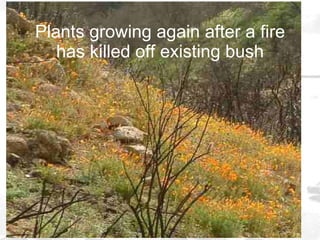
Secondary Succession When an existing community has been cleared Soil is intact Eventually returns to original state by gradual replacement First colonisers short living “weeds” Longer living species in later stages
Plants growing again after a fire has killed off existing bush
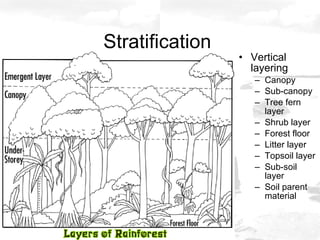
Stratification  Vertical layering  Canopy Sub-canopy Tree fern layer Shrub layer Forest floor Litter layer Topsoil layer Sub-soil layer Soil parent material
The Canopy
Tree Fern Layer
Shrub Layer
Emergents
Vines
Vines and Saprophytes
Zonation  Bands of organisms form in relation to a gradient in a major environmental factor Temperature Water  Tide
Zonation on Mountains
Zonation on a Rocky Shore
 
 
Zonation in Rock Pools
Hormosira (Neptunes Necklace)
 
Crabs


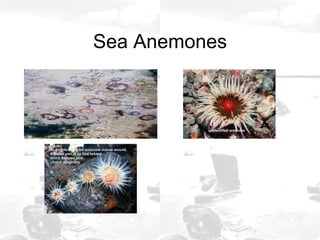
Sea Anemones

4 Patterns

Editor's Notes

  • #7 Lava flow, retreating glacier Lichen grow in crackscaused by water into cracks, freeze at night, force cracks open further, cause crmbling - gives lichens grip Ferns etc roots cause further crumbling, more humus so manuka can grow Manuka shelters - nursery for larger plants Larger plants grow till reaches climax
  • #10 Weeds = plants living where humans don’t want them to
  • #26 Nerita cats eye