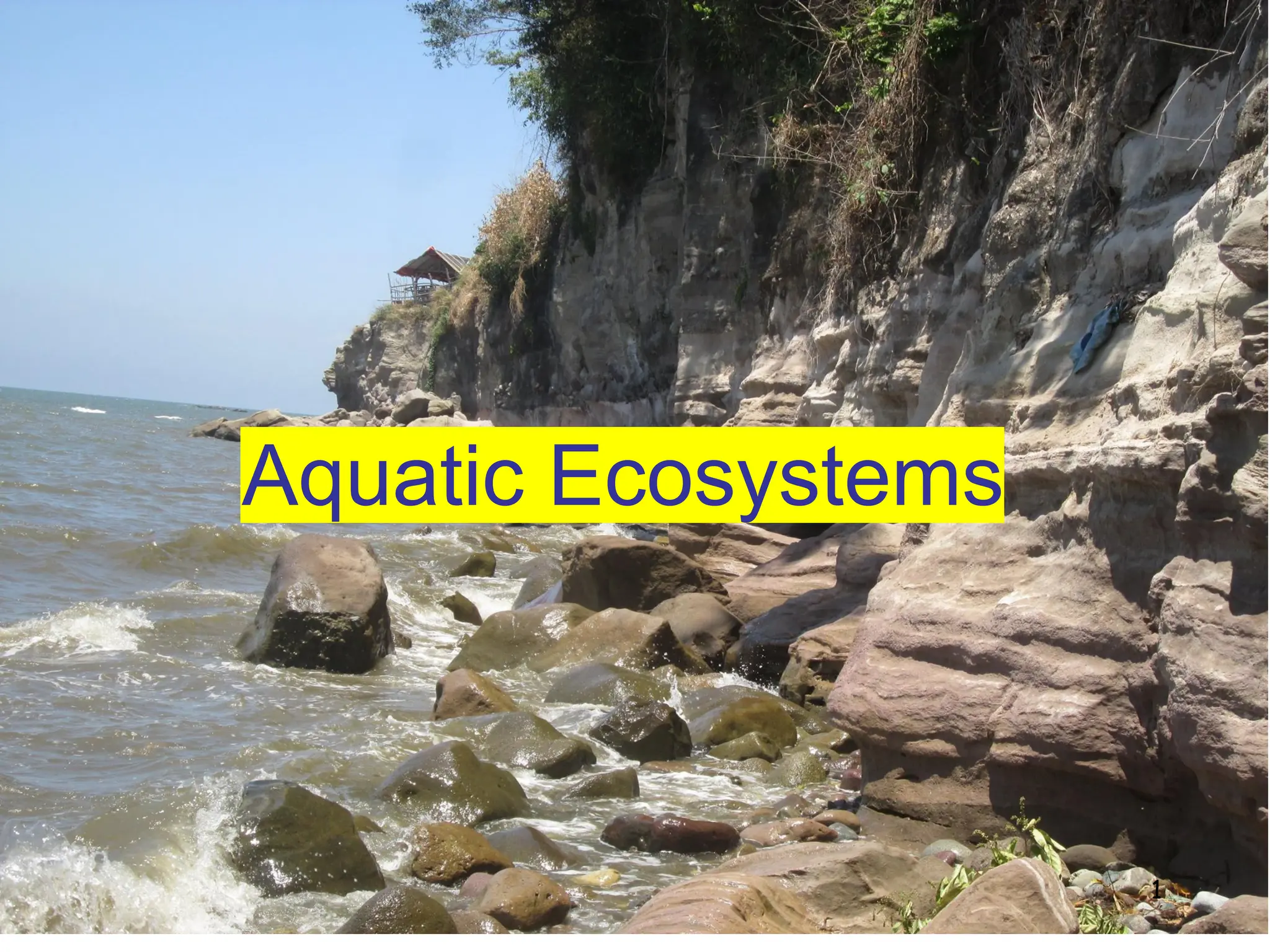
Aquatic Ecosystems
1
Patterns in Aquatic Ecosystems
Shallow vs Deep
Fresh vs Salt
Swift vs Stagnant
Changing vs Constant
Ephemeral vs Permanent
Limnology vs Oceanography
2
Modes of life
• Benthos - attached or resting on bottom
– Epifauna: live on bottom (crabs, scallops)
– Periphyton: attach to stems & leaves of rooted
plants
– Infauna: buried in sediment (clams, worms)
3
• Neuston
– Rest or swim on surface
Modes of Life
• Plankton
– Floating, weak swimmers
• Phytoplankton: photosynthesize
• Zooplankton: herbivores & carnivores
4
• Nekton
– Swimming organisms
– Go where they want
– Fish, squid, frogs, turtles, seals, octopus
Types of Aquatic Ecosystems
• Freshwater
• Marine
• Transitions between land & sea
5
Freshwater Ecosystems
• Lentic
– Standing water
– Lakes, ponds, bogs
• Lotic
– Running water
– Streams, rivers
6
Lentic Zonation
• Limnetic: to depth of
light penetration
• Profundal zone:
beyond depth of light
penetration
– Usually absent in
ponds
7
Lentic Zonation
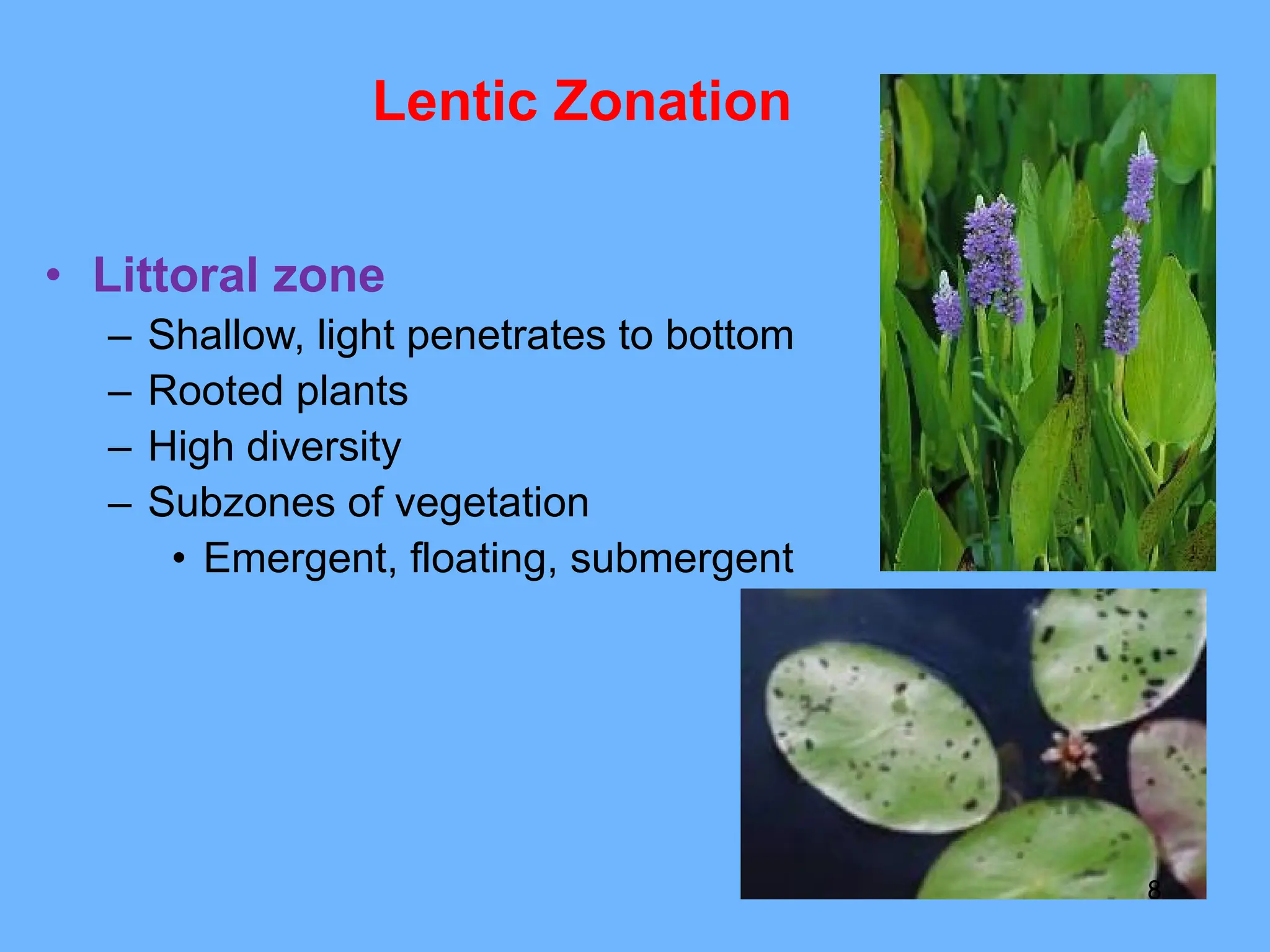
• Littoral zone
– Shallow, light penetrates to bottom
– Rooted plants
– High diversity
– Subzones of vegetation
• Emergent, floating, submergent
8
Littoral Zone in Laguna de Bay
9
Muntinlupa, Metro Manila
Lentic Zonation
• Limnetic zone
– Depth of effective light penetration -
compensation point
– No benthos and few if any neuston
10
• Profundal zone
– Bottom and deep water region
– Fewer plankton and no neuston
– Absent in ponds
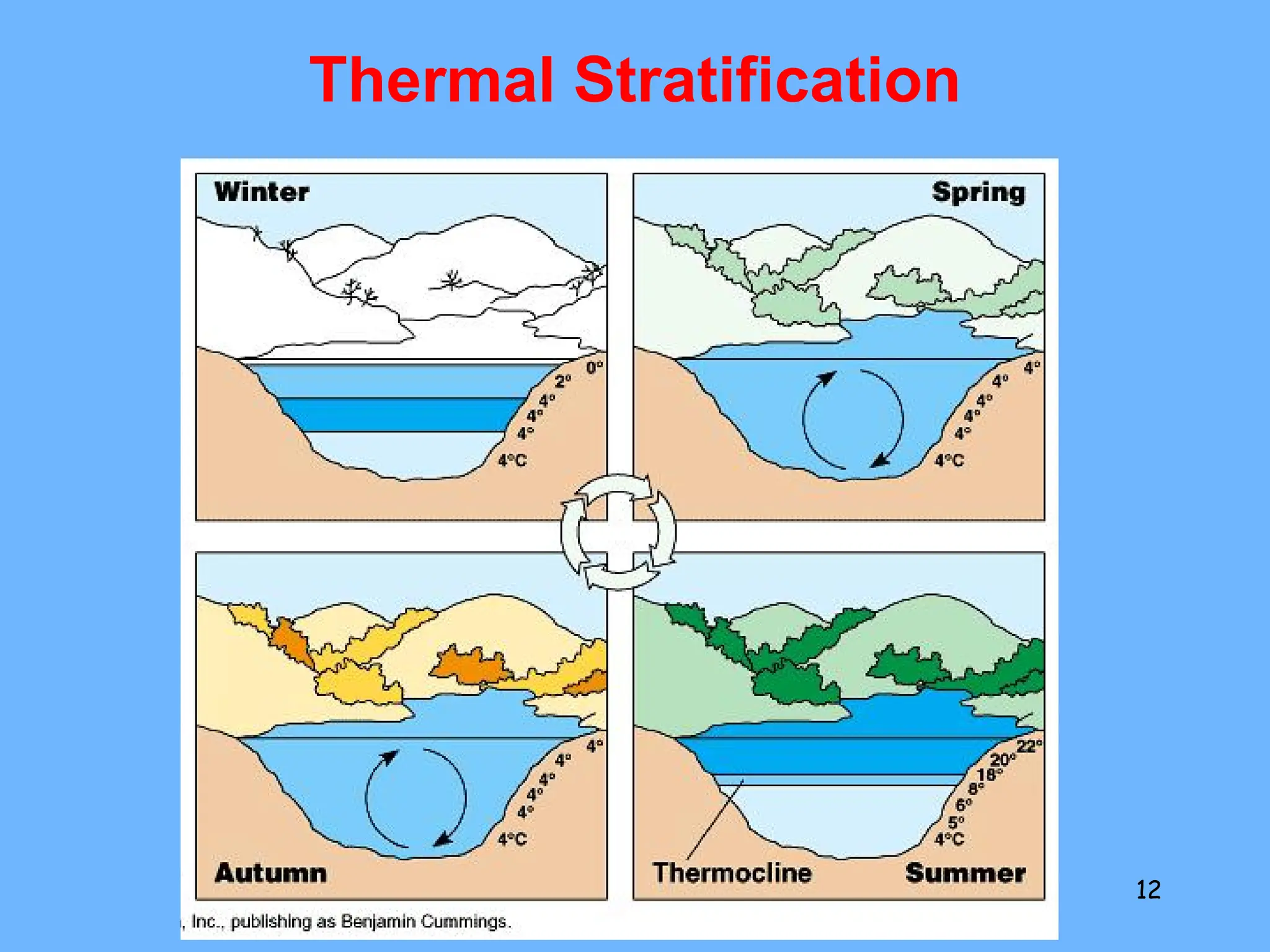
Thermal Stratification
• Epilimnion: warm surface water
• Metalimnion: 0C changes with depth
• Hypolimnion: cold deeper waters
• Changes with season
11
Thermal Stratification
12
13
Seasonal Changes
14
Stratification
• Temperate lakes - mixed twice/year
– Brings oxygen to bottom, nutrients to top
• Tropical lakes
– Low elevation:
• Warm water on top, doesn’t cool regularly
• Poor to no mixing
– High elevation
• Can stratify and mix daily
15
Lake Productivity
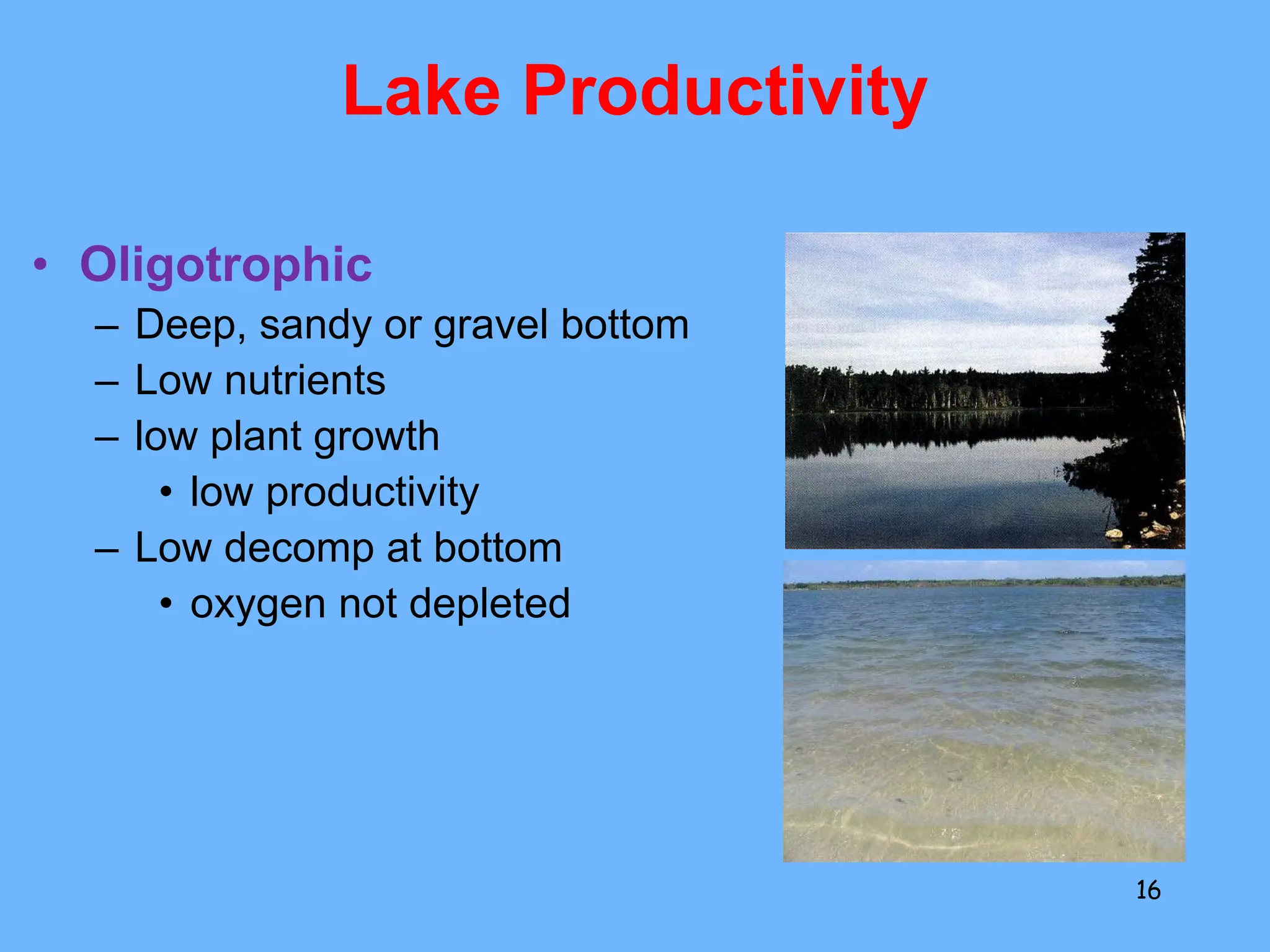
• Oligotrophic
– Deep, sandy or gravel bottom
– Low nutrients
– low plant growth
• low productivity
– Low decomp at bottom
• oxygen not depleted
16
Lake Productivity
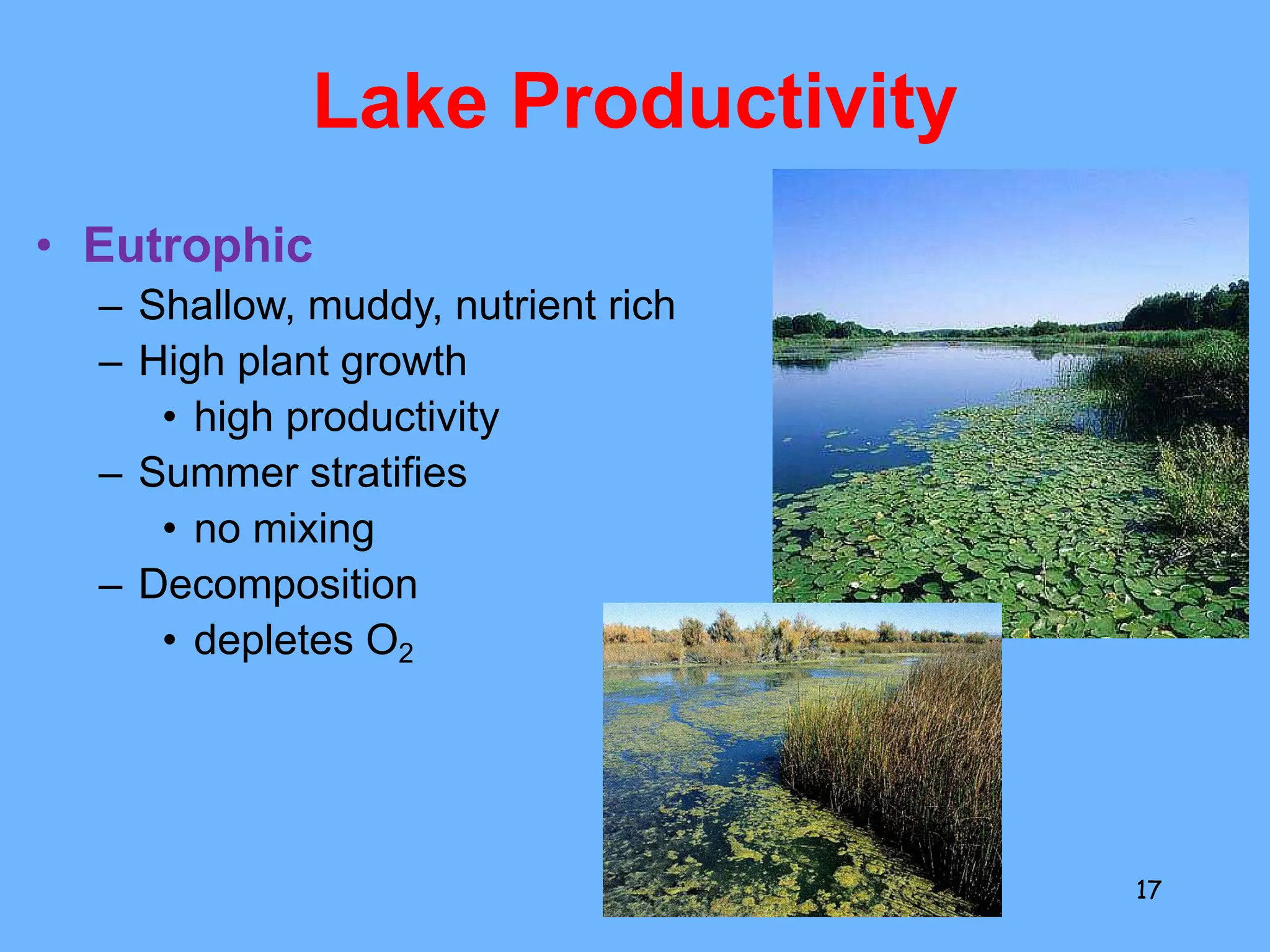
• Eutrophic
– Shallow, muddy, nutrient rich
– High plant growth
• high productivity
– Summer stratifies
• no mixing
– Decomposition
• depletes O2
17
Oligotrophic vs Eutrophic
18
Oligotrophic vs. Eutrophic
19
20
Lotic System: Flowing
• Brook
• Creek
• River
Definition of River
• (From Latin word Ripa “bank”)
- any natural stream of water that flows in a channel with
defined banks
§ Modern usage includes rivers that are multichanneled,
intermittent, or ephemeral in flow and channels that are
practically bankless.
§ The concept of channeled surface flow, however, remains
central to the definition.
§ The word stream (derived ultimately from the Indo-
European root srou-) emphasizes the fact of flow; as a
noun, it is synonymous with river and is often preferred in
technical writing. 21
River
• Small natural watercourses are sometimes called
rivulets, but a variety of names—including branch,
brook, burn, and creek—are more common,
occurring regionally to nationally in place-names
• Arroyo and (dry) wash connote ephemeral streams
or their resultant channels
• Tiny streams or channels are referred to as rills or
runnels
22
Parts of the Rivers
23
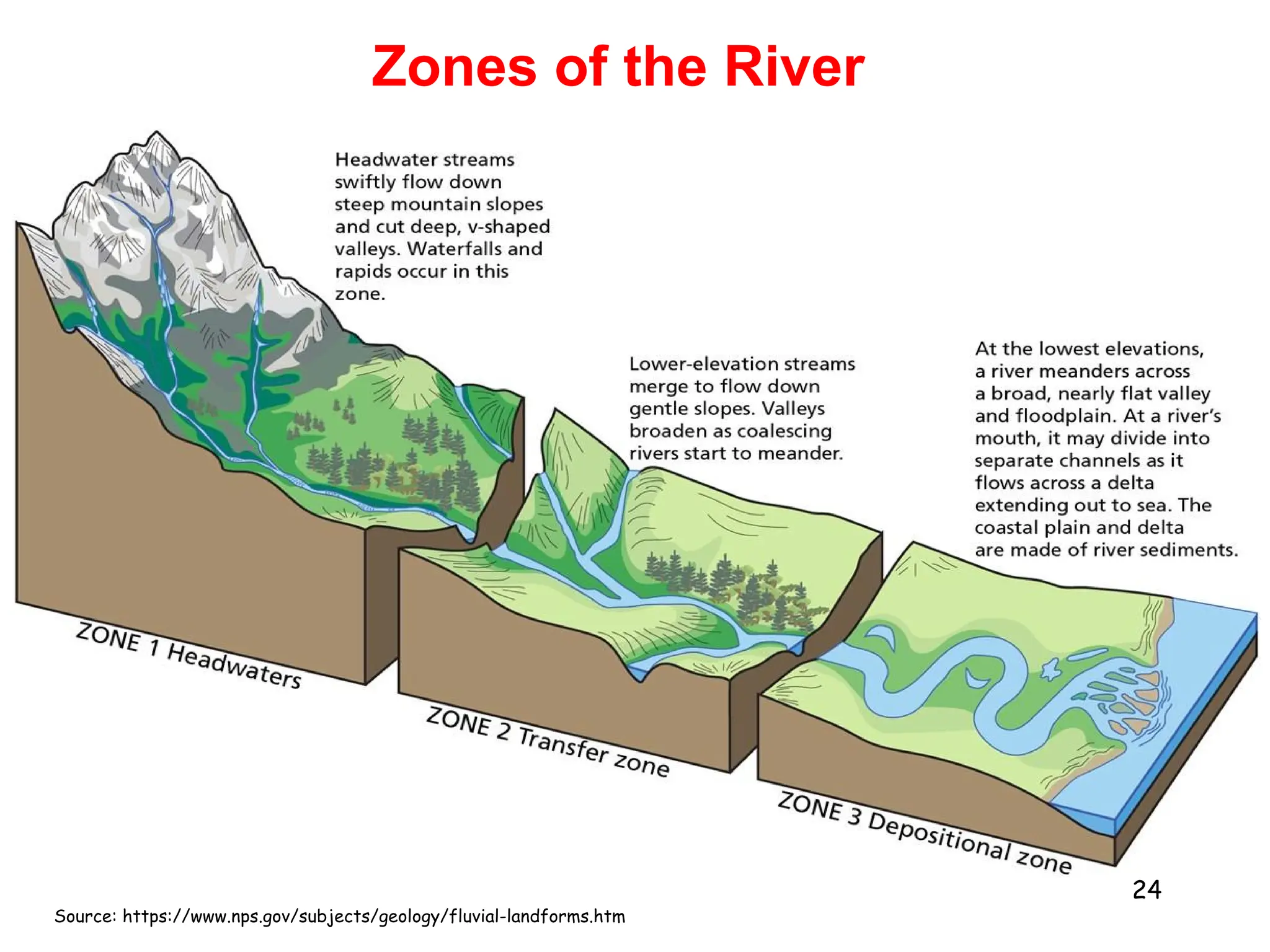
1. Upper course
the part where we find the source of the river (usually in areas with a certain
elevation), and usually it has fast-flowing water.
In this area there is a lot of erosion and transport.
2. Middle course
the part where the river widens and the gradient decreases. There is a lot of
erosion, transport and sedimentation.
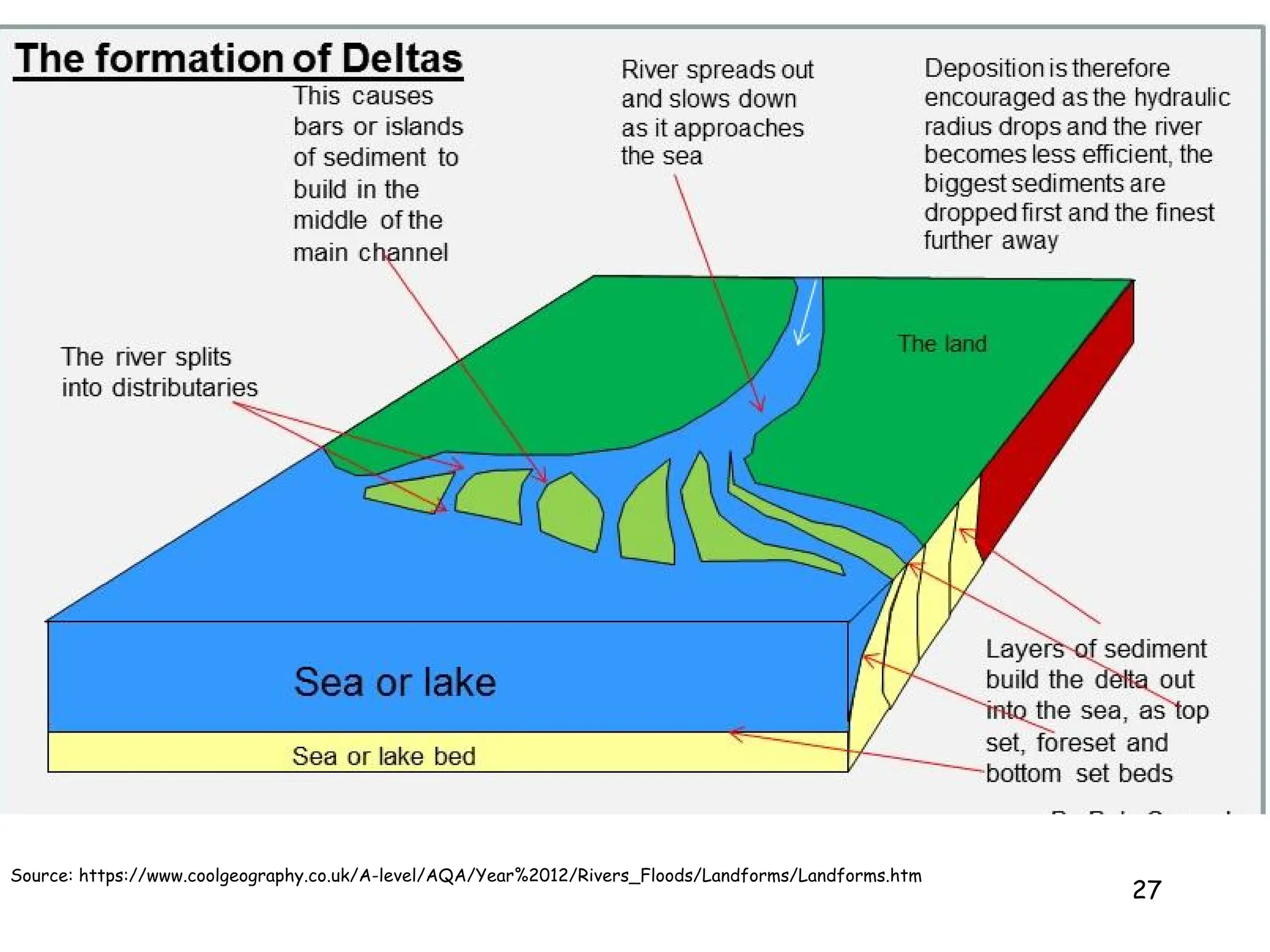
3. Lower course
Where the gradient is gentlest and the water flow is slowest. The sediments
transported by the river are deposited and in its mouth the river may form an
estuary or a delta as large alluvial deposits are created.
Zones of the River
24
Source: https://www.nps.gov/subjects/geology/fluvial-landforms.htm
Landforms and Water forms in the River
25
Source: https://www.geo41.com/river-landforms
River Landscape Evolution
26
Source: https://blogs.agu.org/mountainbeltway/2010/06/11/river-landscape-evolution/
27
Source: https://www.coolgeography.co.uk/A-level/AQA/Year%2012/Rivers_Floods/Landforms/Landforms.htm
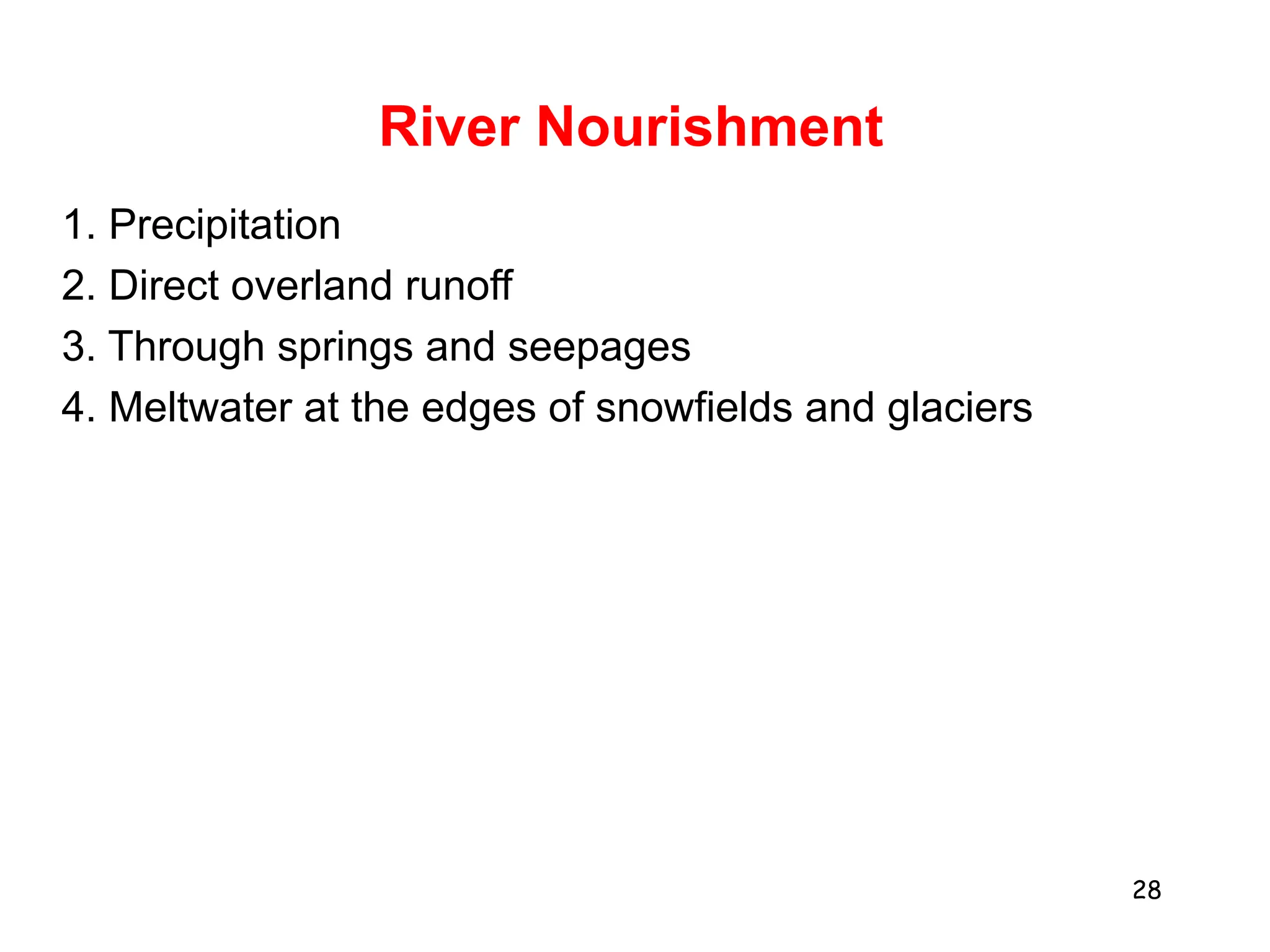
River Nourishment
1. Precipitation
2. Direct overland runoff
3. Through springs and seepages
4. Meltwater at the edges of snowfields and glaciers
28
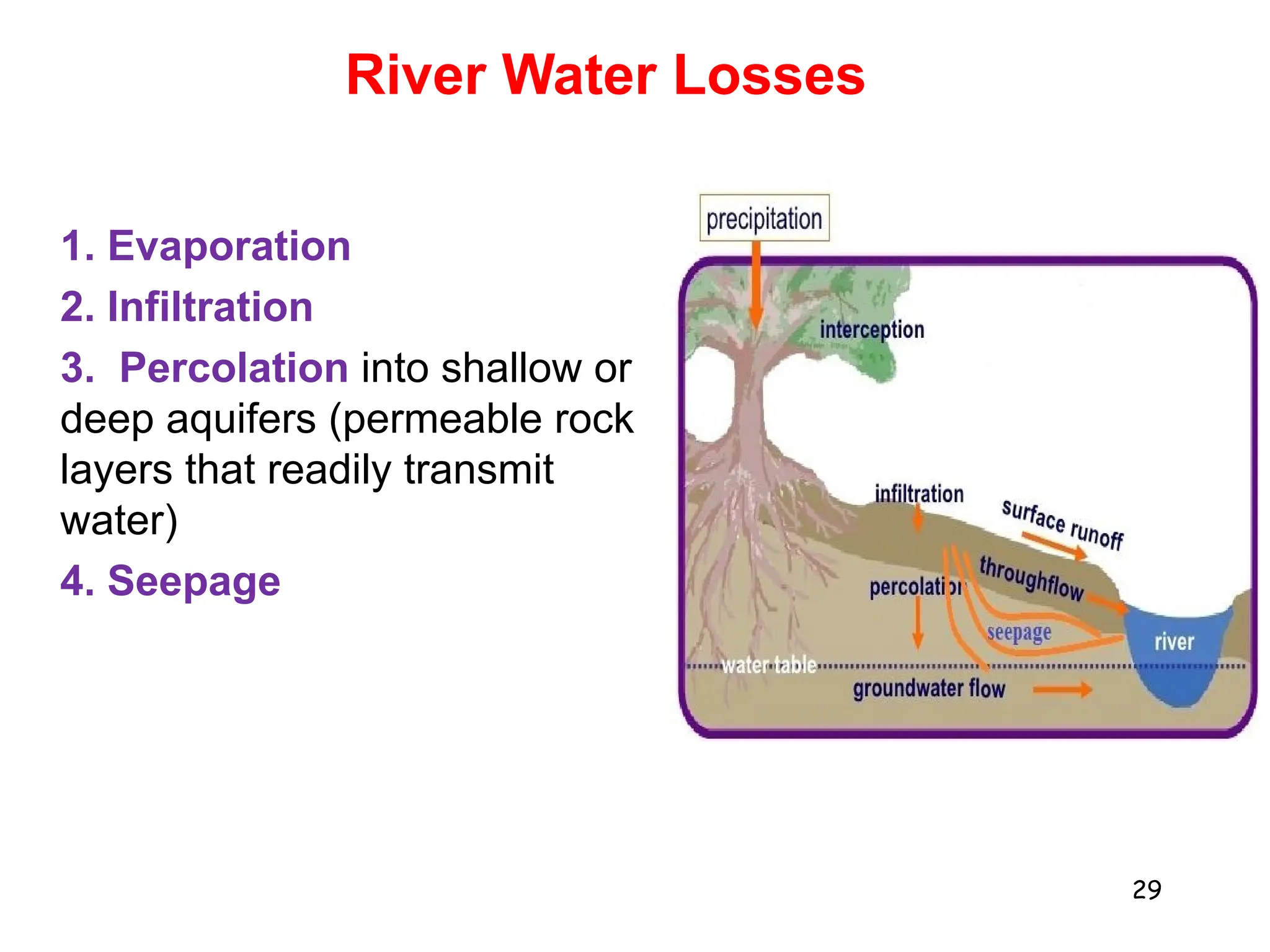
River Water Losses
1. Evaporation
2. Infiltration
3. Percolation into shallow or
deep aquifers (permeable rock
layers that readily transmit
water)
4. Seepage
29
Marine Environment
30
31
Major Oceans of the World
32
33
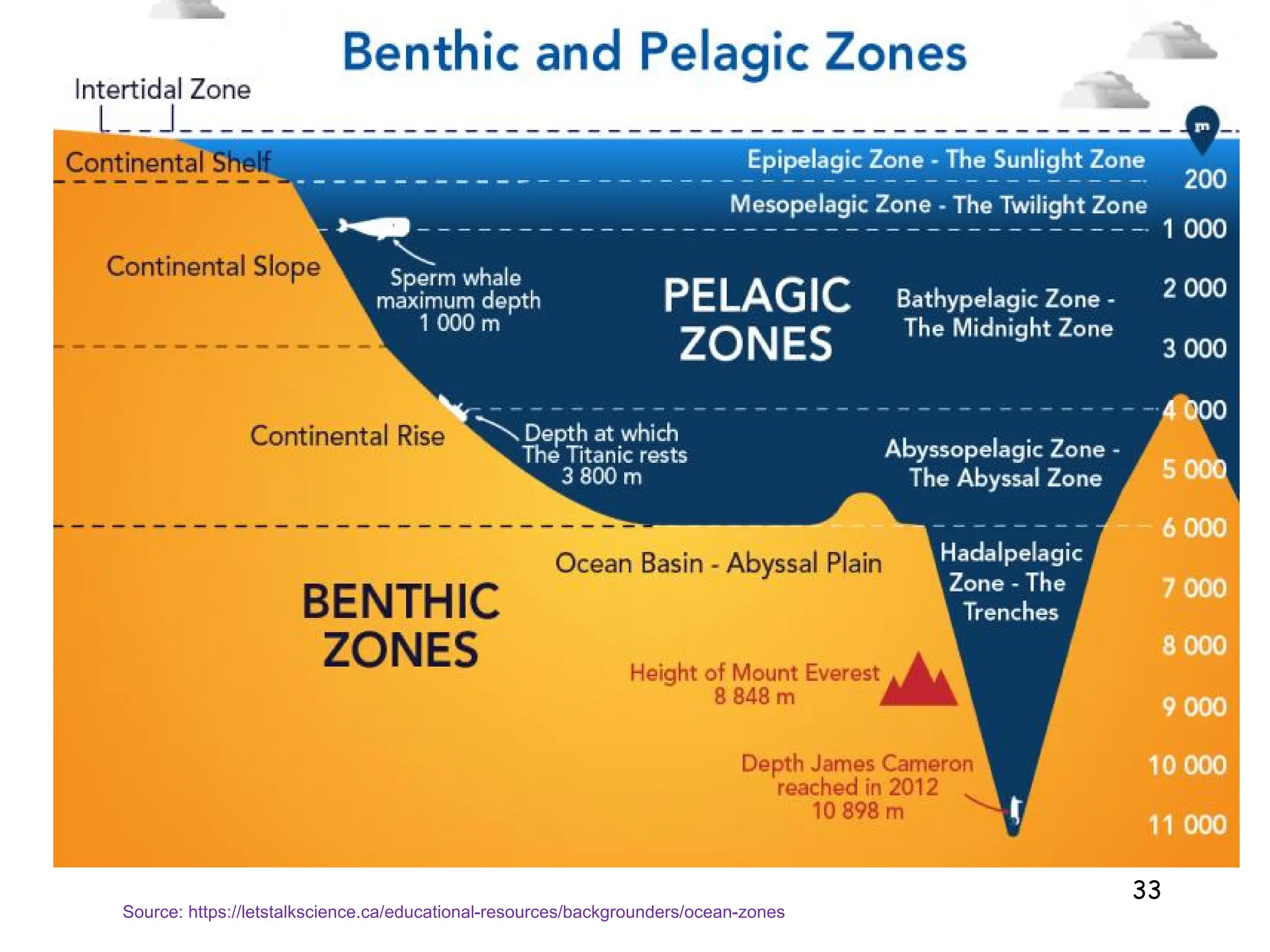
Source: https://letstalkscience.ca/educational-resources/backgrounders/ocean-zones
Layers of the Ocean
Epipelagic Zone
• The surface layer of the ocean is known as the
epipelagic zone and extends from the surface to 200
meters (656 feet).
• It is also known as the sunlight zone because this is
where most of the visible light exists.
• With the light come heat. This heat is responsible for
the wide range of temperatures that occur in this zone.
34
Layers of the Ocean
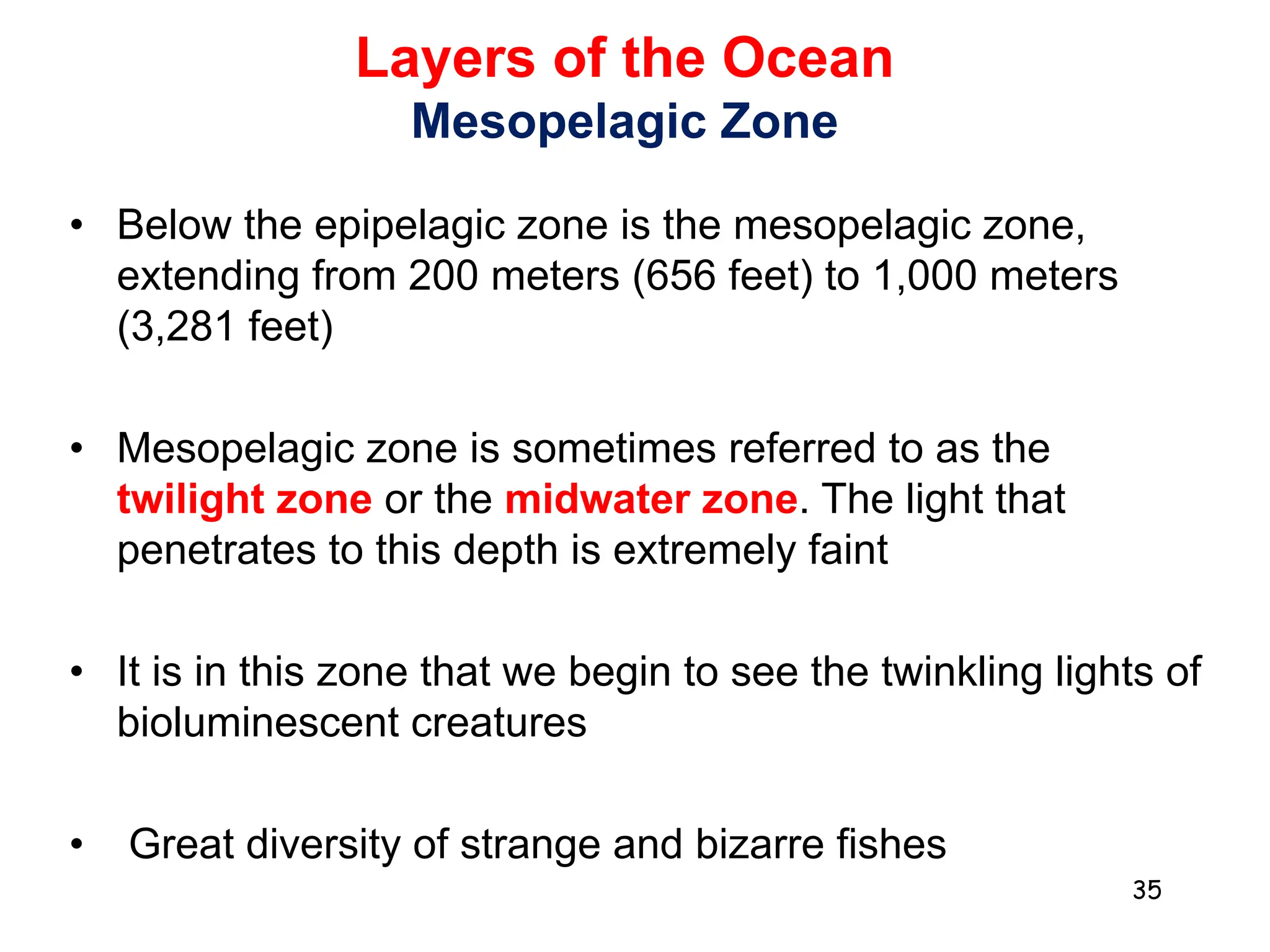
Mesopelagic Zone
• Below the epipelagic zone is the mesopelagic zone,
extending from 200 meters (656 feet) to 1,000 meters
(3,281 feet)
• Mesopelagic zone is sometimes referred to as the
twilight zone or the midwater zone. The light that
penetrates to this depth is extremely faint
• It is in this zone that we begin to see the twinkling lights of
bioluminescent creatures
• Great diversity of strange and bizarre fishes
35
Layers of the Ocean
Bathypelagic Zone
• It is sometimes referred to as the midnight zone or the dark zone
• This zone extends from 1,000 meters (3,281 feet) down to 4,000
meters (13,124 feet)
• Here the only visible light is that produced by the creatures
themselves
• The water pressure at this depth is immense, reaching 5,850
pounds per square inch
• Sperm whales can dive down to this level in search of food
• Most of the animals that live at these depths are black or red in
color due to the lack of light
36
Layers of the Ocean
Abyssopelagic Zone
• Also known as the abyssal zone or simply as the abyss.
• Extends 4,000 meters (13,124 ft) to 6,000 meters (19,686 ft)
• The name comes from a Greek word meaning "no bottom"
• The water temperature is near freezing, and there is no light at all
• Very few creatures can be found at these crushing depths Most of
these are invertebrates such as basket stars and tiny squids
• Three-quarters of the ocean floor lies within this zone
• The deepest fish ever discovered was found in the Puerto Rico
Trench at a depth of 27,460 feet (8,372 meters)
37
Layers of the Ocean
Hadalpelagic Zone
• Extends from 6,000 meters (19,686 feet) to the bottom of the
deepest parts of the ocean
• These areas are mostly found in deep water trenches and canyons
• The deepest point in the ocean is located in the Mariana Trench off
the coast of Japan at 35,797 feet (10,911 meters)
• The temperature of the water is just above freezing, and the
pressure is an incredible eight tons per square inch
• In spite of the pressure and temperature, life can still be found here.
• Invertebrates such as starfish and tube worms can thrive at these
depths.
38
39
Source: https://www.pinterest.ph/pin/381046818468032065/
Organisms in the Ocean
40
Source: https://www.wnct.com/news/ocean-zones-and-what-creatures-live-in-them/
Microorganisms in the Ocean
41
Source: https://upload.wikimedia.org/wikipedia/commons/2/24/Marine_carbon_cycle.jpg
42
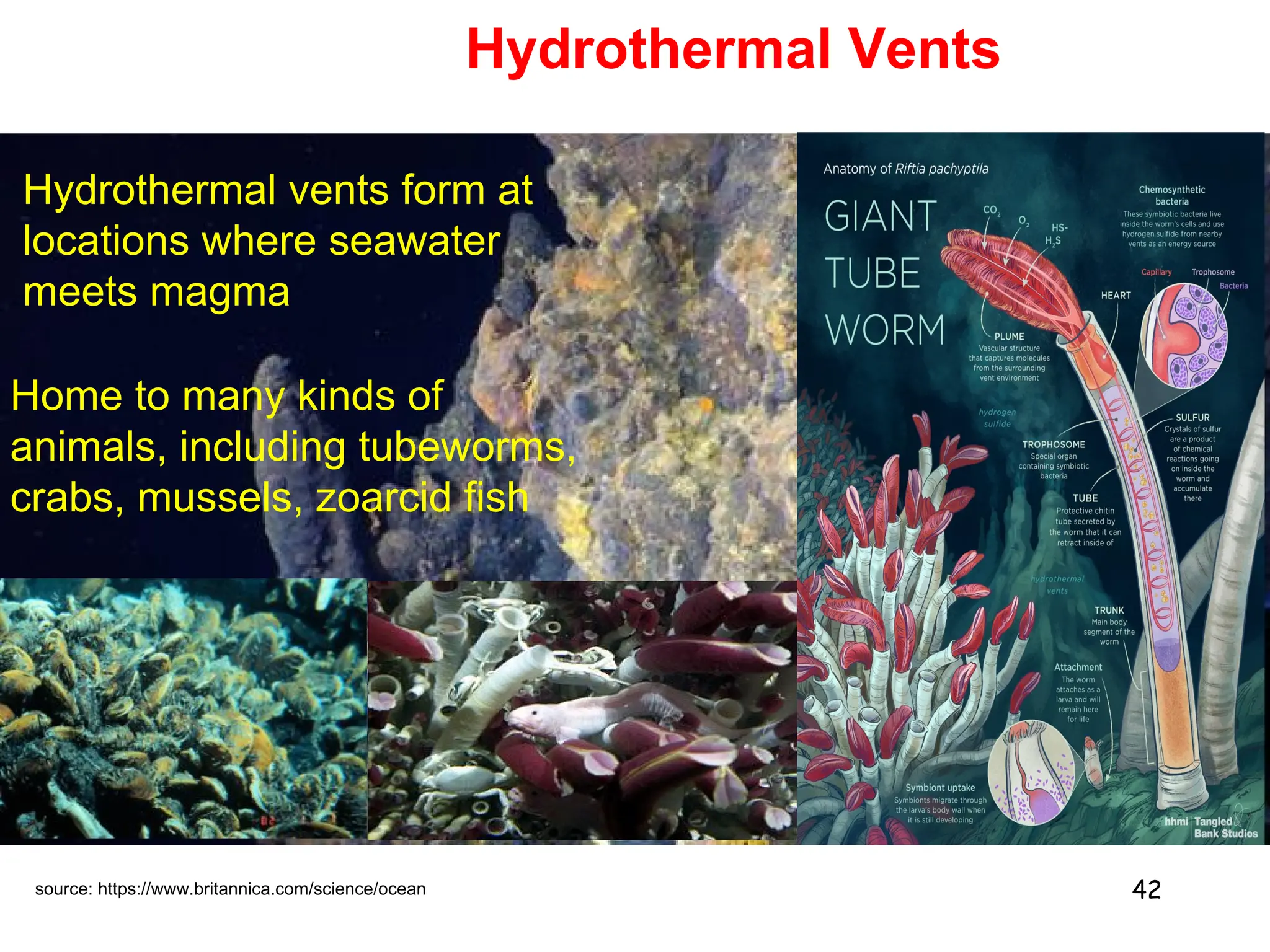
Home to many kinds of
animals, including tubeworms,
crabs, mussels, zoarcid fish
Hydrothermal vents form at
locations where seawater
meets magma
Hydrothermal Vents
source: https://www.britannica.com/science/ocean
Brackishwater
Environment
43
44
What is an estuary?
• An estuary is where the ocean meets a river in a
semi-enclosed area
• This causes a mixing of fresh and salt water.
• These areas are home to an immense amount of
biological productivity and diversity
• Estuaries tend to be rich in nutrients & productivity
due to the trapping of nutrients & sediments.
Classifications of Estuaries
45
Source: https://www.chesapeakequarterly.net/V10N1/side1/
Classifications of Estuaries based on Geology
46
Source: https://www.chesapeakequarterly.net/V10N1/side1/
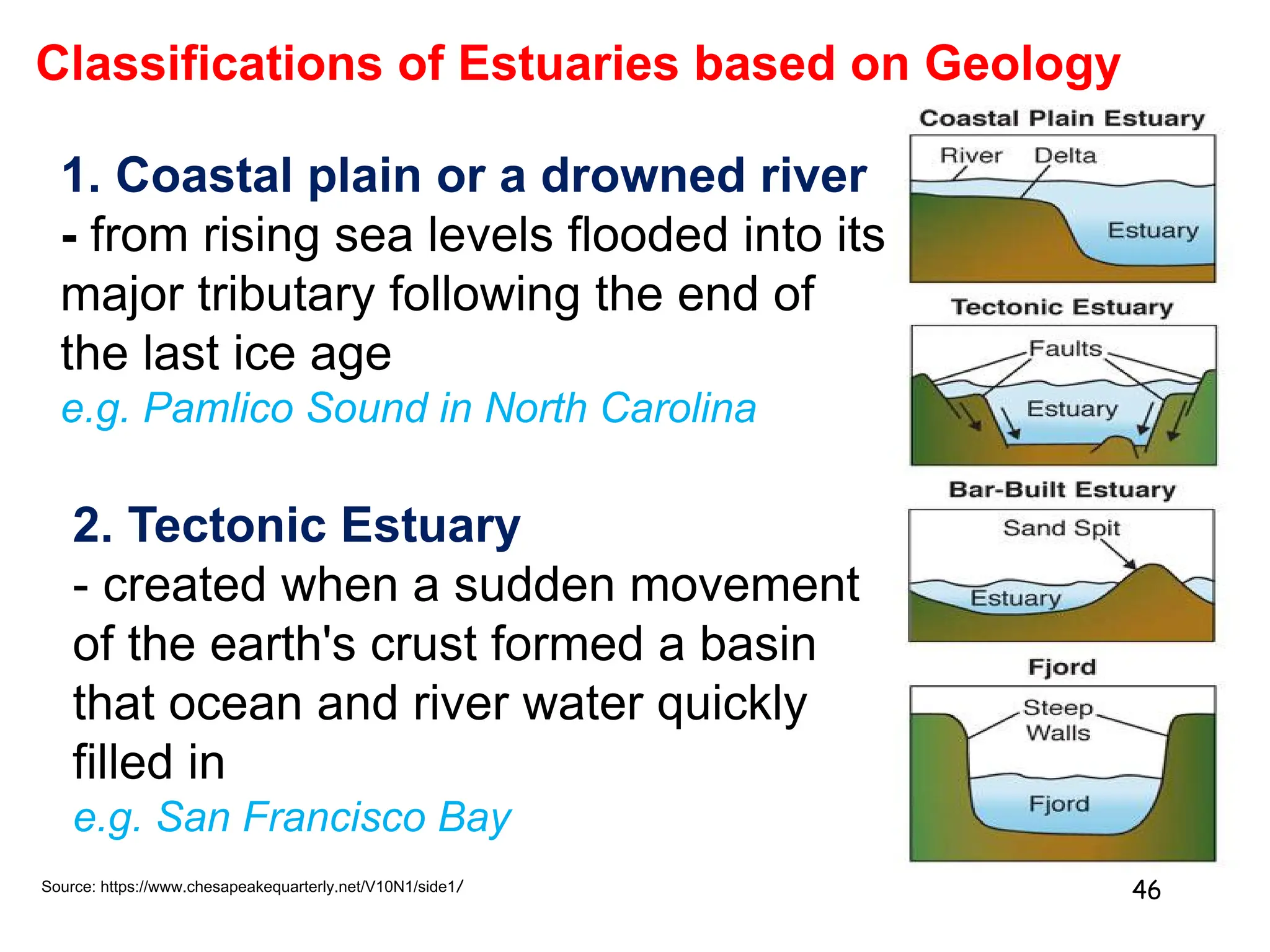
1. Coastal plain or a drowned river
- from rising sea levels flooded into its
major tributary following the end of
the last ice age
e.g. Pamlico Sound in North Carolina
2. Tectonic Estuary
- created when a sudden movement
of the earth's crust formed a basin
that ocean and river water quickly
filled in
e.g. San Francisco Bay
Classifications of Estuaries based on Geology
47
Source: https://www.chesapeakequarterly.net/V10N1/side1/
3. Bar-built/ Delta Estuary
- semi-enclosed bodies of water
created by ocean currents piling up
sand bars or barrier islands
e.g. Mississippi
4. Fjords
- deep channels carved into the
earth by glaciers
e.g. Glacier Bay in Alaska
Biota of the Estuary
48
Source: https://www.researchgate.net/figure/7-The-biota-of-estuaries-denoting-their-relationships-to-the-diets-of-
fishes_fig6_284437755
Food Web in the Estuary
49
Source: https://www.sciencelearn.org.nz/images/1396-estuarine-food-web
50

Aquatic Ecosystems

  • 1.
  • 2.
    Patterns in AquaticEcosystems Shallow vs Deep Fresh vs Salt Swift vs Stagnant Changing vs Constant Ephemeral vs Permanent Limnology vs Oceanography 2
  • 3.
    Modes of life •Benthos - attached or resting on bottom – Epifauna: live on bottom (crabs, scallops) – Periphyton: attach to stems & leaves of rooted plants – Infauna: buried in sediment (clams, worms) 3 • Neuston – Rest or swim on surface
  • 4.
    Modes of Life •Plankton – Floating, weak swimmers • Phytoplankton: photosynthesize • Zooplankton: herbivores & carnivores 4 • Nekton – Swimming organisms – Go where they want – Fish, squid, frogs, turtles, seals, octopus
  • 5.
    Types of AquaticEcosystems • Freshwater • Marine • Transitions between land & sea 5
  • 6.
    Freshwater Ecosystems • Lentic –Standing water – Lakes, ponds, bogs • Lotic – Running water – Streams, rivers 6
  • 7.
    Lentic Zonation • Limnetic:to depth of light penetration • Profundal zone: beyond depth of light penetration – Usually absent in ponds 7
  • 8.
    Lentic Zonation • Littoralzone – Shallow, light penetrates to bottom – Rooted plants – High diversity – Subzones of vegetation • Emergent, floating, submergent 8
  • 9.
    Littoral Zone inLaguna de Bay 9 Muntinlupa, Metro Manila
  • 10.
    Lentic Zonation • Limneticzone – Depth of effective light penetration - compensation point – No benthos and few if any neuston 10 • Profundal zone – Bottom and deep water region – Fewer plankton and no neuston – Absent in ponds
  • 11.
    Thermal Stratification • Epilimnion:warm surface water • Metalimnion: 0C changes with depth • Hypolimnion: cold deeper waters • Changes with season 11
  • 12.
  • 13.
  • 14.
  • 15.
    Stratification • Temperate lakes- mixed twice/year – Brings oxygen to bottom, nutrients to top • Tropical lakes – Low elevation: • Warm water on top, doesn’t cool regularly • Poor to no mixing – High elevation • Can stratify and mix daily 15
  • 16.
    Lake Productivity • Oligotrophic –Deep, sandy or gravel bottom – Low nutrients – low plant growth • low productivity – Low decomp at bottom • oxygen not depleted 16
  • 17.
    Lake Productivity • Eutrophic –Shallow, muddy, nutrient rich – High plant growth • high productivity – Summer stratifies • no mixing – Decomposition • depletes O2 17
  • 18.
  • 19.
  • 20.
    20 Lotic System: Flowing •Brook • Creek • River
  • 21.
    Definition of River •(From Latin word Ripa “bank”) - any natural stream of water that flows in a channel with defined banks § Modern usage includes rivers that are multichanneled, intermittent, or ephemeral in flow and channels that are practically bankless. § The concept of channeled surface flow, however, remains central to the definition. § The word stream (derived ultimately from the Indo- European root srou-) emphasizes the fact of flow; as a noun, it is synonymous with river and is often preferred in technical writing. 21
  • 22.
    River • Small naturalwatercourses are sometimes called rivulets, but a variety of names—including branch, brook, burn, and creek—are more common, occurring regionally to nationally in place-names • Arroyo and (dry) wash connote ephemeral streams or their resultant channels • Tiny streams or channels are referred to as rills or runnels 22
  • 23.
    Parts of theRivers 23 1. Upper course the part where we find the source of the river (usually in areas with a certain elevation), and usually it has fast-flowing water. In this area there is a lot of erosion and transport. 2. Middle course the part where the river widens and the gradient decreases. There is a lot of erosion, transport and sedimentation. 3. Lower course Where the gradient is gentlest and the water flow is slowest. The sediments transported by the river are deposited and in its mouth the river may form an estuary or a delta as large alluvial deposits are created.
  • 24.
    Zones of theRiver 24 Source: https://www.nps.gov/subjects/geology/fluvial-landforms.htm
  • 25.
    Landforms and Waterforms in the River 25 Source: https://www.geo41.com/river-landforms
  • 26.
    River Landscape Evolution 26 Source:https://blogs.agu.org/mountainbeltway/2010/06/11/river-landscape-evolution/
  • 27.
  • 28.
    River Nourishment 1. Precipitation 2.Direct overland runoff 3. Through springs and seepages 4. Meltwater at the edges of snowfields and glaciers 28
  • 29.
    River Water Losses 1.Evaporation 2. Infiltration 3. Percolation into shallow or deep aquifers (permeable rock layers that readily transmit water) 4. Seepage 29
  • 30.
  • 31.
  • 32.
    Major Oceans ofthe World 32
  • 33.
  • 34.
    Layers of theOcean Epipelagic Zone • The surface layer of the ocean is known as the epipelagic zone and extends from the surface to 200 meters (656 feet). • It is also known as the sunlight zone because this is where most of the visible light exists. • With the light come heat. This heat is responsible for the wide range of temperatures that occur in this zone. 34
  • 35.
    Layers of theOcean Mesopelagic Zone • Below the epipelagic zone is the mesopelagic zone, extending from 200 meters (656 feet) to 1,000 meters (3,281 feet) • Mesopelagic zone is sometimes referred to as the twilight zone or the midwater zone. The light that penetrates to this depth is extremely faint • It is in this zone that we begin to see the twinkling lights of bioluminescent creatures • Great diversity of strange and bizarre fishes 35
  • 36.
    Layers of theOcean Bathypelagic Zone • It is sometimes referred to as the midnight zone or the dark zone • This zone extends from 1,000 meters (3,281 feet) down to 4,000 meters (13,124 feet) • Here the only visible light is that produced by the creatures themselves • The water pressure at this depth is immense, reaching 5,850 pounds per square inch • Sperm whales can dive down to this level in search of food • Most of the animals that live at these depths are black or red in color due to the lack of light 36
  • 37.
    Layers of theOcean Abyssopelagic Zone • Also known as the abyssal zone or simply as the abyss. • Extends 4,000 meters (13,124 ft) to 6,000 meters (19,686 ft) • The name comes from a Greek word meaning "no bottom" • The water temperature is near freezing, and there is no light at all • Very few creatures can be found at these crushing depths Most of these are invertebrates such as basket stars and tiny squids • Three-quarters of the ocean floor lies within this zone • The deepest fish ever discovered was found in the Puerto Rico Trench at a depth of 27,460 feet (8,372 meters) 37
  • 38.
    Layers of theOcean Hadalpelagic Zone • Extends from 6,000 meters (19,686 feet) to the bottom of the deepest parts of the ocean • These areas are mostly found in deep water trenches and canyons • The deepest point in the ocean is located in the Mariana Trench off the coast of Japan at 35,797 feet (10,911 meters) • The temperature of the water is just above freezing, and the pressure is an incredible eight tons per square inch • In spite of the pressure and temperature, life can still be found here. • Invertebrates such as starfish and tube worms can thrive at these depths. 38
  • 39.
  • 40.
    Organisms in theOcean 40 Source: https://www.wnct.com/news/ocean-zones-and-what-creatures-live-in-them/
  • 41.
    Microorganisms in theOcean 41 Source: https://upload.wikimedia.org/wikipedia/commons/2/24/Marine_carbon_cycle.jpg
  • 42.
    42 Home to manykinds of animals, including tubeworms, crabs, mussels, zoarcid fish Hydrothermal vents form at locations where seawater meets magma Hydrothermal Vents source: https://www.britannica.com/science/ocean
  • 43.
  • 44.
    44 What is anestuary? • An estuary is where the ocean meets a river in a semi-enclosed area • This causes a mixing of fresh and salt water. • These areas are home to an immense amount of biological productivity and diversity • Estuaries tend to be rich in nutrients & productivity due to the trapping of nutrients & sediments.
  • 45.
    Classifications of Estuaries 45 Source:https://www.chesapeakequarterly.net/V10N1/side1/
  • 46.
    Classifications of Estuariesbased on Geology 46 Source: https://www.chesapeakequarterly.net/V10N1/side1/ 1. Coastal plain or a drowned river - from rising sea levels flooded into its major tributary following the end of the last ice age e.g. Pamlico Sound in North Carolina 2. Tectonic Estuary - created when a sudden movement of the earth's crust formed a basin that ocean and river water quickly filled in e.g. San Francisco Bay
  • 47.
    Classifications of Estuariesbased on Geology 47 Source: https://www.chesapeakequarterly.net/V10N1/side1/ 3. Bar-built/ Delta Estuary - semi-enclosed bodies of water created by ocean currents piling up sand bars or barrier islands e.g. Mississippi 4. Fjords - deep channels carved into the earth by glaciers e.g. Glacier Bay in Alaska
  • 48.
    Biota of theEstuary 48 Source: https://www.researchgate.net/figure/7-The-biota-of-estuaries-denoting-their-relationships-to-the-diets-of- fishes_fig6_284437755
  • 49.
    Food Web inthe Estuary 49 Source: https://www.sciencelearn.org.nz/images/1396-estuarine-food-web
  • 50.