Maps, Landforms, and Climate Physical Geography
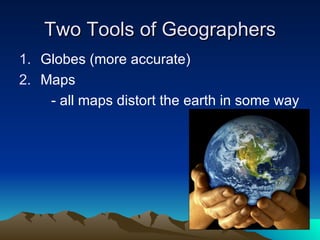
Two Tools of Geographers Globes (more accurate) Maps  - all maps distort the earth in some way
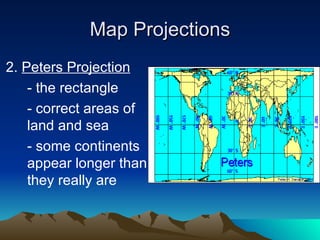
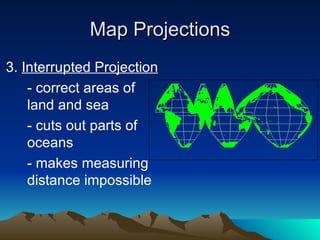
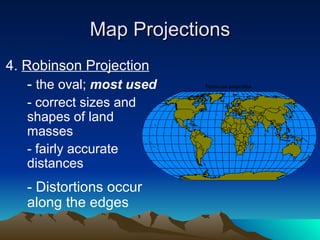
Map projections:  ways of showing the curved earth on a flat surface Four main map projections 1. Mercator Projection 2. Peters Projection 3. Interrupted Projection 4. Robinson Projection Two Tools of Geographers
Map Projections Mercator Projection - the “big box” - accurate near the equator - land is distorted at the poles
Map Projections 2.  Peters Projection - the rectangle - correct areas of land and sea - some continents appear longer than they really are
Map Projections 3.  Interrupted Projection - correct areas of land and sea - cuts out parts of oceans - makes measuring distance impossible
Map Projections 4.  Robinson Projection -  the oval;  most used - correct sizes and shapes of land masses - fairly accurate distances - Distortions occur along the edges
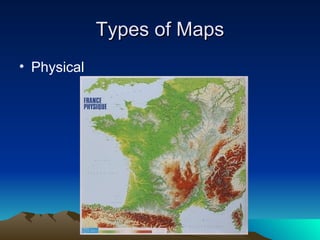
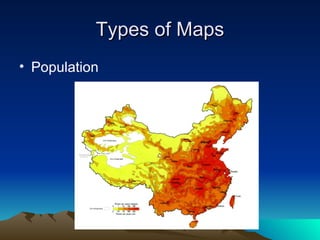
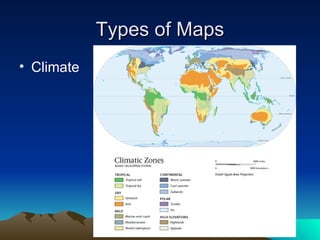
Types of Maps Physical - show  topography :  physical features of a place or region Population - show how many people live in an area Climate - show what the typical climate is like in an area Political, etc.
Physical Types of Maps
Population Types of Maps
Climate Types of Maps
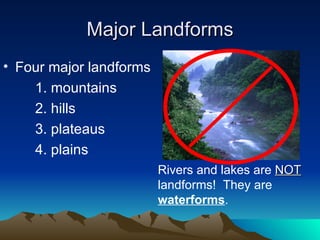
Major Landforms Four major landforms 1. mountains 2. hills 3. plateaus 4. plains Rivers and lakes are  NOT  landforms!  They are  waterforms .
Climate Climate :  the average weather a place has over a period of 20 to 30 years (pg. 778) What is the difference between climate and weather? How can climate affect the way we live?  (think about the 3 rd  theme of geography-  interaction )
Climate Factors that affect climate - latitude (how close to equator?) - proximity to oceans - oceans act as climate  mediators - elevation (height above sea level)
Review 4 Map Projections Mercator, Peters, Interrupted, Robinson 3 types of maps Physical, Population, Climate 4 Major Landforms Mountains, hills, plateaus, plains Climate Factors that affect climate

Maps, Landforms, And Climate

  • 1.
    Maps, Landforms, andClimate Physical Geography
  • 2.
    Two Tools ofGeographers Globes (more accurate) Maps - all maps distort the earth in some way
  • 3.
    Map projections: ways of showing the curved earth on a flat surface Four main map projections 1. Mercator Projection 2. Peters Projection 3. Interrupted Projection 4. Robinson Projection Two Tools of Geographers
  • 4.
    Map Projections MercatorProjection - the “big box” - accurate near the equator - land is distorted at the poles
  • 5.
    Map Projections 2. Peters Projection - the rectangle - correct areas of land and sea - some continents appear longer than they really are
  • 6.
    Map Projections 3. Interrupted Projection - correct areas of land and sea - cuts out parts of oceans - makes measuring distance impossible
  • 7.
    Map Projections 4. Robinson Projection - the oval; most used - correct sizes and shapes of land masses - fairly accurate distances - Distortions occur along the edges
  • 8.
    Types of MapsPhysical - show topography : physical features of a place or region Population - show how many people live in an area Climate - show what the typical climate is like in an area Political, etc.
  • 9.
  • 10.
  • 11.
  • 12.
    Major Landforms Fourmajor landforms 1. mountains 2. hills 3. plateaus 4. plains Rivers and lakes are NOT landforms! They are waterforms .
  • 13.
    Climate Climate : the average weather a place has over a period of 20 to 30 years (pg. 778) What is the difference between climate and weather? How can climate affect the way we live? (think about the 3 rd theme of geography- interaction )
  • 14.
    Climate Factors thataffect climate - latitude (how close to equator?) - proximity to oceans - oceans act as climate mediators - elevation (height above sea level)
  • 15.
    Review 4 MapProjections Mercator, Peters, Interrupted, Robinson 3 types of maps Physical, Population, Climate 4 Major Landforms Mountains, hills, plateaus, plains Climate Factors that affect climate