Studying Geography
Themes and Essential Elements
What is Geography?
• Geography is the study of everything on Earth from
  rocks and rainfall to people and places
• Geographers study how natural environment
  influences people, how people’s activities affect
  Earth, and how the world is changing
• Geographers look at many different things including
  cities, cultures, plants, and resources
• Geographers use spatial perspective to study the
  world
• Spatial perspective is looking for patterns in where
  things are located on Earth and how they are
  arranged
• Geographers try to explain these patterns
• Geographers look at landscapes and how they
  shape the world
• Landscapes include physical, human, and cultural
  features
• Geography has two main branches: Human
  Geography and Physical Geography
• Human geography looks at the distribution and
  characteristics of the world’s people
• H.G. studies where people live, work and their ways
  of life, how people make and trade things they need
  to survive
• Physical geography focuses on Earth’s natural
  environments
• Includes Earth’s landforms, water features,
  atmosphere, animals, plants, soils, and the
  processes that affect them
• The interaction between people links human &
  physical geography together
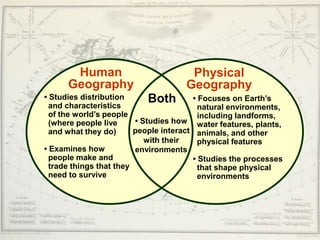
Human                            Physical
      Geography                        Geography
• Studies distribution       Both          • Focuses on Earth’s
  and characteristics                        natural environments,
  of the world’s people                      including landforms,
  (where people live     • Studies how       water features, plants,
  and what they do)      people interact     animals, and other
                            with their       physical features
• Examines how           environments
  people make and                          • Studies the processes
  trade things that they                     that shape physical
  need to survive                            environments
Who Uses Geography?
• We use geography everyday
• Most jobs require an understanding of geography
Subfields of Geography
• Cartography-the study of making maps and
  mapmaking
• Maps help geographers study location
• Cartographers work for companies that publish
  maps, atlases, newspapers, magazines, and books
  as well as city planning agencies and other areas of
  government
• Meteorology-the study of weather
• Meteorologists forecast how the weather will
  develop so people know what to expect
Geographers at Work
• Many geographers work for governmental agencies
• One of the largest employers of cartographers in
  the U.S. is the United States Geological Survey
  (USGS)
• USGS produces detailed maps of the whole country
• Geographers decide where to place new stores and
  plan shipping and trucking routes as well as identify
  new markets
AND THE MOST IMPORTANT!!!!!!!
• Schools hire geography teachers
• Geographic knowledge is needed for good
  citizenship
How Do We Study Geography?
• The idea of regions are an important concept in
  geography
• Regions have one or more common features that
  make them different from surrounding areas
• Regions are defined by their physical and human
  features
• Physical features include kinds of climate, river
  systems, soils, and vegetation you find there
• Human features include languages, religions, and
  trade networks of an area
• Sometimes boundaries are clear like the U.S.
  political boundaries while others are not as clear
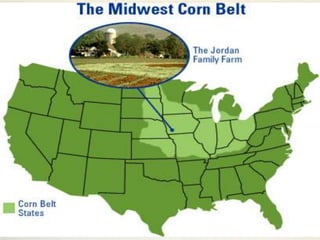
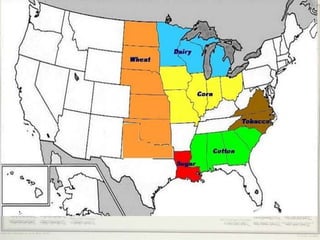
• Ex. The Corn Belt is a farming region in the
  Midwestern U.S. but it does not have clearly set
  boundaries
• Regions can be any size. Countries, deserts and
  mountain ranges are large regions. Suburbs and
  neighborhoods are small regions
Types of Regions
• Formal Region – has one or more common features
  that make it different from surrounding areas
• Formal regions can be based on
  landforms, population, income
  levels, crops, temperature, or rainfall
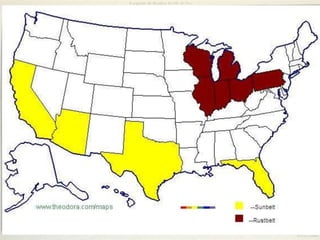
• EX. Corn Belt. Rust Belt. Sun Belt. Piedmont. Sahel.
  Rocky Mountains
• Functional Region – made up of different places
  that are linked together and function as a unit
• Ex. City transit system
• Many functional regions are organized around a
  central point & surrounding areas are linked to this
  point
• Ex. Shopping malls are centers to link surrounding
  neighborhoods. Cities connect to suburbs and
  industry which all function together
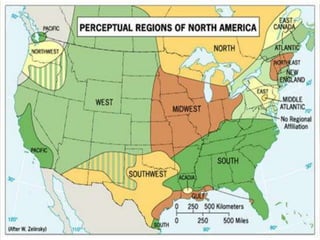
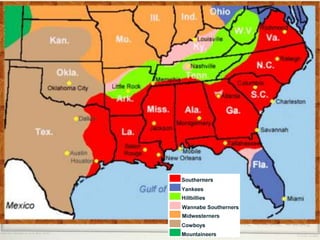
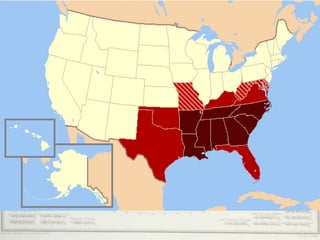
• Perceptual Region – regions that reflect human
  feelings and attitudes
• Ex. “back home”, Midwest, Dixie in the South
• These areas have their own special features that
  make them different from anywhere else
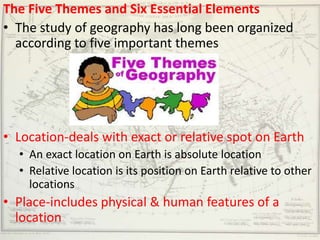
The Five Themes and Six Essential Elements
• The study of geography has long been organized
  according to five important themes


• Location-deals with exact or relative spot on Earth
  • An exact location on Earth is absolute location
  • Relative location is its position on Earth relative to other
    locations
• Place-includes physical & human features of a
  location
• Human-Environmental Interaction-covers ways
  people and environments interrelate with and
  affect each other
• Movement-involves how people and things change
  locations and the effects of these changes
• Region-organizes Earth into geographic areas with
  one or more shared characteristics
• By the early 1990s 18 Geography Standards were
  created and grouped into 6 Essential Elements:
      -The World in Spatial Terms
      -Places and Regions
      -Physical Systems
      -Human Systems
      -Environment and Society
      -The Uses of Geography
Using the Geographer’s Tools
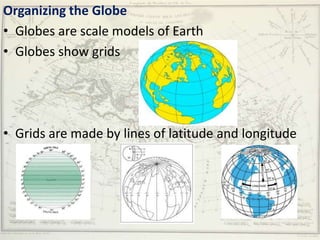
Organizing the Globe
• Globes are scale models of Earth
• Globes show grids


• Grids are made by lines of latitude and longitude
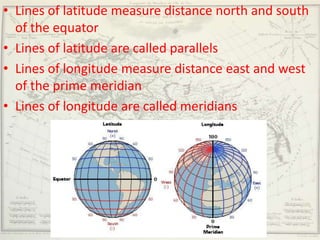
• Lines of latitude measure distance north and south
  of the equator
• Lines of latitude are called parallels
• Lines of longitude measure distance east and west
  of the prime meridian
• Lines of longitude are called meridians
• Parallels and meridians measure distances in
  degrees
• Degrees are further divided into minutes with there
  being 60 minutes in each degree
Hemispheres, Continents, and Oceans
• Geographers use grids to utilize how we look at the
  world
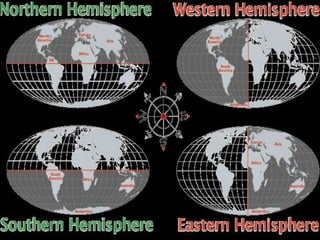
• The equator divides the globe into Northern and
  Southern hemispheres while the prime meridian
  and 180 degree meridian divides it into Eastern and
  Western hemispheres
• The planet’s land surfaces are divided into seven
  continents
• Africa, Antarctica, Asia, Australia, Europe, North
  America, and South America
• Landmasses surrounded by water are called islands
• Greenland is the world’s largest island
• Earth’s water surfaces are organized into separate
  areas: oceans, seas, gulfs, lakes, rivers, etc.
• The four oceans are Pacific (largest), Atlantic,
  Indian, and Arctic (smallest)
• Seas are connected to oceans while lakes are
  inland, Caspian Sea is world’s largest lake
Making Maps
• Maps are flat representations of all or part of
  Earth’s surface
• A collection of maps in a book is called an atlas
• Mapmakers have different ways of presenting our
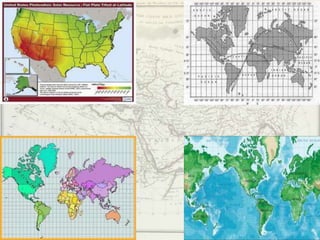
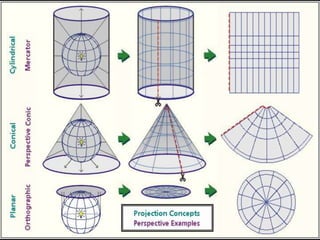
  round Earth on flat maps called map projections
Map Projections
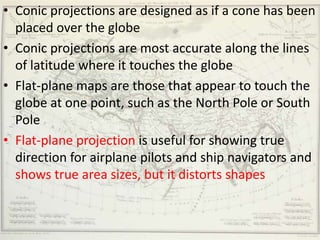
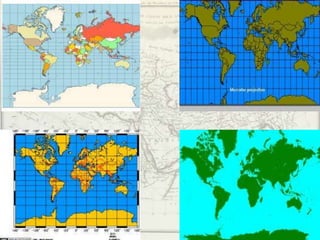
• Maps with cylindrical projections are designed as if
  a cylinder has been wrapped around the globe
• A Mercator map is a cylindrical projection that
  shows true direction and shape
• Landmasses at high altitudes or near the poles are
  exaggerated/distorted in size in a Mercator map
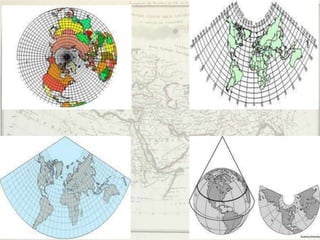
• Conic projections are designed as if a cone has been
  placed over the globe
• Conic projections are most accurate along the lines
  of latitude where it touches the globe
• Flat-plane maps are those that appear to touch the
  globe at one point, such as the North Pole or South
  Pole
• Flat-plane projection is useful for showing true
  direction for airplane pilots and ship navigators and
  shows true area sizes, but it distorts shapes
Great Circle Route
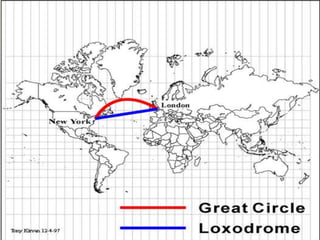
• Drawing a straight line on a flat map will not show
  the shortest route between two places
• Maps represent a round world on a flat plane
• The shortest route between any two places on the
  planet is called a great-circle route
• Airline pilots and ship captains use great-circle
  routes to help them navigate
Understanding Map Elements
• Study of geography includes looking at places at
  different scales
• Almost all maps have common elements such as
  distance scales, directional indicator, and a key
Distance Scales
• Distance scale helps us determine real distance
  between points on a map
Directional Indicators
• Most maps will include a compass rose,
  which has arrows that point to all 4
  principal directions
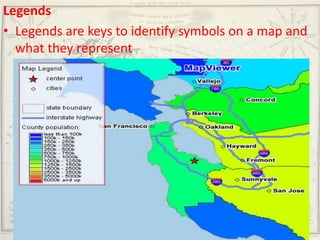
Legends
• Legends are keys to identify symbols on a map and
  what they represent
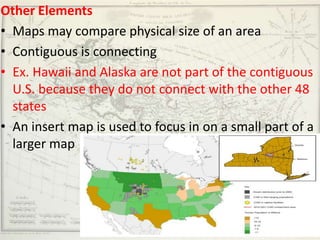
Other Elements
• Maps may compare physical size of an area
• Contiguous is connecting
• Ex. Hawaii and Alaska are not part of the contiguous
  U.S. because they do not connect with the other 48
  states
• An insert map is used to focus in on a small part of a
  larger map
Using Special Purpose Maps
• Geographers use maps that focus on certain
  information about places and regions
• Political maps show borders, cities, countries, states
  and other political features
• Physical maps show natural features like mountains,
  rivers, and other bodies of water
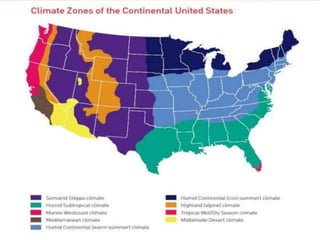
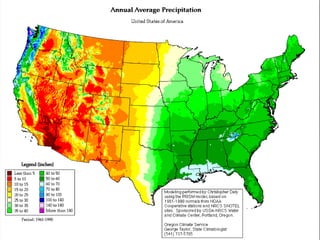
Climate and Precipitation Maps
• Climate maps use color to show various climate
  regions of the world
• Precipitation maps are paired with climate maps
  which show the average amount of precipitation
  that a region gets each year
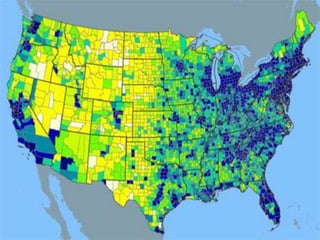
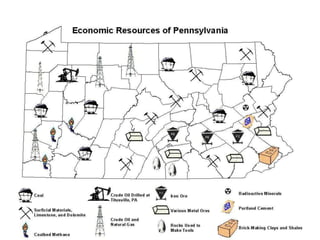
Population and Economic Maps
• Population maps give you a snapshot of the
  distribution of people in a region
• Generally these maps deal with population density
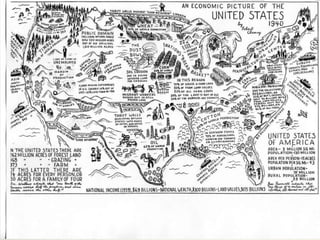
• Economic maps show a region’s important natural
  resources and the ways in which land is used
Elevation Profiles and Topographic Maps
• Elevation profile shows a side view of a place or
  area
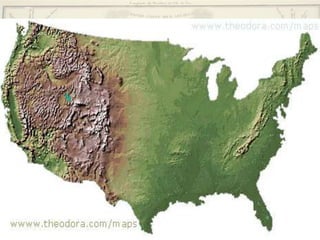
• The purpose of some maps is to show the
  topography of the land
• Special kinds of topography maps are called contour
  map
• Contour maps connects points of equal elevation
  above or below sea level
Climate Graphs and Population Pyramids
• Two common diagrams that show important
  geographic characteristics: climate graphs and
  population pyramids
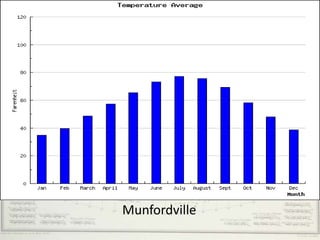
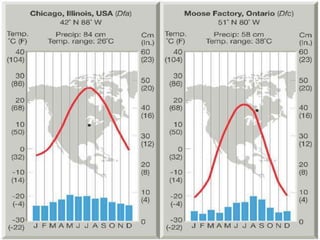
• Climate graphs show the average temperatures and
  precipitation in a place
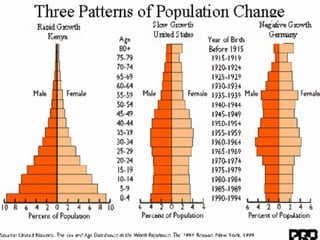
• Population pyramids show the percentage of males
  and females by age group in a country’s population
Munfordville
Topic 6 power point
Topic 6 power point

Topic 6 power point

  • 1.
  • 2.
  • 3.
    What is Geography? •Geography is the study of everything on Earth from rocks and rainfall to people and places • Geographers study how natural environment influences people, how people’s activities affect Earth, and how the world is changing • Geographers look at many different things including cities, cultures, plants, and resources • Geographers use spatial perspective to study the world • Spatial perspective is looking for patterns in where things are located on Earth and how they are arranged
  • 4.
    • Geographers tryto explain these patterns • Geographers look at landscapes and how they shape the world • Landscapes include physical, human, and cultural features • Geography has two main branches: Human Geography and Physical Geography • Human geography looks at the distribution and characteristics of the world’s people • H.G. studies where people live, work and their ways of life, how people make and trade things they need to survive
  • 5.
    • Physical geographyfocuses on Earth’s natural environments • Includes Earth’s landforms, water features, atmosphere, animals, plants, soils, and the processes that affect them • The interaction between people links human & physical geography together
  • 6.
    Human Physical Geography Geography • Studies distribution Both • Focuses on Earth’s and characteristics natural environments, of the world’s people including landforms, (where people live • Studies how water features, plants, and what they do) people interact animals, and other with their physical features • Examines how environments people make and • Studies the processes trade things that they that shape physical need to survive environments
  • 7.
    Who Uses Geography? •We use geography everyday • Most jobs require an understanding of geography Subfields of Geography • Cartography-the study of making maps and mapmaking • Maps help geographers study location • Cartographers work for companies that publish maps, atlases, newspapers, magazines, and books as well as city planning agencies and other areas of government
  • 8.
    • Meteorology-the studyof weather • Meteorologists forecast how the weather will develop so people know what to expect Geographers at Work • Many geographers work for governmental agencies • One of the largest employers of cartographers in the U.S. is the United States Geological Survey (USGS) • USGS produces detailed maps of the whole country • Geographers decide where to place new stores and plan shipping and trucking routes as well as identify new markets
  • 9.
    AND THE MOSTIMPORTANT!!!!!!! • Schools hire geography teachers • Geographic knowledge is needed for good citizenship How Do We Study Geography? • The idea of regions are an important concept in geography • Regions have one or more common features that make them different from surrounding areas • Regions are defined by their physical and human features • Physical features include kinds of climate, river systems, soils, and vegetation you find there
  • 10.
    • Human featuresinclude languages, religions, and trade networks of an area • Sometimes boundaries are clear like the U.S. political boundaries while others are not as clear • Ex. The Corn Belt is a farming region in the Midwestern U.S. but it does not have clearly set boundaries • Regions can be any size. Countries, deserts and mountain ranges are large regions. Suburbs and neighborhoods are small regions
  • 11.
    Types of Regions •Formal Region – has one or more common features that make it different from surrounding areas • Formal regions can be based on landforms, population, income levels, crops, temperature, or rainfall • EX. Corn Belt. Rust Belt. Sun Belt. Piedmont. Sahel. Rocky Mountains
  • 15.
    • Functional Region– made up of different places that are linked together and function as a unit • Ex. City transit system • Many functional regions are organized around a central point & surrounding areas are linked to this point • Ex. Shopping malls are centers to link surrounding neighborhoods. Cities connect to suburbs and industry which all function together • Perceptual Region – regions that reflect human feelings and attitudes • Ex. “back home”, Midwest, Dixie in the South • These areas have their own special features that make them different from anywhere else
  • 19.
    The Five Themesand Six Essential Elements • The study of geography has long been organized according to five important themes • Location-deals with exact or relative spot on Earth • An exact location on Earth is absolute location • Relative location is its position on Earth relative to other locations • Place-includes physical & human features of a location
  • 20.
    • Human-Environmental Interaction-coversways people and environments interrelate with and affect each other • Movement-involves how people and things change locations and the effects of these changes • Region-organizes Earth into geographic areas with one or more shared characteristics
  • 21.
    • By theearly 1990s 18 Geography Standards were created and grouped into 6 Essential Elements: -The World in Spatial Terms -Places and Regions -Physical Systems -Human Systems -Environment and Society -The Uses of Geography
  • 22.
  • 23.
    Organizing the Globe •Globes are scale models of Earth • Globes show grids • Grids are made by lines of latitude and longitude
  • 24.
    • Lines oflatitude measure distance north and south of the equator • Lines of latitude are called parallels • Lines of longitude measure distance east and west of the prime meridian • Lines of longitude are called meridians
  • 25.
    • Parallels andmeridians measure distances in degrees • Degrees are further divided into minutes with there being 60 minutes in each degree Hemispheres, Continents, and Oceans • Geographers use grids to utilize how we look at the world • The equator divides the globe into Northern and Southern hemispheres while the prime meridian and 180 degree meridian divides it into Eastern and Western hemispheres
  • 27.
    • The planet’sland surfaces are divided into seven continents • Africa, Antarctica, Asia, Australia, Europe, North America, and South America • Landmasses surrounded by water are called islands • Greenland is the world’s largest island • Earth’s water surfaces are organized into separate areas: oceans, seas, gulfs, lakes, rivers, etc. • The four oceans are Pacific (largest), Atlantic, Indian, and Arctic (smallest) • Seas are connected to oceans while lakes are inland, Caspian Sea is world’s largest lake
  • 28.
    Making Maps • Mapsare flat representations of all or part of Earth’s surface • A collection of maps in a book is called an atlas • Mapmakers have different ways of presenting our round Earth on flat maps called map projections Map Projections • Maps with cylindrical projections are designed as if a cylinder has been wrapped around the globe • A Mercator map is a cylindrical projection that shows true direction and shape • Landmasses at high altitudes or near the poles are exaggerated/distorted in size in a Mercator map
  • 29.
    • Conic projectionsare designed as if a cone has been placed over the globe • Conic projections are most accurate along the lines of latitude where it touches the globe • Flat-plane maps are those that appear to touch the globe at one point, such as the North Pole or South Pole • Flat-plane projection is useful for showing true direction for airplane pilots and ship navigators and shows true area sizes, but it distorts shapes
  • 34.
    Great Circle Route •Drawing a straight line on a flat map will not show the shortest route between two places • Maps represent a round world on a flat plane • The shortest route between any two places on the planet is called a great-circle route • Airline pilots and ship captains use great-circle routes to help them navigate
  • 36.
    Understanding Map Elements •Study of geography includes looking at places at different scales • Almost all maps have common elements such as distance scales, directional indicator, and a key Distance Scales • Distance scale helps us determine real distance between points on a map Directional Indicators • Most maps will include a compass rose, which has arrows that point to all 4 principal directions
  • 37.
    Legends • Legends arekeys to identify symbols on a map and what they represent
  • 38.
    Other Elements • Mapsmay compare physical size of an area • Contiguous is connecting • Ex. Hawaii and Alaska are not part of the contiguous U.S. because they do not connect with the other 48 states • An insert map is used to focus in on a small part of a larger map
  • 39.
    Using Special PurposeMaps • Geographers use maps that focus on certain information about places and regions • Political maps show borders, cities, countries, states and other political features • Physical maps show natural features like mountains, rivers, and other bodies of water Climate and Precipitation Maps • Climate maps use color to show various climate regions of the world • Precipitation maps are paired with climate maps which show the average amount of precipitation that a region gets each year
  • 42.
    Population and EconomicMaps • Population maps give you a snapshot of the distribution of people in a region • Generally these maps deal with population density • Economic maps show a region’s important natural resources and the ways in which land is used
  • 46.
    Elevation Profiles andTopographic Maps • Elevation profile shows a side view of a place or area • The purpose of some maps is to show the topography of the land • Special kinds of topography maps are called contour map • Contour maps connects points of equal elevation above or below sea level
  • 48.
    Climate Graphs andPopulation Pyramids • Two common diagrams that show important geographic characteristics: climate graphs and population pyramids • Climate graphs show the average temperatures and precipitation in a place • Population pyramids show the percentage of males and females by age group in a country’s population
  • 49.

Editor's Notes

  • #10 Why is geographic knowledge needed for good citizenship? Suburbs being built on farmland. Where to put garbage and hazardous materials?