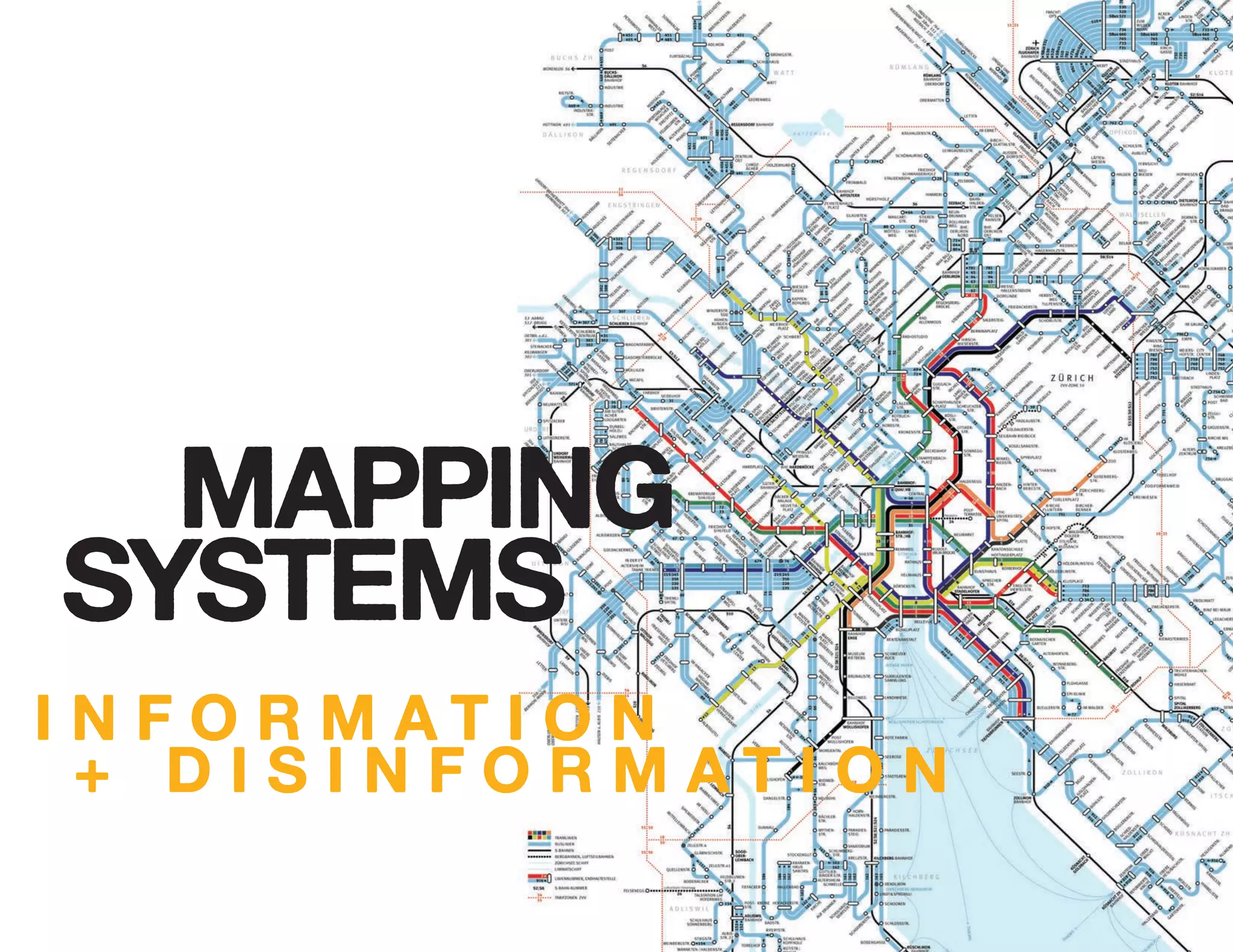
SYSTEMS
MAPPING
I N F O R M A T I O N
+ D I S I N F O R M A T I O N
1. Where am I?
2. Where do I want to go?
3. How do I get there?
Akerman, J. R. & Karrow, R. W., Jr. (2007). Maps: Finding Our
Place in the World.
A map answers the following questions:
M A P P I N G C O N C E P T S
PURPOSE
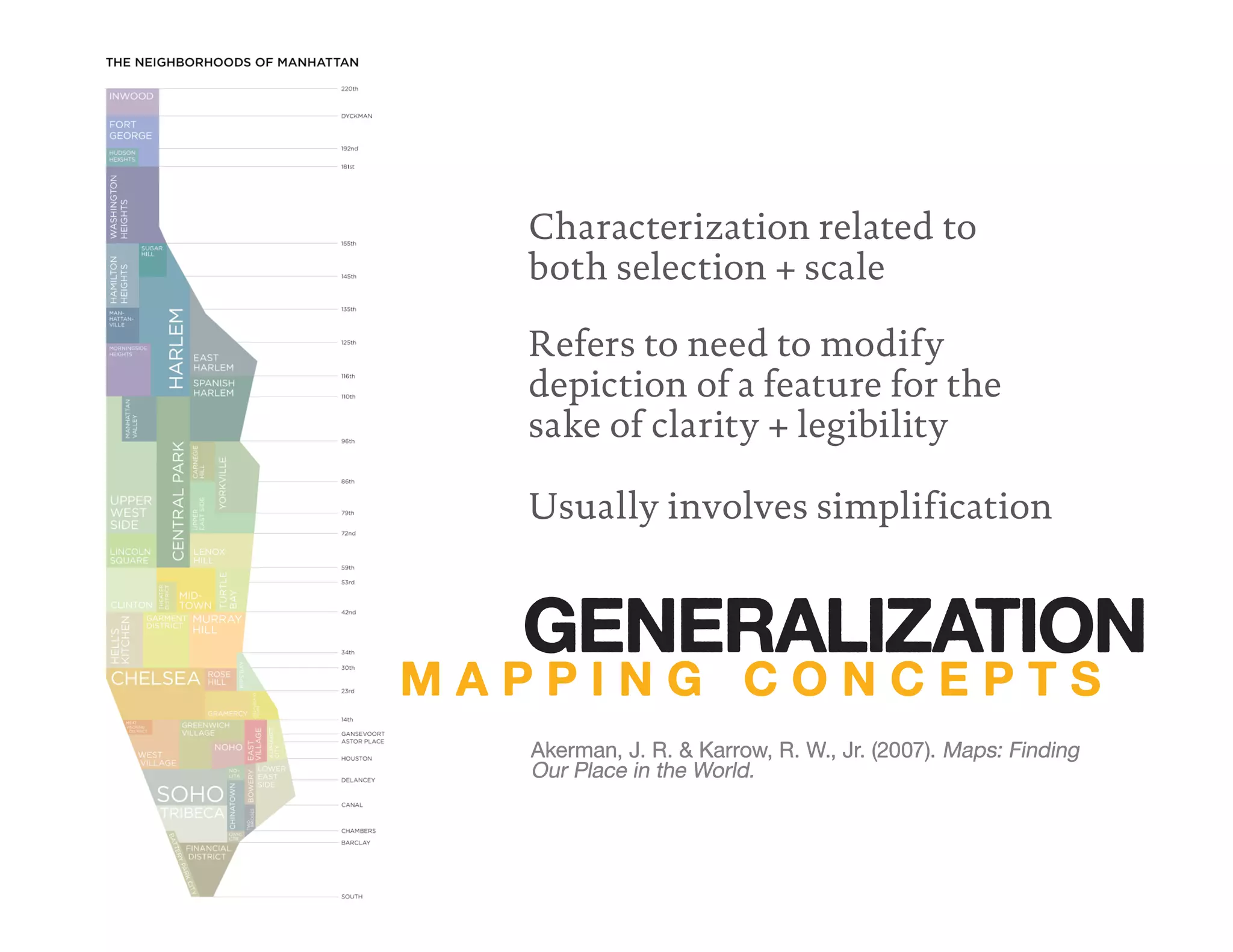
Characterization related to
both selection + scale
Refers to need to modify
depiction of a feature for the
sake of clarity + legibility
Usually involves simplification
M A P P I N G C O N C E P T S
GENERALIZATION
Akerman, J. R. & Karrow, R. W., Jr. (2007). Maps: Finding
Our Place in the World.
Akerman, J. R. & Karrow, R. W., Jr. (2007).
Our Place in the World.
Akerman, J. R. & Karrow, R. W., Jr. (2007).
Internal representation of perceived
environmental features or objects + spatial
relations among them
Necessary for human navigation, but do not
need to be accurate renderings of the real world
Golledge, R. G. (1999). Human Wayfinding and Cognitive Maps.
May be fragmented, distorted, and irregular—
a result of difficulties experienced in mentally
integrating different routes into networked
structures
M A P P I N G C O N C E P T S
COGNITIVE MAPPING
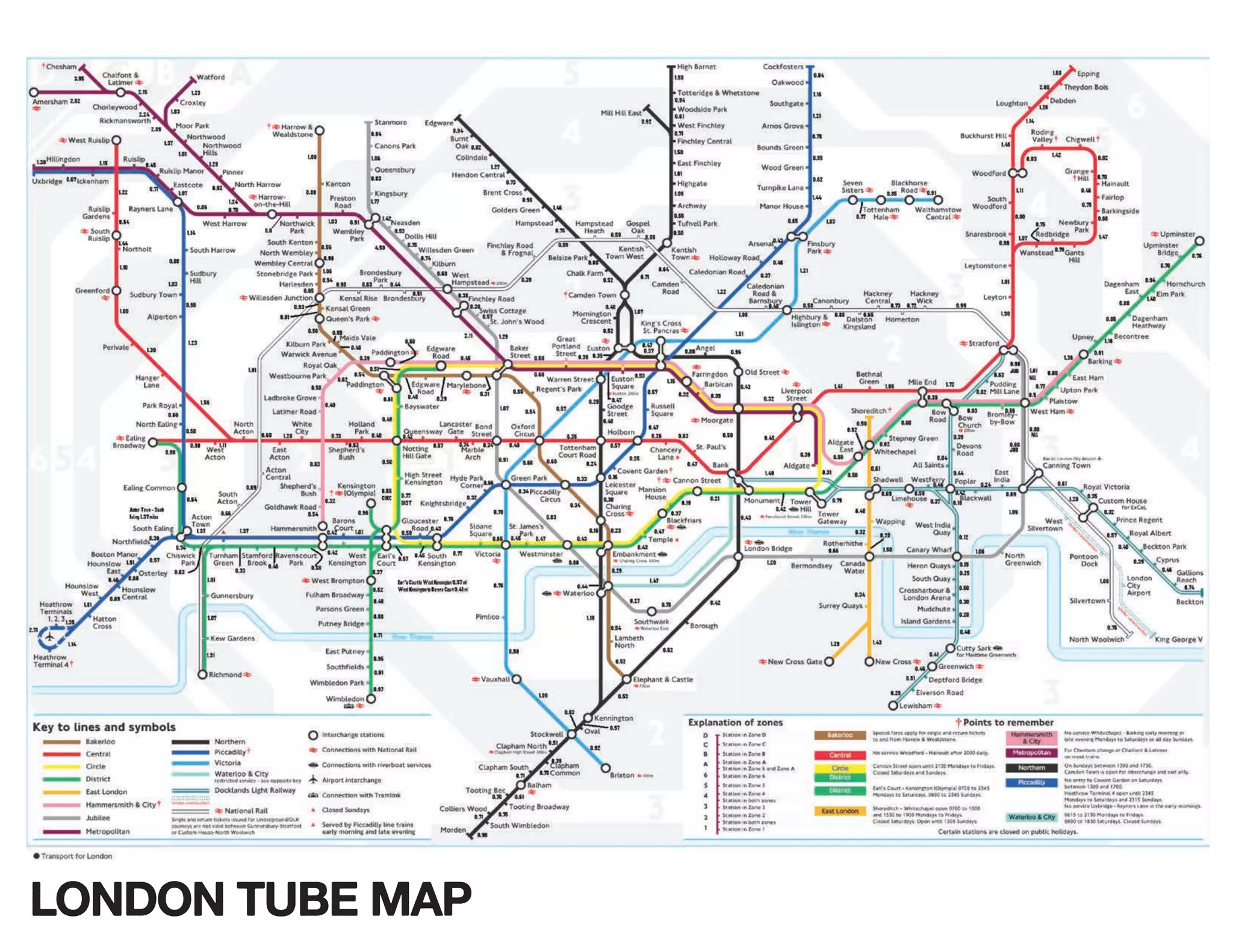
LONDON TUBE MAP
Orientation task
The task of matching the reality to the map
User must find something which can be
uniquely matched between the map + the
actual scene—landmark “footprint” should
have a direction
Davies, C. (2005). Maps Beyond Diagrams: Real-World Spatial Orientation.
Orientation task is harder if the map is not
aligned to the direction that the user is facing
Werner, S., & Long, P. (2003). Cognition Meets Le Corbusier: Cognitive
Principles of Architectural Design.
Werner, S., & Long, P. (2003). Cognition Meets Le Corbusier: Cognitive
Principles of Architectural Design.
Werner, S., & Long, P. (2003). Cognition Meets Le Corbusier: Cognitive
M A P P I N G C O N C E P T S
MAP ORIENTATION
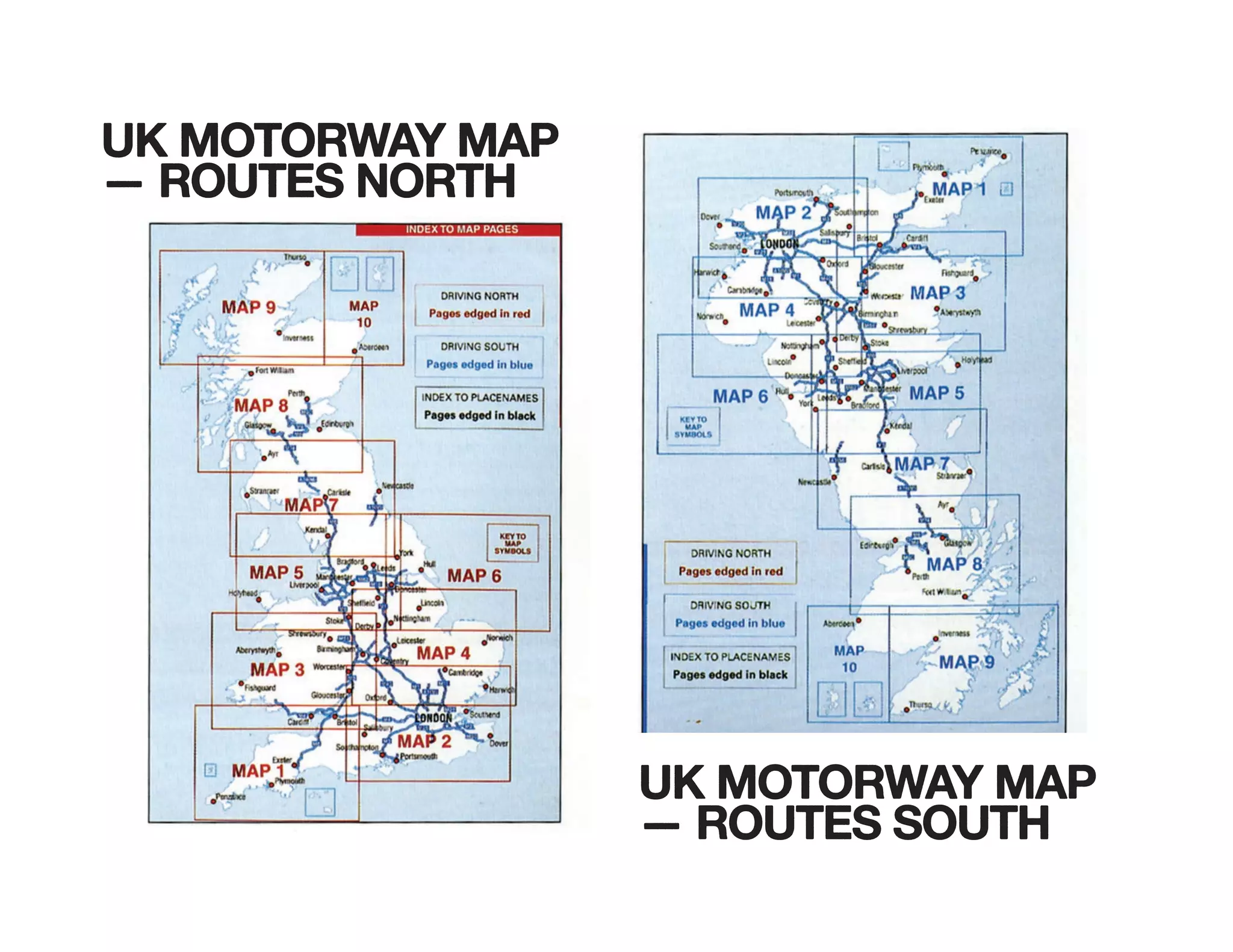
UK MOTORWAY MAP
— ROUTES NORTH
UK MOTORWAY MAP
— ROUTES SOUTH
M A P C O N C E P T S
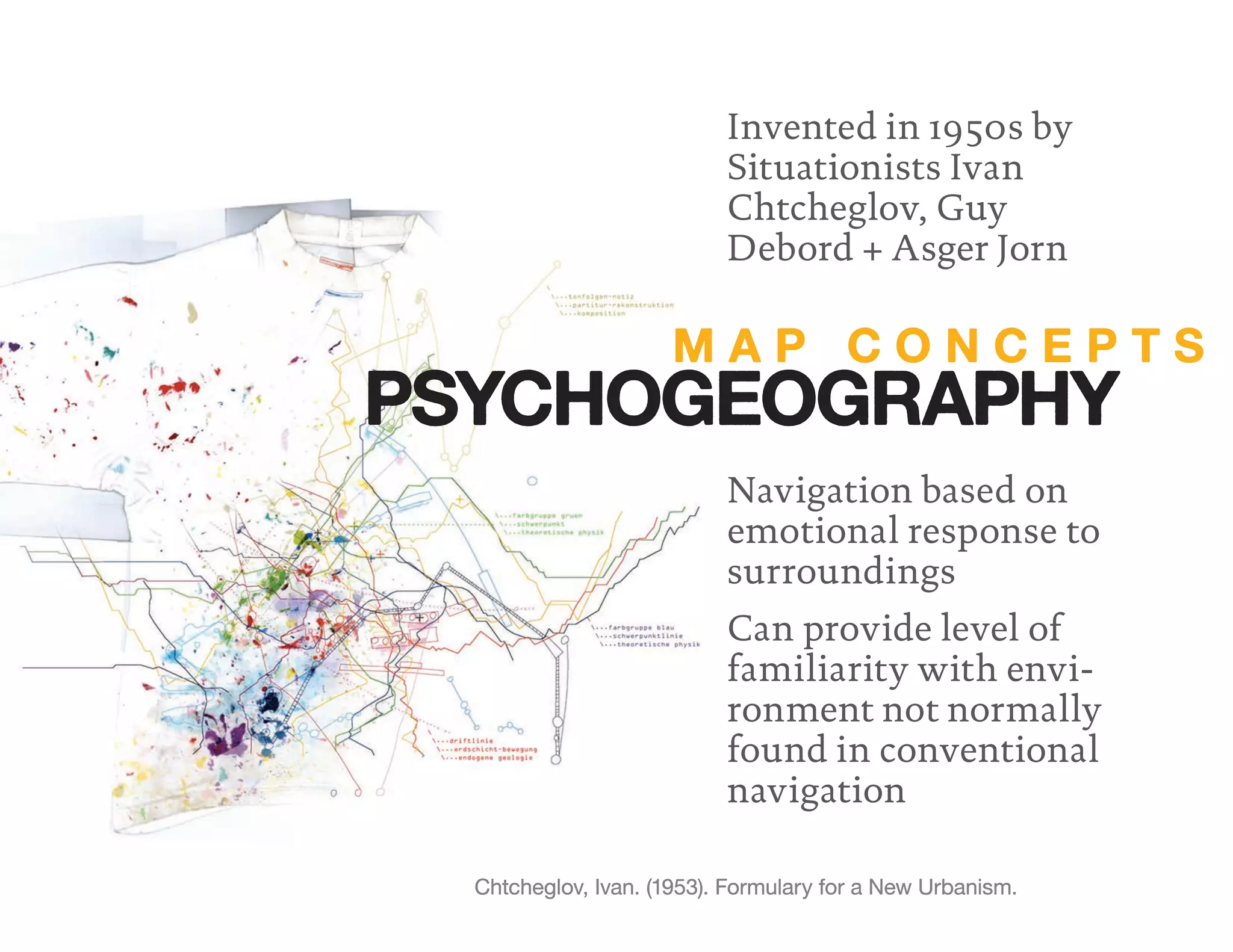
PSYCHOGEOGRAPHY
Invented in 1950s by
Situationists Ivan
Chtcheglov, Guy
Debord + Asger Jorn
Navigation based on
emotional response to
surroundings
Can provide level of
familiarity with envi-
ronment not normally
found in conventional
navigation
Chtcheglov, Ivan. (1953). Formulary for a New Urbanism.
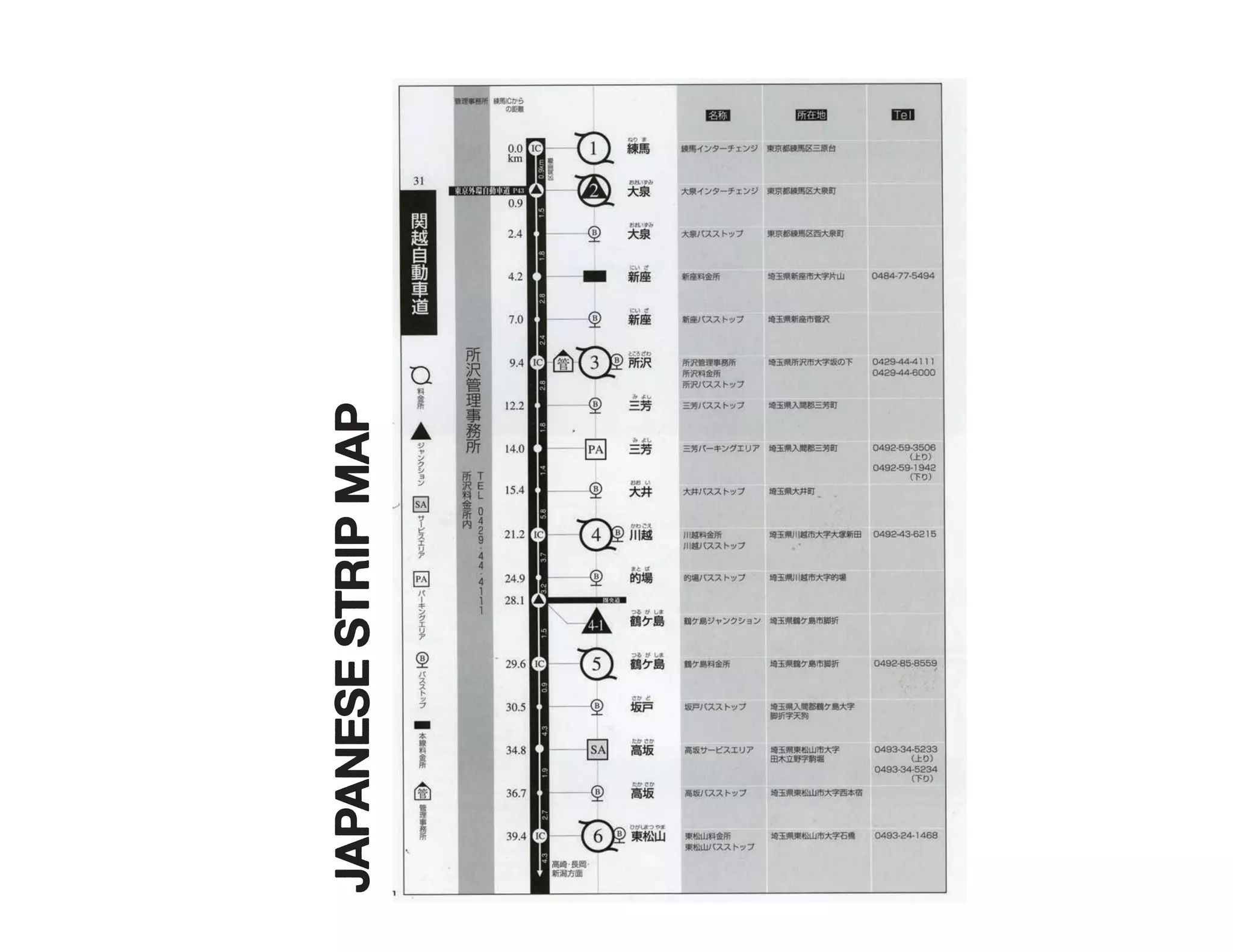
Traditionally, the simplest way for humans to
represent a route
Understood by virtually all cultures and needs
no scale, orientation, or frame of reference
Golledge, R. G. (1999). Human Wayfinding and Cognitive Maps.
Davies, C. (2005). Maps Beyond Diagrams: Real-World Spatial Orientation.
Usually oriented with travel from bottom of
page to top — “pointed in direction of travel”
M A P T Y P E S
STRIP MAP
JAPANESESTRIPMAP
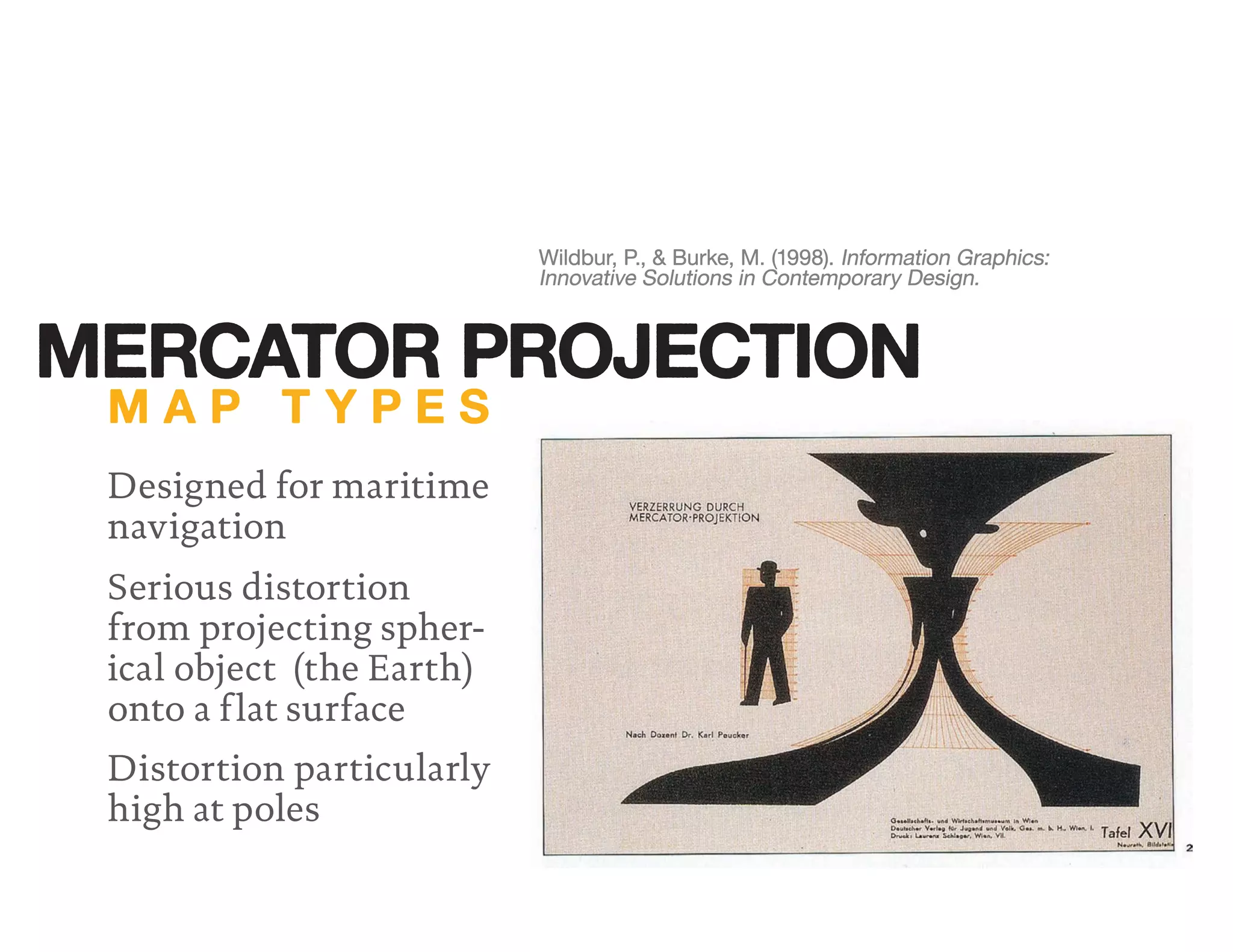
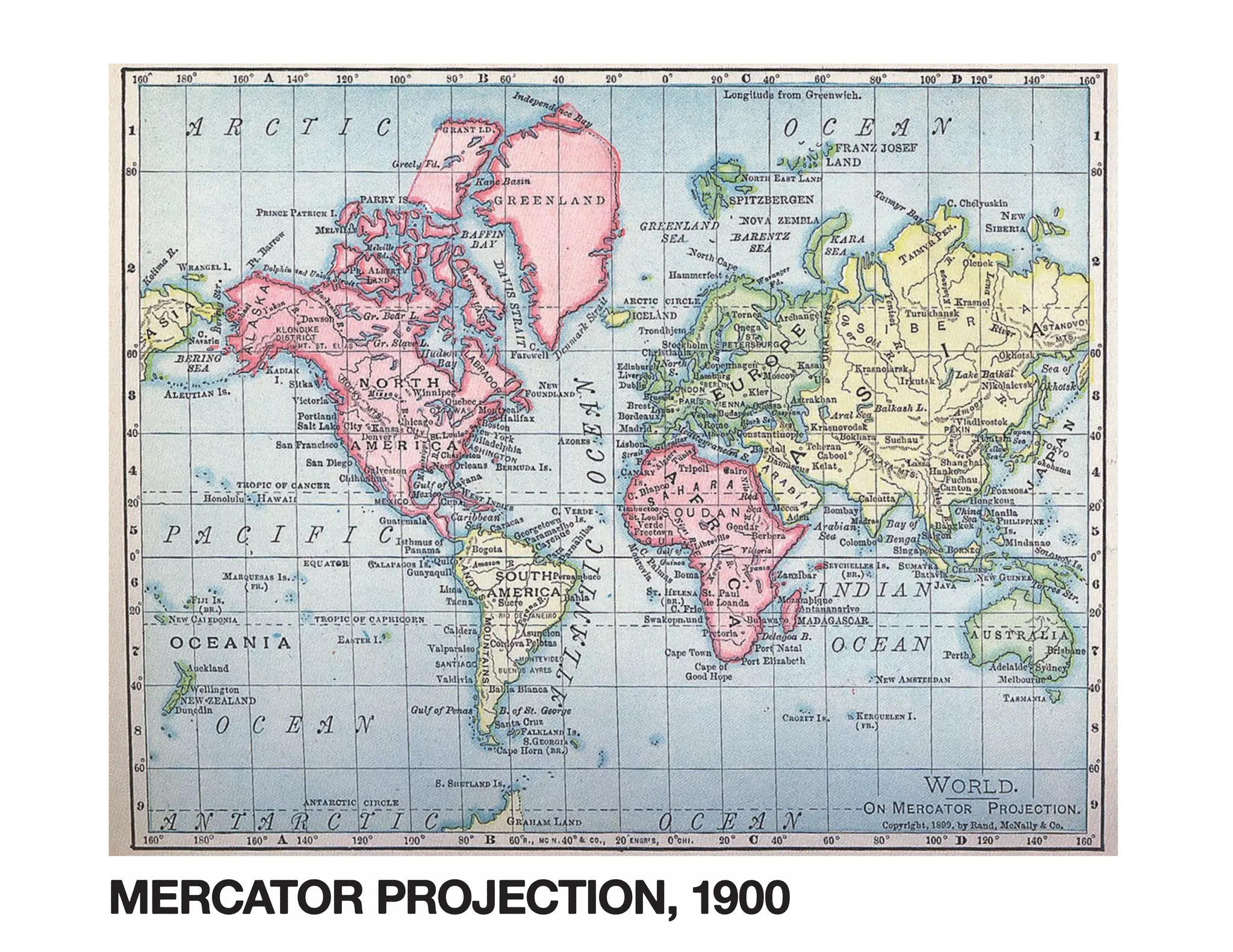
Designed for maritime
navigation
Serious distortion
from projecting spher-
ical object (the Earth)
onto a flat surface
Distortion particularly
high at poles
Wildbur, P., & Burke, M. (1998). Information Graphics:
Innovative Solutions in Contemporary Design.
Wildbur, P., & Burke, M. (1998).
Innovative Solutions in Contemporary Design.
Wildbur, P., & Burke, M. (1998). Information Graphics:
Innovative Solutions in Contemporary Design.
Information Graphics:
M A P T Y P E S
MERCATOR PROJECTION
MERCATOR PROJECTION, 1900
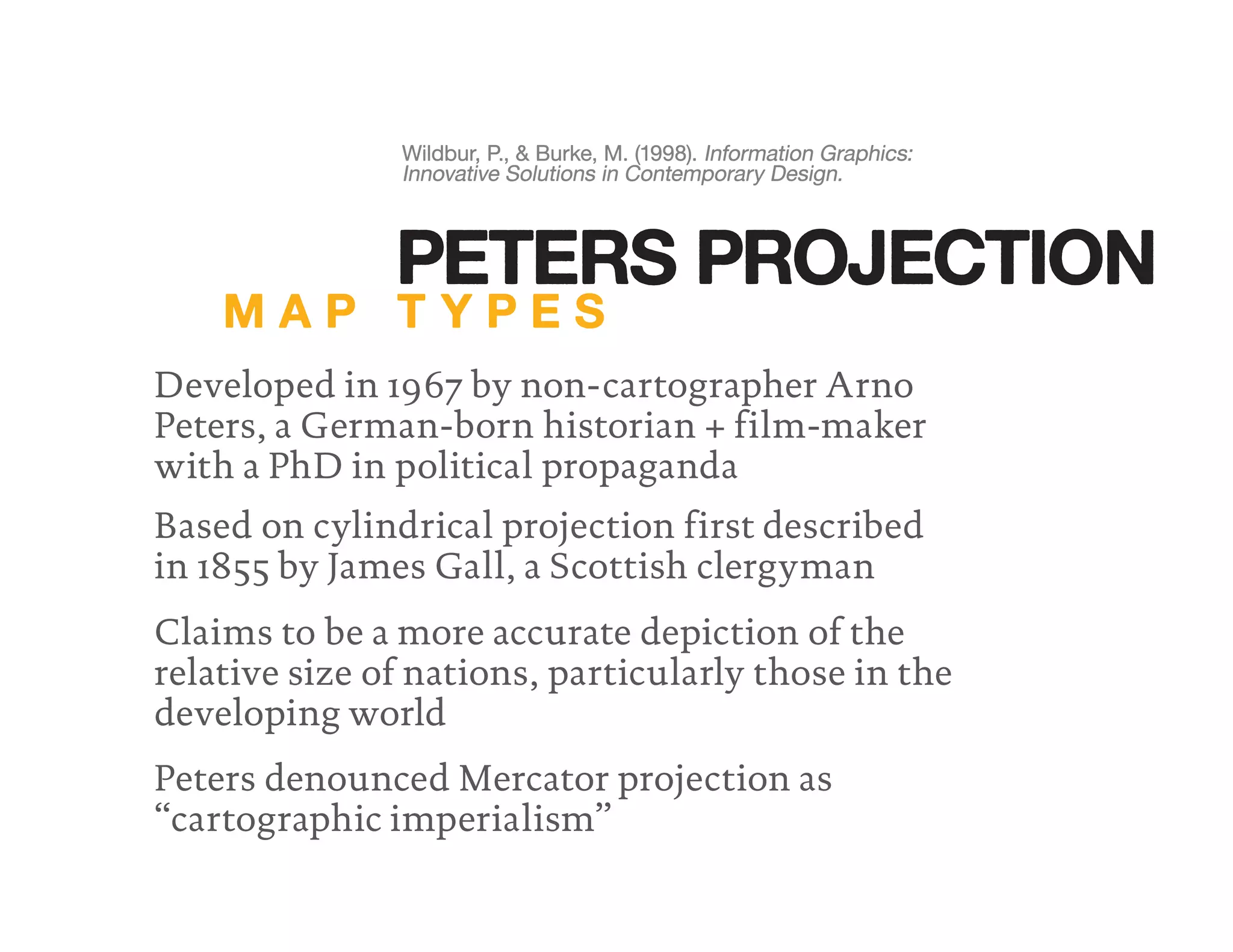
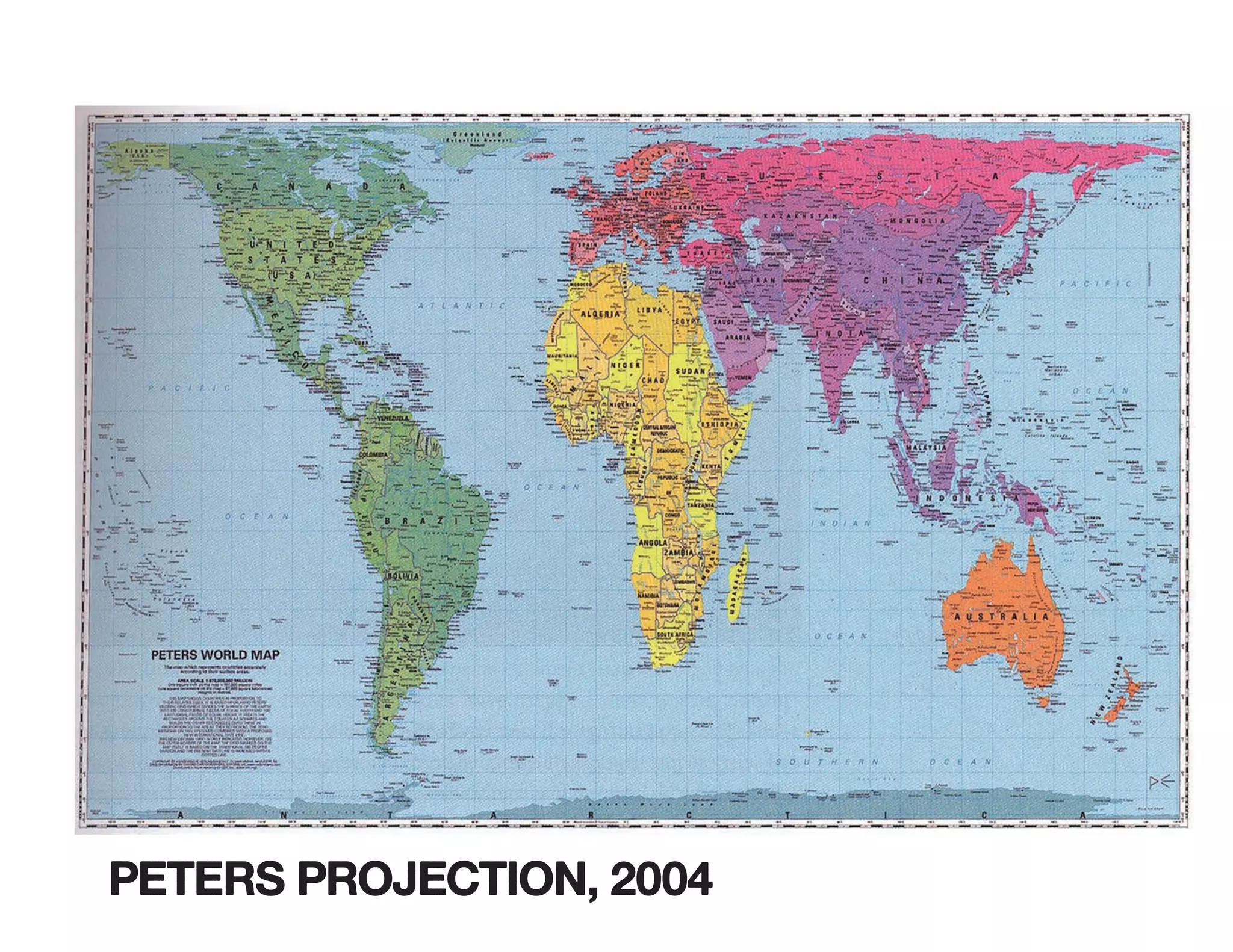
Developed in 1967 by non-cartographer Arno
Peters, a German-born historian + film-maker
with a PhD in political propaganda
Claims to be a more accurate depiction of the
relative size of nations, particularly those in the
developing world
Peters denounced Mercator projection as
“cartographic imperialism”
Wildbur, P., & Burke, M. (1998). Information Graphics:
Innovative Solutions in Contemporary Design.
Wildbur, P., & Burke, M. (1998).
Innovative Solutions in Contemporary Design.
Wildbur, P., & Burke, M. (1998). Information Graphics:
Innovative Solutions in Contemporary Design.
Information Graphics:
Based on cylindrical projection first described
in 1855 by James Gall, a Scottish clergyman
M A P T Y P E S
PETERS PROJECTION
PETERS PROJECTION, 2004
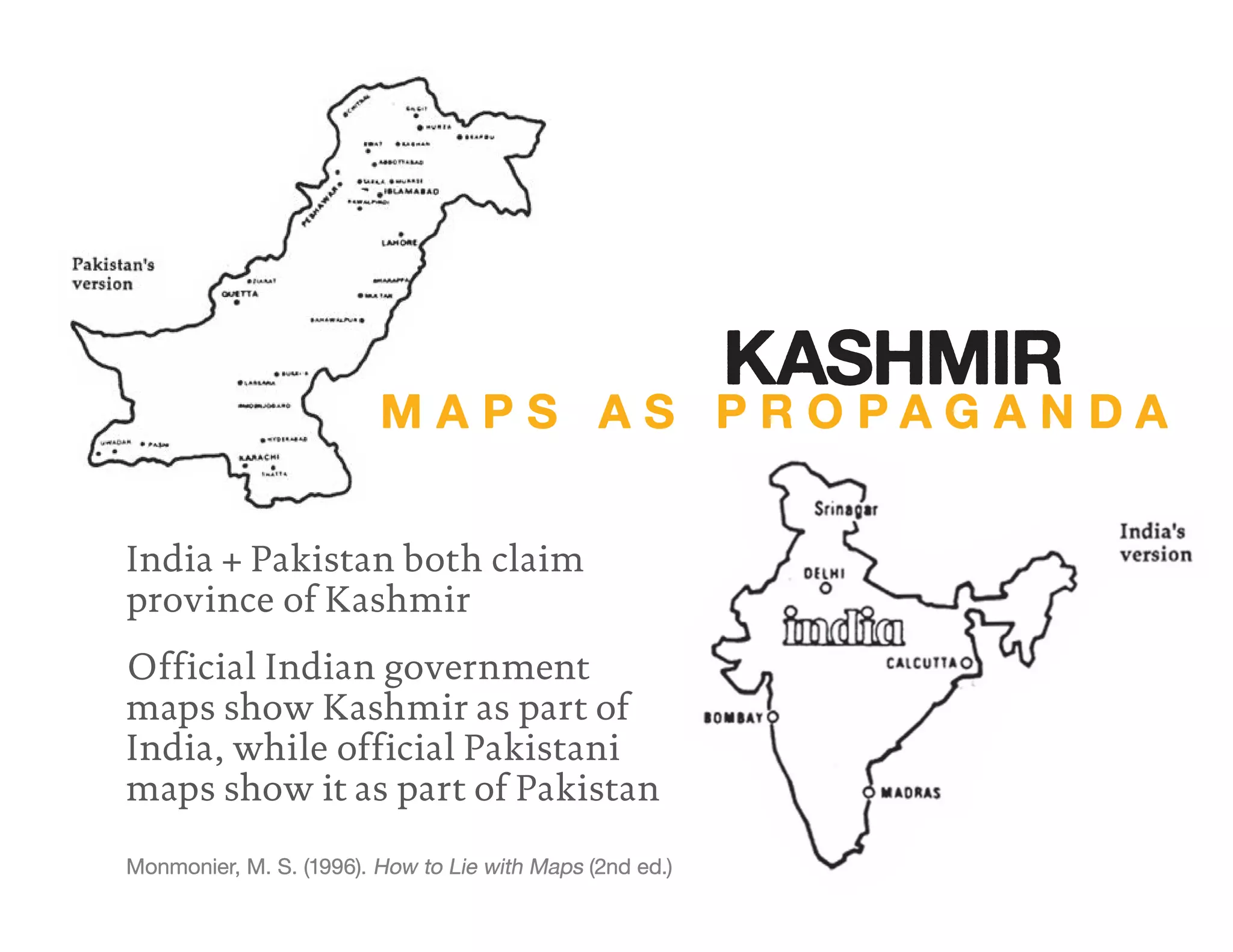
India + Pakistan both claim
province of Kashmir
Official Indian government
maps show Kashmir as part of
India, while official Pakistani
maps show it as part of Pakistan
Monmonier, M. S. (1996). How to Lie with Maps (2nd ed.)
M A P S A S P R O P A G A N D A
KASHMIR
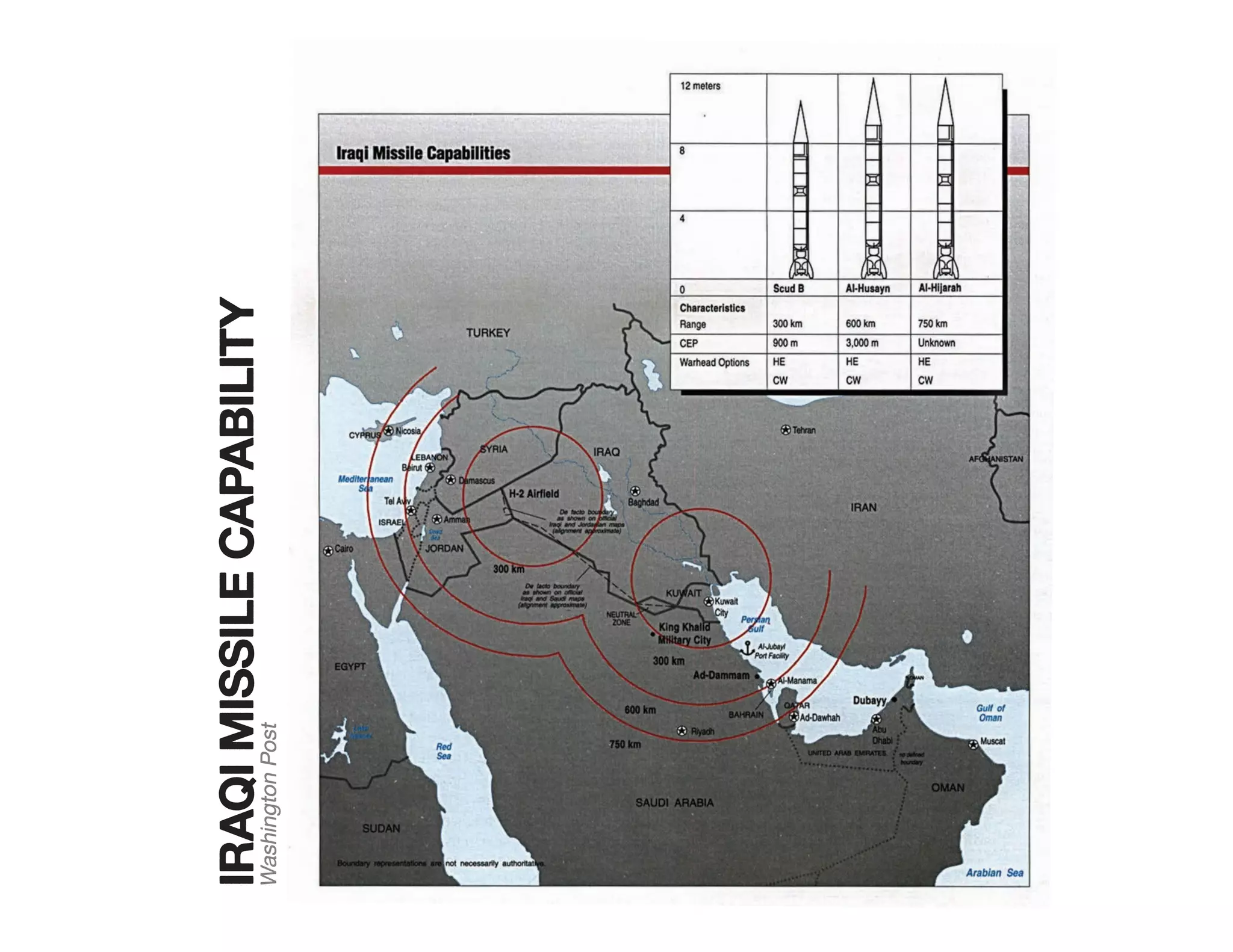
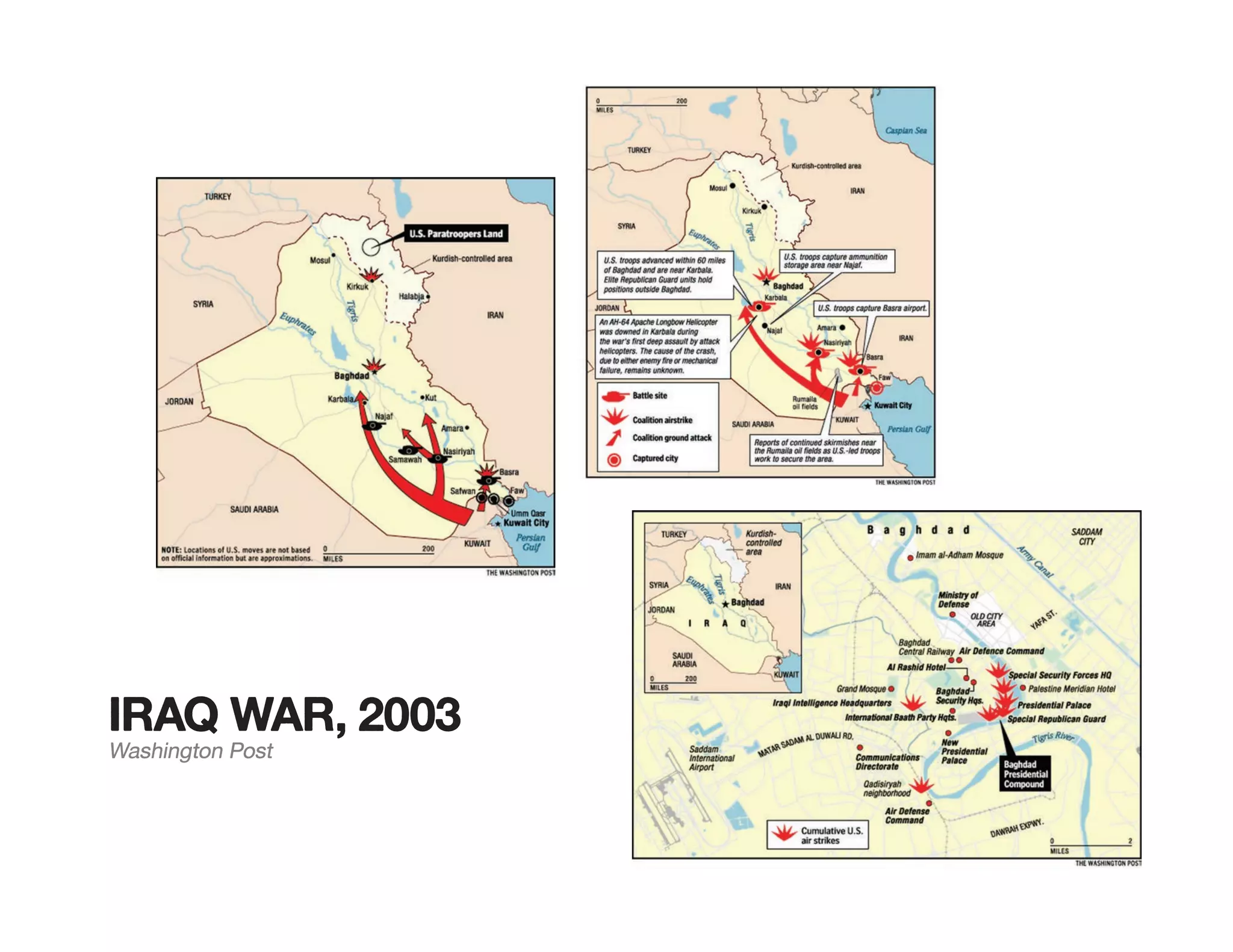
IRAQIMISSILECAPABILITYWashingtonPost
IRAQ WAR, 2003
Washington Post
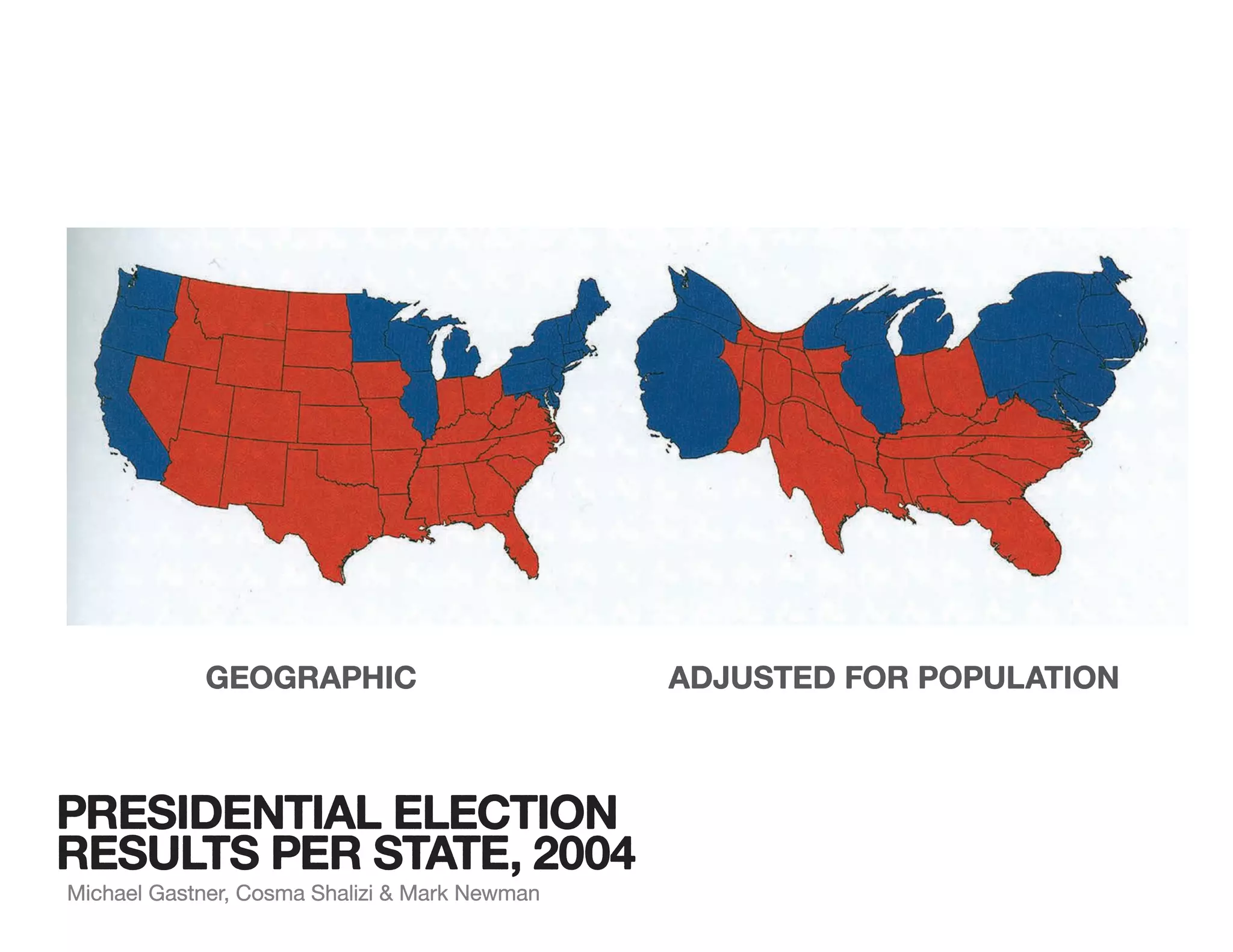
Mapped results of 2004 US election
were misleading because they general-
ized voting patterns a the state level
Gave impression of a huge Republican
majority
Geographic map made no allowances
for population density
Baer, K. (2008). Information Design Workbook.
Akerman, J. R. & Karrow, R. W., Jr. (2007). Maps:
Finding Our Place in the World.
Akerman, J. R. & Karrow, R. W., Jr. (2007).
Finding Our Place in the World.
Akerman, J. R. & Karrow, R. W., Jr. (2007).
M A P S A S P R O P A G A N D A
US ELECTION 2004
PRESIDENTIAL ELECTION
RESULTS PER STATE, 2004
GEOGRAPHIC ADJUSTED FOR POPULATION
Michael Gastner, Cosma Shalizi & Mark Newman
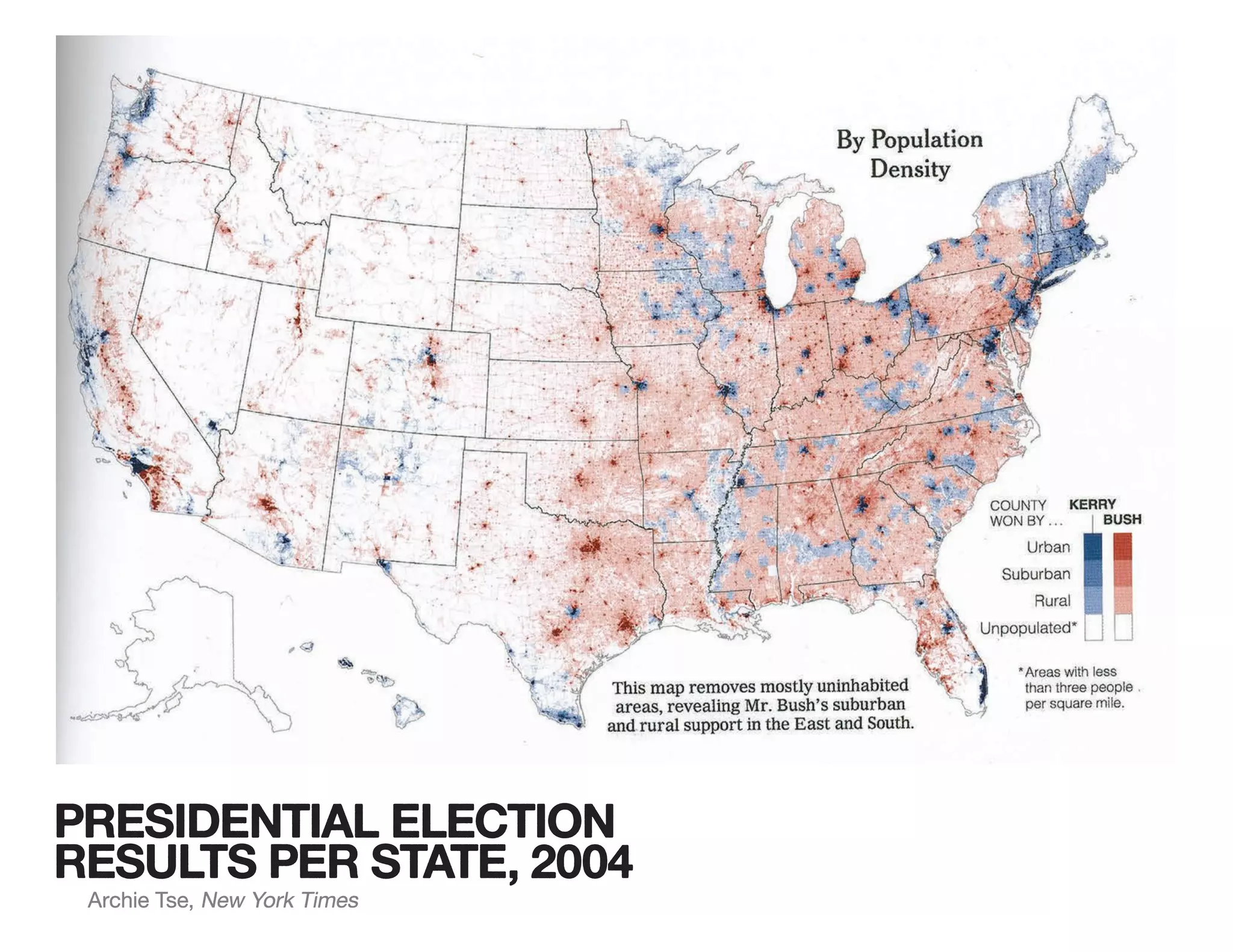
PRESIDENTIAL ELECTION
RESULTS PER STATE, 2004
Archie Tse, New York Times
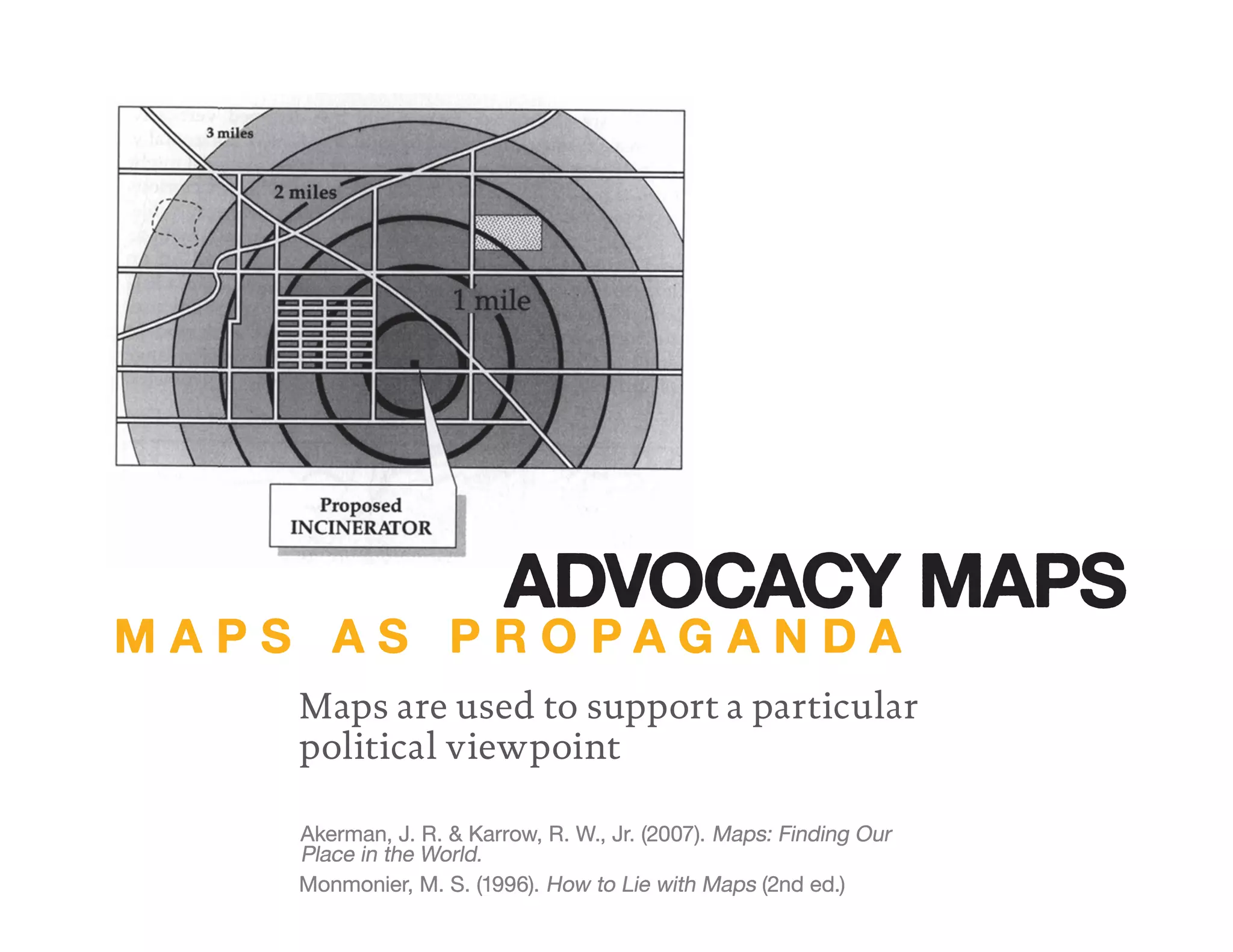
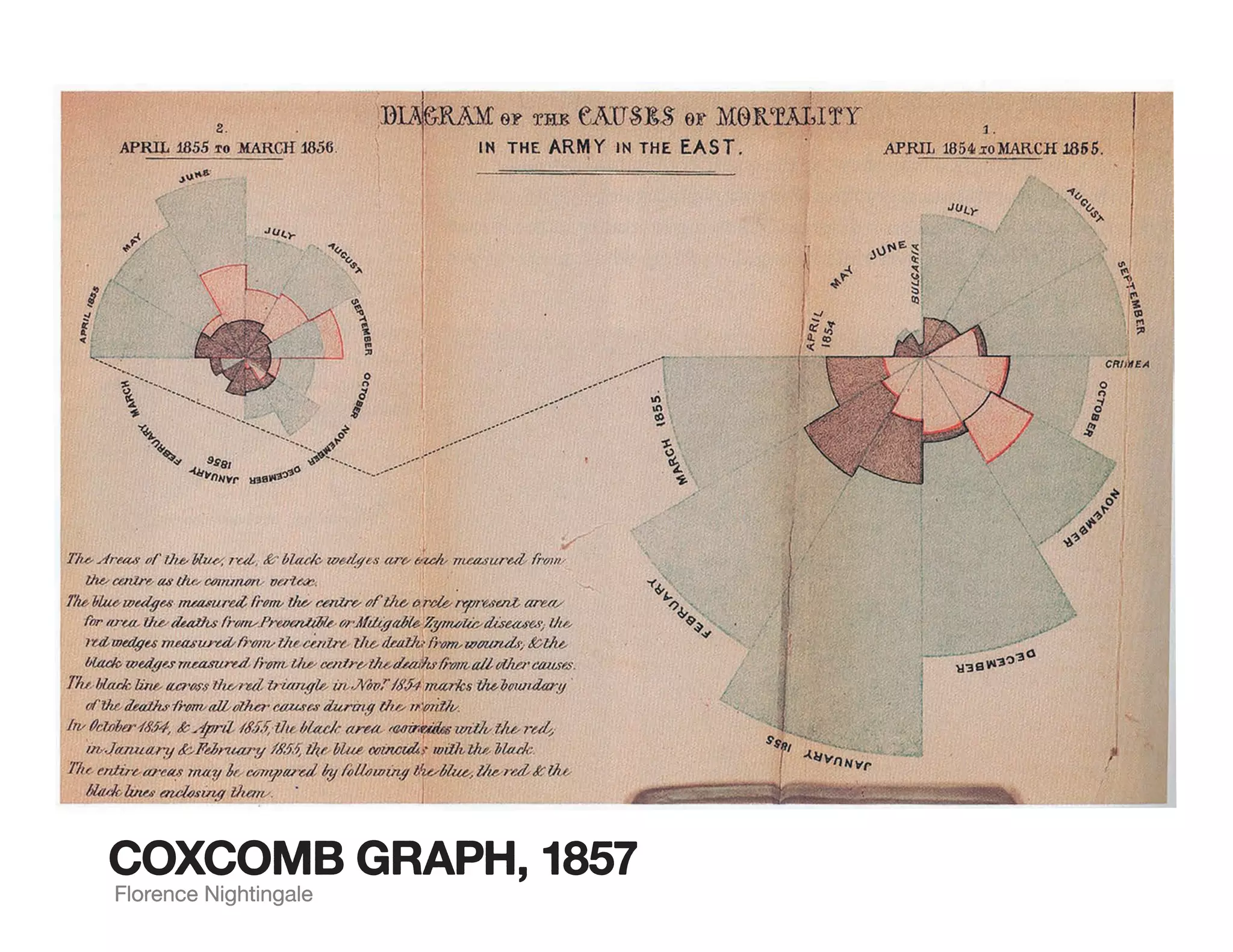
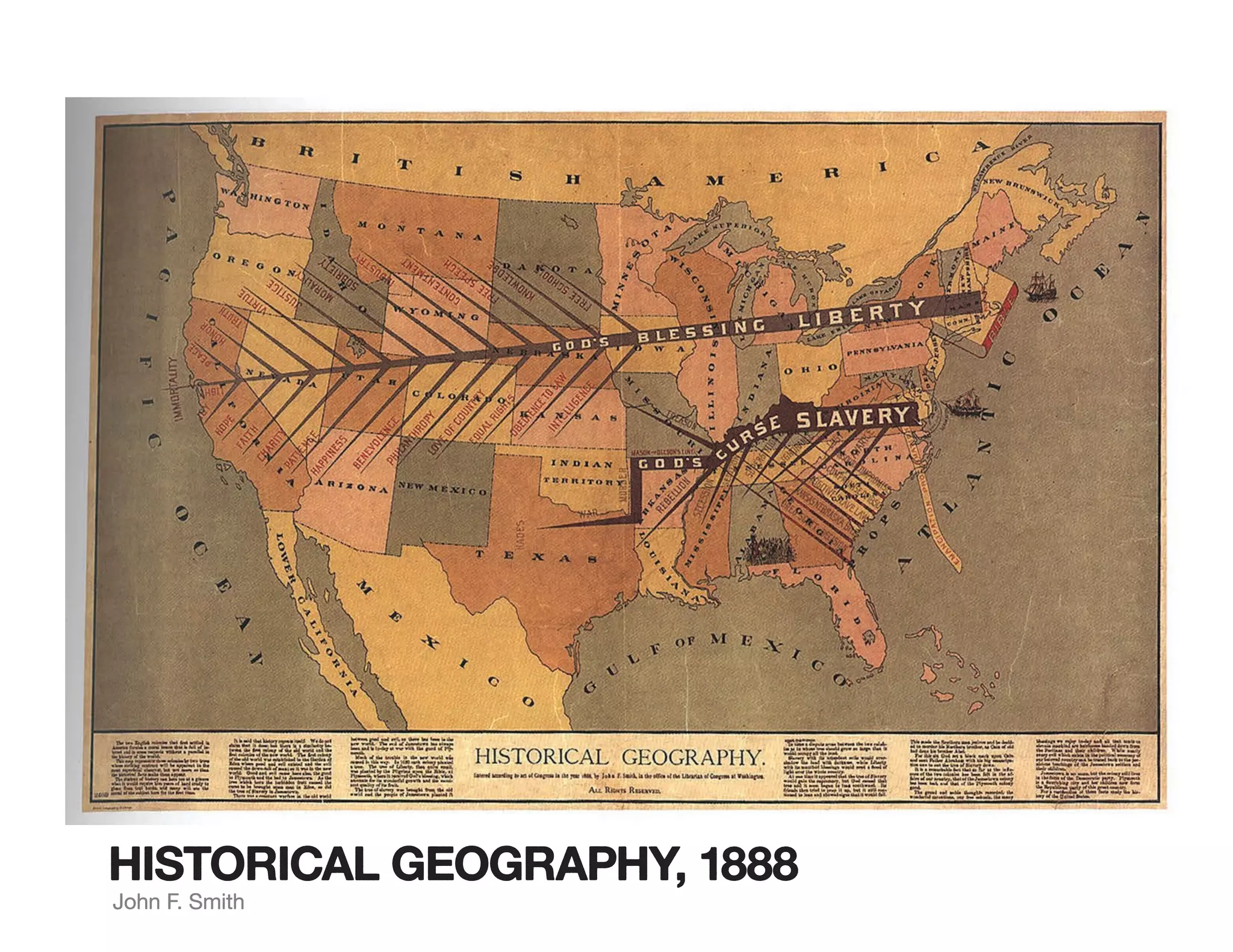
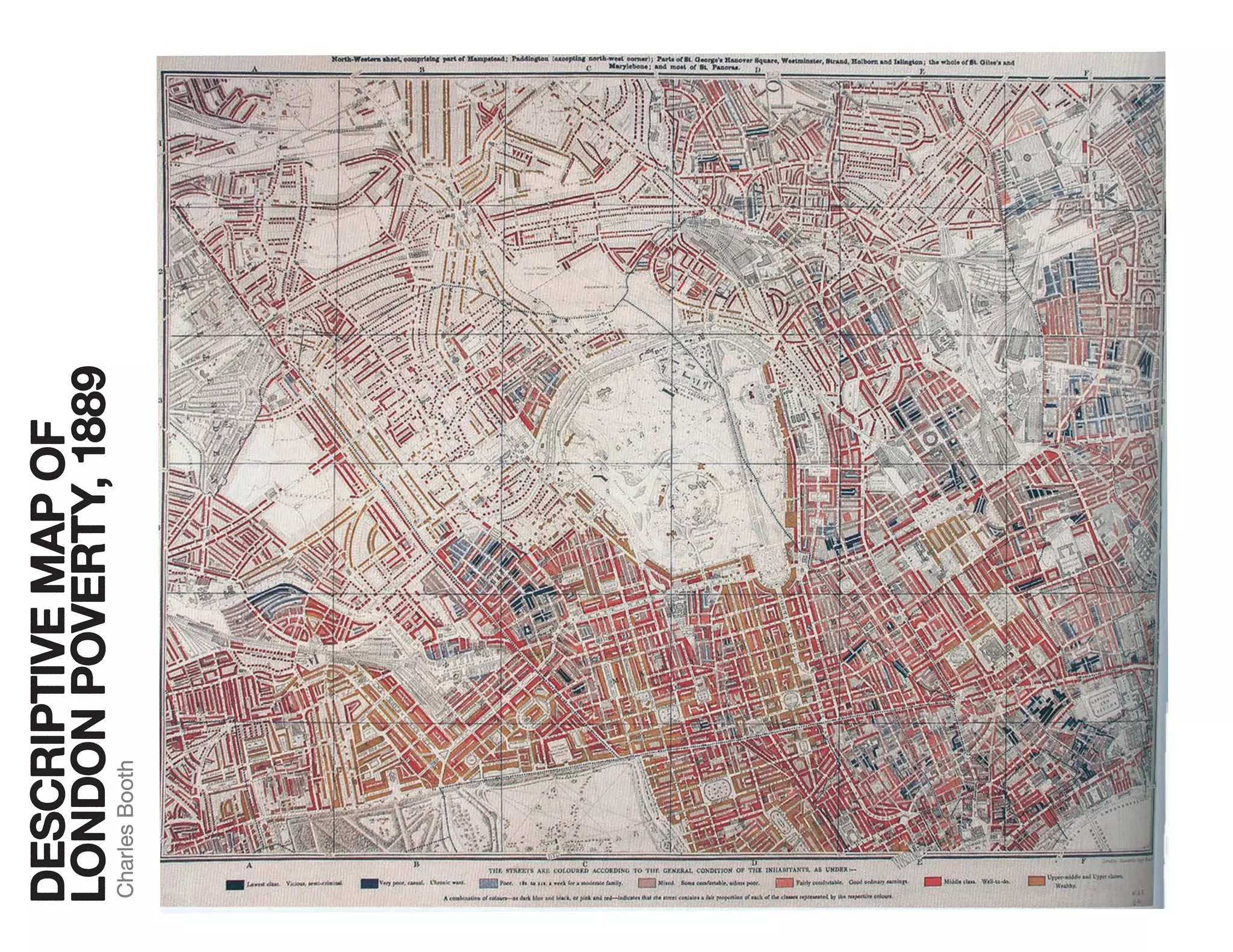
Maps are used to support a particular
political viewpoint
Akerman, J. R. & Karrow, R. W., Jr. (2007). Maps: Finding Our
Place in the World.
Monmonier, M. S. (1996). How to Lie with Maps (2nd ed.)
M A P S A S P R O P A G A N D A
ADVOCACY MAPS
COXCOMB GRAPH, 1857
Florence Nightingale
HISTORICAL GEOGRAPHY, 1888
John F. Smith
DESCRIPTIVEMAPOF
LONDONPOVERTY,1889
CharlesBooth
All maps have inherent bias
There is no such thing as a truly objective map
Despite this, mapping is among the most
effective methods of presenting information
in a visual manner
Virtually anything can be mapped!
I N F O R M A T I O N
+ D I S I N F O R M A T I O N
CONCLUSION
Akerman, J. R. & Karrow, R. W., Jr. (2007).
Maps: Finding Our Place in the World. Chi-
cago: University of Chicago Press.
Baer, K. (2008). Information Design Work-
book. Beverly: Rockport Publishers.
Black, J. (1997). Maps and politics. Chicago:
University of Chicago Press.
Brewer, C. A. (2005). Designing better maps:
A guide for GIS users (1st ed.). Redlands, CA:
ESRI Press.
Brown, B., & Laurier, E. Maps and Journeys:
An Ethno-methodological Investigation. Car-
tographica, 40.3, 17-33.
Chtcheglov, I. (2006). Formulary for a New
Urbanism. (K. Knabb, Trans.) Situationist In-
ternational Anthology. Paris: Éditions Allia.
Clark, J. O. E. (Ed.). (2005). 100 maps : The
science, art and politics of cartography
throughout history. New York: Sterling Pub-
lishing.
Davies, C. (2005). Maps Beyond Diagrams:
Real-World Spatial Orientation. Southamp-
ton: Ordnance Survey Research Labs.
Dorling, D., & Fairbairn, D. (1997). Mapping:
Ways of representing the world. London:
Longman.
Evamy, Michael (2003). World Without
Words. New York: Watson-Guptill.
Golledge, R. G. (1999). Human Wayfinding
and Cognitive Maps. Wayfinding Behavior:
Cognitive Mapping and Other Spatial Pro-
cesses (R. Golledge, Ed.) Baltimore: Johns
Hopkins University Press, 5-45.
I N F O R M A T I O N
+ D I S I N F O R M A T I O N
REFERENCES
Institute for Information Design (2003).
Information Design Source Book. Tokyo:
Graphic-Sha Publishing.
Jeffrey, C. (2007). City maze. Design Week,
22(26), 20-21.
Klinghoffer, A. J. (2006). The power of pro-
jections: How maps reflect global politics
and history. Westport, Conn: Praeger Pub-
lishers.
Lynch, K. (1960). The Image of the City.
Cambridge: MIT Press.
MacEachren, A. M. (1994). Some truth with
maps : A primer on symbolization and
design. Washington, D.C: Association of
American Geographers.
Monmonier, M. S. (1995). Drawing the line:
Tales of maps and cartocontroversy (1st ed.).
New York: H. Holt.
Monmonier, M. S. (1996). How to lie with
maps (2nd ed.). Chicago: University of Chi-
cago Press.
Montello, D. R. (2002). Cognitive Map-
Design Research in the Twentieth Century:
Theoretical and Empirical Approaches. Car-
tography and Geographic Information Sci-
ence, 29, 3, 283-304.
Noyes, L. (1980). The positioning of type on
maps: the effect of surrounding material on
word recognition time. Human Factors, 22,
353-360.
Phillips, R. J., Noyes, L. and Audley, R. J.
(1977). The legibility of type on maps. Ergo-
nomics, 20, 671-682.
I N F O R M A T I O N
+ D I S I N F O R M A T I O N
REFERENCES
Phillips, R. J. and Noyes, L. (1977). Searching
for names in two city street maps. Applied
Ergonomics, 8, 73-77.
Phillips, R. J. (1979). Why is lower case bet-
ter? Some data from a search task. Applied
Ergonomics, 10, 211-214.
Phillips, R. J., Noyes, L. and Audley, R. J.
(1978). Searching for names on maps. Carto-
graphic Journal, 15, 72-77.
Phillips, R. J. (1989). Are maps different
from other kinds of graphic information?
Cartographic Journal, 26, 24-25.
Phillips, R. J. (1979). Making maps easy to
read: a summary of research. Processing of
Visible Language 1, Kolers, P. A., Wrolstad, M.
E. and Bouma, H. (Eds.) New York: Plenum,
165-174.
Sadler, S. (1998). The Situationist City. Cam-
bridge: MIT Press.
Spencer, H. (1968). The Visible Word: Prob-
lems of Legibility. New York: Hastings House.
Whitehouse, R. (1999). The Uniqueness of
Individual Perception. Information Design.
Robert Jacobson. (Ed.) Cambridge: MIT Press.
Wildbur, P., & Burke, M. (1998). Information
Graphics: Innovative Solutions in Contempo-
rary Design. London: Thames and Hudson.
I N F O R M A T I O N
+ D I S I N F O R M A T I O N
REFERENCES
MAPPING SYSTEMS
CHRISTOPHER J. MOOREHEAD
January 2013

mapping_systems

  • 1.
    SYSTEMS MAPPING I N FO R M A T I O N + D I S I N F O R M A T I O N
  • 2.
    1. Where amI? 2. Where do I want to go? 3. How do I get there? Akerman, J. R. & Karrow, R. W., Jr. (2007). Maps: Finding Our Place in the World. A map answers the following questions: M A P P I N G C O N C E P T S PURPOSE
  • 3.
    Characterization related to bothselection + scale Refers to need to modify depiction of a feature for the sake of clarity + legibility Usually involves simplification M A P P I N G C O N C E P T S GENERALIZATION Akerman, J. R. & Karrow, R. W., Jr. (2007). Maps: Finding Our Place in the World. Akerman, J. R. & Karrow, R. W., Jr. (2007). Our Place in the World. Akerman, J. R. & Karrow, R. W., Jr. (2007).
  • 4.
    Internal representation ofperceived environmental features or objects + spatial relations among them Necessary for human navigation, but do not need to be accurate renderings of the real world Golledge, R. G. (1999). Human Wayfinding and Cognitive Maps. May be fragmented, distorted, and irregular— a result of difficulties experienced in mentally integrating different routes into networked structures M A P P I N G C O N C E P T S COGNITIVE MAPPING
  • 5.
  • 6.
    Orientation task The taskof matching the reality to the map User must find something which can be uniquely matched between the map + the actual scene—landmark “footprint” should have a direction Davies, C. (2005). Maps Beyond Diagrams: Real-World Spatial Orientation. Orientation task is harder if the map is not aligned to the direction that the user is facing Werner, S., & Long, P. (2003). Cognition Meets Le Corbusier: Cognitive Principles of Architectural Design. Werner, S., & Long, P. (2003). Cognition Meets Le Corbusier: Cognitive Principles of Architectural Design. Werner, S., & Long, P. (2003). Cognition Meets Le Corbusier: Cognitive M A P P I N G C O N C E P T S MAP ORIENTATION
  • 7.
    UK MOTORWAY MAP —ROUTES NORTH UK MOTORWAY MAP — ROUTES SOUTH
  • 8.
    M A PC O N C E P T S PSYCHOGEOGRAPHY Invented in 1950s by Situationists Ivan Chtcheglov, Guy Debord + Asger Jorn Navigation based on emotional response to surroundings Can provide level of familiarity with envi- ronment not normally found in conventional navigation Chtcheglov, Ivan. (1953). Formulary for a New Urbanism.
  • 9.
    Traditionally, the simplestway for humans to represent a route Understood by virtually all cultures and needs no scale, orientation, or frame of reference Golledge, R. G. (1999). Human Wayfinding and Cognitive Maps. Davies, C. (2005). Maps Beyond Diagrams: Real-World Spatial Orientation. Usually oriented with travel from bottom of page to top — “pointed in direction of travel” M A P T Y P E S STRIP MAP
  • 10.
  • 11.
    Designed for maritime navigation Seriousdistortion from projecting spher- ical object (the Earth) onto a flat surface Distortion particularly high at poles Wildbur, P., & Burke, M. (1998). Information Graphics: Innovative Solutions in Contemporary Design. Wildbur, P., & Burke, M. (1998). Innovative Solutions in Contemporary Design. Wildbur, P., & Burke, M. (1998). Information Graphics: Innovative Solutions in Contemporary Design. Information Graphics: M A P T Y P E S MERCATOR PROJECTION
  • 12.
  • 13.
    Developed in 1967by non-cartographer Arno Peters, a German-born historian + film-maker with a PhD in political propaganda Claims to be a more accurate depiction of the relative size of nations, particularly those in the developing world Peters denounced Mercator projection as “cartographic imperialism” Wildbur, P., & Burke, M. (1998). Information Graphics: Innovative Solutions in Contemporary Design. Wildbur, P., & Burke, M. (1998). Innovative Solutions in Contemporary Design. Wildbur, P., & Burke, M. (1998). Information Graphics: Innovative Solutions in Contemporary Design. Information Graphics: Based on cylindrical projection first described in 1855 by James Gall, a Scottish clergyman M A P T Y P E S PETERS PROJECTION
  • 14.
  • 15.
    India + Pakistanboth claim province of Kashmir Official Indian government maps show Kashmir as part of India, while official Pakistani maps show it as part of Pakistan Monmonier, M. S. (1996). How to Lie with Maps (2nd ed.) M A P S A S P R O P A G A N D A KASHMIR
  • 16.
  • 17.
  • 18.
    Mapped results of2004 US election were misleading because they general- ized voting patterns a the state level Gave impression of a huge Republican majority Geographic map made no allowances for population density Baer, K. (2008). Information Design Workbook. Akerman, J. R. & Karrow, R. W., Jr. (2007). Maps: Finding Our Place in the World. Akerman, J. R. & Karrow, R. W., Jr. (2007). Finding Our Place in the World. Akerman, J. R. & Karrow, R. W., Jr. (2007). M A P S A S P R O P A G A N D A US ELECTION 2004
  • 19.
    PRESIDENTIAL ELECTION RESULTS PERSTATE, 2004 GEOGRAPHIC ADJUSTED FOR POPULATION Michael Gastner, Cosma Shalizi & Mark Newman
  • 20.
    PRESIDENTIAL ELECTION RESULTS PERSTATE, 2004 Archie Tse, New York Times
  • 21.
    Maps are usedto support a particular political viewpoint Akerman, J. R. & Karrow, R. W., Jr. (2007). Maps: Finding Our Place in the World. Monmonier, M. S. (1996). How to Lie with Maps (2nd ed.) M A P S A S P R O P A G A N D A ADVOCACY MAPS
  • 22.
  • 23.
  • 24.
  • 25.
    All maps haveinherent bias There is no such thing as a truly objective map Despite this, mapping is among the most effective methods of presenting information in a visual manner Virtually anything can be mapped! I N F O R M A T I O N + D I S I N F O R M A T I O N CONCLUSION
  • 26.
    Akerman, J. R.& Karrow, R. W., Jr. (2007). Maps: Finding Our Place in the World. Chi- cago: University of Chicago Press. Baer, K. (2008). Information Design Work- book. Beverly: Rockport Publishers. Black, J. (1997). Maps and politics. Chicago: University of Chicago Press. Brewer, C. A. (2005). Designing better maps: A guide for GIS users (1st ed.). Redlands, CA: ESRI Press. Brown, B., & Laurier, E. Maps and Journeys: An Ethno-methodological Investigation. Car- tographica, 40.3, 17-33. Chtcheglov, I. (2006). Formulary for a New Urbanism. (K. Knabb, Trans.) Situationist In- ternational Anthology. Paris: Éditions Allia. Clark, J. O. E. (Ed.). (2005). 100 maps : The science, art and politics of cartography throughout history. New York: Sterling Pub- lishing. Davies, C. (2005). Maps Beyond Diagrams: Real-World Spatial Orientation. Southamp- ton: Ordnance Survey Research Labs. Dorling, D., & Fairbairn, D. (1997). Mapping: Ways of representing the world. London: Longman. Evamy, Michael (2003). World Without Words. New York: Watson-Guptill. Golledge, R. G. (1999). Human Wayfinding and Cognitive Maps. Wayfinding Behavior: Cognitive Mapping and Other Spatial Pro- cesses (R. Golledge, Ed.) Baltimore: Johns Hopkins University Press, 5-45. I N F O R M A T I O N + D I S I N F O R M A T I O N REFERENCES
  • 27.
    Institute for InformationDesign (2003). Information Design Source Book. Tokyo: Graphic-Sha Publishing. Jeffrey, C. (2007). City maze. Design Week, 22(26), 20-21. Klinghoffer, A. J. (2006). The power of pro- jections: How maps reflect global politics and history. Westport, Conn: Praeger Pub- lishers. Lynch, K. (1960). The Image of the City. Cambridge: MIT Press. MacEachren, A. M. (1994). Some truth with maps : A primer on symbolization and design. Washington, D.C: Association of American Geographers. Monmonier, M. S. (1995). Drawing the line: Tales of maps and cartocontroversy (1st ed.). New York: H. Holt. Monmonier, M. S. (1996). How to lie with maps (2nd ed.). Chicago: University of Chi- cago Press. Montello, D. R. (2002). Cognitive Map- Design Research in the Twentieth Century: Theoretical and Empirical Approaches. Car- tography and Geographic Information Sci- ence, 29, 3, 283-304. Noyes, L. (1980). The positioning of type on maps: the effect of surrounding material on word recognition time. Human Factors, 22, 353-360. Phillips, R. J., Noyes, L. and Audley, R. J. (1977). The legibility of type on maps. Ergo- nomics, 20, 671-682. I N F O R M A T I O N + D I S I N F O R M A T I O N REFERENCES
  • 28.
    Phillips, R. J.and Noyes, L. (1977). Searching for names in two city street maps. Applied Ergonomics, 8, 73-77. Phillips, R. J. (1979). Why is lower case bet- ter? Some data from a search task. Applied Ergonomics, 10, 211-214. Phillips, R. J., Noyes, L. and Audley, R. J. (1978). Searching for names on maps. Carto- graphic Journal, 15, 72-77. Phillips, R. J. (1989). Are maps different from other kinds of graphic information? Cartographic Journal, 26, 24-25. Phillips, R. J. (1979). Making maps easy to read: a summary of research. Processing of Visible Language 1, Kolers, P. A., Wrolstad, M. E. and Bouma, H. (Eds.) New York: Plenum, 165-174. Sadler, S. (1998). The Situationist City. Cam- bridge: MIT Press. Spencer, H. (1968). The Visible Word: Prob- lems of Legibility. New York: Hastings House. Whitehouse, R. (1999). The Uniqueness of Individual Perception. Information Design. Robert Jacobson. (Ed.) Cambridge: MIT Press. Wildbur, P., & Burke, M. (1998). Information Graphics: Innovative Solutions in Contempo- rary Design. London: Thames and Hudson. I N F O R M A T I O N + D I S I N F O R M A T I O N REFERENCES
  • 29.
    MAPPING SYSTEMS CHRISTOPHER J.MOOREHEAD January 2013